Why Chicago Patients Are Turning to Regenerative Medicine for Chronic Pain
Amniotic fluid injections pain chicago offers a cutting-edge regenerative therapy option for people struggling with chronic joint and soft tissue pain. This non-surgical treatment uses donated placental tissue to harness your body’s natural healing mechanisms, providing an alternative to traditional surgery or repeated cortisone shots.
Quick Answer: Where to Get Amniotic Fluid Injections in Chicago
- What they are: Injections containing growth factors and healing proteins from donated amniotic tissue
- What they treat: Osteoarthritis, tendon tears, ligament injuries, plantar fasciitis, back/neck pain
- The process: Single in-office injection guided by ultrasound, minimal downtime
- Recovery time: 4-6 months for optimal healing
- Insurance: Often not covered yet, check with your provider
- Local provider: Midwest Pain and Wellness offers comprehensive regenerative therapy options in the Chicago area
If you’ve been living with chronic pain that hasn’t responded to rest, physical therapy, or traditional injections, you’re not alone. Thousands of people in Chicago deal with persistent joint pain, tendon injuries, and degenerative conditions that limit their daily activities.
Traditional treatments often focus on masking symptoms rather than addressing the root cause. Pain medications provide temporary relief but don’t heal damaged tissue. Cortisone shots reduce inflammation but can actually weaken tendons over time. Surgery comes with significant risks, long recovery periods, and no guarantee of success.
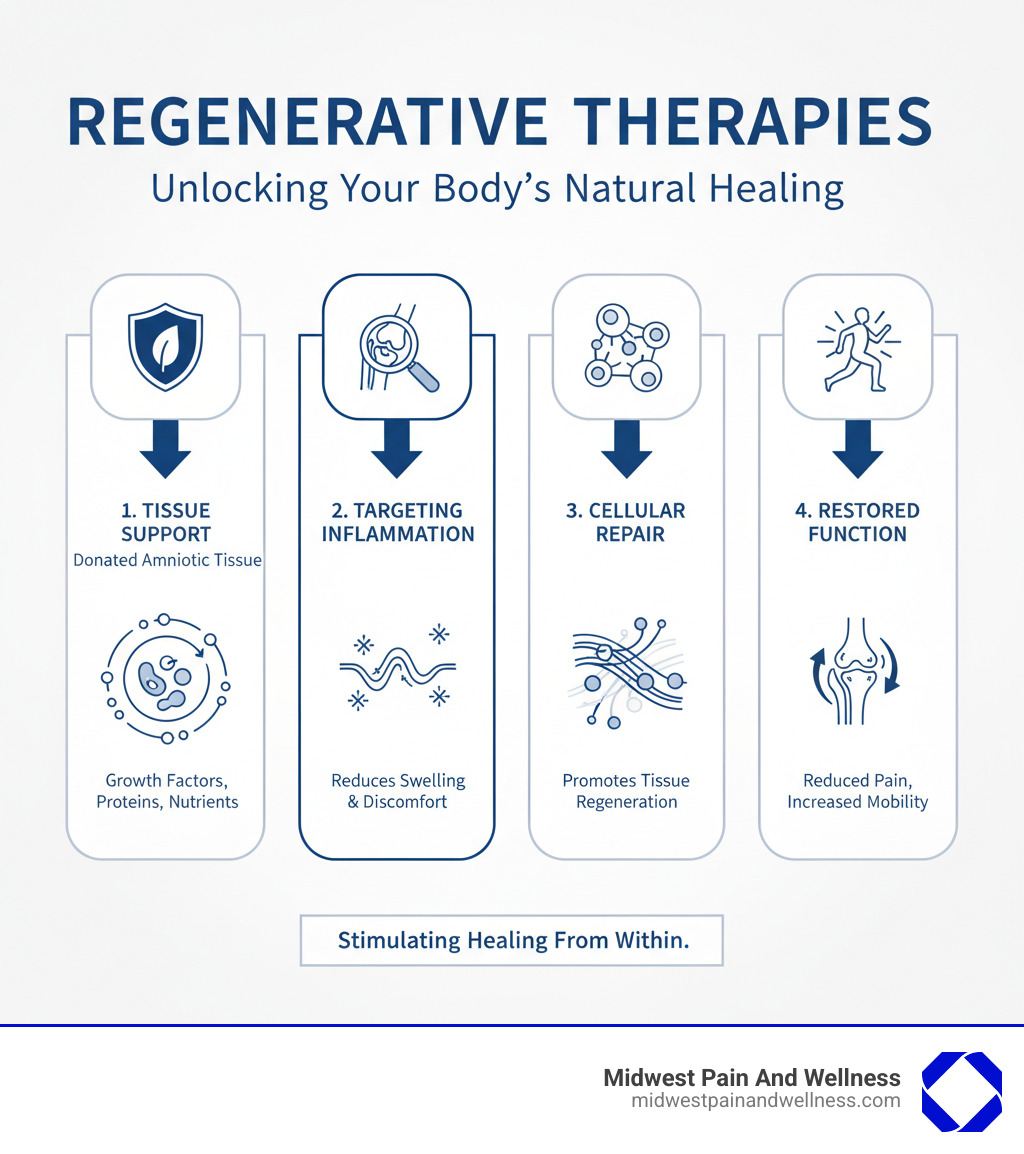
Regenerative medicine takes a different approach. Instead of covering up pain signals, these therapies work with your body’s natural repair systems to actually heal damaged tissue. Amniotic fluid injections represent one of the most promising options in this field, containing over 200 growth factors and naturally occurring nutrients that encourage tissue regeneration.
More than 20,000 procedures have been performed and studied over the past 20 years, confirming both the safety and effectiveness of this therapy. For many patients, it offers hope when other treatments have failed—a chance to return to the activities they love without the risks of surgery.
What Are Amniotic Fluid Injections and How Do They Work?
If you’re tired of treatments that only mask your pain, amniotic fluid injections pain chicago might be the answer you’ve been searching for. At Midwest Pain and Wellness in Chicago Ridge, we’ve seen how this remarkable regenerative therapy helps people move beyond temporary fixes and actually heal their damaged tissues.
Let’s start with where these injections come from. The amniotic fluid and tissue used in your treatment are donated by healthy mothers during scheduled C-sections. These women generously choose to donate their placental tissue instead of having it discarded after delivery. Before you worry about safety, know that every single donor goes through rigorous screening—we’re talking about the same level of thoroughness used for blood donations.
The FDA regulates these products as Human Cell, Tissue, or Cellular Tissue-Based Products (HCT/P) under Section 361 of the Public Health Service Act. That means strict rules govern how the tissue is collected, processed, preserved, and packaged. The tissue undergoes extensive testing for infectious diseases and is carefully sterilized to ensure the highest standards of safety and purity.
Now here’s what makes amniotic tissue so powerful: it’s absolutely packed with healing potential. We’re talking about over 200 growth factors—nature’s own repair signals that tell your cells to grow and regenerate. But that’s just the beginning. These injections also contain cytokines that reduce inflammation, hyaluronic acid that lubricates and cushions your joints, and tissue collagen that acts like scaffolding for new tissue to grow on.
Think of it this way: amniotic fluid provides everything your body needs to rebuild damaged tissue, all in one concentrated package. It even contains special inhibitors that protect your tendons and cartilage from breaking down further. When we inject this into your injured area, we’re essentially giving your body’s repair crew a major upgrade—better tools, clearer instructions, and all the supplies they need to do the job right.
Here’s something important to understand: these injections are acellular, meaning they don’t contain living cells that could trigger rejection. Instead, they work by signaling and activating your body’s own stem cells that are already present in the damaged tissue. Your body does the actual healing—the injection just gives it the boost it needs to get the job done.
The Science Behind Natural Healing
You know how sometimes your body tries to heal an injury but just can’t seem to finish the job? That stubborn knee pain that won’t go away, or that shoulder injury that keeps coming back? That’s where the real magic of amniotic fluid injections pain chicago comes in.
Unlike pain medications or cortisone shots that simply cover up your symptoms, amniotic fluid injections work to actually heal the damaged tissue. This is tissue regeneration, not symptom masking—and that difference matters tremendously for your long-term recovery.
The healing process works through several powerful mechanisms. First, the injection calms down chronic inflammation that’s been preventing your tissue from healing properly. Inflammation isn’t always bad—it’s part of your body’s natural response to injury—but when it becomes chronic, it creates a hostile environment where healing can’t happen. The natural anti-inflammatory properties in amniotic fluid help reset that inflammatory response.
At the same time, the injection helps prevent excessive scar tissue formation. Scar tissue might seem like healing, but it’s actually inferior to your original tissue—it’s less flexible, less strong, and can cause ongoing pain and restricted movement. Amniotic tissue is well known for helping prevent and heal areas of problematic scarring.
Perhaps most importantly, those 200+ growth factors we mentioned earlier? They’re sending powerful signals to your body’s own adult stem cells. These stem cells are already present in your damaged tissue, just waiting for the right instructions. The growth factors activate them, encouraging them to differentiate into the specific types of cells needed to repair your injury—whether that’s cartilage, tendon, or ligament tissue.
This is a completely drug-free and non-steroidal approach. You’re not introducing synthetic medications with potential side effects, and you’re not using steroids that can actually weaken your tissues over time. It’s an all-natural, biologic solution that works in harmony with your body’s own healing processes. You’re simply giving your body what it needs to complete the healing it started but couldn’t finish on its own.
Are Amniotic Fluid Injections Safe?
We know safety is probably your biggest concern when considering any new treatment. Let’s address this head-on because you deserve complete transparency about what you’re putting into your body.
The FDA regulates amniotic tissue products as HCT/P, which means they must meet strict federal guidelines for processing, preservation, and storage. This isn’t a loosely regulated field—there are very specific rules that manufacturers must follow to ensure patient safety at every step.
The screening process for donors is incredibly thorough. These are healthy mothers who’ve just delivered full-term babies via scheduled C-sections. Their complete medical history is reviewed, and they undergo extensive screening for infectious diseases. Think of it as similar to the rigorous testing blood donors go through—nothing gets approved without passing multiple safety checkpoints.
After collection, the tissue goes through a careful sterilization process. Many products are terminally sterilized, which is the gold standard for medical safety. By the time we use it for your injection, the product has been tested, processed, and verified to be completely safe.
Here’s something that often surprises patients: because amniotic fluid products are acellular—meaning they contain no living cells—your body won’t reject them. There’s no immune response to worry about, no risk of your body treating the injection as a foreign invader. This is fundamentally different from organ transplants or other cellular therapies.
What about side effects? Most patients experience very little. You might have some soreness, redness, or swelling at the injection site—pretty much what you’d expect from any injection. These symptoms are typically mild and resolve within a few days. In rare cases, you might experience a temporary flare of discomfort that can last up to two weeks, but most patients notice significant improvement by day three to five.
Serious complications like infection are extremely rare, especially when the procedure is performed in a sterile clinical environment by experienced physicians. At Midwest Pain and Wellness, we take every precaution to ensure your treatment is as safe as possible. Our double board-certified doctors have extensive experience with regenerative medicine procedures, and we maintain the highest standards of care at every step of your treatment.
Conditions Treated with Amniotic Fluid Injections
If you’re seeking a different path to pain relief – one that moves beyond endless medications or the daunting prospect of surgery – then amniotic fluid injections pain chicago might just be the answer you’ve been looking for. This remarkable therapy offers a host of benefits, especially if you’ve found traditional treatments like rest, physical therapy, or even cortisone shots haven’t provided lasting relief. It’s about empowering your body to heal itself, often with minimal downtime, making it a fantastic option when surgery isn’t ideal or you simply want to avoid it.
At Midwest Pain and Wellness, we’ve seen how these injections can accelerate natural healing and significantly improve joint pain and tissue repair. We use this innovative approach to help our Chicago Ridge patients find lasting comfort across a wide range of musculoskeletal conditions.
So, what kinds of pain can these injections address? We commonly use amniotic fluid injections to treat:
- Osteoarthritis: This common “wear and tear” condition can affect nearly any joint, from your knees, hips, and shoulders to your spine. Amniotic fluid injections can help calm inflammation and support the health of your remaining cartilage, offering a new lease on life for stiff, aching joints.
- Tendon Injuries: Whether it’s the persistent ache of a rotator cuff tear in your shoulder, the nagging pain of tennis elbow, or the debilitating soreness of Achilles tendonitis, these injections can provide crucial support for strained or partially torn tendons, helping them mend more effectively.
- Ligament Sprains and Tears: Crucial for joint stability, ligaments can be severely impacted by injuries. For issues in your knees, ankles, or other joints, amniotic fluid can lend a helping hand in the repair process for these vital connective tissues.
- Plantar Fasciitis: That sharp, burning pain in your heel, especially with those first steps in the morning, can be incredibly disruptive. Amniotic injections work to reduce inflammation and promote healing in the thick band of tissue on the bottom of your foot.
- General Chronic Joint Pain: If you have persistent joint pain that hasn’t responded to other treatments, and you’re looking for an alternative to just managing symptoms, the regenerative properties of amniotic fluid could be exactly what your body needs to kickstart its healing.
- Back and Neck Pain: Conditions affecting your spine, such as degenerative disc disease, sacroiliac joint pain, or persistent chronic neck and back discomfort, can also be targets for this therapy, working to promote healing and reduce that deep-seated discomfort.
We believe in a comprehensive approach to pain relief. To learn even more about the wide array of conditions we treat and how our custom plans can help you, we invite you to explore our dedicated page: Conditions We Treat.
The Procedure for Amniotic Fluid Injections for Pain in Chicago
We understand that any medical procedure can feel intimidating, especially when you’re already dealing with chronic pain. That’s why at Midwest Pain and Wellness, we’ve designed our amniotic fluid injections pain chicago process to be as straightforward and comfortable as possible. From your first consultation to your final follow-up, we’ll walk alongside you every step of the way.

Think of us as your partners in healing. Our interventional approach means we don’t just guess where the problem is—we use advanced imaging to pinpoint the exact source of your pain and deliver treatment precisely where it’s needed. To learn more about our comprehensive treatment philosophy, visit our Procedures We Use For Treatment page.
Step 1: Consultation and Preparation
Every successful treatment starts with truly understanding your unique situation. During your initial consultation, we’ll take the time to listen to your story—not just about where it hurts, but how pain has affected your life. Maybe you’ve had to stop playing with your grandkids, or perhaps that morning jog you loved is now just a memory.
We’ll conduct a thorough patient assessment that includes reviewing your complete medical history. This isn’t just paperwork—it helps us understand what you’ve already tried and why those treatments may not have worked for you. We’ll also carefully examine any imaging studies you’ve had done, such as X-rays or MRIs. In some cases, we might use real-time fluoroscopy or musculoskeletal ultrasound to get an even clearer picture of what’s happening beneath the surface.
Once we have all the pieces of the puzzle, we’ll work together to create a custom care plan custom specifically to your needs and goals. This multi-modal approach ensures we’re addressing not just your pain, but your overall well-being and long-term recovery.
If we determine that amniotic fluid injections are right for you, we’ll provide clear pre-procedure instructions. The most important thing to remember is avoiding anti-inflammatory medications (NSAIDs) and steroid medications for at least one to two weeks before your injection. These medications can actually interfere with the healing cascade we’re trying to activate. If you’re concerned about discomfort, you can take over-the-counter Tylenol about two hours before your appointment—just check with us first.
Step 2: The Injection Process for Amniotic Fluid Injections Pain Chicago
Here’s the good news: the actual injection procedure is much simpler than most people expect. It’s an in-office procedure, which means no hospital stays, no overnight monitoring, and no complicated scheduling. You’ll come to our clinic in Chicago Ridge, and in most cases, you’ll head home the same day.
Before we begin, we’ll apply a local anesthetic to numb the injection area. This ensures you’re comfortable throughout the procedure. Some patients report feeling a slight pinch or pressure, but most are surprised by how tolerable it is.
What sets our approach apart is our use of ultrasound guidance for precision. This isn’t just a “best guess” injection. We can actually see your damaged tissue—whether it’s a worn-out joint, a torn tendon, or an inflamed ligament—in real-time on the ultrasound screen. This allows us to deliver the amniotic fluid exactly where your body needs it most, avoiding healthy tissue and maximizing the healing potential.
The minimally invasive nature of this procedure means no incisions, no stitches, and no surgical scars. We’re simply using a small needle to deliver powerful healing components directly to the damaged area. The quick procedure time—typically just a few minutes for the actual injection—means you won’t be spending hours in our office. Of course, your total visit will be longer to allow for preparation and post-procedure observation, but the injection itself is remarkably fast.
Step 3: Recovery and Healing After Amniotic Fluid Injections Pain Chicago
Once your injection is complete, the real work begins—but don’t worry, your body knows what to do. We’ll just help guide it along.
In the first 24 to 48 hours, it’s completely normal to experience some post-injection soreness. You might notice redness, swelling, or mild discomfort at the injection site. This is actually a good sign—it means your body is responding to the treatment. You can manage these symptoms with ice or heat applied for 15 minutes every one to two hours. Most patients find that by day three to five, these initial symptoms begin to resolve significantly. In rare cases, a flare-up might last up to two weeks, but this is uncommon.
During the first couple of days after your procedure, we recommend modifying your activity to stick with basic daily living tasks. You can do gentle range of motion exercises, but save the intense workouts for later. Think of it as giving your body permission to focus on healing.
Physical therapy often plays a crucial role in your recovery. We may recommend working with a physical therapist to help rebuild strength and function as your tissue heals. This isn’t just about managing pain—it’s about restoring your body’s full capabilities.
Your gradual return to activity will begin around two weeks post-injection, based on your doctor’s guidance and your specific injury. Impact activities—things like running, jumping, or heavy lifting—will be restricted for anywhere from two weeks to eight weeks, depending on what we’re treating. And remember, keep avoiding anti-inflammatory medications for at least two weeks after your injection. They can actually slow down the regenerative process we’ve worked so hard to kickstart.
Here’s where patience becomes your best friend. While some patients notice improvements right away, the healing timeline for true tissue regeneration typically takes four to six months to reach its full potential. We often see strength and improved function first, before complete pain relief. That’s actually encouraging—it means your body is rebuilding, not just masking symptoms.
The long-term results are what make this all worthwhile. Many of our patients experience significant, lasting pain relief and find success with amniotic fluid injections pain chicago after other treatments have failed. This regenerative approach aims for genuine healing, giving you the chance to return to the activities you love—not just for a few weeks, but for the long haul.
Comparing Regenerative Therapies
Regenerative medicine isn’t a one-size-fits-all solution, and that’s actually a good thing. At Midwest Pain and Wellness, we offer several different regenerative options because every patient’s body, pain condition, and healing journey is unique. Think of it like choosing the right tool for a job—sometimes you need a hammer, sometimes a screwdriver, and sometimes something entirely different.

Understanding your options empowers you to make the best decision for your health. When you come to our clinic in Chicago Ridge, our double board-certified doctors won’t just hand you a standard treatment plan. Instead, we’ll sit down with you, review your imaging, discuss your lifestyle and goals, and create a custom care plan that addresses your specific needs. This is what personalized medicine really means—matching the right therapy to the right patient at the right time.
We encourage you to explore our comprehensive range of options on our Regenerative Therapy PRP & Cell-Based Options in Chicago Ridge page, where you can learn more about how these innovative treatments work together to support your healing journey.
Amniotic Fluid vs. Other Regenerative Options
You might be wondering how amniotic fluid injections pain chicago compare to other regenerative treatments you’ve heard about. The most common alternatives include Platelet-Rich Plasma (PRP) therapy and various stem cell-based treatments. While they all share the same goal—activating your body’s natural healing response—they each bring something different to the table.
Platelet-Rich Plasma (PRP) is derived from your own blood. We draw a small sample, spin it in a centrifuge to concentrate the platelets, and inject that concentrated solution back into your injured tissue. The platelets release growth factors that signal your body to start repairing damaged areas. It’s autologous, meaning it comes from you, so there’s zero risk of rejection. PRP works particularly well for mild to moderate tendon injuries, early-stage arthritis, and ligament sprains. The treatment typically takes about an hour from start to finish, and many patients need a series of two to three injections spaced a few weeks apart for optimal results.
Stem cell therapy often uses cells harvested from your own bone marrow or adipose (fat) tissue. These adult stem cells have the remarkable ability to differentiate into various cell types, potentially becoming cartilage, tendon, or bone cells depending on where they’re needed. The procedure is more involved than PRP because we need to extract the cells first, but the regenerative potential can be significant for more severe degenerative conditions. This approach is especially valuable for patients with advanced joint degeneration who want to avoid or delay surgery.
Amniotic fluid injections take a different approach entirely. Instead of using your own cells or platelets, these injections harness the incredible healing potential found in donated amniotic tissue from healthy C-section births. This tissue contains over 200 growth factors, cytokines, heavy chain hyaluronic acid, and tissue collagen that acts as a healing scaffold. What makes amniotic fluid particularly special is its anti-inflammatory properties and ability to prevent scar tissue formation—something that sets it apart from other regenerative options.
Because amniotic fluid is acellular (it doesn’t contain living cells that could be rejected), your body won’t fight against it. Instead, it uses all those growth factors and healing components as signals to activate your own local stem cells and repair mechanisms. This makes it an excellent choice for patients with moderate to severe tendon tears, advanced osteoarthritis, or chronic conditions that haven’t responded to other treatments.
The choice between these therapies often comes down to your specific condition, the severity of tissue damage, your overall health, and your treatment goals. Some patients benefit most from PRP’s simplicity and quick recovery. Others need the more robust regenerative potential of stem cell therapy. And many find that amniotic fluid injections offer the perfect balance of powerful healing factors with minimal invasiveness and excellent safety profile.
Scientific research on regenerative therapies for pain relief continues to evolve, giving us better insights into which patients benefit most from each approach. Our doctors stay current with the latest evidence so we can offer you treatments backed by real science, not just hype.
During your consultation, we’ll discuss these options in detail, help you understand the pros and cons of each, and recommend the approach that makes the most sense for your situation. Sometimes we even combine therapies for improved results. The goal is always the same: getting you back to living life without pain limiting what you can do.