If you're asking how much Botox costs in Illinois, the clearest starting point is this: the average Botox Cosmetic treatment in Illinois is $330, compared with a $420 national average, and many Chicago-area providers price Botox by the unit, often around $14 to $20 per unit. That makes the Chicago Ridge area and nearby suburbs more affordable than many parts of the country, even though your final price still depends on why you're getting Botox and how many units your treatment requires.
Starting a search online often leads to seeing a dozen wildly different price ranges, and coming away more confused than informed. One website talks about forehead lines. Another quotes a low teaser price. A third gives a national average that doesn't tell you much if you live in Oak Lawn, Palos Heights, Worth, Bridgeview, Hickory Hills, Alsip, Burbank, Evergreen Park, Orland Park, or here in the Chicago Ridge area.
That confusion gets worse when you're looking at therapeutic Botox, not cosmetic Botox. The medication may be familiar, but the financial picture is different when Botox is used for chronic migraine or cervical dystonia. Dosing is different. Insurance often matters. The training of the injector matters even more.
Your Guide to Botox Costs in the Chicago Suburbs
Patients from the southwest suburbs usually want a straight answer first. They want to know whether Botox is going to be a modest out-of-pocket expense, a major medical bill, or something insurance may help cover.

A good local benchmark helps. According to CareCredit's Illinois and national Botox pricing overview, the national average cost for a Botox Cosmetic treatment is $420, while the Illinois average is $330. That puts Illinois on the more affordable side compared with states such as South Carolina at $703 and Wisconsin at $536.
Why local pricing matters
A national average can be useful, but it doesn't answer the question most patients are really asking: what should I expect in the Chicago suburbs?
The practical answer is that pricing in this region often looks better than pricing in large coastal markets. For patients in Orland Park, Palos Hills, Evergreen Park, and Oak Lawn, that means the same product may be available at a lower overall cost than what you see quoted from higher-overhead cities.
What patients should focus on first
When you're trying to budget for treatment, look at three things before anything else:
- Your reason for treatment: Cosmetic wrinkle treatment and medical treatment for migraine or neck muscle spasm are not priced the same way.
- Your unit requirement: The total number of units usually drives the bill more than anything else.
- Whether insurance applies: For therapeutic use, coverage can change the conversation completely.
Practical rule: The online price that catches your eye is rarely the price that tells you what you'll actually pay.
If you're comparing clinics across Bridgeview, Burbank, Hickory Hills, and nearby communities, start by asking whether the quote is cosmetic or medical, whether it's priced per unit, and whether the office handles insurance authorization for therapeutic treatment. Those answers matter more than a low headline number.
Understanding the Two Main Botox Pricing Models
Botox is usually priced in one of two ways. A clinic may charge per unit, or it may quote a flat price per treatment area.
The easiest analogy is gasoline. Paying per unit is like paying by the gallon. Paying per area is more like paying one flat fee to fill the tank, whether you needed a little or a lot.
Per-unit pricing
This is the cleaner and more transparent model. Botox is a medication measured in units, so pricing by the unit lets patients see exactly what they're receiving.
According to this Botox pricing guide from Minars Dermatology, most U.S. providers charge $10 to $25 per unit. The same source notes that a typical cosmetic session using 20 to 30 units often costs $400 to $600, while larger treatments can run $700 to $1,200.
That framework matters even more in medicine than in aesthetics. Therapeutic Botox isn't a one-size-fits-all service. A patient with chronic migraine may need a very different dose than a patient with cervical dystonia. Unit-based pricing shows how the cost scales with the actual treatment plan, not with a generic menu label.
Per-area pricing
Per-area pricing is common in cosmetic marketing because it's simple and easy to advertise. A clinic may quote one amount for the forehead, another for frown lines, and another for crow's feet.
That sounds convenient, but it can blur important details. Two patients may both be told they're treating the same area while needing very different amounts of product. One has stronger muscles. Another has a broader treatment pattern. The flat fee doesn't always tell you how much medication is included.
Why transparent pricing works better for medical care
Therapeutic Botox works best when treatment decisions follow anatomy, diagnosis, and response to prior care. It doesn't work well when the financial structure encourages oversimplification.
For that reason, a per-unit model is usually the better professional standard for medical Botox. It lets the clinician tailor the treatment and lets the patient understand why the quote is what it is.
A transparent quote should answer these questions:
- How many units are planned
- What condition is being treated
- Whether insurance may cover some or all of the treatment
- What follow-up costs, if any, should be expected
If you're evaluating options, it also helps to review the range of interventional procedures used for treatment at a pain clinic rather than assuming Botox is the only path forward. In practice, the right plan depends on the condition being treated, how severe it is, and what has or hasn't worked already.
When a quote is vague, patients usually end up comparing marketing, not medicine.
Key Factors That Determine Your Final Botox Cost
Two people can call the same region, ask about Botox, and hear very different numbers. That isn't automatically a red flag. Botox cost changes because several variables affect the final bill.
The biggest variable is the number of units
In real-world practice, the unit count usually matters more than anything else. A smaller cosmetic treatment may use a modest amount of product. A therapeutic treatment may require far more, especially when the goal is controlling a pain condition rather than softening facial lines.
That difference is why a cheap headline price can be misleading. If the quote doesn't say how many units are included, you don't yet know what you're buying.
Provider training changes the value
A patient isn't just paying for a vial of medication. They're paying for evaluation, anatomy knowledge, diagnosis, injection technique, and judgment.
That matters a great deal in pain management. Medical Botox for headache or cervical dystonia isn't the same as a fast cosmetic touch-up at a med spa. The injection pattern, target muscles, and safety considerations are different. A highly trained physician may not be the lowest-price option, but expertise often reduces the chance of under-treatment, poor targeting, or a treatment plan that doesn't fit the actual diagnosis.
Location affects the baseline
Even within the same metro region, pricing changes with overhead, staffing, and market positioning. A suburban office in communities such as Palos Hills, Worth, or Alsip may have a different cost structure than a high-end cosmetic practice in a denser, more expensive part of the city.
The key point for patients in the Chicago Ridge area is that regional pricing is often more favorable than the quotes people see from premium urban markets online. That doesn't make every local quote low, but it does mean local context matters.
Manufacturer pricing can raise costs even when the clinic changes nothing
Sometimes the price changes before the patient ever walks into the office. In February 2024, Allergan increased base Botox rates by $1 to $2 per unit, according to this review of the 2024 manufacturer price adjustment. That source notes a standard 30 to 40 unit treatment that once cost $300 to $600 might now range from $330 to $680.
This is an important example because it shows that clinics don't control every part of the price. When the manufacturer raises acquisition cost, the effect can reach patients even if the office's process and treatment approach stay the same.
A useful question to ask: Is this quote different because the treatment plan changed, or because product pricing changed?
Product choice and treatment design also matter
Botox is a brand name, and patients often use it as a catch-all term for botulinum toxin injections. In practice, the exact product used, the diagnosis, the muscles involved, and the treatment pattern all influence cost.
For pain conditions, design matters as much as dose. A well-planned therapeutic injection session should follow the condition being treated, not a cosmetic template.
Here are the cost drivers that deserve the most attention when you compare options:
- Dose requirement: Higher unit counts usually mean higher cost.
- Medical complexity: A straightforward wrinkle treatment isn't priced like a condition that requires a clinical diagnosis and follow-up.
- Injector qualifications: Experience in pain medicine can justify a higher fee because the goals and anatomy are different.
- Supply cost shifts: Manufacturer increases can affect pricing without any drop in quality or any change in clinic policy.
If you want a reliable estimate, ask for a quote tied to a diagnosis and an expected unit range. That's far more useful than a promotional number without context.
Medical vs Cosmetic Botox A Cost and Coverage Breakdown
The word "Botox" causes a lot of confusion because patients hear the same product name used in two very different settings. One is cosmetic. The other is therapeutic.
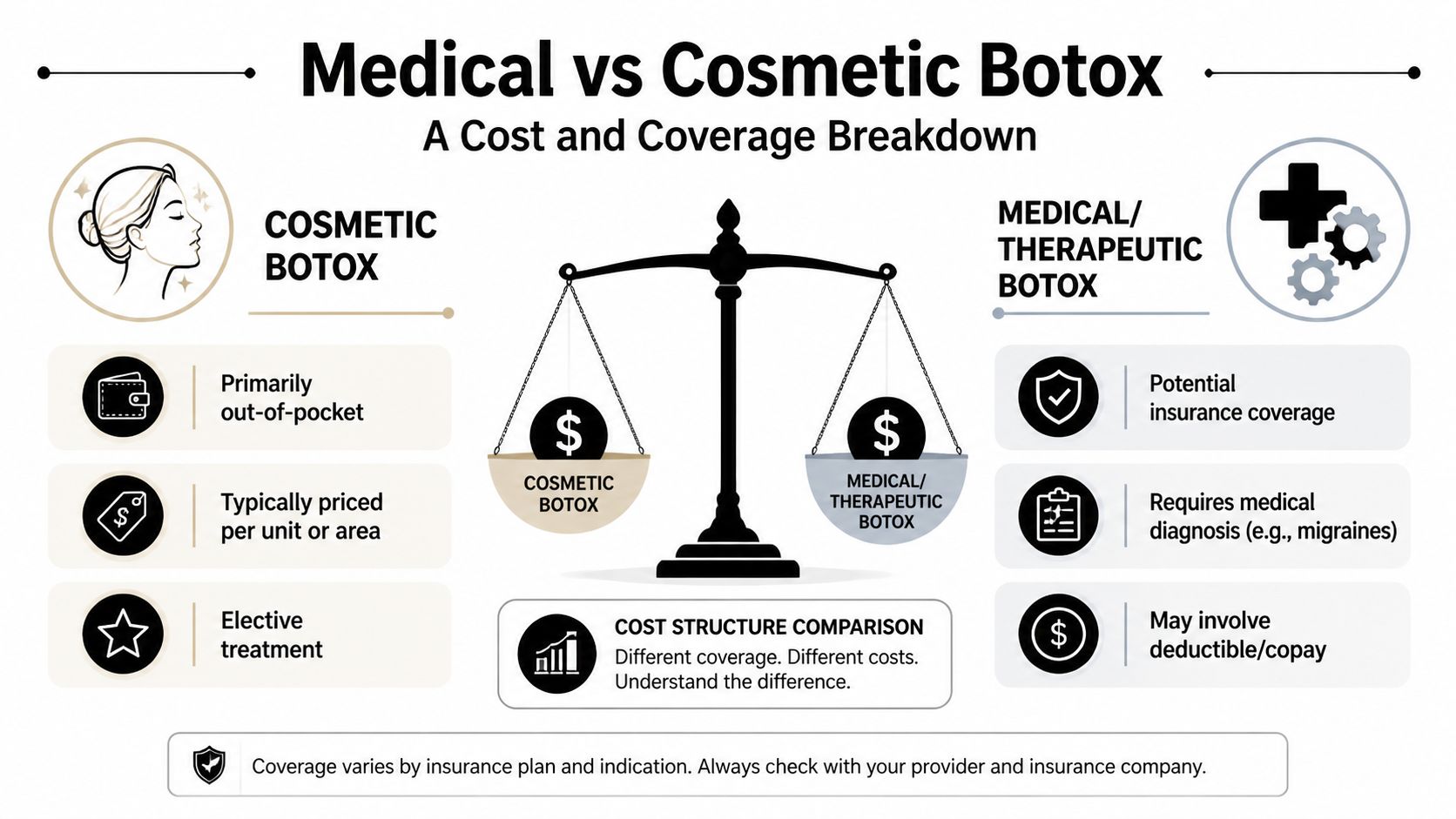
Cosmetic Botox is elective. Patients usually pay out of pocket. The goal is appearance.
Therapeutic Botox is used for diagnosed medical conditions such as chronic migraine and cervical dystonia. The goal is symptom control and functional improvement. That difference affects both the dose and the payment pathway.
Cosmetic treatment uses fewer units
Cosmetic treatment often involves small, targeted areas of the face. The amount used is usually limited because the purpose is to relax specific muscles that create expression lines.
Medical treatment may require a much larger dose
For chronic migraine prevention, dosing can be dramatically higher. According to this therapeutic Botox dosing and pricing review, chronic migraine prophylaxis can require up to 155 units per session, compared with 12 to 20 units for cosmetic forehead treatment. At $10 to $25 per unit, that puts a full therapeutic migraine session at $1,550 to $3,875 before insurance.
That number gets patients' attention, and it should. It also explains why medical coverage matters so much for therapeutic care.
Insurance is often the dividing line
Cosmetic Botox is generally a cash-pay service. Medical Botox is different. When Botox is used for an FDA-approved indication such as chronic migraine or cervical dystonia, insurance may cover treatment, though approval often depends on documentation and prior authorization.
That means the number on a cosmetic med spa website may have little relevance to a patient with severe headaches or neck muscle spasm. The treatment may use more medication, require a formal diagnosis, involve chart review, and move through a medical billing process rather than a simple retail payment.
A practical comparison looks like this:
| Feature | Cosmetic Botox | Therapeutic Botox |
|---|---|---|
| Primary goal | Appearance | Symptom relief and function |
| Typical payment path | Usually out of pocket | May involve insurance |
| Dose pattern | Smaller, appearance-based | Diagnosis-based and often higher |
| Evaluation | Aesthetic preference | Medical assessment and treatment planning |
Why the same product leads to a different patient experience
Patients sometimes assume the cheaper option is smarter because the substance is the same. That isn't how medical Botox works.
In pain medicine, the clinician isn't only selling units. The clinician is deciding whether Botox fits the diagnosis, whether it should be part of a larger opioid-sparing plan, and whether another treatment may be a better next step. That's especially important for conditions that may overlap with spine pain, nerve irritation, headache disorders, or muscle overactivity.
If you're dealing with persistent pain symptoms and want to understand where Botox fits, reviewing the range of conditions treated in interventional pain care helps frame the conversation correctly. Botox can be highly useful for the right diagnosis, but it should be matched to the patient's condition, not to a trend or a promotional package.
Medical Botox should be judged by diagnosis, dosing strategy, and coverage pathway. Not by a cosmetic ad.
Sample Cost Scenarios in the Illinois Area
Patients usually understand pricing best when they can see how it plays out in real situations. The examples below aren't quotes. They're practical scenarios based on the pricing patterns and dosing ranges discussed above.
One reason these examples matter is that online Botox content tends to focus on cosmetic treatments. GoodRx notes in its discussion of Botox pricing that online cost information heavily emphasizes cosmetic sessions averaging $300 to $600, while therapeutic applications such as chronic migraine can reach $600 to $1200 or more before insurance because of higher dosing requirements, as outlined in GoodRx's Botox cost overview.
Estimated Botox Costs by Treatment Type in Illinois
| Treatment Type | Typical Units | Estimated Cost (Per Session) | Insurance Coverage |
|---|---|---|---|
| Cosmetic baseline for context | 20 to 30 units | $400 to $600 | Usually out of pocket |
| Chronic migraine treatment | 30 to 60+ units | $600 to $1200 or more before insurance | Often may be covered if medically approved |
| Cervical dystonia treatment | Individualized | Varies based on dose and diagnosis | Often may be covered if medically approved |
Scenario one: Cosmetic baseline
A patient in Burbank wants Botox only for appearance and is comparing prices with med spas and dermatology offices. This is the type of treatment most websites describe.
The quote may look straightforward because the treatment is elective and usually paid out of pocket. It's useful as a baseline, but it doesn't tell a chronic pain patient very much about therapeutic Botox.
Scenario two: Chronic migraine in the southwest suburbs
A patient from Hickory Hills has frequent migraines and has already tried other conservative treatments. The treatment plan may require a much higher dose than a cosmetic visit, and the pre-insurance price can look substantial.
Insurance review becomes central. For the right diagnosis, what looks expensive on paper may become much more manageable after authorization, deductible, or copay considerations are sorted out.
Scenario three: Cervical dystonia and neck pain
A patient from Alsip has abnormal neck muscle contraction, pain, and limited comfort with daily activities. Unlike a cosmetic treatment menu, this isn't a preset service with one predictable amount of product.
Dose is individualized. The total can vary depending on which muscles need treatment and how extensive the spasm pattern is. That means the most accurate quote only comes after a medical evaluation.
A fair estimate for therapeutic Botox starts with the diagnosis, not with the advertisement.
For patients across Oak Lawn, Evergreen Park, Palos Heights, and Orland Park, that distinction matters. The cost question is real, but so is the need to know whether Botox is the right tool for the condition in front of you.
Navigating Payments and Your Consultation at Midwest Pain & Wellness
The hardest part for many patients isn't the injection itself. It's figuring out how payment will work and whether the office can help with the insurance steps.

What payment usually involves for medical Botox
For therapeutic Botox, the process often includes insurance verification, review of medical history, confirmation of diagnosis, and prior authorization if your plan requires it.
That may sound administrative, but it protects patients from surprises. A proper review can clarify whether Botox is likely to be covered, whether any deductible or copay applies, and whether the insurer has specific documentation requirements.
Why the consultation matters
A consultation for medical Botox shouldn't feel like a cosmetic sales appointment. It should function as a real medical visit.
That means the clinician needs to understand:
- Your diagnosis: Headache history, muscle symptoms, prior imaging, and prior treatments all matter.
- Your treatment history: What you've already tried can affect both clinical planning and insurance approval.
- Your goals: Relief from migraine frequency, reduced neck spasm, better function, and less dependence on medication are very different from cosmetic goals.
If you have out-of-pocket costs
Even when insurance helps, patients may still have out-of-pocket responsibilities. Some use health-related financing tools, including CareCredit, for medical expenses. Others prefer to know the expected charge in advance and plan around it.
The most useful financial conversation is a detailed one. Ask for clarity on the estimated treatment cost, what insurance is expected to cover, and what part could remain your responsibility.
What to bring to your appointment
Coming prepared can make the process smoother. A few items help more than people expect:
- Insurance information: Bring your current card and any referral paperwork if your plan uses referrals.
- Medication list: Include migraine medications, muscle relaxants, and previous injections if you've had them.
- Prior records: Notes from neurology, pain management, primary care, or imaging reports can support both diagnosis and authorization.
Patients who are ready to move forward can request a visit through the clinic's appointment scheduling page. That's often the fastest way to turn a vague online search into a clear, individualized plan.
The most reassuring quote is the one attached to a real diagnosis and a real treatment plan.
Frequently Asked Questions About Botox Treatment
Why can't a clinic give me an exact Botox quote over the phone?
Because the exact price depends on the diagnosis, the number of units needed, and whether insurance may apply. For therapeutic Botox, a proper estimate usually requires medical review, not just scheduling.
Should I be suspicious of very cheap Botox pricing?
Yes, at least enough to ask better questions. Low advertised pricing may reflect a limited number of units, a cosmetic-only offer, or a quote that doesn't match your medical needs. For therapeutic use, safety, diagnosis, and injector expertise matter more than a teaser rate.
How often will I need Botox if it works for me?
Therapeutic Botox is not usually a one-time treatment. Ongoing care is often spaced around a repeating cycle, and your physician will determine whether repeat treatment makes sense based on your response, diagnosis, and insurance rules.
Is medical Botox always covered by insurance?
No. Coverage is often possible for approved medical conditions, but it isn't automatic. Some plans require prior authorization, documentation of failed conservative care, or other criteria before approving treatment.
What if Botox isn't the right fit for my condition?
A good pain clinic shouldn't force Botox into every plan. Depending on the diagnosis, patients may do better with image-guided injections, nerve-targeted treatments, radiofrequency ablation, neuromodulation, minimally invasive spine procedures, rehabilitation-based care, or a combination approach. The right treatment is the one that fits the pain generator and the patient's goals.
Does Botox for pain work the same way as cosmetic Botox?
The medication is related, but the clinical use is different. Cosmetic Botox targets appearance. Therapeutic Botox is used to reduce symptoms tied to diagnosed medical conditions, and the injection plan follows the condition being treated.
If you're in Chicago Ridge or nearby communities such as Bridgeview, Worth, Palos Hills, Oak Lawn, Evergreen Park, Burbank, Alsip, Hickory Hills, Palos Heights, or Orland Park, it's reasonable to ask both questions at once: How much does Botox cost? and Is Botox the right treatment for me? The best answers come from a medical evaluation that looks at both.
If you're considering therapeutic Botox for chronic migraine, cervical dystonia, or another pain condition, Midwest Pain & Wellness can help you understand both the medical fit and the financial side of care. The practice serves patients in Chicago Ridge and surrounding Illinois communities with compassionate, opioid-sparing pain management and personalized treatment planning.