A lot of people in Chicago Ridge and the surrounding Illinois suburbs ask the same question in almost the same words. How do I know if it’s a migraine? They usually ask after a headache has already started taking over the day. Work gets pushed aside. Light from the kitchen window feels sharp. Noise feels louder than it should. Regular pain relievers may help a little, or not at all.
That uncertainty matters. A migraine isn't just a stronger version of an ordinary headache, and not every severe headache is a migraine. In pain management, getting that distinction right is what opens the door to the right next step. Sometimes that means confirming migraine and treating it directly. Sometimes it means finding a mimic, especially a neck-driven headache, and treating the actual pain source instead of chasing symptoms.
That Pounding in Your Head Is It Just a Headache or a Migraine
You wake up with pressure behind one eye, drive into work from Palos Heights or Evergreen Park, and by late morning the pain has turned into a throb that makes the screen look harsh and normal office noise feel intolerable. Coffee does nothing. Bending down to pick something up makes it worse. A dark, quiet room starts to sound like the only workable plan.

At that point, many patients ask the same question. Is this a migraine, a sinus problem, stress, poor sleep, or a headache coming from the neck? It is a fair question, because several headache disorders can feel similar at the start. In practice, that overlap is one reason people get labeled incorrectly in primary care and spend months or years treating the wrong condition.
What makes people second guess themselves
The confusion usually starts with the word "headache." It sounds broad, and it is. Migraine is one cause of head pain, but so are tension-type headaches, cervicogenic headaches from the cervical spine, medication overuse, dehydration, sleep disruption, and true sinus disease. A patient can also have more than one of these.
In my practice, I often hear from adults in Oak Lawn, Worth, Bridgeview, and Burbank that they feel they should be able to push through the pain. That approach often delays the right diagnosis. One practical clue is loss of function. If walking, climbing stairs, commuting, computer work, or even conversation predictably intensifies the pain, migraine rises on the list. If the pain starts in the neck, stays tied to neck movement, or consistently radiates from the back of the head forward, a cervicogenic source also deserves attention.
Sinus headache is another common point of confusion. Many patients who say they have "sinus headaches" are describing migraine with facial pressure, forehead pain, or nasal congestion. On the other hand, a true neck-driven headache can mimic migraine closely enough that the distinction is easy to miss without a focused exam.
If the pain repeatedly disrupts normal activity, the diagnosis needs more precision than "just a headache."
Why the label matters
The diagnosis determines the treatment path. Confirmed migraine may call for migraine-specific medication, procedural options, or both. A cervicogenic headache may respond better to treatment directed at the cervical joints, nerves, or surrounding structures. A presumed sinus headache that keeps returning despite decongestants needs a second look before more time is lost.
This matters for another reason. The goal is not to keep cycling through temporary fixes or defaulting to opioids. The goal is to identify the actual pain generator and treat it directly, especially when modern interventional options in the Chicago area can help patients who have gone too long without a clear answer.
Defining a True Migraine Beyond the Pain
A migraine is a neurological disorder, not just a bad headache. The head pain is often the first part noticed, but clinically the diagnosis depends on a pattern. That pattern includes duration, the character of the pain, associated symptoms, and recurrence over time.
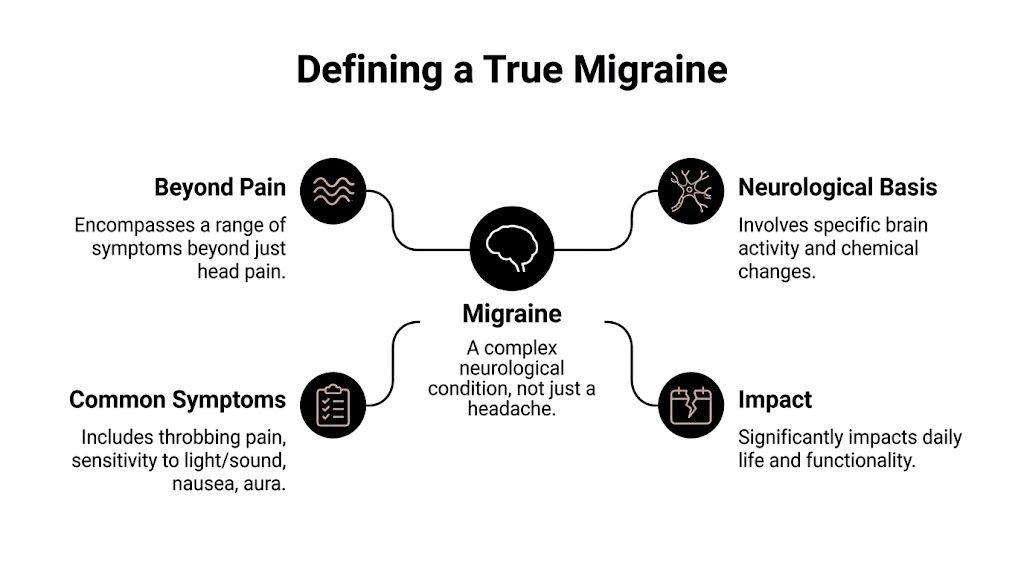
The simplest way to think about it is this. A tension headache tends to stay local. A migraine acts more like a neurological storm. Pain is part of it, but so are sensory changes, stomach symptoms, and a drop in function that often feels out of proportion to what an ordinary headache would cause.
The pattern doctors use
The formal standard comes from the International Classification of Headache Disorders. According to the ICHD-3 diagnostic summary published in PubMed Central, migraine diagnosis relies on a history of at least five attacks. Each attack must last 4 to 72 hours and include at least two of these features:
- One-sided pain that is often unilateral
- Pulsating or throbbing quality
- Moderate to severe intensity
- Worsening with routine physical activity
In addition, the headache phase must include either:
- Nausea or vomiting, or
- Both light sensitivity and sound sensitivity
That matters because migraine isn't diagnosed by one symptom in isolation. A throbbing headache alone isn't enough. Nausea alone isn't enough. The diagnosis comes from the whole pattern recurring over time.
What that looks like in real life
Patients don't usually walk in saying, "I meet ICHD criteria." They say things like:
- "It's always worse if I try to keep moving."
- "I need the room dark and quiet."
- "I feel sick to my stomach when it hits."
- "It can knock out most of a day."
Those descriptions fit the clinical picture more closely than "I had head pain." Migraine typically creates a cluster of symptoms that affect function, not just comfort.
Practical rule: If the pain throbs, lasts for hours, worsens when you stay active, and comes with nausea or sensitivity to light and sound, that's much more suggestive of migraine than a routine headache.
What migraine is not
Migraine doesn't require a dramatic movie-scene presentation to be real. Some attacks are severe and obvious. Others are less intense but still follow the same pattern. Some are mostly head pain. Others are heavily dominated by light sensitivity, nausea, or sensory changes.
It also doesn't need a blood test, scan, or biomarker to be diagnosed. The diagnosis is clinical. That's one reason a detailed symptom history matters so much. If a patient only says, "I get headaches," the key details can get missed. If the patient describes timing, triggers, associated symptoms, and what happens with activity, the picture becomes much clearer.
Features that should make you think migraine
A quick way to organize it is to ask whether the episode has these qualities:
| Feature | More consistent with migraine |
|---|---|
| Duration | Lasts 4 to 72 hours |
| Pain quality | Throbbing or pulsating |
| Location | Often one side |
| Activity effect | Worse with normal physical activity |
| Associated symptoms | Nausea, vomiting, light sensitivity, sound sensitivity |
| Pattern | Recurrent attacks, not a one-time isolated event |
The core takeaway is simple. A true migraine is defined by a repeatable symptom pattern, not by how dramatic the pain feels in a single moment.
Understanding the Different Faces of Migraine
Not every migraine looks the way people expect. Some patients have the classic pounding headache with nausea and light sensitivity. Others first notice visual changes, tingling, dizziness, or a strange sense that something neurologic is happening. That's why the question "How do I know if it’s a migraine?" can't be answered by looking for head pain alone.
Migraine without aura
This is the commonly imagined version. The headache itself is the main event. It tends to be throbbing, often one-sided, and disruptive enough that people want to stop what they're doing. The sensory symptoms, especially light and sound sensitivity, are often what make the attack feel all-encompassing.
For many adults, this is the form that leads to missed work, canceled plans, and repeated urgent care visits. They know they are getting "bad headaches," but they don't always realize those headaches fit a recognizable neurologic pattern.
Migraine with aura
Aura means reversible neurologic symptoms that happen before or during a migraine attack. Patients may describe flashing lights, blind spots, shimmering vision, tingling, numbness, or trouble finding words. These symptoms can be alarming, especially the first time.
Aura doesn't mean the diagnosis is automatically simple. Visual symptoms can make people worry about an eye problem. Sensory changes can make them worry about a stroke. That concern is understandable and should never be dismissed, especially if symptoms are new or unusual.
Silent migraine
One of the more confusing presentations is silent migraine, also called acephalgic migraine or migraine aura without headache. According to Temple Health's discussion of migraine versus headache, 25 to 30% of migraine sufferers experience aura, and some people have those visual, sensory, or vertigo symptoms without any head pain at all. The same source notes that this presentation is more common in adults over 40 and is often mistaken for a TIA or stroke.
That matters because many people assume, "If my head doesn't hurt, it can't be migraine." Clinically, that's not true. A patient may have visual zigzags, a spreading numb sensation, dizziness, or transient sensory symptoms and never develop the pounding head pain people associate with migraine.
Silent migraine is one of the easiest migraine variants to miss because the symptom people expect most isn't there.
Why this matters in practice
Patients in Orland Park, Oak Lawn, or Palos Hills may spend months describing the wrong symptom because that symptom feels the strangest. They may focus on the blurry vision, the ear pressure, the ringing, the tingling, or the dizziness. If no one asks the follow-up questions, migraine can stay hidden in plain sight.
Three practical points help here:
- Track the sequence. Did visual or sensory symptoms come first, followed by fatigue, nausea, or head pain later.
- Note reversibility. Aura symptoms typically come and go rather than causing fixed deficits.
- Take new neurologic symptoms seriously. If a symptom pattern is new, atypical, or concerning, it needs medical evaluation.
What patients often get wrong
People often assume migraine should look identical every time. It doesn't. One attack may be mostly pain. Another may be mostly nausea and light sensitivity. Another may involve aura. The broader pattern over time is what matters.
That variability is exactly why specialist evaluation is useful when the diagnosis isn't clear. A patient may be accurately noticing the symptoms but interpreting them through the wrong label.
Is It a Migraine or Something Else Entirely
Some headaches are migraine. Some are not. Some are mixed. That's where diagnosis gets practical. A patient may walk in convinced they have sinus headaches when the history fits migraine. Another may carry a migraine diagnosis for years when the actual driver is the neck.
A side by side comparison
The most useful starting point is to compare the common patterns.
| Headache Type | Pain Location | Pain Quality | Key Associated Symptoms |
|---|---|---|---|
| Migraine | Often one side, but can vary | Throbbing or pulsating, moderate to severe | Nausea, vomiting, light sensitivity, sound sensitivity, worse with routine activity |
| Tension headache | Often across the forehead, temples, or both sides | Pressure, tightness, dull ache | Muscle tightness, stress-related discomfort, usually less disabling |
| Cluster headache | Often around one eye or one side of the face | Severe, piercing, explosive | Restlessness, tearing, nasal symptoms on the same side |
| Sinus headache | Face, cheeks, forehead | Pressure or fullness | Nasal congestion, facial pressure, symptoms tied to sinus illness |
| Cervicogenic headache | Often starts in the neck or back of the head and refers upward | Aching, pressure, sometimes migraine-like | Neck pain, reduced neck motion, headache triggered by neck position or movement |
This table doesn't replace an exam, but it does show why self-diagnosis goes wrong so often. Overlap is common. A migraine can feel like sinus pressure. Neck pain can show up with migraine. A neck-generated headache can mimic migraine closely enough that patients and clinicians both miss it.
The sinus headache trap
Patients often use "sinus headache" to mean pain in the forehead or around the eyes. That's understandable, but facial pressure alone doesn't prove sinus disease. If the episode also includes nausea, light sensitivity, sound sensitivity, and worsening with activity, migraine becomes much more likely.
In practice, this is one of the most common detours. People treat themselves for allergies, congestion, or weather-related sinus problems while the underlying condition continues untreated.
If a "sinus headache" keeps recurring in a pattern and brings sensory symptoms with it, don't assume the sinuses are the source.
The neck connection most people miss
A major blind spot is cervicogenic headache. This headache starts from structures in the neck but can create pain that feels very much like migraine. Patients may feel pain on one side, at the base of the skull, behind the eye, or across the temple. They may even report nausea or sensitivity that muddies the picture further.
The key issue is that treatment changes if the source is cervical. The Mayo Clinic migraine overview notes the importance of distinguishing migraine from other causes, and clinicians recognize that a significant diagnostic gap exists with cervicogenic headaches because they can produce migraine-like symptoms and may require confirmation through diagnostic blocks.
Clues that push the diagnosis toward the neck
Consider cervicogenic headache more seriously when:
- The pain starts in the neck and then radiates to the head.
- Turning the head or holding one posture reliably brings it on.
- The neck feels stiff or restricted during the headache.
- Headache follows injury, strain, or chronic cervical pain.
- Standard migraine treatment only partly helps or helps inconsistently.
This is one reason headache care overlaps with interventional pain management. When the neck is a contributor, the evaluation goes beyond symptom checklists. It includes cervical exam findings, pain referral patterns, and in selected cases, diagnostic procedures that help identify the true generator.
Patients who want to review the range of disorders that can overlap with head and neck pain can see the clinic's conditions we treat.
What works and what doesn't
What works is pattern recognition plus examination. What doesn't work is assuming every severe headache is migraine or every forehead headache is sinus.
A few trade-offs are worth knowing:
- Over-the-counter pain relievers may help occasional headache but can muddy the pattern if used repeatedly.
- Primary care symptom treatment can be helpful, but complex or mixed headache cases often need a more targeted workup.
- A neck-driven headache won't improve the right way if treatment only targets migraine pathways.
The goal isn't to force every headache into one category. It's to identify the dominant source, then treat that source directly.
Your Migraine Self-Assessment and When to Seek Urgent Care
Migraine diagnosis is clinical. There isn't a blood test or scan that confirms it. That doesn't mean the process is vague. It means the history matters, and a few focused questions can make the picture much clearer.

The American Migraine Foundation explanation of migraine diagnosis and treatment notes that validated tools such as the 3-item ID Migraine questionnaire focus on three practical areas. Disability, nausea, and photophobia.
A quick self-check
Ask yourself these questions about your typical headache episodes:
Do your headaches limit what you can do?
If a headache causes you to stop working, cancel plans, lie down, or avoid normal activity, that's meaningful.Do you feel nauseated during the headache?
Even mild nausea counts. You don't need to be vomiting for this to matter.Does light bother you when the headache happens?
If you seek out dim rooms, close blinds, or avoid screens, that's an important clue.
This isn't a formal diagnosis. It is a practical screen. If your answer is yes to these kinds of questions and the episodes recur in a recognizable pattern, migraine becomes more likely.
Keep a useful symptom record
A good headache diary doesn't need to be complicated. The most helpful entries are usually short and consistent.
- When it started and how long it lasted
- Where the pain was
- What the pain felt like
- What other symptoms showed up
- What made it worse
- What you took and whether it helped
- Whether neck pain was present
That last point is important when the diagnosis could overlap with a cervicogenic pattern.
When a headache needs urgent care
Most migraines are not emergencies. Some headaches are. In such cases, SNOOP5 red flags matter. Imaging such as CT or MRI is not used to diagnose migraine itself, but it may be used to rule out secondary causes when warning signs are present.
Seek urgent medical evaluation if a headache comes with red flags such as:
- Systemic symptoms or signs, including fever or major illness
- Neurologic symptoms or signs, such as new weakness, confusion, or persistent abnormal findings
- Sudden onset, especially a thunderclap-type headache
- Onset after age 50
- Pattern change, meaning the headache is new, clearly different, or escalating in an unusual way
A headache that is suddenly different from your usual pattern should never be shrugged off as "probably another migraine."
If you're dealing with recurring headaches and need a proper evaluation rather than repeated guesswork, scheduling a focused visit through the clinic's appointment page is a reasonable next step.
Finding Lasting Migraine Relief in the Chicago Area
You miss work after another "sinus headache," but your nose is clear. Or you wake up with pain at the base of the skull, assume you slept wrong, and later develop light sensitivity and nausea. In clinic, I see this often in Chicago Ridge area patients. The name attached to the headache is wrong, so the treatment is wrong too.
Once the diagnosis is accurate, treatment choices become much more useful. Migraine care is different from treatment for cervicogenic headache, occipital neuralgia, or a mixed pattern that includes both head and neck pain. That distinction matters because the best plan is often not more medication. It is targeted, opioid-sparing care based on the actual pain generator.
When to move beyond self-treatment
Over-the-counter treatment has limits. Recurrent headaches deserve a closer look when they are disruptive, hard to classify, or no longer responding in a predictable way.
Another clue is a long trail of vague labels. "Sinus headache." "Stress headache." "Probably migraine." "Maybe from my neck." In primary care, those labels can stick for years, especially when the exam has not sorted out whether the source is migraine biology, cervical structures, or both.
Migraine is common during the years when work, parenting, commuting, and poor sleep put the most strain on a person. As noted earlier, headache disorders affect a large share of adults. That is one reason a correct diagnosis matters early, before repeated attacks start dictating daily life.
What targeted treatment looks like
For confirmed migraine, treatment may include migraine-specific medications, trigger management, and procedural care in selected cases. For chronic migraine, Botox can be appropriate when the history fits and simpler treatment has not given consistent control.
For headache that starts in the upper neck, radiates into the back of the head, or is reproduced by neck movement or pressure over cervical structures, the plan often changes. In that setting, the goal is to identify whether the pain is cervicogenic, occipital, or mixed with migraine. That may lead to occipital nerve blocks, medial branch blocks, or other interventional headache and neck pain procedures based on the examination.
A generic headache plan misses that nuance.
Why opioid-sparing care matters
Opioids are a poor long-term fit for migraine and many chronic headache disorders. They do not correct the mechanism behind migraine. They can also increase the risk of medication overuse headache, reduce function, and make the overall pattern harder to interpret over time.
Targeted care serves patients better. If the problem is chronic migraine, the plan should address migraine directly. If the main driver is the neck, treatment should address the cervical source. If both are present, both need attention.
The most effective headache treatment is the one matched to the diagnosis.
A practical path for patients in the southwest suburbs
For adults in Chicago Ridge, Oak Lawn, Palos Hills, Palos Heights, Worth, Bridgeview, Hickory Hills, Alsip, Burbank, Evergreen Park, and Orland Park, a reasonable process usually looks like this:
Define the pattern clearly
Track duration, associated symptoms, triggers, and whether normal activity worsens the pain.Check for common mimics
Sinus pressure, neck pain, occipital tenderness, and posture-related pain can point away from pure migraine or suggest overlap.Separate neck-driven pain from migraine features
Cervicogenic headache often starts in the neck or back of the head and may be provoked by neck movement. Migraine more often brings light sensitivity, nausea, sound sensitivity, or worsening with routine activity.Match treatment to the source
Migraine-focused care for migraine. Cervical intervention for neck-driven pain. Combined treatment when both mechanisms are present.Measure progress by function
Fewer missed workdays, better sleep, safer driving, and less interruption to family life matter as much as pain scores.
Where interventional pain medicine fits
Interventional pain medicine has a specific role in headache care. It does not replace emergency evaluation for warning signs or neurology care when a neurologic disorder is suspected. It helps patients whose headaches are recurrent, overlapping, difficult to classify, or tied in part to the cervical spine and occipital nerves.
In that setting, Midwest Pain & Wellness may be one option for evaluating chronic migraine, cervicogenic headache, and occipital pain with an opioid-sparing, procedure-based approach. Treatment can include Botox for chronic migraine, targeted nerve blocks, and cervical interventions when the history and physical exam support that direction.
What patients should expect from a proper evaluation
A proper evaluation should answer a few practical questions with some precision:
- Is this migraine, or a mimic such as cervicogenic or so-called sinus headache?
- Is there a neck component that changes treatment?
- Are there warning signs that require imaging or urgent referral?
- Would a procedure help, or is another specialist the better next step?
That level of accuracy changes the entire treatment path. It turns repeated guessing into a plan that fits the source of the pain and gives patients a better chance at steady, opioid-free relief.
If recurring headaches are interfering with work, sleep, driving, or daily life in Chicago Ridge or nearby Illinois communities, the next step is a careful diagnosis, not more guesswork. Midwest Pain & Wellness evaluates migraine, cervicogenic headache, and related pain conditions with an opioid-sparing, interventional approach designed to match treatment to the source of symptoms.