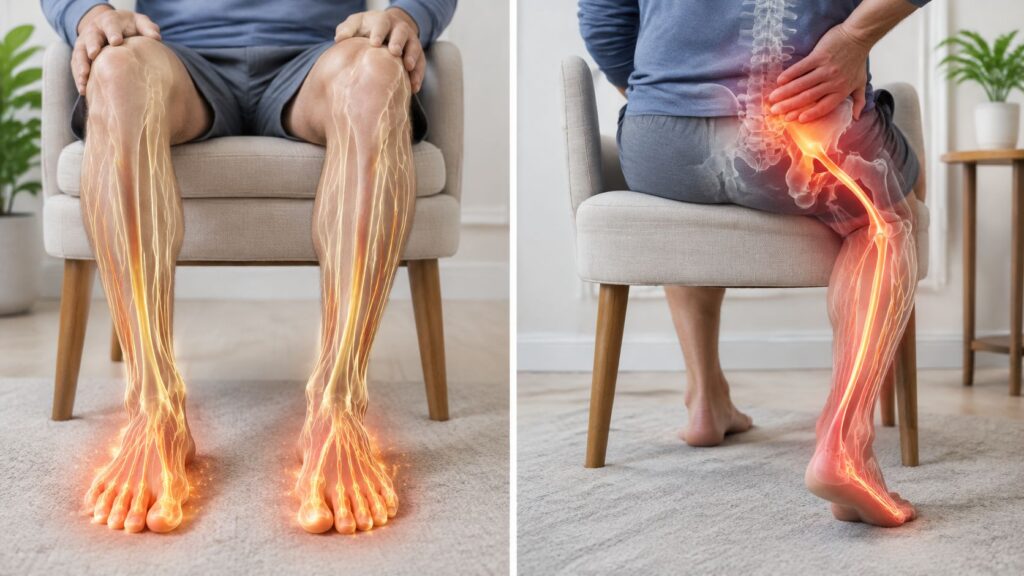
Back pain usually starts with something ordinary. You bend to tie a shoe, stand up from the couch, carry groceries in from the car, or sit through a workday in Oak Lawn or Orland Park and realize your back has become the thing controlling every decision. People often respond the same way. They stop moving, brace every step, and hope rest will fix it.
That instinct makes sense, but it often keeps the cycle going. The right kind of movement usually helps more than complete shutdown. In pain management, the question isn't whether you should move. It's how to exercise back pain safely, when to start, and how to progress without turning a flare-up into a setback.
Understanding Back Pain and the Role of Movement
Back pain changes behavior fast. Patients start avoiding stairs, walking less, and skipping normal tasks because they're worried one wrong move will make everything worse. That fear can be as limiting as the pain itself.
For many people, smart movement is part of treatment, not a threat to recovery. Large-scale longitudinal research found that replacing just 1 hour per day of sedentary time with physical activity reduced incident back-pain risk by 2% to 8% in a 2024 study published in the Journal of Orthopaedic & Sports Physical Therapy (study details on physical activity and back-pain risk). That matters because it reinforces a practical point I discuss with patients often. Small reductions in sitting can matter before anyone starts a formal workout plan.
Why complete rest usually backfires
Short-term rest may help during a sharp flare, especially in the first day or two when movement feels guarded. But staying inactive for too long usually creates new problems:
- Muscles stiffen: The hips, trunk, and lower back lose normal motion quickly.
- Pain sensitivity rises: A back that isn't moving often becomes more reactive to simple tasks.
- Confidence drops: Patients begin to treat normal movement as dangerous.
- Function shrinks: Work, sleep, household chores, and exercise all become harder.
Clinical reality: A sore back often needs less fear and more controlled exposure to movement.
That doesn't mean every patient should do the same exercises. Back pain from a muscle strain doesn't behave like pain from spinal stenosis, post-surgical irritation, sacroiliac dysfunction, or a nerve-related condition. The movement plan has to match the problem.
Exercise belongs inside a broader pain plan
In an interventional pain clinic, exercise isn't a stand-alone internet tip. It's one tool inside an opioid-sparing, multimodal approach. Some patients improve with walking, mobility work, and gradual core training. Others need a broader evaluation because the pain pattern suggests a disc issue, joint inflammation, nerve irritation, or a structural problem that won't respond to generic stretching alone.
If your pain has become persistent, recurrent, or limiting, it helps to start with a condition-specific review instead of guessing. The team at Midwest Pain & Wellness treats spine, nerve, joint, and chronic pain conditions for patients in Chicago Ridge and nearby Illinois communities including Palos Hills, Hickory Hills, Burbank, Evergreen Park, and Worth.
Before You Start Exercising Your Back Pain
The most common mistake isn't choosing the wrong stretch. It's starting without knowing whether your symptoms are stable enough for home exercise at all.
Some online routines are written as if everyone has the same body, the same diagnosis, and the same risk factors. They don't. General back-pain exercise advice often ignores people with diabetes, osteoporosis, balance problems, neuropathy, or anticoagulant use, and it rarely explains how to modify exercise after a procedure such as an epidural steroid injection (clinical discussion of these common gaps). That's a big issue in pain management, where many patients are older, post-surgical, or dealing with several conditions at once.
Know the difference between effort and warning pain
Exercise for back pain should feel controlled. You may notice stiffness, muscular effort, or a mild pulling sensation. That can be appropriate.
What you don't want is pain that feels threatening, unstable, or progressively sharper as you continue. A useful rule is simple: if a movement makes you feel looser afterward, that's usually a good sign. If it leaves you more guarded, more crooked, or sends symptoms farther into the buttock or leg, stop and reassess.
Here's a practical guide:
| Symptom | What It Means | What to Do |
|---|---|---|
| Mild muscular effort | The area is working, not being irritated | Continue slowly and keep range small |
| Gentle stretching or stiffness that eases | Tissues may be warming up and tolerating motion | Proceed and recheck symptoms after the set |
| Sharp, stabbing, or catching pain | The movement may be aggravating a sensitive structure | Stop that exercise immediately |
| Pain spreading down the leg | Possible nerve irritation or poor exercise selection | Stop and get evaluated if it continues |
| New numbness or weakness | Neurologic symptoms need medical attention | Seek prompt professional assessment |
| Pain that keeps rising with each repetition | Your back isn't tolerating the current dose | Reduce range, reduce volume, or pause the program |
Red flag symptoms
Some symptoms should never be treated as a home exercise problem.
Get urgent medical attention if back pain comes with loss of bladder or bowel control, rapidly worsening weakness, saddle numbness, fever, major trauma, or unexplained weight loss.
If you develop severe numbness, a foot that won't lift normally, or pain that becomes dramatically worse instead of gradually easing, don't try to push through a workout.
For people in Bridgeview, Worth, Palos Heights, or nearby Illinois communities, the right next step in that situation is medical evaluation, not another video routine.
Ask these questions before your first session
A home program works better when you screen yourself accurately.
- Has the pain stabilized: If pain is still escalating hour by hour, start with simple walking and position changes rather than floor exercises.
- Do you have leg symptoms: Tingling, numbness, heaviness, or shooting pain may change which movements are safe.
- Did you recently have a procedure: Post-injection and post-ablation activity often needs temporary modification.
- Are you unsteady: Balance issues from neuropathy, medication effects, or deconditioning can make floor-to-stand transitions risky.
- Do you have osteoporosis or fracture history: Aggressive bending and twisting may be inappropriate.
If you're not sure where you fit, get guidance before starting. Patients can request a medical review through Midwest Pain & Wellness appointments when pain is persistent, recurrent, or complicated by other health issues.
Your First Steps Gentle Exercises for Back Pain Relief
When your back is sore, stiff, and reactive, your first job isn't building strength. It's calming the system down. This is the phase where many people overdo it. They jump into planks, heavy stretching, or online “fixes” before the pain has settled enough to tolerate them.
A better starting point is gentle motion after the sharpest phase has stabilized. Existing exercise guides often don't explain when to begin relative to the pain cycle, which leaves people guessing (discussion of this timing gap in exercise guidance). If pain is still rapidly worsening, keep it simple with short walks, position changes, and supported rest. Once symptoms are steadier, these exercises are often reasonable starting points.
Pelvic tilts
This is one of the safest ways to reintroduce motion to a guarded low back. Lie on your back with knees bent and feet flat. Gently rock your pelvis so your low back flattens slightly toward the floor, then return to neutral.
The movement should be small. You're not trying to force range. You should feel a mild change in tension through the lower back and lower abdomen, not a hard contraction or a pinch.
Try this approach:
- Start slow: Move through a small range and breathe normally.
- Use comfort as your guide: If flattening the back hurts, reduce the motion.
- Look for an after-effect: The goal is a slight release in stiffness after several repetitions.
Knee to chest
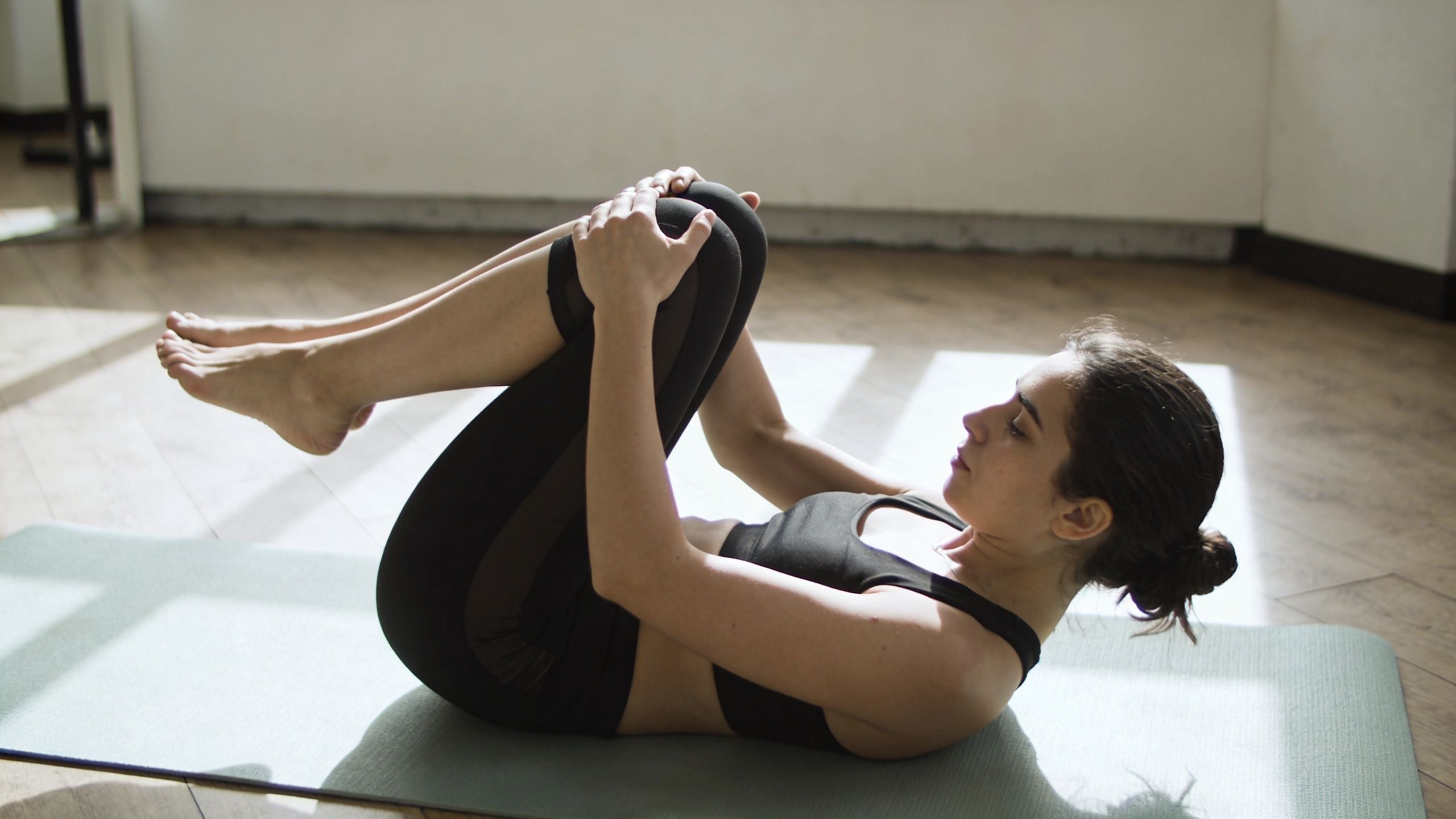
Single-knee-to-chest stretching often helps when the back feels compressed from prolonged sitting. Lie on your back, bring one knee toward your chest with your hands behind the thigh or over the shin, and hold gently. Then switch sides.
This should feel like a soft lengthening through the lower back or buttock. It shouldn't create pulling down the leg or a deep pinch in the hip.
The right stretch feels relieving while you're in it and neutral to better when you stand up afterward.
If one knee feels good, you can try both knees together later, but many irritated backs tolerate the single-leg version better at first.
Cat-cow
Move to hands and knees if getting on the floor is manageable. Slowly round your back, then gently extend it in the opposite direction. Keep the motion easy and smooth.
This exercise is most helpful for stiffness. It is not meant to be a forceful end-range stretch. If extension feels jammed or rounding feels threatening, make the arc smaller.
A few cues matter:
- Lead with the pelvis: Let the spine follow instead of cranking through the mid-back.
- Keep the neck relaxed: Don't throw your head up and down.
- Stop before strain: Gentle repetition works better than forcing mobility.
Supported child's pose or countertop reach
Some patients find kneeling uncomfortable. In that case, stand facing a kitchen counter, place both hands on it, and sink your hips back while keeping your feet planted. This gives you a supported decompression position without getting on the floor.
If kneeling is comfortable, a modified child's pose can work similarly. The sensation should be broad and easing, not sharp and localized.
How often to do these early exercises
During this gentle phase, short sessions usually work better than a single long session. Think in terms of “movement snacks” throughout the day. Morning stiffness may respond to one routine, and another short session later in the day may undo the effects of sitting, driving, or desk work in Alsip, Burbank, or Evergreen Park.
A simple pattern is to rotate through a few movements you tolerate well rather than forcing every exercise every day. If one movement clearly leaves you worse, remove it. Early rehab should build trust, not test your pain tolerance.
Strengthening Your Core for Long-Term Back Health
A back that only knows how to calm down is still vulnerable. Relief matters, but resilience is what keeps you from ending up in the same flare again after lifting laundry, carrying a child, or getting through a long commute.
Many people misunderstand “core training.” It doesn't mean chasing ab workouts. It means building the deep muscular support that helps the spine stay controlled during everyday movement. Structured exercise programs for chronic low back pain reduce pain scores by about 15 points on a 0 to 100 scale, and one monitored program reported a 52.5% mean decrease in back-pain intensity with a 27.3% reduction in disability (evidence summary on exercise therapy for chronic low back pain). Those results don't come from random hard workouts. They come from progressive, repeatable exercise.

What a stable core actually does
Think of your core as a support system that limits unwanted motion. It helps you bend from the hips instead of collapsing through the low back. It helps you carry a bag, climb stairs, roll in bed, and get out of a chair without the spine absorbing all the load.
Patients in Palos Hills and Orland Park often tell me they thought their back pain meant they needed stretching forever. Sometimes they do need mobility. But many also need better control.
Bird-dog
Start on hands and knees with your spine in a neutral position. Reach one leg back and, if tolerated, the opposite arm forward. The point is not height. The point is keeping the trunk steady while the limbs move.
Good bird-dogs feel long and controlled. Bad ones turn into trunk rotation and low-back arching.
A few checkpoints help:
- Keep hips level: Don't let one side roll open.
- Reach, don't lift high: Length matters more than height.
- Shorten the version if needed: Start with just the leg or just the arm.
Glute bridge
Lie on your back with knees bent and feet flat. Press through your heels and lift your hips until your trunk and thighs form a smooth line.
You should feel this mostly in the glutes and back of the hips. If you feel cramping in the low back, you're probably lifting too high or arching through the spine.
Modified plank
A full plank is not the starting point for everyone. Begin on the knees or use a raised surface such as a sturdy bench or countertop. Brace the midsection and hold a straight line from shoulders through hips.
What matters is quality. A shorter hold with steady breathing and good form helps more than a long hold done while sagging and straining.
Progress marker: When you can keep the rib cage and pelvis stacked without shaking, holding your breath, or flaring your pain, you're ready for the next step.
Dead bug
This is one of the best drills for teaching the trunk to stay stable while the arms and legs move. Lie on your back with knees bent up and arms toward the ceiling. Slowly lower one arm and the opposite leg, then return and switch sides.
The challenge is to keep the lower back quiet. If your back arches or your symptoms increase, shorten the movement.
What doesn't work well
Patients often get stuck in one of two unhelpful patterns.
- Too much stretching, not enough strengthening: Relief feels temporary because the spine isn't getting more support.
- Too much too soon: Aggressive planks, sit-ups, twisting, or boot-camp style workouts often flare an irritable back.
- Training through poor form: Repetition doesn't help if every rep reinforces compensation.
- Only exercising when pain spikes: The back improves more when exercise becomes part of routine maintenance.
Long-term improvement usually comes from boring consistency. That's not exciting advice, but it's the advice that holds up.
Designing Your Personal Back Pain Exercise Plan
Most people don't fail because they chose terrible exercises. They fail because the plan doesn't fit real life. It's too long, too intense, too inconsistent, or too vague to follow on a workday.
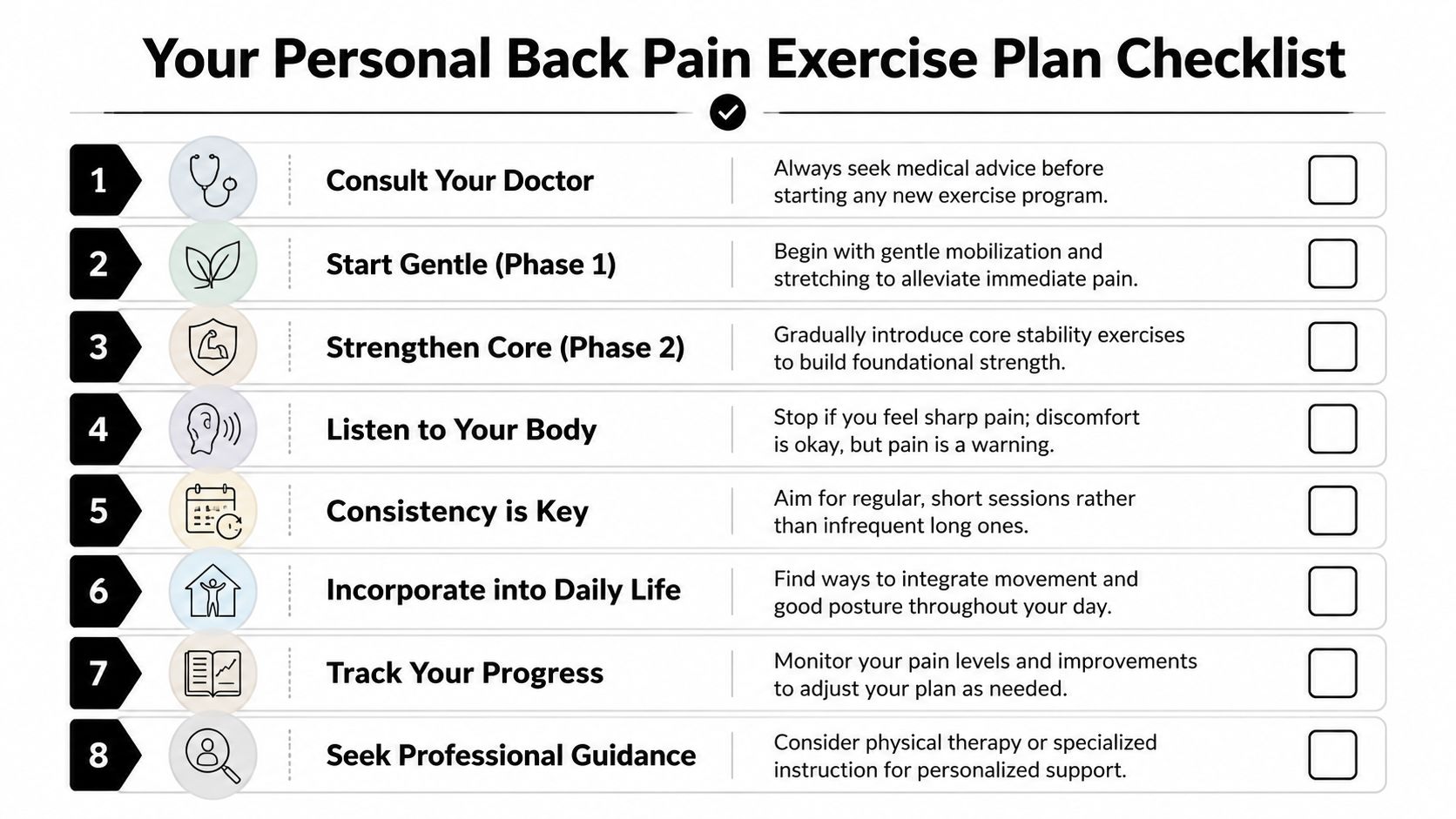
The better model is shorter and more repeatable. Meta-analytic research found that back-pain exercise programs performed best when sessions lasted 30 minutes or less, were done more than 4 times per week, and were delivered in treatment cycles not exceeding 4 weeks (meta-analysis on effective exercise dose for low back pain). In practice, that means brief, frequent sessions often outperform a single hard workout on the weekend.
A simple weekly template
If you're learning how to exercise back pain, start with a plan you can realistically sustain.
Option A for an irritable back
- Day 1: Gentle mobility work plus a short walk
- Day 2: Mobility work and light core activation
- Day 3: Walk and repeat the easiest tolerated exercises
- Day 4: Rest from formal exercise, but avoid staying sedentary all day
- Day 5: Mobility plus core work
- Day 6: Short walk and a light repeat session
- Day 7: Recovery day with easy movement only
Option B for a more stable back
- Most weekdays: Combine a few minutes of mobility with a brief strengthening circuit
- One or two lighter days: Use these for walking and recovery
- One full rest day: Rest from formal exercise, but still change positions and move around
The best plan is the one that leaves you functional the next day.
How to progress without flaring up
Progression should be boring and deliberate. If you jump from easy floor work to heavy resistance or long sessions, symptoms often return.
Use these decision rules:
- Increase one variable at a time. Add a little range, one extra set, or a slightly harder variation. Don't change everything in one week.
- Earn the next step. If your current version feels controlled and doesn't worsen symptoms later that day or the next morning, then move up.
- Keep some reserve. End sessions feeling like you could have done a bit more.
- Step back early if needed. Reducing intensity after a mild flare is smart, not failure.
A useful self-monitoring method
You don't need complicated tracking. A notebook or phone note works.
Write down:
- What you did: Exercises, walking, and how long the session lasted
- How your back felt during the workout: Better, neutral, or worse
- How you felt later that day: Looser, same, or flared
- How you felt the next morning: This often tells you more than the session itself
A good exercise plan improves your day-to-day function first. Pain relief often follows that trend.
Match the plan to your life, not the internet
Someone working a desk job in Evergreen Park may need repeated movement breaks and a short evening session. Someone recovering after a procedure in Palos Heights may need a temporary reduction in bending, lifting, or twisting. Someone with neuropathy or balance problems may do better with countertop-supported exercises than floor routines.
That's why generic advice often misses the mark. A useful plan accounts for your diagnosis, your baseline tolerance, your procedure history, and what your day demands.
Integrating Exercise with Advanced Pain Management
Exercise matters, but it doesn't solve every pain problem by itself. Some patients have pain that keeps recurring because the pain generator is more specific than muscle tightness. It may involve inflamed facet joints, sacroiliac dysfunction, nerve irritation, spinal stenosis, post-surgical changes, or pain that has become persistent enough to block normal rehabilitation.
That's where pain management becomes more than an exercise handout. Research indicates that personalized treatment protocols have a 38% higher pain relief success rate than standardized exercise therapies, and one major rehab mistake is staying stuck in the passive relief phase without advancing to strength-building (report on individualized rehabilitation and progression). In other words, the right plan is both individualized and progressive.

When exercise alone isn't enough
A few patterns suggest you need more than self-directed rehab:
- Pain keeps returning with ordinary activity
- You can't progress beyond gentle movements without flaring
- Pain interrupts sleep, work, or walking
- Leg symptoms, joint pain, or post-procedure issues are complicating recovery
- You've been stuck in temporary relief with no functional gains
In those cases, exercise should stay in the plan, but it may need support from a medical diagnosis and targeted treatment.
How interventional care fits
In an interventional setting, treatments such as image-guided injections, radiofrequency ablation, or minimally invasive options can reduce pain enough for patients to move normally again. The point isn't to replace exercise. The point is to make exercise possible and productive.
That combination is often where durable progress happens. A patient gets enough symptom control to stop bracing, starts moving better, then builds the strength and tolerance that protect the spine over time. Midwest Pain & Wellness is one clinic in the Chicago Ridge area that uses this kind of multimodal approach, including image-guided and minimally invasive pain procedures alongside coordinated rehabilitation and opioid-sparing care.
Passive relief helps you calm pain. Progressive exercise helps you keep it from taking over again.
For patients in Oak Lawn, Palos Hills, Worth, Bridgeview, Hickory Hills, Alsip, Burbank, Evergreen Park, and Orland Park, that distinction matters. The goal isn't just fewer painful days. The goal is getting back to walking, working, sleeping, lifting, and living with more confidence.
If your back pain isn't improving with careful exercise, or if you're not sure which movements are safe after an injury, procedure, or flare-up, schedule an evaluation with Midwest Pain & Wellness. A personalized, opioid-sparing plan can help you combine the right exercise strategy with appropriate medical treatment so you can move forward safely.