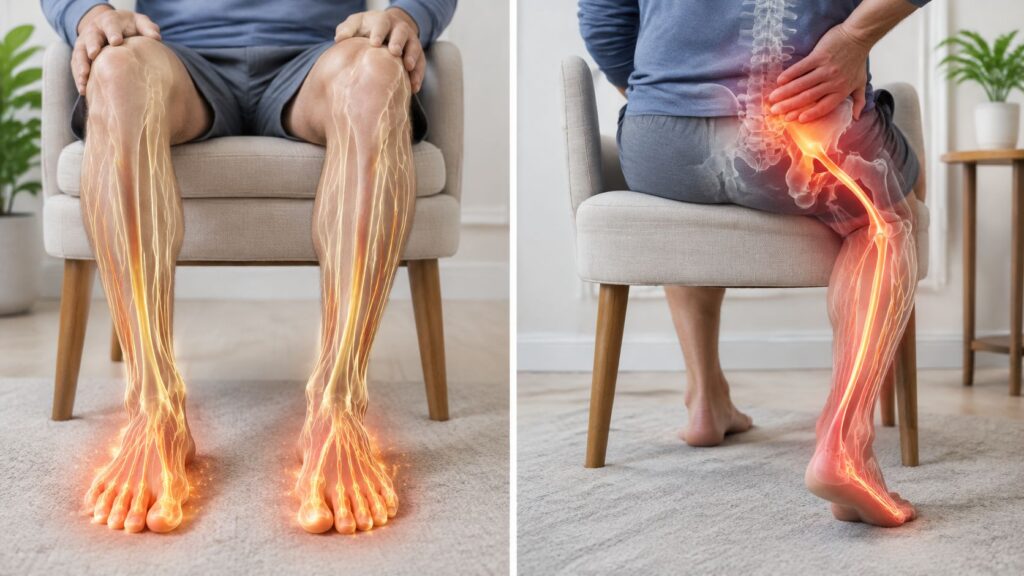
That first step out of bed can tell you how much sciatica is running your day. You stand up, the pain catches in the low back or buttock, then shoots down the leg. Sitting is bad. Driving is worse. Bending to put on socks feels risky. Many people in Chicago Ridge and nearby Illinois communities end up doing what seems safest. They move less and wait for the nerve to calm down.
That instinct makes sense, but it often slows recovery.
Sciatica responds best to the right kind of movement, not complete rest. The challenge is knowing how to exercise sciatica without irritating the nerve more. Generic online routines often miss the details that matter most. Which direction should you move? What should you feel? What pain means “keep going,” and what pain means “stop today”?
This guide is the practical version I'd want a patient to follow at home. It focuses on safe movement, symptom control, and the point where home exercise should give way to a medical evaluation.
Understanding Sciatica and the Power of Safe Movement
Sciatica isn't a diagnosis by itself. It's a pattern of nerve-related pain that usually starts in the lower back or buttock and travels down the leg because a lumbar nerve root is irritated or compressed. A disc problem can do it. Spinal stenosis can do it. In some people, inflammation is the dominant issue. In others, mechanics are.
That distinction matters because the best exercise plan isn't about “stretching everything.” It's about choosing movements that reduce pressure on the irritated nerve and help your body tolerate activity again.

Why rest usually backfires
Old advice told people with back and leg pain to stay in bed. That approach sounds protective, but it tends to stiffen joints, weaken stabilizing muscles, and make it harder to return to normal walking, sitting, and lifting.
Conservative care, including low-impact aerobic exercise, provides partial or complete symptom relief in up to 90% of patients, and those same exercises can accelerate healing by up to 25% through improved blood flow and nutrient delivery, according to this review of sciatica exercises and conservative care. That doesn't mean every exercise helps every person. It means movement is usually part of the answer.
What safe movement actually does
Gentle, targeted exercise helps in a few ways:
- Improves circulation: Better blood flow supports irritated tissues around the nerve root.
- Reduces stiffness: A guarded spine gets less tolerant of normal movement.
- Builds support: Core and hip muscles take load off the lower back.
- Restores confidence: Fear changes how people move, and that often keeps pain going.
Practical rule: If an exercise makes the pain move out of the calf and closer to the buttock or low back, that's often a good sign. If it drives pain farther down the leg, it's usually the wrong move for now.
The right goal for the first week
The early goal isn't to become flexible or strong overnight. It's simpler than that. You want to:
- Calm the irritated nerve
- Keep moving without provoking a flare
- Find positions and exercises your body tolerates
- Build from mobility to stability
If your pain has been persistent, severe, or hard to explain, it's worth reviewing common spine and nerve-related conditions through Midwest Pain & Wellness conditions we treat so you can understand what may be driving your symptoms.
What works better than random stretching
Patients often do too much too soon. They pull aggressively on the hamstring, twist through pain, or force a deep stretch because they assume tightness is the main problem. With sciatica, the issue is often nerve irritability, not just muscle shortness.
A better approach is controlled movement, repeated consistently, with attention to symptom response. That's how to exercise sciatica safely at home. Start by creating space, restoring motion, and gently mobilizing the nerve itself.
Foundational Sciatica Stretches and Nerve Glides
When sciatica is active, the first job is to reduce tension around the nerve, not win a stretching contest. Good mobility work should feel controlled and specific. You may notice pulling, tightness, or mild discomfort. You should not feel sharp, electric, or escalating leg pain.
Many home programs go off track at this stage. People either do nothing or they stretch too hard. The middle ground is what works best.
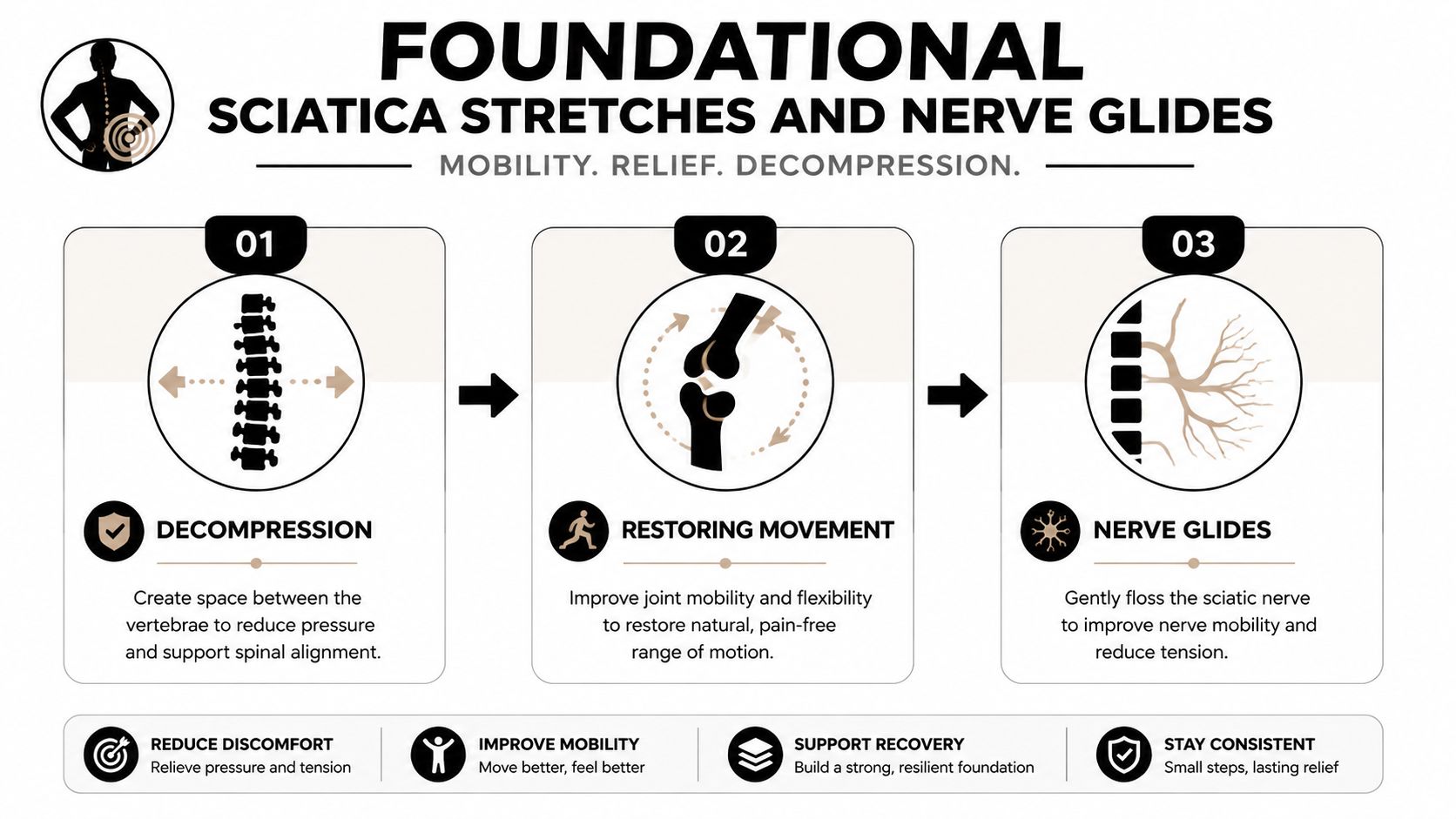
Start with decompression positions
Some people need a quiet starting point before they tolerate formal exercises. Two simple positions often help settle symptoms.
Prone lying
Lie face down on a firm surface with your forehead resting on your hands or a small towel. Stay there for a few minutes and breathe normally. If leg pain eases or pulls upward toward the buttock, this position is useful.
Supported hook-lying
Lie on your back with knees bent and feet flat. Keep the back relaxed. This position isn't a treatment by itself, but it gives many people a neutral place to reset before moving.
A visual summary helps:
Two gentle stretches that usually make sense
These are not maximal stretches. Think light tension, steady breathing, and easy exits.
Supine piriformis stretch
Lie on your back with both knees bent. Cross the ankle of the painful side over the opposite knee. Reach through and gently bring the non-painful thigh toward you until you feel a stretch in the buttock.
Use this when the buttock feels tight and the position doesn't increase leg symptoms.
- Hold: a brief, easy hold
- Feel: buttock stretch, not nerve zing
- Stop if: pain shoots lower down the leg
Knee to opposite shoulder
Stay on your back. Bend the painful-side knee and lightly draw it toward the opposite shoulder. Don't yank it across the body. Keep the pelvis relaxed.
This can open the gluteal region and reduce local buttock tension. It is not appropriate if crossing the leg sharply worsens radiating pain.
The best stretch for sciatica is the one your nerve tolerates. If a “good” stretch leaves you limping afterward, it wasn't good for your body that day.
Nerve glides need precision
Sciatic nerve glides, also called nerve flossing or neurodynamics, are different from stretches. The goal is not to lengthen the nerve. The goal is to help it move more freely through surrounding tissues.
A study on patients with sciatica found that adding neurodynamic nerve gliding exercises to a conventional exercise program produced a 25 to 30% greater immediate reduction in radicular pain and improvement in biceps femoris muscle activation compared with conventional exercise alone, as reported in this PMC article on neurodynamic mobilization for sciatica.
How to do a seated sciatic nerve glide
This is the version individuals can learn safely.
- Sit upright near the front of a chair.
- Keep the spine tall and shoulders relaxed.
- Slowly straighten the painful-side knee as you pull the toes up.
- Hold briefly if tolerated.
- Then bend the knee back down as you point the toes away.
That creates a gentle sliding motion along the nerve pathway. The movement should be smooth and calm.
What you should feel: mild pulling behind the thigh or knee, sometimes a light nerve tension that eases as you return.
What you should not feel: sharp pain, tingling that builds with each rep, or symptoms that linger and spread after you're done.
Common mistakes with nerve glides
People get into trouble when they treat nerve glides like hamstring stretches. Don't force the knee straight. Don't hold the end range aggressively. Don't add neck movement unless you already tolerate the basic version well.
Use these checkpoints:
- Stay rhythmic: Smooth in, smooth out.
- Keep it submaximal: Gentle motion works better than a hard pull.
- Watch the leg symptoms: Better in the leg is the target, even if the back feels slightly more aware.
- Choose consistency over intensity: A few well-done sets beat a single aggressive session.
What a good session feels like afterward
You should finish feeling looser, not inflamed. Walking should feel the same or easier. Sitting should feel the same or slightly more tolerable. If the calf or foot pain is stronger after the session, cut the range down next time or stop that exercise entirely.
Mobility work creates the opening. Strengthening is what keeps that opening.
Building Support with Core and Glute Strengthening
Once the pain is less irritable, the focus changes. Stretching alone won't protect your back when you sit, stand, carry groceries, or get out of a car. You need muscle support around the pelvis and lower spine.
The two areas I care about most are the deep core and the glutes. When they do their job well, the lower back doesn't have to grip and overwork during every movement.
Why strengthening changes the long game
Strength work helps reduce repeated strain on irritated lumbar segments. It also improves movement quality. Many people with sciatica don't just have pain. They have guarded mechanics. They hinge poorly, shift off one side, or arch the lower back every time they move a leg.
The McKenzie Method, which often includes movements like prone press-ups and bird-dogs, has shown a 70 to 85% success rate in centralizing and resolving sciatica symptoms by identifying and repeating movements that reduce nerve compression, according to this summary of MDT-based sciatica exercises. The key idea is simple. Repeat what centralizes symptoms, and avoid what peripheralizes them.
Bird-dog
Bird-dog is one of the best starting drills because it teaches spinal control while the limbs move.
Beginner version
Get on hands and knees. Brace the abdomen gently, as if tightening a wide belt one notch. Slide one leg straight back without lifting it high. Return and switch sides.
Intermediate version
Lift one leg to hip level while keeping the pelvis steady. If tolerated, add the opposite arm reaching forward.
Advanced version
Pause briefly at full reach without twisting or arching. Move slowly on the way back.
What to watch for:
- Hips should stay level
- The lower back shouldn't dip
- The neck stays neutral
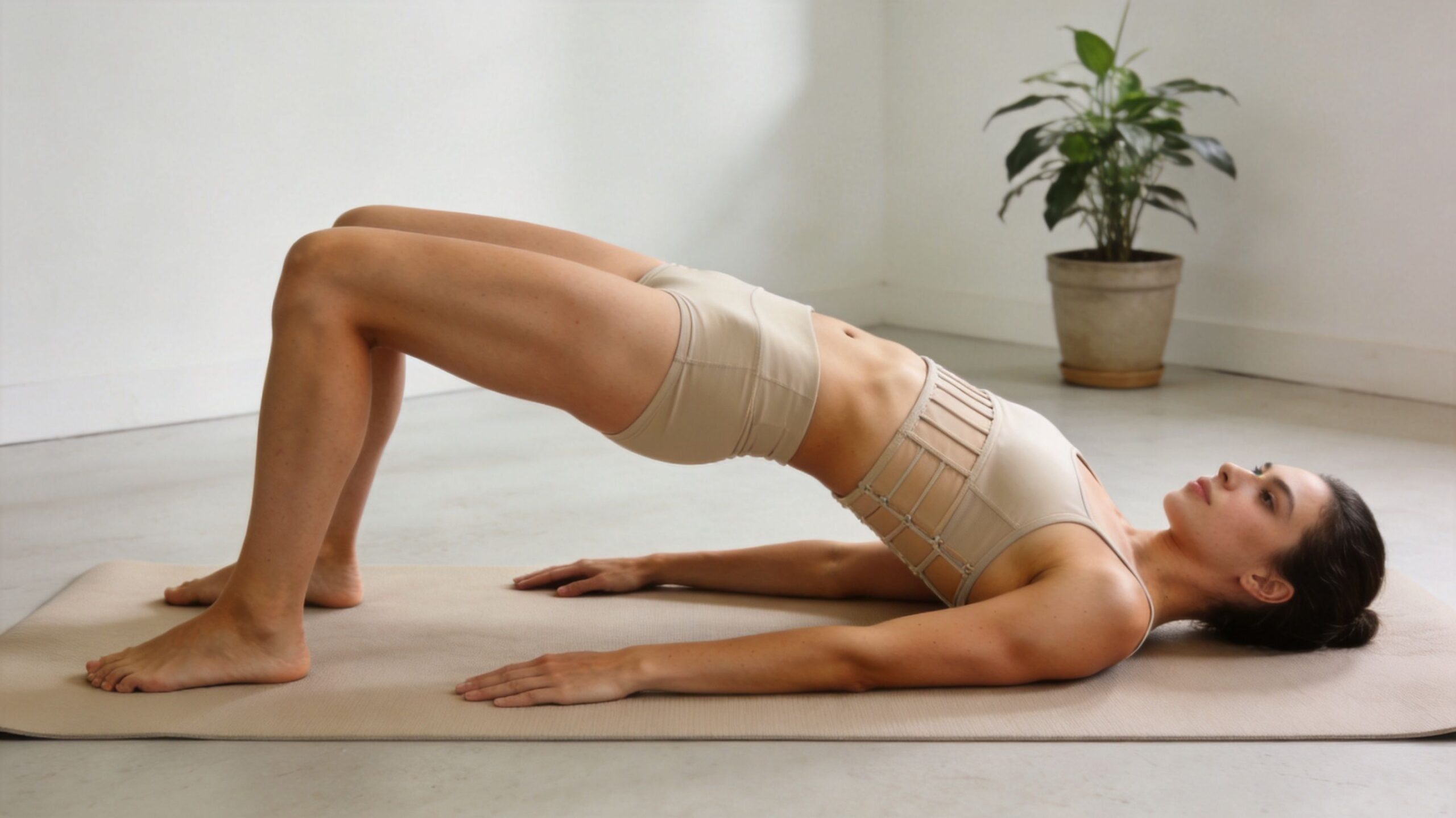
Glute bridge
This exercise trains hip extension without forcing the lower back to do the work.
Lie on your back with knees bent and feet flat. Tighten the abdomen lightly, press through the heels, and lift the hips until the body forms a straight line from shoulders to knees. Lower with control.
Good progression options
- Beginner: small lift, shorter range
- Intermediate: full bridge with steady breathing
- Advanced: pause at the top or march gently one foot at a time if symptoms are quiet
Clamshell
Clamshells target the side glutes, which stabilize the pelvis during walking and stair use.
Lie on your side with hips and knees bent. Keep the feet together while lifting the top knee. Don't roll the whole body backward to fake more range. The motion is small, and it should burn in the outer hip.
If you feel clamshells mostly in the low back, reduce the range and reset your pelvis. More motion isn't better. Better control is better.
Prone press-up for directional preference
This movement isn't for everyone, but when extension centralizes symptoms, it can be very helpful.
Lie face down, place your hands under the shoulders, and gently press the chest upward while keeping the hips on the surface. Only go as far as tolerated. You're not trying to create a dramatic backbend. You're checking whether extension reduces leg pain.
A useful sign is this: the buttock or back may feel more pressure, but the pain in the calf or foot eases. That's often a favorable response.
A simple way to progress
Don't progress by adding random exercises. Progress by improving one variable at a time:
| Exercise | Easier version | Harder version |
|---|---|---|
| Bird-dog | Leg slide only | Opposite arm and leg reach with pause |
| Bridge | Partial lift | Full bridge with controlled hold |
| Clamshell | Smaller range | Longer hold with strict pelvic control |
| Press-up | Elbows or short range | Higher press-up if leg pain centralizes |
What strengthening should feel like
Muscle fatigue is acceptable. Mild effort is expected. Sharp buttock-to-foot pain is not. If strength work causes the nerve symptoms to spread, return to the mobility phase for a day or two and retry with less range.
How to exercise sciatica well often comes down to sequencing. Restore motion first, then build support around that motion.
Your Weekly Sciatica Exercise Schedule
A complicated rehab calendar is unnecessary for many individuals. A routine that can be repeated without guesswork is more effective. The schedule below blends decompression, nerve mobility, strengthening, and aerobic movement so the body gets frequent input without being overloaded.
One principle matters more than variety. Be consistent early. Preclinical research suggests treadmill exercise was particularly effective for sciatica-like pain, and shorter interventions under four weeks showed the strongest effect on mechanical pain thresholds in rodent models, according to this 2024 meta-analysis on exercise and sciatic nerve injury. Human exercise plans aren't built from rodent data alone, but the practical takeaway fits what we see clinically. Moderate, regular movement early tends to work better than sporadic bursts of effort.
Sample weekly sciatica exercise protocol
| Day | Focus | Exercises | Sets & Reps / Duration |
|---|---|---|---|
| Monday | Mobility and reset | Prone lying, seated nerve glides, piriformis stretch, easy walk | Brief decompression, gentle glides, short walk |
| Tuesday | Strength | Bird-dog, glute bridge, clamshell | Controlled sets with good form |
| Wednesday | Active recovery | Walking, supported mobility work | Easy pace, symptom-guided |
| Thursday | Mobility and directional work | Nerve glides, knee to opposite shoulder, prone press-up if extension helps | Light volume, stop if leg pain spreads |
| Friday | Strength | Bird-dog, bridge, clamshell | Repeat Tuesday with small progression if tolerated |
| Saturday | Aerobic day | Walking, pool exercise, stationary bike, or elliptical if tolerated | Moderate, steady effort |
| Sunday | Recovery and check-in | Gentle decompression, short walk, reassess symptom pattern | Keep it easy |
How to organize the week
The pattern is intentional.
- Mobility days reduce stiffness and calm the nerve.
- Strength days build support around the lumbar spine and pelvis.
- Aerobic work keeps blood flowing and improves tolerance for daily activity.
- Recovery days prevent the boom-and-bust cycle where you do too much on one good day and pay for it the next two.
Aerobic exercise counts more than people think
Walking is often the best starting choice because it's available and easy to adjust. A slower pace with shorter bouts is fine if that's what your symptoms allow. Some people do better in a pool or on a stationary bike because the body feels supported.
Keep these guardrails in mind:
- Choose low impact: Walking, swimming, water aerobics, elliptical work, and stationary cycling are usually reasonable options.
- Avoid symptom spikes: If an activity reliably increases radiating leg pain, modify it or stop it.
- Stay moderate: You shouldn't finish feeling wrung out or flared up.
- Track the trend: The next morning matters. Better, same, or worse tells you whether the dose was right.
Good scheduling beats heroic effort. A repeatable week is more useful than one hard workout followed by three bad days.
Safety First When Exercising with Sciatica
The biggest fear people have about exercise is also the right one. Can I make this worse? Yes, if you ignore the way the nerve is responding.
That doesn't mean movement is dangerous. It means you need rules. Sciatica improves when activity is matched to the stage of irritation. It gets aggravated when people push through warning signs because they assume all pain during exercise is productive.

The stop signals that matter
A 2023 review discussed in this Healthline sciatica stretching article reported that 28% of sciatica patients worsened symptoms by ignoring pain signals during exercise. The same source notes critical red flags that require immediate stop and medical consultation, including new bowel or bladder incontinence and progressive weakness in the legs.
Those aren't “wait and see” symptoms.
Use a simple pain scale
A practical home rule is to use a 0 to 10 pain scale during and after exercise.
- 0 to 3 out of 10: Usually acceptable if symptoms settle quickly and don't spread down the leg
- Above that range: Back off, shorten the range, reduce the reps, or stop
- Worsening leg symptoms afterward: Treat that as a failed session, even if you got through it
Nerve pain behaves differently from muscle fatigue. Muscle work tends to stay local. Nerve irritation radiates, burns, tingles, or causes zapping pain down the leg.
Movements that often make sciatica worse
Not everyone reacts the same way, but these commonly aggravate an active flare:
- Heavy lifting with a rounded back: This increases load on irritated lumbar structures.
- Repeated forward bending: Especially first thing in the morning or during an acute flare.
- Aggressive hamstring stretching: Many people think they're stretching muscle when they're really pulling on the nerve.
- Twisting under load: Rotating while carrying something can trigger sharp pain.
- High-impact exercise: Running and jumping can be too jarring when the nerve is already irritated.
Stop the session if pain travels farther down the leg than where it started. That's the clearest home warning sign that the movement isn't helping.
How to modify when other joints hurt
Some patients want to exercise but also have knee arthritis, deconditioning, balance problems, or a higher body weight. That doesn't disqualify you from movement. It changes your setup.
If your knees hurt
Use a chair for seated nerve glides, reduce floor transfers, and favor walking on level ground, a recumbent bike, or pool exercise.
If getting on the floor is difficult
Do more in bed, on a couch edge, or in a chair. Bird-dog can wait until transitions feel easier.
If walking flares the leg quickly
Break it into shorter bouts. A few short walks spread across the day are often better tolerated than one long walk.
If you're unsure whether pain is acceptable
Get evaluated instead of guessing. You can request a clinical assessment through the Midwest Pain & Wellness appointment page if symptoms are hard to interpret or worsening.
What “safe” should feel like
A safe program isn't pain-free every second. It is predictable. Symptoms don't spiral. Recovery between sessions is manageable. Walking and daily tasks gradually become less guarded.
If your exercise plan feels like roulette, it needs revision.
When to See a Specialist in the Chicago Ridge Area
Home exercise is useful, but it has limits. Some cases of sciatica improve steadily with movement and time. Others stall because the underlying problem is more stubborn, more inflamed, or more structural than a home routine can solve.
In practice, several situations justify a specialist evaluation.
Signs self-care isn't enough
You should move beyond home exercise if:
- Pain remains severe or disabling despite your best effort to stay active
- Symptoms keep returning as soon as you increase walking, sitting, or normal activity
- Leg weakness, numbness, or gait changes are becoming more noticeable
- You can't find a movement direction that helps
- Your daily function is shrinking, not expanding
The point of an evaluation isn't to abandon exercise. It's to identify why the nerve stays irritated and decide whether an interventional option can reduce that irritation enough for exercise to work again.
What an interventional pain specialist adds
A pain and wellness clinic isn't a physical therapy office, and it shouldn't pretend to be one. The role is different. An interventional pain specialist evaluates whether the pain pattern fits a disc issue, stenosis, facet-related pain, sacroiliac involvement, or another spine and nerve disorder, then builds a treatment plan around that diagnosis.
That may include:
- Image-guided injections to reduce inflammation around an irritated nerve root
- Targeted diagnostic blocks to clarify where pain is coming from
- Radiofrequency procedures when appropriate for certain pain generators
- Minimally invasive options for selected lumbar stenosis cases
- Coordinated rehab planning so exercise resumes at the right time and intensity
For patients in Oak Lawn, Palos Hills, Palos Heights, Worth, Bridgeview, Hickory Hills, Alsip, Burbank, Evergreen Park, Orland Park, and nearby Illinois communities around Chicago Ridge, that kind of workup can be the difference between months of guessing and a more direct plan.
Why timing matters
Some patients wait too long because they assume seeking care means surgery is next. That's not the typical pathway. In many cases, a specialist visit helps you avoid both prolonged suffering and unnecessary escalation. The right injection or decompression strategy can make walking, sleeping, and exercising realistic again.
If home exercise hasn't restored function or symptoms point to a more persistent spine issue, review the range of procedures used for treatment at Midwest Pain & Wellness to understand what non-opioid, image-guided options may be appropriate.
The best time to seek help is before pain reorganizes your whole life around avoidance.
Frequently Asked Questions About Exercising with Sciatica
Can exercise make my sciatica worse?
Yes, the wrong exercise can. The usual pattern is too much range, too much intensity, or the wrong direction. If pain spreads farther down the leg, lingers after the session, or leaves you walking worse, that exercise isn't the right fit right now. Properly chosen movement should calm symptoms or make them more manageable.
How long does it take for sciatica exercises to start helping?
That depends on the cause and how irritable the nerve is. Some people notice a change in a few sessions, especially when they find a directional preference that centralizes pain. Others improve more gradually. What matters most is the trend over time. You want less leg pain, easier walking, and more tolerance for sitting or standing.
What's the difference between a physical therapist and a pain management specialist?
They do different jobs. A physical therapist focuses on movement assessment, exercise progression, and function. A pain management specialist diagnoses the pain generator, looks for nerve root irritation or structural spine problems, and can offer image-guided procedures when home care or rehab alone isn't enough. In many cases, the best care uses both, but they are not interchangeable.
Is there one best exercise for everyone?
No. That's one of the biggest myths online. Some people improve with extension-based movements like press-ups. Others don't. Some tolerate nerve glides well early. Others need irritability to settle first. The best exercise is the one that reduces leg symptoms, improves function, and doesn't trigger a setback.
Should I stretch my hamstrings if they feel tight?
Be careful. Hamstring “tightness” during sciatica is often nerve tension, not a short muscle. Aggressive stretching can flare the nerve. Gentle mobility is fine if it doesn't increase radiating symptoms, but don't force long, intense pulls just because the back of the leg feels tight.
If sciatica is limiting your walking, sleep, work, or ability to stay active, Midwest Pain & Wellness offers expert evaluation and opioid-sparing treatment for spine and nerve pain in Chicago Ridge and surrounding Illinois communities. Dr. Yaw Donkoh and the team provide personalized care that can include image-guided interventions, coordinated rehab planning, and minimally invasive options to help you return to movement safely.