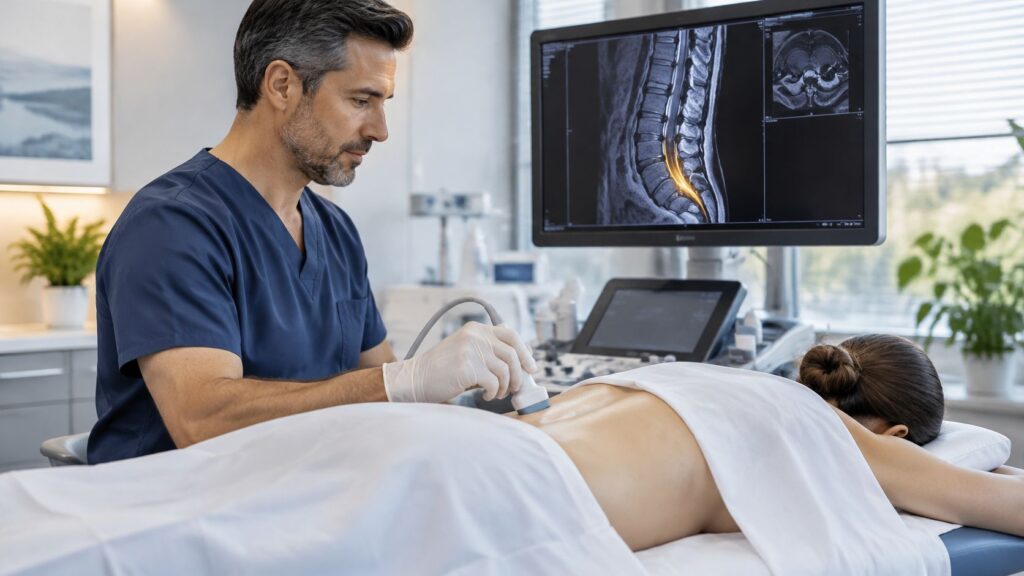
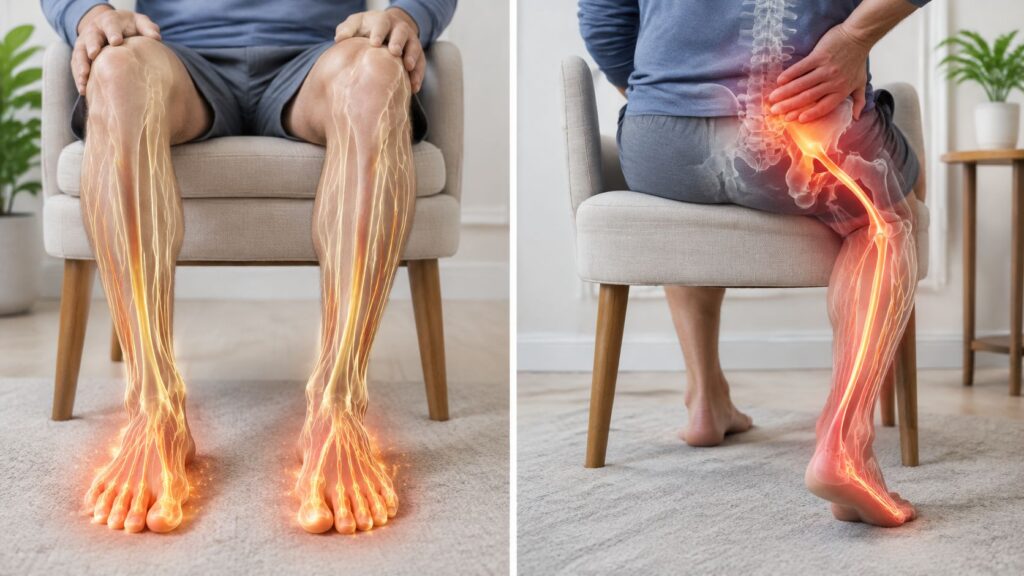
If you're reading this, there's a good chance walking has become the problem. You start out fine, then your back, buttocks, or legs begin to ache, burn, tingle, or feel heavy. You lean on a shopping cart and suddenly it's easier. You sit down for a minute and the symptoms ease off. Then you wonder the question almost every patient asks sooner or later: Can spinal stenosis be healed, or can it only be managed?
As a double board-certified interventional pain specialist, I tell patients the same thing every day. You can often get meaningful, durable relief from spinal stenosis, but the path depends on what “heal” means. If you mean reversing the narrowing with home remedies alone, that usually isn't realistic. If you mean walking farther, standing longer, sleeping better, and getting back to daily life with less pain, that is often very realistic.
Understanding Spinal Stenosis What It Means to Heal
Spinal stenosis means there's less space in part of the spine than there should be. That narrowing can crowd the spinal cord or the nerves that travel through the spinal canal. In plain language, the problem isn't just “back pain.” The bigger issue is often pressure and irritation on nerves.
Spinal stenosis typically presents in one of two broad patterns. Lumbar stenosis affects the lower back and commonly causes pain, cramping, heaviness, numbness, or tingling into the buttocks and legs, especially with standing or walking. Cervical stenosis affects the neck and may cause neck pain, arm symptoms, hand clumsiness, balance problems, or weakness.
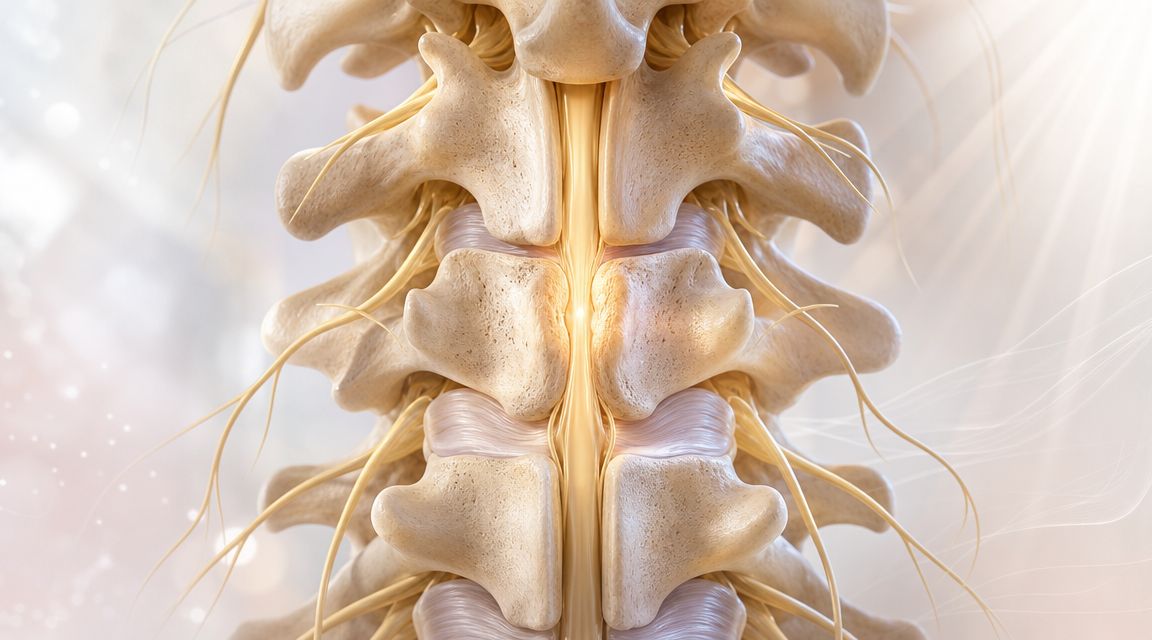
Healing the symptoms versus reversing the anatomy
A lot of online advice becomes confusing. Patients want a yes-or-no answer. Medicine is more precise than that.
High-quality clinical sources, including the NIH and Cleveland Clinic, consistently note that the underlying anatomical narrowing usually cannot be reversed with home care or medications, but treatment can be highly effective at improving function and controlling symptoms. The goal is durable relief, not necessarily anatomical reversal, as described by Cleveland Clinic's overview of spinal stenosis.
That distinction matters because it changes what success looks like. Success means:
- Walking farther before symptoms start
- Standing longer with less leg pain or heaviness
- Reducing nerve irritation so daily activity is possible again
- Avoiding unnecessary opioid use while improving function
- Choosing the right level of care at the right time
Practical rule: If your life is getting smaller because walking, standing, shopping, cooking, or working have become difficult, treatment should focus on restoring function, not chasing the idea of a perfect-looking MRI.
The symptom pattern that often points to stenosis
A classic lumbar stenosis symptom is neurogenic claudication. That means leg or buttock discomfort builds with walking or standing and improves when you sit down or bend forward. Patients often notice they can walk farther leaning on a cart than walking upright in an open parking lot.
That “bending forward helps” pattern isn't random. Flexion can temporarily create a little more room for irritated nerves. It doesn't cure the condition, but it often explains why certain positions feel better than others.
A careful evaluation also matters because not every pain in the back or legs is stenosis. Disc problems, facet joint pain, sacroiliac pain, vascular problems, and peripheral nerve conditions can overlap. That's one reason a full spine and nerve evaluation through a clinic that treats pain conditions and nerve disorders is useful before anyone jumps to conclusions.
Lumbar and cervical stenosis are not the same problem
Here's a simple comparison:
| Region | Common symptom pattern | Common functional complaint |
|---|---|---|
| Lumbar spine | Back, buttock, or leg pain with standing and walking | “I can't walk far” |
| Cervical spine | Neck pain, arm symptoms, hand weakness, balance trouble | “My hands or balance feel off” |
Cervical symptoms deserve extra attention because worsening coordination, hand weakness, or gait problems can signal more significant spinal cord involvement. Lumbar stenosis often limits walking first. Cervical stenosis can affect dexterity and balance in ways patients may initially dismiss as aging or fatigue.
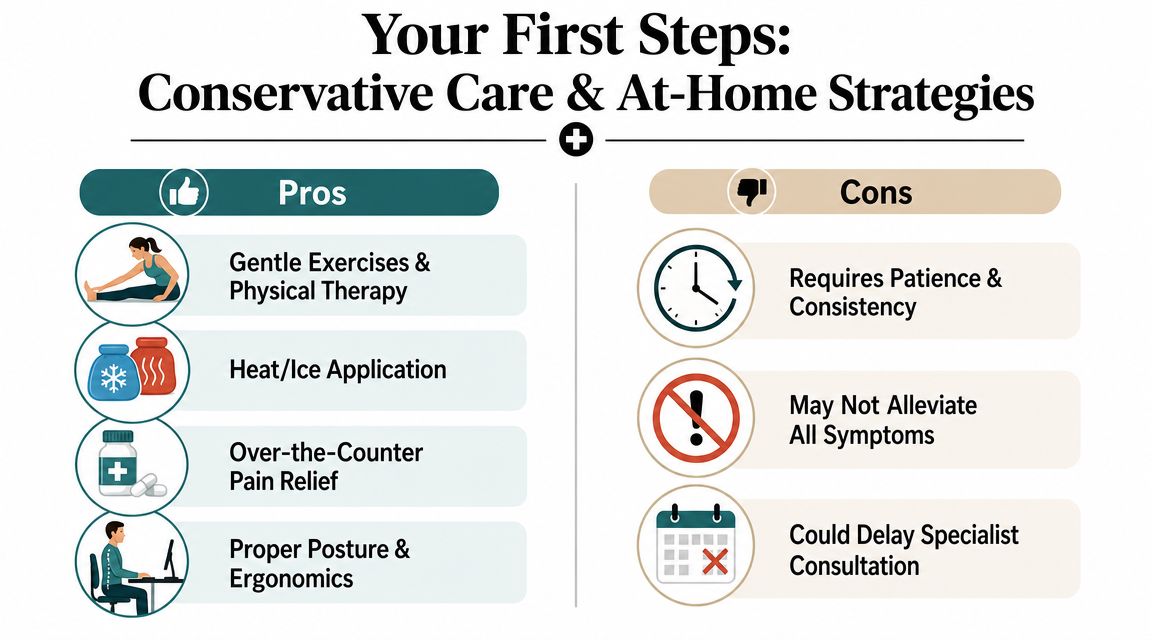
Your First Steps Conservative Care and At-Home Strategies
A common early pattern looks like this: you can still get through the day, but standing in one place, walking through a store, or doing chores starts to set off back, buttock, or leg symptoms. That is the stage where conservative care makes sense. The goal is not to pretend the narrowing is gone. The goal is to calm irritated nerves, protect walking ability, and see whether function improves enough to avoid more invasive treatment.
Mayo Clinic describes the usual starting point as symptom management with physical therapy, weight management, walking aids that support a forward-flexed posture, and over-the-counter pain relievers, all aimed at improving day-to-day function in its spinal stenosis treatment guidance.
Start with symptom control that matches how stenosis behaves
With spinal stenosis, position often changes symptoms. Patients with lumbar stenosis often tolerate sitting better than prolonged standing. Many also do better with a slight forward bend than with an extended, upright posture. I tell patients to use that information. It is a practical clue, not a weakness.
A few simple adjustments often help:
- Use supported forward flexion during flare-ups: Leaning on a shopping cart, countertop, or walker can reduce leg symptoms enough to keep you moving.
- Set up standing tasks differently: If meal prep, shaving, or folding laundry brings on pain, do them in shorter blocks and sit before symptoms spike.
- Choose firmer, supportive seating: A chair that lets you sit and stand without dropping into a deep arch is usually easier on the low back than a soft couch.
- Avoid repeated backward bending if it clearly aggravates symptoms: Some exercises help one patient and flare another. Stenosis care is not one-size-fits-all.
These changes do not heal the narrowing itself. They can reduce the mechanical irritation that limits walking and daily activity.
Keep moving, but stop trying to prove toughness
The worst early mistake is often on one of two extremes. Some patients push through escalating pain until they need two days to recover. Others cut activity so sharply that strength, endurance, and confidence drop within weeks.
Gentle, repeatable movement works better than either approach. In practice, the right amount is the amount you can recover from and repeat.
Useful options often include:
Short walks with planned rest
Walk to the point where symptoms begin to build, then sit or lean forward before they become severe. That approach usually works better than one long painful walk.Stationary cycling or similar flexion-tolerant exercise
Many patients can exercise longer in a slightly forward-leaning position than they can walking upright.Core and trunk endurance work
The target is better support and better movement efficiency, not heavy strengthening.Physical therapy matched to the specific problem
Therapy is more useful when it addresses gait limits, hip tightness, balance deficits, and deconditioning instead of giving the same generic sheet to every patient.
Exercise should be judged by function. Can you walk farther, stand longer, recover faster, or rely less on medication? Those are meaningful wins.
Use medication carefully and keep the goal clear
At-home treatment sometimes includes over-the-counter medication. That may help during milder phases, especially when paired with activity changes and therapy. The trade-off is straightforward. Pain relief from medication can make activity more tolerable, but it does not remove the narrowing, and it can mask when you are overdoing it.
For that reason, I advise patients to use the lowest level of medication that helps them stay active and sleep reasonably well. The aim is opioid-sparing care focused on function. If symptom control depends on escalating medication while walking tolerance keeps shrinking, the plan is no longer working well enough.
Home tools can help, but some help more than others
A few simple supports are reasonable early on:
- Heat or ice: Cleveland Clinic notes that mild cases may start with at-home care such as heat or ice. Either can be reasonable if it gives short-term relief.
- Cane or walker: A walking aid is often a functional tool, not a sign that you have failed conservative care.
- Weight reduction: Less load can make movement easier, especially when standing and walking are the main limits.
- Smoking cessation: Better circulation and tissue health support recovery and tolerance for exercise.
Patients often waste time and money on passive fixes that promise to “cure” stenosis at home. Braces, gadgets, and random stretches may provide temporary comfort, but they rarely change the larger picture if nerve compression is the main driver.
Know what conservative care can and cannot do
This is the part many people want answered clearly. Can spinal stenosis heal with home care alone? Sometimes symptoms improve enough that active treatment can stay conservative for a long time. That is a good outcome. It means the condition is being managed successfully.
What conservative care usually cannot do is reverse fixed structural narrowing. If your symptoms are stable, your walking ability is holding up, and you are still making progress with exercise and daily modifications, staying conservative is reasonable. If function is slipping despite a real effort, continuing the same home plan for months usually delays better treatment.
A practical benchmark is simple. Conservative care is working when it helps you do more with less pain and less reliance on medication. It is falling short when pain, weakness, sleep disruption, or walking limits continue to tighten your world.
When to Escalate to Interventional Pain Management
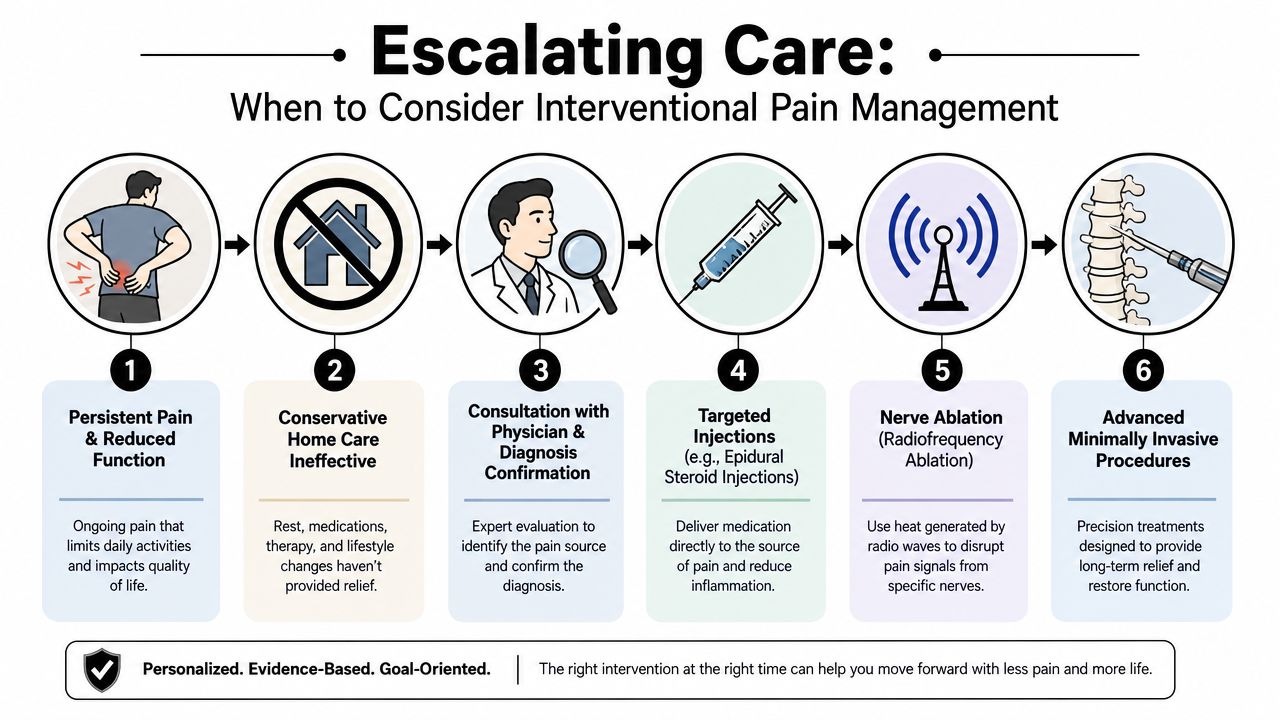
A common turning point sounds like this. You can still get through the day, but your world keeps getting smaller. You park closer, stand for shorter periods, skip errands, and sit down more often because the leg pain, heaviness, or numbness keeps coming back. At that stage, the question is no longer whether you are trying hard enough at home. The question is whether the current plan is protecting your function.
That is when I advise patients to get evaluated for interventional pain care. The goal is not to chase temporary pain relief for its own sake. The goal is to identify what structure is driving symptoms, reduce irritation around the nerve or joints when possible, and create enough improvement that walking, exercise, sleep, and daily tasks become realistic again.
What interventional pain care actually does
Interventional care sits in the middle ground between basic conservative treatment and a decompression procedure or surgery. For the right patient, that middle ground matters. It can confirm the pain generator, calm inflammation, and buy back enough function to avoid rushing into an operation. It can also show that a structural problem is too advanced for repeated symptom management alone.
A good evaluation should answer a few practical questions:
- Is the main driver irritated spinal nerves, arthritic facet joints, sacroiliac joint pain, or a combination?
- Do the symptoms and imaging match well enough to justify a targeted procedure?
- Would a focused injection create a useful window for physical therapy and walking progression?
- Are there signs that symptom management is becoming a short-term patch instead of a durable plan?
I take an opioid-sparing approach here. Opioids may blunt pain for a period of time, but they do not create space around crowded nerves or correct the mechanics behind stenosis. If medication use is going up while activity keeps dropping, the treatment strategy needs to change.
Injections can clarify the problem, not just quiet it
Patients often hear "injection" and assume the goal is simple pain relief. Relief matters, but diagnosis matters too.
A targeted epidural can help when leg-dominant symptoms suggest inflamed nerve roots in a narrowed canal or foramen. Medial branch blocks can help sort out whether facet joints are contributing to back pain that overlaps with stenosis. If those blocks give the expected response, radiofrequency ablation may provide longer relief for the facet component. That does not treat every part of stenosis, but it can reduce one meaningful source of pain.
This step matters because spinal stenosis is not one uniform problem. Two patients can have similar MRI language and need very different treatment plans.
What effective escalation looks like
The best use of interventional pain management is strategic. If an epidural injection helps a patient walk farther, tolerate therapy, and rely less on medication, that is a productive result. If relief lasts only a few days, does not match the symptom pattern, or never improves function, repeating the same procedure without rethinking the diagnosis is poor care.
I tell patients to judge progress by function first. Can you stand long enough to cook? Walk through the grocery store? Sleep without waking from leg pain? Return to exercise safely? Pain scores matter, but function tells us whether treatment is changing your life.
In practice, that may include epidural injections, medial branch blocks, radiofrequency ablation, or other image-guided pain management procedures for spinal and joint pain. The point is not to use every option. The point is to match the treatment to the anatomy and the symptoms.
Signs it is time to see a specialist
Consider specialist evaluation if you notice any of the following:
- Your walking distance keeps shrinking
- Leg pain, cramping, or heaviness is limiting you more than back soreness
- You need to sit down more often to get relief
- Home measures help, but the benefit is brief
- You have cut out activities that matter to you
- You are taking more medication and doing less
- Weakness, balance problems, or repeated flares are becoming more common
This is also where the "healing versus managing" question becomes more honest. If symptoms are controlled and function is stable, management may be the right path. If function keeps slipping despite solid conservative care, it is time to stop hoping the narrowing will reverse on its own and start looking at targeted treatment that addresses the problem more directly.
Advanced Options Minimally Invasive Procedures and Surgery
A common turning point sounds like this: you can still get through the day, but every outing is planned around where you can sit down. At that point, the goal is no longer temporary symptom control alone. The question becomes whether treatment should physically relieve the narrowing that is crowding the nerves.
For spinal stenosis, “healing” does not always mean reversing every age-related change on an MRI. In this stage, it often means choosing the least invasive treatment that improves walking tolerance, standing time, and leg function in a durable way.
Minimally invasive decompression for the right anatomy
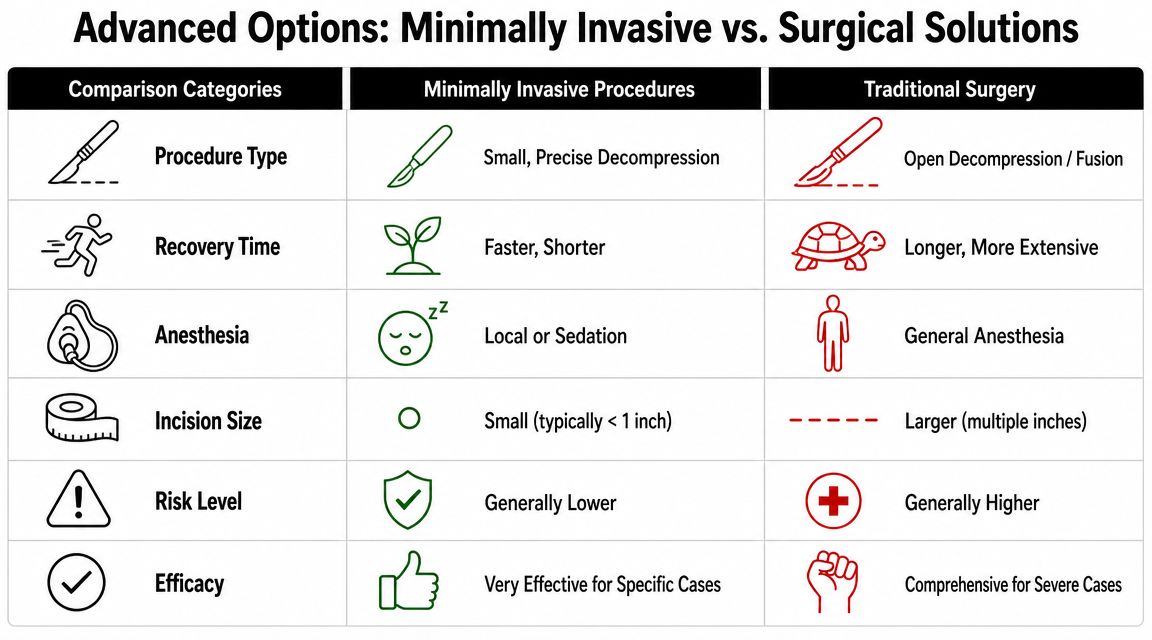
Some patients are good candidates for a targeted decompression procedure rather than open surgery. One example is the MILD procedure for lumbar stenosis related to a thickened ligamentum flavum. Johns Hopkins describes MILD as an outpatient, image-guided procedure done through a small incision with specialized tools to remove excess ligament tissue. It is typically performed with local anesthesia and light sedation, and patients usually go home the same day, according to Johns Hopkins Medicine's description of the MILD procedure.
Patient selection decides whether this is a smart option. If imaging shows that the main problem is not ligament thickening, a MILD procedure may leave the actual pain generator untouched. Stenosis from bone overgrowth, significant disc bulging, instability, or multilevel compression often calls for a different plan.
That trade-off matters.
A smaller procedure usually means less tissue disruption and a shorter recovery. It also has narrower indications. I tell patients that minimally invasive treatment works best when the anatomy fits cleanly and the symptoms match what we see on the scan.
Surgery still has a clear role
Surgical decompression remains an appropriate treatment for patients with persistent neurogenic claudication, progressive limits in walking, or neurologic symptoms that continue despite well-executed nonoperative care. For the right patient, surgery is not an overreaction. It is a direct way to create space for the nerves.
The exact operation depends on the structure causing compression. Some patients need decompression alone. Others may need a more involved surgical approach if there is instability, deformity, or compression at multiple levels. That is why a blanket promise to “heal spinal stenosis without surgery” is often misleading. Some cases can be managed for years. Some improve with injections or minimally invasive decompression. Some require an operation to restore function.
How I frame the decision
I focus on four questions:
| Question | Why it matters |
|---|---|
| What is actually causing the narrowing? | Ligament thickening, facet overgrowth, disc issues, and instability do not all respond to the same procedure. |
| How limited are you in daily life? | Reduced walking distance, frequent sitting breaks, and loss of independence push the decision toward decompression. |
| Is the goal symptom management or structural relief? | If symptoms are manageable and function is stable, continued conservative care may be reasonable. If function keeps dropping, structure matters more. |
| What recovery are you willing to take on? | A smaller procedure may mean an easier recovery, but only if it addresses the real source of compression. |
This is the practical framework patients need. Management makes sense when symptoms are tolerable and function is holding. “Healing,” in the more definitive sense, usually means removing or reducing the structure pressing on the nerves.
Choosing the least invasive option that fits
The best plan is matched, not maximal. I would rather recommend a focused outpatient procedure than send someone to surgery too early. I would also rather recommend a surgical opinion than repeat short-lived treatments for a problem that clearly needs decompression.
Patients considering this stage of care often do better when they review the clinic's image-guided and minimally invasive spine procedures ahead of the visit. That makes the conversation more specific. We can spend less time guessing and more time deciding which option gives you the best chance of walking farther, standing longer, and getting back to the parts of life that have narrowed along with your spine.
Finding a Spinal Stenosis Specialist Near Chicago Ridge
If you live near Chicago Ridge, the practical issue is simple. You need a clinician who can tell the difference between symptoms that should be managed conservatively and symptoms that need more advanced evaluation.
That matters whether you're in Oak Lawn, Palos Hills, Palos Heights, Worth, Bridgeview, Hickory Hills, Alsip, Burbank, Evergreen Park, or Orland Park. These Illinois communities are close enough that a focused spine and pain evaluation should be accessible without turning your care into a long-distance project.
What to look for in a pain specialist
Start with credentials and scope. For spinal stenosis, you want someone who understands imaging, physical exam findings, nerve-related symptom patterns, and image-guided procedures. A clinic that only offers one kind of treatment is more likely to force every patient into the same lane.
Look for these features:
- Board certification in pain medicine: That signals formal training in diagnosing and treating spine and nerve pain conditions.
- Image-guided procedural expertise: Precision matters in epidural, facet, and decompression-related care.
- Opioid-sparing philosophy: The goal should be function and durable relief, not stronger medication.
- Access to multiple levels of treatment: Conservative care, injections, advanced procedures, and coordination with surgeons when appropriate.
- Clear decision-making: You should leave the visit understanding what the pain source likely is and why a given treatment is being recommended.
Questions worth asking at the first visit
A good consultation should answer questions like these:
- Do my symptoms fit spinal stenosis, or could something else be causing them?
- Is my problem mainly inflammatory, structural, or mixed?
- What can still be managed conservatively?
- What signs would mean I should consider a minimally invasive procedure or surgery?
- Which treatments are intended to buy time, and which ones are intended to decompress the nerves?
Those questions help separate thoughtful care from generic care.
Local care should be comprehensive, not narrow
For patients in the Chicago Ridge area, full-spectrum care means more than one procedure type on a brochure. It means the clinician can move from diagnostic clarity to targeted treatment and, when needed, coordinate with surgical colleagues rather than delaying referral too long.
If you want to understand the background and training of a local interventional specialist, you can review Dr. Yaw Donkoh's profile and qualifications. Credentials aren't the whole story, but they do matter when your symptoms involve the spine, nerves, and decisions about procedures versus surgery.
Frequently Asked Questions About Spinal Stenosis
Can spinal stenosis be cured without surgery
Patients often ask whether spinal stenosis can be healed or only managed. The honest answer depends on what is causing the narrowing and how much that narrowing is affecting the nerves.
Home treatment, exercise, medication, and physical therapy do not reverse the bony or ligament-related narrowing itself. What they can do is reduce irritation, improve mechanics, and help you regain walking tolerance, standing time, and day-to-day function. For many patients, that is a meaningful win.
If symptoms stay controlled and function improves, management is the right goal. If the nerves remain compressed and your activity keeps shrinking, it is time to discuss treatments aimed at decompression rather than symptom control alone.
How long do epidural steroid injections last
Epidural steroid injections can calm inflammation around an irritated nerve and reduce pain for a period of time. The duration varies. Some patients get brief relief, some get a few months, and some get little benefit at all.
I advise patients to judge an injection by function, not just pain scores. If you can walk farther, stand longer, sleep better, and participate in therapy after the injection, it may be doing its job. If relief is short-lived or repeated injections stop helping, that usually signals a structural problem that needs a different plan.
When does surgery make more sense than continued pain management
Surgery becomes a more reasonable option when nerve compression is driving persistent limitation and less invasive care is no longer giving durable benefit. The decision should center on function. How far can you walk, how long can you stand, and are weakness or balance problems progressing?
Pain management and surgery are not competing camps. Good pain care helps identify who can continue with conservative treatment, who may benefit from a minimally invasive procedure, and who should meet with a spine surgeon sooner rather than later.
What symptoms need urgent medical attention
Some symptoms need immediate evaluation.
Seek urgent or emergency care if you develop:
- New loss of bowel or bladder control
- Numbness in the groin or saddle area
- Rapidly worsening leg weakness
- Severe balance decline that could reflect cervical cord compression
- A sudden major drop in your ability to walk
Progressive weakness or changes in bowel or bladder function should not wait for the next routine appointment.
Can chiropractic care, acupuncture, or massage help
They can help some patients, especially when muscle guarding, stiffness, poor sleep, and secondary pain are making the main problem harder to tolerate. These treatments may improve comfort and mobility.
Their limitation is straightforward. They do not create more space for a compressed nerve. I consider them supportive options, not definitive treatment for clinically significant stenosis. If they help you stay active, they may be worth using. If your walking tolerance keeps declining, the treatment plan needs to be reconsidered.
What's the difference between spinal stenosis pain and a herniated disc
The symptoms can overlap, but the pattern often points us in one direction or the other. Spinal stenosis more often causes gradual leg pain, heaviness, numbness, or weakness with standing and walking, then improves with sitting or bending forward. A herniated disc often causes a more sudden flare, sometimes after lifting or twisting, with sharper pain tracking along a specific nerve.
The distinction matters because the treatment target may be different. An MRI helps, but the scan is only one part of the diagnosis. The history, exam, and the way symptoms behave during activity matter just as much.
If spinal stenosis is limiting how far you can walk, how long you can stand, or how confidently you can move through daily life, Midwest Pain & Wellness offers evaluation and opioid-sparing treatment for spine and nerve pain in the Chicago Ridge area. The goal is straightforward: identify the specific pain generator, start with the least invasive effective option, and move toward targeted procedures only when they fit your anatomy and functional goals.