Back pain often starts as something people think they can outwait. A sore lower back after unloading groceries in Oak Lawn. A sharp catch after getting out of the car in Palos Hills. A dull ache that keeps building through the workweek in Evergreen Park or Bridgeview until even sleep becomes difficult.
That's where many people get stuck. They try rest, a heating pad, a few stretches they found online, maybe over-the-counter medication, and they still don't feel like themselves. The next step isn't guesswork. The best path depends on what's causing the pain, how long it has lasted, and whether the problem is muscular, disc-related, arthritic, nerve-related, or coming from spinal narrowing.
Your Guide to Overcoming Back Pain in the Chicago Suburbs
You wake up in Oak Lawn with a stiff lower back, tell yourself it will pass, and by the end of the day you are planning every movement around the pain. That is the point where people stop wanting generic advice. They want a clear plan for what helps, what delays recovery, and when it makes sense to move beyond home remedies.
Back pain is common, and for many adults it is disruptive enough to affect sleep, work, exercise, and basic daily tasks. Global and national data have made that clear. The practical question for patients in Worth, Alsip, Burbank, Hickory Hills, Palos Heights, Orland Park, and nearby communities is more immediate. How do you get from a painful flare to durable relief without drifting from one temporary fix to the next?
A useful plan starts with the cause.
What healing actually looks like
Healing back pain usually happens in stages, not all at once. Early on, the priority is settling the flare while avoiding the two mistakes that commonly slow recovery. Too much rest and too much strain. After that, the focus shifts to restoring motion, rebuilding tolerance for sitting, standing, walking, and lifting, and correcting the movement or posture habits that keep re-irritating the same structures.
If pain does not follow the expected course, the plan should change.
A strained lumbar muscle, an irritated disc, arthritic facet joints, sacroiliac joint pain, spinal stenosis, and lumbar radiculopathy can all feel like “back pain” to a patient. They do not respond to the same treatment. That is where many people lose time. They repeat stretching routines, short courses of medication, or passive treatments without identifying the actual pain generator.
Evidence-based care has shifted away from a rest-only or medication-only model. The better approach uses rehabilitation, reassurance, careful activity progression, and opioid-sparing treatment. For some patients, that is enough. For others, the right next step is a specialist evaluation and a targeted procedure that reduces inflammation, clarifies the diagnosis, or creates a window to participate in therapy again.
A specialist's perspective
In practice, lasting improvement usually comes from a structured progression. Start with sensible self-care. Reassess when recovery stalls. Use imaging and physical examination findings to narrow the diagnosis. Then match treatment intensity to the problem in front of you.
That trade-off matters. It does not make sense to rush every patient to injections, and it does not make sense to keep someone in months of ineffective conservative care when leg pain, numbness, walking intolerance, or recurrent flares suggest a more specific spinal source. The goal is function. Relief matters because it helps people return to work, sleep, exercise, and normal life, but durable relief usually comes from treating the right structure at the right time.
Immediate Steps for Managing Acute Back Pain
When back pain hits suddenly, individuals often make one of two mistakes. They either keep pushing through full activity and aggravate the area, or they shut everything down and spend too much time in bed. Both approaches can delay recovery.
The better approach is modified activity. Major clinical guidance has moved away from prolonged rest. The American Association of Neurological Surgeons notes that conservative care commonly includes limited activity and back exercises, with nonoperative care typically tried for 4 to 6 weeks before more invasive options are considered, as outlined by the American Association of Neurological Surgeons low back pain guidance.
What to do in the first few days
If the pain began after lifting, twisting, yard work, housework, or waking up stiff and locked up, start with a short list of safe steps.
- Keep walking in small doses. Short, easy walks are usually better than lying down for hours. Stop before pain escalates sharply.
- Reduce the provoking activity, not all activity. Avoid repetitive bending, heavy lifting, forceful twisting, and long periods in one position.
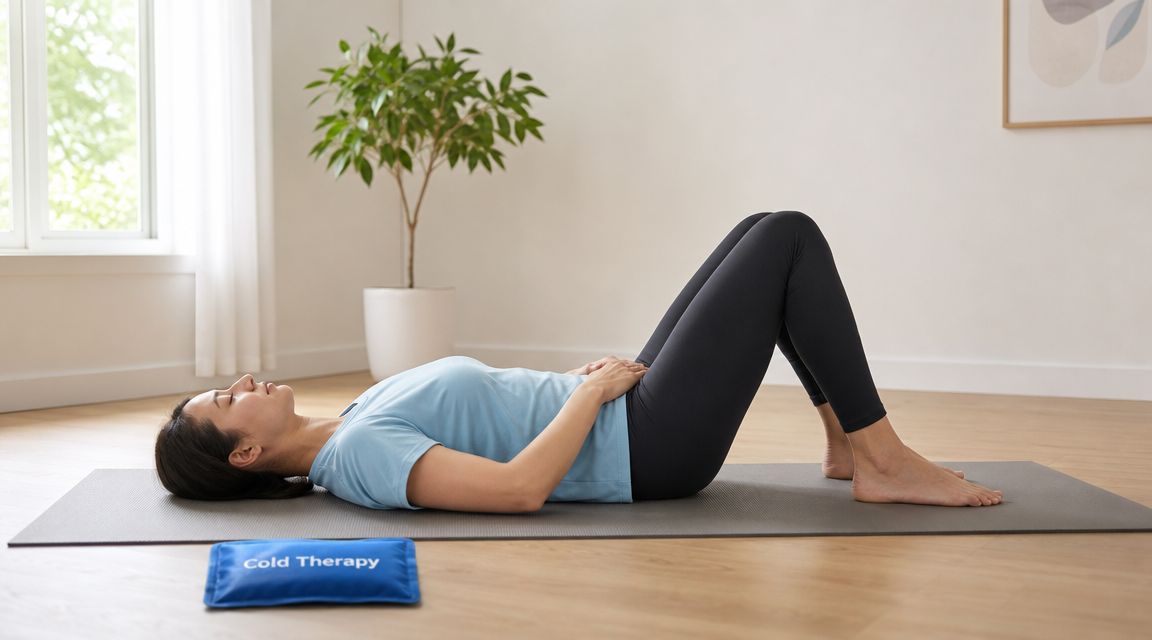
- Use heat or ice based on what feels better. Ice can be useful when the area feels acutely irritated or flared after activity. Heat can help when muscles feel tight and guarded.
- Use over-the-counter medication carefully. If your own physician says these medications are safe for you, many people use nonprescription pain relievers during an acute flare. Follow label instructions and consider your stomach, kidneys, blood pressure, and other medical conditions.
- Change positions often. Even a good position becomes a bad position if you stay there too long.
Positions that usually calm the spine
People often need a simple way to reduce pressure without guessing. These positions tend to be well tolerated:
- On your back with knees bent and pillows supporting the legs.
- On your side with a pillow between the knees if rotation increases pain.
- Reclined sitting with lumbar support for short periods if standing is worse.
- Standing with one foot on a low step if extension-based discomfort builds while upright.
None of these positions are cures. They're tools to settle the system enough for movement to resume.
Don't judge your recovery by whether one stretch “fixes” you. Judge it by whether you can move more normally, walk farther, and do more with less guarding.
What not to do
This part matters just as much as the treatment steps.
- Don't stay in bed all day. Rest can feel protective at first, but prolonged inactivity often leads to more stiffness and fear of movement.
- Don't force aggressive stretching into sharp pain. A painful spine is rarely helped by yanking on irritated tissues.
- Don't keep testing the pain. Repeated bending, twisting, or lifting “just to see if it's still there” often re-irritates the area.
- Don't assume severe pain means severe damage. Pain intensity and tissue damage don't always match.
When home care is reasonable
Home management makes sense when pain is localized, you can still move with some modification, and symptoms are gradually settling. Improvement doesn't have to be dramatic. It just needs to be moving in the right direction.
A practical home plan for the first several days looks like this:
| Focus | Useful approach | Avoid |
|---|---|---|
| Movement | Short walks, gentle position changes | Long bed rest |
| Symptom relief | Heat or ice based on response | Constant passive treatment only |
| Daily tasks | Smaller loads, slower transitions | Heavy lifting or repeated bending |
| Exercise | Gentle mobility if tolerated | Aggressive stretching into pain |
Signs the flare is no longer “just a flare”
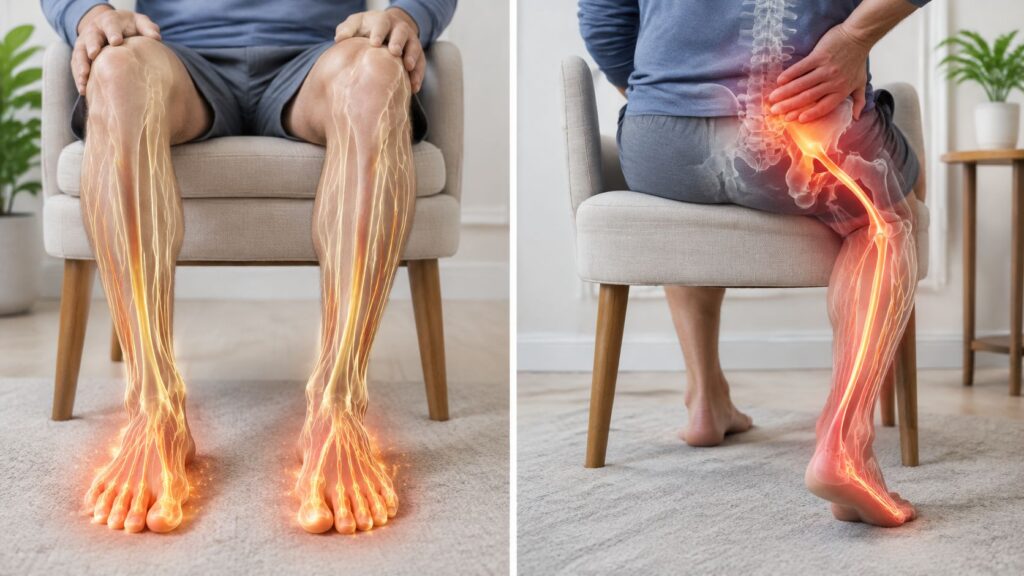
Acute pain deserves re-evaluation when it stops behaving like a simple strain. If pain starts shooting down a leg, numbness appears, or the back locks up so severely that walking and standing are becoming harder rather than easier, it's time to think beyond home care.
That's especially true if you've already tried the basics and keep cycling through the same episode.
Building a Resilient Back with Movement and Ergonomics
Pain relief is only part of the job. A back that feels better for one week but keeps relapsing isn't healed in any durable sense. The stronger strategy is to build a body that tolerates daily life better.
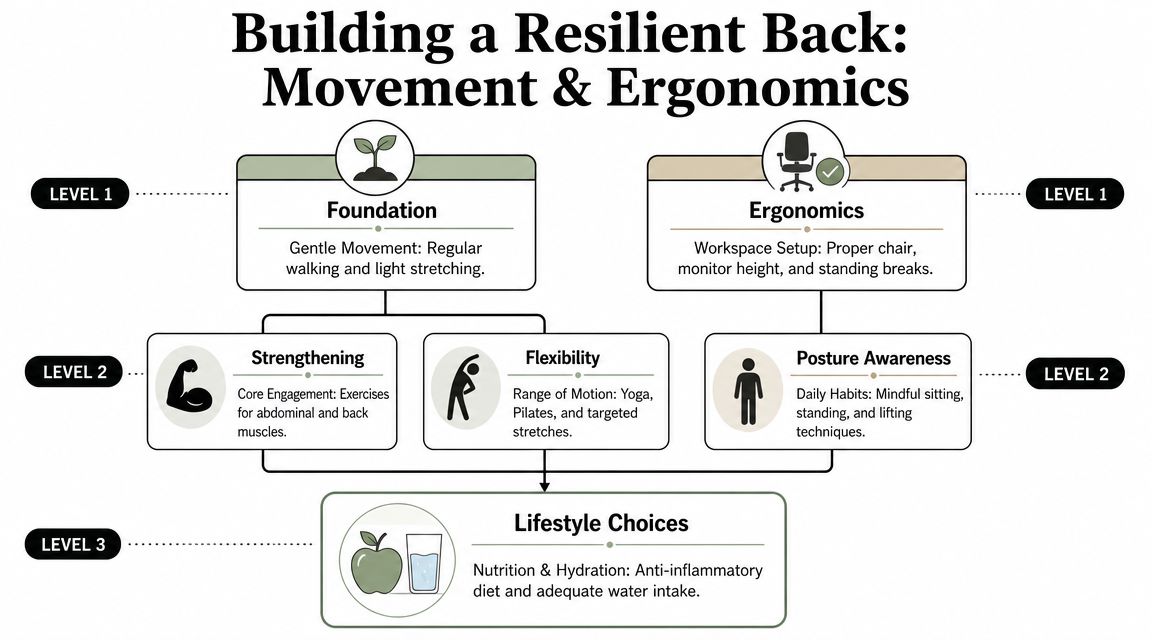
That means movement quality, trunk control, hip mobility, and practical ergonomics. It also means dropping the idea that a generic handout of exercises is enough for everyone.
A systematic review of 58 randomized controlled trials involving more than 10,000 patients found that individualized treatment produced 38% better pain-relief success than standard exercise therapy, and when individualized exercise was combined with cognitive behavioral therapy, success improved 84% above standard treatment, as summarized in this report on individualized exercise and CBT for chronic low back pain.
Why resilience beats repeated flare management
A resilient back isn't built by waiting for pain to disappear before moving. It's built by dosing movement correctly.
If the hips are stiff, the lower back often does too much bending and twisting. If the trunk muscles aren't coordinating well, the spine takes more load with routine tasks like getting out of a car, carrying laundry, or standing at the kitchen counter. If fear of movement grows after a painful episode, activity shrinks, conditioning falls, and ordinary tasks start to feel threatening.
That's why the best noninterventional plans are progressive, not random.
Movements that usually belong in the plan
Many individuals benefit from some combination of these categories, adjusted to tolerance and pain pattern:
- Walking progression: Start with a manageable distance and build consistency before intensity.
- Gentle lumbar mobility: Controlled movements can reduce guarding when done within tolerance.
- Hip mobility work: Tight hips often shift force into the lumbar spine.
- Core engagement: The goal is control, not dramatic abdominal exertion.
- Glute strengthening: Better pelvic support often reduces strain on the low back.
A few practical examples include pelvic tilts, supported bridges, dead bug variations, side-lying clamshells, sit-to-stand drills, and hip flexor stretching. The right mix depends on whether flexion, extension, rotation, standing, or sitting is your main trigger.
Practical rule: If an exercise leaves you briefly worked but not progressively worse later in the day, it may be appropriately dosed. If it predictably flares symptoms every time, it needs to be changed.
Ergonomics that actually matter
People in Oak Lawn, Palos Heights, Burbank, and Worth don't need perfect posture all day. They need fewer repeated stressors.
At a desk
- Support the low back. Use a chair with lumbar support or a small cushion.
- Keep the screen at eye level. Looking down for hours often increases upper and lower spinal strain.
- Break static sitting. Stand up, walk briefly, or reset your position regularly.
- Bring work to you. Don't hunch toward the keyboard or lean into the screen.
In the car
Driving bothers many patients because it combines sitting, vibration, and difficulty changing position.
- Move the seat so you're not overreaching.
- Use a small lumbar roll if it helps.
- Step out and walk briefly during longer drives.
- Pivot your whole body when getting out instead of twisting through the low back.
During lifting
The key isn't just “lift with your legs.” Real-world lifting is messier than that.
- Get close to the object.
- Tighten the trunk before lifting.
- Avoid lifting and twisting at the same time.
- Break a large load into smaller carries when possible.
What usually doesn't work long term
Some people rely entirely on passive strategies for months. Heat, massage, occasional manipulation, and stretches can all have a place, but none should become the whole program if the back remains weak, deconditioned, or movement-avoidant.
What usually works better is a plan with progression. Less symptom chasing. More capacity building.
When to Seek Specialist Evaluation for Your Back Pain
It often starts the same way. A person tweaks the back lifting laundry, sitting through a long commute, or getting out of the car after work. Two weeks later, the pain is still there. They are sleeping poorly, avoiding errands, and wondering whether they should keep waiting or get a higher level of care.
That decision matters. Back pain is common, but a common problem can still become disabling when the source is missed or recovery stalls. The goal at this stage is no longer symptom control alone. The goal is to find out what is driving the pain and to stop the cycle before reduced activity, poor sleep, and fear of movement become part of daily life.
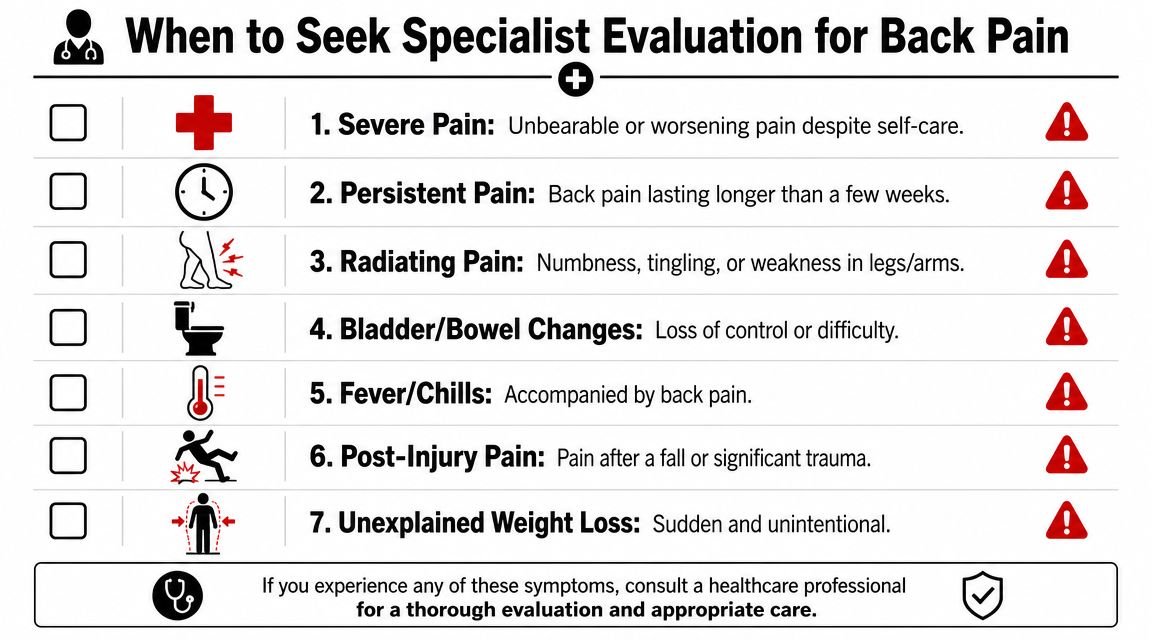
Red flags that need prompt medical attention
Some symptoms warrant urgent evaluation, not several more days of home treatment.
- Bladder or bowel changes: New loss of control or major difficulty can signal serious nerve compression.
- Progressive leg weakness: Trouble lifting the foot, repeated buckling, or worsening weakness needs prompt assessment.
- Fever with back pain: Infection has to be considered.
- Pain after a significant fall or trauma: A fracture or structural injury may be present.
- Unexplained weight loss with persistent back pain: This raises concern for a non-mechanical cause.
Signs that self-care has reached its limit
A specialist visit is also appropriate when the problem is not improving as expected, even if it is not an emergency.
| Pattern | Why it matters |
|---|---|
| Pain lasting beyond a few weeks | The usual recovery window may be passing |
| Pain that wakes you regularly at night | The pain pattern is more irritable and may need a closer workup |
| Pain radiating into the buttock or leg | Disc or nerve involvement becomes more likely |
| Numbness or tingling | Neurological irritation should be assessed |
| Recurrent flares with the same triggers | The underlying driver may not have been identified |
| Walking intolerance or standing intolerance | Spinal stenosis, facet-related pain, or other structural causes become more likely |
What a specialist evaluates differently
A specialist should not stop at “Where does it hurt?” The better questions are functional and diagnostic.
Can you stand long enough to cook dinner? Walk through a grocery store without leaning on the cart? Sit through work, sleep through the night, or get from sitting to standing without bracing? Does bending forward relieve the pain, or does it shoot into the leg? Do coughing, sneezing, or prolonged sitting make it worse?
Those details help separate a simple strain from disc pain, facet pain, sacroiliac pain, vertebral fracture, spinal stenosis, or radiculopathy. They also help determine whether more imaging, a focused exam, or a procedure-based plan is appropriate. For patients who want a clearer sense of the diagnoses typically seen at this stage, the conditions treated in interventional pain care provide a practical overview.
In the Chicago suburbs, I often see patients from Orland Park, Bridgeview, Hickory Hills, and nearby communities who did many of the right things early on. They stayed active, used heat, tried stretching, and gave it time. What they needed next was not more guesswork. They needed a clearer diagnosis and a treatment plan that matched the actual pain generator.
Advanced Diagnostics and Interventional Pain Management
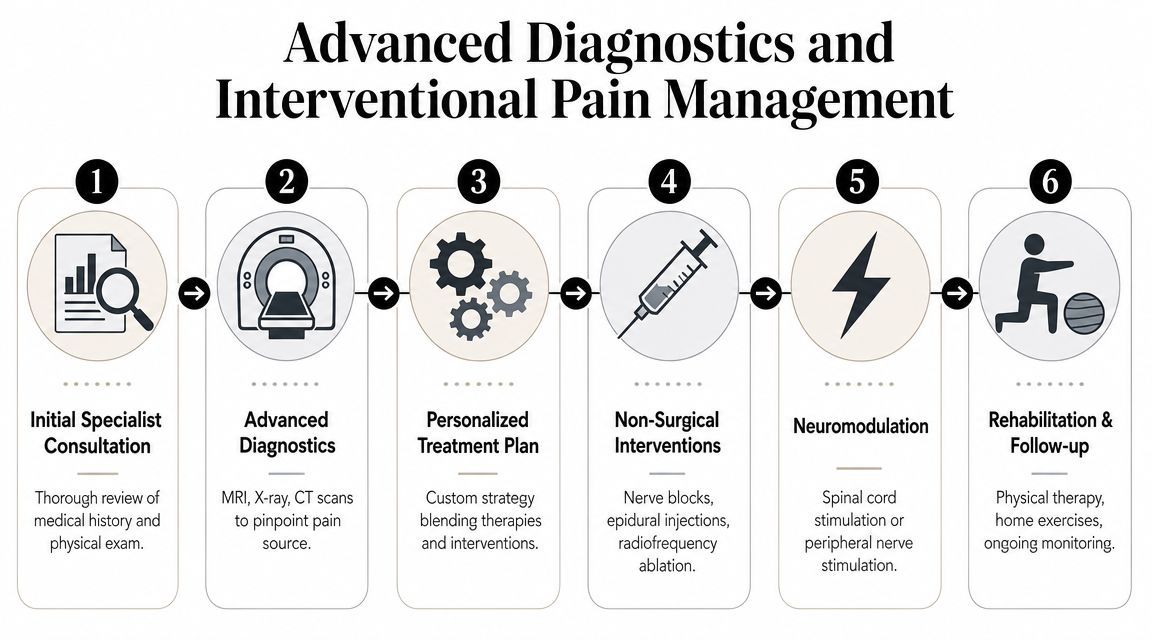
A pain clinic is not the same as a physical therapy office, a chiropractic office, or a primary care visit. The role is different. The focus is to identify the pain generator with more precision and use targeted, opioid-sparing interventions when conservative measures haven't gone far enough.
Modern care has moved beyond medication alone. The International Association for the Study of Pain reports that multidisciplinary rehabilitation for chronic low back pain can be more effective than usual care or physical treatment alone, and it also notes long-term value from approaches like CBT and mindfulness in selected patients, according to the International Association for the Study of Pain fact sheet on the psychology of back pain.
How specialists pinpoint the pain source
The first job is diagnosis. Many back pain complaints sound similar, but the source can be very different.
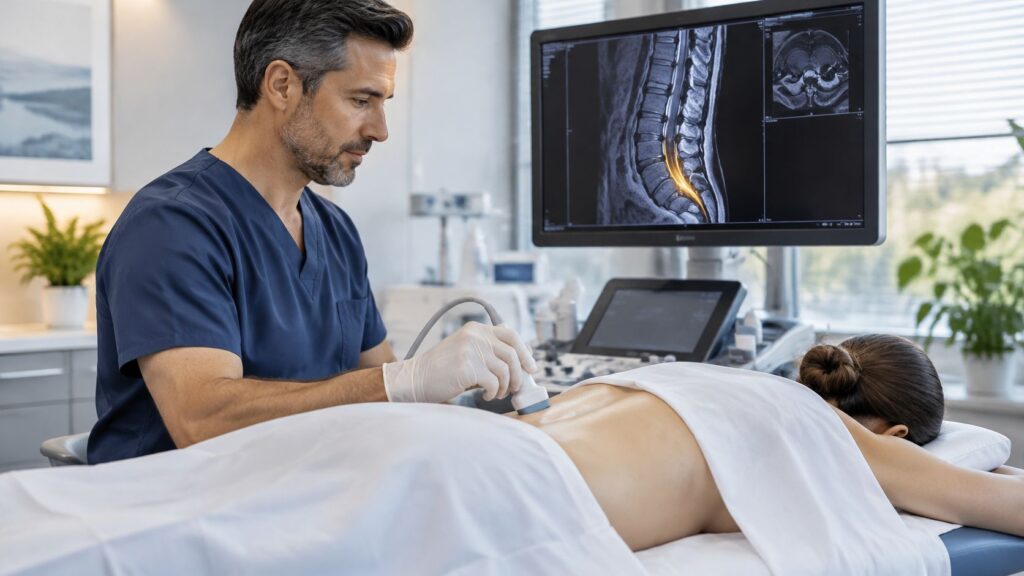
A detailed history and exam often suggest the category. Imaging like MRI, CT, or X-ray may help when symptoms persist, when nerve features are present, or when a structural problem is suspected. In some cases, electromyography can clarify nerve involvement.
Interventional specialists also use diagnostic blocks. These are targeted injections used not only for treatment but to test whether a specific structure is producing the pain. That distinction matters because MRI findings alone don't always match what's hurting.
For example:
- Pain that worsens with extension and rotation may suggest facet-mediated pain.
- Buttock-dominant pain with certain positional triggers may suggest sacroiliac involvement.
- Leg pain following a dermatomal pattern may point toward nerve root irritation.
- Walking that worsens with standing upright but improves when leaning forward can suggest lumbar stenosis.
Where injections fit, and where they don't
Image-guided injections are tools. They are not magic, and they are not all used for the same reason.
Some injections reduce inflammation around an irritated nerve root. Others help confirm whether facet joints or medial branch nerves are responsible. Some are used around the sacroiliac joint. The goal may be short-term pain reduction, diagnostic clarity, or creating a window where the patient can move better and participate in rehabilitation.
That last point is important. A procedure should support function, not replace it.
Comparing Interventional Pain Treatments
| Treatment | Best For | Goal | Approach |
|---|---|---|---|
| Epidural steroid injection | Radiating pain from irritated spinal nerve roots | Reduce inflammation and leg-dominant pain | Image-guided medication placed near the affected nerve pathway |
| Facet joint injection or medial branch block | Suspected facet-mediated back pain | Diagnose and temporarily reduce pain | Image-guided anesthetic, sometimes with anti-inflammatory medication |
| Radiofrequency ablation | Confirmed facet-mediated pain after successful diagnostic blocks | Longer-lasting interruption of pain signaling | Heat lesioning of targeted medial branch nerves |
| Sacroiliac joint injection | Suspected sacroiliac joint pain | Confirm diagnosis and reduce joint-related pain | Image-guided injection into or around the SI joint |
| Spinal cord stimulation | Persistent nerve-related pain that has not responded to simpler measures | Modulate pain signaling and improve function | Implanted neuromodulation system after appropriate evaluation |
| MILD or Vertiflex | Selected patients with lumbar spinal stenosis | Improve walking and standing tolerance by addressing stenosis-related symptoms | Minimally invasive decompression or spacer-based intervention |
Procedures people often hear about
Epidural steroid injections
These are commonly used when pain radiates into the leg and suggests inflammation around a lumbar nerve root. The aim is usually to calm the nerve enough to improve walking, sitting tolerance, sleep, and rehabilitation participation.
Facet blocks and medial branch blocks
These are useful when the pain pattern suggests arthritic or mechanically irritated facet joints. A strong but temporary response can support the diagnosis and guide the next step.
Radiofrequency ablation
When diagnostic medial branch blocks clearly identify facet-mediated pain, radiofrequency ablation can interrupt the pain signal from those nerves for a longer period than a simple injection. It doesn't “fix” arthritis, but it can reduce pain enough for people to move and function more normally.
Spinal cord stimulation
This is generally considered later, not first. It's used for selected patients with persistent nerve-related pain, including some who have pain after spine surgery or chronic radicular symptoms that haven't responded to more conservative strategies.
MILD and Vertiflex
For carefully selected patients with lumbar spinal stenosis, minimally invasive options can help when walking and standing are limited by stenosis-type symptoms. These procedures are not interchangeable with injections. They address a different problem pattern.
The role of coordinated care
Advanced care works best when the procedure matches the diagnosis and the diagnosis matches the patient's function goals. That usually means combining intervention with rehabilitation, home exercise, medication review, and realistic follow-up.
For patients exploring available options, interventional procedures used in treatment include image-guided injections, radiofrequency ablation, neuromodulation, and minimally invasive lumbar interventions.
A successful procedure is not one that merely changes a pain score for a few days. It's one that lets you stand longer, walk farther, sleep better, and return to the activities pain had taken away.
Your Path to Lasting Relief and Lifelong Prevention
Lasting relief doesn't come from one perfect injection, one perfect exercise, or one perfect diagnosis. It comes from matching the treatment to the pain driver, then keeping the gains.
That matters because back pain isn't one condition. The evidence for treatments varies depending on whether pain is acute or chronic and whether the driver appears mechanical, inflammatory, or nerve-related. The National Center for Complementary and Integrative Health notes low- to moderate-quality evidence for several complementary options in chronic low back pain, while support in acute low back pain is weaker or lower quality for some of the same treatments, as described by the National Center for Complementary and Integrative Health low back pain guidance.
The long game is coordinated care
People often improve fastest when care stops being fragmented. A primary care doctor may identify the problem early. A pain specialist may clarify the diagnosis and perform image-guided treatment. A physical therapist may rebuild movement and strength. A surgeon may weigh in if structural correction is needed. Chiropractors, rehab therapists, and other clinicians may also be part of the plan depending on the case.
That team approach matters in the Chicago Ridge area and surrounding Illinois suburbs because patients rarely fit into one neat box. Some have disc pain plus deconditioning. Some have arthritis plus nerve irritation. Some have pain after surgery. Some have workers' compensation or injury-related cases where function and documentation both matter.
Where regenerative medicine can fit
Regenerative options such as PRP are not universal solutions. They may have a role for selected patients, depending on the tissue involved, the diagnosis, and the broader treatment plan. The key is to place them in context.
Used well, regenerative care is part of a strategy. It is not a replacement for a proper exam, good imaging when needed, activity progression, or interventional treatment when the true pain source is spinal and procedural options are more appropriate.
Prevention after the pain improves
The most common mistake after relief is stopping everything that created the improvement. Once pain drops, many people return to the exact routine that led them there.
A better maintenance plan usually includes:
- Continuing movement practice: Keep walking, strengthening, and doing the mobility work that your body responds to.
- Protecting work and driving posture: Don't slide back into long static positions without breaks.
- Using procedures strategically: Injections and other interventions should support rehab and activity, not become isolated repeat events without a broader plan.
- Watching for recurrence patterns: If the same trigger keeps causing the same flare, the trigger or the support system around it still needs attention.
What durable recovery looks like
A durable result is functional. You're sleeping more normally. You can sit through dinner, drive without bracing, walk through a store, get through work, lift more safely, and stop organizing the day around pain.
That's the ultimate endpoint when people ask how to heal back pain. Not zero sensation forever. Not a miracle cure. A back that is understood, treated appropriately, and supported well enough that it no longer dominates daily life.
If your pain has moved beyond self-care, an evaluation should be specific, diagnosis-driven, and built around the next logical step. You can request an appointment with Midwest Pain & Wellness when you're ready for that level of care.
If back pain is limiting your work, sleep, mobility, or independence, Midwest Pain & Wellness provides evaluation and opioid-sparing interventional care in Chicago Ridge for adults across Oak Lawn, Palos Hills, Palos Heights, Worth, Bridgeview, Hickory Hills, Alsip, Burbank, Evergreen Park, Orland Park, and nearby Illinois communities. The focus is straightforward: identify the source of pain, use the right treatment at the right time, and help you return to active living.