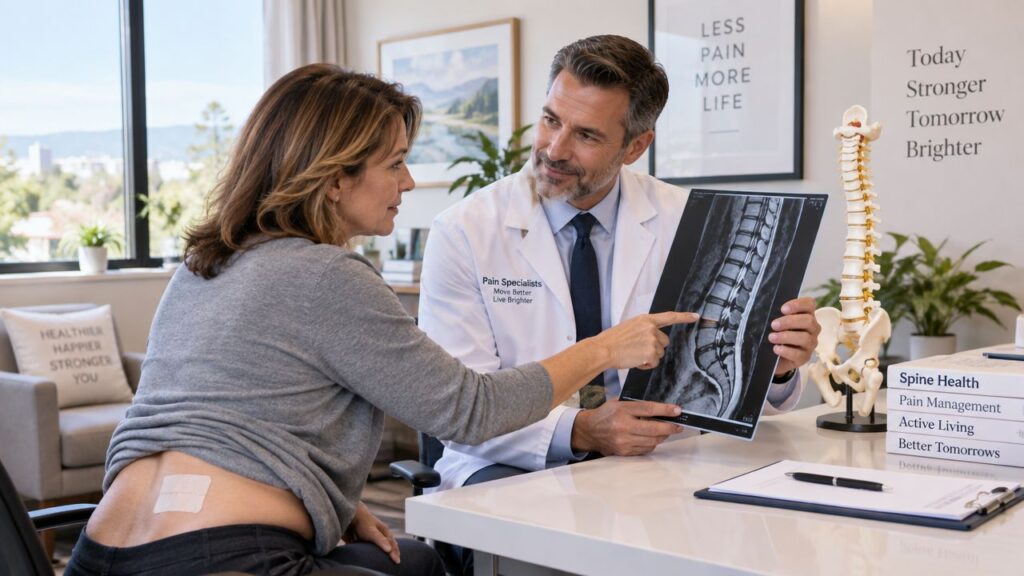
You bend to tie a shoe, lift a laundry basket, or roll over in bed, and your back lets you know immediately. Sometimes it's a sharp catch. Sometimes it's a deep ache that makes sitting, standing, and sleeping feel equally frustrating. Sometimes it's been there so long that you've started planning your day around it.
If that's where you are, you're not alone, and you're not stuck with guessing. Back pain is common enough that the CDC reported 39.0% of U.S. adults had back pain in the past 3 months in 2019, and the same source notes low back pain affected 619 million people globally in 2020, with a projection of 843 million by 2050 according to the WHO summary cited there (CDC back pain data brief). Those numbers matter because they explain why there isn't a single magic fix. There has to be a practical pathway.
The right question usually isn't just “how to get back pain relief.” It's “what should I try first, what should I avoid, and when is it time to get a diagnosis?” Good care starts with the least invasive options that improve function, then moves toward targeted treatment when the pain pattern, exam, and imaging point in a specific direction.
For people in Chicago Ridge and nearby Illinois communities like Oak Lawn, Palos Hills, Palos Heights, Worth, Bridgeview, Hickory Hills, Alsip, Burbank, Evergreen Park, and Orland Park, that stepwise approach matters. You want relief, but you also want to avoid temporary fixes that delay the right treatment.
The Unrelenting Grip of Back Pain
Back pain has a way of shrinking life. It turns a grocery trip into a chore. It makes commuting miserable. It interrupts sleep, then makes the next day harder because you're already tired and guarded before you even start moving.
What patients often tell me is not just “my back hurts.” It's “I can't sit through work,” “I'm afraid to pick up my grandchild,” or “I don't feel like myself anymore.” That distinction matters. Pain relief isn't only about reducing discomfort. It's about getting your function back.
Why random treatment often fails
A lot of people try whatever seems reasonable first. Rest. Heat. Stretching from a video. A new mattress. A brace. Sometimes that helps. Sometimes it doesn't, because back pain isn't one condition. A muscle strain, irritated facet joint, compressed nerve, spinal stenosis, vertebral compression fracture, and vertebrogenic pain don't behave the same way, and they shouldn't be treated the same way.
That's why a structured plan works better than trial and error. Start with measures that calm pain and let you move. Add active recovery early. Escalate when the pattern suggests you need more than self-care.
Relief is usually fastest when the treatment matches the pain generator, not when you keep repeating a remedy that only partly helps.
What a good plan aims to do
A useful back pain plan should do three things:
- Reduce pain enough to let you function so you can sleep, walk, work, and move with less guarding.
- Identify what's driving the pain so you don't waste weeks treating the wrong problem.
- Avoid unnecessary opioid use when safer, evidence-based options can help.
That last point is important. In pain medicine, the goal isn't to hand out stronger medication because the pain has lasted longer. The goal is to understand the source, restore activity, and use treatments that improve daily life.
Immediate Relief Strategies You Can Use Today
When your back flares, you need something practical. Not a long-term theory. Not a vague promise. You need a few steps that can lower irritation and make the next several hours more manageable.
Calm the flare instead of fighting your body
If the pain is new after an awkward lift, twist, or strain, the first goal is to settle things down without becoming completely inactive.
Try this:
- Use ice early for a fresh flare if the area feels hot, inflamed, or newly aggravated. A wrapped cold pack for short sessions can help calm irritation.
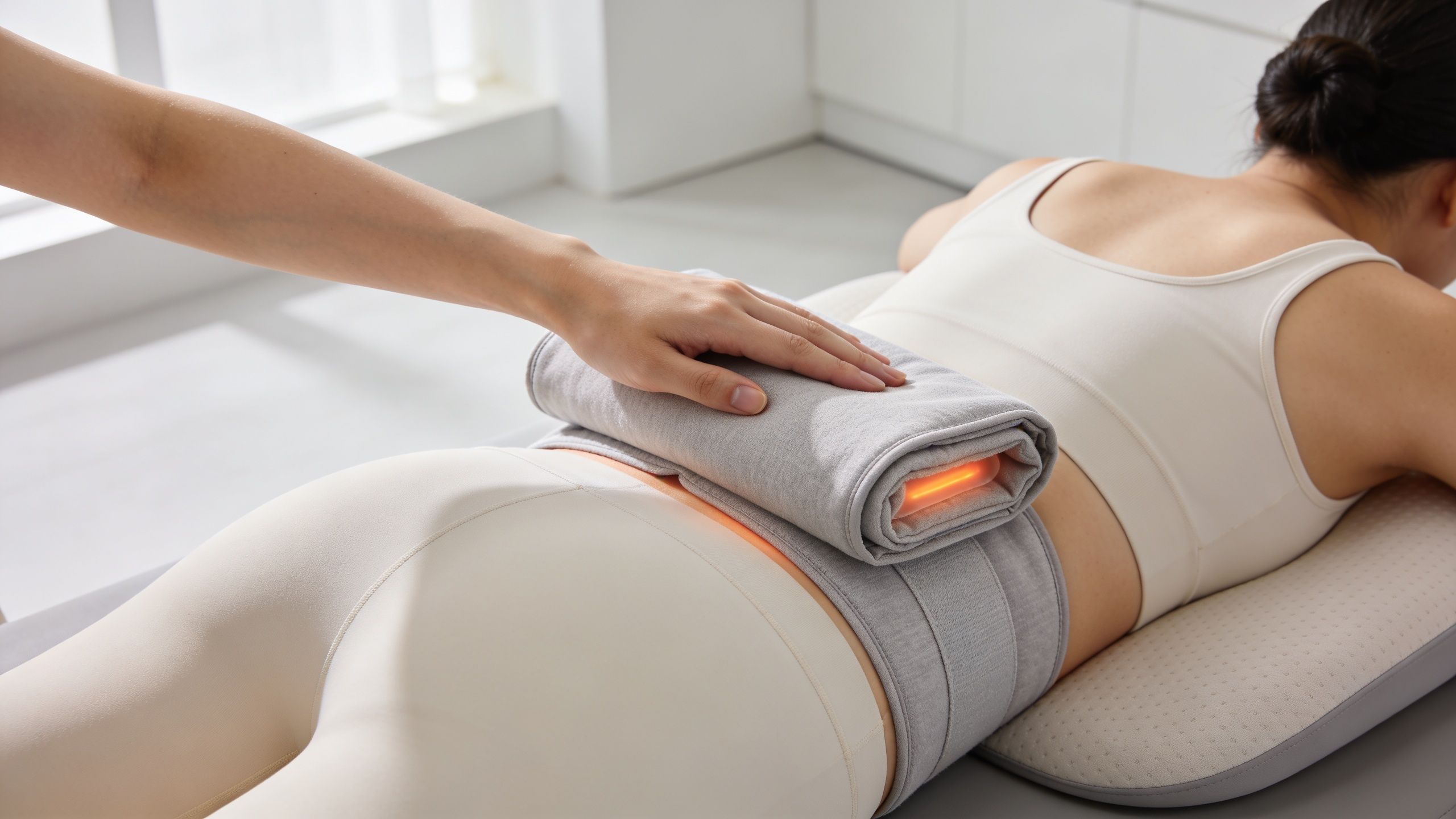
- Use heat for stiffness and muscle spasm when the problem feels tight, locked up, or worse after sitting. Heat often helps muscles relax and makes movement easier.
- Change positions often instead of staying in one posture for too long. Long periods of sitting, slouching, or bed rest usually make the back more sensitive.
If one option clearly makes you worse, stop doing it. That sounds obvious, but many people keep forcing a stretch or staying on a heating pad too long because they assume more treatment must be better.
Find a position that unloads the back
Positioning can make a meaningful difference, especially in the first day or two of a flare.
A few options that often help:
- On your back with pillows under your knees. This can reduce tension through the low back.
- On your side with a pillow between your knees. This can keep the pelvis and spine in a more comfortable position.
- In a reclined position rather than bolt upright sitting if upright sitting sharply increases symptoms.
Use over-the-counter medication carefully
Many people use an anti-inflammatory or pain reliever for short-term symptom control. That can be reasonable, but it needs common-sense caution. Follow the label. Don't combine medications casually. If you have kidney disease, stomach ulcers, are on blood thinners, have uncontrolled high blood pressure, or have been told to avoid NSAIDs, check with your physician before taking them.
A practical rule is to think of these medications as short-term support, not the whole plan. If a pill helps you walk, sleep, and do gentle activity, that's useful. If you're taking more and more while function keeps dropping, it's time to get evaluated.
Practical rule: If your treatment only helps while you're perfectly still, it isn't solving much. The real target is comfortable movement.
Gentle movement beats complete shutdown
One of the biggest mistakes I see is full stop bed rest for ordinary low back pain. Rest for a brief period may feel good, but too much of it can leave the back stiffer, weaker, and more sensitive.
Here's a better same-day approach:
- Take short walks around the house or outside if walking doesn't sharply worsen symptoms.
- Do small, easy movements such as standing up, sitting down carefully, and changing positions every so often.
- Avoid heavy lifting, repetitive bending, and twisting until the flare settles.
What not to do in a fresh flare
A short “don't” list is just as important as the treatment list.
| Situation | Usually helpful | Usually unhelpful |
|---|---|---|
| New low back strain | Brief relative rest, ice or heat, light walking | All-day bed rest |
| Muscle tightness after sitting | Heat, posture changes, gentle movement | Aggressive stretching into pain |
| Pain after overdoing it | Temporary activity modification | Trying to “push through” sharp pain |
Relief now vs relief later
Some home measures are meant to reduce symptoms quickly. That's valuable. But they don't always address the source of recurring pain. Heat, position changes, massage tools, and a temporary pause in activity may help you get through the day. They don't automatically fix a disc problem, inflamed facet joints, spinal stenosis, or nerve irritation.
That's why how to get back pain relief starts with immediate measures, but it can't end there if the same pain keeps coming back.
Building a Foundation with Smart Movement and Ergonomics
Once the flare is under control enough that you can move, the most important shift is from passive relief to active recovery. At this point, many people either improve steadily or stay stuck in a cycle of “better for a day, worse for a week.”
Movement matters because the back generally responds better to graded use than to fear, bracing, and prolonged inactivity. A large systematic review found structured exercise therapy improved pain by 10.2 points on a 0 to 100 scale compared with no treatment, and the review favored early active participation and graded movement over prolonged inactivity (systematic review on exercise therapy for low back pain).

Start with controlled, non-threatening motion
You don't need an intense workout. You need motions your back can tolerate, repeated consistently.
A few useful examples:
Pelvic tilts
Lie on your back with knees bent. Gently flatten and release your low back against the surface. This can reduce guarding and help you reconnect movement with less fear.Cat-cow style spinal motion
On hands and knees, move slowly between a rounded and gently extended position. Keep it comfortable. This is about mobility, not forcing range.Gentle hamstring stretching
Tight hamstrings can add tension to the pelvis and low back in some people. Use a light stretch, not an aggressive pull.Short walking sessions
Walking is simple, repeatable, and often better tolerated than people expect.
If a movement causes sharp, radiating, or escalating pain, stop. Good exercise for back recovery should feel manageable, not punishing.
Use the traffic-light rule
A simple way to judge movement:
- Green light means the motion feels okay during and after.
- Yellow light means mild soreness that settles quickly and doesn't reduce function.
- Red light means increasing pain, leg symptoms, or a pain flare that lingers.
That framework keeps people from doing too little because they're afraid, and too much because they think recovery should hurt.
The best exercise for back pain is usually the one you can do consistently, with good control, without setting off a bigger flare.
Fix the postures that keep feeding the problem
A lot of back pain isn't caused by one dramatic injury. It's aggravated by repeated low-grade stress. Hours at a desk. Long drives. Poor lifting habits. Slouching into a laptop. Looking down at a phone with the rest of the body collapsing around it.
Use this ergonomic checklist:
- Monitor at eye level so you're not bending your neck and upper back forward all day.
- Chair support at the low back to reduce prolonged slumping.
- Feet flat on the floor or on a stable footrest.
- Keyboard and mouse close enough that your shoulders stay relaxed.
- Frequent posture resets instead of trying to sit “perfectly” for hours.
No single posture is perfect forever. The body usually tolerates a variety of positions better than one fixed position held too long.
Protect your back during everyday tasks
Good body mechanics don't need to look robotic. They need to reduce repeated strain.
For lifting groceries, laundry, or a child:
- Get close to the object instead of reaching far in front.
- Use your hips and knees rather than rounding and yanking with your back.
- Avoid twisting while lifting. Turn your whole body.
- Break up the load when possible.
For getting out of bed during a flare, roll to your side first, then use your arms to help push up. That often feels much better than trying to jackknife straight up.
Build resilience, not just flexibility
Many people assume they need to “stretch out” all back pain. Sometimes stiffness is part of the problem. Sometimes weakness, poor control, or fear of movement is the bigger issue. That's why lasting improvement often comes from a mix of mobility, gentle strengthening, and better movement habits.
A balanced foundation usually includes:
| Focus area | Why it helps |
|---|---|
| Mobility | Reduces stiffness and helps normal motion return |
| Core and hip control | Reduces overload on irritated spinal structures |
| Walking and general activity | Improves tolerance for daily life |
| Ergonomics and lifting habits | Keeps you from re-aggravating the problem |
If you want to know how to get back pain relief that lasts longer than a few hours, the durable part begins here.
Knowing When to Escalate Your Care
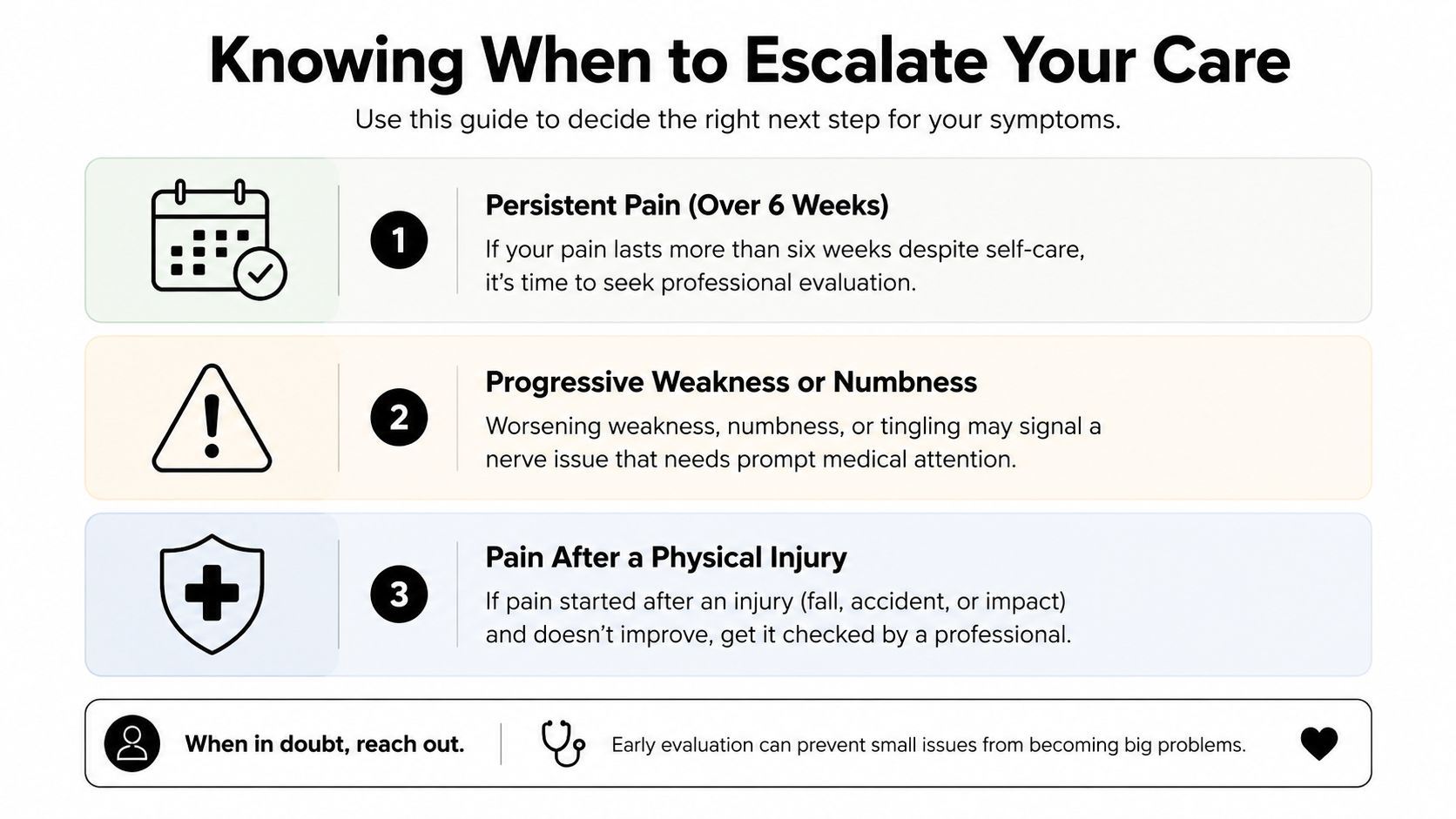
Self-care is appropriate for many back pain episodes, but there's a point where continuing to guess becomes unproductive. The key reason is simple. Back pain relief is not one-size-fits-all, and different conditions need different strategies. The National Center for Complementary and Integrative Health notes that acute and chronic low back pain can respond to different approaches, and that problems such as nerve compression, stenosis, or post-surgical pain may need different interventions than a simple strain (NCCIH guidance on low back pain and complementary approaches).
Red flags that need prompt medical attention
Some symptoms shouldn't be watched at home.
Seek urgent evaluation if back pain comes with:
- Loss of bladder or bowel control
- Progressive leg weakness
- Fever or signs of infection
- Major trauma
- Numbness in the saddle area
- A history that raises concern for fracture, infection, or cancer
Those situations call for immediate medical judgment, not internet advice.
Signs it's time to see a pain specialist
Not every problem is an emergency, but many deserve a proper diagnosis rather than more self-treatment.
A specialist evaluation makes sense when:
- Pain keeps returning despite sensible home care
- Pain radiates down the leg, especially with numbness or tingling
- Standing or walking becomes limited, which can suggest stenosis or another structural issue
- Daily activities are shrinking because of pain
- You've had surgery and still hurt
- The pain followed a clear injury and hasn't settled as expected
Why diagnosis changes treatment
A back muscle flare and a compressed nerve may both be called “back pain,” but they don't usually respond the same way. The same is true for facet joint pain, sacroiliac joint pain, vertebrogenic pain, and vertebral compression fracture. If the diagnosis is wrong, the treatment often looks active while accomplishing very little.
If your back pain has become a pattern instead of an isolated event, don't keep treating it like a minor strain.
Your Diagnostic Pathway with a Pain Specialist
A pain clinic visit shouldn't feel mysterious. Good evaluation is methodical. The point is to identify the most likely pain generator, rule out what doesn't fit, and build a treatment plan that starts with the least invasive useful option.
What happens at the first visit
The first step is a careful history. When did the pain start? Where do you feel it? Does it stay in the back or travel into the buttock, thigh, or foot? Is it worse with sitting, bending, standing, walking, coughing, or extension? Did it begin after a work injury, car accident, surgery, or no clear event at all?
Then comes the physical exam. That may include checking motion, strength, reflexes, sensory changes, tenderness patterns, gait, and which movements reproduce your pain. Those details help separate likely causes. Disc-related pain often behaves differently from facet pain. Radicular symptoms don't sound like pure muscular tightness. Stenosis tends to create a different pattern than vertebrogenic pain.
When imaging helps and when it doesn't
Imaging has a role, but it's not the first answer for every sore back. X-rays may help in some situations. MRI is more useful when symptoms suggest nerve compression, structural pathology, persistent pain, post-surgical problems, or planning for targeted intervention.
The important point is that imaging should support the clinical picture, not replace it. Many people have findings on scans that don't fully explain their symptoms. A pain specialist uses the history, exam, and imaging together.
Why the plan should be opioid-sparing
Modern back pain care puts strong emphasis on opioid-sparing treatment because long-term opioid use has limited value for chronic back pain. One source cited by the American Chiropractic Association notes that patients who started with conservative care such as chiropractic services had a 55% lower likelihood of later being prescribed an opioid (ACA key facts on opioid-sparing back pain care).
That doesn't mean every patient follows the same path. It means the plan should focus on restoring function with treatments matched to the problem. That may include activity modification, targeted therapy, image-guided injections, nerve procedures, or minimally invasive options when simpler steps haven't been enough.
What personalization actually looks like
At a clinic visit, personalization doesn't mean “everyone gets a little of everything.” It means the treatment plan changes based on the pattern.
For example:
- Mechanical low back pain without red flags may start with guided rehab, home exercise, and selective medication support.
- Sciatica or nerve-related pain may point toward imaging review and possible epidural treatment if symptoms persist.
- Pain after prior surgery may require a very different workup than first-time low back pain.
- Older adults with suspected compression fracture need a distinct pathway from someone with a gym strain.
If you'd like to learn more about the physician leading that type of evaluation, you can review Dr. Donkoh's background and approach.
Advanced Opioid-Sparing Interventions for Lasting Relief
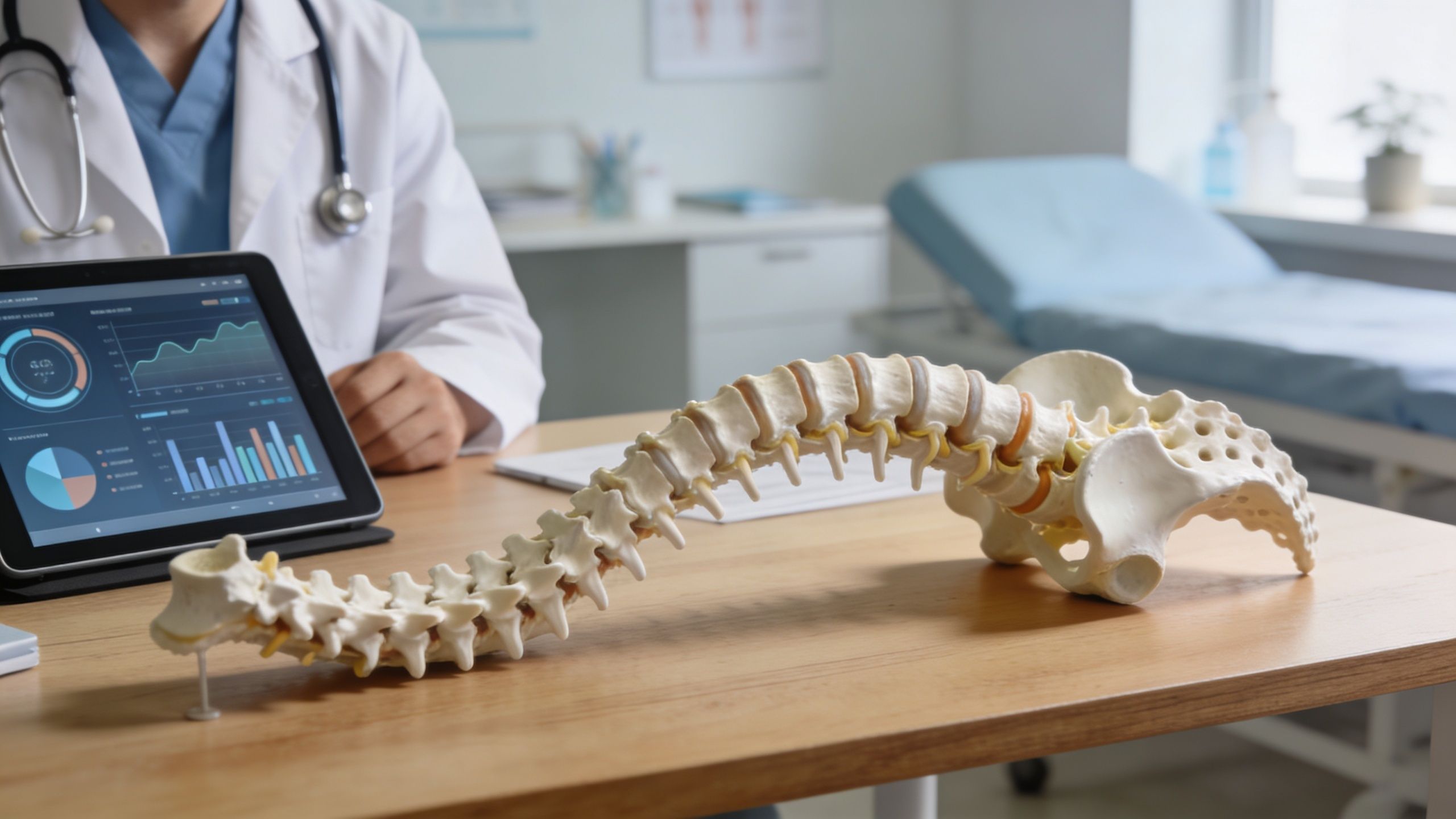
When home care and basic conservative measures don't get you where you need to be, the next step is not automatically surgery and it shouldn't automatically be opioids. Interventional pain medicine offers targeted procedures that can reduce pain, improve function, and help people move forward when the diagnosis is clear.
Procedures that target inflammation and nerve irritation
For some patients, the problem is inflammation around a nerve root or pain coming from joints in the spine.
Common options include:
Epidural steroid injections
These are often used when pain radiates down the leg, especially when disc irritation or nerve inflammation is part of the picture. The aim is to reduce inflammation around the affected nerve and make movement, sleep, and rehabilitation easier.Medial branch blocks
These diagnostic injections help determine whether facet joints are the source of pain. They're especially useful when the pain pattern fits facet-mediated back pain.Radiofrequency ablation
If diagnostic blocks strongly suggest facet-mediated pain, radiofrequency ablation can interrupt pain signals from the involved nerves for longer-lasting relief than a temporary numbing injection.
These procedures are targeted. They work best when the symptom pattern and exam point toward the structure being treated.
Procedures that create space or restore stability
Some back pain comes from compression, collapse, or narrowing rather than generalized soreness.
Examples include:
| Procedure | Best suited for | Main goal |
|---|---|---|
| MILD | Lumbar spinal stenosis in selected patients | Reduce crowding around the nerves |
| Vertiflex Superion | Certain cases of lumbar stenosis | Help maintain space and reduce leg-heavy symptoms |
| Kyphoplasty | Vertebral compression fracture | Stabilize the fracture and reduce pain |
These are not “one-size-fits-all” solutions. The anatomy and diagnosis have to fit.
Vertebrogenic pain and the Intracept procedure
A category that many patients haven't heard of is vertebrogenic pain, which can come from changes around the vertebral endplates. For properly selected patients, basivertebral nerve ablation with the Intracept procedure can be a meaningful option. Clinical summaries report 64 to 69% of properly selected patients achieve at least 50% pain relief at 12 months (Intracept outcome summary for vertebrogenic low back pain).
That result does not mean the procedure is right for every person with low back pain. It means that when the pattern is vertebrogenic and the imaging supports it, a diagnosis-specific treatment can be much more useful than repeating generic care that never fully matches the source.
Neuromodulation for chronic or persistent pain
For more complex cases, especially chronic nerve pain or pain that persists after prior spine treatment, neuromodulation may be considered.
That can include:
- Spinal cord stimulation, which changes how pain signals are processed
- Peripheral nerve stimulation, which targets more localized nerve-related pain
These options are usually considered after careful evaluation and after simpler measures have either failed or provided only partial relief. The purpose isn't to mask pain blindly. It's to improve function when the pain system remains persistently active despite appropriate prior treatment.
Regenerative and supportive options
Some clinics also use regenerative approaches such as PRP in selected musculoskeletal cases. The value of these treatments depends heavily on diagnosis, tissue involved, and realistic expectations. They're not interchangeable with procedures designed for stenosis, nerve compression, or vertebral pain.
Supportive care may also include targeted therapy, bracing in specific situations, and coordinated treatment with surgeons, primary care physicians, chiropractors, or rehab providers when that combination makes sense.
One local option for these kinds of interventional services is the range of procedures used for treatment at Midwest Pain & Wellness.
What works vs what often disappoints
Patients deserve honesty here. Some things help but only briefly. Some help the right patient a great deal. Some are popular but poorly matched to the underlying problem.
What tends to work better:
- A clear diagnosis
- Image-guided treatment when precision matters
- Combining intervention with activity restoration
- Avoiding repeated passive care that never changes function
What often disappoints:
- Treating every back pain episode like a muscle strain
- Repeating injections without rethinking the diagnosis
- Chasing temporary pain suppression while mobility keeps declining
- Using stronger and stronger medication instead of refining the plan
Durable relief usually comes from matching the treatment to the structure involved, then using that relief to rebuild movement and function.
Your Partner for Pain Relief in the Chicago Area
If you've been trying to figure out how to get back pain relief, the most important takeaway is this. You don't need to choose between suffering at home and jumping straight to major surgery. There's a middle path, and for many patients, that's where real progress happens.
Start with sensible self-care. Add smart movement early. Pay attention to warning signs. If the pain persists, radiates, returns repeatedly, or limits your life, get it evaluated properly. A muscle flare, sciatica, stenosis, vertebrogenic pain, and post-surgical pain may all feel like “back pain,” but they don't call for the same treatment.
For adults in Oak Lawn, Palos Hills, Palos Heights, Worth, Bridgeview, Hickory Hills, Alsip, Burbank, Evergreen Park, Orland Park, and nearby Illinois communities around Chicago Ridge, specialized pain care is close to home. If you're ready for a personalized, opioid-sparing plan, you can request an appointment with Dr. Donkoh and the clinic team.
Back pain can wear you down, but it doesn't have to control your routine, your work, or your sleep. Midwest Pain & Wellness provides evaluation and treatment for patients who need more than basic home remedies, with a focus on diagnosis-driven, opioid-sparing care that helps restore function.