A lot of people start in the same place. You wake up in Orland Park, head to work in Oak Lawn, or try to get through a normal afternoon in Evergreen Park, and a headache takes over your whole day. It may be pounding. It may come with nausea. You may need a dark room. Or it may not look dramatic at all, which can make it even more confusing.
That uncertainty is often the hardest part. People ask, “Is this just stress? Sinus pressure? A bad headache? Or is this a migraine?” If you're trying to figure out how to identify a migraine, the most important thing to know is that migraine isn't defined by one symptom and it isn't confirmed by a single blood test or scan. It is identified by a pattern.
Is It More Than Just a Bad Headache
Migraine is often misunderstood because the word gets used casually. In medical practice, though, migraine is a neurologic condition with a recognizable symptom pattern, not just a severe headache. That distinction matters because treatment decisions depend on getting the pattern right.
According to Mayo Clinic's migraine overview, migraine is a clinical diagnosis, which means there is no lab test or imaging study that can confirm it. Doctors identify it by listening closely to the story of your attacks. They look at the pain itself, but also the symptoms around it, such as light sensitivity, sound sensitivity, nausea, visual changes, and how much the episode disrupts your ability to function. The same source notes that headache disorders affect about 40% of the global population, with migraine among the most disabling forms.
Why the pattern matters more than the scan
This surprises many patients. People often assume that a “real” migraine should show up on an MRI or blood panel. In most cases, that isn't how diagnosis works. Imaging is useful when something else is suspected. It is not the routine tool that proves a migraine is present.
That's why the history is so important. A clinician wants to know:
- When the headaches started
- How long each attack lasts
- Whether the pain throbs, pulses, or presses
- If light, noise, motion, or smells make it worse
- Whether nausea, vomiting, or visual changes happen with it
- How much it limits work, driving, parenting, or sleep
A migraine diagnosis usually becomes clearer when repeated attacks follow the same general script, even if every episode isn't identical.
Why this feels so frustrating for patients
A lot of people in Palos Hills, Bridgeview, Hickory Hills, and nearby Illinois communities spend months second-guessing themselves because their symptoms don't seem “official” enough. They may still get to work. They may not vomit. They may not have aura. That doesn't rule migraine out.
The better question is not “Is this the worst headache anyone could have?” The better question is “Does this keep happening in a recognizable pattern that fits migraine more than another kind of headache?”
If you've been living with recurring headaches and need a clearer path forward, it helps to understand the full range of conditions treated in interventional pain care, especially when headaches overlap with neck pain, nerve irritation, or chronic pain conditions.
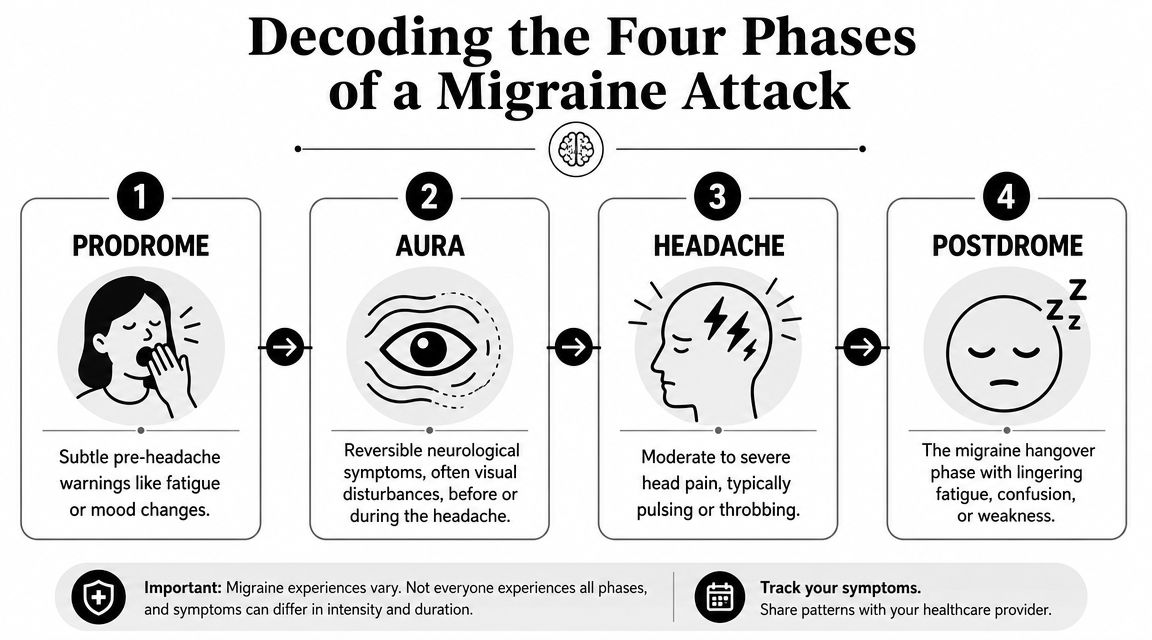
Decoding the Four Phases of a Migraine Attack
A migraine attack often has more than one stage. Some people experience all of them. Others only notice one or two. Knowing the phases helps you recognize migraine earlier, especially if the head pain itself is only part of what you're experiencing.
Migraine is also common enough that family pattern matters. A major review reports that migraine affected 1.1 billion people globally in 2019, is more common in females across all age groups, and that prevalence rose by 1.7% from 1990 to 2019. Practical estimates from the same evidence base note migraine affects about 1 in 5 women, 1 in 16 men, and 1 in 11 children, with attacks occurring three times more often in women than men. Cleveland Clinic also notes that up to 80% of people with migraine have a first-degree biological relative with the condition, which is why family history matters so much during diagnosis, as summarized in this epidemiology review on migraine prevalence and risk patterns.
Prodrome
This is the warning phase. It can start well before the pain becomes obvious. People often describe a vague sense that something is off.
You might notice fatigue, neck tightness, irritability, unusual food cravings, frequent yawning, or trouble concentrating. On their own, these signs don't prove anything. But when they happen repeatedly before a headache attack, they become useful clues.
Many patients miss this phase because it doesn't feel dramatic. Still, it often explains why migraine seems to “come out of nowhere” when in fact the body started signaling earlier.
Aura
Aura is the phase people hear about most, but it doesn't happen in every migraine. When it does happen, it usually involves temporary neurologic symptoms.
Common examples include visual changes such as flashing lights, blind spots, zigzag lines, or shimmering areas in your vision. Some people get tingling, numbness, or brief speech difficulty. Aura can happen before the pain starts or during the attack itself.
Clinical clue: If a symptom is reversible, keeps recurring in a similar way, and fits the timing of a headache attack, it may point toward migraine aura rather than a separate eye or brain problem. New or alarming neurologic symptoms still need prompt medical evaluation.
The headache phase
This is the part often recognized. The pain is often moderate to severe. It may throb or pulse. It may worsen with routine activity, including walking, climbing stairs, bending, or trying to push through the workday.
A classic migraine attack often includes several of these features:
- Pain quality that feels pulsing, pounding, or throbbing
- One-sided pain, although some attacks occur on both sides
- Nausea or vomiting during the episode
- Disabling intensity that reduces normal function
- Sensitivity to light and sound
Not every person experiences every feature every time. That's normal. What matters is the recurring pattern.
Postdrome
After the pain fades, many people don't feel immediately normal. They feel wrung out. Some describe it as a “migraine hangover.”
You may feel mentally foggy, tired, weak, or unusually sensitive to movement. This phase is easy to dismiss, but it can be one of the clearest signs that the event was more than a simple tension headache.
What risk patterns can tell you
If you're a woman in adolescence or adulthood, if close relatives have migraine, or if your attacks follow a repeated symptom pattern, suspicion rises. That doesn't mean everyone in Worth, Alsip, Burbank, or Palos Heights with a bad headache has migraine. It means certain patterns make migraine more likely and worth evaluating carefully.
One of the biggest practical mistakes is focusing only on the pain location. Migraine is often a full-body neurologic event with early warning signs, sensory symptoms, a headache phase, and a drained recovery period. When patients start tracking all four phases, the diagnosis often becomes much easier to see.
Is It a Migraine Tension or Cluster Headache
The most common source of confusion isn't whether the pain is real. It's which kind of headache it is. Migraine, tension headache, and cluster headache can all cause major distress, but they don't usually behave the same way.
A migraine also doesn't have to look “textbook.” According to MedlinePlus guidance on migraine symptoms and diagnosis, migraine is diagnosed from the collection of symptoms, not from one single hallmark. Attacks can last hours to days, may occur on one or both sides, and can include nausea and sensitivity to light or sound. That's why a headache can still be a migraine even if there is no aura or the pain isn't always one-sided.
Headache type comparison
| Feature | Migraine | Tension Headache | Cluster Headache |
|---|---|---|---|
| Pain quality | Often throbbing or pulsating | Usually pressure or tightness | Often piercing, sharp, or intensely drilling |
| Location | One side is common, but can be both sides | Often across the forehead, scalp, or back of head | Usually around or behind one eye |
| Severity | Moderate to severe | Mild to moderate | Very severe |
| Associated symptoms | Nausea, light sensitivity, sound sensitivity, sometimes aura | Usually fewer associated symptoms | Often eye watering, nasal symptoms, agitation |
| Activity effect | Routine activity may worsen it | Activity may be tolerated | Pain is often so intense that stillness is difficult |
| Duration pattern | Hours to days | Variable, often more steady and dull | Comes in attacks, often with a striking pattern |
How migraine usually feels
Migraine pain often has a rhythm to it. Patients describe it as pounding, pulsing, or beating with their heartbeat. Light feels harsher. Sound feels amplified. Normal movement becomes irritating. Some people can function through the early part of it, but many reach a point where work, errands, conversation, or driving become difficult.
Migraine can also shift. One attack may sit behind one eye. Another may spread across the forehead. Another may include more nausea than pain. That variability is one reason self-diagnosis is hard.
How tension headache usually feels
Tension headache tends to feel more like pressure than pounding. People often describe a tight band around the head, forehead pressure, or soreness in the scalp, temples, jaw, or neck.
It is often less dramatic than migraine, but it can still be exhausting. The difference is that it usually doesn't bring the same combination of nausea, sensory sensitivity, and functional shutdown that migraine does.
If the pain feels like squeezing or tightening and the surrounding migraine features are absent, tension headache moves higher on the list.
How cluster headache usually feels
Cluster headache is different enough that patients often know something is very wrong, even if they don't know the name. The pain is typically severe, focused around one eye, and hard to ignore. People may pace, rock, or feel unable to sit still. The eye may water. The nose may run or feel congested on the same side.
That pattern is distinct from the more common migraine picture, even though the two can occasionally be confused at first.
What does not rule out migraine
A lot of people exclude migraine too early. These features do not automatically rule it out:
- No aura
- Pain on both sides
- Pain that isn't the worst you've ever felt
- An attack that starts in the neck or temple
- Episodes that change somewhat from one month to the next
The key is whether the attacks repeat in a migraine-like cluster of symptoms. When nausea, sensory sensitivity, reduced function, and a recurring headache pattern travel together, migraine remains a strong possibility.
Your Headache Diary The Most Powerful Diagnostic Tool
If you want to know how to identify a migraine more accurately, start keeping a headache diary. Nothing you do at home is more useful for a clinician than a clear record of what happens before, during, and after each attack.
That record does two important things. First, it shows patterns you might miss in memory. Second, it saves time at the visit because the discussion becomes specific instead of vague.

What to write down every time
You don't need a perfect spreadsheet. A notebook, phone note, calendar, or app can work. What matters is consistency.
Track these details:
Date and start time
Write down when the attack began and, if possible, when it ended.Pain location
Note whether it was behind one eye, in the temple, across the forehead, in the back of the head, or on both sides.Pain quality
Words matter here. Write “throbbing,” “pulsing,” “pressure,” “stabbing,” or “burning,” not just “bad.”Severity and function
Record how much it disrupted your day. Could you work, drive, read, cook, or tolerate light?Associated symptoms
Include nausea, vomiting, light sensitivity, sound sensitivity, smell sensitivity, visual changes, dizziness, tingling, or speech difficulty.Possible triggers
Note poor sleep, missed meals, stress, hormonal changes, weather shifts, bright light, or unusual foods if they seem relevant.What you took and whether it helped
Include over-the-counter medicines, prescriptions, caffeine, rest, ice, a dark room, or hydration.
Why specialists care about the diary
A diary helps separate random headache from a reproducible syndrome. If your notes show repeated attacks that last for a meaningful stretch, interfere with activity, and come with sensory symptoms or nausea, that pushes the evaluation toward migraine. If the attacks are brief, eye-centered, and come in bursts with restlessness, that points in a different direction. If they feel like pressure and track with muscle tension or stress, that suggests another path.
The diary also reveals treatment problems. Some patients discover that they are taking rescue medication frequently but getting only partial relief. Others learn that the medication works, but only if taken early. Those details change management.
A useful sample entry
Tuesday. Started at 1:30 p.m. Right temple and behind right eye. Throbbing pain. Light from computer felt sharp. Mild nausea. Worse when walking around office. Took my usual medicine at 2:00 p.m., went to dark room at home by 4:00 p.m., pain eased by evening but felt foggy the next morning.
That short entry already gives a clinician important clues.
Keep it simple enough to maintain
The best diary is the one you'll keep. Don't design a tracking system so complicated that you abandon it after three days.
A practical format is:
- When it started and ended
- Where it hurt and what it felt like
- Symptoms that came with it
- What you took
- How much it interrupted your day
Bring your diary to every headache appointment. Memory tends to blur details. Written patterns don't.
For people in Palos Hills, Worth, Oak Lawn, and nearby Illinois communities, this is often the turning point. Once the pattern is on paper, the question shifts from “What is happening to me?” to “What is the most likely diagnosis, and what should we do about it?”
Red Flags and Reasons to See a Pain Specialist
You may be sitting at your kitchen table in Chicago Ridge, trying to decide whether this attack is another migraine you can ride out or something that needs medical attention today. That uncertainty is common. It is also one of the hardest parts of the diagnostic journey.
Most recurring headaches are not emergencies, but some headaches need urgent care because they can signal bleeding, infection, stroke, or another secondary cause. The goal is to know when home tracking is reasonable and when it is time to stop guessing.
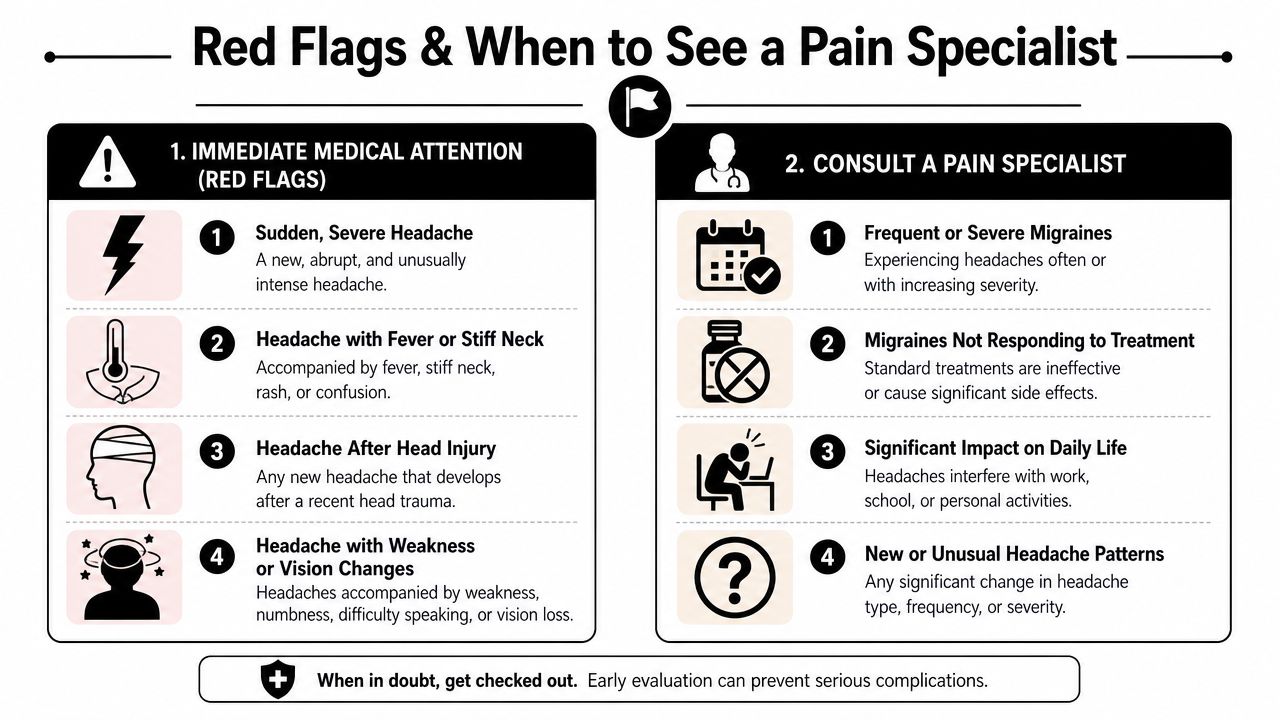
Get immediate medical care for these warning signs
Seek urgent evaluation now if you have a sudden, explosive headache; headache with fever, stiff neck, confusion, rash, or seizure; headache after head injury; or headache with weakness, numbness, trouble speaking, or major vision loss.
These symptoms should not be monitored at home overnight to “see what happens.” They need prompt assessment.
When specialist care makes sense even if it is not an emergency
A different situation comes up often in clinic. The headache is not sending you to the ER, but it keeps returning, keeps changing, or keeps disrupting work, sleep, driving, and family life. At that point, the question shifts from simple symptom relief to diagnosis.
A pain specialist looks at the full pattern, not just the pain score. That includes when the headaches started, how long they last, whether they build gradually or hit fast, what the pain feels like, what symptoms come with it, and how often medication is being used. Migraine has a pattern. Tension headache has a pattern. Cluster headache has a pattern. Secondary headaches have their own warning signs. Sorting those apart is the work.
One screening tool clinicians may use is the 3-item ID-Migraine questionnaire. It can support the clinical impression, especially when nausea, light sensitivity, and disability tend to show up together. As noted earlier in the article's prior diagnostic review, tools like this help organize the history, but they do not replace a proper evaluation.
What a specialist evaluation usually includes
Patients are sometimes surprised that migraine diagnosis is often more about careful listening than about rushing to a scan. Imaging has a role, but not every person with recurring migraine symptoms needs immediate imaging. The trade-off matters. Too little evaluation can miss an important secondary cause. Too much reflex testing can add cost, delay, and anxiety without improving care.
A focused assessment often includes:
A detailed headache history
When the headaches began, whether the pattern is stable or changing, and how the attacks affect normal functionA symptom review
One-sided versus both sides, throbbing versus pressure, nausea, light sensitivity, sound sensitivity, aura, neck pain, and eye symptomsA medication review
What you take, how often you take it, how well it works, and whether overuse may be making headaches more frequentA neurologic and pain-focused exam
To look for signs that point away from straightforward migraine and toward another diagnosisSelective testing when needed
Imaging, labs, or referral based on red flags, exam findings, age, medical history, or a meaningful change in the headache pattern
Why waiting can make migraine harder to control
I see many patients only after the headaches have started running the schedule of their lives. They are missing work in Oak Lawn, leaving family events early in Burbank, or planning every week around the possibility of another attack. By then, the problem is no longer “just headaches.” It is lost function.
Schedule a specialist visit if any of these are true:
- Headaches are becoming more frequent or more intense
- The pattern is changing
- You are relying on rescue medication more often
- The pain is interfering with work, driving, sleep, or family responsibilities
- You are unsure whether these are migraines at all
- Current treatment gives poor relief or side effects you cannot tolerate
For many people in Chicago Ridge and nearby communities, this is the point where the process becomes clearer. A structured evaluation can tell you whether you are dealing with migraine, another primary headache disorder, or a condition that needs a different workup entirely.
If you want to review the experience of the physician who performs this type of headache assessment, see Dr. Yaw Donkoh's clinical background and training.
Advanced Migraine Diagnosis and Treatment in Chicago Ridge
Once migraine is identified, the next question is what to do about it. A good plan doesn't start with “take this and hope.” It starts with matching treatment to the pattern, the severity, the frequency, and the way the attacks affect your life.
For patients in Chicago Ridge and nearby communities such as Bridgeview, Burbank, Alsip, Hickory Hills, and Palos Heights, the best migraine care is usually built around three things: diagnostic clarity, realistic goals, and an opioid-sparing treatment strategy. That means understanding whether the problem is episodic migraine, chronic migraine, a mixed headache picture, or a headache condition that overlaps with neck pain or nerve irritation.
What a strong first consultation should accomplish
A productive migraine visit should answer more than “Do you get headaches?” It should clarify:
- What type of headache pattern you most likely have
- Which symptoms support migraine and which suggest another headache disorder
- What may be triggering or amplifying attacks
- Whether your current treatment is underpowered, mistimed, or poorly tolerated
- Whether preventive care should be part of the plan
Your headache diary is extremely valuable. It allows the clinician to compare your real-world attacks against formal diagnostic criteria rather than relying only on memory.
What often works better than trial and error
Many patients have already tried some combination of over-the-counter products, rest, caffeine, hydration, and “pushing through.” Sometimes those measures help. Often they don't help enough, or they help unpredictably.
A more advanced pain practice looks at broader options, especially when headaches are frequent, disabling, or tied to neck and nerve pain patterns. Depending on the individual case, treatment may involve medication strategy, procedural care, or both. That can include Botox for chronic migraine, targeted nerve-related interventions, and other image-guided approaches when the clinical picture supports them.
In practice, the trade-off is straightforward. Conservative care is less invasive, but it may be too limited for complex or persistent migraine. Interventional care can offer a more targeted option, but only when the diagnosis is solid and the pattern fits.
Good migraine care is not about doing the most treatment. It is about choosing the right treatment for the right headache pattern.
Why opioid-sparing care matters
Headache treatment works best when it preserves function without creating a second problem. In pain medicine, that means avoiding reflexive reliance on opioids for migraine whenever possible. Migraine is usually better managed with migraine-specific strategies, preventive planning when appropriate, and targeted procedures for carefully selected patients.
That approach is especially important for people who also have chronic neck pain, back pain, nerve pain, post-injury pain, or other overlapping conditions. Their headache plan has to fit into the bigger picture of their health, not compete with it.
Local access matters more than people think
Migraine care is hard to sustain if visits, follow-up, and treatment access become a burden. That's one reason local, coordinated care matters for residents of Orland Park, Evergreen Park, Worth, and surrounding Illinois suburbs.
Patients do better when they can review their diary, discuss a pattern change, adjust treatment, and move to the next step without starting over each time. If procedural treatment becomes appropriate, it also helps to have access to a clinic already equipped for interventional pain management rather than needing a scattered referral chain.
If you want to see the range of procedural options used in a modern interventional pain setting, review the clinic's treatment procedures and interventional options.
The next step if you suspect migraine
If your headaches repeat, disrupt your routine, and come with the kind of symptom cluster described above, don't wait for them to become your normal. Start the diary. Record the pattern. Bring the details to a qualified clinician.
That is how migraine gets identified accurately. Not by guessing. Not by one dramatic symptom. And not by waiting for a scan to “prove” what your history already shows.
For many patients, relief begins when the diagnosis finally becomes clear.
If recurring headaches are disrupting your work, sleep, family time, or daily routine in Chicago Ridge, Oak Lawn, Palos Hills, Palos Heights, Worth, Bridgeview, Hickory Hills, Alsip, Burbank, Evergreen Park, or Orland Park, Midwest Pain & Wellness can help you take the next step. Dr. Yaw Donkoh and the team provide compassionate, opioid-sparing migraine and pain care focused on clear diagnosis, personalized treatment, and practical relief.