A lot of people start looking up how to manage sciatica after the pain stops being a nuisance and starts running the day. It may begin as a pull in the low back when you get out of bed in Oak Lawn, then turn into burning pain down the buttock and leg while you're driving through Orland Park, standing at work in Burbank, or trying to sleep in Evergreen Park. By the time you search for answers, you're usually not wondering what a textbook says. You're wondering how to get through today, what not to do, and whether this is something that will pass or keep getting worse.
That uncertainty is one of the hardest parts of sciatica. The good news is that there is a clear care pathway. Individuals generally don't start with procedures or surgery. They begin with the basics that help, then move to more targeted treatment only if symptoms persist, function drops, or nerve warning signs appear. For people in Oak Lawn, Palos Hills, Palos Heights, Worth, Bridgeview, Hickory Hills, Alsip, Burbank, Evergreen Park, and Orland Park, understanding that sequence can make the condition feel much less overwhelming.
That Shocking Pain Down Your Leg Understanding Sciatica
A patient in Oak Lawn may feel it after a routine morning. Bend to lift a bag, stand up from the car, or sit through a workday, and a sharp pain starts in the low back, then shoots through the buttock and down the leg. By evening, sitting is miserable, walking feels off, and sleep turns into a series of position changes.
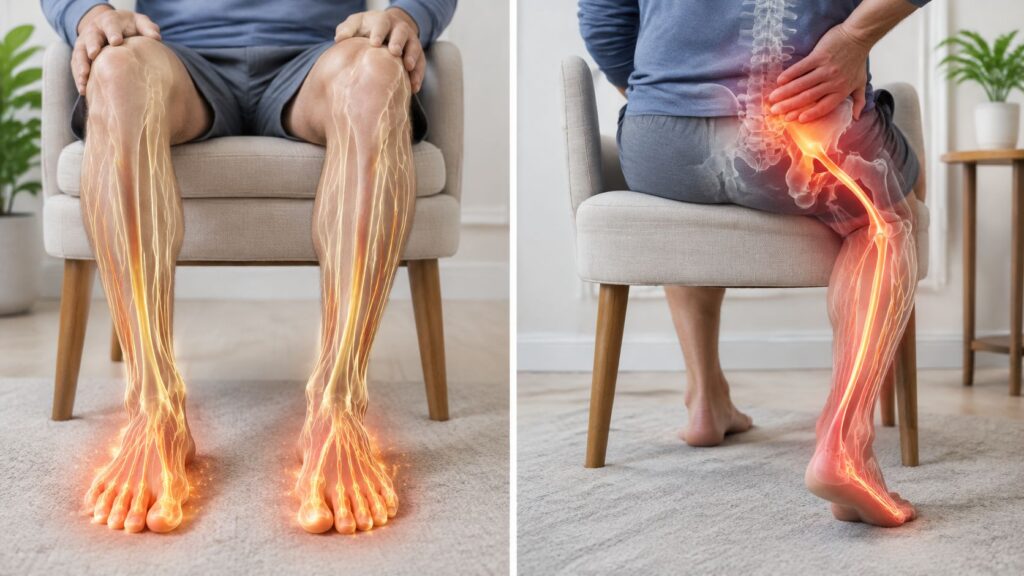
That pattern often points to sciatica. Sciatica is a symptom pattern, not a stand-alone diagnosis. It usually means a lumbar nerve root is irritated, inflamed, or compressed, and the pain radiates along the path of the sciatic nerve into the leg.
What the name does and doesn't tell you
The term sciatica describes the route of the pain, not the exact structure causing it. In practice, the source may be a herniated disc, foraminal narrowing, spinal stenosis, inflammation around a nerve root, or another condition that mimics nerve pain. Treatment works best when it matches the actual pain generator rather than the label alone.
Patients are often surprised by that distinction. They assume leg pain means the problem is in the leg. Many times, the source is higher up in the lower spine, with pain, tingling, numbness, or burning traveling downward. For a broader view of spine, nerve, and musculoskeletal problems that can overlap with radiating leg pain, see the conditions we treat at Midwest Pain & Wellness.
Severe leg pain can feel alarming. It still does not automatically mean you need an injection or surgery on day one.
What I look for clinically
As an interventional pain specialist, I do not treat every case of sciatica the same way, because sciatica is not one problem with one fix. I want to know where the pain starts, how far it travels, whether coughing or sitting makes it worse, and whether there is numbness, weakness, or loss of reflexes. Those details help separate an irritated nerve root from hip arthritis, sacroiliac pain, peripheral nerve entrapment, or muscle-related pain that can sound similar at first.
The trade-off is straightforward. Moving too quickly to procedures without a clear diagnosis can lead to treatment that misses the target. Waiting too long while weakness progresses can create a harder recovery.
A practical framework for sciatica care
The safest and most useful way to approach sciatica is step by step:
- Calm the flare and keep the body moving so the irritated nerve is not being provoked all day.
- Measure function along with pain by looking at walking, sleep, work tolerance, driving, and sitting.
- Escalate care when the pattern calls for it, especially with worsening weakness, expanding numbness, or major limits in daily activity.
That approach gives patients in Orland Park, Palos Hills, Alsip, and nearby suburbs a clear path from home care to specialist treatment. It also helps avoid two common errors. One is assuming every severe flare needs an invasive solution immediately. The other is trying to push through for too long when the symptoms are no longer improving or the nerve is starting to show warning signs.
Immediate Relief Strategies for Sciatica Pain at Home
You stand up from the couch, take three steps, and feel that familiar pull shoot from the low back into the leg. In that moment, the goal at home is not to force a workout or stay frozen on the couch. The goal is to settle the nerve enough that normal movement becomes possible again.

Use cold or heat with a purpose
Cold can help early in a flare, especially when the pain feels sharp or irritated. Heat often helps later, when the muscles in the low back, buttock, or hip start tightening in response to pain. Neither one corrects the source of sciatica, but both can reduce discomfort enough to make walking and position changes easier.
Practical rule: Use heat or cold for short sessions, then get up and move for a few minutes instead of lying back down.
Patients often ask which one is better. The honest answer is that the better option is the one that calms symptoms without leaving you stiffer afterward. If ice makes the area feel guarded, switch to heat. If heat makes the leg throb more, use cold instead.
Keep moving, but cut out the trigger
Complete bed rest usually backfires. The back stiffens, the hips tighten, and the leg often hurts more when you try to get moving again.
A better plan is relative rest. Stop the activities that clearly spike leg pain, but keep the body in motion in small, tolerable doses.
- Pause the obvious aggravators, such as heavy lifting, repeated bending, twisting, or long periods in a car.
- Walk in short intervals if walking does not make the pain travel farther down the leg.
- Change positions often instead of sitting through the pain.
- Use pain relief to make movement possible, not to push through a demanding workout or yard project.
One simple test helps here. If an activity causes mild soreness that settles fairly quickly, it may be reasonable. If it pushes pain farther down the leg, increases numbness, or leaves you limping for hours, scale it back.
Stretch gently, and stop before the nerve gets angry
Stretching can help, but only when it reduces tension without stirring up the nerve. The right stretch leaves the area feeling looser or calmer. It should not create sharp pain, more tingling, a new limp, or a wave of numbness.
Try these carefully:
Hamstring stretch with a strap or towel
Lie on your back and lift the affected leg until you feel light tension. A slight bend in the knee is fine. For many patients, that works better than forcing the leg straight.Figure-four stretch for the hip
While lying down, cross one ankle over the opposite knee. Pull the supporting leg toward you only to a comfortable limit.Prone press-up or gentle extension
Some patients with disc-related irritation feel better when they prop up on the elbows for a few seconds. Stop if the pain spreads farther down the leg.Pelvic tilts
These are simple, low-strain movements that can reduce guarding in the low back.
In practice, aggressive stretching is one of the most common mistakes I see. Patients are told to "loosen everything up," then they keep pulling into nerve pain. That usually sets them back.
Fix the daily positions that keep feeding the pain
Home care often succeeds or fails based on what happens in the other twenty-three hours of the day. A good stretch routine will not help much if every sitting, driving, sleeping, and lifting position keeps irritating the same nerve.
| Situation | Helpful change |
|---|---|
| Desk work | Sit with feet flat, support the low back, and stand up at regular intervals |
| Driving | Move the seat closer so you are not reaching, and stop to walk on longer trips |
| Sleeping | Place a pillow between the knees when side sleeping, or under the knees when on your back |
| Standing tasks | Shift weight often or rest one foot on a low step for short periods |
| Lifting | Keep the object close to the body and avoid twisting while bent forward |
These adjustments are simple. They also matter. Small reductions in repeated irritation can calm a flare more effectively than one long stretch session.
What to avoid during a flare
A few habits make sciatica harder to settle:
- Staying in bed for days
- Starting intense core exercises too early
- Stretching into sharp leg pain
- Depending only on massage or passive care
- Ignoring new weakness, foot drop, or worsening numbness
Home treatment has limits. If symptoms are not steadily improving, or if the leg feels weaker rather than just painful, it is time for a proper evaluation. Patients in Oak Lawn, Orland Park, Palos Hills, Alsip, and nearby suburbs can request a sciatica evaluation with Midwest Pain & Wellness when home care stops moving things in the right direction.
When to Seek a Specialist in the Chicago Area
Some sciatica episodes settle with home care. Others stall out. The decision to move from self-management to specialist care shouldn't be based on frustration alone. It should be based on what the symptoms are doing over time and whether your function is returning.
The timeline that matters
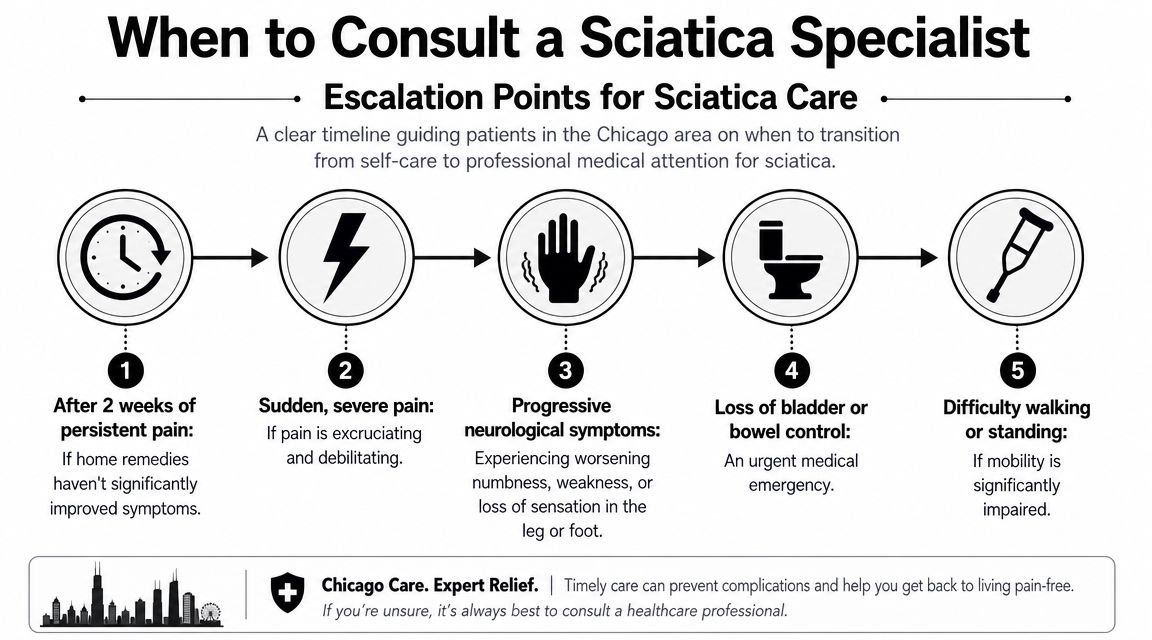
A commonly cited summary is that 80% to 90% of sciatica cases improve without surgery, and about 50% resolve within six weeks, with more advanced options becoming more relevant once symptoms persist beyond that window, as outlined in this summary of sciatica statistics and treatment timing. The important point isn't to count the days anxiously. It's to notice whether the trend is moving in the right direction.
If you live in Palos Hills, Bridgeview, Palos Heights, or Alsip and your pain is still dominating sitting, walking, sleep, or work after a sustained effort at home management, it makes sense to get evaluated rather than keep cycling through the same strategies.
Signs that shouldn't wait
You don't need to be in agony to justify a consultation. You need a pattern that says the problem is lingering, progressing, or interfering with normal use of the leg.
Consider specialist evaluation when you have:
- Pain that isn't improving after a meaningful trial of home care
- Worsening pain intensity or pain spreading further down the leg
- Numbness or tingling that is increasing
- Weakness in the foot or leg
- Trouble standing or walking normally
- Symptoms that keep returning after brief improvement
Some warning signs are more urgent.
Loss of bladder or bowel control, rapidly progressive weakness, or severe neurologic change needs immediate medical attention.
What the visit usually involves
A proper sciatica workup is less mysterious than many patients expect. The first step is a focused history and physical exam. The pattern of pain, numbness, weakness, sitting tolerance, walking tolerance, and reflex changes often tells a lot before any procedure is discussed.
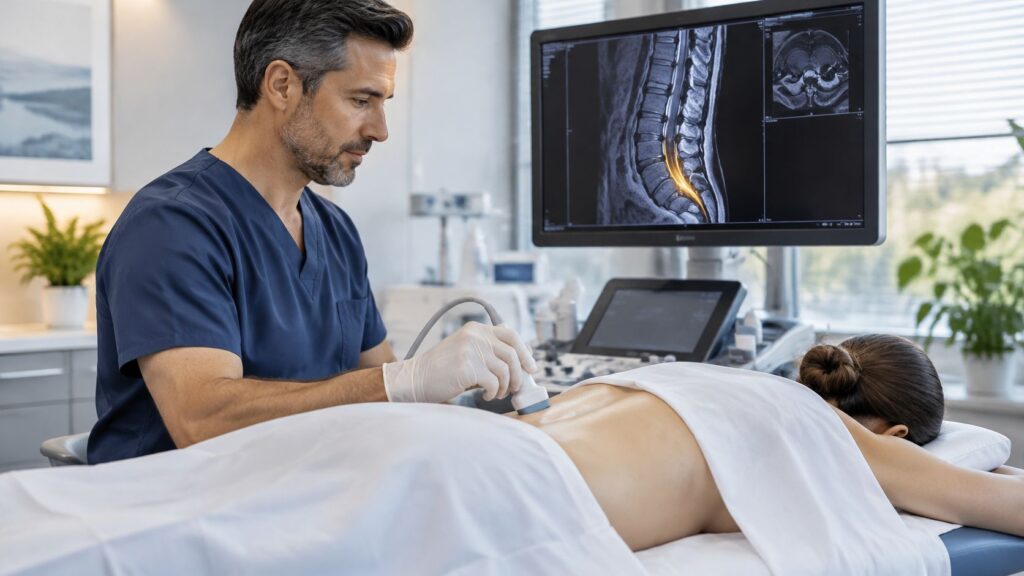
A specialist may also decide whether imaging is useful. That can include an MRI when a disc or nerve root problem needs to be clarified, or other studies when the diagnosis isn't straightforward. The point of testing isn't to collect images. It's to connect symptoms, exam findings, and anatomy so treatment targets the actual pain source.
If you're ready to stop guessing, you can request an appointment with Midwest Pain & Wellness for a diagnostic evaluation and treatment plan.
Why this step matters
A lot of people delay specialist care because they assume the next step is surgery. Usually it isn't. The usual sequence is still conservative care first, then more directed treatment if the nerve keeps getting irritated or function remains limited.
That shift from "trying things" to "matching treatment to the pain generator" is often what finally moves the case forward.
Targeted Interventional Pain Treatments
When conservative care helps but doesn't help enough, interventional pain treatment can create the opening needed for recovery. The goal isn't to numb everything and send you on your way. The goal is to reduce the specific pain source enough that you can move better, rehabilitate better, and avoid getting trapped in a cycle of pain, fear, and inactivity.
Epidural steroid injections
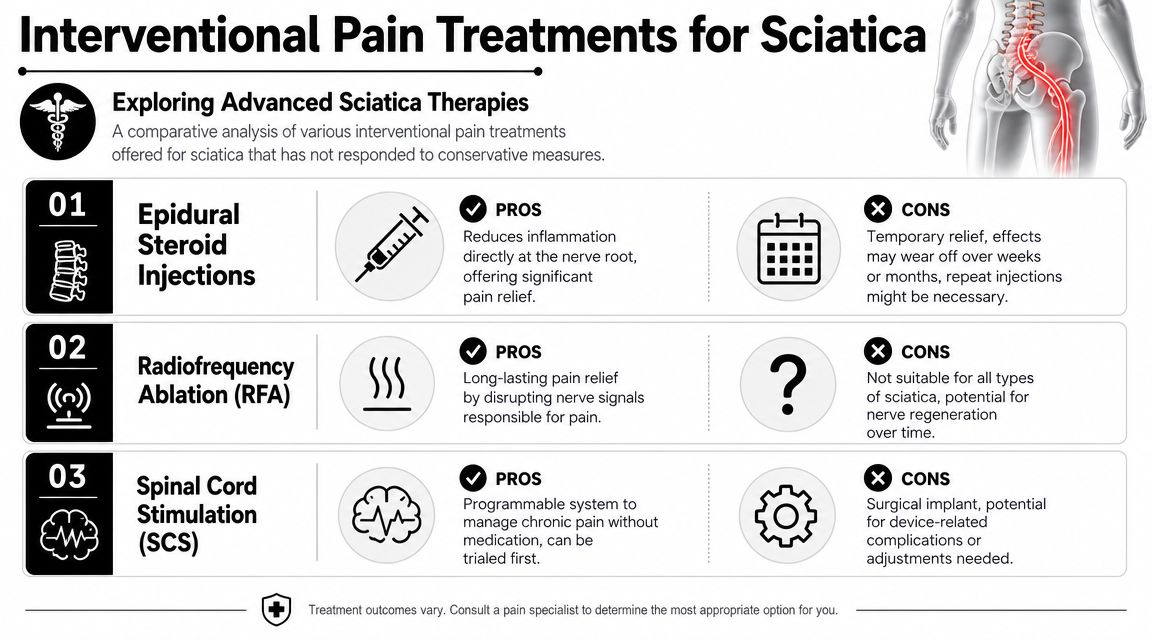
For sciatica caused by inflammation around a nerve root, epidural steroid injections are one of the most common next steps. According to Mayo Clinic's sciatica treatment overview, corticosteroid shots placed around the affected nerve root can help, and often one injection reduces pain. The key point is that they are generally used as temporary inflammation-reduction tools, not as a permanent cure.
That distinction matters. A good injection should buy you something concrete:
- Better walking tolerance
- Better sleep
- Less leg pain with sitting
- Improved participation in rehab
- A clearer picture of how much of the pain is nerve-driven
If an injection reduces pain but function doesn't change, the treatment plan may need to be reconsidered. Repeating procedures without measurable gain is rarely the right long-term strategy.
What the experience is like
From a patient's perspective, an epidural steroid injection is usually a brief image-guided procedure. The treatment is targeted to the area where the nerve appears inflamed or compressed. Patients commonly want to know three things: Will it hurt, how soon will I know, and what happens next?
The answer depends on the pattern of symptoms, but the larger principle is straightforward. The injection is not the finish line. It is a tool that may create enough symptom relief to restore movement and progress.
A procedure should open the door to function. If it doesn't help you move, sleep, or participate in recovery, it hasn't done enough.
Radiofrequency ablation
Radiofrequency ablation, or RFA, is a strong treatment for certain spine-related pain generators, especially when a well-defined nerve is carrying pain signals from structures such as facet joints. It works by using controlled heat to disrupt pain signaling from targeted nerves.
For classic sciatica from a compressed nerve root, RFA is not always the primary tool. That's an important trade-off. Some patients hear about RFA and assume it applies to every kind of back and leg pain. It doesn't. It works best when the diagnosis supports it.
When RFA does fit, patients often like it because it is targeted, opioid-sparing, and can provide longer-lasting relief than a short-lived medication response. The right candidate is someone whose exam, imaging, and response to diagnostic blocks point toward that specific pain pathway.
Spinal cord stimulation
Spinal cord stimulation, or SCS, is usually reserved for more persistent nerve-related pain, especially when simpler options haven't produced durable improvement or when surgery has already occurred and leg pain remains. This system delivers electrical signals that change how pain is perceived.
What makes SCS different is the trial phase. Before a permanent implant is considered, patients can usually test whether the therapy meaningfully changes day-to-day pain control and function. That makes it a very different decision from committing to a major operation without a preview.
A patient who may benefit from SCS often has:
- Ongoing neuropathic leg pain
- Pain that has outlasted standard conservative measures
- Limited benefit from less invasive interventions
- A desire to reduce reliance on chronic medication
Choosing the right procedure
The right interventional treatment depends less on how severe the pain feels and more on what is causing it. That is why precise diagnosis matters so much in pain medicine.
Here's a practical way to think about the main options:
| Treatment | Best fit | Main limitation |
|---|---|---|
| Epidural steroid injection | Inflamed or compressed nerve root with radiating leg pain | Relief may be temporary |
| Radiofrequency ablation | Pain from specific spine structures with a confirmed nerve target | Not ideal for every form of sciatica |
| Spinal cord stimulation | Chronic neuropathic pain that hasn't responded to simpler treatment | Requires careful screening and trialing |
For patients comparing options, the interventional procedures used for treatment at Midwest Pain & Wellness include image-guided injections, radiofrequency ablation, and neuromodulation among other pain interventions.
Minimally Invasive and Regenerative Solutions
Some cases of sciatica don't come from a brief inflammatory flare. They come from a structural problem that keeps narrowing space around the nerves. In those situations, repeatedly chasing symptoms without addressing the anatomy can leave patients stuck. That's where minimally invasive procedures and selected regenerative options enter the conversation.
When decompression makes more sense than repeated symptom treatment
If the problem is lumbar spinal stenosis or another narrowing process, the question changes. It is no longer just "How do we reduce irritation today?" It becomes "How do we create more room for the nerve without pushing the patient straight to a major open operation?"
That is why procedures such as MILD and Vertiflex can be valuable in the right patient. Both are designed for carefully selected cases where space needs to be improved around the neural elements. They are not interchangeable with every sciatica procedure, and they are not for every cause of leg pain. Their value is in matching the treatment to the structure driving the symptoms.
Patients often gravitate to these options because they want a middle ground. They aren't interested in endless temporary treatment, but they also want to avoid a large surgical intervention if a less invasive path can reasonably address the issue.
The trade-offs patients should understand
Minimally invasive doesn't mean casual. It means the treatment is more targeted and usually less disruptive than traditional surgery. The upside is often a shorter recovery path, less tissue disruption, and a more focused correction of the pain source. The downside is that candidacy matters a great deal.
A patient with the wrong anatomy for the procedure usually won't get the result they want. That is why careful exam findings, symptom pattern, and imaging review matter more than enthusiasm for a newer technique.
Useful questions during decision-making include:
- Is the pain pattern consistent with stenosis or another compressive issue?
- Has conservative care plateaued?
- Would a decompression-style treatment address the source of symptoms?
- Would surgery be excessive for the degree of structural problem, or is surgery the better answer?
Where regenerative care may fit
Regenerative options such as platelet-rich plasma, or PRP, appeal to patients who want to support healing in damaged soft tissues that may be contributing to pain and instability. The logic is straightforward. If surrounding structures are part of the problem, helping those tissues recover may reduce ongoing mechanical stress and irritation.
That said, regenerative medicine is not a universal answer for sciatica. It may have a role in selected cases, especially when tendon, ligament, or joint-related contributors overlap with nerve irritation. It is less about replacing every established treatment and more about adding another tool when the clinical picture supports it.
The best advanced treatment is the one that matches the anatomy, the symptom pattern, and the patient's goals. Not the one that sounds newest.
For many patients in Oak Lawn, Palos Heights, Hickory Hills, or Orland Park, this is the point where specialist pain care becomes especially useful. The decision is no longer just whether to treat pain. It is how to choose the least disruptive option that still addresses the reason the pain keeps returning.
Building a Sciatica-Proof Life After Treatment
Relief is only half the job. The other half is protecting it. Whether your symptoms improved with home care, an injection, or a minimally invasive procedure, the long-term goal is the same: keep the nerve calm, keep the spine moving well, and avoid the patterns that recreate the problem.
Build your routine around movement
One of the clearest principles in persistent sciatica care is that staying active beats prolonged bed rest. A BMJ review available through PMC found little difference in pain or function between bed rest and advice to remain active, and noted that prolonged inactivity is no longer recommended. The practical meaning is simple. Recovery usually goes better when movement is protected and guided, not abandoned.
That doesn't mean doing everything at once. It means returning to activity in a way the nerve can tolerate.
Habits that lower the chance of another flare
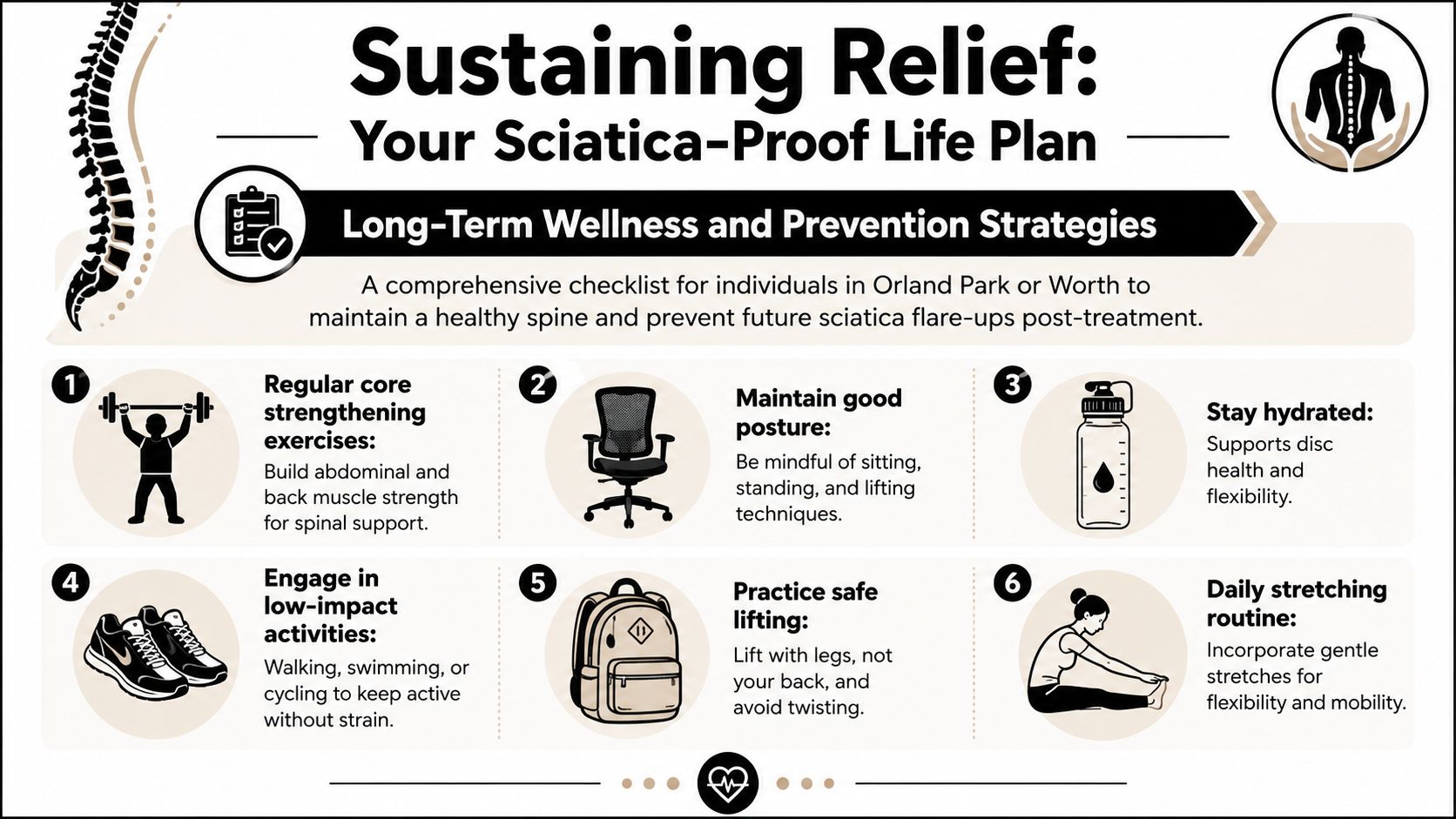
A sustainable prevention plan usually includes a mix of strength, mobility, posture awareness, and pacing.
Core work that supports, not strains
Focus on controlled abdominal and trunk stability work rather than high-load exercises that provoke back and leg symptoms.Low-impact conditioning
Walking, swimming, and cycling can keep the body active without the repeated jarring that some people can't tolerate early on.Daily mobility
Gentle stretching for the hamstrings, hips, and low back can reduce the stiffness that often feeds symptom recurrence.Better lifting mechanics
Keep loads close to the body and avoid twisting when bent.Workstation changes
If your flare started during long sitting, your desk setup and movement breaks are part of treatment, not an afterthought.
Know the red flags
Some symptoms are not part of routine recovery. They require urgent attention.
Emergency warning signs
- Loss of bladder or bowel control
- Rapidly worsening leg weakness
- A major increase in numbness in the groin or saddle area
- Sudden inability to walk normally because the leg is giving out
These signs can indicate significant nerve compromise. Waiting them out is not appropriate.
What success looks like
A lot of patients expect recovery to mean zero discomfort forever. That's not always a realistic target. More often, success means your pain is manageable, your leg strength is stable, your sleep and mobility are back, and you know how to respond early if symptoms start to return.
For people in Worth, Orland Park, Evergreen Park, and nearby Illinois communities, that kind of durable recovery usually comes from consistency. Not from one perfect stretch, one perfect procedure, or one good week.
Frequently Asked Questions About Sciatica Management
Will I need surgery for my sciatica
Usually, no. Many people improve without surgery, especially when the problem is treated early and function is protected. Surgery becomes more relevant when symptoms persist despite appropriate care, when imaging shows a structural issue that is unlikely to improve enough on its own, or when there are neurologic warning signs such as progressive weakness.
The better question is not "Will I need surgery?" It's "What is causing my sciatica, and what is the least invasive treatment that reasonably matches that cause?"
Is it safe to exercise with sciatica
Often, yes, but the type of exercise matters. Walking and other low-impact movement are commonly better tolerated than heavy lifting, repeated bending, or high-intensity workouts during a flare. The rule is to favor motion that keeps symptoms controlled rather than exercise that pushes pain further down the leg.
If activity consistently increases numbness, weakness, or radiating pain, the program needs adjustment.
How do I know which interventional treatment is right for me
The right treatment depends on the pain generator. A nerve root irritated by a disc problem is a different scenario than leg symptoms related to spinal stenosis, facet pain, or persistent neuropathic pain after prior spine treatment. That is why a specialist looks at the full picture: pain pattern, neurologic findings, aggravating positions, imaging, prior response to treatment, and functional limits.
A good plan should answer three questions clearly:
- What structure is most likely causing the pain?
- What treatment best targets that structure?
- How will we know if the treatment helped?
Can sciatica come back after treatment
Yes, it can. Relief doesn't make the spine immune to future strain, disc changes, or narrowing around the nerves. What usually lowers recurrence risk is not just pain treatment. It's what you do after pain treatment. Daily movement, stronger trunk support, better lifting mechanics, and earlier response to warning symptoms all help.
The encouraging part is that recurrence doesn't mean failure. It often means the condition needs maintenance, reassessment, or a different layer of treatment.
Should I keep stretching if it hurts
Mild tension is one thing. Sharp radiating pain is another. Stretching through nerve pain often irritates the problem more. If a stretch makes symptoms travel farther, causes tingling to intensify, or leaves the leg more painful afterward, stop doing that movement and get guidance.
The goal is to calm the nerve, not challenge it.
When should I stop trying to manage it on my own
Stop relying on home care alone when the pattern is no longer improving, when function is shrinking, or when weakness and numbness are increasing. If you're changing how you walk, can't tolerate sitting or standing for basic daily life, or keep having flares that quickly return, it is time for a proper diagnosis.
For patients in Oak Lawn, Palos Hills, Palos Heights, Worth, Bridgeview, Hickory Hills, Alsip, Burbank, Evergreen Park, and Orland Park, that's often the difference between spinning your wheels and finally getting the right treatment.
If sciatic pain is limiting your work, sleep, or mobility, Midwest Pain & Wellness offers evaluation and interventional pain care in Illinois with a focus on identifying the pain source and building a personalized, opioid-sparing treatment plan.