Vertebroplasty injects bone cement into a fractured vertebra to stabilize it and relieve pain, while kyphoplasty adds a balloon step before cement placement to potentially restore vertebral height and reduce leakage. In pooled case-series data, cement extravasation occurred in approximately 41% of vertebroplasty cases compared with 9% of kyphoplasty cases.
A sudden, severe back pain after bending, reaching, or even coughing can leave you wondering whether you strained a muscle or damaged something more serious. In an older adult, especially someone with osteoporosis, that pain may come from a vertebral compression fracture. The right next step isn't automatically a procedure. It's an accurate diagnosis, an assessment of stability and nerve function, and an honest discussion about what treatment can and can't accomplish.
Table of Contents
- Understanding What These Procedures Address
- Key Differences Between Vertebroplasty and Kyphoplasty
- What Happens During the Procedure Step by Step
- Evidence on Pain Relief and Clinical Outcomes
- Identifying the Right Candidate for Augmentation
- Integrating Augmentation Into a Comprehensive Pain Plan
- Preparing for Your Consultation at an Illinois Pain Clinic
Understanding What These Procedures Address
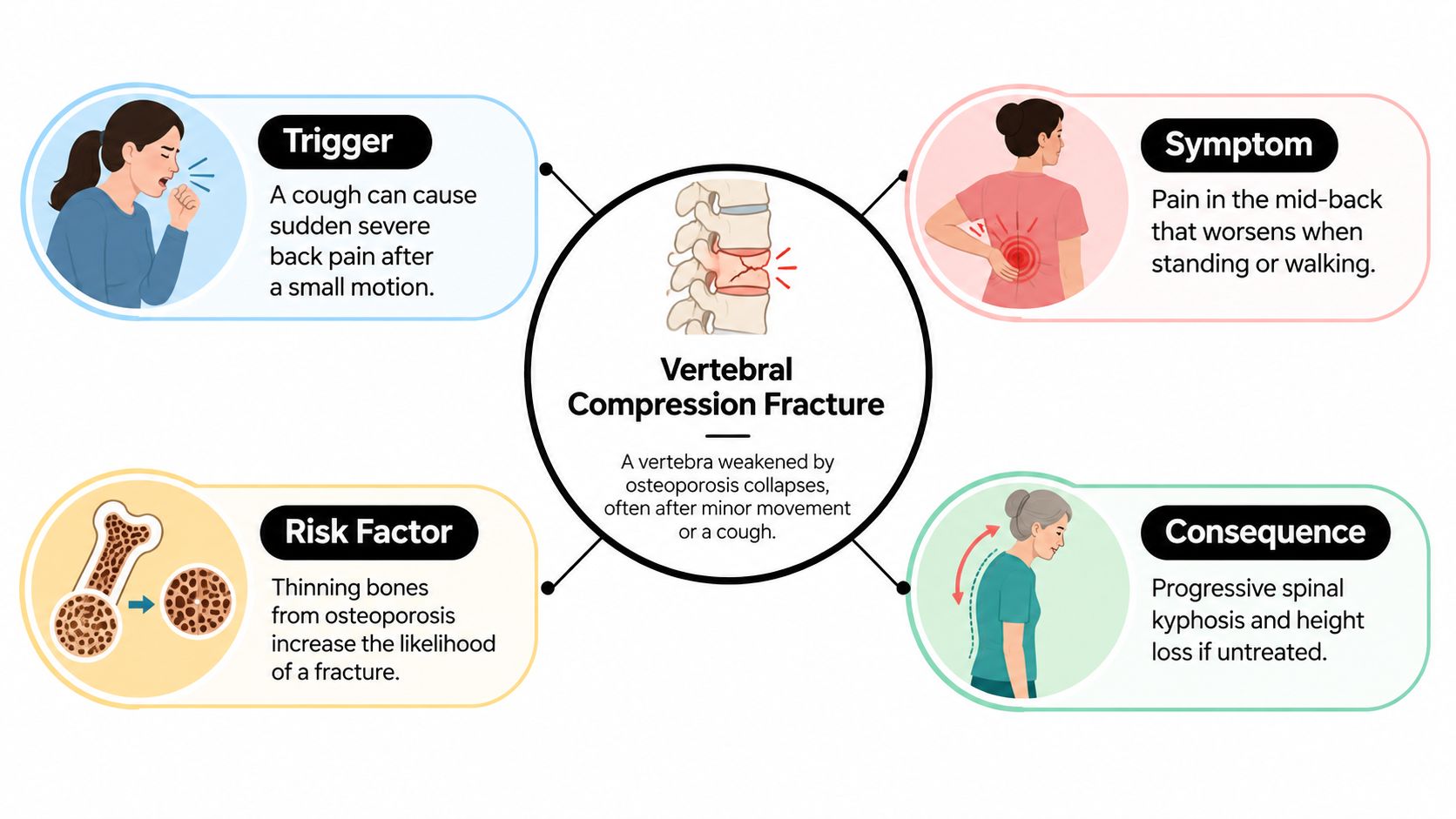
A vertebral compression fracture occurs when a weakened vertebral body partially collapses. Osteoporosis is a common cause, but trauma and malignancy can also produce these fractures. Pain may worsen when you stand, walk, change position, or take a deep breath. Some people also develop a progressive forward curve, known as kyphosis, when vertebral collapse accumulates.
The fracture can create tiny areas of movement inside the bone. That motion may irritate pain-sensitive structures and make ordinary activities feel unsafe. Vertebral augmentation aims to limit that movement by placing medical-grade bone cement inside the collapsed vertebra.
The basic definitions
Vertebroplasty uses a needle to deliver polymethylmethacrylate bone cement directly into the fractured vertebral body. The cement hardens and can stabilize microfractures, with the intended result of reducing painful motion.
Kyphoplasty uses the same basic cement-stabilization principle but adds balloon inflation first. The balloon creates a cavity inside the vertebra and may partially restore vertebral height before it's deflated and removed. Cement can then be placed in that cavity, often at lower pressure.
These aren't general treatments for every type of back pain. They're targeted procedures for a confirmed, painful vertebral compression fracture. Degenerative discs, muscle strain, ordinary facet arthritis, and many nerve conditions require a different evaluation and treatment plan. A practical overview of the condition is available in this guide to vertebral compression fracture pain.
Practical rule: The most important decision is usually whether the fracture is active, painful, and suitable for augmentation. The choice between the two techniques comes after that decision.
Key Differences Between Vertebroplasty and Kyphoplasty
The easiest way to understand the difference is to follow the path of the cement. Vertebroplasty places cement directly through a needle into the fractured bone. Kyphoplasty first uses an inflatable balloon tamp to create a controlled cavity, which may improve cement containment and partially address vertebral collapse.
Neither method is universally superior. Vertebroplasty is technically simpler and generally takes less procedural time. Kyphoplasty requires additional equipment and a balloon step, but that step may be useful when cement control, vertebral height, or kyphotic alignment matters.
| Feature | Vertebroplasty | Kyphoplasty |
|---|---|---|
| Primary action | Injects cement directly into the fractured vertebra | Inflates a balloon before placing cement |
| Stabilization | Cement stabilizes microfractures and limits painful motion | Cement stabilizes the fracture after a cavity is created |
| Vertebral height | Doesn't specifically attempt restoration | May partially restore vertebral height |
| Cement control | Cement is injected directly and may travel through fracture clefts | The cavity may permit lower-pressure, more contained delivery |
| Technical profile | Simpler technique with fewer procedural steps | More equipment and an additional balloon step |
| Main trade-off | Simplicity versus a greater risk of radiographic leakage in some studies | Better containment in many studies, without a consistent long-term pain advantage |
What the leakage data mean
A comparative review of pooled case-series data included 4,861 fractures treated with vertebroplasty and 1,070 treated with kyphoplasty. It reported cement extravasation of approximately 41% with vertebroplasty and 9% with kyphoplasty, while clinically consequential complications occurred in about 3.9% and 2.2%, respectively. The same review found substantial pain reduction with both procedures, although the observational design means those results may overestimate benefit. The comparative review of vertebral augmentation procedures explains both the mechanical distinction and the limits of pooled case-series evidence.
Another meta-analysis reported leakage in 54.7% of vertebroplasty-treated vertebrae and 18.4% of balloon-kyphoplasty-treated vertebrae. Its analysis associated higher leakage risk with cortical disruption, an intravertebral cleft, low-viscosity cement, and larger cement volume. The evidence summary on cement leakage and clinical outcomes also reported broadly similar pain and disability improvement between techniques.
Those figures describe radiographic leakage, not inevitable injury. Many leaks cause no symptoms, but cement entering the spinal canal, neural foramina, paravertebral tissues, or venous system can rarely produce serious complications. The treating specialist must therefore match the technique to fracture morphology, posterior-wall integrity, bone quality, and the patient's symptoms.
What Happens During the Procedure Step by Step
Your procedure starts before you enter the treatment room. The specialist reviews your history, imaging, medications, bone health, and neurological examination to determine whether the fracture is the likely pain generator and whether augmentation is appropriate.
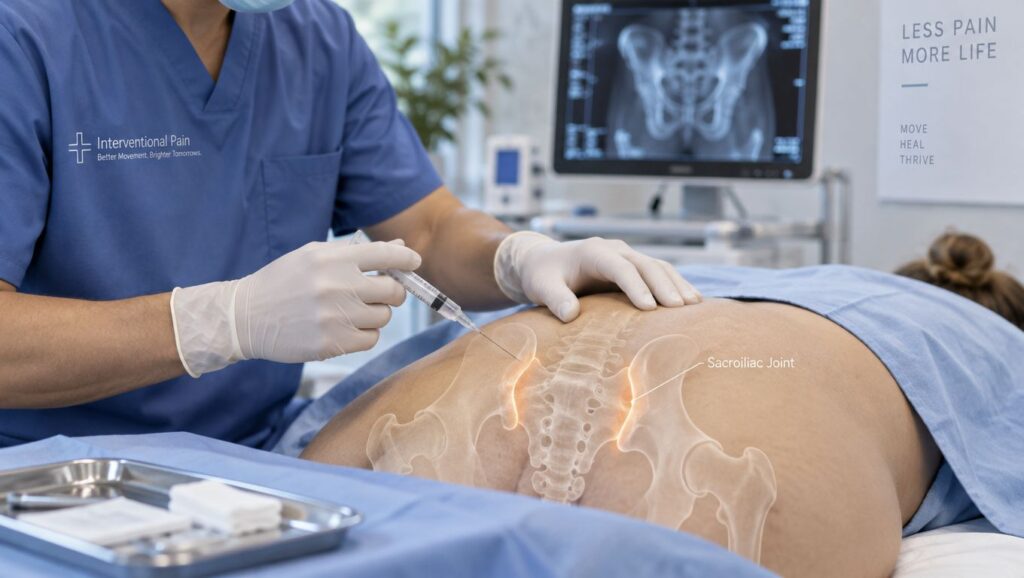
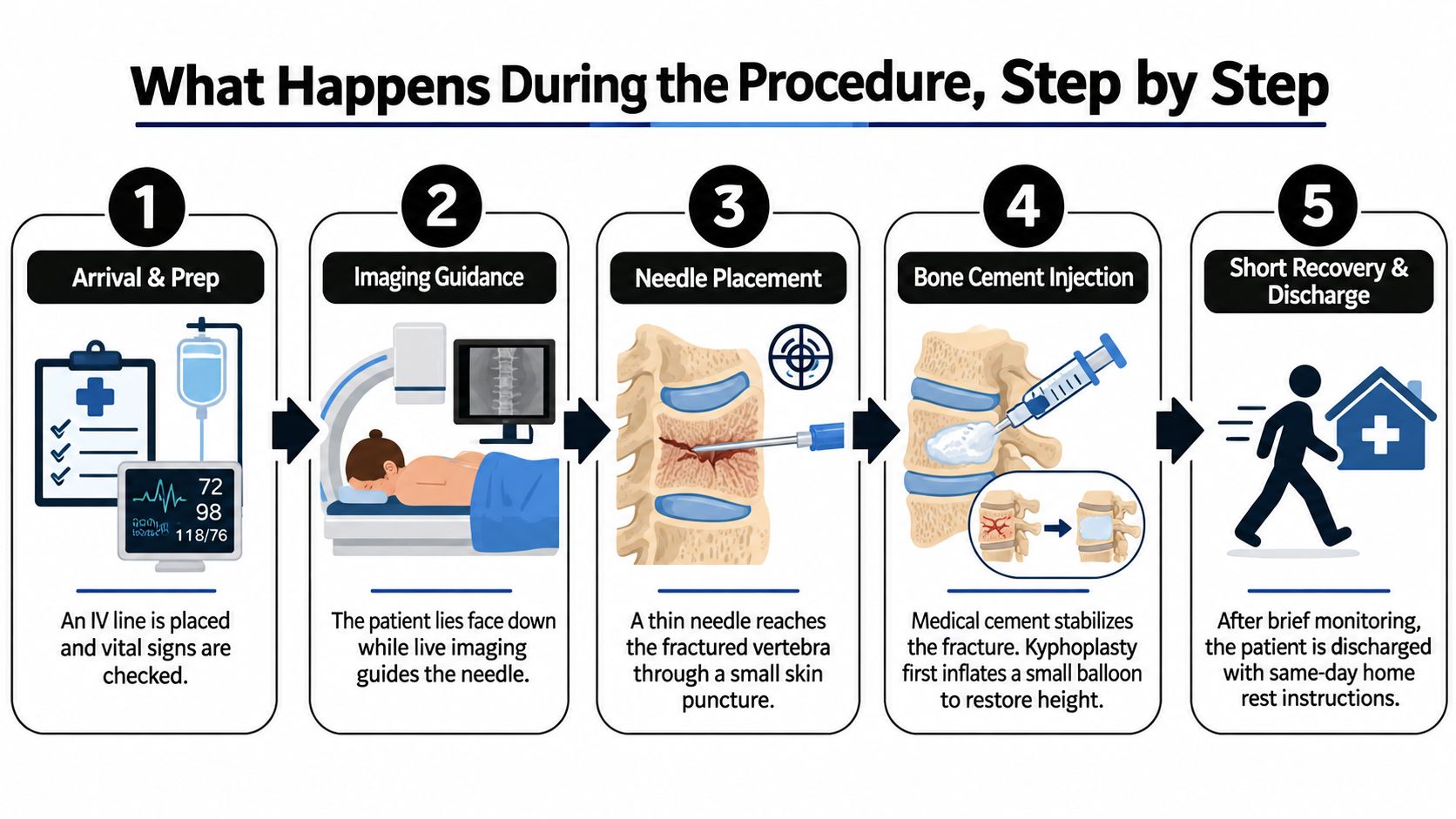
Once you arrive, the team checks vital signs, reviews consent, and positions you carefully. Sedation or local anesthesia may be used according to the procedure and your medical needs. You'll typically lie face down so the physician can approach the vertebra from the back while maintaining continuous image guidance.
The procedural sequence
Preparation and monitoring: The team establishes the required access, checks your vital signs, and confirms the treatment level.
Image-guided positioning: Fluoroscopy, and sometimes CT guidance, helps the physician visualize the vertebra and plan a safe needle path. Detailed information about this approach appears in the explanation of fluoroscopy-guided injections.
Needle placement: A needle passes through a small skin puncture into the vertebral body. The approach may be transpedicular or extrapedicular, depending on the anatomy and fracture pattern.
Cement delivery: With vertebroplasty, cement is injected directly. With kyphoplasty, the balloon is inflated first, then removed before cement is placed. The physician injects cement incrementally while watching for migration.
Recovery and discharge: The team observes you after treatment and provides activity, wound, medication, and warning-sign instructions. Whether you go home the same day depends on your overall condition, sedation needs, medical history, and local protocol.
Cement viscosity and injection technique matter. Higher-viscosity cement flows less readily through cortical defects and fracture clefts. A review of five randomized trials and eight cohort studies involving 840 patients and 1,280 vertebral bodies found a relative risk of leakage of 0.42 with high-viscosity cement compared with low-viscosity cement. The review of cement viscosity and leakage risk also emphasizes careful monitoring and the importance of treating osteoporosis after the procedure.
For practical home planning, patients may find DME Superstore home recovery advice useful as general preparation guidance. Your own discharge instructions take priority because recovery restrictions vary with your health and the treated fracture.
Evidence on Pain Relief and Clinical Outcomes
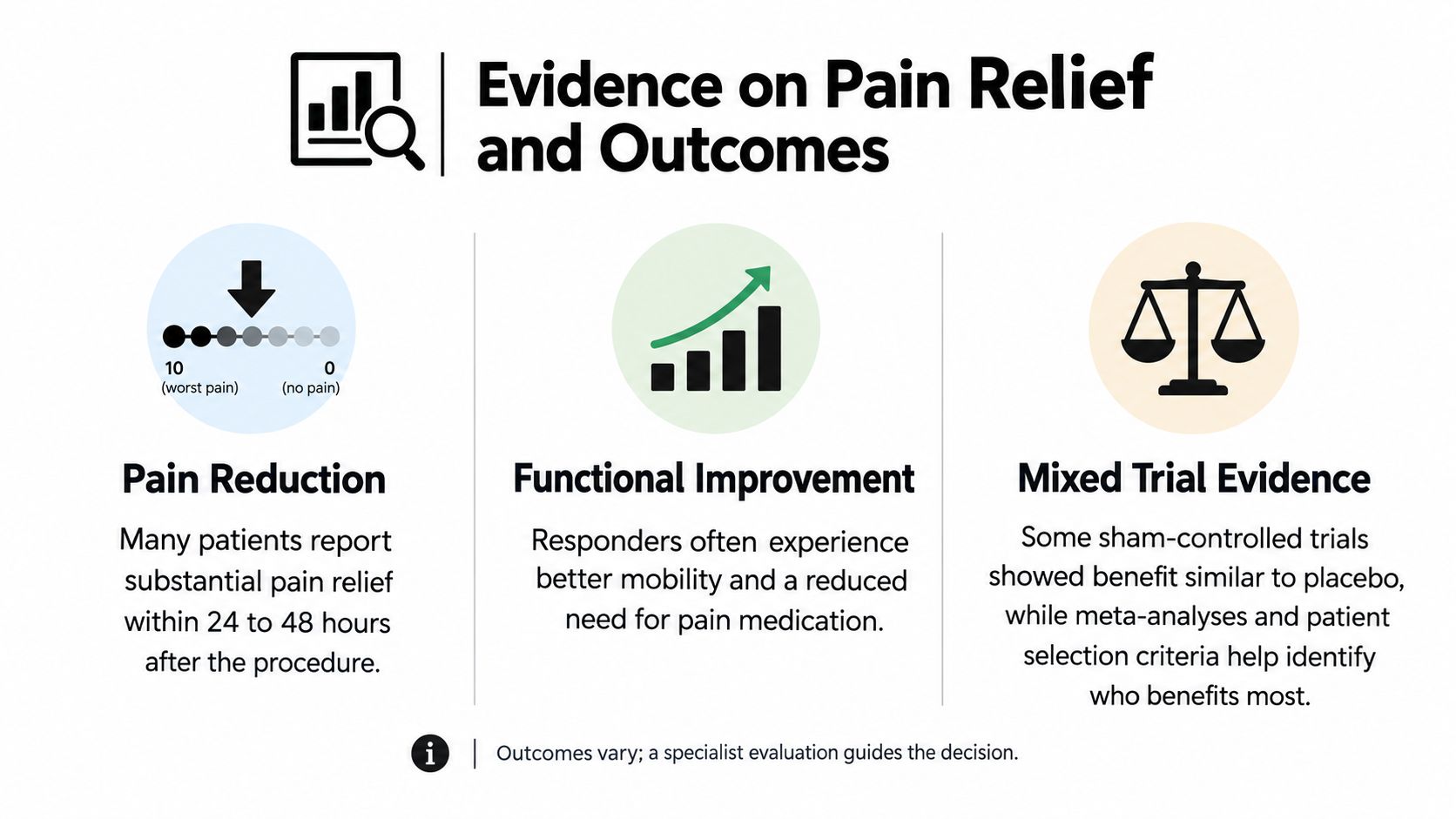
Patients usually ask a straightforward question: will this help? The most accurate answer is that some carefully selected patients improve substantially, but the evidence doesn't support automatic augmentation for every osteoporotic compression fracture.
The caution comes largely from sham-controlled research. An updated Cochrane review summarized 21 randomized controlled trials involving 2,862 participants. Its most rigorous comparison included five sham-controlled trials with 541 patients. At one month, vertebroplasty produced only a 6% pain reduction and a 7% improvement in Roland-Morris disability scores compared with sham treatment, changes the reviewers judged not clinically important. The updated Cochrane evidence review found no meaningful routine-treatment advantage for pain, disability, quality of life, or treatment success in acute or subacute osteoporotic fractures.
That doesn't mean no patient benefits. It means the average effect in controlled comparisons was smaller and less certain than early uncontrolled reports suggested. Patients with an incidental, healed, or minimally painful fracture may have little reason to expect meaningful improvement from cement augmentation.
What direct comparisons show
Randomized studies comparing the procedures with each other generally show similar pain and disability outcomes. In one trial, 191 patients were randomized to kyphoplasty and 190 to vertebroplasty, although enrollment ended early. At twelve months, subsequent radiographic fractures occurred in 50 of 140 evaluable kyphoplasty patients and 57 of 131 vertebroplasty patients. At twenty-four months, the figures were 54 of 110 and 64 of 111, respectively. Pain and disability improved similarly, while kyphoplasty took longer to perform and produced fewer cement leakages. The randomized comparison of balloon kyphoplasty and vertebroplasty supports discussing procedural trade-offs rather than promising one technique as a universal winner.
A separate randomized trial of 115 patients also found substantial improvement with both approaches and no statistically significant between-group differences at the measured follow-up points. The trial comparing pain and disability after both procedures reinforces the same clinical message. The procedure choice should reflect the fracture, not a marketing-style assumption that newer or more elaborate automatically means better.
The evidence is also inconclusive regarding new fractures. In the Cochrane review, about 10 of 100 vertebroplasty patients developed a new fracture compared with 7 of 100 receiving placebo or usual care. The estimated difference was 3 percentage points, with uncertainty ranging from 8 percentage points fewer to 13 percentage points more. That uncertainty is why augmentation must be paired with an osteoporosis plan rather than presented as protection from future fractures.
Identifying the Right Candidate for Augmentation
A reasonable candidate usually has a symptomatic fracture confirmed by imaging, pain that remains disabling, and a clinical picture that matches the imaging finding. MRI or other appropriate imaging can help establish whether the fracture is active and distinguish it from an older collapse that may no longer be the pain source.
The evaluation should address:
- Fracture timing: Recent acute or subacute fractures may present differently from chronic, healed deformities.
- Neurologic status: Weakness, numbness, bowel or bladder changes, or signs of spinal cord or nerve compression require careful assessment before augmentation.
- Structural integrity: Posterior-wall disruption, instability, fracture clefts, and deformity can change the risk profile and technique.
- Cause of the fracture: Osteoporosis is common, but malignancy, trauma, and other bone problems may require additional workup.
- Conservative treatment: Medication, activity modification, bracing when appropriate, and other nonoperative measures should be considered unless the clinical situation calls for a different course.
A fracture caused by an unknown or suspected malignancy deserves particular attention. The team may need to identify the primary cancer or obtain additional diagnostic information before treating the vertebra. Neurological compromise may also require surgical or urgent specialist evaluation rather than routine augmentation.
Coverage adds another layer. Medicare's local coverage policy addresses percutaneous vertebral augmentation for osteoporotic compression fractures and ties payment to medical necessity. It cites criteria involving incapacitating pain from an acute or subacute fracture, inability to taper injected opioids or transition to oral opioids within seven days of hospital admission, or intolerable opioid side effects. The Medicare coverage policy makes clear that this is a utilization criterion, not a universal definition or automatic requirement for every patient. Illinois patients should verify rules with their specific insurer.
Integrating Augmentation Into a Comprehensive Pain Plan
Cement can stabilize one fracture, but it doesn't rebuild bone throughout the skeleton. A durable plan addresses the reason the fracture occurred and reduces the chance that untreated osteoporosis will create another painful collapse.
At a Chicago Ridge pain and wellness clinic, augmentation may fit within an opioid-sparing, multimodal plan that includes coordination with primary care, spine specialists, surgeons, and rehabilitation professionals. Midwest Pain & Wellness offers kyphoplasty and vertebroplasty alongside broader interventional pain services, with treatment selected according to the diagnosis and the patient's goals.
What follows stabilization
Bone health care may include:
- Calcium and vitamin D adequacy, based on the patient's nutritional status and clinician guidance.
- Guideline-directed medication, including antiresorptive or anabolic therapy when clinically appropriate.
- Fall-risk reduction, especially for patients with balance, vision, medication, or home-safety concerns.
- Rehabilitation, such as appropriately selected resistance or extension-based exercise once the treating team considers it safe.
- Functional monitoring, including walking tolerance, sleep, medication needs, and the ability to resume daily activities.
The purpose of follow-up is not just to confirm that cement is in place. It's to determine whether pain is improving, whether another condition is contributing to symptoms, and whether the patient can safely progress activity. Recovery guidance for kyphoplasty aftercare should be individualized rather than copied from a generic checklist.

Preparing for Your Consultation at an Illinois Pain Clinic
If you're seeking care near Chicago Ridge, Palos Heights, Palos Hills, Evergreen Park, or Hickory Hills, bring your imaging reports, medication list, prior treatment records, and a clear description of how the pain began. Note what makes the pain worse, whether you can walk and sleep normally, and whether you have weakness, numbness, or other neurological symptoms.
Ask direct questions during the visit:
- Is the fracture active and the likely source of my pain?
- What did the MRI or other imaging show about stability and the posterior wall?
- What conservative treatments should I try, and for how long?
- Why would vertebroplasty or kyphoplasty fit my fracture pattern?
- What are the risks of cement leakage in my case?
- How will we address osteoporosis and prevent another fracture?
- What should I expect during recovery, and which activities should I avoid?
- Does my insurance require specific medical-necessity documentation?
An Illinois pain clinic can also help coordinate records and communication with other clinicians. Midwest Pain & Wellness supports workers' compensation and personal injury cases and maintains weekday access for patients who need an organized evaluation and follow-up plan.
Midwest Pain & Wellness provides individualized evaluation and interventional pain care for vertebral compression fractures, including discussion of whether kyphoplasty or vertebroplasty is appropriate. Visit Midwest Pain & Wellness to request an appointment in Chicago Ridge and bring your imaging and treatment history for a focused consultation.