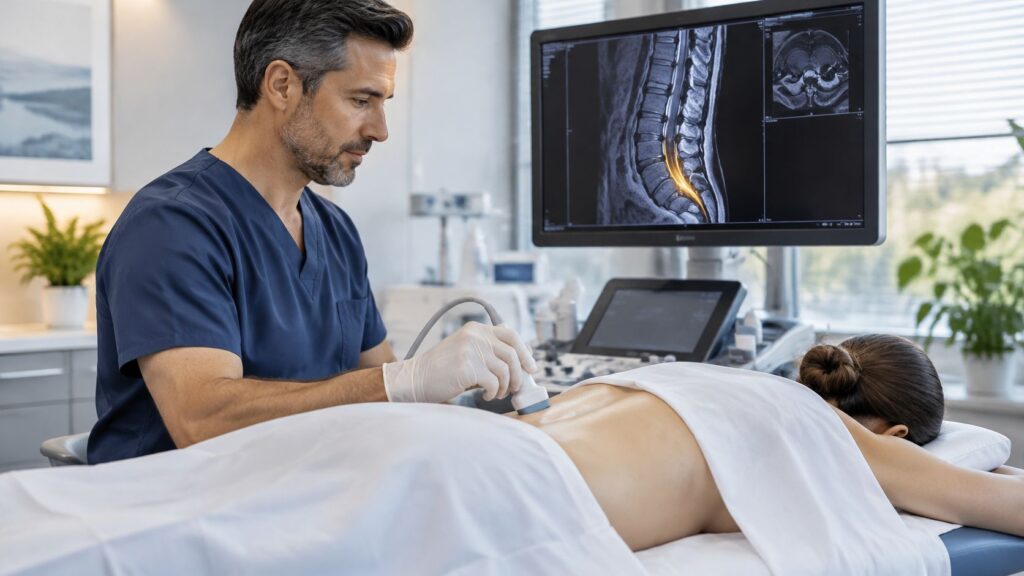
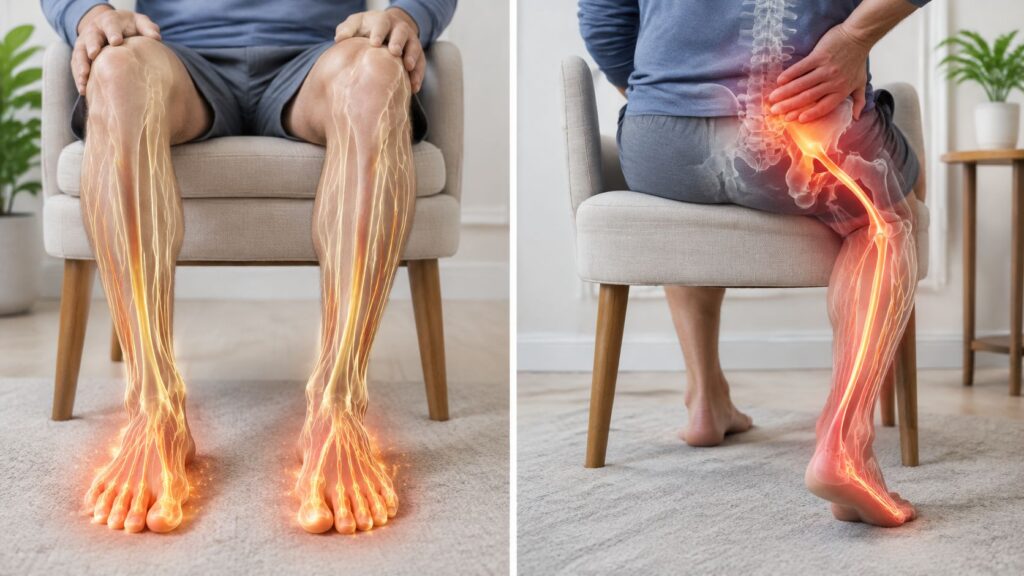
Low back pain from degenerative disc disease usually doesn’t start with one dramatic moment. It builds. First, it’s stiffness when you get out of the car. Then it’s pain after grocery shopping, trouble sitting through work, and that constant calculation before every errand: how bad will my back be afterward?
Many adults around Chicago Ridge and nearby suburbs end up in that cycle. They’ve tried rest, heat, stretches they found online, and maybe a short course of medication. Some improve for a while, then flare again. Others start worrying about the next step because they don’t want to live on opioids and they don’t want surgery unless necessary.
That’s the right instinct. The best treatment for degenerative disc disease is rarely one treatment. It’s usually a personalized treatment ladder that starts with conservative care, moves to targeted interventional procedures when needed, and only considers surgery or newer restorative options in the right clinical setting.
Navigating Back Pain from Degenerative Disc Disease in Illinois
A patient from Palos Hills or Worth might describe degenerative disc disease the same way: “Some days I can function. Some days tying my shoes hurts.” That pattern matters. DDD often causes a mix of mechanical back pain, stiffness, reduced tolerance for sitting or standing, and occasional radiating symptoms depending on what else is happening around the disc, joints, and nerves.

What patients usually feel
DDD is a wear-related condition of the spinal discs. The disc loses some of its normal shock-absorbing function, and nearby structures can become painful too. That’s why one person feels central low back pain, while another feels pain into the buttock or leg.
Common patterns include:
- Morning stiffness that improves slowly, then returns after too much activity
- Pain with bending, lifting, or prolonged sitting
- Flare-ups after routine tasks like laundry, shopping, or yard work
- Good days and bad days that make people feel like they’re never fully in control
That unpredictability is frustrating. It also pushes some patients toward treatments that numb pain briefly without addressing function.
Why opioid-sparing care matters
One of the most overlooked parts of DDD care is the long view. Patients don’t just want short-term pain relief. They want a plan they can live with. A Cleveland Clinic background summary notes an underserved angle in DDD care: the limited coverage of long-term outcomes and risks of opioid-sparing multimodal treatment compared with traditional opioid-based management. That same summary references a 2022 Journal of Translational Medicine study in which more than 60% of 75 patients achieved more than 50% pain reduction and improved mobility at 6 months with intradiscal stem cell injections, supporting interest in restorative options alongside treatments such as PRP, spinal cord stimulation, and MILD (https://my.clevelandclinic.org/health/diseases/16912-degenerative-disk-disease).
The goal in DDD care isn’t just to reduce pain this week. It’s to improve function without creating a second problem through dependency, sedation, or loss of mobility.
If you’re trying to sort through symptoms, the range of related conditions is broader than many people realize. Midwest Pain & Wellness lists the spine, nerve, and musculoskeletal problems they evaluate at https://midwestpainandwellness.com/conditions-we-treat/.
Starting Your Journey with Conservative Treatments
Before discussing procedures, it’s important to say this clearly: conservative treatment is the first step for most patients with degenerative disc disease. That isn’t a brush-off. It’s the standard because it works for many people and because a strong foundation improves outcomes if you later need injections or other interventions.
Hospital for Special Surgery guidance identifies non-surgical care as the cornerstone of treatment, and notes that up to 80-90% of patients can find significant relief through a combination of physical therapy, NSAIDs, and targeted injections, helping many avoid surgery and opioid risks (https://www.hss.edu/health-library/conditions-and-treatments/list/degenerative-disc-disease).
| Treatment step | Main purpose | Best fit | Limits |
|---|---|---|---|
| Activity modification | Reduce repeated aggravation | Early flare-ups, overuse patterns | Too much avoidance can weaken the spine |
| Physical therapy | Improve strength, movement, and support | Most patients with mechanical back pain | Needs consistency and the right program |
| Non-opioid medication | Calm inflammation or pain during flares | Short-term symptom control | Doesn’t fix the pain generator by itself |
| Targeted injections | Diagnose and treat deeper pain sources | Persistent pain despite the basics | Relief can be temporary depending on the source |
Physical therapy is not passive
A good therapy program isn’t just heat, stretching, and hoping for the best. It should work on core strength, hip mobility, lumbar control, posture, and movement tolerance. Patients often feel better when the muscles around the spine stop overworking to protect an irritated segment.
The point is not to “cure the disc” through exercise. The point is to make the whole system function better.
Medication should support activity, not replace it
Non-opioid medications can be useful during flare-ups. Depending on the patient, that may include an anti-inflammatory, acetaminophen, or a medication chosen for nerve-related pain. The role of medication is support. If a treatment plan is built around pills alone, it usually stalls.
In practice, the better question is not “What medication is strongest?” It’s “What helps me move, sleep, and participate in treatment safely?”
Daily habits matter more than many people expect
Individuals with DDD don’t need to stop living. They do need to stop repeating the exact movements and loads that keep triggering pain.
Try to identify:
- Positions that trigger symptoms such as long car rides or slumped sitting
- Tasks that need modification like lifting from the floor with rotation
- Recovery habits including walking, pacing activity, and avoiding all-day bed rest
Practical rule: If a patient can’t tolerate normal movement patterns, the plan should focus on restoring tolerance first, not skipping straight to the most aggressive option.
Coordination improves care
A pain clinic is not a physical therapy office, but pain treatment works better when providers coordinate. That may include communication with primary care, chiropractors, physical therapists, and surgeons when needed. The best treatment for degenerative disc disease often comes from that shared view of what’s driving the pain and what has already failed.
Comparing Interventional Pain Management Options
When conservative care helps but doesn’t get you far enough, interventional pain management becomes the next step. Here, precision matters. A useful procedure matches the actual pain generator. An unhelpful procedure usually means the diagnosis was incomplete, the target was wrong, or the treatment was expected to do something it was never designed to do.
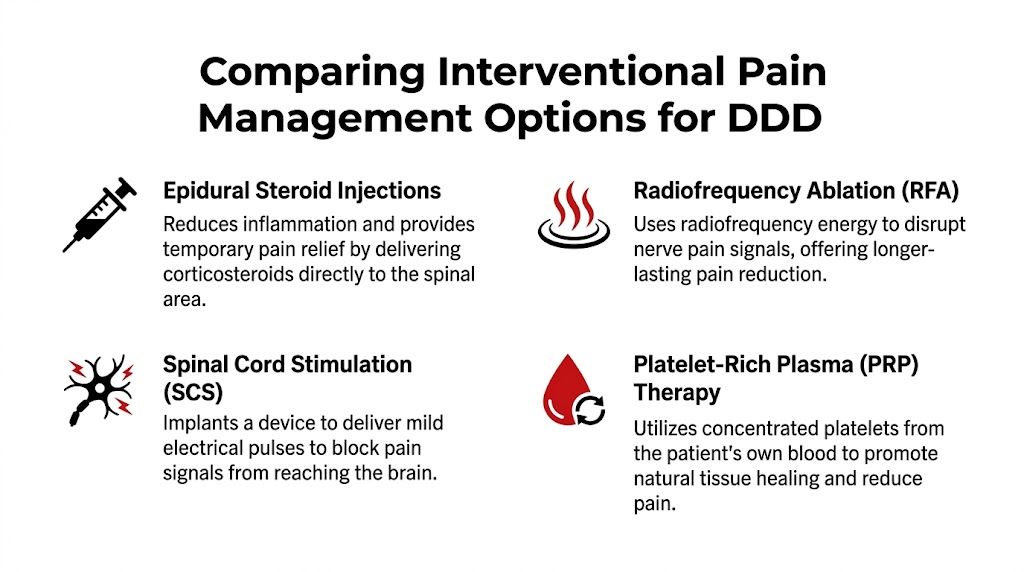
A practical overview of procedure options offered in interventional pain settings, including injections, nerve procedures, stimulation, and minimally invasive decompression, appears at https://midwestpainandwellness.com/procedures-we-use-for-treatment/.
Quick comparison of common options
| Procedure | What it targets | When it helps most | What patients should know |
|---|---|---|---|
| Epidural steroid injection | Inflamed spinal nerve roots | Leg pain, nerve irritation, stenosis-related symptoms | Better for radiating pain than isolated central low back pain |
| Facet or medial branch block | Facet joints and their nerve supply | Pain worse with standing, extension, rotation | Often used diagnostically before RFA |
| Radiofrequency ablation | Medial branch nerves | Confirmed facet-mediated pain | Meant for joint pain, not every kind of disc pain |
| Spinal cord stimulation | Pain signal processing | Selected chronic pain cases after other care fails | Typically considered later, after careful evaluation |
| Peripheral nerve stimulation | Specific peripheral pain pathways | Focal pain syndromes in selected cases | Target depends on symptom pattern |
| MILD or Vertiflex | Stenosis-related compression | Patients with neurogenic claudication or walking intolerance | Best when anatomy matches the procedure |
Image-guided injections
For many DDD patients, the first procedure isn’t surgery. It’s an injection designed either to reduce inflammation or identify the painful structure more precisely.
Epidural steroid injections
An epidural steroid injection places anti-inflammatory medication near irritated spinal nerves. This can be especially useful when disc degeneration is part of a bigger picture that includes disc bulging, narrowing, or nerve irritation.
Good candidates often report:
- Pain traveling into the buttock or leg
- Burning, tingling, or electrical symptoms
- Worse pain with sitting, coughing, or certain bending motions
This procedure is less useful when the pain is purely central low back pain with no clear nerve inflammation component. That mismatch is common. If the pain source is the facet joints, SI joint, or disc itself, an epidural may not be the right answer.
Facet blocks and medial branch blocks
The facet joints are small joints in the back of the spine. They often become painful alongside disc degeneration because the segment’s mechanics change over time. Facet pain usually feels more localized and mechanical. Patients may hurt more with standing upright, twisting, or extending backward.
A facet joint injection or a medial branch block can help answer an important question: are the facet joints causing the pain?
If temporary numbing of the medial branch nerves sharply reduces pain, that result can support moving to radiofrequency ablation.
These blocks are valuable because they prevent guessing. They help separate facet-mediated pain from discogenic pain, nerve root pain, and SI joint pain.
Nerve-directed treatments
When a clear nerve target is found, the next step may involve longer-acting procedures.
Radiofrequency ablation
Radiofrequency ablation, sometimes called radiofrequency neurotomy, uses heat generated by radiofrequency energy to interrupt pain signals from selected sensory nerves. In the lumbar spine, that usually means the medial branch nerves that carry pain from the facet joints.
Cleveland Clinic identifies radiofrequency neurotomy as one of the non-surgical treatment options used to block pain signals in degenerative disc disease care, alongside medications, therapy, and steroid injections. Their DDD guidance also emphasizes that physical therapy commonly focuses on strengthening and stretching as part of the larger treatment plan (https://my.clevelandclinic.org/health/diseases/16912-degenerative-disk-disease).
RFA tends to work best when:
- The pain is mostly axial low back pain
- Facet blocks were clearly positive
- The patient has failed appropriate conservative care
- The pain pattern fits facet loading rather than nerve compression
RFA is not a universal DDD treatment. It does not repair the disc. It does not treat every source of back pain. It can, however, be very effective for the right patient because it targets a specific pain pathway rather than treating the whole spine as one problem.
Spinal cord stimulation and peripheral nerve stimulation
These therapies occupy a different category. They don’t remove the structural problem. They alter how pain signals are processed or delivered.
Spinal cord stimulation is generally considered when pain has become persistent and disabling despite other reasonable treatments. It may be relevant for selected patients with chronic spine-related pain, especially when surgery isn’t appropriate or prior surgery didn’t solve the pain problem.
Peripheral nerve stimulation can be useful in more focal pain patterns where a specific peripheral nerve target makes sense.
These are not first-step treatments for typical early DDD. They are later-stage options in a carefully selected patient.
Minimally invasive decompression procedures
Not every patient with disc degeneration has pure disc pain. Many have lumbar spinal stenosis layered on top of degenerative changes. That changes the treatment conversation.
MILD
Minimally Invasive Lumbar Decompression, commonly called MILD, is designed for patients with stenosis-related symptoms, especially neurogenic claudication. These patients often say:
- “I can’t walk very far before my back or legs tighten up.”
- “I lean on the shopping cart and that helps.”
- “Standing still is worse than sitting down.”
That profile is very different from isolated discogenic back pain. MILD is aimed at relieving pressure from thickened ligament and narrowed spinal canals in the right patient.
Vertiflex
Vertiflex Superion is another minimally invasive option for selected stenosis patients. It acts as an indirect decompression device and is usually considered when symptom relief is needed without moving straight to more extensive surgery.
The key issue with both MILD and Vertiflex is fit. They are useful when the anatomy and symptom pattern match. They are not a substitute for a proper diagnosis.
What tends not to work well
Patients often ask what fails most often. In my view, three problems show up again and again.
- Treating the MRI instead of the patient. Many adults have degenerative changes on imaging. The scan matters, but the symptom pattern matters just as much.
- Repeating a procedure that never really helped. If the first injection didn’t match the diagnosis, doing the same thing again usually won’t solve it.
- Using opioids as the long-term strategy. That may dull pain temporarily, but it doesn’t restore mechanics, calm the correct target, or improve function in a durable way.
Exploring Advanced Surgical and Regenerative Solutions
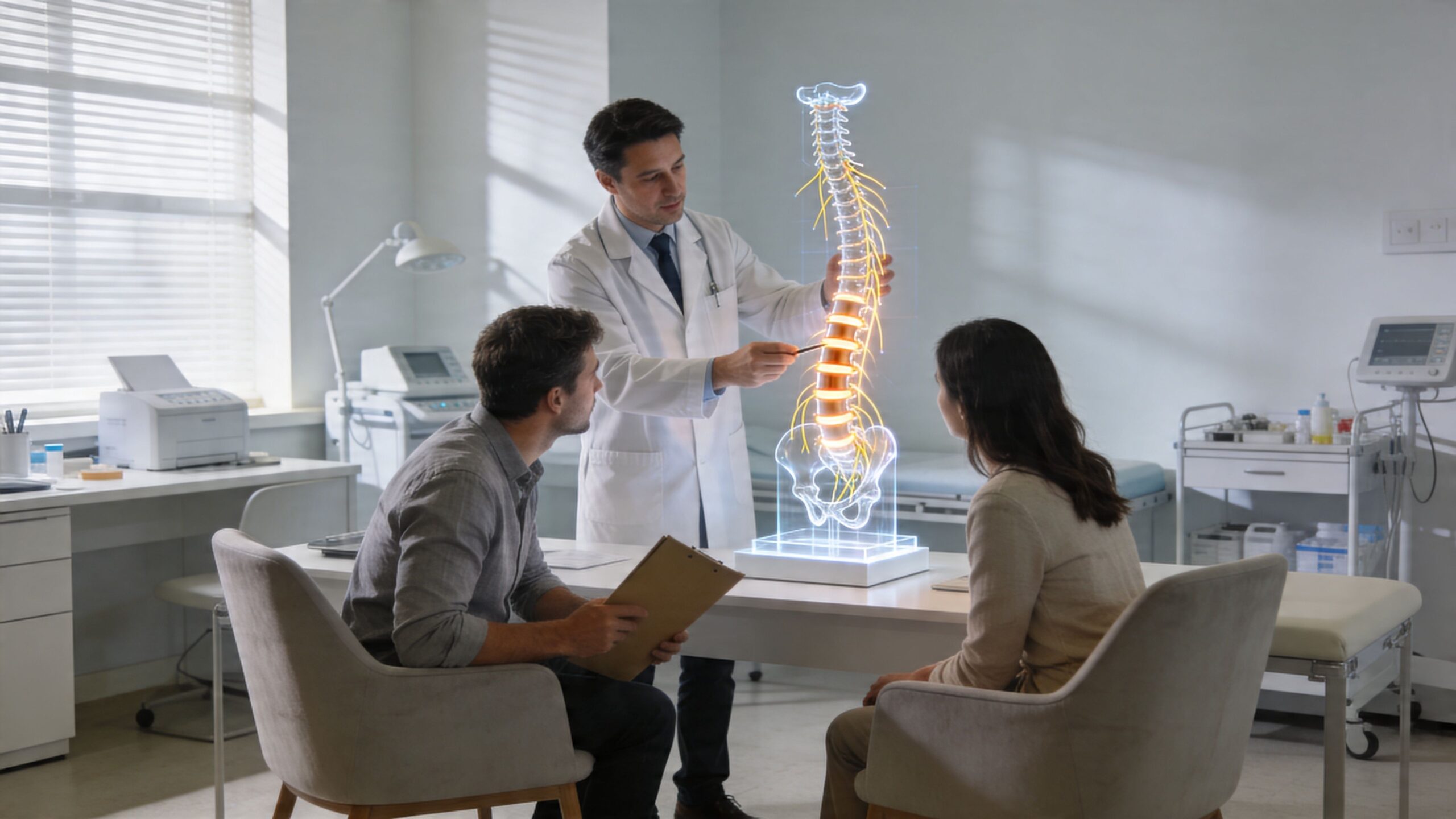
Some patients do everything right and still have significant pain or loss of function. At that point, the conversation may shift toward surgery or restorative therapies. These options need a sober review. They can help the right person, but they aren’t interchangeable.
Fusion and artificial disc replacement
For surgical candidates, one of the biggest distinctions is stability versus motion preservation.
Fusion aims to stop motion at a painful spinal level. In selected patients, that can reduce pain tied to instability or severe degenerative change. The trade-off is obvious. The fused segment no longer moves, so forces shift to adjacent levels.
Artificial disc replacement tries to preserve motion rather than eliminate it. That makes it especially interesting for active patients with carefully selected single-level disease.
A network meta-analysis of six randomized controlled trials involving 1417 patients with single-level lumbar degenerative disc disease found that the activL artificial disc replacement demonstrated superior efficacy compared with lumbar fusion and conservative care across outcomes including Oswestry Disability Index success, back pain reduction, and patient satisfaction. Employment outcomes were comparable, and reoperation rates did not show significant differences (https://pubmed.ncbi.nlm.nih.gov/29542364/).
That does not mean every patient should have artificial disc replacement. It means the option deserves serious discussion when the anatomy, age, symptom pattern, and surgical candidacy line up.
Surgery is usually not first
Patients with DDD typically should not start with a fusion consult. Surgery generally enters the picture after appropriate conservative and interventional care has failed, or when structural pathology and symptoms clearly justify it.
Good surgical decision-making asks:
- Is the pain source well identified?
- Is there instability, nerve compression, or structural failure that non-surgical care won’t correct?
- Is the patient trying to solve pain, neurologic loss, or both?
- Is motion preservation realistic, or is stabilization more appropriate?
A technically successful surgery can still disappoint if the wrong structure was blamed for the pain.
Regenerative and restorative options
This area gets a lot of attention, and patients deserve a balanced explanation. Some regenerative approaches are promising. None should be sold as magic.
PRP and cell-based treatments
Platelet-rich plasma and cell-based intradiscal treatments are being used in selected settings with the goal of reducing pain and supporting a more restorative response. These approaches may be considered when standard conservative care has failed and the patient wants to explore options short of surgery.
The evidence remains mixed across spine applications, and patient selection is critical. In practice, these treatments make more sense when imaging, symptom location, and exam findings point toward a disc-related pain source rather than widespread arthritic pain, severe instability, or major stenosis.
VIA Disc NP
One restorative option that has drawn interest is VIA Disc NP, an intradiscal allograft supplementation procedure using cryopreserved nucleus pulposus tissue. A clinical summary discussing this treatment reports that 80% of patients avoided repeat injections over 3-5 years post-procedure, with sustained pain and function improvements described in treated cohorts (https://www.hchcares.org/blog/degenerative-disc-treatments/).
That kind of result is encouraging, but it still has to be placed in context. A patient with severe stenosis, major instability, or a pain pattern dominated by facet joints may not be the right candidate. Restorative procedures require diagnosis discipline. They are not broad replacements for every other treatment.
What patients should keep in mind
Advanced treatment is about matching the intervention to the problem.
- If the main issue is motion-sensitive disc pain in a selected surgical candidate, artificial disc replacement may deserve review.
- If the main issue is severe instability or a structural problem needing stabilization, fusion may be more appropriate.
- If surgery feels premature but the pain appears disc-driven, regenerative options may enter the conversation.
- If another structure is causing pain, none of these options should be rushed.
Creating Your Personalized Treatment Pathway
Patients often ask for a single answer to the question, “What is the best treatment for degenerative disc disease?” The honest answer is that the best treatment depends on which tissue hurts, how long it has hurt, what has already failed, and what your goals are.
A useful treatment pathway works like a decision tree.
Common symptom patterns and next steps
If your pain is mostly low back stiffness and mechanical pain without major leg symptoms, the first step is usually conservative care focused on movement, strength, activity modification, and non-opioid medication support.
If your pain travels into the leg, especially with burning, numbness, or tingling, evaluation should focus on whether nerve irritation is part of the problem and whether an epidural approach makes sense.
If your pain is localized across the low back and worsens with standing upright, twisting, or extension, facet joint evaluation may be more useful than repeating general pain treatment.
If you can stand only briefly or need to lean forward on a cart to walk farther, the pattern may fit lumbar stenosis, which opens the door to decompression-oriented options rather than disc-only treatment.
A practical treatment ladder
Confirm the diagnosis
Imaging helps, but the pain story and physical exam are just as important. Many patients have more than one pain generator.Build the base
Conservative care remains essential even if a procedure is likely. Better movement and conditioning improve tolerance and recovery.Use diagnostic precision
Injections are not only treatment. They can also clarify whether the disc, nerve root, facet joint, or another structure is the main pain source.Escalate only when the target is clear
RFA should follow a convincing facet pattern and diagnostic blocks. Decompression should fit stenosis symptoms. Stimulation should be reserved for selected chronic cases.Reassess function, not just pain scores
Better sleep, walking, sitting tolerance, and reduced flare frequency often matter more than chasing complete pain elimination.
How patients in Illinois can think about timing
A patient in Oak Lawn, Palos Heights, or Orland Park doesn’t need to wait until pain becomes unbearable to get evaluated. Early evaluation is useful when:
- Pain keeps returning despite reasonable home care
- Work, driving, or sleep are consistently affected
- Leg symptoms are appearing
- You’re relying more and more on medication
- You’ve already done therapy or chiropractic care without a clear diagnosis
The right next step is not always a procedure. Sometimes the most valuable visit is the one that prevents the wrong procedure.
Your Next Steps for DDD Treatment Near Chicago Ridge
If you live near Chicago Ridge and you’re trying to figure out what to do next, start with this mindset: you don’t need to choose between doing nothing and having surgery. There’s a large middle ground where targeted, opioid-sparing treatment can help.

That middle ground may include image-guided injections, facet interventions, radiofrequency ablation, spinal cord or peripheral nerve stimulation, MILD, Vertiflex, or regenerative options such as PRP and cell-based therapies when clinically appropriate. The key is sequencing. Not every patient needs every step.
Midwest Pain & Wellness in Chicago Ridge provides this kind of interventional, opioid-sparing evaluation and treatment approach for spine and nerve pain, with coordination across other providers when needed. If you’re ready to discuss a customized plan, appointments can be requested at https://midwestpainandwellness.com/appointments/.
Whether you’re in Oak Lawn, Palos Hills, Palos Heights, Worth, Bridgeview, Hickory Hills, Alsip, Burbank, Evergreen Park, or Orland Park, experienced pain management care is close by. A good consultation should leave you with a clearer diagnosis, a realistic treatment ladder, and a better sense of what’s worth trying next.
Frequently Asked Questions About DDD Treatment
Can degenerative disc disease be cured
Usually, treatment focuses on management and function, not a complete reversal of age-related disc change. Many people do very well when the painful structure is identified and treated appropriately, but the broader goal is durable symptom control and better daily activity.
How long does it take to recover from a minimally invasive procedure
That depends on the procedure and the patient. In general, injections involve relatively quick recovery, while radiofrequency ablation may cause a short post-procedure soreness period before benefit becomes clearer. Implant-based procedures or decompression procedures usually involve a more structured recovery plan.
The right question to ask is not only “How many days until I feel normal?” Ask, “What should improve first, and what restrictions matter?”
How do I know if my pain is from the disc, facet joints, or something else
The pattern often gives clues, but symptoms overlap. Disc pain is often mechanical and central. Facet pain often worsens with extension and rotation. Nerve pain tends to travel, burn, or tingle. Stenosis often limits walking and improves with leaning forward.
That’s why a careful history, exam, imaging review, and sometimes diagnostic injections matter so much.
Will insurance cover treatment
Coverage varies by plan and by procedure. Commonly used treatments such as imaging, therapy, many injections, and some interventional procedures are often handled differently than newer regenerative options. Workers’ compensation and injury-related care may also follow different approval pathways.
A reputable clinic should help clarify what usually requires prior authorization and what questions to ask before scheduling.
When should I think about surgery
Think about surgery when pain remains disabling despite appropriate conservative and interventional care, or when structural findings and symptoms clearly support it. Progressive neurologic symptoms, major functional decline, or confirmed pathology that doesn’t fit non-surgical treatment may also change the timeline.
Are opioids the best treatment for degenerative disc disease
For most chronic DDD cases, no. Opioids may have a limited short-term role in selected situations, but they do not correct the underlying mechanics or identify the pain generator. Long-term plans usually work better when they focus on function, targeted procedures when indicated, and coordinated non-opioid care.
If degenerative disc disease is limiting your work, sleep, or daily routine, Midwest Pain & Wellness can help you understand what’s driving the pain and what treatment path makes sense next. Schedule an evaluation to discuss a personalized, opioid-sparing plan for lasting relief and better function.