Understanding Botox: A Treatment That Combines Art and Science
How is botox administered is a common question for first-time patients, especially when you want natural-looking results and a safe, predictable experience. Here is the streamlined process:
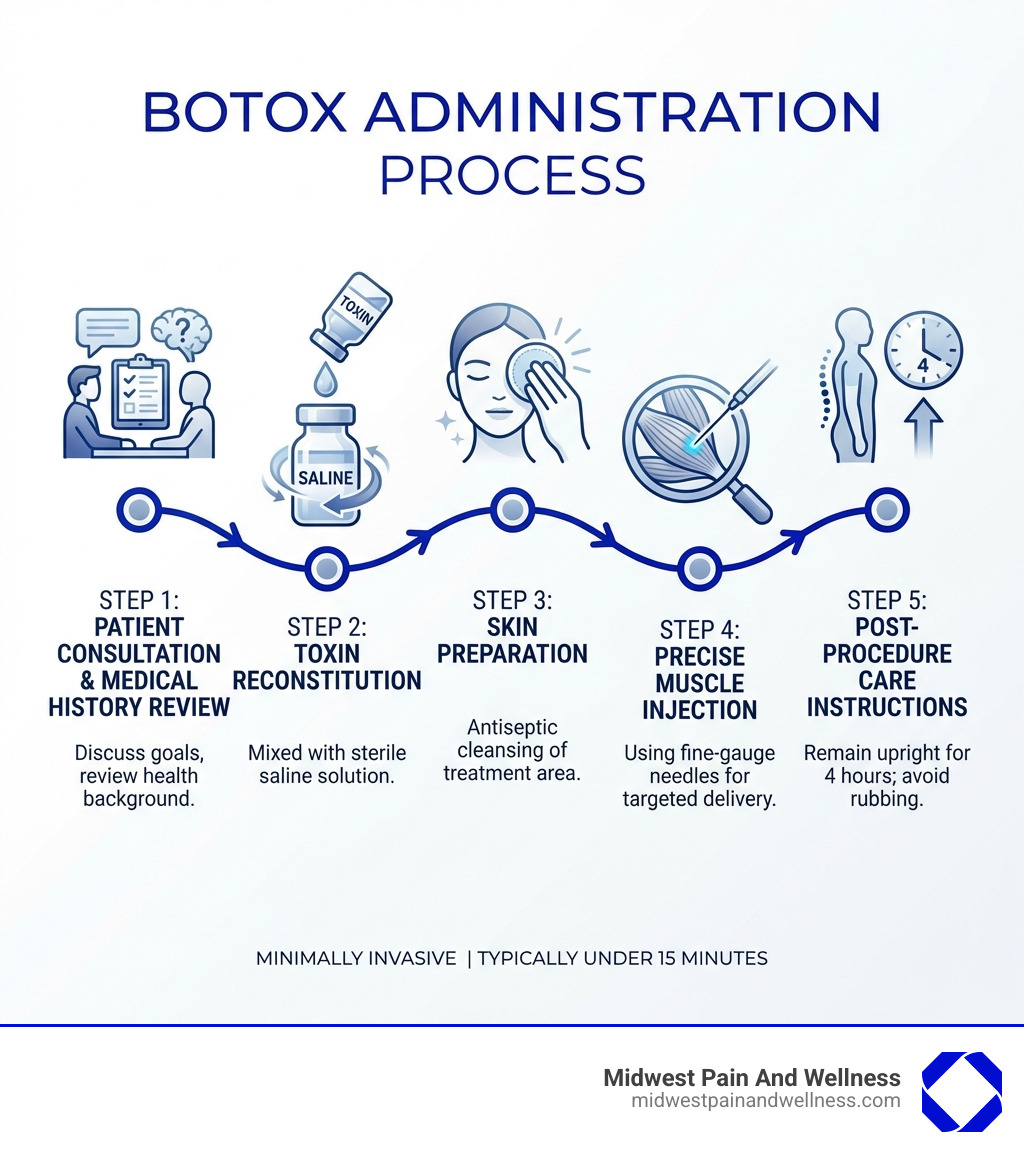
- Consultation – Review of medical history, medications, prior toxin exposure, and your goals.
- Preparation – Reconstitution of the toxin with sterile saline to a known concentration.
- Cleansing – The area is sanitized with alcohol.
- Injection – Precise delivery using a fine 30-32 gauge needle.
- Post-Care – Instructions to stay upright and avoid rubbing the area.
The procedure usually takes under 15 minutes with minimal discomfort, and most patients return to normal daily activities right away.
Botox administration is a quick, minimally invasive clinical treatment. It involves injecting tiny amounts of purified botulinum toxin into specific muscles using needles similar to those used for insulin. As experts note, it is both an art and a science requiring an experienced professional.
The “art” involves understanding the 43 facial muscles and their interactions, including how one muscle group can compensate for another (which is why injector technique matters as much as the medication itself). The “science” is the precise depth and dosage required, plus an understanding of anatomy, symmetry, and how diffusion can vary slightly from person to person. When done correctly, Botox weakens wrinkle-producing muscles while preserving natural expressions.
The administration technique varies by condition and by anatomy. Cosmetic applications typically target superficial facial muscles responsible for dynamic expression lines. For chronic migraines, the protocol involves 155 units across 31 sites in specific head and neck muscle groups. For excessive sweating, it is injected just under the skin to block sweat gland signals.
At Midwest Pain And Wellness, our focus is not only appearance-related concerns, but also therapeutic uses that can improve quality of life. For example, patients seeking chronic migraine relief often come in after trying multiple options and wanting an opioid-free approach with evidence-based protocols and careful follow-up.
I’m Dr. Yaw Donkoh, a double board-certified physician at Midwest Pain And Wellness. I’ve administered countless treatments, focusing on how is botox administered for chronic migraine relief to transform patient lives. Whether you are new to neurotoxin treatments or have had them before, the goal is always the same: accurate placement, conservative dosing when appropriate, and a plan that matches your symptoms and goals.
Understanding the Science: How Botox Works
Botox is a purified form of Botulinum Toxin Type A. While “toxin” sounds intense, medical versions are highly purified and used in therapeutic doses.
What is Botulinum Toxin? It is a prescription medicine that temporarily blocks nerve signals. How does Botox work to reduce wrinkles? Facial expressions involve muscle contractions that etch lines over time. Botox targets these muscles, preventing the release of acetylcholine—the neurotransmitter that signals muscles to contract. This results in temporary chemical denervation, allowing the skin to smooth out for three to four months.
For more on these mechanisms, see Scientific research on Botulinum Toxin mechanisms.
Available Formulations:
- Botox® (onabotulinumtoxinA): The industry standard.
- Dysport® (abobotulinumtoxinA): Often has a faster onset and wider diffusion.
- Xeomin® (incobotulinumtoxinA): A “naked” neurotoxin without complexing proteins.
- Jeuveau® (prabotulinumtoxinA): A newer Type A option.
These products differ in onset (2-5 days), diffusion (Dysport spreads more), and potency units, which are not interchangeable.
The Clinical Procedure: How is Botox Administered Step-by-Step?
At Midwest Pain And Wellness in Chicago Ridge, we prioritize safety and comfort. Here is how is botox administered in our clinic.
The process begins with a consultation to review medical history and goals. We then perform facial mapping, asking you to make expressions to identify target muscles. The skin is cleansed with alcohol to prevent infection.

| Feature | Botox | Dysport | Xeomin |
|---|---|---|---|
| Onset | 3-5 days | 2-3 days | 3-5 days |
| Duration | 3-4 months | 3-4 months | 3-4 months |
| Diffusion | Localized | Wider | Localized |
For migraine patients, this is part of a broader strategy. See More info about migraine pain management.
Reconstitution and Preparation
Botox arrives as a vacuum-dried powder. It must be reconstituted with sterile 0.9% sodium chloride (saline). The dilution ratio determines the concentration, which is vital for accurate dosing. We gently swirl the vial to mix, avoiding vigorous shaking that could denature the protein. Reconstituted toxin is typically used within 24 hours.
Injection Technique and Depth
We use 30-32 gauge needles to minimize discomfort. How is botox administered regarding depth depends on the target:
- Intramuscular: For deep wrinkles or large muscles (e.g., Masseter).
- Subcutaneous: For superficial lines (e.g., Crow’s feet).
- Intradermal: For sweat glands (Hyperhidrosis).
Specific depths include 2-3 mm for frown lines and 1-2 mm for crow’s feet. Precision is required to avoid complications like eyelid ptosis. For more on injection depths, see Scientific research on muscle depth for injections.
Precision Targeting: How is Botox Administered for Medical Conditions?
Botox is a powerful therapeutic tool for conditions like chronic migraines, cervical dystonia, and hyperhidrosis. How is botox administered for medical needs involves specific FDA-approved protocols.
Specialized Protocols for Chronic Migraine Relief
The protocol for chronic migraine involves 155 units divided into 0.1 mL (5 Units) injections across 31 sites in the head and neck:
- Forehead/Brows: Procerus, Corrugator, and Frontalis muscles.
- Sides/Back: Temporalis and Occipitalis muscles.
- Neck/Shoulders: Trapezius and Cervical Paraspinal muscles.
Retreatment occurs every 12 weeks. Learn More info about Botox for Chronic Migraine.
Managing Hyperhidrosis and Muscle Spasticity
For axillary hyperhidrosis, 50 units per armpit are injected intradermally across 10-15 sites. This blocks acetylcholine near sweat glands to stop excessive sweating for several months.
For limb spasticity, doses range from 75 to 400 units. We often use EMG guidance or nerve stimulation to ensure the toxin reaches the specific stiff muscles, maximizing relief and safety.
Post-Procedure Care: Ensuring Safety and Results
Aftercare is vital for optimal results. We advise staying upright for 4 hours and avoiding rubbing the treated area to prevent the toxin from migrating.
Timeline and Longevity
- Onset: 1-3 days.
- Peak Effect: 2 weeks.
- Duration: 3-4 months.
- Maintenance: Repeat treatments are recommended every 3-4 months.
How is Botox Administered to Minimize Risks?
Safety is our priority. We use anatomical knowledge to avoid the orbital rim, preventing eyelid ptosis. To reduce bruising, patients should avoid blood thinners (aspirin, NSAIDs) before treatment. If a vessel is punctured, we apply immediate pressure. For more, see Scientific research on managing post-injection bruising. In rare cases of asymmetry or ptosis, corrective injections or eye drops like apraclonidine can be used.
Botox vs. Dermal Fillers: Choosing the Right Treatment
| Feature | Botox | Dermal Fillers |
|---|---|---|
| Mechanism | Relaxes muscles | Adds volume |
| Primary Use | Dynamic wrinkles | Static lines/Volume loss |
| Duration | 3-4 months | 6 months – 2 years |
Botox treats lines caused by movement (frown lines), while fillers “fill in” lines present at rest (nasolabial folds) and restore volume to cheeks or lips. We can help you decide which is best for your goals.
Frequently Asked Questions about Botox Administration
Does the administration of Botox hurt?
Most patients feel minimal discomfort. We use micro-needles and offer topical numbing or ice to further reduce the quick pinching sensation. The process takes less than 15 minutes.
If you are prone to bruising or sensitive to injections, let your provider know during the consultation. Comfort measures can include:
- Ice before and after treatment
- Topical anesthetic when appropriate
- Slower injection technique and smaller aliquots in sensitive areas
Can Botox be administered during pregnancy or breastfeeding?
No. Botox is FDA Category C for pregnancy, and its effects on breast milk are unknown. We recommend waiting until after childbirth and breastfeeding to resume treatment.
Contraindications include:
- Allergies to ingredients.
- Active infection at the site.
- Neuromuscular disorders (ALS, Myasthenia Gravis).
- Interactions with certain antibiotics.
If you have a history of facial surgery, eyelid droop, swallowing issues, or significant neck weakness, mention this during your visit so the injector can adjust the plan or recommend alternatives.
How are the specific doses determined?
Dosing is personalized based on muscle mass, wrinkle depth, gender, and previous response. Men often require higher doses due to stronger muscles. For migraines, we follow the strict 155-unit protocol.
For cosmetic treatment areas, dosing is often refined over time. At follow-up, we may discuss:
- Whether the effect was strong enough or too strong
- How long the result lasted for you (some patients metabolize neurotoxin faster)
- Whether a small touch-up is appropriate (depending on timing and clinical judgment)
Insurance Coverage: Insurance often covers Botox for medical conditions like migraines or hyperhidrosis. Cosmetic use is typically out-of-pocket. Our Chicago Ridge team assists with medical insurance claims.
What should I avoid after Botox is administered?
To reduce the risk of unwanted spread and to optimize results, we typically recommend:
- Stay upright for 4 hours after treatment
- Avoid rubbing or massaging the treated area for the rest of the day
- Avoid strenuous exercise for 24 hours
- Avoid facials or aggressive skin treatments over injection sites for at least 24-48 hours
Your provider will tailor aftercare to the specific areas treated (for example, forehead lines vs. migraine protocol sites).
When should I call the clinic?
Mild redness, tenderness, or a small bruise can occur and usually resolves quickly. Contact your provider promptly if you have concerning symptoms such as:
- Significant eyelid droop, vision changes, or worsening asymmetry
- Trouble swallowing, speaking, or breathing
- Signs of infection (increasing redness, warmth, swelling, fever)
While serious side effects are uncommon when Botox is administered correctly, having clear guidance on what is normal vs. not normal is part of a safe treatment experience.
Conclusion
Understanding how is botox administered helps you approach treatment with confidence. From precise reconstitution to expert injection techniques, every step at Midwest Pain And Wellness is designed for your safety and relief.
Our double board-certified doctors in Chicago Ridge, Illinois, provide custom, opioid-free care plans. If you are seeking relief from chronic pain or a refreshed look, we are here to help.
Schedule a consultation for Botox for Chronic Migraine in Chicago Ridge