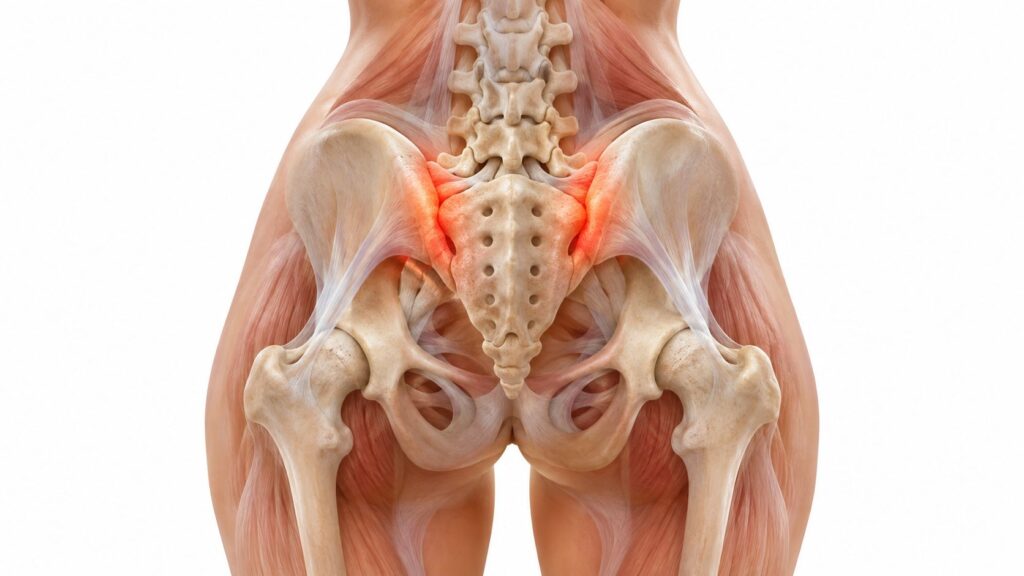
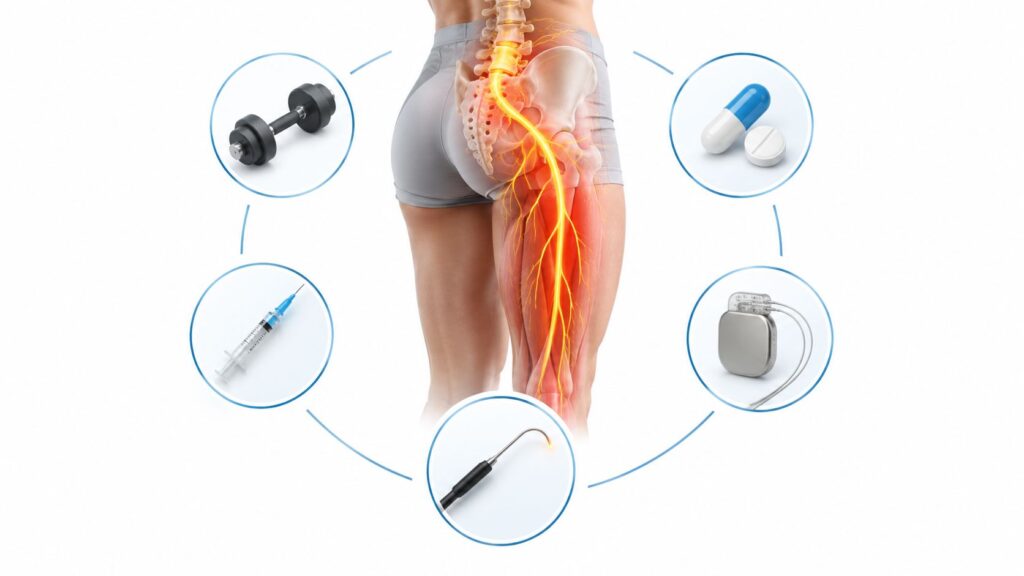
If you're reading this with a heating pad on your neck, rotating between ibuprofen, stretching, and hoping the pain finally lets up, you're not alone. Many people across Chicago Ridge and nearby Illinois communities like Oak Lawn, Palos Hills, Palos Heights, Worth, Bridgeview, Hickory Hills, Alsip, Burbank, Evergreen Park, and Orland Park reach a point where neck pain stops being an occasional nuisance and starts shaping daily life.
That change shows up in small ways first. You avoid backing out of the driveway because turning your head hurts. You sit through work with a stiff upper back and a headache building at the base of your skull. Sleep gets lighter. Driving, lifting, desk work, and even reading become irritating.
For the right patient, prp for neck pain can be a useful next step. It isn't magic, and it isn't the right tool for every diagnosis. But when neck pain is coming from irritated facet joints, injured supporting ligaments, or persistent pain after whiplash, PRP may help calm inflammation and support tissue repair in a way that standard anti-inflammatory injections do not.
What Is PRP and How Does It Heal Neck Pain
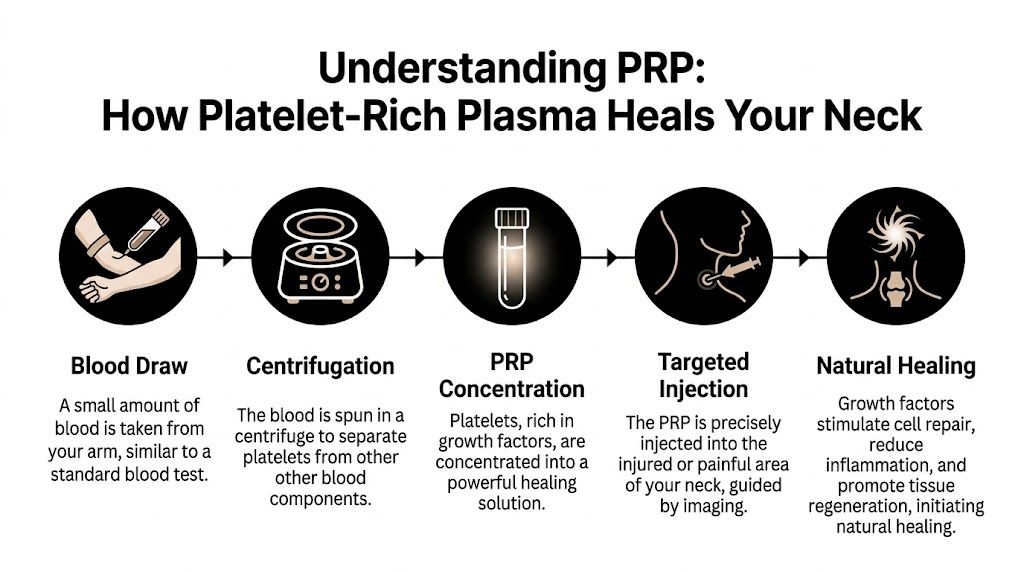
PRP stands for platelet-rich plasma. The simplest way to think about it is this: it’s a concentrated healing portion of your own blood. A small blood sample is drawn, spun in a centrifuge, and the platelet-rich layer is separated so it can be placed precisely where the problem is.
Why platelets matter
Platelets are known for their role in blood clotting. In pain medicine, they matter for another reason. Platelets carry signaling proteins that help coordinate repair. They don't work like a numbing medicine that blocks pain for a few hours, and they don't work like a steroid that tries to suppress inflammation quickly. PRP works more like a biological instruction set. It tells the body where to focus repair activity.
That matters in the neck because neck pain often isn't coming from one big obvious injury. It may come from small facet joints, irritated joint capsules, overstretched ligaments, or a mix of those structures after an accident or repetitive strain.
How PRP fits neck pain specifically
In chronic whiplash-related neck pain, the facet joints and their capsules are common pain generators. A review discussing PRP for chronic whiplash-associated disorder notes that PRP appears to help through an anti-inflammatory effect on facet joint synovium and capsules, and reports pain scores falling from 5.8/10 before treatment to 2.2/10 at 3 months, with nearly 80% of patients reaching at least 50% pain relief by 6 months in some studies (PMC review on PRP for whiplash-related neck pain).
Practical rule: PRP makes the most sense when the diagnosis points to injured or inflamed tissue that still has healing potential.
The neck also depends on ligament stability. If those supporting structures become lax after whiplash or years of wear, the joints can move poorly and stay irritated. In that setting, PRP is used to support a better healing response, not just to quiet symptoms for a short window.
What PRP is not
It helps to be clear about trade-offs.
- It isn't instant relief. PRP usually works gradually.
- It isn't a cure-all. If pain is mainly coming from severe nerve compression, major spinal instability, or a condition better treated with another intervention, PRP may not be the best choice.
- It isn't guesswork when done well. The benefit depends heavily on diagnosing the pain source accurately and placing the injection precisely.
That last point matters most. PRP has the best chance of helping when the painful structure has been identified carefully, especially in a neck where several tissues can produce similar symptoms.
Are You a Candidate for PRP Neck Injections
Not every sore neck needs a regenerative injection. The best candidates usually have chronic neck pain that hasn't responded well enough to conservative care, and the pain pattern points to a structure PRP can reasonably help.

Patients who often enter the conversation
PRP for neck pain often comes up in people with:
Persistent pain after whiplash
when the neck never fully settled down after a car accident or similar injuryFacet-mediated neck pain
especially when pain is worse with extension, rotation, or prolonged posturesAxial neck pain with ligament strain or laxity
where the issue is less about one compressed nerve and more about poor support and chronic irritationSome cases of cervical radiculopathy
particularly when ligament instability or adjacent irritated structures may be contributing to the problem
A careful evaluation matters more than the label alone. "Neck pain" is not a diagnosis. It's a starting complaint.
The role of diagnostic workup
A good workup usually includes a history, physical exam, review of imaging when available, and sometimes diagnostic injections. For facet pain, medial branch blocks can help confirm whether those joints are the source of symptoms. That matters because a biologic treatment should be aimed at a real target, not offered just because standard care has been frustrating.
For readers who want an overview of the kinds of pain problems that can overlap with chronic neck symptoms, the clinic’s conditions we treat for spine, nerve, and musculoskeletal pain gives a useful picture of how broad the differential can be.
When ligament instability is part of the problem
One reason some patients continue to hurt despite medication, exercise, or repeated temporary injections is that the neck isn't just inflamed. It may also be mechanically irritated.
A Centeno-Schultz review states that ligamentous laxity is present in 60-70% of chronic cervical pain cases, and that PRP using a 5-10x platelet concentrate into structures such as the alar and transverse ligaments may help restore stability. The same source reports that clinical series show this approach can resolve radicular symptoms in 70-80% of patients (Centeno-Schultz discussion of PRP for cervical radiculopathy).
If your pain keeps returning after treatments that only calm inflammation, the next question isn't always "What medicine is stronger?" Sometimes it's "What structure keeps getting irritated, and why?"
When PRP may not be the right first move
PRP is less compelling when:
- The diagnosis is still unclear
- The pain is mostly muscular and improving with time
- There is severe neurologic compression
that may require another level of intervention - The expectation is immediate relief
because PRP usually needs time to work
The strongest candidates are people whose symptoms, exam, imaging, and diagnostic response all line up. That's where regenerative care moves from appealing idea to rational treatment plan.
The Clinical Evidence for PRP in Neck Pain Management
The evidence for PRP in neck pain is promising, but it isn't one-size-fits-all. The most useful way to look at it is by asking a practical question: for which neck pain patterns has PRP shown meaningful improvement?
Strongest data so far
A 2024 study followed 44 individuals with chronic whiplash-associated disorder and confirmed facet-mediated neck pain that had not responded to conservative treatment. At 3 months, 70% exceeded the minimal clinically important difference for pain improvement, 80% exceeded the minimal clinically important difference for disability improvement on the Neck Disability Index, and 41% reported greater than 50% pain relief. The study also reported no adverse events recorded one week after injection. Follow-up from a smaller group extended to 12 months, with improvements in pain and disability maintained (2024 PMC study on cervical facet PRP for chronic whiplash-related neck pain).
Those numbers matter because they reflect more than a minor change on paper. They suggest that a substantial portion of carefully selected patients felt meaningfully better in daily life, not just during a short post-injection window.
What that evidence really means for patients
The encouraging part is not just that PRP "worked." It's that these were patients with chronic symptoms and a confirmed pain source. In other words, this wasn't vague neck tightness treated with wishful thinking. The treatment was directed at a specific diagnosis.
There are still limits.
- The study group was small
- Patient selection was strict
- Results apply most directly to facet-mediated pain after whiplash
- They do not automatically generalize to every cause of neck pain
That last point is where many articles oversimplify the topic. PRP may help a patient with facet pain and do much less for someone whose main issue is advanced stenosis, severe nerve compression, or a pain pattern that was never clearly diagnosed.
Better outcomes usually come from better targeting, not from using the same injection for every painful neck.
Why evidence-based selection matters
Patients often ask whether PRP is "proven." A better question is whether it is supported for your diagnosis. In neck pain, that distinction matters more than in many other body regions because the pain source can be a joint, ligament, nerve root, disc, muscle, or several at once.
That is why diagnosis comes before enthusiasm. The current evidence supports PRP most clearly in selected neck pain populations, especially chronic facet-related pain after whiplash. It supports consideration, not indiscriminate use.
Your PRP Procedure at Our Chicago Ridge Clinic
Most patients are less worried about the science than the day itself. They want to know what happens when they arrive, how uncomfortable it is, and how precise the injection really is.

What the visit usually feels like
A PRP visit is more like a focused image-guided procedure than a dramatic treatment day. Patients from Bridgeview, Alsip, Oak Lawn, or nearby Illinois suburbs usually start with a final review of the plan, including the exact target, expected soreness afterward, and any medication instructions that matter around the procedure.
Then comes the blood draw. It’s similar to a routine lab draw. That blood is processed so the platelet-rich portion can be prepared for injection.
Precision matters in the neck
The injection itself should not be treated casually. The neck contains small joints, nerves, blood vessels, and several layers of tissue packed closely together. That’s why PRP for neck pain should be placed with imaging guidance, typically fluoroscopy or ultrasound depending on the target.
The point isn't theatrics. The point is accuracy.
- If the target is a facet joint, the injectate needs to reach that structure.
- If the target is a supporting ligament, placement has to match the diagnosis.
- If the pain generator is uncertain, the procedure should pause until the plan is clear.
For patients who want to understand the broader interventional toolkit often used alongside regenerative treatment, the page on procedures used for pain treatment shows how PRP fits within a larger image-guided pain practice.
What patients usually notice during and after
Patients typically feel pressure more than sharp pain during the blood draw. During the injection, there can be brief discomfort when the needle reaches the irritated area. That isn't unusual. In fact, it often tells you the physician has reached the tissue that has been causing trouble.
Afterward, patients usually rest for a short observation period and then go home the same day. You should plan for a quieter schedule that day. Driving may still be possible depending on the exact procedure details and how you feel, but many patients prefer to have someone with them for simplicity.
A well-run PRP visit should feel organized, deliberate, and calm. The treatment is biologic, but the process should be highly technical.
What to Expect During Your PRP Recovery
PRP recovery is different from the recovery after a numbing shot or a steroid injection. With steroids, patients often judge the treatment quickly because the goal is short-term suppression of inflammation. With PRP, you're waiting on the body to respond.

The first few days
It's common to have localized soreness after the injection. Some patients describe it as a bruised or flared feeling at the treatment site. That doesn't necessarily mean something is wrong. PRP works by triggering a healing response, and some short-term irritation can be part of that process.
It's generally beneficial to avoid overtesting the neck right away. This isn't the time to "see if it's fixed" by lifting, twisting aggressively, or returning to every aggravating activity at once.
The next few weeks
Improvement is often gradual. Early changes may show up as:
- Less constant aching
- Improved tolerance for driving or desk work
- Fewer sharp turns of pain
- Better sleep because the neck settles more easily
Some patients notice progress in stages rather than all at once. A rough week doesn't always mean failure, and an early good day doesn't always mean the full benefit has arrived.
Risks and realistic expectations
Because PRP uses your own blood, many patients find it reassuring from a safety standpoint. Still, "natural" doesn't mean risk-free. Any injection can cause temporary pain, bleeding, irritation, or infection. The practical aim is to reduce those risks through careful technique, proper target selection, and clean image-guided procedure standards.
Recovery also depends on behavior after treatment. If the neck pain has been driven by poor mechanics, repetitive strain, or an untreated structural issue, PRP may need to be paired with activity modification and other parts of a broader plan.
The most satisfied PRP patients usually understand two things from the start. Improvement can be gradual, and the injection works best when it supports a larger diagnosis-based strategy.
PRP Compared to Steroid Injections and Other Options
PRP has a clear role, but it sits among several treatment choices. The right comparison isn't "Is PRP better than everything else?" The right question is "What is each option trying to do, and what problem is it best suited for?"
PRP and steroid injections are not doing the same job
A 2024 randomized comparative trial looked at PRP versus corticosteroid injections for cervical facetogenic pain. Both groups improved at 1 month. In that study, 47.6% of PRP patients achieved 50% or greater pain relief compared with 36.8% in the corticosteroid group, and 57.1% of PRP patients reached a 2-point or greater NRS reduction compared with 36.8% in the corticosteroid group. Those differences were not statistically significant, and pain reductions were not sustained significantly beyond 1 month compared with baseline (NYSORA summary of the 2024 PRP versus corticosteroid trial for cervical facetogenic pain).
That trial is useful because it keeps expectations honest. PRP was comparable in the short term, not dramatically superior. The appeal of PRP is that it aims at biologic repair rather than relying on repeat steroid exposure.
A practical comparison
| Treatment | Primary Goal | Typical Relief Duration | Key Consideration |
|---|---|---|---|
| PRP | Support healing and modulate inflammation in targeted tissue | Varies by diagnosis and response | Best when the pain generator is well defined and the tissue is a reasonable regenerative target |
| Steroid injection | Reduce inflammation quickly | Often shorter-term | May help calm a flare, but it doesn't aim to repair tissue |
| Medial branch block | Diagnose or temporarily reduce facet-related pain | Usually temporary | Useful for confirming facet pain, not usually a durable solution by itself |
| Radiofrequency ablation | Interrupt pain signaling from facet joints | Can last longer than a diagnostic block | Helpful for confirmed facet pain, but it doesn't address ligament injury or tissue healing |
| Physical therapy | Improve movement, strength, and mechanics | Builds over time | Often important, but some patients remain limited if a painful structure stays inflamed or unstable |
| Surgery | Decompress or stabilize when structurally necessary | Depends on procedure and diagnosis | Usually reserved for specific structural problems, not every chronic neck pain case |
What tends to work and what tends not to
PRP tends to make the most sense when the goal is to avoid repeated short-acting injections and address tissue that may still heal. Steroids tend to make more sense when a patient needs rapid anti-inflammatory relief or when a diagnostic response is part of treatment planning.
What doesn't work well is forcing one option into every situation.
- PRP is not a substitute for surgery when surgery is clearly indicated.
- Steroids are not a long-term tissue-repair strategy.
- Exercise alone may not solve pain driven by a persistently irritated facet capsule or unstable ligament.
- Procedures without a solid diagnosis usually disappoint.
The best plans combine the right tool with the right pain source.
Why Choose Midwest Pain & Wellness for Your Care
When people look for prp for neck pain in Chicago Ridge or nearby Illinois communities like Hickory Hills, Burbank, Evergreen Park, Oak Lawn, Palos Heights, or Orland Park, provider judgment matters as much as the procedure itself.
Skill matters before the injection and during it
PRP is not just a product in a syringe. The outcome depends on selecting the right patient, identifying the pain generator accurately, and placing the treatment with image-guided precision. That takes interventional training and a practice style that does not push one procedure as the answer to every complaint.
At Midwest Pain & Wellness, care is built around that diagnostic mindset. The clinic is led by Dr. Yaw Donkoh, a double board-certified interventional pain specialist, and the practice focuses on evidence-based, opioid-sparing treatment plans for spine, joint, nerve, and post-injury pain.
A local option for surrounding Illinois suburbs
For patients in Chicago Ridge and surrounding areas including Worth, Bridgeview, Alsip, Palos Hills, and Evergreen Park, convenience matters too. Chronic neck pain is hard enough without driving far for each visit, follow-up, or procedure.
Just as important, PRP is offered in the setting of a multimodal pain practice. That means treatment doesn't stop at one injection. If your neck pain also calls for diagnostic blocks, radiofrequency ablation, headache management, nerve-focused treatment, or coordination with other providers, those options exist within the same larger framework.
Local access is valuable, but what patients usually remember most is whether the clinic listened carefully and built a plan that actually fit the diagnosis.
Frequently Asked Questions About PRP for Neck Pain
How many PRP treatments will I need
It depends on the diagnosis, how long you've had symptoms, and how your neck responds after the first treatment. Some patients improve with one injection. Others may need a series. The exact plan should come from the condition being treated, not from a preset package.
Is PRP for neck pain covered by insurance
PRP is often treated as a self-pay service. Coverage varies by plan and by how insurers classify regenerative treatments. The practical step is to ask the clinic for current pricing and payment details before scheduling, so there are no surprises.
Is PRP better than a steroid shot
Not automatically. A steroid injection may be appropriate when the immediate goal is short-term anti-inflammatory relief. PRP may be more appealing when the diagnosis suggests irritated or damaged tissue that could benefit from a healing-focused approach. The better option depends on the pain source and the treatment goal.
How is PRP different from stem cell therapy
PRP uses your own concentrated platelets from a blood draw. It does not involve the same process or material as cell-based therapies. Patients often group regenerative treatments together, but they are not interchangeable.
Does the injection hurt
Most patients tolerate it well, but the neck is a sensitive area and some discomfort is expected. The blood draw is usually simple. The injection can create pressure or a brief sharp sensation when the painful structure is reached.
How soon will I know if it worked
Not right away. PRP usually has a slower ramp than numbing medicine or steroid. Some people notice change over the first few weeks, while others improve more gradually. It's better to judge progress over time than to decide too early that it failed.
Can PRP help if I've already tried other treatments
Sometimes yes, especially if prior treatment reduced symptoms only temporarily or never addressed the exact pain generator. But previous treatment failure doesn't automatically make PRP the answer. The diagnosis still has to fit.
If neck pain has kept you from driving comfortably, sleeping well, or getting through work without stiffness and headaches, a focused evaluation can clarify whether PRP belongs in your treatment plan. Midwest Pain & Wellness provides evidence-based, opioid-sparing pain care in Chicago Ridge for patients across Oak Lawn, Palos Hills, Palos Heights, Worth, Bridgeview, Hickory Hills, Alsip, Burbank, Evergreen Park, Orland Park, and surrounding Illinois communities. Schedule a consultation to find out whether your pain is coming from a facet joint, ligament injury, nerve irritation, or another source, and what treatment approach makes the most sense for you.