Back pain changes the shape of your day. You stop bending the way you used to. Driving becomes harder. Sleep gets lighter. Sometimes the pain stays in the low back. Sometimes it shoots into the buttock or leg and turns a normal walk through Oak Lawn, Palos Hills, or Orland Park into something you dread.
Many people reach the same point before they call a pain specialist. They have tried rest, heat, stretching, medication, and time. They may even have gone through physical therapy. Yet the pain keeps returning, or it never really leaves.
That is where an epidural steroid injection for back pain can make sense. It is not a last resort, and it is not the same as surgery. It sits in the middle ground between basic conservative care and a more invasive spine procedure. For the right patient, that middle ground matters. It can calm an irritated spinal nerve, reduce pain enough to move again, and create a real opportunity to rebuild function.
Patients in the southwest Chicago suburbs often want the same thing. They want straight answers. They want to know whether the injection is appropriate, what the risks are, how much relief is realistic, and whether a local specialist is making the decision carefully instead of reflexively. Those are the right questions.
Finding Relief from Debilitating Back Pain
Back pain rarely stays confined to one problem. It affects work, family life, mood, and confidence in your own body. When pain starts traveling down the leg, many patients also become afraid of movement. They begin avoiding stairs, longer drives, errands, and exercise because every flare feels like a warning.
That pattern is common in communities like Bridgeview, Worth, Hickory Hills, and Evergreen Park. People often push through symptoms for too long because they are busy, caring for family, or hoping the problem will settle on its own. Sometimes it does. Sometimes it does not.
An epidural steroid injection for back pain is designed for the second situation. It does not rebuild a disc or reverse every age-related spine change. What it can do is reduce inflammation around a painful nerve root so the pain signal becomes less intense.
Why the middle ground matters
A lot of patients think they have only two choices. Keep living on pills and activity modification, or move straight to surgery. That is not how good pain care works.
Interventional pain management fills the space in between. It uses image-guided procedures to target the pain source with more precision than oral medication can provide. That approach often helps patients tolerate physical therapy better, sleep more comfortably, and return to daily routines with less fear.
A well-timed injection is often most useful when it helps a patient move again. Relief is important, but restored function is the primary goal.
When an injection enters the conversation
An injection usually becomes part of the discussion when:
- Pain has lasted beyond the early flare: Rest and home care are no longer enough.
- Symptoms suggest nerve irritation: Burning, shooting, or radiating pain points to inflammation around a nerve.
- Daily life is shrinking: Walking, sitting, driving, or working has become difficult.
- The diagnosis is clear enough to target: The treatment works best when the pain pattern and imaging line up.
For many patients, the value of an epidural steroid injection is not just the procedure itself. It is the decision-making around it. The right injection, for the right diagnosis, at the right time, can spare a patient from months of avoidable suffering.
What Is an ESI and Who Is a Good Candidate
An epidural steroid injection, often shortened to ESI, places anti-inflammatory medication into the epidural space around irritated spinal nerves. If you think of a painful nerve root as a wire with surrounding inflammation, the steroid works like a firefighter directed at the hot spot rather than spraying the whole building.
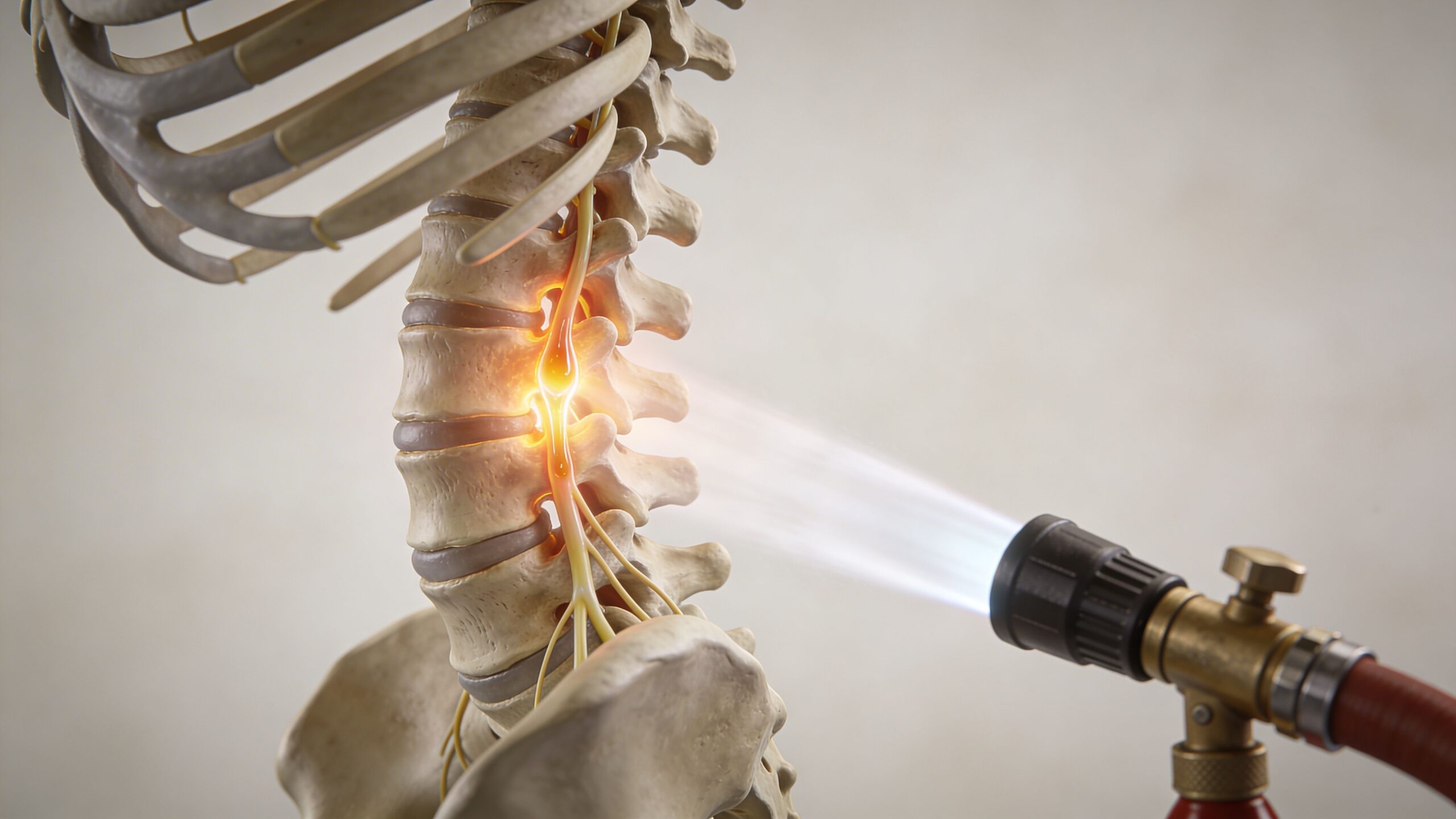
The goal is straightforward. Calm inflammation. Reduce pressure-related irritation. Lower the intensity of the pain signal coming from the spine into the back, buttock, or leg.
How the medication works
The steroid does not act like a pain pill. It is intended to reduce the inflammatory process around the nerve. A local anesthetic is often included as well, which can provide quick short-term relief while the steroid begins doing its slower anti-inflammatory work.
This matters most in conditions where inflamed tissue around a nerve is driving symptoms. That is why the diagnosis comes first.
Conditions that often respond well
Common examples include:
- Lumbar disc herniation: A disc can irritate a nearby nerve and produce sciatica.
- Lumbar radiculopathy: Pain, numbness, tingling, or weakness can travel along the path of the nerve.
- Spinal stenosis: Narrowing in the spine can crowd nerve structures and create back and leg symptoms.
- Sciatica: This is a symptom pattern rather than a single diagnosis, but many cases involve nerve root inflammation.
For patients with a lumbar herniated disc, 40% to 80% achieved over 50% improvement in sciatica pain and function, with benefits lasting from 3 months up to 1 year, according to the NCBI review of epidural steroid injections. That range is important because results vary by diagnosis, anatomy, severity, and overall treatment plan.
Who tends to be a good candidate
Not every patient with low back pain needs an epidural. The stronger candidates usually have a pattern that suggests inflammation around a spinal nerve, not just generalized muscle tightness or mechanical soreness.
A good evaluation looks at the whole picture:
- Your symptom pattern: Is the pain mostly in the leg, mostly in the back, or both?
- Neurologic findings: Numbness, tingling, reflex changes, or weakness can help localize the problem.
- Imaging when appropriate: MRI findings should match the clinical story rather than listing age-related changes.
- Response to earlier treatment: If medication, time, and therapy have not been enough, an injection may become more useful.
Patients from Worth, Burbank, or Palos Heights often arrive wanting a quick answer. The better answer is an accurate one. The procedure works best when it matches the pain generator. If you are exploring options for nerve-related spine pain, a review of conditions treated in interventional pain care can help clarify whether your symptoms fit that profile.
The best candidate is not the patient with the worst pain. It is the patient whose symptoms, exam, and imaging point to a treatable pain source.
Comparing Transforaminal, Interlaminar, and Caudal ESIs
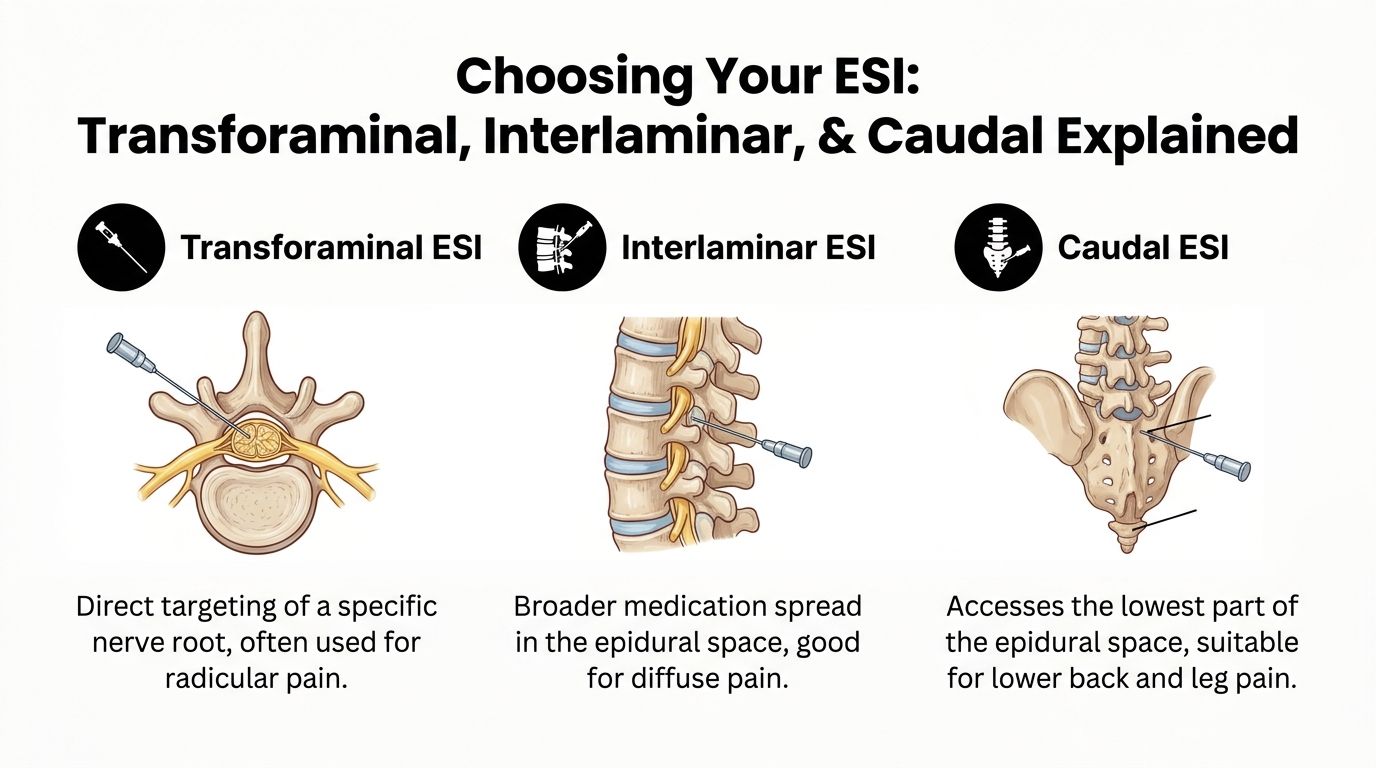
Not all epidural injections are the same. The route matters because each approach reaches the epidural space differently and suits a different pain pattern. This is one of the most important parts of decision-making. A carefully chosen approach often matters as much as the medication itself.
The three basic approaches
Think of the options this way:
- Transforaminal is the sniper. It targets one specific nerve root.
- Interlaminar is the sprinkler. It spreads medication more broadly in the epidural space.
- Caudal is the broad wash. It enters from the sacral area and is useful when wider lower spine coverage is needed.
Three Types of Epidural Steroid Injections at a Glance
| Approach | Target Area | Best For (Condition) | Analogy |
|---|---|---|---|
| Transforaminal | Specific nerve root near the foramen | One-sided radicular pain or sciatica | Sniper |
| Interlaminar | Posterior epidural space with broader spread | Bilateral symptoms, axial pain, or stenosis patterns | Sprinkler |
| Caudal | Lower epidural space through the sacral hiatus | Post-surgical anatomy, multilevel symptoms, broader lumbosacral coverage | Broad wash |
Transforaminal ESI
This approach places medication closest to the irritated nerve root and dorsal root ganglion. That makes it especially useful when pain travels down one leg in a clear nerve distribution.
The transforaminal ESI offers the highest specificity and has shown 60% to 80% short-term pain reduction in radiculopathy cases, according to Hospital for Special Surgery’s epidural injection overview. In plain terms, this is often the most precise option when the pain generator is focal and one-sided.
This approach is often chosen when a patient says, “The pain starts in my back and shoots down one leg,” and the exam plus imaging point to a specific compressed or inflamed nerve.
Interlaminar ESI
The interlaminar approach enters from the back between the laminae and lets medication spread more broadly in the epidural space. It is less pinpointed than transforaminal delivery, but that wider spread can be helpful.
This option can make sense when symptoms are more central, affect both sides, or involve a combination of back pain and leg pain. It is also useful when the goal is broader epidural coverage rather than targeting a single nerve root.
Patients sometimes assume “broader” means “weaker.” That is not the right way to think about it. It means the treatment strategy is different. If the pain pattern is not isolated to one irritated nerve, a broader field may be exactly what is needed.
Caudal ESI
Caudal epidural injection enters through the sacral hiatus at the base of the spine. It is often the most practical route when the lower lumbar region has post-surgical changes or when symptoms involve multiple levels.
For many post-operative patients, this route offers a safer way to access the epidural space. It is also a useful choice when scar tissue or altered anatomy makes a more direct route less attractive.
How the decision gets made
Specialists do not choose the route based on habit. They look at several factors at once:
- Pain location: One-sided leg pain suggests a different target than diffuse low back pain.
- Imaging findings: A disc herniation at one level is different from multilevel stenosis.
- Prior surgery: Scar tissue and hardware can affect the safest path.
- Treatment goal: Some patients need precision. Others need coverage.
The important takeaway is that “getting an epidural” is not one generic event. It is a customized procedure. The route should match the diagnosis, not the other way around.
What to Expect Before, During, and After Your Injection
Patients usually feel better about an epidural steroid injection when they know what the day looks like. Anxiety often comes from uncertainty, not from the procedure itself.

Before the procedure
Preparation starts with a review of your medications, symptoms, imaging, and treatment goal. If you take blood thinners or have a medical condition that changes procedural planning, that should be discussed in advance. Many patients are also asked to arrange a driver, especially if there is any chance they will feel sore, numb, or prefer not to drive after the visit.
The practical side matters just as much as the technical side. Wear comfortable clothing. Ask every question you have before the procedure starts. A good visit should feel organized, not rushed.
A few useful reminders:
- Bring your medication list: It helps avoid last-minute confusion.
- Report new symptoms: Fever, infection, or a major change in neurologic symptoms can affect timing.
- Plan a lighter day afterward: Many patients return to routine activity quickly, but a quiet schedule is smart.
During the procedure
Once positioned, the skin is cleaned carefully and numbed with local anesthetic. The injection itself is performed using fluoroscopic guidance, which is live X-ray imaging used to improve accuracy and safety.
According to the MedStar procedural overview of caudal epidural and related nerve block technique, the physician advances a 22-25G needle under fluoroscopic guidance, then uses 2-3 mL of contrast dye to confirm placement in the epidural space before giving the steroid and local anesthetic. The injectate may include dexamethasone 10-15 mg. The local anesthetic can provide rapid relief within hours, which may help predict how well the steroid component will work.
What do patients usually feel? Most describe pressure more than pain. Some feel a brief reproduction of their usual symptoms as medication spreads near the irritated nerve. That can be unsettling if you do not expect it, but it is often temporary.
Fluoroscopy is not a luxury for this procedure. It is a core safety tool that helps confirm where the medication is going.
After the procedure
After the injection, patients usually spend a short period being observed. This is a time to make sure they feel steady, understand discharge instructions, and know what is normal over the next day or two.
You may notice several different phases of response:
- Early numbness or light relief from the anesthetic.
- A return of baseline pain once the anesthetic wears off.
- Gradual steroid benefit over the following days.
That timeline is normal. The steroid is not expected to work instantly.
What home recovery usually looks like
The first day is usually simple. Take it easy. Watch for unusual symptoms. Pay attention to how the pain behaves in the back and leg.
Common guidance includes:
- Use ice if you are sore at the injection site
- Resume routine medications unless your physician says otherwise
- Track your pain and function, not just your pain score
- Call if symptoms feel clearly outside the expected range
A useful sign is whether you can do something after the injection that you could not do before. Walk farther. Sit longer. Sleep with fewer interruptions. Those are often the changes that matter most.
Understanding ESI Benefits, Risks, and Typical Outcomes
An epidural steroid injection can be a very helpful treatment, but it works best when expectations are realistic. The goal is not to promise a cure. The goal is to reduce inflammation enough to improve comfort and restore function.
What patients often gain
The most meaningful benefits usually include less leg pain, easier movement, and better participation in physical therapy or home exercise. When a nerve calms down, patients often stop guarding every movement. That reduction in fear can be as important as the pain relief itself.
Another important role is helping patients stay in conservative care rather than escalating too quickly to surgery. In one study of 143 patients, the greatest median pain reduction occurred at one month and five months, and 76.22% of patients did not require spine surgery during 12 months of follow-up, according to this PMC review of clinical outcomes after epidural steroid injection.
What the procedure does not do
Here, clear counseling matters. An epidural does not “fix” every structural issue in the spine. It does not fuse unstable segments, rebuild severe degeneration, or guarantee long-term relief in every case.
Even when the injection works, some patients get a modest improvement rather than a dramatic one. Others improve enough to postpone surgery, continue rehabilitation, or get through an acute flare without needing a larger intervention.
Risks and trade-offs
Most side effects are minor and temporary. Soreness at the injection site and a brief increase in symptoms can happen. More serious complications are uncommon, which is why careful patient selection and image guidance matter so much.
Risk is also tied to approach. A targeted transforaminal injection offers precision, but it also requires careful technique because of nearby vascular structures. Broader approaches may be less focal but can be preferable in the right anatomy.
A careful consent discussion should cover:
- Why this route is being chosen
- What level of relief is realistically expected
- What symptoms should prompt a call after the procedure
- How success will be measured beyond pain score alone
The most useful outcome is not “I felt perfect for a day.” It is “I moved better, slept better, and could restart the parts of life pain had interrupted.”
When to Consider Alternatives to Epidural Injections
An epidural steroid injection is one tool. It is not the only tool, and it should not be repeated automatically if it is not helping in a meaningful way.
For some chronic spine conditions, relief can fade. A review notes that benefits may wane after 3 to 6 months, and if pain persists or returns after 3 to 4 injections in a year, it is appropriate to consider other options such as radiofrequency ablation or spinal cord stimulation, as discussed in this PMC review on the durability and repetition of epidural steroid injections.
Signs it may be time to pivot
A treatment plan should be reconsidered when:
- Relief is too brief: The benefit does not meaningfully change function.
- The diagnosis has shifted: The pain source appears to be facet joints, SI joint, or another structure rather than a nerve root.
- The pattern is chronic and recurrent: Repeating the same intervention is producing less return.
- The problem is structural in a different way: Some stenosis patterns call for another minimally invasive option.
What other options may fit better
Different pain generators call for different treatments.
Radiofrequency ablation can help when the pain is coming from facet joints rather than a compressed nerve.
Spinal cord stimulation may be considered for persistent neuropathic pain, including some post-surgical cases.
MILD and Vertiflex may be more appropriate in select patients with lumbar spinal stenosis.
Targeted physical therapy remains a core part of recovery because better movement often protects the benefit achieved with a procedure.
Regenerative options such as PRP may be discussed in the right musculoskeletal setting, depending on the diagnosis.
For patients comparing these routes, interventional procedures used in advanced pain treatment can give a clearer sense of how one procedure differs from another.
One factual example from local practice options: Midwest Pain & Wellness offers image-guided spine interventions, neuromodulation, lumbar decompression options, and other opioid-sparing procedures as part of broader multimodal care.
The bigger point
The right plan is not “more injections.” The right plan is the one that matches the pain source, the timeline, and the functional goal. Sometimes that means an epidural. Sometimes it means moving on.
Why Choose Midwest Pain & Wellness for Your ESI
When patients from Oak Lawn, Alsip, Burbank, Hickory Hills, or Orland Park are choosing a specialist, they should focus on a few things that matter more than branding language.
Credentials and procedural judgment
For epidural steroid injection for back pain, experience alone is not enough. Training matters. Decision-making matters. The physician should understand spinal anatomy, image-guided technique, complications, medication selection, and when not to inject.
Dr. Yaw Donkoh is a double board-certified physician in Anesthesiology and Pain Medicine. Patients who want to review his background can do so on the Dr. Donkoh profile page.
Precision and safety
This procedure should be planned carefully and performed with image guidance. A specialist should be able to explain why a transforaminal, interlaminar, or caudal route fits your anatomy and symptom pattern.
That level of precision matters in everyday practice. A patient with one-sided sciatica after lifting something heavy does not need the same strategy as a patient with prior lumbar surgery and multilevel stenosis. Those are different problems.
An opioid-sparing philosophy
Many patients are specifically looking for help that does not push them toward long-term opioid dependence. That is a reasonable goal. Good pain care should expand options, not narrow them.
An opioid-sparing approach usually means the physician is thinking in layers:
- diagnostic clarity
- activity restoration
- targeted procedures
- rehabilitation support
- escalation only when necessary
Practical support for real-world cases
A lot of patients in the southwest suburbs are not arriving with simple histories. Some have workers’ compensation claims. Some are dealing with injury-related pain. Some have had surgery already. Some are coordinating care between a primary doctor, surgeon, chiropractor, and therapist.
Those cases benefit from a clinic that understands how to work within a larger care network. Good pain management is not just procedural skill. It is also communication, follow-up, and clarity.
If you are choosing locally, ask direct questions. Who performs the injection? Is it image-guided? How is the route selected? What happens if it does not work? Strong answers to those questions usually tell you more than any advertisement will.
Your Epidural Steroid Injection Questions Answered
Is the injection itself painful
Most patients feel pressure more than sharp pain. The skin is numbed first, which reduces discomfort at the entry site. You may feel a brief ache or a familiar radiating sensation as the medication spreads, especially when the target is close to an irritated nerve.
Will my insurance cover an epidural steroid injection
Coverage varies by plan and by the medical details that support the procedure. In many cases, approval depends on diagnosis, symptoms, prior treatment, and documentation. The practical step is to ask the office to review benefits and authorization requirements before the procedure date so there are no surprises.
Can I still get an epidural if I have had back surgery
Often, yes. Prior surgery changes planning, but it does not automatically rule out treatment. For patients with failed back surgery syndrome, a caudal ESI is often the preferred approach because it uses the sacral hiatus and carries a lower risk of dural puncture in post-surgical anatomy, according to the Cleveland Clinic overview of lumbar epidural steroid injection.
How many injections are safe in a year
This depends on diagnosis, response, and your overall treatment plan, but injections are generally limited rather than repeated endlessly. If pain keeps returning despite an appropriate series, the better question becomes whether the diagnosis or treatment strategy should change.
When should I call after the procedure
Call if your symptoms feel clearly outside the expected range, if new neurologic changes appear, or if you are unsure whether what you are experiencing is normal. Good post-procedure care includes access to guidance, not just the injection itself.
If back or leg pain is limiting your life in Chicago Ridge, Oak Lawn, Palos Hills, Orland Park, or the surrounding Illinois suburbs, Midwest Pain & Wellness offers evaluation and treatment for spine, nerve, injury, and post-surgical pain with an opioid-sparing, image-guided approach. The first step is a careful diagnosis and a treatment plan built around function, safety, and what fits your pain pattern.