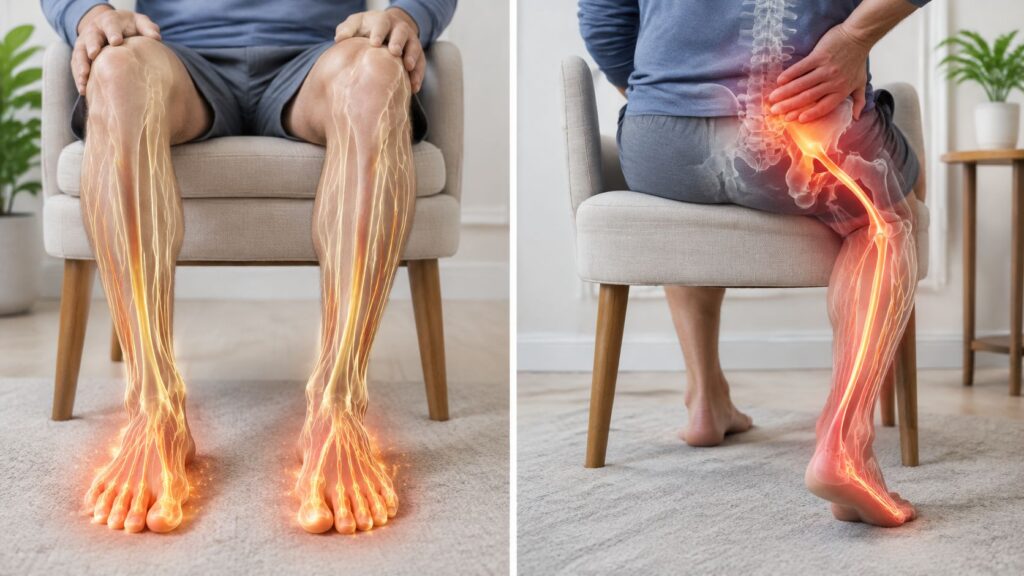
If walking to the mailbox, standing at the sink, or finishing a grocery aisle turns into a stop-and-sit routine because your back and legs start to burn, tingle, feel heavy, or go numb, you're dealing with a very specific kind of misery. The hard part is that the pain often isn't worst when you're lying down. It shows up when you try to live your day.
That pattern matters. Minimally invasive lumbar decompression, often called MILD or PILD, is designed for people whose symptoms come from lumbar spinal stenosis, especially when thickened tissue is crowding the nerves and conservative care hasn't been enough. Johns Hopkins Medicine describes it as a small-incision, image-guided outpatient procedure done with local anesthesia and mild sedation, usually taking about one hour with same-day discharge, and the procedure was cleared by the FDA in 2006 (FDA-cleared milestone and clinical evidence summary).
Patients usually don't come in asking for a procedure by name. They come in because they can't stand long enough to wash dishes, shop without leaning on the cart, or walk the dog without planning where the next bench is. If that sounds familiar, the next few sections will show what MILD does, who it helps, where it fits in the treatment pathway, and where it doesn't.
What Minimally Invasive Lumbar Decompression Means
A patient sits in the exam room and says, “I can walk to the mailbox, but then my legs give out.” That kind of story is familiar in lumbar spinal stenosis, where the space around the nerves gets tight enough that standing and walking set off pain, heaviness, numbness, or weakness. The symptoms often ease when the person sits down or bends forward, because that position gives the nerves a little more room.
Minimally invasive lumbar decompression is built for that specific pattern. It uses a tiny incision and specialized instruments to remove a small amount of tissue that is crowding the canal, so the nerves have more space again. Johns Hopkins Medicine describes MILD as an image-guided outpatient procedure with local anesthesia, mild sedation, and same-day discharge, which is why it is often discussed more like a targeted office-based intervention than a traditional spine operation (Johns Hopkins Medicine on the MILD procedure).
That distinction matters. MILD is not meant to erase every source of back pain. It is meant to address a structural narrowing problem when thickened ligament tissue is squeezing the nerves and making basic activities hard to tolerate. If the anatomy is the reason a person can stand only briefly or must keep stopping during a walk, opening that space can make daily movement feel possible again.

Why patients hear about it after other treatments
Many people reach MILD only after they have already tried rest, medicines, activity changes, physical therapy, or injections. That is often the right sequence, because lumbar stenosis treatment usually starts with the least invasive options first, and only then moves toward a procedure if symptoms keep limiting life. If you want a plain-language overview of how doctors confirm the problem, this guide to diagnosing spinal stenosis can help connect the symptoms to the anatomy.
A 2021 review found that controlled clinical studies had already supported the procedure's safety and effectiveness, which is one reason clinicians place it inside a real treatment pathway instead of treating it like a last-minute experiment (evidence review). For some patients, that pathway leads to better walking and standing tolerance without going straight to open surgery. For others, especially when the spine is unstable or the narrowing comes from a different problem, open decompression may still be the better answer.
That is the honest middle ground. MILD can be the bridge between conservative care and a larger operation, but it is not the right bridge for everyone.
Practical rule: if sitting or bending forward eases your symptoms, the next question is what is narrowing the space for the nerves, not just where the pain is felt.
For many patients, that is the moment the decision starts making sense.
How Stenosis Works and Who Qualifies for MILD
A patient may have leg pain that worsens with standing, then eases when they sit or bend forward. That pattern often points back to the space around the nerves, not just to soreness in the back itself. Lumbar spinal stenosis works like a narrowed tunnel, the nerve roots have less room, and that reduced room is what can trigger pain, heaviness, or cramping.
The anatomy MILD is built to treat
MILD focuses on hypertrophic ligamentum flavum, which means the ligament has thickened and is pushing inward on the spinal canal. That narrowing is often what turns ordinary standing or walking into a pain trigger. The procedure does not try to solve every possible cause of stenosis. It targets the anatomy where the ligament is the main source of crowding.
Expert guidance cited by ASRA uses MRI criteria that help separate likely candidates from people who need a different approach. The commonly cited thresholds are ligamentum flavum thickness greater than 2.5 mm and central canal cross-sectional area under 100 mm² (candidate-selection guidance). Those numbers matter because symptoms alone can be misleading. Two people can both have leg pain, but only one may have the anatomy that MILD can address.
For more on how stenosis is diagnosed, see our guide to diagnosing spinal stenosis.
Who usually is not a fit
Some conditions suggest the canal is narrow for reasons MILD does not directly correct. Grade II or higher spondylolisthesis is one of the big ones, because that level of slippage can point to instability rather than simple ligament thickening. Significant epidural lipomatosis is another exclusion concern, since excess fat in the epidural space changes the compression pattern. If the stenosis comes from a different source, the procedure can miss the problem.
That is why the imaging review matters so much. A patient can have severe symptoms and still not be a MILD candidate if the anatomy does not match. The right lesson is clarity, not disappointment. Matching the procedure to the cause gives the best chance of making the treatment count.
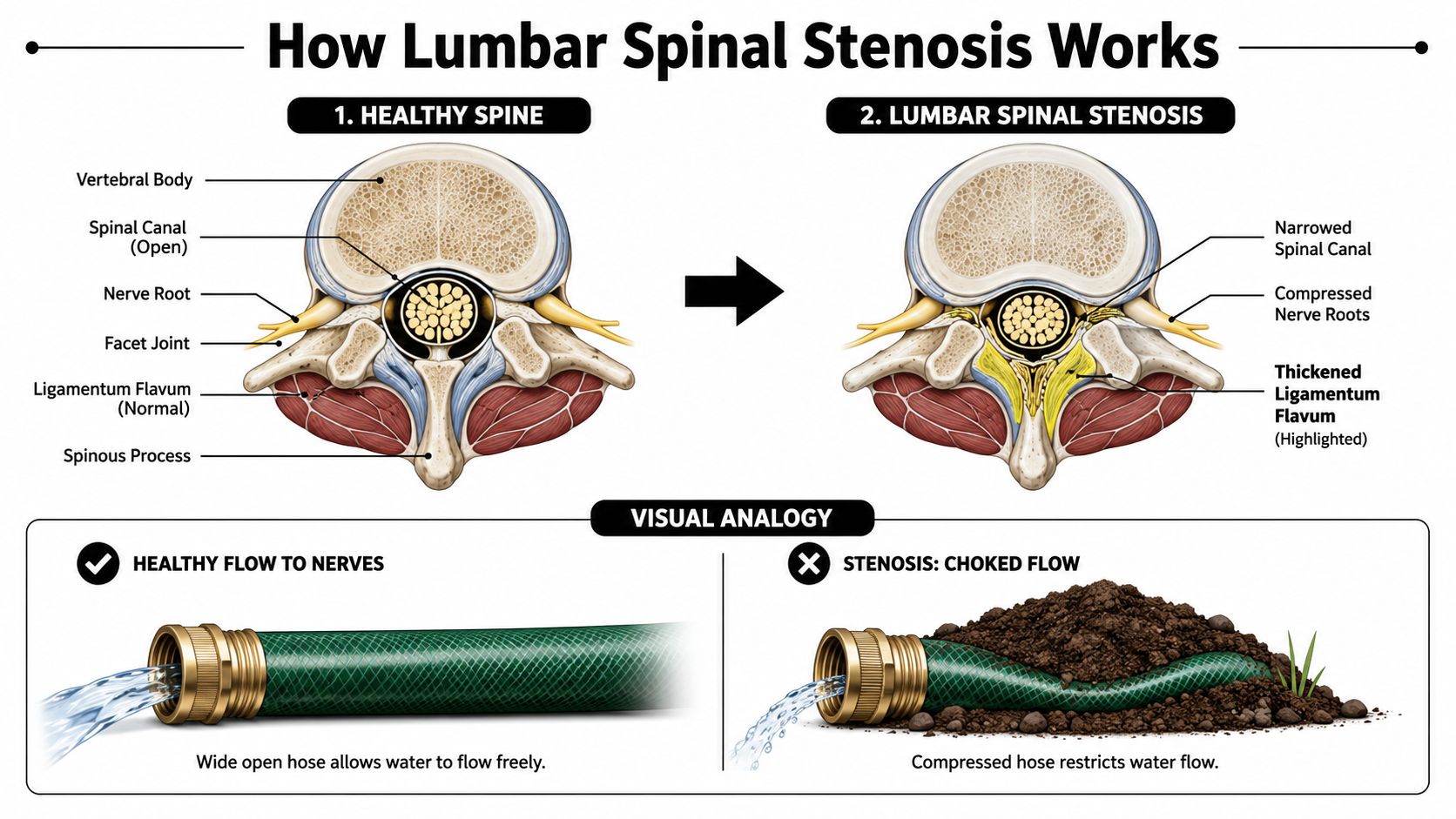
The simplest way to keep that straight is to ask one question, does the MRI show a canal narrowed mainly by thickened ligament, or is something else driving the compression?
What Happens Before, During, and After the Procedure
The day usually begins with a calm, practical conversation, not a rushed decision. Your clinician reviews your symptoms, imaging, medications, and any instructions about what to hold before the procedure. You also sign consent after your questions are answered, which is the right time to bring up blood thinners, allergy history, and any worries about sedation.
Before the room gets busy
The pre-procedure visit is where the plan gets made real. Imaging is checked again to confirm that the anatomy still matches the procedure being considered. If a medication needs to be paused, that should be written down clearly so you are not trying to remember it from memory on procedure day.
This is also when people should ask the plain-English questions they are often embarrassed to ask, like how long they will need to lie still, whether they will feel awake, and when they will be allowed to walk. A direct answer is usually more reassuring than a generic reassurance.
What the procedure feels like
Johns Hopkins Medicine describes the treatment as a small-incision, outpatient procedure done with local anesthesia and mild sedation, usually taking about one hour (procedure overview). In the room, the experience is usually less dramatic than patients fear. You will hear the fluoroscopy machine adjust, feel pressure rather than pain, and be able to answer questions while the team checks that everything is in the right place.
The doctor uses fluoroscopic guidance, which is live X-ray imaging, to place the tools precisely. That image guidance is the reason the work can stay so focused. The goal is to remove just enough thickened tissue to relieve pressure without turning the procedure into a major operation.
You may notice that the staff keeps checking in with you in simple, steady ways. That is normal. Small changes in position, a quick question about where you feel pressure, or a reminder to stay still all help the clinician work safely and accurately.
You should expect to be awake enough to respond, but relaxed enough that the experience feels controlled rather than alarming.
Right after
Most patients go home the same day. That is a big reason MILD feels different from open surgery. You will usually be encouraged to walk soon after, and the first instructions often focus on simple dressing care, short walks, and watching for unusual pain or drainage. The first follow-up call is usually about how you are moving, how the incision looks, and whether your pain pattern is settling the way it should.
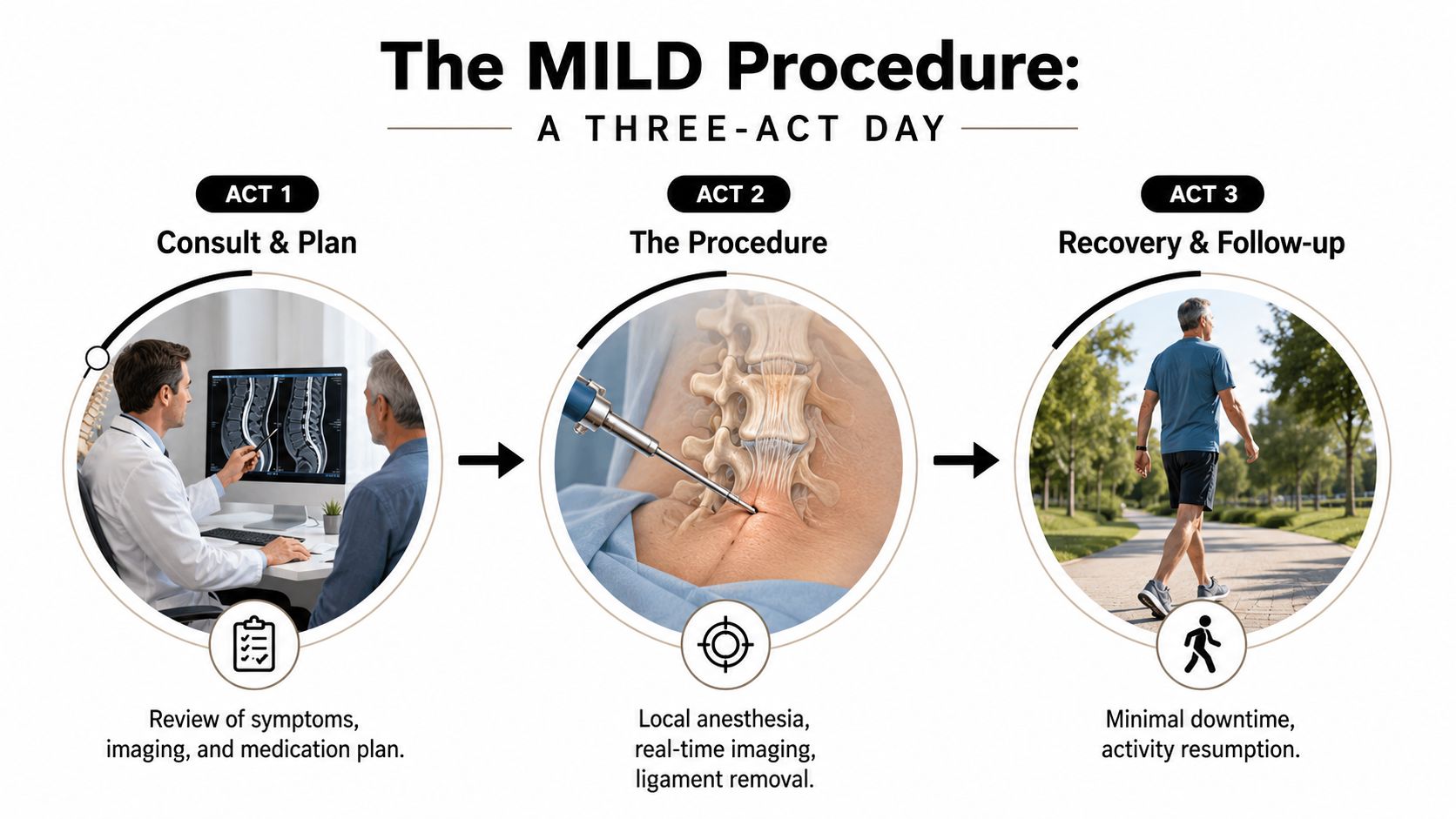
What surprises many patients is how much the day is built around movement, not bed rest. The procedure opens the space, then early walking helps the body start using it. For a clearer sense of what early soreness can feel like, see this guide to postoperative pain after spine procedures.
How MILD Compares to Other Back Pain Treatments
A lot of confusion disappears once the options are laid out side by side. MILD is not the same as open surgery, and it isn't the same as an injection. It sits in the middle of the pathway for people with a specific kind of lumbar stenosis.
MILD Compared to Common Stenosis Treatments
| Treatment | Anesthesia | Incision / Approach | Typical Recovery | Best Patient Profile | Durability |
|---|---|---|---|---|---|
| MILD | Local anesthesia with mild sedation | Tiny incision, image-guided removal of thickened ligament | Same-day discharge, early walking | Lumbar stenosis driven mainly by hypertrophic ligamentum flavum | Can be durable for properly selected patients |
| Open laminectomy | Typically more extensive anesthesia support | Larger surgical exposure and decompression | Longer recovery and more tissue healing | Patients who need direct, broader decompression | Often more definitive for structural compression |
| Vertiflex/Superion | Procedure-based anesthesia approach varies | Interspinous spacer placed through a minimally invasive approach | Usually faster than open surgery | Different anatomy, often mild-to-moderate stenosis with preserved structure | Intended for a different stenosis pattern |
| Epidural steroid injections | Local anesthetic, sometimes with sedation | Needle-based injection, no decompression | Short downtime, but relief may be limited | Short-term symptom control while deciding next steps | Usually a bridge, not a decompression |
MILD's appeal is its lower morbidity and lighter recovery burden than open surgery. But the tradeoff has to be honest. A recent 2025 comparative study found that open decompression outperformed MILD on pain improvement and reoperation outcomes, while MILD had fewer durotomies but more neurological deficits. That's the kind of information patients deserve before they choose.
If your stenosis comes from anatomy that fits an interspinous spacer or you mainly need a temporary bridge, a different option may make more sense. If you're looking for a durable structural fix and your anatomy is more severe, open surgery may be the better discussion.
For people trying to understand the recovery burden better, this overview of what postoperative pain often means after spine procedures can help frame the difference between healing discomfort and a problem that needs attention.
Simple decision check: if your main goal is short-term symptom control, an injection may be enough. If you need space restored inside the canal, ask whether your anatomy is right for MILD or whether broader surgery belongs on the table.
Evidence, Outcomes, and Honest Tradeoffs
A patient often wants one clear answer: will this help enough to justify choosing it? The honest answer is that MILD has a real evidence base, and that evidence helps show where it fits in the treatment path. A recent long-term study reported a lumbar surgery incidence after MILD of 2.4% per year, and 88% of patients with symptomatic lumbar spinal stenosis avoided open lumbar decompression surgery for at least 5 years (5-year durability data).
What the longer-term data show
Those numbers matter because many spine treatments look good at first and then taper off. MILD has shown sustained benefit in a meaningful share of patients, but the response is not identical from one person to the next. A review from 2023 reported an effective-rate range from 57.1% to 88%, and the MiDAS ENCORE study reported effective rates of 57.3% at 1 year and 71.7% at 2 years (sustained outcome review).
The safety profile belongs in the same conversation. A 2-year outcomes study reported an Oswestry Disability Index improvement of 22.7 points and a Numeric Pain Rating Scale improvement of 3.6 points, with no serious device- or procedure-related adverse events and only 1.3% experiencing a device- or procedure-related adverse event (2-year outcomes study). For the right anatomy, that mix of functional improvement and low serious complication reporting is part of why many clinicians consider MILD a reasonable middle step before bigger surgery.
What recent clinical reports add
A 2024 clinical report presented to anesthesiology specialists found mean pain scores fell by 53% at 1 month, maximum pain scores fell by 38%, and 72% of patients reported functional improvement (2024 clinical report). Early improvement like that can matter to a patient who is trying to get through daily life, but it still does not answer the whole question of whether the anatomy is a good match.
That is where honest tradeoffs matter. MILD can serve as a bridge between conservative care and open surgery, especially when the goal is to create more space without the recovery burden of a larger operation. For patients with different anatomy, Vertiflex Superion may be an option. Open surgery can still outperform MILD in some cases, especially when stenosis is more severe or the structural problem is broader, and that is a reminder that the best treatment is the one matched to the cause of the narrowing.
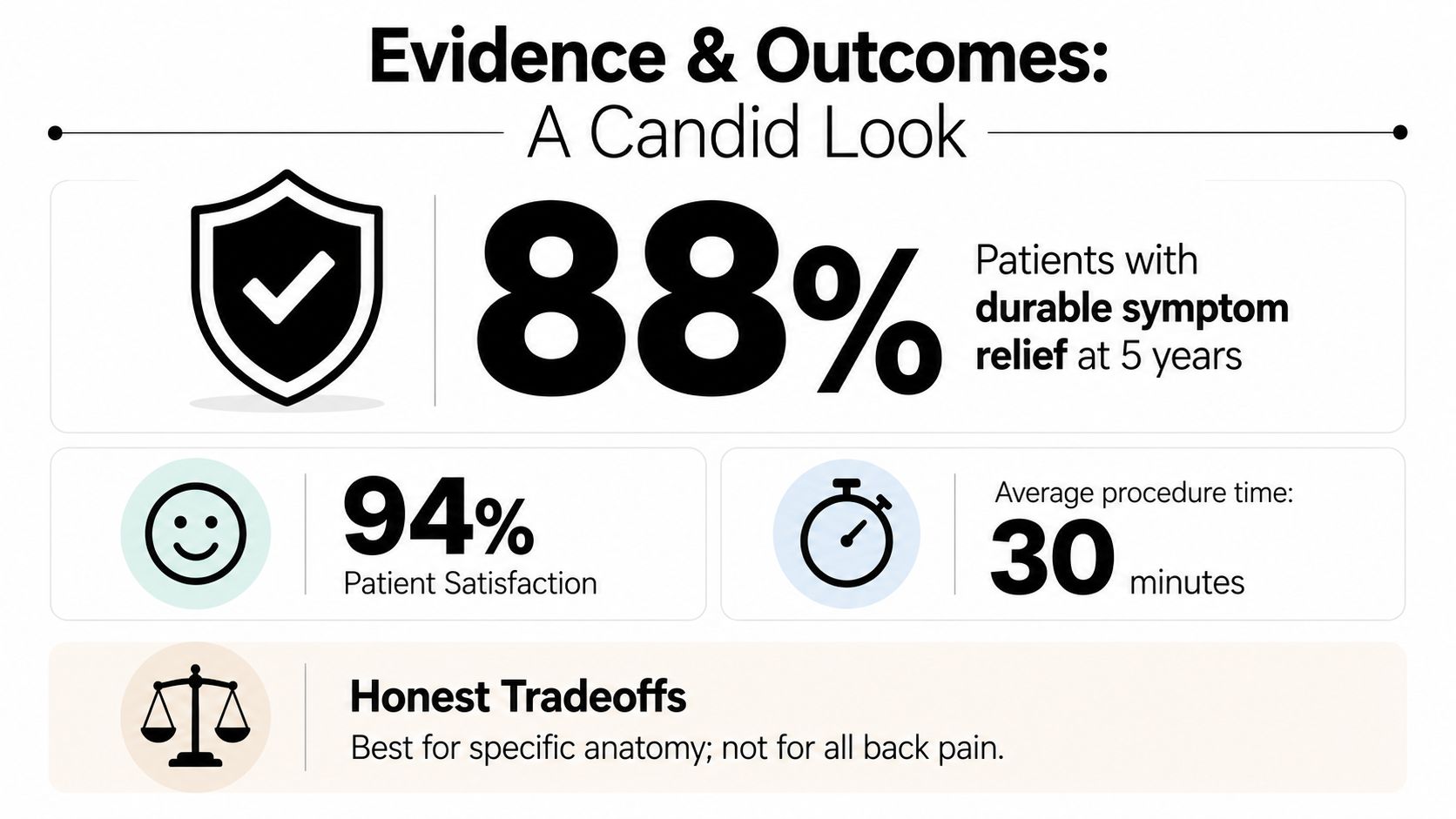
If you look at the evidence with a careful eye, the pattern is straightforward. MILD can help selected patients avoid a larger operation for years, but the decision still depends on what is narrowing the canal and how much relief the patient needs.
Recovery Timeline and What Real Improvement Looks Like
Recovery after MILD usually feels less like a dramatic reset and more like a steady widening of what you can tolerate. The first week is often about movement without overdoing it, and the later weeks are about rebuilding the habits that keep the canal open and the back working well.
Week 1
The first few days usually center on gentle walking, dressing care, and keeping the day broken into short bursts. Standing for too long can still bring on symptoms, so patients often do better with brief activity, then a sit-down break before symptoms flare. The point isn't to test the limits, it's to keep the body moving without irritating the area.
Weeks 2 to 4
By the second week, light household activity usually starts to feel more realistic, and that's often when a physical therapy consult becomes useful. Weeks 3 and 4 are when many patients notice they're walking farther, leaning on the cart less, and taking fewer sit-down breaks. That's the functional marker patients care about, not just whether the incision looks fine.
Weeks 5 to 6
By weeks 5 and 6, many patients are moving into a more structured rehab plan that works on core stability and gait mechanics. The procedure creates space, but strength and movement patterns protect that space. That's why rehab isn't optional busywork. It's part of making the result last.
A few warning signs deserve immediate attention:
- Worsening leg weakness: New loss of strength is not something to watch casually.
- Bowel or bladder changes: New trouble controlling either one needs prompt medical review.
- Fever: That can point to infection and should be reported.
- Expanding wound drainage: Drainage that increases instead of settling needs a call.
Recovery rule: if the trend is getting worse instead of gradually easier, don't wait for the next appointment.
The clearest sign of real improvement is usually not zero pain. It's being able to stand longer, walk farther, and spend the day with fewer interruptions. That's the shift patients tend to notice first.
Insurance, Coverage, and Choosing Care in Chicago Ridge
Coverage for MILD is often more straightforward than patients expect, but it still usually requires paperwork. Most commercial plans cover it for symptomatic lumbar spinal stenosis after conservative care has failed, and Medicare covers it nationally. Prior authorization is common, so the office usually has to show the anatomy, the symptoms, and the treatment history.
What usually helps approval
The documentation that tends to matter most is plain and specific. That includes failed physical therapy, prior epidural injections, MRI evidence that matches the qualifying anatomy, and clear notes about neurogenic claudication symptoms. In a workers' compensation or injury case, the connection between symptoms and the event also has to be documented carefully.
Midwest Pain & Wellness is a pain and wellness clinic, not a physical therapy practice, and it supports workers' compensation and personal injury cases when they're part of the picture. The clinic also offers MILD care in Chicago Ridge as part of an opioid-sparing interventional plan, and that matters because some patients need a clinic that can coordinate injections, imaging review, and procedural care in one place.
Why local access matters
For patients traveling from Oak Lawn, Palos Hills, Palos Heights, Worth, Bridgeview, Hickory Hills, Alsip, Burbank, Evergreen Park, and Orland Park, convenience isn't a small detail. If a procedure is outpatient and follow-up matters, being able to get to the clinic without turning the day into a major trip makes care easier to follow through on.
Dr. Yaw Donkoh is a double board-certified interventional pain specialist, and the practice emphasizes opioid-sparing multimodal care with weekday hours. If you're trying to figure out whether your stenosis belongs in a decompression conversation, the next useful step is simple, bring your imaging if you have it, ask how your MRI fits the candidacy criteria, and find out whether MILD belongs in your treatment plan.
A CTA for Midwest Pain & Wellness.