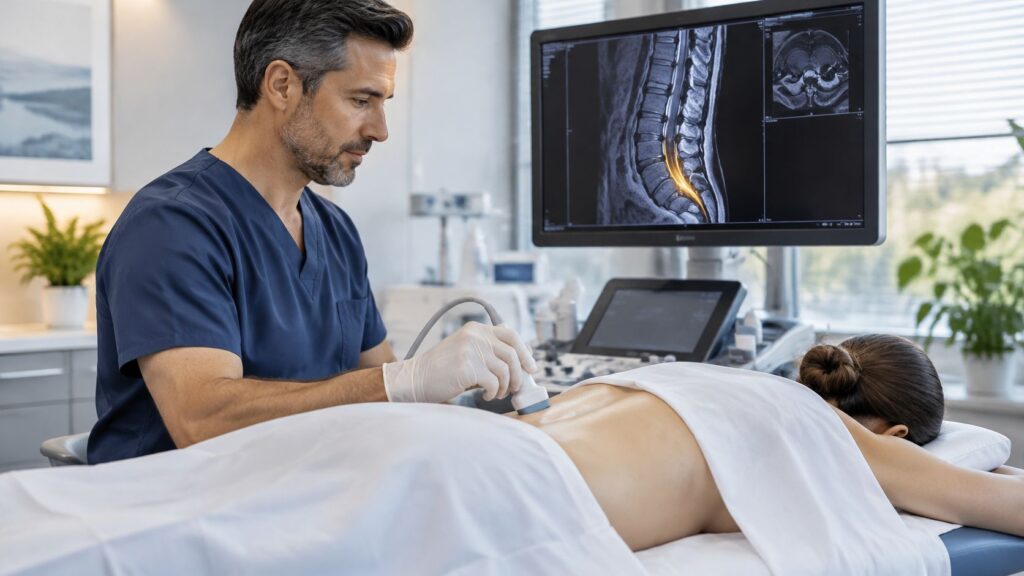
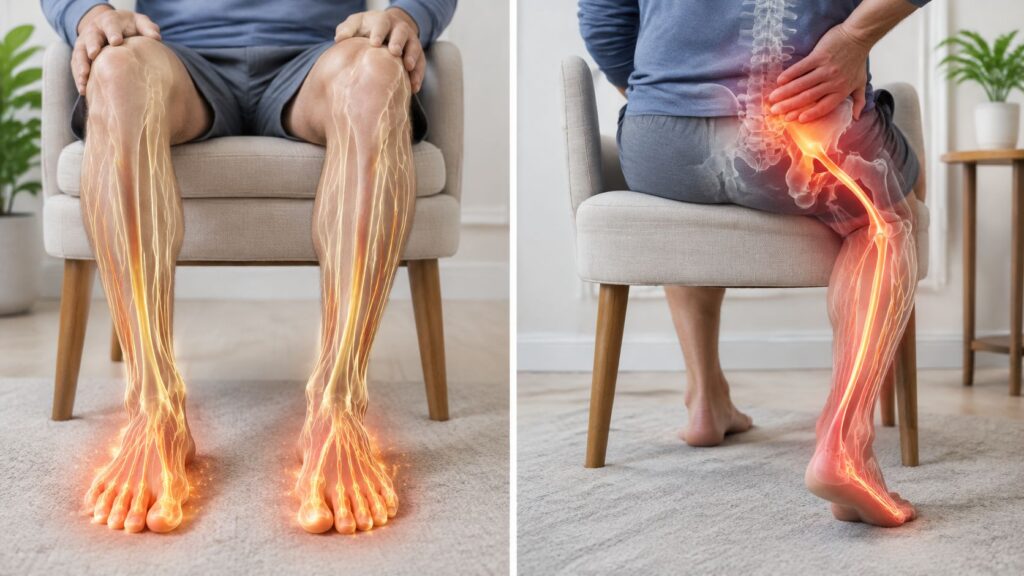
If you're reading this because walking the grocery store has turned into a stop-and-rest exercise, you're not alone. Many people with spinal stenosis first notice the problem in ordinary moments. A short walk brings on leg pain, heaviness, tingling, or weakness. Leaning over a cart helps. Standing upright makes it flare again.
That pattern matters. Lumbar spinal stenosis affects an estimated 103 million people worldwide and has a clinical prevalence of about 11% in U.S. adults, rising with age, and the diagnosis often starts with a very specific story: back and lower extremity pain brought on by extension and relieved by flexion, as outlined in this PubMed review on lumbar spinal stenosis diagnosis.
How to diagnose spinal stenosis isn't about ordering every test at once. It's about doing the right things in the right order. A careful history comes first. A focused physical and neurological exam comes next. Imaging confirms what the history and exam already suggest. In more complex cases, specialized nerve testing helps sort out whether the pain is really coming from the spine or from something that can look similar.
At a pain management clinic, that sequence matters because diagnosis drives treatment. If the pain source is identified accurately, you can build an opioid-sparing plan around the actual problem instead of chasing symptoms.
Recognizing Telltale Symptoms and Red Flags
A common patient description goes like this: "I can walk for a bit, then my legs start burning or going numb. If I sit down or bend forward, it eases up." That pattern is classic for neurogenic claudication, the hallmark symptom of lumbar spinal stenosis.

When the spinal canal narrows in the lower back, nerves have less room. Symptoms often worsen when the spine extends, such as when you're standing upright or walking downhill. They often improve when you bend forward, sit, or lean over support. That's why many patients can walk farther with a shopping cart than they can empty-handed.
This isn't the only way stenosis shows up, but it's one of the most useful clues. If you're wondering whether your symptoms fit, reviewing the broader range of conditions we treat at Midwest Pain & Wellness can help put spinal and nerve pain in context.
What lumbar stenosis usually feels like
Lumbar stenosis often causes a mix of back and leg symptoms. Some people feel cramping in the calves. Others describe aching in the buttocks, numb feet, tingling down the legs, or legs that feel unreliable after standing too long.
The details matter more than the pain scale alone. I care about what brings symptoms on, what relieves them, how far you can walk before they start, and whether the legs or the back are the bigger issue. Stenosis often produces symptoms tied to posture and walking tolerance, not just pain at rest.
Common features include:
- Standing intolerance: Symptoms build when you're upright for too long.
- Walking limitation: Pain, heaviness, or weakness may force frequent stops.
- Flexion relief: Sitting, bending forward, or leaning on a counter often helps.
- Leg-dominant symptoms: Many patients notice the legs more than the low back.
Practical rule: The more clearly symptoms worsen with standing or walking and improve with bending forward, the more seriously I consider lumbar stenosis in the differential.
Cervical stenosis feels different
Not all spinal stenosis is in the low back. Cervical stenosis involves narrowing in the neck and can affect the spinal cord or exiting nerve roots.
Patients with cervical involvement may report neck pain, pain radiating into the arms, hand numbness, loss of dexterity, dropping objects, or balance trouble. Some notice that buttons, handwriting, or using keys becomes harder before they ever describe severe pain. Those symptoms deserve careful attention because spinal cord involvement changes the urgency and the treatment discussion.
A low back problem usually doesn't make your hands clumsy. A neck problem usually doesn't produce classic shopping-cart relief in the legs by itself. That distinction is one reason a detailed symptom history matters so much.
Red flags that need urgent evaluation
Most spinal stenosis cases are evaluated in a standard office setting. Some symptoms are different. They need urgent or emergency attention.
Seek immediate medical care if you develop:
- Loss of bowel or bladder control
- New numbness in the groin or saddle area
- Rapidly worsening leg weakness
- Frequent falls with new neurological changes
- Severe balance decline, especially with neck-related symptoms
Those findings raise concern for major nerve compression, including cauda equina syndrome in the lumbar spine or spinal cord compression in the cervical spine. That's not something to monitor at home for a few weeks.
If symptoms are changing quickly, the question isn't just "Do I have stenosis?" The real question is "Are the nerves still safe?"
The Focused Physical and Neurological Exam
A good spinal stenosis exam isn't a formality between the waiting room and the MRI order. It's where the diagnosis starts to become specific.
A structured exam can be highly indicative. Testing for hyper-extension intolerance and observing a wide-based, start-stop gait are especially useful, and a structured physical exam may even outperform imaging for judging the functional impact of the condition, as described in this clinical overview of spinal stenosis diagnosis.
Watching how you move
Before any reflex hammer comes out, I want to see how you stand up, how you walk, and how your posture changes when symptoms start. Patients often reveal important diagnostic clues before formal testing begins.
A gait affected by stenosis may look cautious, broad-based, or interrupted. Some patients slow down, stop, and restart because their legs fatigue or tighten. Others naturally shift into a slight forward bend because that position opens space for the nerves and feels better.
That observation is useful because imaging can show narrowing without proving it's the cause of the problem. Watching your function helps match anatomy to symptoms.
Testing what the nerves are doing
The neurological exam checks whether the nerve roots are functioning normally. That usually includes strength testing, reflexes, and sensory mapping.
In plain terms, that looks like this:
- Muscle strength testing: I check whether certain muscle groups are weak in a pattern that fits a compressed nerve root.
- Reflex testing: Changes at the knee or ankle can support the diagnosis and help localize the level involved.
- Sensation testing: Areas of numbness or altered sensation can suggest which nerves are irritated.
- Balance and coordination: These are especially important if there are concerns about cervical stenosis or broader neurologic involvement.
No single finding "proves" stenosis on its own. The exam works by adding up clues. When the history, movement pattern, and neurological findings all point in the same direction, the diagnosis becomes much more reliable.
Provocative testing tells us more than rest pain
One of the most helpful parts of the exam is reproducing the symptom pattern safely. In lumbar stenosis, extension is often provocative. Asking a patient to extend the low back can bring on the same buttock or leg symptoms they feel while standing or walking.
That matters because stenosis is often a functional problem, not just a static picture. A patient may sit comfortably in the exam room and still be unable to walk far without leg pain. Provocative testing bridges that gap.
Other in-office checks may include:
- Posture response: Does bending forward reduce symptoms?
- Straight leg raise: This is more helpful for disc-related nerve irritation than classic stenosis, but it can still be part of the broader evaluation.
- Pedal pulse assessment: If leg pain with walking could be vascular, pulse checks help sort that out early.
The exam shouldn't feel random. Each maneuver answers a question: Is the pain mechanical, neurologic, vascular, or coming from somewhere else?
What the exam can and can't do
A strong exam can identify patterns that imaging later confirms. It can also keep us from overreacting to scan findings that may not explain the patient's actual complaint.
What it can't do is measure the canal directly or show every structural detail. That's where imaging becomes important. But if the exam is weak or rushed, even excellent imaging can be misleading because the wrong structure gets blamed for the pain.
For most patients, the physical and neurological exam does three jobs at once:
- Builds a preliminary diagnosis
- Screens for urgency or instability
- Guides which imaging study, if any, should come next
That's a much more useful approach than jumping straight to a scan and trying to reverse-engineer the symptoms afterward.
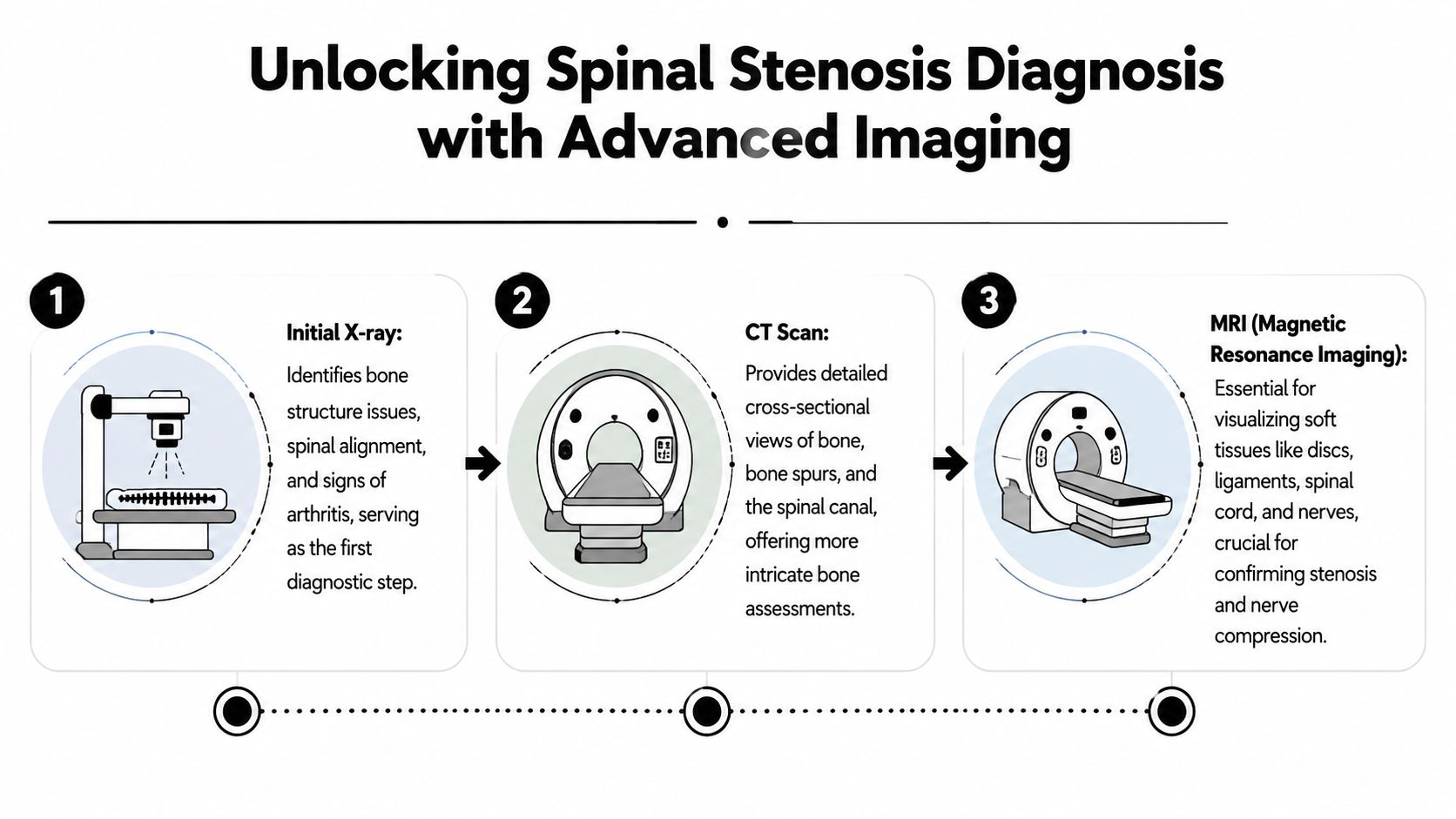
Unlocking the Diagnosis with Advanced Imaging
Imaging confirms spinal stenosis. It doesn't replace the history and exam.
That's an important distinction because MRI has been the most appropriate noninvasive test for lumbar spinal stenosis since the 1980s, yet imaging findings are common in older adults and don't always match symptoms. Radiological evidence affects up to 20% of U.S. adults over 60, while only about 11% have clinical symptoms, and around 600,000 surgeries are performed for the condition annually in the U.S., according to this PMC review on lumbar spinal stenosis.
What an X-ray can tell you
An X-ray is often the opening imaging study when the clinical picture suggests spine degeneration, arthritis, or instability. It won't show nerves, discs, or soft tissue detail the way MRI can, but it still has value.
X-rays are useful for spotting:
- Spinal alignment problems, including slippage of one vertebra over another
- Arthritic change in the bony structures
- Fracture or deformity
- Degenerative patterns that may support the broader diagnosis
If symptoms suggest stenosis, an X-ray is usually a setup step, not the final answer. It helps define the bony structure and can reveal reasons to order more detailed imaging.
Why MRI is the gold standard
MRI is the study that usually answers the key anatomical questions. It gives a detailed look at discs, ligaments, nerve roots, the dural sac, and other soft tissues that X-rays can't show.
That matters because spinal stenosis isn't just a bone problem. Thickened ligaments, disc bulging, facet joint overgrowth, and soft tissue crowding can all contribute to narrowing. MRI shows where the canal or nerve passageways are tight and whether that narrowing matches the patient's symptom pattern.
Clinicians also look at established imaging criteria. In lumbar stenosis, cross-sectional canal area and anterior-posterior diameter help define severity. MRI can also show qualitative signs, such as cerebrospinal fluid space obliteration and other features that support the diagnosis when they fit the clinical picture.
A useful MRI doesn't just say "stenosis present." It helps answer where the narrowing is, how severe it appears, and whether that location matches the patient's symptoms.
When CT or CT myelography makes more sense
Some patients can't have an MRI because of implanted devices, severe claustrophobia, or other contraindications. In that setting, CT becomes more useful, especially for bone detail.
CT can show:
- Bony canal narrowing
- Facet overgrowth and bone spurs
- Spondylolisthesis or alignment issues
- Postsurgical anatomy, where metal hardware can complicate MRI interpretation
If more detail is needed and MRI isn't an option, CT myelography can help define how the spinal canal and nerve roots are being compressed. It's not the first-line study for every patient, but it remains valuable in selected cases.
What imaging does poorly
Patients often assume the scan settles everything. It doesn't.
A report may describe "moderate" or "severe" stenosis, but the image alone can't tell you whether that narrowing is causing today's pain, whether it's the main pain generator, or whether another problem is driving the symptoms instead. That's why spine specialists don't treat the scan in isolation.
A practical way to think about it is this:
| Imaging test | Best use | Main limitation |
|---|---|---|
| X-ray | Alignment, arthritis, bony change | Doesn't show soft tissue or nerve compression well |
| MRI | Soft tissue detail, nerve compression, canal narrowing | Can show abnormalities that aren't causing symptoms |
| CT or CT myelogram | Bone detail or MRI contraindications | Usually selected for specific situations, not every patient |
Imaging is powerful when it's used to confirm a well-built clinical suspicion. It's much less useful when it's ordered without a symptom pattern to interpret it against.
Ruling Out Mimics and Using Specialized Tests
One of the most important parts of how to diagnose spinal stenosis is making sure it really is spinal stenosis. Back and leg pain can come from the spine, the hip, blood flow problems, peripheral nerves, or more than one source at the same time.
That overlap is why diagnosis can get tricky. Neurogenic claudication is present in about 70% of spinal stenosis cases and is defined by relief with leaning forward, while vascular claudication is more likely to improve by stopping and standing still. At the same time, 20% to 30% of older adults have incidental stenosis on MRI without symptoms, which is why clinical differentiation matters so much, as explained in this Cleveland Clinic overview of spinal stenosis.
Spinal stenosis vs common mimics
| Symptom feature | Spinal Stenosis (Neurogenic Claudication) | Vascular Claudication | Hip Osteoarthritis |
|---|---|---|---|
| What brings it on | Standing upright, walking, lumbar extension | Walking or exertion | Weight-bearing, joint use, certain hip movements |
| What relieves it | Sitting, bending forward, leaning on support | Rest, especially standing still | Rest, position change, avoiding painful hip motion |
| Typical pain pattern | Buttock, thigh, calf, numbness or heaviness | Cramping or fatigue in the legs with exertion | Groin pain, upper thigh pain, stiffness |
| Posture effect | Forward flexion often helps | Posture usually matters less | Hip rotation and joint loading matter more |
| Exam clues | Extension intolerance, neurologic findings may be present | Pulse findings may be abnormal | Hip motion reproduces pain |
This table doesn't replace an exam, but it shows why the details matter. "My leg hurts when I walk" is too broad to diagnose. "My legs go numb after standing, and leaning on a cart lets me keep going" is much more specific.
Why incidental MRI findings create confusion
A scan can show narrowing and still not explain the patient's symptoms. That's common enough that relying on the MRI alone leads people in the wrong direction.
I see this problem most often in two situations. First, a patient has leg pain from poor circulation or hip disease, but the MRI report dominates the conversation because the word stenosis appears on the page. Second, a patient has real spinal stenosis but also has another overlapping pain generator, such as peripheral neuropathy or a painful arthritic hip.
That is exactly why the sequence matters. History first. Exam second. Imaging third. When needed, targeted testing after that.
If the symptom pattern and the scan don't match, the scan doesn't win by default.
When EMG and nerve conduction studies help
Not every patient with suspected stenosis needs electromyography (EMG) or nerve conduction studies. These tests become useful when the picture is muddy.
They can help when:
- Symptoms don't line up cleanly with imaging
- Peripheral neuropathy is also possible
- Prior surgery has complicated the anatomy
- Weakness, numbness, or radiating pain needs clearer localization
- A mimic such as another nerve disorder is in the differential
EMG looks at electrical activity in muscles to see whether a nerve root is irritated or damaged. Nerve conduction testing evaluates how signals travel along peripheral nerves. Together, they can help separate radiculopathy from peripheral nerve entrapment or generalized neuropathy.
For patients trying to understand treatment choices, that's a major practical point. The procedures used for nerve-related spine pain are different from the options used for vascular disease, hip arthritis, or diffuse neuropathy. Reviewing the range of procedures used for treatment makes more sense once the pain source has been pinned down accurately.
Other targeted tests that may enter the picture
Some cases need a wider workup. That doesn't mean the diagnosis is doubtful. It means the clinician is being careful.
Additional tools may include:
- Pulse checks and vascular assessment when walking pain sounds circulatory
- Hip-focused exam maneuvers when groin pain or reduced hip motion points away from the spine
- Dynamic imaging or flexion-extension films if instability is suspected
- Electrodiagnostic testing when neurologic symptoms need clarification
Good diagnosis often feels less dramatic than patients expect. It's usually a process of excluding what doesn't fit until the remaining explanation is the one that consistently matches the story, the exam, and the testing.
Your Diagnostic Journey at Midwest Pain & Wellness
By the time many patients come in, they've already heard several versions of the story. One clinician focused on arthritis. Another focused on a disc bulge. An MRI report used alarming language. Meanwhile, the central question is still unanswered: what is causing the pain, numbness, or walking limitation, and what should be done next?
That question deserves a structured answer. A full diagnostic protocol that includes clinical scoring, neurologic testing such as EMG with 70% sensitivity for radiculopathy, and tiered imaging achieves a 92% positive predictive value for symptom relief after intervention. That level of precision helps avoid acting on incidental MRI findings, which are present in 23% of asymptomatic adults over 60, and helps match patients to the right treatment, including decompression, which has a 71.4% success rate for improving function, according to Mayo Clinic diagnostic and treatment guidance for spinal stenosis.
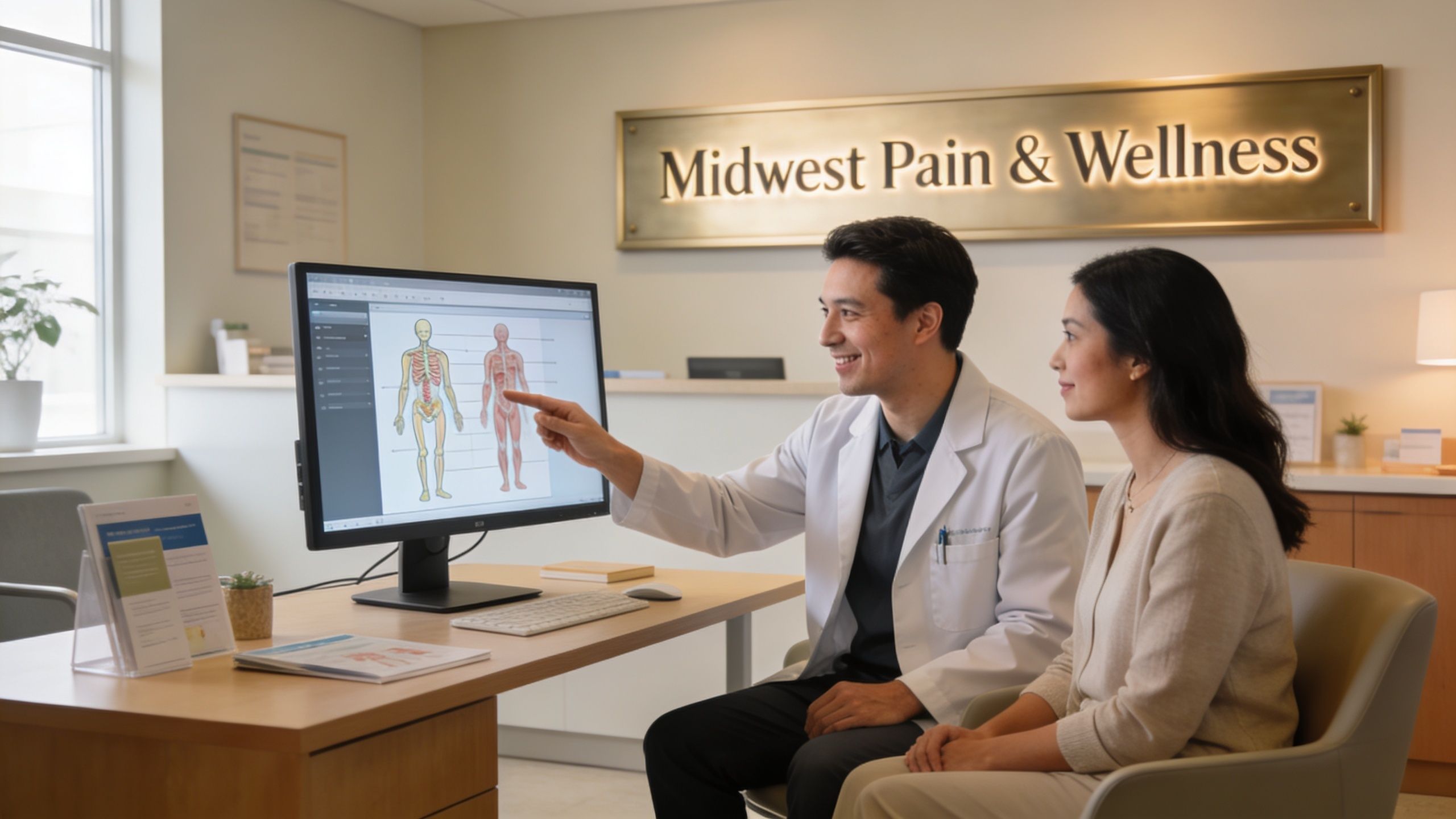
What patients can expect in clinic
For patients in Oak Lawn, Palos Hills, Palos Heights, Worth, Bridgeview, Hickory Hills, Alsip, Burbank, Evergreen Park, and Orland Park, Illinois, the diagnostic process should feel organized, not rushed.
It usually starts with a detailed conversation about symptom behavior. Not just where it hurts, but when it hurts, what posture changes it, whether walking is limited, whether the legs or arms are involved, and whether there are any warning signs that change urgency. Prior injections, surgeries, therapy history, medication response, and outside imaging all matter.
The next step is a focused physical and neurological exam. That provides the working diagnosis. If imaging is needed, it should be ordered to answer a specific question, not just because back pain exists.
Why this matters in pain management
Pain management isn't just about reducing pain scores. In spinal stenosis, the primary targets are usually function, walking tolerance, nerve safety, sleep, and independence.
That's where a careful diagnosis changes the plan. A patient with leg-dominant neurogenic claudication may need a very different pathway than a patient whose main problem is facet-mediated back pain, hip arthritis, postsurgical scar-related pain, or peripheral neuropathy. The wrong diagnosis leads to ineffective treatment and frustration.
At Midwest Pain & Wellness, that diagnostic workup informs an opioid-sparing plan that may include image-guided injections, minimally invasive lumbar decompression, Vertiflex evaluation, or coordination with surgeons, primary care physicians, chiropractors, and rehabilitation providers when appropriate.
The right procedure for the wrong diagnosis is still the wrong treatment.
How diagnosis turns into a treatment plan
Once the diagnosis is clear, treatment planning becomes more honest and more efficient. If symptoms, exam findings, and imaging line up with lumbar stenosis, the next discussion is about severity, goals, and what level of intervention makes sense.
That conversation often includes trade-offs such as:
- Observation and conservative care when symptoms are present but manageable
- Targeted injections when inflammation around compressed nerves is part of the pain picture
- Minimally invasive decompression options when function is limited and anatomy supports them
- Surgical referral when neurological risk, instability, or treatment failure makes that the appropriate next step
An opioid-sparing approach works best when the diagnosis is specific. If pain is being driven by mechanical narrowing, nerve irritation, or instability, the goal is to treat that generator directly rather than masking it with escalating medication.
For many patients, the most reassuring part of the process is finally understanding why symptoms happen. Once you know whether the problem is posture-dependent nerve compression, a mimic such as hip or vascular pain, or a mixed picture, the path forward becomes much clearer.
If you're dealing with back, buttock, or leg symptoms that worsen with standing or walking, a focused evaluation can clarify whether spinal stenosis is the cause and what to do next. Midwest Pain & Wellness provides interventional, opioid-sparing pain care for Illinois patients, with diagnosis built around history, examination, imaging review, and treatment planning that matches the pain source.