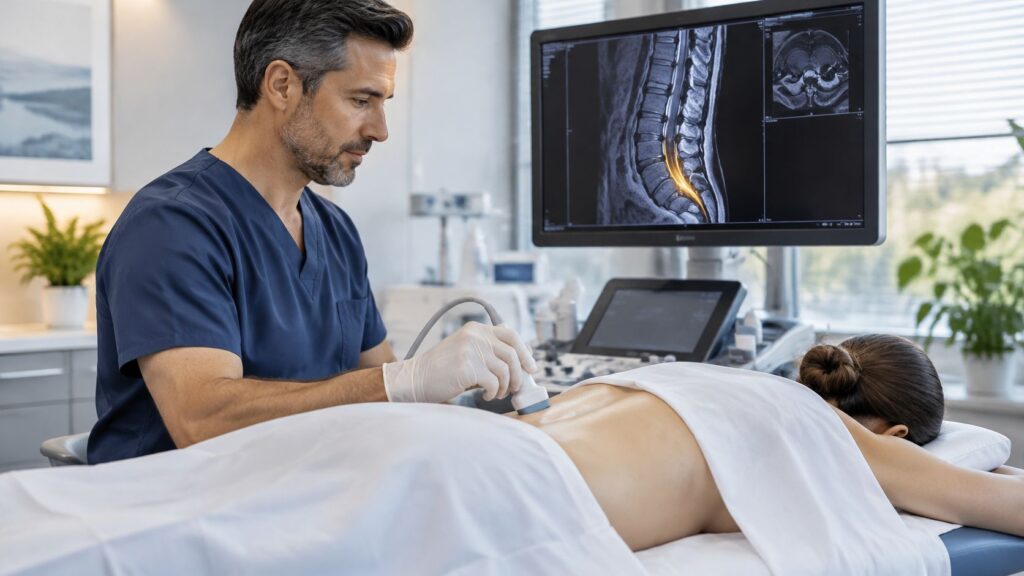
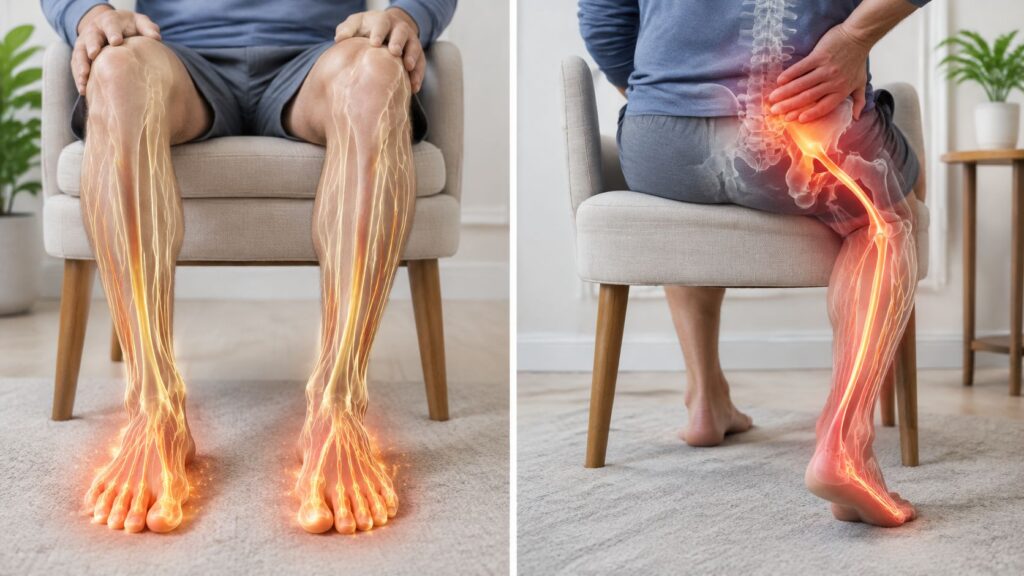
That sharp pain starting in your low back or buttock and shooting down your leg can make ordinary life feel unstable fast. Sitting in the car hurts. Standing too long hurts. Bending to put on a shoe can send a jolt down the calf. Many people search for how to heal sciatica when they're already frustrated, sleep deprived, and unsure whether they should rest, stretch, walk, or head straight to a specialist.
The good news is that sciatica often improves with conservative care. The hard part is knowing when simple home treatment is enough and when the pain is signaling a problem that needs a more precise diagnosis and a structured treatment plan. That difference matters, because the fastest path to relief usually isn't doing more of everything. It's doing the right thing for the reason your nerve is irritated.
Understanding Sciatica and What's Causing Your Pain
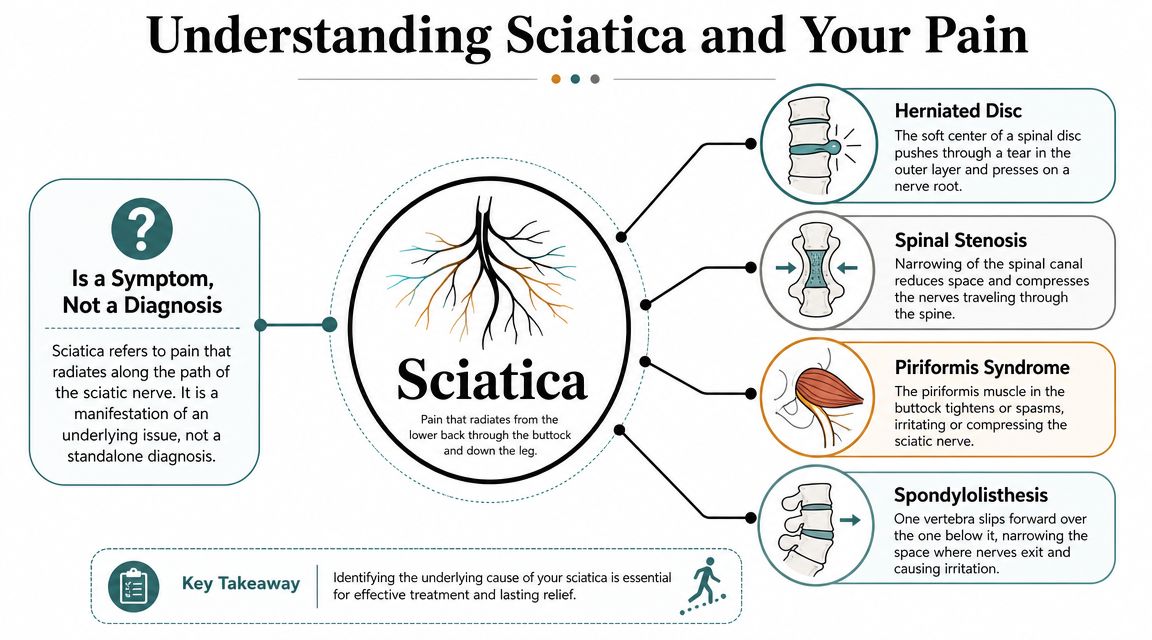
Sciatica is not a stand-alone diagnosis. It's a symptom pattern. The sciatic nerve starts from nerve roots in the lower spine, then travels through the buttock and down the leg. When one of those nerve roots gets irritated or compressed, pain can radiate along that path.
That's why sciatica can feel sharp, electric, burning, aching, or numb. Some people mainly notice calf pain. Others feel buttock pain, tingling into the foot, or weakness when trying to lift the toes. The location matters, but the source is usually in the lower back or nearby structures.
The common causes aren't all the same
A lumbar herniated disc is one common cause. A disc can bulge or leak material that irritates a nearby nerve root. In that setting, certain movements, especially repeated bending forward or sitting too long, can aggravate symptoms.
Spinal stenosis is different. Here, the spaces around the nerves narrow, often from degenerative changes in the spine. People with stenosis often describe leg pain or heaviness with standing and walking, and relief when sitting or leaning forward.
Piriformis syndrome is a separate pattern. The sciatic nerve may become irritated near the buttock rather than from the spine itself. That can mimic disc-related pain, but the treatment approach may differ.
Spondylolisthesis can also trigger sciatica. In that condition, one vertebra shifts relative to another, which may narrow the space around a nerve root.
Sciatica tells you a nerve is unhappy. It doesn't tell you why.
Why one-size-fits-all advice fails
Many patients often get stuck. They find a generic list of stretches online, try all of them, and feel worse. That happens because different causes behave differently. A movement that helps one patient may flare another.
If your pain is driven by disc irritation, aggressive forward folding may worsen symptoms. If tight muscles around the hip are contributing, carefully chosen mobility work may help. If stenosis is the issue, the plan often needs to focus on posture, walking tolerance, inflammation control, and in some cases procedures rather than endless stretching.
A proper evaluation starts with the pattern of pain, numbness, weakness, what positions aggravate it, and how your exam behaves. If you want a clearer picture of the underlying conditions behind radiating leg pain, the clinic's overview of conditions treated in pain management is a useful starting point.
The first step in healing is naming the source
People often ask how to heal sciatica quickly. The honest answer is that healing starts when the cause is identified. Treating every case as “just a tight muscle” delays progress. So does assuming every flare means surgery.
Most patients need a stepwise plan. First calm the nerve. Then restore movement. Then decide whether the pain is following the expected course or whether it needs more targeted care.
Immediate Relief at Home Your First 72 Hours
You wake up with pain shooting from the low back into the leg, and every move feels loaded. The job for the first 72 hours is straightforward. Calm the irritated nerve, protect it from repeated provocation, and keep enough movement in your day that stiffness does not take over.
I tell patients to treat this phase like irritation control. Do less of what clearly flares the leg, but do not disappear into bed for the weekend. A short period of reduced activity can help. Prolonged inactivity usually makes the back, hips, and nerve more sensitive.
What to do on day one
Scale down activity right away. Put off heavy lifting, repeated bending, twisting, yard work, and long drives if possible. Short walks through the house or down the hallway are often better tolerated than staying in one position for hours.
Use cold on the painful area of the low back or buttock for brief sessions, with a cloth between the pack and your skin. For many patients, cold is most useful early, when the pain feels hot, sharp, or newly inflamed.
Positioning matters more than people expect. If you need to lie down, choose a posture that takes tension off the low back:
- On your back with knees supported: Place a pillow under your knees.
- On your side with legs slightly bent: Put a pillow between your knees.
- Avoid stomach sleeping: It often increases strain through the lumbar spine.
A practical target for day one is simple. Keep changing positions before symptoms spike.
Mistakes that slow early recovery
The biggest problems in the first few days are usually self-inflicted. Patients often keep testing the pain to see whether it is "still there," or they stop moving altogether.
Avoid these early missteps:
- Prolonged bed rest: Brief rest is reasonable. Hours and hours in bed usually lead to more stiffness and harder movement later that day.
- Repeated pain testing: Forceful stretching, deep forward bends, and trying to crack the back can make an angry nerve angrier.
- Long sitting blocks: Sitting can increase pressure on sensitive discs, joints, and nerve roots, especially if your symptoms already worsen in a chair.
Useful rule: If an activity sends pain farther down the leg, reduce it or stop it.
Days two and three
By this point, I am less interested in whether the pain has vanished and more interested in the trend. Is it a little less intense? Are position changes easier? Can you walk a bit farther before the leg starts to bark? Those are the signs that home care may be working.
Keep walks short and frequent. If you work at a desk, stand up regularly and reset your posture before symptoms build. Move deliberately when getting out of bed, out of a chair, or into the car. Quick twisting motions commonly trigger another flare.
Some patients use over-the-counter anti-inflammatory medication during this window. Harvard Health's guidance on sciatica relief includes ibuprofen or naproxen as conservative options for appropriate patients. They are not right for everyone. A history of ulcers, kidney disease, blood thinner use, uncontrolled blood pressure, or certain heart conditions changes that decision. Follow label directions and your own clinician's advice.
After the first couple of days, heat can help if the muscles around the back and hip are tightening up. A heating pad or warm compress may reduce guarding and make walking or changing positions easier. Heat does not fix the underlying cause. It can make the area more tolerable while the nerve settles.
A simple first 72-hour plan
Reduce the movements that clearly trigger leg pain
Pause heavy chores, awkward bending, repetitive lifting, and long seated trips.Use cold early
Brief cold sessions are often most helpful during the initial flare.Walk in small doses
A few minutes at a time is enough if that is your current limit.Change positions sooner
Do not wait until sitting or standing becomes unbearable.Add heat later if muscle guarding builds
Many patients find this more useful after the first couple of days.Track symptom direction
Pain that starts traveling farther down the leg is usually a sign to modify what you are doing.
This period is about buying the nerve some quiet. If symptoms are easing, home care may be enough. If they are not, or if the pain is already severe, that is when a more structured treatment pathway matters. In practice, that can mean moving from self-care to targeted rehab, medication guidance, imaging when indicated, and procedures if the nerve is being compressed and not improving on its own.
Safe Stretches and Exercises for Sciatica Relief
A common mistake during a sciatica flare is doing the stretch that feels strongest instead of the movement your nerve tolerates best. The right exercise usually settles symptoms during the session or leaves you less irritated afterward. The wrong one often drives pain farther down the leg.
Harvard Health's guidance on sciatica relief makes the same practical point. Gentle movement often helps, but aggressive stretching, twisting, or bouncing can aggravate an already sensitive nerve.

Start with the response, not the exercise name
Patients often ask whether a specific stretch is good for sciatica. My answer is to watch the symptom pattern. If pain becomes less intense, pulls out of the foot or calf, or feels more centered in the buttock or low back, that is usually a favorable response. If a movement creates sharper leg pain, new numbness, or a lingering flare after you stop, that movement is not serving you right now.
Use a slow pace. Stay in a comfortable range. Quit before the nerve gets angry.
Press-up extension
This movement can help some patients whose symptoms worsen with sitting, slouching, or repeated forward bending.
- Lie on your stomach.
- Rest on your forearms first.
- If that position feels acceptable, place your hands under your shoulders.
- Gently press your chest upward while keeping your hips down.
- Rise only to a comfortable height.
- Pause briefly, then lower with control.
I tell patients to judge this exercise by the leg, not the back. Mild pressure in the low back can be acceptable. More pain traveling down the leg is a sign to stop.
Gentle piriformis stretch
This can be useful when the buttock feels tight, sore, or tender, especially if sitting loads that area.
- Lie on your back with both knees bent.
- Cross the ankle on the painful side over the opposite knee.
- Gently draw the uncrossed thigh toward your chest.
- Stop when you feel a mild buttock stretch.
- Hold steadily, then release slowly.
Keep it easy. A light stretch is enough. Forcing range often irritates the nerve instead of calming the surrounding muscle.
Knee-to-chest variation
Some patients tolerate this well when the back feels stiff and achy rather than sharply inflamed.
- Start on your back.
- Bring one knee toward your chest slowly.
- Keep the other leg bent or straight, depending on comfort.
- Hold in a comfortable range.
- Lower the leg with control.
This works better as a gentle mobility drill than a prolonged stretch. If you feel pulling, tingling, or pain tracking farther down the leg, stop and choose a different movement.
Nerve-friendly walking
Walking is often one of the safest ways to stay active during recovery. It limits stiffness without forcing the spine into deep bending or rotation, and short walks are usually better tolerated than one long outing.
Try it this way:
- Walk for a brief interval around the house, hallway, driveway, or block.
- Stop while symptoms are still manageable.
- Repeat later in the day instead of trying to do too much at once.
This approach sounds simple because it is. It also works.
Movements to avoid during a flare
Certain motions are more likely to irritate a sensitive sciatic nerve, especially early on:
- Deep forward bends
- Aggressive hamstring stretching
- Twisting stretches under tension
- Fast, bouncing movements
- Any exercise that consistently sends pain farther down the leg
The trade-off matters here. Pushing through discomfort may feel productive in the moment, but it often turns a manageable flare into several bad days.
When exercise needs to match the cause
Sciatica is a symptom pattern, not a single diagnosis. A patient with disc-related nerve irritation may respond to extension-based movements. A patient with piriformis irritation may need hip-focused stretching and loading changes. A patient with spinal stenosis may tolerate very different positions and may need a plan that goes beyond home exercise if walking remains limited.
That is where a coordinated pain clinic can change the course of treatment. At Midwest Pain & Wellness, we use the response to exercise as one part of the evaluation, then build the next step around the actual pain generator. If your symptoms are not improving or your pattern is recurring, schedule a sciatica evaluation with our pain specialists. Exercises help many patients. The ones who do not improve with self-care often need a more specific diagnosis, a more targeted rehab plan, or an image-guided procedure rather than more stretching.
When Self-Care Is Not Enough Recognizing Red Flags and Seeking Help
Most patients want to know two things. Is this likely to improve on its own, and when should I stop waiting? Those are the right questions.
Harvard Health notes that roughly three out of four patients improve within a few weeks and that surgery becomes a consideration, rather than a first-line option, if symptoms haven't improved after about six weeks in the right clinical context, as described in Harvard Health's review of sciatica recovery. That same review reports that about 20% to 30% of patients still have persistent problems after one or two years, which is why lingering symptoms deserve a more formal plan.
What typical improvement looks like
In the first week, the main goal is reduced irritability. The pain may still be present, but you should start seeing small wins. Sitting may become a little easier. The pain may not travel as far. Sleep may improve.
By weeks two through four, many people notice a steadier pattern. Flare-ups happen less easily. Walking tolerance improves. The pain may shift from sharp and radiating to more localized soreness.
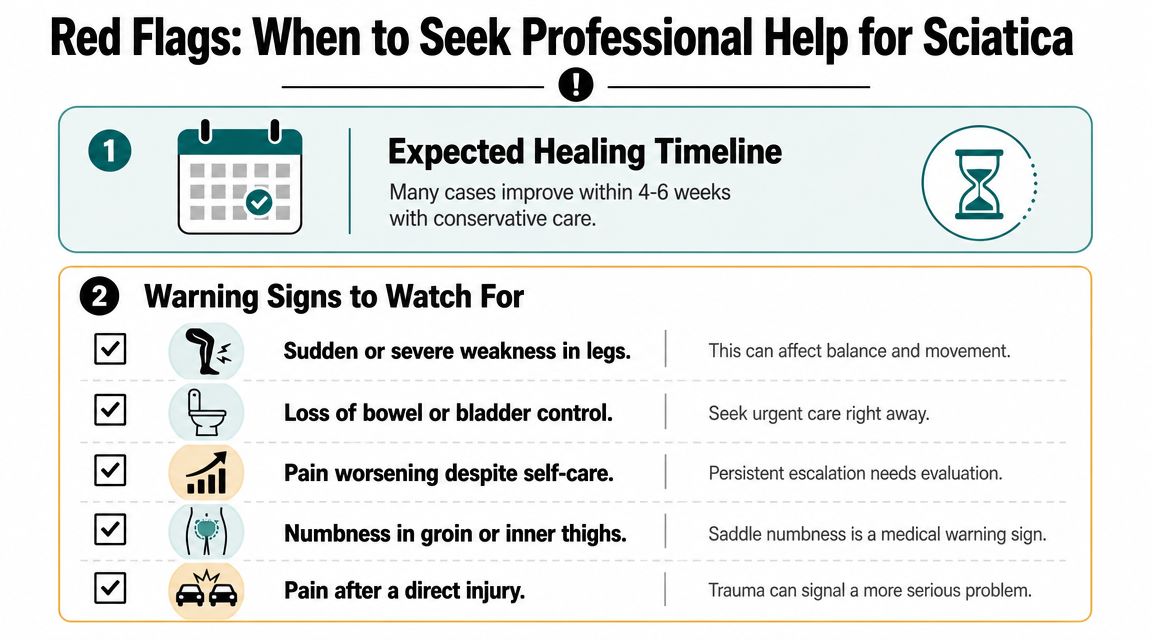
If you get to about six weeks with little meaningful improvement, or you still can't function normally because of pain, that's the point where a professional evaluation becomes more important. You may need imaging, medication adjustment, targeted procedures, or a different diagnosis than the one you assumed.
Red flags that need urgent attention
Some symptoms are not “wait and see” symptoms.
- Progressive leg weakness: Trouble lifting the foot, climbing stairs, or pushing off.
- Loss of bowel or bladder control: This needs immediate medical evaluation.
- Numbness in the groin or inner thighs: This can signal severe nerve involvement.
- Pain after a significant injury: Especially if symptoms began after trauma.
- Rapidly worsening pain despite self-care: Particularly if paired with numbness or weakness.
Severe weakness, bowel or bladder changes, or numbness in the saddle area should be evaluated urgently.
When to stop self-treating
Self-care is reasonable at the beginning. It's not meant to become a holding pattern for months. If pain keeps you from sleeping, walking, working, or caring for yourself, the next step is a focused medical assessment.
A consultation can clarify whether the pain is likely disc-related, stenosis-related, coming from the facet joints, involving the sacroiliac region, or reflecting another pain generator altogether. If you're ready for that next step, you can request an appointment for a sciatica evaluation.
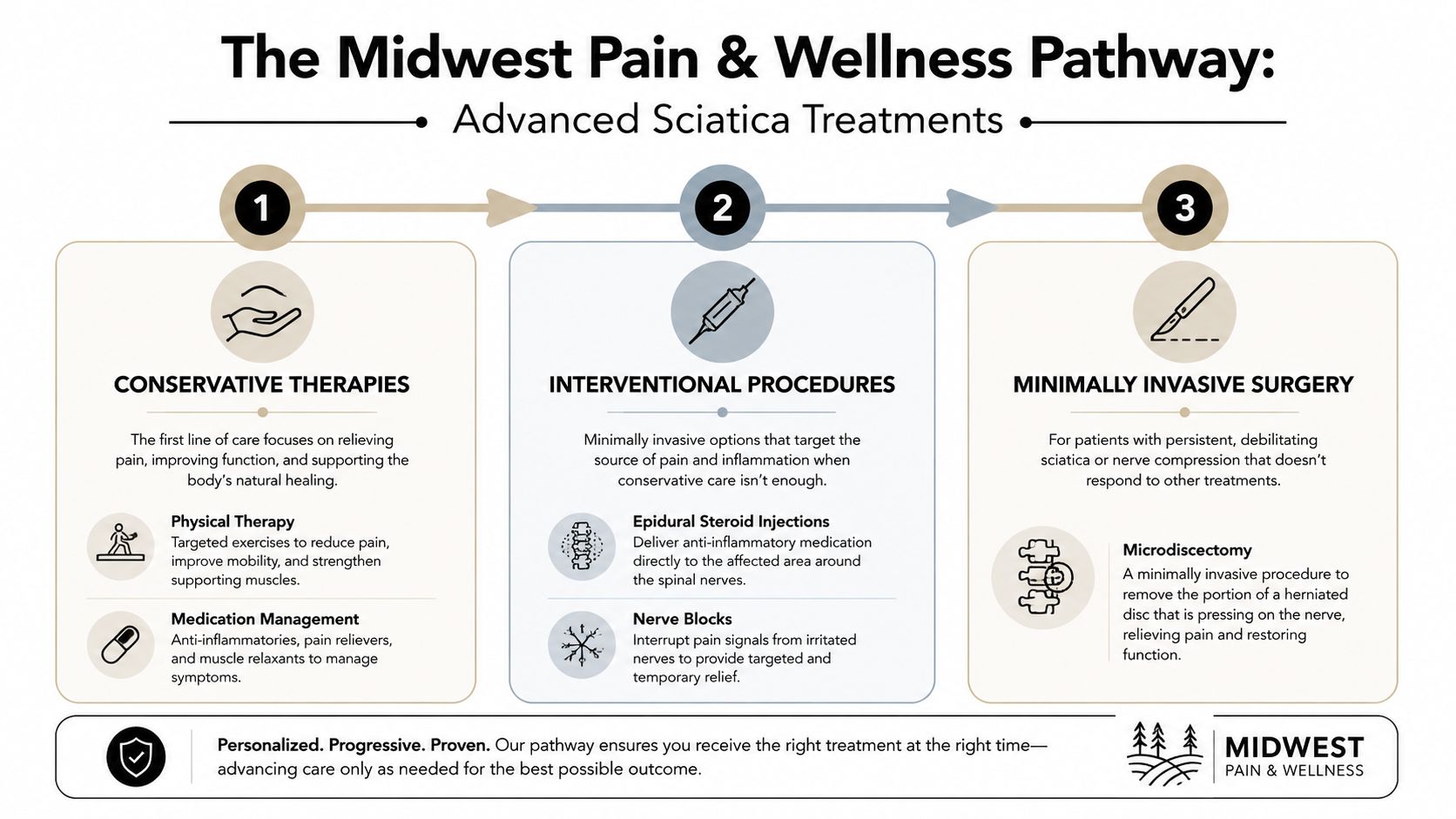
The Midwest Pain & Wellness Pathway Advanced Sciatica Treatments
When sciatica doesn't settle with time, movement, and home measures, the answer usually isn't jumping straight to surgery. It's building a treatment ladder around the likely pain generator, how long symptoms have lasted, whether there's neurologic change, and which activities are still limited.
That process starts with diagnosis. A careful history often tells you more than an MRI alone. The pattern of pain, whether coughing or sitting worsens it, whether standing and walking are the primary problem, where numbness travels, and whether weakness is present all help separate a disc problem from stenosis, facet-mediated pain, sacroiliac pain, hip pathology, or a peripheral nerve issue.
Step one is precision, not guesswork
A complete evaluation usually includes a physical exam, review of prior treatment, and, when appropriate, imaging. Imaging is useful when symptoms persist, the exam suggests nerve compromise, or a procedure is being considered. But the image has to fit the person. Many adults have degenerative findings on scans that aren't the true pain source.
The next question is whether your pain is mostly inflammatory, mechanical, or structural.
- Inflammatory pain often responds to calming the irritated nerve root.
- Mechanical pain often depends on position and load.
- Structural narrowing may need decompression-focused strategies rather than repeated temporary fixes.
That's why an interventional clinic can be valuable. It helps sort out which of those categories is driving the symptoms and what the next least invasive step should be. One local option for patients reviewing procedure-based care is Midwest Pain & Wellness and its treatment procedures.
Coordinated conservative care still matters
Even when symptoms have lasted longer than expected, the foundation is often still conservative care, just done with more discipline. That may include medication review, guidance on activity modification, and coordination with targeted rehabilitation instead of generic exercise sheets.
Johns Hopkins, Cleveland Clinic, and Harvard are all referenced in the verified guidance as supporting a staged model in which many patients start with movement, heat or cold, and medication, while more advanced options are reserved for persistent or function-limiting pain. In that same evidence-based progression, spinal injections may provide short-term relief for some patients with ongoing severe symptoms, while Harvard notes they do not appear to reduce the need for future surgery in the long run. That trade-off matters. Injections can still be very useful when the immediate goal is reducing inflammation, restoring sleep, or helping a patient participate in rehab.
Image-guided injections and blocks
For classic lumbar radicular pain, an epidural steroid injection may reduce inflammation around an irritated nerve root. The value here is specificity. The medication is delivered under imaging guidance to the level most likely responsible for symptoms.
A selective nerve root block may also help, especially when the diagnosis needs clarification. It can sometimes function as both treatment and diagnostic confirmation.
These procedures aren't magic. They don't reverse every structural problem. But in the right patient, they can reduce enough pain to allow walking, sleeping, and therapeutic movement again.
The best injection is the one tied to a clear diagnosis and a clear goal.
When radiofrequency ablation fits and when it doesn't
Radiofrequency ablation, or RFA, is often misunderstood in sciatica discussions. RFA is not typically used to treat true nerve root compression from a disc herniation. It is more commonly used for facet-mediated back pain, where the small joints in the spine are contributing to chronic axial pain.
That distinction matters because many patients have both. They may have radiating symptoms from one source and persistent low back pain from another. In that situation, facet blocks followed by RFA can help the back-pain component even if they don't directly address the radicular leg pain.
This is one reason a broad pain clinic approach can be useful. Patients rarely present with textbook, isolated pathology. They present with overlapping pain generators.
Advanced options for spinal stenosis
Some sciatica-like patterns are really neurogenic claudication from lumbar stenosis. These patients often say standing and walking are limited, and leaning forward gives relief. When conservative care and injections aren't enough, minimally invasive options become more relevant.
MILD, which stands for minimally invasive lumbar decompression, is designed for certain patients with lumbar spinal stenosis related to thickened ligament. The goal is to create more room in the spinal canal without traditional open surgery.
Vertiflex Superion is an interspinous spacer used in selected stenosis patients. It helps maintain a posture that relieves pressure on the nerves, particularly in patients whose symptoms improve with flexion.
These are not interchangeable with disc treatment. They fit a different problem. Matching the procedure to the pattern is the whole point.
Neuromodulation and regenerative options
For more complex, chronic nerve pain, especially when prior surgery has failed or standard measures haven't restored function, spinal cord stimulation may enter the discussion. Neuromodulation changes pain signaling rather than physically removing a source of compression.
Some patients also ask about PRP or other regenerative strategies. These may be considered in select musculoskeletal conditions, but they are not a universal answer for classic sciatica. The decision depends on what structure is injured or inflamed.
Advanced Sciatica Treatment Options at Midwest Pain & Wellness
| Treatment | Primary Goal | Ideal Candidate | Procedure Type |
|---|---|---|---|
| Epidural steroid injection | Reduce nerve root inflammation | Patient with persistent radiating leg pain suggestive of lumbar radiculopathy | Image-guided injection |
| Selective nerve root block | Calm pain and help confirm the symptomatic level | Patient with unclear level of nerve irritation or mixed findings | Image-guided diagnostic and therapeutic block |
| Medial branch block and RFA | Treat facet-related back pain that may coexist with sciatica | Patient with chronic axial low back pain and positive diagnostic blocks | Diagnostic block followed by nerve ablation |
| MILD | Improve space for nerves in selected lumbar stenosis cases | Patient with lumbar spinal stenosis and walking-limited symptoms | Minimally invasive decompression |
| Vertiflex Superion | Reduce stenosis-related leg symptoms in selected cases | Patient whose standing and walking trigger symptoms relieved by flexion | Minimally invasive implant procedure |
| Spinal cord stimulation | Modulate chronic pain signaling | Patient with persistent neuropathic pain after other treatments | Neuromodulation implant |
What works and what tends to waste time
What works is a diagnosis-led sequence. Calm the inflammation when that's the driver. Use rehabilitation when movement deficits and conditioning matter. Use targeted procedures when symptoms remain function-limiting. Move to decompression strategies when anatomy and walking tolerance point toward stenosis.
What often wastes time is repeating the same failed advice in different forms. More stretching isn't always better. More pills aren't always safer. More months of waiting doesn't always equal healing.
People asking how to heal sciatica usually want one answer. In practice, the reliable answer is a pathway.
Your Partner for Sciatica Relief in the Chicago Area
Sciatica can improve. For many people, it does. But improvement is rarely about doing one dramatic thing. It's about choosing the right next step at the right time.
At home, that means avoiding the early traps. Don't stay inactive too long. Don't force painful stretches. Don't assume all leg pain is the same. If your symptoms are easing, keep building on that progress with smart movement and activity control.
If your symptoms aren't following that course, the plan should change. Persistent radiating pain, recurring flares, weakness, limited walking, and pain that keeps disrupting work or sleep deserve more than generic advice. They deserve a diagnosis and a treatment ladder matched to the source of the problem.
That's especially important in Illinois patients dealing with overlapping issues such as disc disease, stenosis, facet pain, sacroiliac dysfunction, post-surgical pain, or age-related degeneration. In those situations, effective care often means combining medication review, procedure-based treatment, and coordination with other clinicians rather than relying on a single tool.
Dr. Donkoh's approach is built around that kind of stepped, opioid-sparing care. The aim isn't to push every patient toward an intervention. The aim is to use the least invasive treatment that has a reasonable chance of helping, then escalate only when the diagnosis and your symptoms justify it.
Patients in Oak Lawn, Palos Hills, Palos Heights, Worth, Bridgeview, Hickory Hills, Alsip, Burbank, Evergreen Park, Orland Park, and the surrounding Illinois communities near Chicago Ridge often start in the same place. They want to know what this pain is, whether it's dangerous, and what works. The right plan answers all three.
If you've been trying to heal sciatica on your own and the pain still controls your day, don't keep guessing. A focused evaluation can tell you whether you need more time, a different movement strategy, an image-guided injection, treatment for stenosis, or a discussion about more advanced options.
If sciatica pain is limiting your sleep, work, or mobility, schedule a consultation with Midwest Pain & Wellness. Dr. Donkoh provides evidence-based pain management for patients in Chicago Ridge and nearby Illinois communities, with personalized plans that can range from conservative care to image-guided procedures and minimally invasive treatment when appropriate.