If you're reading this after another missed workday, another canceled dinner, or another weekend spent in a dark room, you probably don't need another generic list of “migraine triggers.” You need a prevention plan that makes sense. You also need a clear answer to a question patients ask all the time: How do you prevent migraine attacks when sleep, water, and avoiding obvious triggers still aren't enough?
That's where migraine care often breaks down. People get told to “manage stress” and “track patterns,” but no one explains when those basics help, when they don't, and when it's time to move to prescription prevention or advanced options. In practice, migraine prevention works best as a layered, opioid-sparing plan. Start with pattern recognition and daily habits. Add medical prevention when the burden is high. Escalate again when headaches remain frequent, disabling, or difficult to control.
For patients in Chicago Ridge and nearby Illinois communities like Oak Lawn, Palos Hills, Palos Heights, Worth, Bridgeview, Hickory Hills, Alsip, Burbank, Evergreen Park, and Orland Park, that stepwise approach matters. Migraine isn't a character flaw, and it isn't something you “tough out.” It's a neurologic condition that often responds best when care becomes structured.
First Steps Identifying Your Personal Migraine Triggers
Individuals often start trigger tracking the wrong way. They cut out several foods, try to sleep more, start supplements, drink more water, and stop caffeine all in the same week. Then they have no idea what helped, what didn't, or whether the migraine pattern shifted on its own.
A better approach is more methodical. A clinical review in the Cleveland Clinic Journal of Medicine recommends quantifying triggers and adherence with a headache and sleep diary, then adjusting one variable at a time, because changing multiple factors at once makes trigger attribution unreliable and prevents a clear baseline from being established (clinical review on structured migraine tracking).
Start with a real baseline
Track your headaches for at least long enough to see patterns emerge, but don't overcomplicate the first version of your diary. You need consistency more than perfection.
Write down:
- Timing of the attack. When it started, when it peaked, and when it eased.
- Symptoms around the headache. Nausea, light sensitivity, sound sensitivity, visual changes, neck pain, or scalp tenderness.
- Sleep variables. Bedtime, wake time, and whether sleep felt broken or restorative.
- Food and drink timing. Not just what you ate, but whether you skipped meals or went too long without eating.
- Stress load. Work pressure, emotional stress, travel, conflict, or major schedule disruption.
- Menstrual or hormonal timing if relevant.
- Medication use. What you took and whether it helped.
That last part matters. A prevention plan isn't only about what triggers migraines. It's also about how often you're forced to chase them once they begin.
Practical rule: If you can't tell whether a pattern is real, you don't have enough clean data yet.
Track one variable at a time
Patients often ask whether weather, hormones, dehydration, red wine, missed meals, poor sleep, or stress caused the attack. The honest answer is that migraine usually doesn't behave like a light switch. It behaves more like a threshold problem. One factor may not trigger an attack on its own, but several in the same day can.
That's why I recommend making one deliberate change at a time. If skipped lunches look suspicious, fix meal timing first. If sleep inconsistency jumps off the page, work on wake time first. Keep everything else as stable as you can while you observe what happens.
What a useful diary actually shows
A good diary doesn't just confirm “I get migraines when I'm stressed.” It helps you answer more practical questions:
| What to look for | Why it matters |
|---|---|
| Headaches after irregular sleep | Suggests schedule stabilization may help |
| Headaches after missed meals | Points toward meal timing as a prevention target |
| Attacks around menstrual cycles | May support targeted prevention rather than the same plan every day |
| Frequent need for rescue medicine | Signals that prevention may need to be stronger |
| Clusters after travel or shift changes | Suggests routine disruption is a key driver |
Some triggers are obvious. Others only become clear after you stop guessing and start recording.
Don't turn trigger tracking into trigger fear
This is another common mistake. Patients begin to believe everything is a trigger. They become afraid of exercise, restaurants, social events, perfumes, weather changes, or a single late night. That mindset narrows life without necessarily improving migraine control.
The point of a diary is to identify repeatable patterns, not to make your world smaller. If your notes show that sleep disruption and skipped meals matter far more than any specific food, that's useful. It lets you focus your energy where it's most likely to help.
For people looking into broader headache and pain conditions, Midwest Pain & Wellness conditions treated offers a practical overview of the kinds of pain syndromes that often overlap with migraine, including neck pain and nerve-related complaints that can muddy the picture.
Building Your Daily Prevention Toolkit with the SEEDS Method
Lifestyle prevention works best when it stops being vague. “Be healthier” is not a plan. SEEDS is a plan. It stands for Sleep, Exercise, Eat, Diary, and Stress, and a 2022 peer-reviewed review describes it as a cornerstone of lifestyle migraine prevention. That review encourages about 150 to 300 minutes per week of moderate-intensity aerobic exercise, such as walking, jogging, swimming, cycling, or cross-training for 30 to 60 minutes, 3 to 5 times per week, and notes that regular meals, sleep hygiene, and avoiding triggers like dehydration and irregular sleep can reduce both the frequency and severity of attacks (peer-reviewed review on SEEDS and exercise dosing).
Sleep needs to be boringly consistent
Migraine brains tend to dislike extremes. Too little sleep can trigger attacks. So can sleeping in after a deprived week. What helps most is regularity.
A practical sleep routine includes:
- Fixed wake time. Keep it consistent even after a rough night.
- Less time awake in bed. Don't let the bed become a place for scrolling, work, or worry.
- Predictable wind-down. Dim lights, cut stimulating input, and avoid turning bedtime into negotiation.
- Attention to sleep quality. In one clinical review, sleep goals included aiming for about 90% sleep efficiency and keeping a fixed wake time to reduce mismatch between time in bed and actual sleep (clinical review on SEEDS implementation).
If your migraines consistently worsen after erratic schedules, shift work, or weekend catch-up sleep, sleep stabilization often gives better returns than obsessing over one specific food.
Exercise is medicine when the dose is realistic
People with migraine sometimes avoid exercise because exertion can worsen an active attack. That's understandable, but it can lead to an all-or-nothing pattern. Either they push too hard and flare up, or they stop moving entirely.
Use a middle path:
- Choose low-drama aerobic activity. Walking, stationary cycling, swimming, or light jogging are often easier to sustain.
- Build consistency before intensity. A routine you repeat beats a plan you abandon.
- Avoid heroic workouts after long inactivity. Sudden extremes often backfire.
- Stay aware of heat, dehydration, and fasting. The workout may not be the problem. The setup may be.
A useful benchmark from the review above is 30 to 60 minutes, 3 to 5 times per week within that broader 150 to 300 minute weekly range.
Keep the bar low enough that you'll still clear it on a busy week.
Eat on time, not just “clean”
Many patients focus on identifying forbidden foods and ignore meal timing. In practice, irregular eating causes more trouble than many single ingredients. If your blood sugar swings because breakfast gets skipped and lunch happens late, migraine risk often goes up.
Try this:
- Regular meals instead of long gaps.
- Hydration across the day instead of trying to catch up at night.
- Simple repeatable meals on hectic days so work chaos doesn't become a physiologic stressor.
- Awareness rather than food fear. If one item seems suspicious, test it carefully instead of banning half your diet.
The diary stays in the plan
A lot of people stop tracking once they start feeling a little better. That's often when the diary becomes most useful. It can show whether improvement came from better sleep, more consistent exercise, fewer skipped meals, or a reduced need for rescue medication.
Your diary doesn't need to be elaborate forever. It just needs to remain accurate enough to answer one question at a time.
Stress reduction has to fit real life
“Reduce stress” isn't actionable when you have work, family, caregiving, and poor sleep all colliding at once. Stress management for migraine prevention works better when it's specific and repeatable.
Good options include:
- Short breathing or relaxation sessions done consistently, not only after a migraine starts
- Brief walks or movement breaks during high-pressure workdays
- Boundaries around overstimulation such as light, noise, and nonstop screen exposure
- A calmer evening routine so stress doesn't spill directly into sleep disruption
The NIH notes that non-drug prevention commonly includes keeping a migraine diary, using relaxation techniques, and improving sleep, exercise, hydration, and meal regularity, while also noting that some adults try supplements such as magnesium, riboflavin, coenzyme Q10, and feverfew, with evidence that varies (NIH migraine prevention guidance).
When Lifestyle Changes Are Not Enough
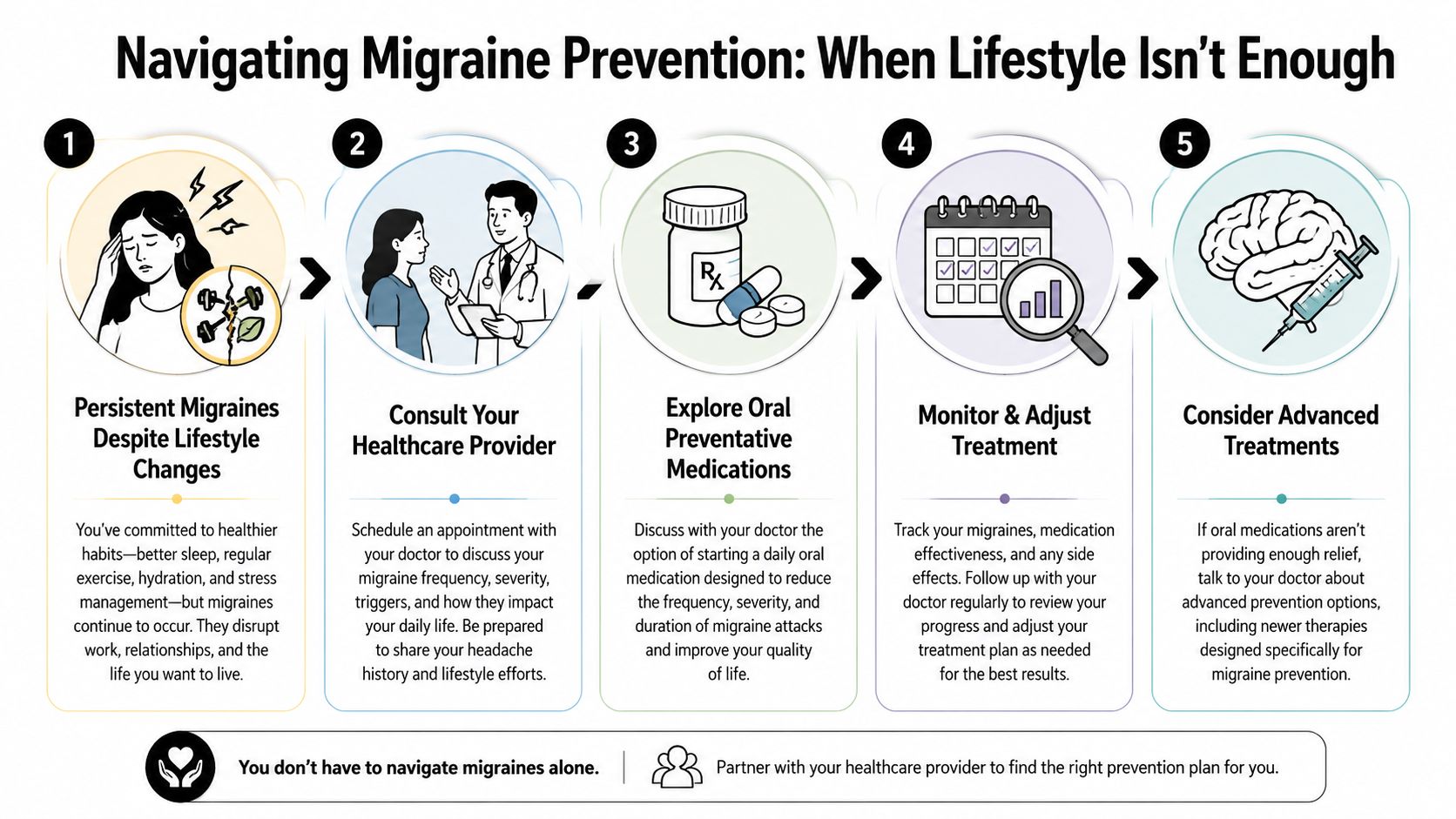
This is the decision point many articles avoid. If you've cleaned up your schedule, tracked your patterns, exercised more consistently, eaten more regularly, and still keep getting hit with disruptive migraines, you have not failed. You've gathered evidence that lifestyle measures alone aren't enough.
That matters because prevention should escalate when the burden stays high. According to NIH guidance, clinicians typically consider preventive treatment when a patient has three or more debilitating migraine attacks per month, attacks lasting longer than three days, or needs acute pain medicine on more than 10 days per month. The same guidance notes that clinicians commonly consider prevention successful if it reduces attack frequency by 50% or more (NIH criteria for migraine prevention and treatment success).
Signs you should stop waiting
Lifestyle-first advice becomes unhelpful when it delays appropriate care. Consider a specialist discussion if any of these sound familiar:
- You're losing function. Work, parenting, driving, exercise, or social plans keep getting derailed.
- Your attacks are long. The headache doesn't just hurt. It occupies days.
- Rescue medicine is becoming routine. You're spending too many days each month trying to put out fires.
- Your life is shrinking around migraine. You've become so focused on avoiding triggers that you're still not in control.
Prevention is not a last resort
Too many patients treat preventive medication like an admission of defeat. It isn't. It's the next rational step when migraine frequency, severity, or duration remains too high. A preventive plan aims to reduce attacks before they start, lower reliance on acute medication, and give your nervous system more stability.
The American Migraine Foundation makes this point well: trigger avoidance is only one part of prevention, which may also include medications, supplements, and devices (American Migraine Foundation overview of layered migraine prevention).
If your current approach is “I just keep trying harder to avoid triggers,” you may be under-treating the problem.
Advanced Medical and Interventional Migraine Prevention
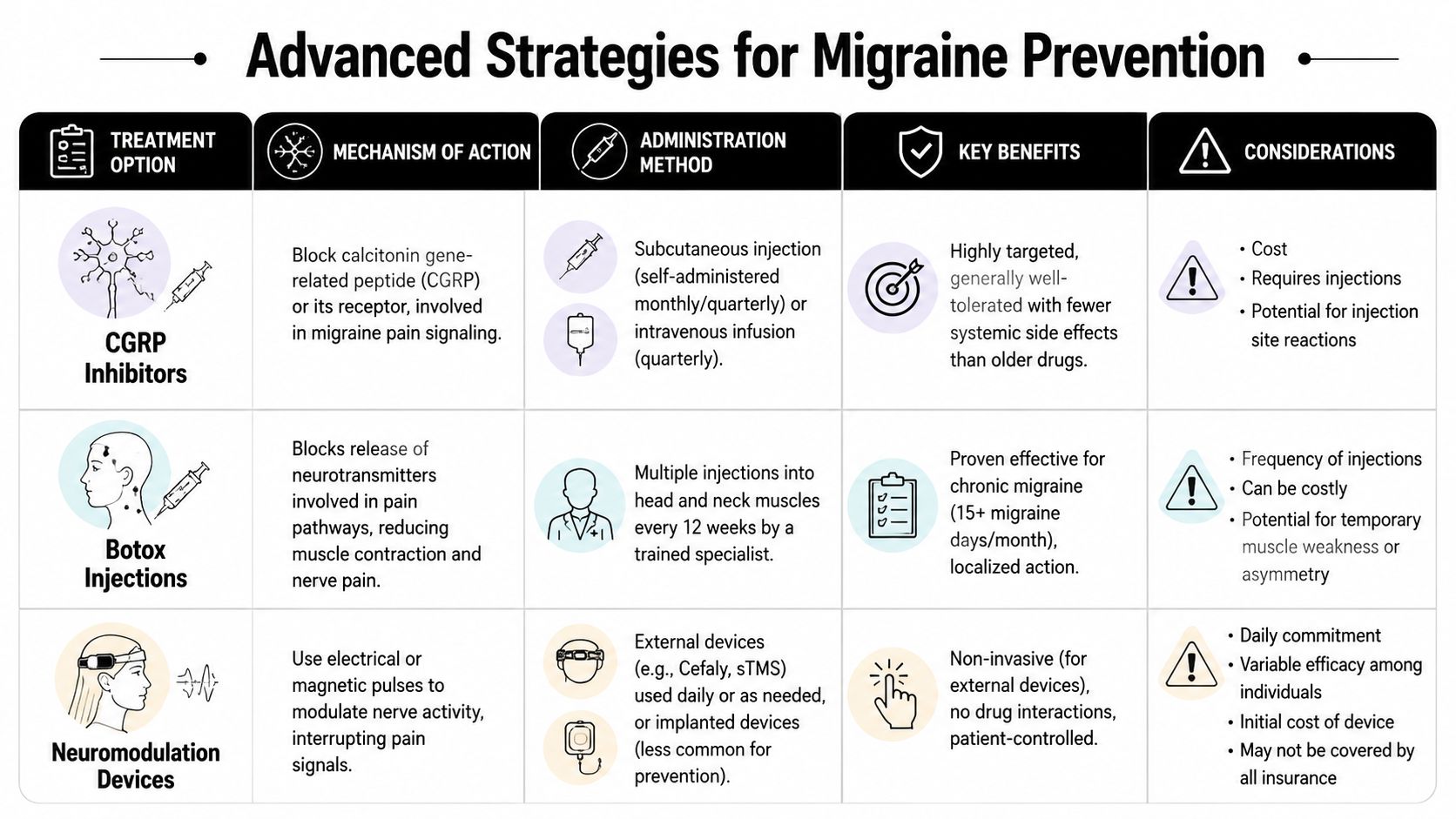
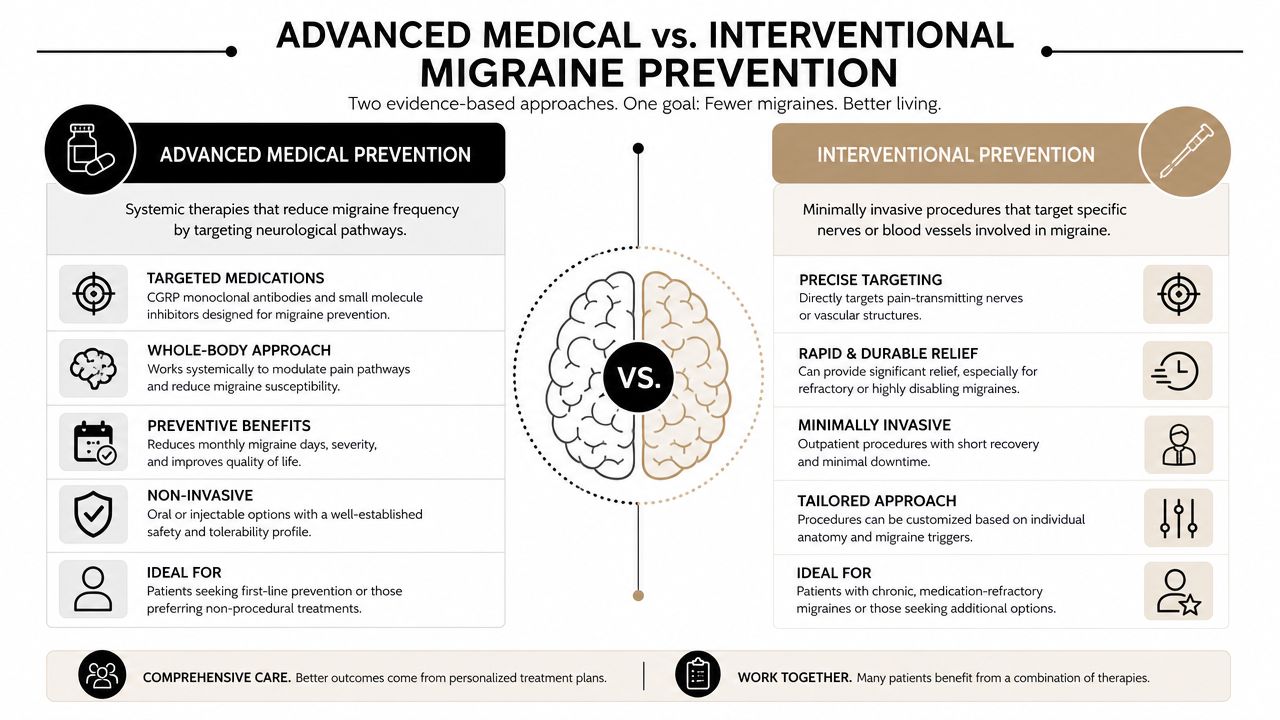
Once migraine prevention moves beyond lifestyle changes, the options widen quickly. That's good news, but it also creates confusion. Patients often hear about daily oral preventives, Botox, CGRP-targeted therapies, and nerve-based procedures all at once. The question isn't which option sounds newest. Instead, it's which option fits the pattern of your headaches, your response to prior treatment, your schedule, your side-effect tolerance, and your treatment goals.
Oral preventive medications
For many patients, oral medication is the first prescription prevention step. The appeal is obvious. These treatments are familiar, accessible, and often easier to start than procedure-based options.
The trade-off is that oral preventives can be effective but sometimes limited by side effects, incomplete benefit, or poor fit for a patient's day-to-day life. Some people do well with them. Others stop because the balance between benefit and tolerability isn't good enough. In clinic, this is one of the most common reasons a plan needs to evolve rather than end.
Botox and where it fits
Botox is one of the most established advanced options for chronic migraine prevention. Patients are often surprised by how specific its role is. This is not the same as using Botox cosmetically, and it's not a casual add-on. It's a medical treatment performed on a structured schedule by a trained clinician.
Botox can make sense when migraine has become chronic, when oral preventive options haven't helped enough, or when side effects make daily medication a poor long-term fit. The benefit for the right patient is that treatment is localized and doesn't require swallowing another daily pill. The downside is that it requires office-based injections and ongoing follow-up.
CGRP-targeted therapies
CGRP-targeted treatments have changed migraine prevention because they were designed around a pathway closely tied to migraine biology. For the right patient, that targeting can make them an attractive option, especially when older preventive medications haven't delivered enough relief or weren't tolerated.
These therapies aren't a universal answer. Access, insurance, cost, injection comfort, prior treatment history, and overall headache pattern all influence whether they're a good fit. But they've become an important part of modern migraine care because they give patients another path besides cycling through broad older medications.
Good migraine prevention is rarely about picking one “winner.” It's about matching the treatment to the pattern.
Interventional options beyond medication
In pain medicine, migraine care sometimes intersects with procedures that help calm an irritated pain system, especially when headache overlaps with neck pain, occipital pain, muscle tension, or a prolonged flare pattern. For selected patients, interventions such as occipital nerve blocks can be part of a broader strategy.
These procedures don't replace a full prevention plan. They complement it. A patient may still need lifestyle consistency, a preventive medication, or Botox, but a targeted intervention can help reduce pain intensity, interrupt a cycle of persistent headache, or clarify whether a nerve-related pain generator is contributing.
For patients comparing office-based procedural options, procedures used for pain and headache treatment provides a practical overview of interventional therapies used in a pain management setting.
How I compare the options in practice
A simple side-by-side view helps:
| Option | Best fit | Main advantage | Main limitation |
|---|---|---|---|
| Oral prevention | Earlier prescription step | Familiar and straightforward to start | Side effects or incomplete relief can limit success |
| Botox | Chronic migraine pattern | Localized scheduled treatment | Requires repeat office procedures |
| CGRP-targeted therapy | Patients needing a more targeted prevention strategy | Designed around a migraine-relevant pathway | Access and coverage can be limiting |
| Interventional procedures | Patients with overlapping nerve or neck pain patterns | Can target specific pain generators | Usually part of a broader plan, not a stand-alone cure |
What doesn't work well is drifting from one isolated tactic to another with no framework. Taking rescue medication whenever pain breaks through, trying random supplements, then stopping and starting prevention out of frustration usually leads to unstable control. The better route is a structured plan that stays opioid-sparing, tracks response, and changes course based on actual results.
Partnering with a Specialist for Long-Term Relief
Migraine prevention is rarely a one-time decision. It's an ongoing process of selecting the right layer, measuring response, and adjusting when life changes or the headache pattern changes. That's why specialist care matters most after the initial diagnosis, not just at the beginning.
A lot of public migraine advice stops at trigger avoidance. That leaves patients thinking they should just keep trying harder with sleep, hydration, and stress control even when the headaches remain disruptive. The American Migraine Foundation has highlighted this gap by emphasizing that prevention often requires a layered plan that may include medications, supplements, and devices rather than trigger avoidance alone.
What a layered plan looks like in real life
A specialist usually isn't just handing you one prescription. The more effective approach is to build a plan with several moving parts that don't work against each other.
That often means:
- Keeping the basics stable so sleep and meal disruption don't keep pushing the nervous system in the wrong direction
- Using preventive treatment intentionally rather than bouncing between acute medications
- Watching for overlapping pain sources such as neck pain, occipital pain, or muscle tension that can amplify migraine burden
- Reassessing the result instead of assuming the first treatment choice is the final answer
Why follow-up matters
Patients sometimes expect prevention to work immediately and perfectly. That's rarely how this goes. The more realistic process is adjustment. If a medication helps but not enough, the plan changes. If Botox reduces headache burden but a neck-based pain pattern remains active, the next layer may need to address that component. If the diary shows a predictable menstrual or schedule-related pattern, prevention may need to become more targeted.
That kind of refinement is hard to do well without continuity.
The goal isn't to chase every headache separately. The goal is to lower the number of bad days and make the remaining attacks easier to control.
For patients who want to understand the background and treatment philosophy of the physician directing that kind of care, Dr. Yaw Donkoh's profile outlines his interventional pain background and the clinic's multimodal, opioid-sparing approach.
Frequently Asked Questions About Migraine Prevention
Some prevention questions don't fit neatly into a long discussion. These are the ones patients usually want answered directly.
Common questions about migraine prevention
| Question | Answer |
|---|---|
| How do I know if I need preventive treatment instead of just rescue medication? | If migraine attacks are frequent, prolonged, disabling, or you're relying on acute medication too often, it's time to discuss prevention with a specialist. The key issue is function. If your life keeps getting interrupted, the plan likely needs to escalate. |
| Can lifestyle changes still matter if I start prescription prevention? | Yes. Lifestyle work and prescription prevention aren't opposing strategies. They usually work better together. Medication can lower the baseline burden, while sleep regularity, meals, hydration, and stress control reduce avoidable triggers. |
| What if my migraines are predictable around my period? | Predictable migraine patterns often call for a different strategy than random attacks. Mount Sinai notes that women with menstrual migraines can take preventive medicine in advance of their cycle, which differs from the daily prevention often used for chronically frequent, unpredictable migraine (Mount Sinai guidance on targeted prevention for menstrual migraine). |
| Are opioids a good preventive option for migraine? | No. In pain management, migraine prevention should stay opioid-sparing whenever possible. Opioids don't address migraine biology well and can complicate long-term headache care. A structured prevention plan is usually the better route. |
| Will insurance cover advanced treatments like Botox or CGRP therapies? | Coverage depends on your plan, prior treatment history, and the documentation supporting medical necessity. This is one reason keeping a headache diary and treatment history organized is so useful. |
| What should I bring to a migraine consultation? | Bring your headache diary, medication list, prior imaging if you have it, and notes on what you've already tried. The more specific you are about frequency, duration, disability, and treatment response, the faster the visit becomes productive. |
For people asking how to prevent migraine attacks, the most important point is this: prevention isn't one trick. It's a sequence. Start with pattern recognition. Build a routine that lowers common triggers. Escalate when the migraine burden stays high. Use advanced options when the pattern and prior response justify them.
If migraine attacks are still disrupting work, sleep, family time, or daily function, Midwest Pain & Wellness offers evaluation and opioid-sparing treatment planning for patients in Chicago Ridge and surrounding Illinois communities, including Oak Lawn, Palos Hills, Palos Heights, Worth, Bridgeview, Hickory Hills, Alsip, Burbank, Evergreen Park, and Orland Park. A structured consultation can help clarify whether your next step should be stronger lifestyle prevention, prescription therapy, Botox, or another interventional option.