A lot of people in the Chicago Ridge area first notice this problem in a way that feels almost unfair. They bend to pick up a laundry basket, cough hard, twist to reach into the back seat, or carry groceries in from the car, and a sharp mid-back or low-back pain hits hard enough to stop them in place.
If that sounds familiar, you're not overreacting. Sudden, severe spine pain after a routine movement can be a vertebral compression fracture, especially in older adults and in people with osteoporosis. It can feel alarming because the pain often seems out of proportion to what you were doing.
Patients from Oak Lawn, Palos Hills, Palos Heights, Worth, Bridgeview, Hickory Hills, Alsip, Burbank, Evergreen Park, Orland Park, and nearby Illinois communities often come in with the same questions. Did I pull a muscle? Is this a slipped disc? Why does standing hurt so much more than lying down? The right answer starts with the right diagnosis, because vertebral compression fracture pain has a different pattern, a different timeline, and different treatment decisions than many other back conditions.
The Sudden Back Pain That Changes Everything
One of the most recognizable stories in spine care starts with a normal day. Someone is getting dressed, lifting a bag, or turning in the kitchen. Then the pain arrives fast. It may feel stabbing, gripping, or deep and mechanical, and it can make standing upright feel impossible.
That experience is common with a vertebral compression fracture. The fracture may happen after a fall, but it can also happen with much less force if the bone has already become fragile. Many people are surprised to learn that this isn't rare. An American Family Physician review notes that vertebral compression fractures are the most common complication of osteoporosis and affect more than 700,000 Americans each year. The same review states that lifetime risk is about 25% in postmenopausal women, with prevalence rising to 40% by age 80. It also emphasizes that pain can be incapacitating for months in some patients, and that initial care usually starts conservatively before considering vertebral augmentation if debilitating pain continues after at least 3 weeks of nonoperative treatment (American Family Physician review on vertebral compression fractures).
What makes this pain so disruptive
This isn't the usual sore-back-after-yardwork feeling. Vertebral compression fracture pain often changes how you move, sleep, dress, and even breathe fully. People start guarding every motion because small movements can trigger a sharp increase in pain.
Severe back pain after a minor movement deserves attention, especially in an older adult or anyone with known bone loss.
Why quick recognition matters
Some patients assume they should just wait it out because they “must have strained something.” Sometimes that's true. Sometimes it isn't. A vertebral compression fracture is one of the clearest examples of why persistent, function-limiting back pain shouldn't be brushed off.
The goal isn't to create panic. It's to get clarity early, so treatment matches the actual pain generator.
What Is a Vertebral Compression Fracture
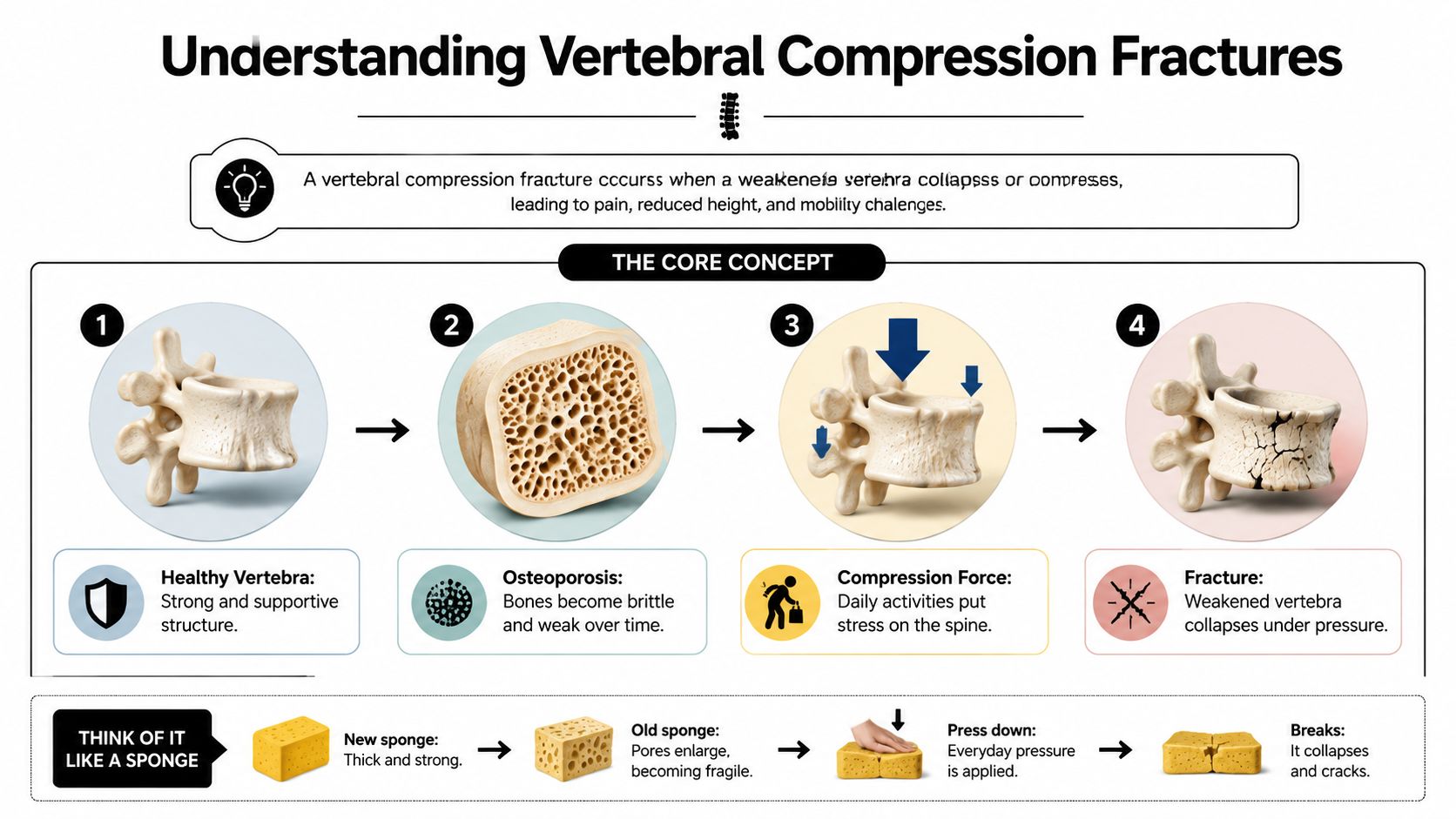
A vertebral compression fracture happens when one of the bones in the spine weakens and collapses under load. The easiest way to picture it is an empty soda can. When the metal is intact, it supports weight. Once the structure is weakened, even ordinary pressure can make it crumple.
That's what osteoporosis can do to a vertebra. The outside shape may still look like a normal spinal bone at first glance, but the internal support becomes more fragile. Then daily stress, not just a dramatic accident, can cause the vertebra to compress.
Why it hurts
The pain usually isn't coming from only one source.
- Bone pain can come directly from the fracture itself.
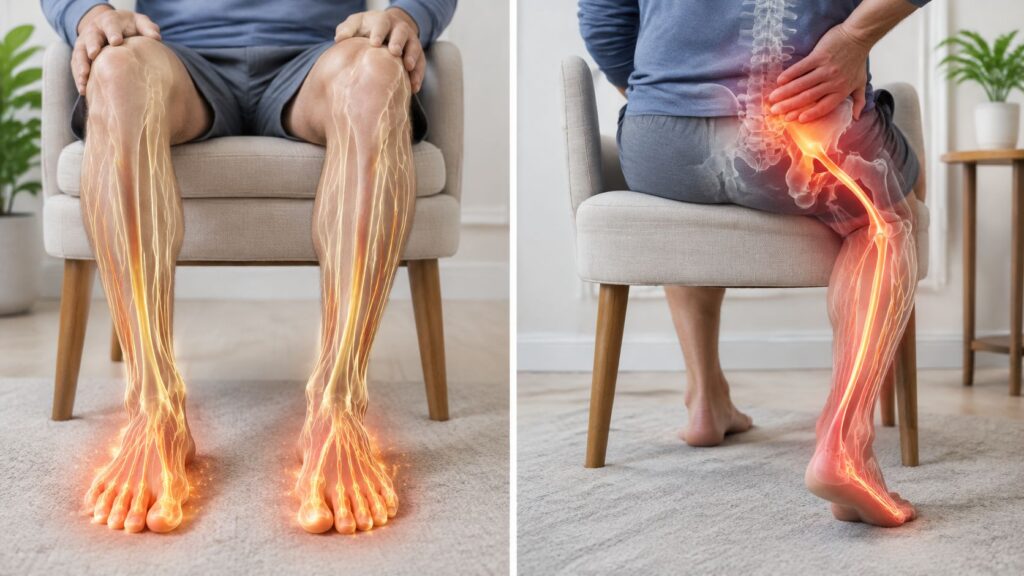
- Nerve irritation may happen if nearby structures are inflamed or if collapse changes local anatomy.
- Muscle spasm often develops because the body tries to protect the injured area by tightening surrounding muscles.
That mix explains why the pain can feel deeper and more persistent than a simple strain.
Why patients should know the term
Knowing the diagnosis changes what happens next. A person with vertebral compression fracture pain may need a different workup, different imaging, and a different conversation about timing than someone with routine low back pain. If you're looking at the broader range of spine-related issues a pain clinic evaluates, conditions treated at Midwest Pain & Wellness include fracture-related spine pain along with other causes of back and nerve symptoms.
Practical rule: If pain started suddenly, feels sharply positional, and makes standing or walking much worse, don't assume it's “just muscular.”
Primary Causes and Key Risk Factors
The main cause of vertebral compression fractures is osteoporosis. In plain terms, the bone loses strength over time and becomes easier to crush under normal spinal load. That's why a fracture can happen during what looks like a small event rather than a major injury.
But osteoporosis isn't the only possibility. Trauma can cause the same fracture pattern, especially after a fall or accident. In less common situations, a tumor or another disease process can weaken the bone first. That's one reason spine pain should be evaluated in context rather than guessed at based on symptoms alone.
Who is at higher risk
Some patterns matter more than others.
- Older adults are at higher risk because bone strength tends to decline with age.
- Postmenopausal women face a higher likelihood of osteoporotic fracture.
- People on long-term steroid therapy may have weaker bone quality.
- Smokers may carry added bone-health risk.
- Patients with a history of osteoporosis or prior fragility fracture should take new sudden back pain seriously.
None of those risk factors means a fracture is certain. They raise suspicion when the story fits.
Why the cause matters for treatment
Treatment decisions depend on the reason the bone fractured. Osteoporotic fractures often lead to a conversation about stabilization, pain control, activity modification, and bone health follow-up. Traumatic fractures may require a different pathway. Suspicion for tumor, infection, or another underlying problem changes the workup more substantially.
A common mistake is focusing only on pain intensity. Severe pain doesn't automatically tell you the cause. The history, exam, and imaging tell you whether the problem is a fragile vertebra, a soft-tissue injury, nerve irritation, or something more concerning.
For patients in Illinois communities such as Palos Heights, Bridgeview, or Worth, specialist input proves beneficial. The right diagnosis isn't just a label. It determines whether the next step should be bracing, imaging review, medication adjustment, procedural evaluation, or referral for another condition entirely.
Symptoms and Getting an Accurate Diagnosis
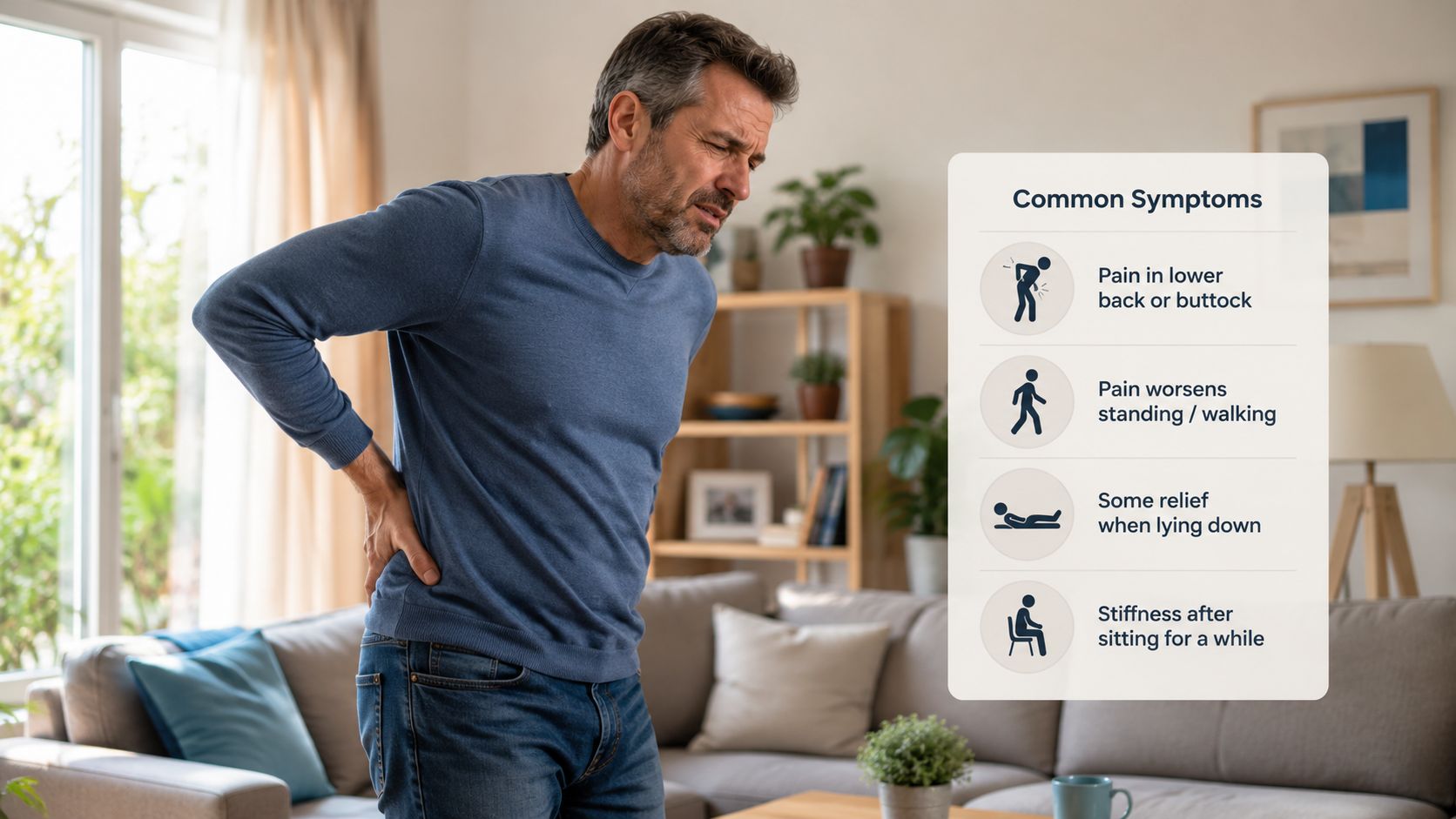
Vertebral compression fracture pain usually has a pattern. Many patients describe a sudden onset of sharp back pain, often in the middle or lower spine. Standing, walking, and changing positions can aggravate it. Lying down may reduce it. Over time, some people also notice they're less upright than before or that they seem shorter.
That symptom pattern overlaps with other spine problems, which is why diagnosis matters. Muscle strain, degenerative arthritis, disc problems, and fracture pain can all sit in the same area but behave differently.
Symptoms that raise suspicion
Look for a cluster, not just one symptom.
- Sudden pain after a routine movement such as bending, lifting, coughing, or twisting
- Pain that worsens upright and eases when lying down
- Local tenderness in the spine rather than broad soreness across the whole back
- Reduced ability to walk, stand, or transfer because movement sharply increases pain
- Postural change over time, including a more stooped posture
What the diagnostic visit usually involves
A clinician starts with the story. How quickly did the pain begin? Was there a fall? Do you have osteoporosis, cancer history, steroid exposure, or prior fractures? Then comes the exam, including where the spine is tender, how movement changes pain, and whether there are signs that suggest nerve involvement.
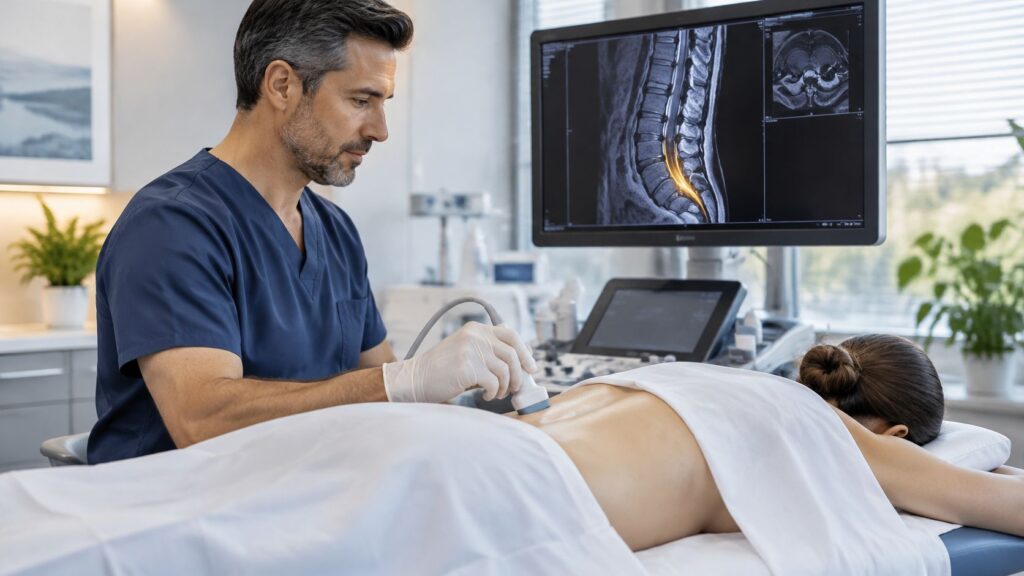
Imaging often follows. X-rays are commonly an early step because they can show changes in vertebral shape. But they don't always answer the most important question, which is whether the fracture is active and causing the current pain.
Why MRI can be so important
A review on persistent vertebral fracture pain highlights a key issue. Pain can remain or recur for several reasons, and imaging such as MRI or bone scan can help distinguish an actively healing fracture from an older one. That matters because pain may come from the fracture itself, a pinched nerve, or another source entirely. The same review notes that persistent pain is often multifactorial rather than proof that the bone never healed (clinical review of vertebral compression fracture pain mechanisms).
A fracture on an X-ray and the source of today's pain aren't always the same thing. That's why precise imaging can change the treatment plan.
For patients in Alsip or Hickory Hills who've already had an X-ray but still don't have a clear answer, that distinction is often the turning point.
Comparing Conservative Care and Interventional Treatments
The first question that often comes to mind is: Can this heal without a procedure? Sometimes yes. But that's only half the question. The other half is whether the pain is manageable enough to let you function while healing happens.
A patient guide from the University of Maryland notes that many fractures heal in about three months with conservative care, while also emphasizing that the timing of escalation matters and that benefit from procedures such as kyphoplasty often depends on fracture acuity. The same guidance explains why MRI confirmation of an active fracture can be critical before intervention (University of Maryland guide to lumbar compression fractures).
What conservative care can do well
Conservative care is often the right starting point, especially when pain is improving and there are no alarming neurologic findings.
This approach may include:
- Brief activity reduction so the fracture isn't repeatedly aggravated
- Bracing when appropriate to reduce painful motion
- Medication management aimed at pain control without relying on long-term opioid use
- Careful return to movement because prolonged bed rest usually makes recovery harder
What doesn't work well is total inactivity for an extended period. Patients often think complete rest protects the spine. In reality, too much inactivity can weaken muscles, worsen stiffness, and make recovery slower.
When conservative care is falling short
The issue isn't whether pain exists. The issue is whether pain remains debilitating despite appropriate early treatment. If a person still can't stand, walk, sleep, or perform basic daily tasks after a reasonable trial of nonoperative care, the discussion should change.
Some practice references reserve vertebral augmentation procedures for persistent symptoms after 4 to 6 weeks of failed nonoperative treatment, and an orthopedic review also notes that temporary pain interventions such as selective nerve blocks may help for only up to two weeks, with benefit often fading by one month (Orthobullets review of osteoporotic vertebral compression fracture).
How kyphoplasty fits into the decision
Kyphoplasty is a minimally invasive stabilization procedure used in selected patients with painful vertebral compression fractures. The basic goal is to stabilize the fractured vertebra internally. In a pain practice, the key question isn't whether a procedure exists. It's whether the patient is the right candidate at the right time.
If you're reviewing procedural options, interventional treatments used for spine and pain conditions include kyphoplasty among other image-guided treatments.
| Feature | Conservative Care | Kyphoplasty |
|---|---|---|
| Best fit | Pain that is improving and function that is gradually returning | Persistent, severe pain when the fracture is confirmed as an active pain source |
| Main approach | Rest in moderation, brace if appropriate, medication, gradual movement | Minimally invasive vertebral stabilization |
| Timeline thinking | Often tried first for early management | Considered when nonoperative care hasn't provided adequate relief |
| Imaging role | Helps identify fracture and monitor context | MRI can be especially important to confirm acuity before proceeding |
| What patients should avoid | Too much bed rest and waiting indefinitely with disabling pain | Assuming every old compression fracture seen on imaging needs a procedure |
The best timing is not “as soon as possible” for everyone, and it's not “wait as long as you can.” It depends on how severe the pain is, whether function is collapsing, and whether imaging shows an active fracture.
Recovery Outlook and Managing Persistent Pain
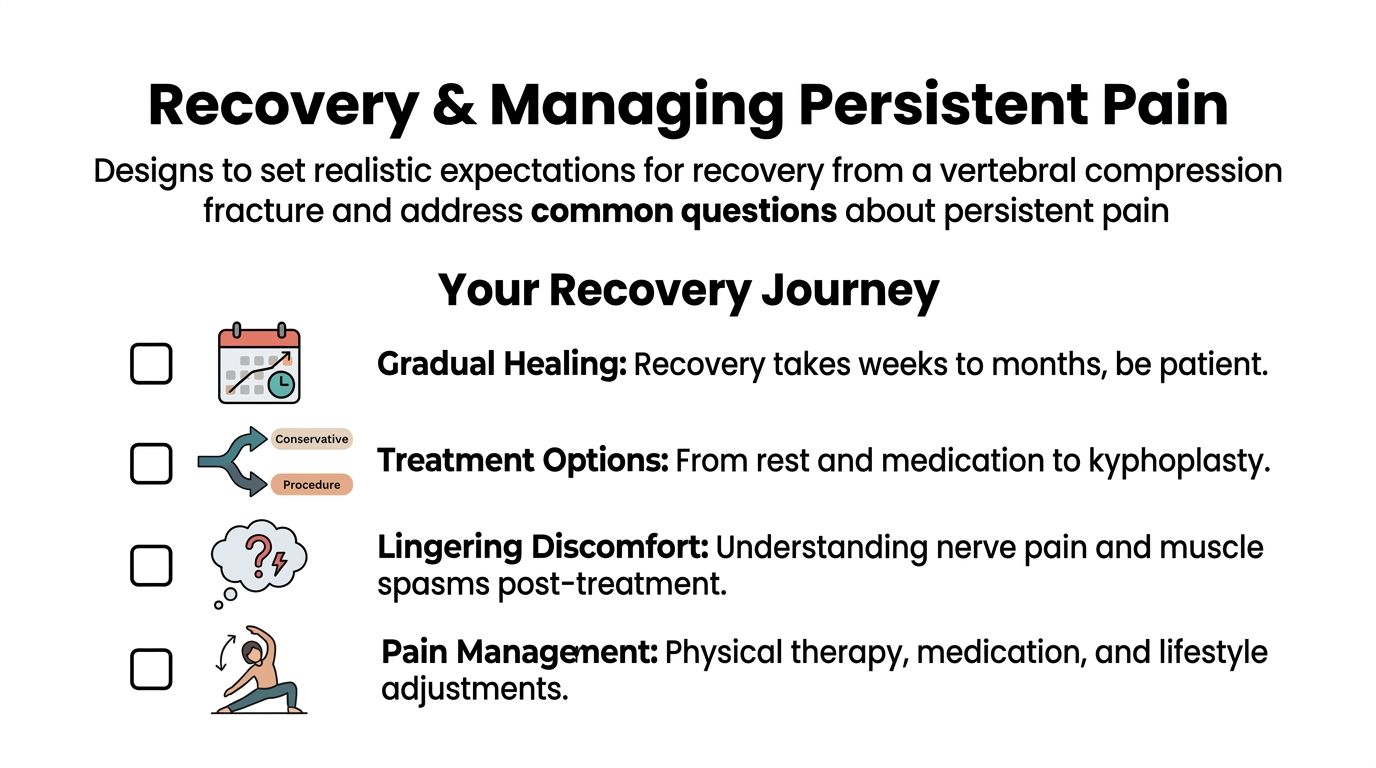
Recovery doesn't always move in a straight line. Some patients improve steadily over weeks. Others get partial relief but still feel pain with standing, walking, or prolonged activity. That can be frustrating, especially if someone has been told the fracture is “healing.”
Persistent pain after a vertebral compression fracture often has more than one source. It may involve the original bone injury, but it can also involve surrounding muscles, ligaments, and altered spinal mechanics. That's why ongoing pain doesn't automatically mean treatment failed or that the vertebra never healed.
Why pain may linger
A published review states that persistent pain after a vertebral compression fracture can be confusing because it is often multifactorial, and that pain may come not only from the fracture site but also from secondary effects on muscles, ligaments, and other spinal structures. The review emphasizes the need for a thorough workup to separate mechanical pain from other causes (review of persistent pain after vertebral compression fracture).
That point matters in clinic every week. Some patients need reassurance and time. Others need a different diagnosis considered.
What usually helps during recovery
The most useful recovery plans are practical.
- Progressive movement helps prevent deconditioning once your clinician says it's safe.
- Targeted pain treatment should match the pain pattern rather than just masking symptoms.
- Follow-up evaluation matters if pain changes character, spreads, or stops matching the expected course.
Red flags that need urgent attention
Some symptoms are not part of routine recovery and should be evaluated quickly.
- New leg weakness
- New numbness that is worsening
- Loss of bowel or bladder control
- Severe pain with concerning systemic symptoms, such as signs that suggest infection or another serious illness
- A pain pattern that suddenly changes in a way that no longer fits a simple compression fracture recovery
Patients often feel unsure about whether they're healing normally. If the answer isn't clear, that's a reason to be reassessed, not a reason to keep guessing.
Your Path to a Pain Specialist near Chicago Ridge
There's a point where it makes sense to move beyond general advice and get a focused spine pain evaluation. If you're in Oak Lawn, Palos Hills, Palos Heights, Worth, Bridgeview, Hickory Hills, Alsip, Burbank, Evergreen Park, Orland Park, or near Chicago Ridge, that point is usually when back pain remains severe enough to limit basic life despite appropriate early care.
A pain specialist can help answer the questions that matter most. Is the fracture active? Is the pain still coming from the vertebra, or are muscles, nerves, or another spinal structure now driving the symptoms? Is continued conservative care reasonable, or is it time to discuss a procedure such as kyphoplasty?
A dedicated pain clinic in Illinois can integrate into the care pathway. Midwest Pain & Wellness in Chicago Ridge evaluates spine and fracture-related pain, reviews imaging in context, and offers interventional options including kyphoplasty when appropriate. That kind of assessment is different from merely renewing medication or telling someone to wait longer without a clear plan.
If you're still struggling after the first few weeks, or if the pain is so limiting that you can't function normally, schedule a specialist evaluation rather than trying to power through it. You can request a visit through the clinic's appointment page for Midwest Pain & Wellness.
If vertebral compression fracture pain is disrupting your day, you don't have to figure it out alone. Midwest Pain & Wellness provides compassionate, opioid-sparing pain care in Chicago Ridge for patients who need clear answers, modern treatment options, and a practical plan to get moving again.