You've tried to keep moving, but your knee keeps changing the rules. Stairs hurt, longer walks require planning, and the relief from a previous injection didn't last. Then you see an advertisement for stem cell therapy for knee pain and start wondering whether an injection could help you avoid or delay surgery.
That question deserves more than a promise of “regeneration.” The important questions are what product is being offered, what the research shows, what risks you're accepting, and how much improvement comes from the cells rather than the injection process, expectations, and rehabilitation around it. For patients in Chicago Ridge, Palos Heights, Palos Hills, Evergreen Park, and Hickory Hills, Illinois, a careful consultation should answer those questions before any payment or procedure.
Table of Contents
- Why Patients in Chicago Ridge Are Asking About Stem Cell Therapy for Knee Pain
- What Stem Cell Therapy for Knee Pain Means
- What the Evidence Shows About Results
- Who Is a Real Candidate for Cell-Based Knee Treatment
- What the Procedure and Recovery Look Like
- Risks, Safety, and What to Watch For
- Costs, Insurance, and How to Evaluate a Clinic in Illinois
- When Stem Cell Therapy Is the Right Next Step and When It Is Not
Why Patients in Chicago Ridge Are Asking About Stem Cell Therapy for Knee Pain
A patient from Palos Heights may seek help after years of knee stiffness and aching. Exercise, medication, activity changes, or a corticosteroid injection may have provided limited relief, yet the knee still interferes with errands, work, recreation, or sleep. Then a local advertisement describes stem cells as a way to rebuild cartilage, making treatment sound like the missing step between conservative care and knee replacement.
The appeal is understandable. Avoiding surgery matters when an injection might reduce pain. The harder question is what produces that improvement. Pain relief, better function, and cartilage regeneration are different outcomes. A person may move more comfortably even when imaging does not show that the damaged joint has repaired itself.
A practical question to bring to a consultation: “What improvement are we realistically trying to achieve, and how will we know whether it came from the cells?”
That question helps separate the cells from the rest of the procedure. Needle placement, the injected material, expectations, and rehabilitation may all influence how someone feels afterward. A clinic should explain which part is supported by evidence and which part remains uncertain, rather than treating the entire package as proof of regeneration.
The consultation should connect your diagnosis and imaging with previous treatments, expectations, surgical options, and alternatives. Those alternatives may include rehabilitation, activity modification, other injections, or a surgical opinion when appropriate. A knee support can help some people during daily activity, and this Thermo Recovery Wear knee support resource offers general information about supporting knee health without presenting support as a cure.
This article is a patient education guide, not a promise that cell-based treatment is right for you. It will help you assess terminology, conflicting studies, safety concerns, billing details, and whether an Illinois clinic can explain its proposed treatment clearly. Some patients may experience meaningful symptom improvement, but no clinician should promise cartilage regeneration or present uncertain evidence as settled science.
What Stem Cell Therapy for Knee Pain Means
The phrase stem cell therapy can describe several different treatments. Before discussing possible benefits, identify where the cells or tissue come from, how the material is prepared, and what is injected into the knee.
Mesenchymal stem cells, or MSCs, are studied for their ability to interact with nearby tissue and influence inflammation and repair signals. They are not a guaranteed cure or a direct replacement for missing cartilage. In a pain clinic, the term may describe a cell-containing preparation rather than a standardized product with identical cell counts and biological behavior from one clinic to another.
Common categories include:
- Bone marrow concentrate: A clinician collects marrow, commonly from the pelvic area, and processes it before placing the preparation into the knee.
- Adipose-derived preparations: Tissue is collected from fat and processed for injection. The final product depends heavily on how it is handled and what it contains.
- Umbilical or amniotic products: These donor-derived, or allogeneic, products require careful review of their composition and regulatory status.
- Autologous versus allogeneic: Autologous material comes from your own body. Allogeneic material comes from a donor.
These sources differ in important ways, like repair crews arriving with different tools, training, and materials. The tissue source, preparation method, and cell content may all change, so evidence for one product cannot automatically be applied to another.
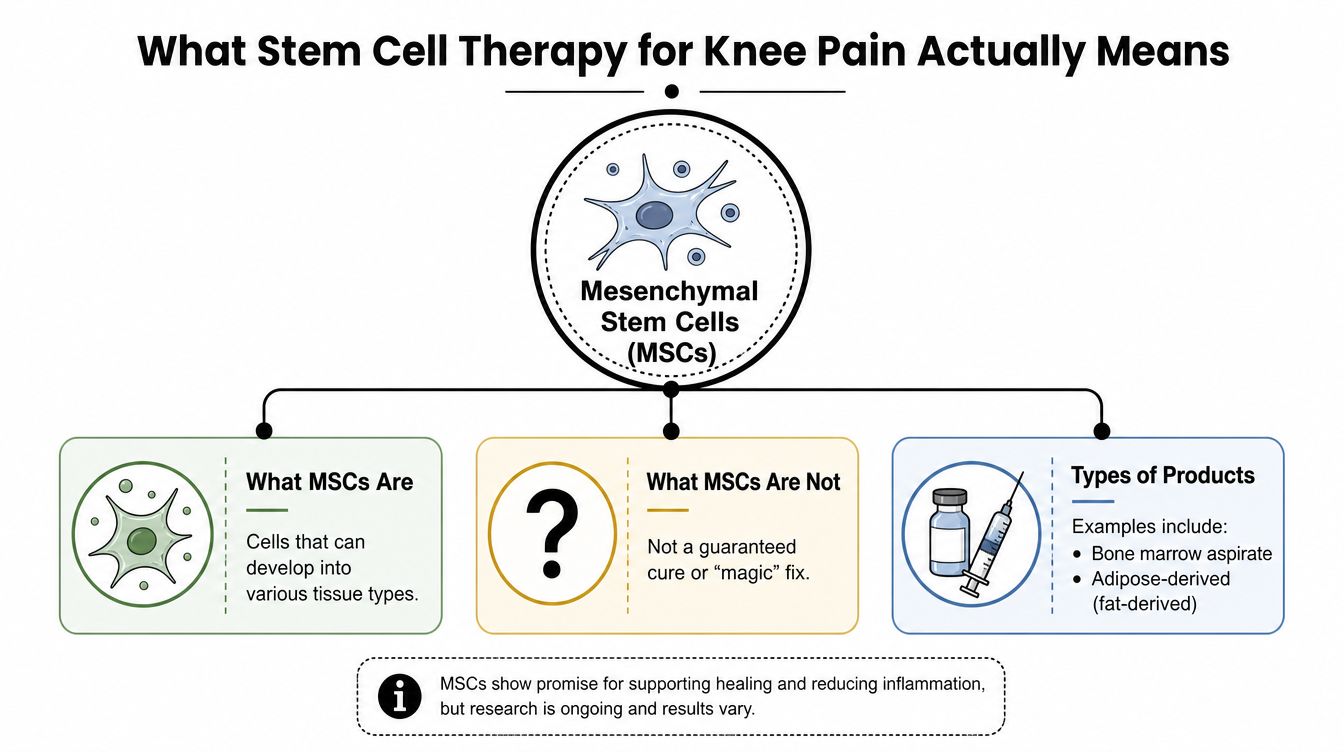
Ask whether the clinic uses your own tissue or donor material, how it is processed, whether the injection is image-guided, and which regulatory pathway applies. The U.S. Food and Drug Administration distinguishes appropriately regulated medical products from unapproved offerings marketed directly to patients. Terms such as “natural” and “regenerative” do not replace informed consent or careful review.
Patients considering an autologous option can read the clinic's explanation of autologous cell therapy before discussing whether it fits their diagnosis.
What the Evidence Shows About Results
Patients often hear two very different messages about stem cell therapy for knee pain. Some analyses report meaningful symptom improvement. Others find little or uncertain benefit. Both can be true because studies may use different cell sources, doses, comparison treatments, outcome measures, and follow-up periods. Results from one product should not be treated as proof for every injection marketed as regenerative medicine.
A 2025 meta-analysis of randomized controlled trials included 8 RCTs and 502 patients with osteoarthritis. It reported significant WOMAC improvements at 6 months and 12 months, including a mean difference of 10.31 points at 12 months. WOMAC combines patient-reported pain, stiffness, and physical function. Another 2025 meta-analysis reported a pooled standardized mean difference of -1.35 for WOMAC at 12 months and found significant improvement in studies using 25 million cells or fewer. These results suggest a possible symptom-relief signal, not that every cell product works in the same way. (2025 evidence review)
A separate 2024 review reached a more cautious conclusion. It found that intra-articular MSCs probably provide little to no improvement in pain or physical function for chronic knee pain caused by osteoarthritis. An earlier review identified only 5 RCTs and 1 non-RCT, and judged all included studies to have a high risk of bias. (Review of evidence limitations)
A snapshot of recent evidence
| Study | Year | Design | Key finding |
|---|---|---|---|
| Randomized trial of an allogeneic adipose-derived MSC product | 2024 | Double-blind phase I/IIa RCT | Enrolled 40 participants with moderate knee OA, tested a single injection across 10, 20, 50, and 100 million cell dose cohorts versus placebo, and followed patients for 12 months. (Trial report) |
| MILES multicenter trial | 2024 | Multicenter comparative trial | Included 480 participants at four sites and compared multiple stem cell sources with corticosteroid injection. |
| Autologous MSC systematic review | 2021 | 14 randomized controlled trials | Found improvements in 19 of 26 clinical outcome measures at 1 year, but certainty ranged from low to very low. (Systematic review) |
| MSC randomized-trial meta-analysis | Published evidence reviewed separately | Meta-analysis | Reported improved pain and function, with no severe adverse events in the included analysis, while emphasizing symptom relief rather than proven structural regeneration. (Meta-analysis) |
| Cochrane review | 2025 | Systematic review | Found low-certainty evidence for small pain and function improvements and remained uncertain about quality of life, safety, treatment success, and imaging changes. (Cochrane review) |
| Randomized-trial meta-analysis | 2026 | Meta-analysis | Found statistically significant pain reduction, including a mean VAS difference of -1.67, but no significant MRI structural improvement. (2026 meta-analysis) |
Why pain relief does not prove cartilage repair
A knee may hurt less because inflammation, nerve sensitivity, movement patterns, or surrounding muscle function changes. That improvement is meaningful for daily life, but it does not demonstrate that damaged cartilage has regrown. Current evidence has not established reliable structural disease modification.
The procedure itself can also affect symptoms. Extra attention, hope, temporary activity changes, hands-on care, and a planned rehabilitation program may all contribute to improvement. A 2025 analysis found that contextual and placebo effects may account for much of the symptomatic change, leaving a smaller added effect from the MSC product itself. (Analysis of contextual effects)
For an Illinois patient comparing clinics, the practical question is whether a provider uses the phrase “stem cells.” Ask what evidence supports the specific product and procedure, and whether the study measured pain, function, or cartilage structure. Some patients may experience meaningful symptom relief, but cartilage regeneration remains unproven. A responsible clinician should explain that uncertainty rather than promise a repaired knee.
Who Is a Real Candidate for Cell-Based Knee Treatment
Candidacy starts with the diagnosis, not the advertisement. Knee pain can come from osteoarthritis, a meniscus problem, ligament injury, referred pain, nerve irritation, or several conditions at once. An injection aimed at the joint won't solve a problem that hasn't been correctly identified.
A cell-based discussion may be reasonable for someone with early-to-moderate osteoarthritis, persistent symptoms despite appropriate conservative care, and a goal of preserving activity rather than immediately pursuing replacement. A younger or middle-aged adult with a post-traumatic cartilage problem may also ask about options, although the evidence for one injury pattern can't automatically be transferred to another.
The following questions help organize the consultation:
- What does the imaging show? The clinician should connect the X-ray or MRI findings with your examination and symptoms.
- What have you already tried? Include exercise, rehabilitation, medication, bracing, activity changes, and previous injections.
- What are you hoping to accomplish? “Walk farther with less pain” is more measurable than “regrow my knee.”
- What happens if it doesn't work? A reasonable plan includes alternatives and follow-up.
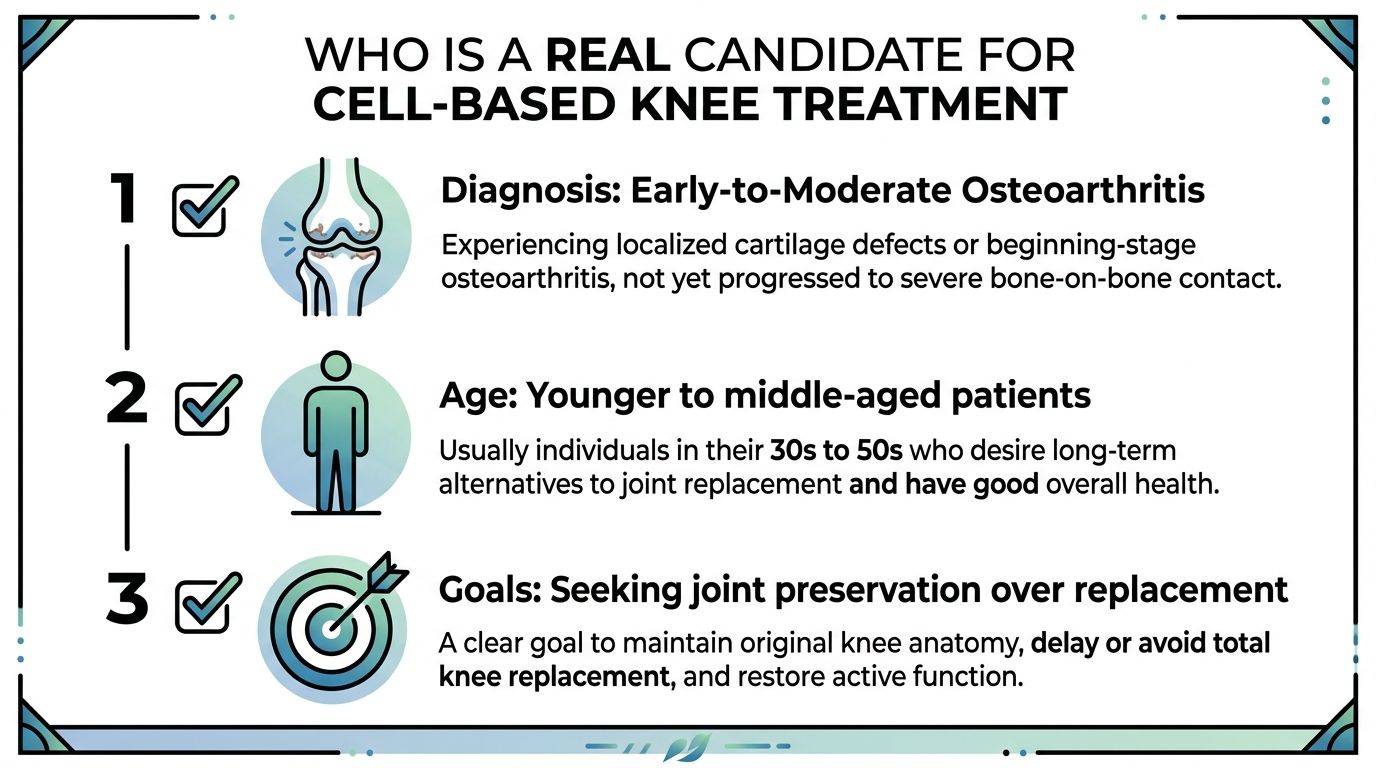
Severe end-stage arthritis, active infection, significant bleeding concerns, certain cancer histories, or expectations of guaranteed cartilage regrowth may make treatment inappropriate or require additional evaluation. Those aren't automatic conclusions, but they are reasons for a more cautious discussion.
The best candidate isn't just someone who wants to avoid surgery. It's someone who understands the uncertainty, has a treatable pain problem, can follow the recovery plan, and has a backup strategy if the result falls short.
What the Procedure and Recovery Look Like
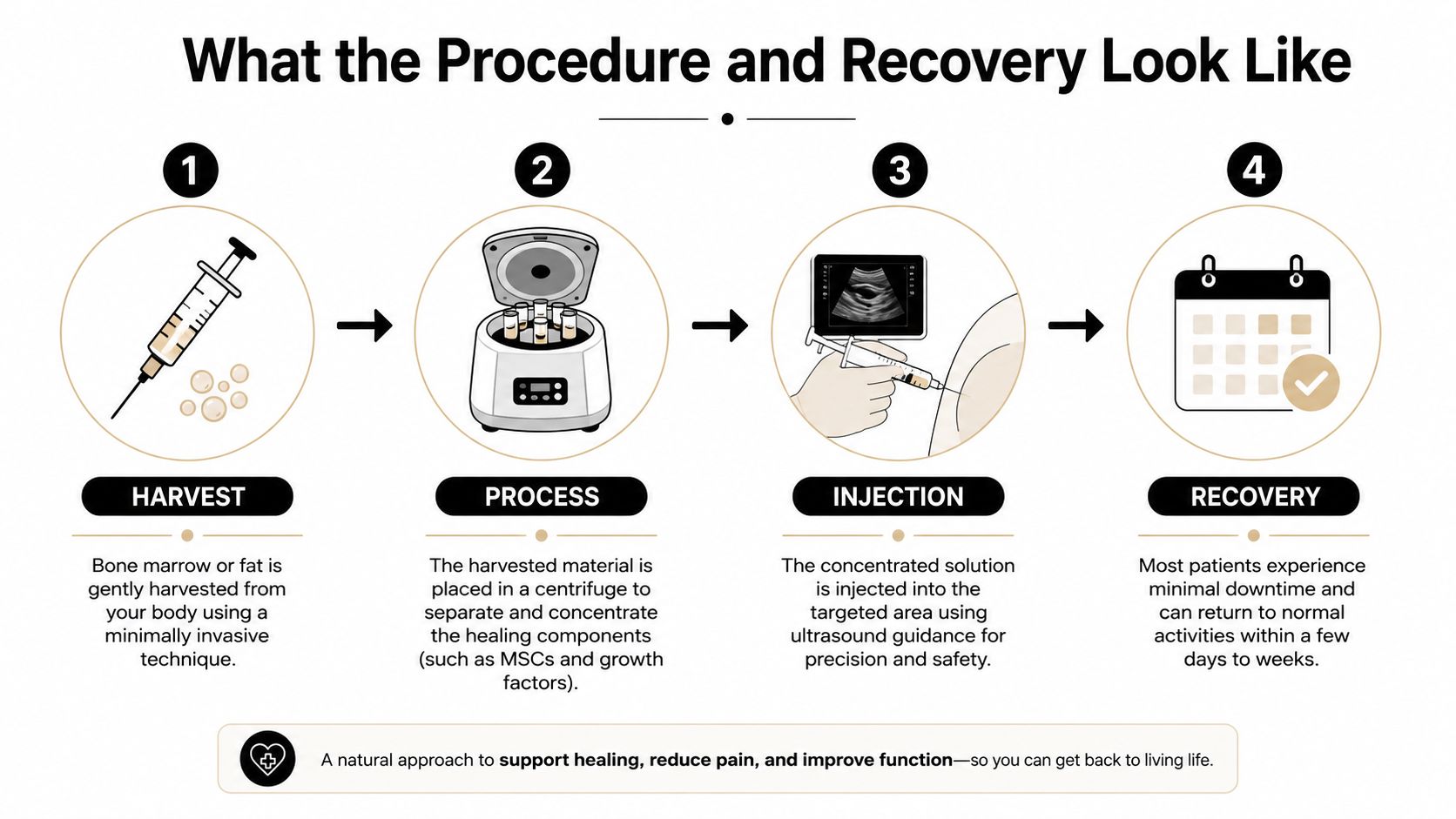
The exact day varies with the cell source. If the treatment uses your own bone marrow, the clinician first numbs the collection area and obtains the marrow, commonly from the pelvis. An adipose-based approach requires a fat-harvest step. The collected material is then processed, often with a centrifuge or related preparation method, before injection.
The knee injection should be performed with appropriate image guidance when indicated. The clinician identifies the joint space, prepares the skin, and places the product into the knee. Soreness can occur at both the harvest site and the knee, so ask how the practice handles medication restrictions, ice or heat, walking, and warning symptoms.
A typical plan may progress in stages:
- Immediately afterward: Follow the clinician's instructions for weight-bearing, wound care, and symptom control.
- Early recovery: Gentle movement is often prioritized, while impact activity may be limited.
- Rehabilitation phase: Strength and mobility work can resume according to the treating clinician and rehabilitation provider.
- Later follow-up: Improvement, if it occurs, may develop gradually rather than immediately.
Midwest Pain & Wellness is an interventional pain and wellness clinic, not a physical therapy office. That distinction matters. The practice can coordinate with rehabilitation providers while using image-guided procedures and multimodal pain care to support function.
Cell therapy should also be compared with other choices rather than treated as a category by itself. Corticosteroid injections commonly focus on short-term symptom control. Hyaluronic acid injections use a different approach. PRP uses your own platelets rather than a cell-based preparation. Knee replacement is a surgical option with a different level of invasiveness, recovery, durability expectations, and evidence. No single treatment wins on every criterion.
During recovery, low-impact movement can help maintain conditioning without provoking the joint. This guide to building strength with bad knees may provide general exercise ideas, but your clinician should tailor activity to your diagnosis and procedure.
Risks, Safety, and What to Watch For
A knee injection isn't risk-free because the product is described as biological. Potential problems include infection, bleeding, temporary swelling, increased pain, and reaction to the material or anesthetic. When tissue is harvested, the collection site introduces its own soreness and complication risks.
Adipose preparations deserve careful discussion because fat-based procedures can carry specific concerns, including the possibility of fat embolism. The risk may be uncommon, but a patient should still understand how the clinic processes tissue, what safeguards are used, and what symptoms require urgent attention.
Questions that belong in informed consent
A legitimate consent conversation should identify:
- The exact product: Ask whether it is bone marrow concentrate, an adipose-derived preparation, or donor-derived material.
- The source: Confirm whether the material comes from you or another person.
- Processing details: Ask where processing occurs, what the preparation contains, and whether the clinic can explain its limitations.
- Regulatory status: Be cautious when a clinic uses FDA language loosely or implies that an unapproved product has established effectiveness.
- Follow-up responsibility: Find out who handles worsening pain, fever, drainage, severe swelling, or other concerning symptoms.
The FDA has warned consumers about unapproved stem cell and exosome products marketed for a range of conditions. A clinic should never use regulatory ambiguity as a substitute for evidence. Claims about “permanent repair,” “guaranteed regeneration,” or replacing surgery without discussing failure are warning signs.

Compare the alternatives honestly
Corticosteroid injections may offer a familiar, relatively quick option for symptom control, but relief may not last and they don't establish cartilage regeneration. Hyaluronic acid is another injection category, with variable results and a different proposed mechanism.
PRP uses autologous platelets rather than MSCs. It may be discussed when a patient wants a biologic injection without harvesting marrow or fat, but it also has variable protocols and uncertain outcomes. The product, preparation, and diagnosis matter.
Partial or total knee replacement is more invasive, but it directly addresses advanced joint damage. It involves surgical risks, rehabilitation, and recovery planning. Cell therapy isn't a guaranteed substitute for replacement, particularly when arthritis is severe or the joint has lost substantial function.
A 2021 systematic review found clinically interesting signals for autologous MSCs, but rated certainty low to very low. A separate randomized-trial analysis reported no severe adverse events in its included studies, yet that finding doesn't eliminate the need to assess procedure-specific risks or long-term uncertainty. (Autologous MSC evidence)
Safety rule: If a clinic spends more time describing miraculous outcomes than explaining product identity, alternatives, complications, and follow-up, pause before proceeding.
Insurance and billing create another practical risk. Regenerative injections are commonly offered as self-pay services, and an Illinois clinic listing states that regenerative therapies aren't covered by insurance and are considered self-pay. (Illinois billing example) Ask for the full written price, including consultation, imaging, harvesting, processing, injection, medication, and follow-up. Don't assume a quoted procedure fee includes every part of care.
Costs, Insurance, and How to Evaluate a Clinic in Illinois
Most patients should approach cell-based knee injections as a potential out-of-pocket expense rather than a routine insurance benefit. Coverage can depend on the product, diagnosis, plan language, and medical setting, so verify directly with your insurer and the clinic's billing team. Don't make a treatment decision until you know whether the quoted price includes evaluation, imaging, tissue collection, laboratory processing, injection, and follow-up.
Patients in Chicago Ridge, Palos Heights, Palos Hills, Evergreen Park, and Hickory Hills can use the same screening process when comparing local offices.
A clinic screening checklist
- Verify the clinician: Ask about medical licensure, training in interventional pain procedures, and experience with image-guided knee injections.
- Identify the product: Get the cell source, whether it's autologous or allogeneic, and a plain-language description of processing.
- Request evidence boundaries: Ask which studies apply to this exact product and diagnosis. A study involving one preparation doesn't automatically validate another.
- Review regulatory language: The clinic should explain what is and isn't approved, authorized, or investigational without making vague promises.
- Get written pricing: Request an itemized estimate and ask about cancellation policies, additional visits, and treatment failure.
- Ask about alternatives: A trustworthy consultation should include rehabilitation, other injections, medication strategies, and surgical referral when appropriate.
- Confirm coordination: Ask whether the practice communicates with your primary clinician, surgeon, chiropractor, or rehabilitation provider when needed.
Red flags include guaranteed results, claims that the treatment will regrow cartilage in every patient, pressure to pay immediately, refusal to disclose the product source, or testimonials presented as if they were clinical evidence. You should also be wary of clinics that treat every knee problem with the same injection.
For a more direct discussion of financial considerations, review how much stem cell therapy may cost and bring specific questions to the consultation. The price matters, but so does the opportunity cost of delaying a treatment that may be better supported for your condition.
When Stem Cell Therapy Is the Right Next Step and When It Is Not
Cell-based treatment may be reasonable when your knee problem is clearly diagnosed, symptoms remain despite appropriate conservative care, arthritis is not end-stage, and you understand that the primary hoped-for benefit is symptom relief rather than proven cartilage repair.
It may not be the right next step if you haven't tried a structured rehabilitation plan, the pain comes from a different source, infection or another medical concern needs attention, or imaging shows advanced disease that warrants a surgical discussion. A corticosteroid injection, exercise plan, weight-related care when relevant, or surgical consultation may offer a more appropriate path.
Use five questions:
- What exactly is causing my pain?
- What treatments have I already tried, and for how long?
- What result would count as meaningful improvement?
- What are the risks, total costs, and alternatives?
- What is the plan if the injection doesn't help?
Patients seeking conventional injection options can review knee joint pain relief injections as part of that broader conversation. The right decision isn't the most dramatic treatment. It's the option that fits the diagnosis, evidence, risk tolerance, budget, and long-term goals.
Midwest Pain & Wellness offers evaluation and interventional pain care for knee pain, including image-guided injections and regenerative options such as PRP and cell-based therapies when appropriate. Visit Midwest Pain & Wellness to schedule a consultation in Chicago Ridge and discuss an evidence-aware plan for your knee.