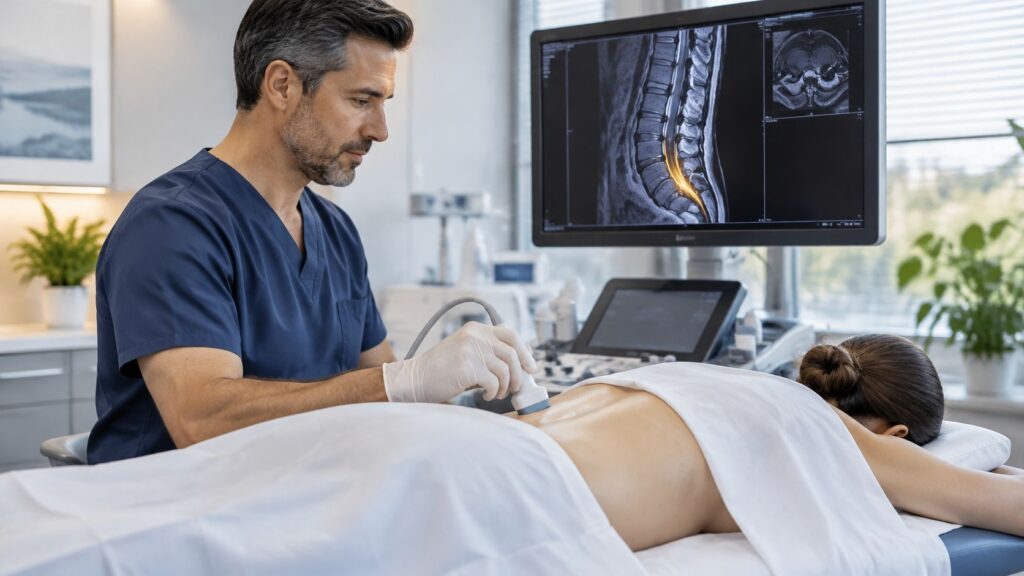
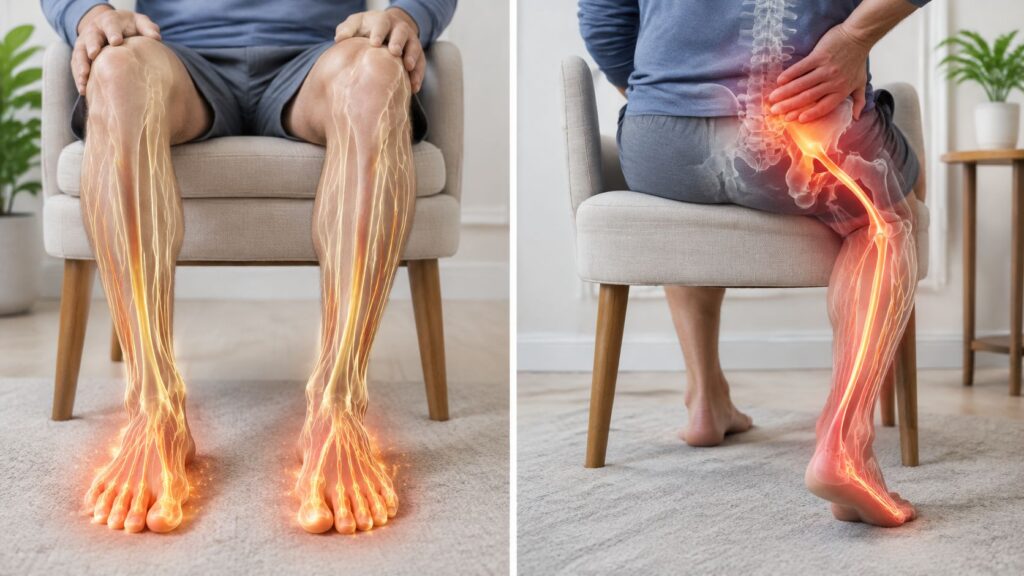
You finally got through back surgery. The incision healed. The first few weeks felt encouraging. Then the leg pain started creeping back in.
For many people, it begins in a familiar way. A calf ache shows up during longer walks. Then a burning line develops behind the knee or into the shin. Sleep gets choppy. You start wondering whether the surgery failed, whether something new is wrong, or whether you're supposed to keep waiting it out.
That question matters because post back surgery leg pain is not one diagnosis. It's a pattern with several possible pain generators, and those generators don't respond to the same treatment. In practice, the difference between recurrent stenosis, scar tethering, adjacent segment disease, hardware irritation, and ongoing nerve irritation is the difference between a treatment plan that fits and one that wastes months.
Persistent pain after spine surgery is common enough to be a major clinical issue. A 2023 systematic review reported a pooled prevalence of 14.97% for chronic pain after spinal surgery, with individual studies ranging from 5% to 27.6% after surgery, which helps explain why ongoing leg symptoms remain such a common reason for follow-up and pain management after lumbar procedures (systematic review in PMC).
Table of Contents
- Why Leg Pain Can Return After an Initially Successful Back Surgery
- What Post Back Surgery Leg Pain Actually Means
- The Most Common Causes of Leg Pain After Spine Surgery
- Matching Your Symptom Pattern to the Likely Generator
- How Doctors Diagnose the Source of Persistent Leg Pain
- A Realistic Recovery Timeline and When Improvement Should Happen
- Treatment Options From Conservative to Interventional
- Red Flags and When to Seek a Pain Specialist or Surgeon
Why Leg Pain Can Return After an Initially Successful Back Surgery
A common story goes like this. A patient has a lumbar decompression, does well early, and feels lighter on their feet by week four or five. By week six, the old pressure is gone, but a different ache starts during longer walks. A week later, the calf burns at night. The first reaction is usually fear. “Why is this back if the surgery worked?”
The answer is that the surgery may very well have worked for the problem it was designed to treat. What changed is everything around that repair. Nerves heal slowly and can stay irritable after pressure is removed. Scar forms as part of normal healing. A fused level can shift force to the next mobile segment. A decompressed area can later narrow again, or a different level can become symptomatic.
The return of symptoms usually has a pattern
The important question isn't whether pain returned. The useful question is how it returned.
If the pain shows up mostly with standing and walking, that suggests one path. If it burns constantly at rest and seems to pull with position changes, that suggests another. If it mirrors the exact pre-op shooting pain into one dermatome, that points in a more specific direction.
Practical rule: A return of leg pain after surgery rarely means the original operation was pointless. It usually means the current pain generator needs to be identified again, not guessed at.
Why the emotional whiplash is so intense
Patients often feel misled when pain comes back after an early improvement phase. That reaction is understandable. Surgery carries hope, downtime, cost, and physical effort. When symptoms return, people often assume there are only two possibilities: complete success or complete failure.
That's too simplistic. Postoperative leg pain is usually mechanism-driven, and more than one mechanism can exist at the same time. One patient has recurrent foraminal narrowing. Another has scar around a nerve root. Another develops a new adjacent-level problem after fusion.
The practical takeaway is straightforward. The pain pattern, timing, and associated neurologic signs usually narrow the list. Once the likely generator is identified, the treatment path becomes much clearer.
What Post Back Surgery Leg Pain Actually Means
Post back surgery leg pain is better treated as a specific clinical category than a vague statement that surgery “didn't work.” It can happen after laminectomy, discectomy, fusion, or decompression. The key feature is that pain travels into the leg in a way that suggests a nerve-related source, whether from ongoing compression, inflammation, scarring, or chronic nerve dysfunction.
The older umbrella label was failed back surgery syndrome. That term is still widely used, but it tends to lump every persistent symptom into one bucket. It tells you very little about what structure is hurting and even less about what to do next.
A more useful framework is chronic pain after spinal surgery, a term that reflects the fact that this is a heterogeneous condition rather than one diagnosis. Public-facing sources also note that leg-dominant pain more often points toward a nerve-related generator such as stenosis, epidural fibrosis, or recurrent disc herniation, while back-dominant pain more often comes from facet, sacroiliac, or myofascial sources (NCBI overview of post-laminectomy pain and terminology).
A simple analogy that fits
Think of the spine like a repaired plumbing system. One leak gets fixed, but the system can still develop a new blockage downstream, strain another joint, or build pressure where the flow pattern changed. The repair itself can be intact while the overall system still doesn't move cleanly.
That's why it helps to stop asking, “Did my surgery fail?” and start asking better questions:
- Where is the pain traveling
- What positions trigger it
- Did it ever fully calm down after surgery
- Is the pain mainly in the leg, the back, or both
- Has weakness, numbness, or walking tolerance changed
Why naming the generator matters
Treatment depends on the label being accurate. Generic rehab won't fix every nerve-related problem. Repeat surgery won't help scar-mediated pain unless there's a true compressive lesion to address. A targeted injection can be useful, but only if it matches the suspected source.
When the diagnosis becomes specific, the choices become specific too. That is the difference between circling through treatments and moving forward.
The Most Common Causes of Leg Pain After Spine Surgery
The most common mistake I see is treating all postoperative leg pain as if it comes from the same problem. It doesn't. The anatomy matters, and the symptom pattern usually gives the first clue.
Recurrent stenosis
This is narrowing that returns at the operated level or develops as residual or progressive narrowing. Patients often describe leg heaviness, cramping, or aching with standing and walking, especially when upright extension loads the canal and foramina. The pain often eases with sitting or bending forward.
Epidural scar tissue and nerve tethering
Scar tissue is part of healing, but sometimes it wraps or tethers a nerve root. This can create burning, pulling, electric, or dragging pain that doesn't behave like simple mechanical compression. In practice, this pain may persist at rest, flare with activity, and feel oddly fixed to one line down the leg.
A clinically important distinction after spine surgery is radiculopathy versus radiculitis. Radiculopathy means nerve-root pain with objective neurologic deficit. Radiculitis means nerve-root pain without a clear deficit. In postoperative patients, both can occur, and contrast-enhanced MRI is often used when scar tissue must be differentiated from recurrent herniation because standard MRI may miss fibrosis patterns that drive symptoms (review on postoperative radicular pain mechanisms and imaging).
Recurrent or new disc herniation
This usually produces a more mechanical, root-specific pain pattern. Sitting, bending, coughing, or sneezing may aggravate it. Patients often say, “This feels exactly like the sciatica I had before surgery,” which is a useful clue when the distribution matches.
Adjacent segment disease
After a fusion, the levels above and below absorb more motion and load. Over time, that can create a new level problem rather than a recurrence at the original site. Patients may notice new radiating pain, numbness, tingling, weakness, or reduced walking tolerance that doesn't fit the original pre-op map.
Hardware irritation or loosening
This tends to produce focal aching near the incision or deeper paraspinal region, sometimes with secondary referral into the buttock or leg. Hardware can also become part of the differential when movement, palpation, or position changes create a very localized pain pattern.
Persistent nerve root irritation
Sometimes the compression is relieved, the images look acceptable, and the nerve still hurts. Persistent or recurrent leg pain after lumbar surgery is a recognized pattern that can affect about 8% to 40% of lumbar surgery patients, and it may include radiating pain, numbness, weakness, heaviness, or spasm. Structural drivers include recurrent disc herniation, foraminal stenosis, nerve-root injury, and epidural fibrosis, while non-structural contributors include inflammation, neuronal sensitization, and glial activation (review of chronic pain after spine surgery mechanisms).
Sleep setup doesn't diagnose the cause, but it can make nighttime nerve pain easier or harder to tolerate. If side sleeping or hip pressure is making symptoms worse, it can help to find a mattress for hip discomfort that reduces pelvic tilt and pressure concentration while you work through the real spinal diagnosis.
Matching Your Symptom Pattern to the Likely Generator
Patients do better when they can describe the pattern clearly instead of saying, “My leg still hurts.” The table below is the way I'd want someone to organize the problem before a consultation.
Symptom pattern tells you where to look first
| Dominant Symptom Pattern | Likely Generator | Best Diagnostic Clue |
|---|---|---|
| Leg heaviness, cramping, or aching that worsens with walking and standing upright, often easing with sitting or flexion | Recurrent stenosis or residual narrowing | MRI correlated with walking tolerance and posture-dependent symptoms |
| Constant burning, pulling, or electric pain that persists at rest and shifts with position changes | Epidural scar tissue or nerve tethering | Contrast-enhanced MRI to separate scar-related changes from recurrent disc |
| Pain that closely mirrors the original pre-op sciatica and is aggravated by sitting, coughing, or bending | Recurrent disc herniation | MRI plus a root-specific exam pattern |
| New leg symptoms after fusion that seem to come from above or below the original surgery level | Adjacent segment disease | Weight-bearing imaging and level-specific degenerative change near the fusion |
| Focal pain near the surgical site with tenderness and motion-related aggravation, sometimes with referred leg pain | Hardware irritation or loosening | CT for hardware position and bony detail |
| Persistent pain in the same dermatome despite a structurally acceptable study | Ongoing nerve root irritation or sensitized nerve pain | Neurologic exam and, in selected cases, a diagnostic nerve block |
A few distinctions matter more than patients realize
Pain that worsens after several minutes of walking is not the same as pain that hits the moment you sit. Pain that follows the exact old route into the foot is not the same as diffuse thigh aching. A new pain above or below the original surgical level is not the same as persistent pain at the treated level.
If your symptoms changed location, changed triggers, or changed quality, the diagnosis probably changed too.
That's why “post back surgery leg pain” should always be described as a pattern, not a verdict.
How Doctors Diagnose the Source of Persistent Leg Pain
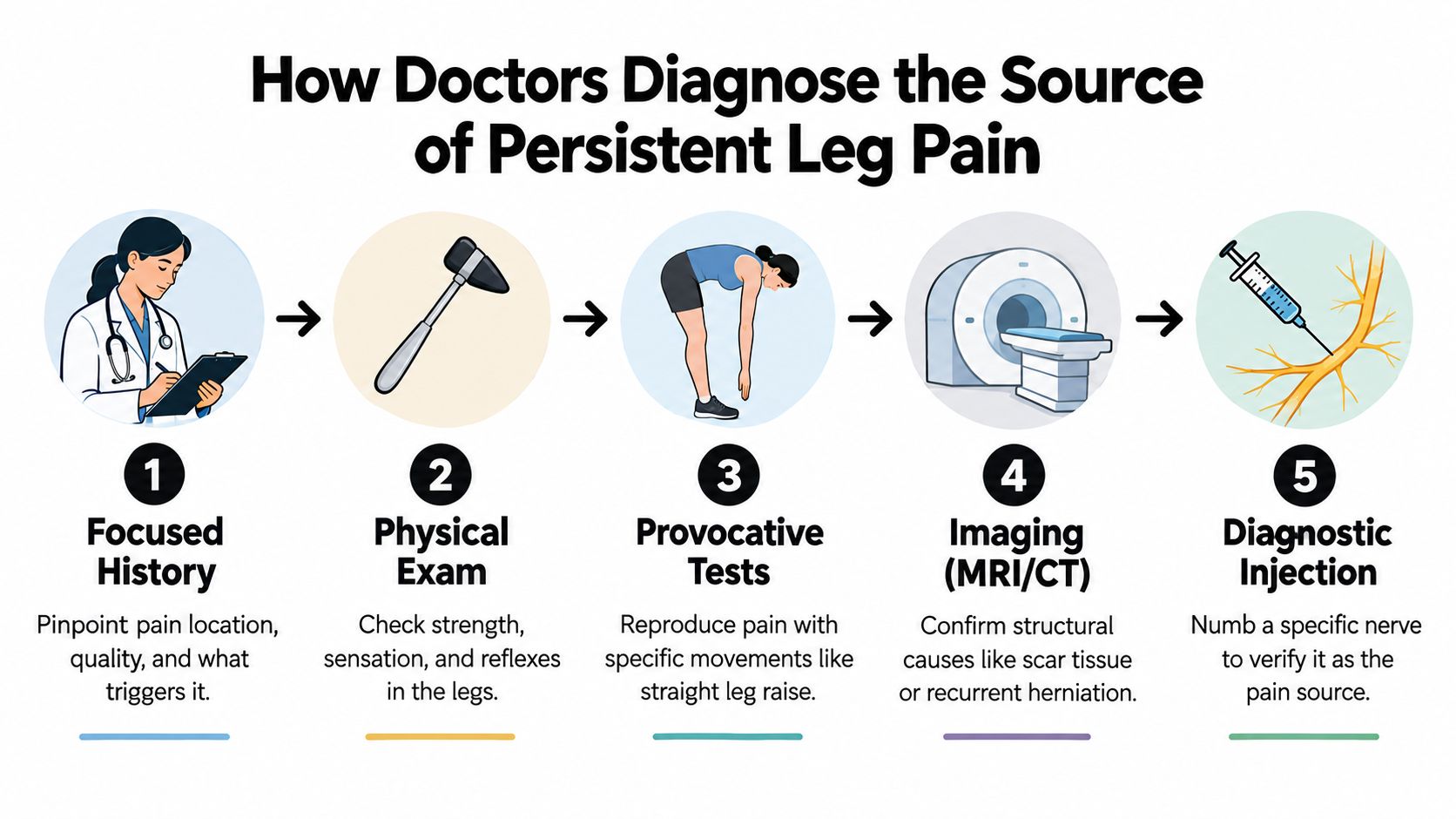
Good diagnosis starts before imaging. The story usually points the way.
A focused history asks where the pain begins, where it travels, whether it's burning or cramping or electric, and whether sitting, standing, walking, coughing, or lying down changes it. Timing matters too. Did the pain never fully improve after surgery, or was there a clean pain-free window before it returned? Those are different problems.
The exam narrows the list fast
A targeted physical exam maps symptoms against anatomy.
- Straight leg raise: Helps reproduce lower lumbar root tension patterns.
- Femoral stretch testing: Helps when the pain pattern suggests a higher lumbar root.
- Gait observation: Can reveal guarding, weakness, antalgia, or early foot drop.
- Sensory and motor mapping: Checks whether the deficit follows a dermatomal or peripheral nerve distribution.
If you want a plain-language overview of how clinicians sort out neuropathic symptoms, this guide on how to diagnose nerve pain is a helpful starting point.
Imaging is useful, but it isn't the whole diagnosis
When scar tissue and recurrent disc are both on the table, contrast-enhanced MRI is often the key study. Scar tends to enhance with contrast, while recurrent disc material behaves differently. CT is useful when hardware position or bony detail matters more. Flexion-extension or other weight-bearing films can help when instability or adjacent-level motion is suspected.
A “normal” MRI does not end the evaluation. Static imaging can miss dynamic stenosis. Small irritated nerves may not look dramatic on a scan. Facet-mediated referral can mimic leg pain without producing a striking MRI abnormality.
Diagnostic injections can clarify the picture
Selective nerve root blocks and facet blocks can do two jobs at once. They may reduce pain, and they can also confirm whether the suspected structure is the source.
That is often the turning point in cases where symptoms are real, disabling, and not fully explained by routine imaging.
A Realistic Recovery Timeline and When Improvement Should Happen
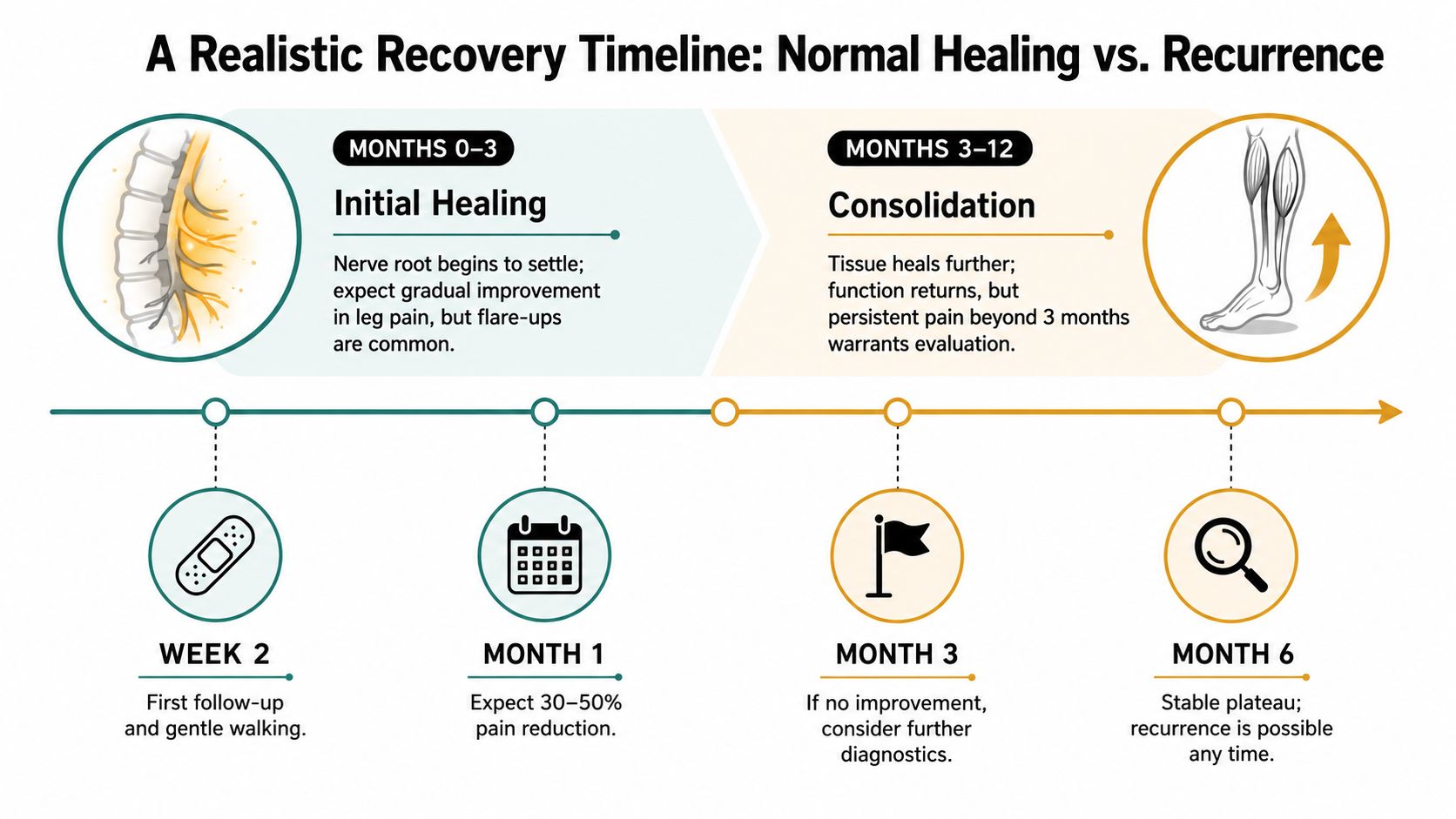
Recovery after lumbar surgery is rarely linear. Patients often expect a steady upward line. Real recovery usually looks more like improvement interrupted by flare-ups.
A large systematic review of lumbar discectomy outcomes found that mean preoperative leg pain across 50 studies and 14,910 participants was 7.04 on a 0 to 10 scale, and that leg pain improved substantially immediately after surgery with benefit maintained over time (systematic review of lumbar discectomy outcomes). That matters because it sets the expectation that surgery often helps leg pain, but recovery speed still varies.
The first three months
In the early window, nerve irritation, inflammation, tissue healing, and muscle guarding dominate the picture. Improvement may be gradual rather than immediate. One NHS postoperative guide notes that 85% of patients experience improvement after lumbar decompression, while leg pain and walking distance may improve gradually over the first three months and continue improving for up to two years. The same guide notes that about 1 in 5 patients may have an early recurrence of pre-operative symptoms a few days after surgery (lumbar decompression recovery guidance from CUH NHS).
That's why a brief early flare-up doesn't automatically mean something is wrong.
The longer recovery window
From three months forward, I get more concerned when leg pain is not improving, is getting worse, or has become more clearly patterned. Years later, a fresh return of symptoms raises a different question. In that setting, a new adjacent-level problem often deserves more attention than the idea that the original surgery “failed.”
Structured rehabilitation still matters in this phase. Patients who need more guidance on graded activity and progression after a procedure often benefit from reviewing a practical outline of post-surgical rehabilitation.
Improvement after spine surgery should be progressive, not perfect. But if the trend stalls or reverses, waiting longer is not always the right move.
Treatment Options From Conservative to Interventional
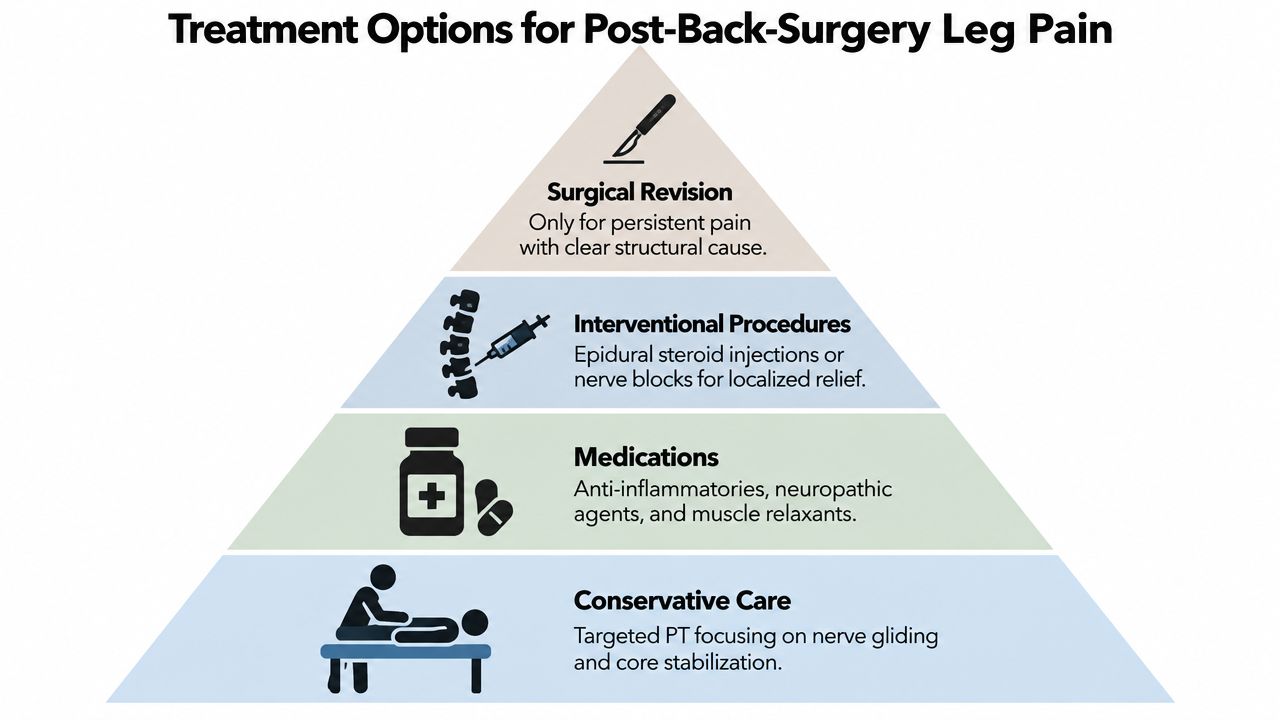
Treatment works best when it matches the mechanism. Many patients lose time. They get generic stretches for a nerve-root problem, or they get an injection aimed at the wrong target, or they're told to keep taking medication for a lesion that really needs surgical review.
Conservative care when the condition is stable
The conservative tier makes sense when there are no red flags and no rapidly progressive neurologic losses.
- Targeted rehabilitation: This is not generic stretching. The useful version focuses on nerve gliding, walking tolerance, trunk control, and movement patterns that don't keep irritating the involved structure.
- Medication choices: Neuropathic agents and SNRI-type options may help burning or electric leg pain. Anti-inflammatory medication may help if inflammation is driving the pain. Opioids usually don't perform well for chronic neuropathic leg pain except as a very short bridge in selected cases.
- Activity modification: Shorter sitting bouts, pacing, and position changes often help while the diagnosis is still being clarified.
Image-guided procedures when the pain generator is clearer
This is where precision matters.
Transforaminal or interlaminar epidural steroid injections are often used when an inflamed nerve root is the likely driver. Medial branch blocks and radiofrequency ablation fit much better when part of the pain is coming from the facet joints rather than the nerve root itself. A patient with ongoing radicular symptoms after surgery may also be a candidate for a more focused interventional review, including options described in this overview of epidural steroid injection for back pain.
At Midwest Pain & Wellness, those options can include image-guided injections, radiofrequency ablation, spinal cord stimulation evaluation, MILD for selected lumbar stenosis cases, and Vertiflex for patients who are not good revision candidates. The right fit depends on the mechanism, not the label.
When advanced therapies make sense
Spinal cord stimulation belongs in the conversation when neuropathic leg pain persists after appropriate conservative care and the anatomy does not offer a clean surgical fix. It does not remove compression. It does not reverse hardware problems. What it can do is modulate chronic nerve pain when the main issue is persistent neuropathic signaling rather than a target that surgery can clearly correct.
MILD and Vertiflex fit a narrower lane. These are not “treat everything” procedures. They may help selected patients with lumbar stenosis who are not ideal candidates for revision surgery.
The best treatment for post back surgery leg pain is rarely the most aggressive one first. It's the one that matches the pain generator accurately.
Red Flags and When to Seek a Pain Specialist or Surgeon
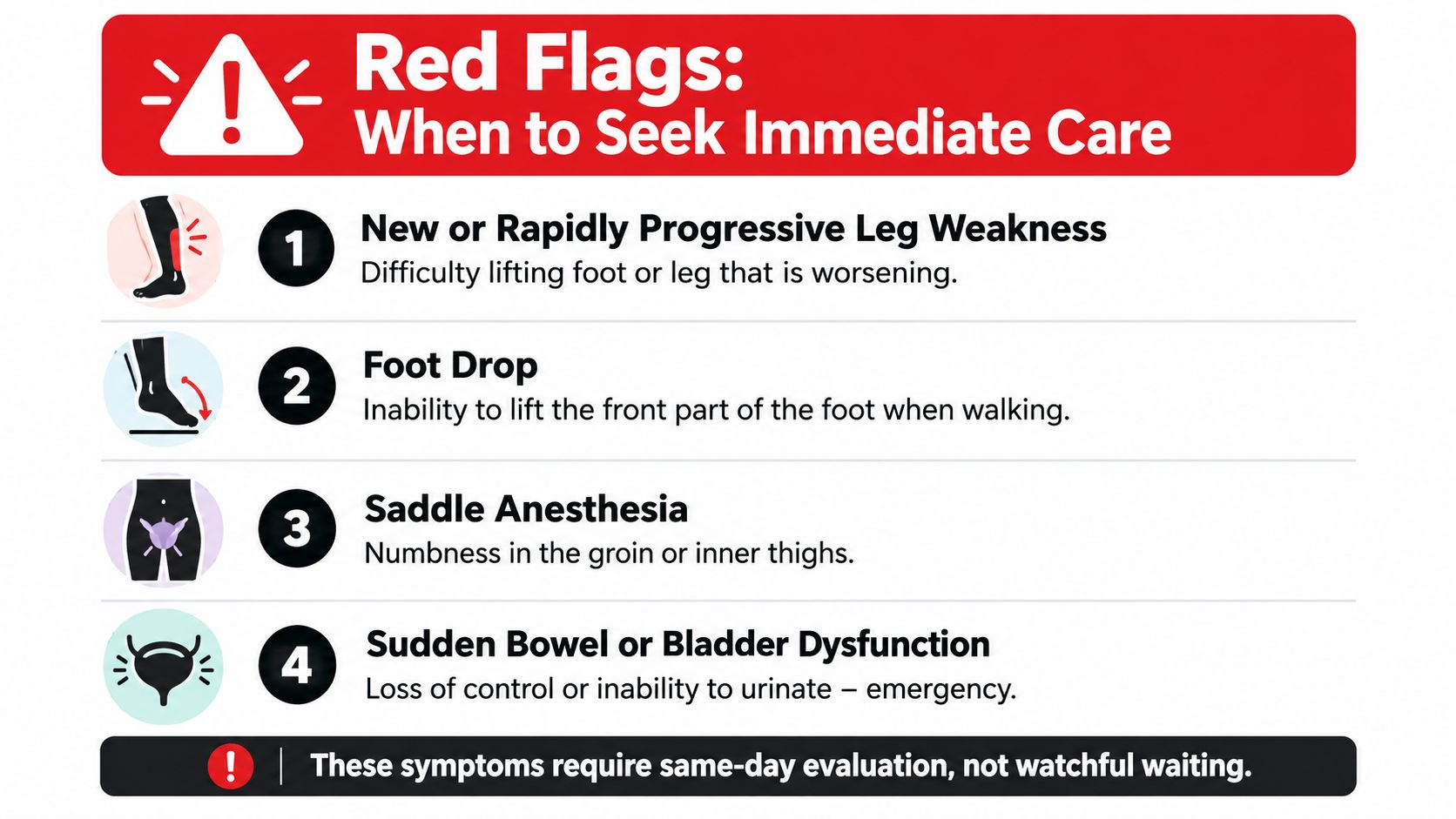
Some symptom changes should never be watched at home for days to “see what happens.” New or rapidly progressive weakness, a foot that starts slapping the ground, numbness in the saddle region, or sudden bowel or bladder dysfunction need same-day evaluation.
Fever, wound drainage, and increasing redness near a recent surgical site also raise concern for infection. Escalating night pain that is deep, unrelenting, and out of proportion deserves prompt review as well.
When to call the surgeon first
Go back to the original surgeon, or seek urgent surgical evaluation, when the pattern suggests a structural or emergency issue.
- New weakness or foot drop: Especially if it appeared quickly or is progressing.
- Bowel or bladder change: Retention or incontinence is not routine postoperative pain.
- Saddle anesthesia: This can signal cauda equina compression.
- Fever or wound drainage: Infection needs immediate attention.
- Abrupt severe change after a fall or strain: Hardware or a new compressive event has to be considered.
When a pain specialist is often the better first stop
If the pain has been gradually worsening over weeks or months, if the main issue is burning or radiating leg pain without a new major neurologic deficit, or if the imaging is confusing and the symptom pattern is mixed, an interventional pain evaluation is often the more useful first move.
The practical difference is this. A surgeon looks first for structural failure, compressive lesions, instability, infection, or revision candidacy. A pain specialist maps the pain generator in more detail, correlates symptoms with prior imaging, and may use targeted diagnostic or therapeutic procedures to clarify the next step. In many cases, both are needed, just in the right sequence.
A practical checklist for patients in southwest suburban Illinois
For patients in Chicago Ridge, Palos Heights, Palos Hills, Evergreen Park, Hickory Hills, and nearby southwest suburban communities, this is what I'd recommend doing this week if your leg pain has returned after back surgery:
- Keep a two-week symptom log: Write down where the pain starts, where it travels, the time of day, what positions worsen it, what eases it, and whether numbness or weakness appears.
- Bring the records that matter: Operative notes if you have them, prior MRI or CT reports, any image discs, and a current medication list.
- Describe the timeline clearly: Did surgery help at first? Was there a pain-free interval? Did the current pain begin gradually or abruptly?
- Note functional loss: Track walking tolerance, sleep disruption, driving tolerance, stair difficulty, and whether the foot catches when you walk.
- Separate back pain from leg pain: That distinction often changes the workup.
A first interventional pain visit usually focuses on mechanism. The review includes symptom mapping, prior procedure history, exam findings, and whether the current pattern sounds compressive, inflammatory, scar-related, or sensitization-based. If revision is a real possibility, coordination with the original surgeon matters. If the pattern fits conservative care or an injection trial, that route may come first. If the findings suggest advanced neuropathic pain, neuromodulation may enter the conversation.
A large U.S. claims analysis of 102,047 patients found time-based failed back surgery syndrome rates of 5.4% within 6 months and 8.4% within 12 months after lumbar fusion or decompression, with higher rates in inpatient than outpatient cases. Another study of 1,842 lumbar surgery patients reported an overall prevalence of 20.6%. Those figures reinforce the practical point: persistent postoperative leg pain is not rare, and it varies by procedure complexity and patient factors (PMC review and prevalence data on FBSS).
The label matters less than the mechanism. Once the mechanism is identified, post back surgery leg pain becomes a problem you can work through logically instead of a mystery you keep enduring.
If your leg pain has returned after spine surgery, Midwest Pain & Wellness offers mechanism-focused evaluation for nerve-related and post-surgical pain, including image-guided diagnostics, injections, neuromodulation assessment, and coordination with your surgeon when revision is a concern. If you're in Chicago Ridge, Palos Heights, Palos Hills, Evergreen Park, Hickory Hills, or nearby Illinois communities, visit Midwest Pain & Wellness to take the next step toward a treatment plan that matches the actual source of your pain.