Radiofrequency ablation (RFA) is sometimes covered by insurance, but coverage is never automatic. Approval hinges on four factors: the body area being treated, the diagnosis on file, the medical records supporting the request, and the written policy of the specific plan. A helpful way to think about it is as a dimmer switch rather than a light switch.
Table of Contents
- How Radiofrequency Ablation Coverage Really Works
- How Insurers Decide Whether Treatment Is Medically Necessary
- Why Diagnostic Blocks Often Come Before Approval
- Matching Codes to Your Prior Authorization and Appeals
- Estimating Your Out-of-Pocket Costs Before Scheduling
- Real-World Example and Your Visit Checklist
- Frequently Asked Questions About Coverage
How Radiofrequency Ablation Coverage Really Works

Many patients picture coverage as an on-or-off switch. In reality, it works more like a dimmer. Each plan turns the light up or down depending on how well your case is documented.
A well-documented request, with clear symptoms and a real treatment history behind it, often gets strong support. A thin or patchy file might get partial approval, or none at all.
What Sets the Dimmer Level
- Body area: Spine and joint treatments are often reviewed under different criteria than other regions.
- Diagnosis: The condition on file has to match the treatment being requested.
- Medical records: Visit notes, imaging reports, and treatment history need to back up the request.
- Plan policy: Every insurer publishes its own written criteria for approval.
The procedure name alone never decides coverage. What matters is the story your records tell about why treatment is needed.
Why Your Payer Changes the Picture
Midwest Pain & Wellness in Chicago Ridge, IL helps patients from Palos Heights, IL, Palos Hills, IL, Evergreen Park, IL, and Hickory Hills, IL review their benefits before treatment gets scheduled. Midwest Pain & Wellness is a pain and wellness clinic, not a physical therapy practice. We serve patients in Illinois in Chicago Ridge, IL and the surrounding communities. We start with the plan for a simple reason. The same procedure can be approved under one policy and questioned under another.
How Coverage Commonly Differs by Payer Type
Not every payer looks at RFA the same way. The table below offers a quick snapshot of what each type of coverage tends to focus on, along with the first question worth asking before you book.
| Coverage Source | Typical Review Focus | First Question to Ask |
|---|---|---|
| Employer-sponsored commercial plan | Written medical policy, prior authorization, and proof of conservative care | Does my plan require prior authorization for RFA? |
| Medicare | Local coverage rules, your diagnosis, and treatment history | Is my area covered under the local contractor policy? |
| Medicare Advantage | The plan's own criteria, network rules, and authorization steps | Which criteria does my plan apply? |
| Workers' compensation | Claim approval, adjuster review, and injury documentation | Has my claim been approved for this treatment? |
| Personal injury claims | Liability questions, medical records, and billing documentation | Will my attorney or the carrier review the treatment plan? |
Before you schedule anything, confirm the rules that apply to your specific plan. The sections ahead walk through medical necessity, diagnostic blocks, codes, costs, and what to bring with you.
How Insurers Decide Whether Treatment Is Medically Necessary
Picture a building inspector walking through a house with a clipboard. The house might be solid, but if the paperwork doesn't show every required item, it doesn't pass. Insurers use a similar approach with radiofrequency ablation (RFA), and they call it medical necessity.
What Reviewers Check First
Most plans look for the same core items before they approve spine or joint RFA. Each one answers a practical question about your case.
- Confirmed pain source: Your records need to show which joint or nerve is producing the pain.
- Documented conservative care: Medication trials, activity changes, and home-based conservative care should be recorded over a meaningful stretch of time.
- Functional limits: Notes should describe which daily tasks, such as sitting, walking, or lifting, have become hard to do.
- Response to diagnostic nerve blocks: A measurable drop in pain after a test injection helps support the diagnosis.
- Advance authorization: The plan has to approve the procedure before it's scheduled.
A Real-World Lesson from Medicare
Medicare's history shows how much weight documentation can carry. Back in 2009, Medicare had no national coverage policy for catheter RFA used to treat atrial fibrillation, so regional contractors made their own decisions.
Even in 2026, a Medicare review record showed no national or local coverage decision for RFA used on uterine fibroids. When that happens, a health plan's own clinical criteria often make the call.
The takeaway for spine and joint patients is straightforward. Approval depends on your documentation, not on a blanket rule that covers every RFA case. Think of your file as the evidence and the policy as the rulebook.
Two patients with the same diagnosis can receive different answers, because their files tell different stories.
Steps to Request Your Plan's Medical Policy
- Call the member services number on the back of your insurance card and ask for the written medical policy that covers RFA.
- Ask for the policy number that governs your case. Illinois patients can request this directly from their plan.
- Write down the criteria the reviewer will apply, such as relief thresholds and limits on the number of treatments.
- Compare the policy with your records before the request is submitted.
Patients in Chicago Ridge, IL, Palos Heights, IL, Palos Hills, IL, Evergreen Park, IL, and Hickory Hills, IL can make this request by phone or through their plan portal. It usually takes only a few minutes.
Asking for the policy early gives you time to read it before you schedule anything. It also helps you spot gaps in your file while there's still time to fix them.
Bring a copy of the policy to your appointment so your care team can match it against your notes.
Why Diagnostic Blocks Often Come Before Approval
Picture buying a used car. Nobody hands over the cash before taking it for a spin. A diagnostic medial branch block works the same way. For many patients pursuing radiofrequency ablation covered by insurance, it's the test drive that comes first.
Following the Standard Pathway
Most payers don't approve a procedure based on a single test. They look for a sequence, and that sequence usually starts with conservative care at a pain and wellness clinic, such as medication trials, changes to daily activity, and structured conservative care exercises.
Imaging, a physical exam, and a measurable response to diagnostic injections come next. Each step narrows the question, a bit like a detective ruling out suspects one at a time.
The infographic below walks through this sequence from start to finish, so you can see how each stage builds on the one before it.
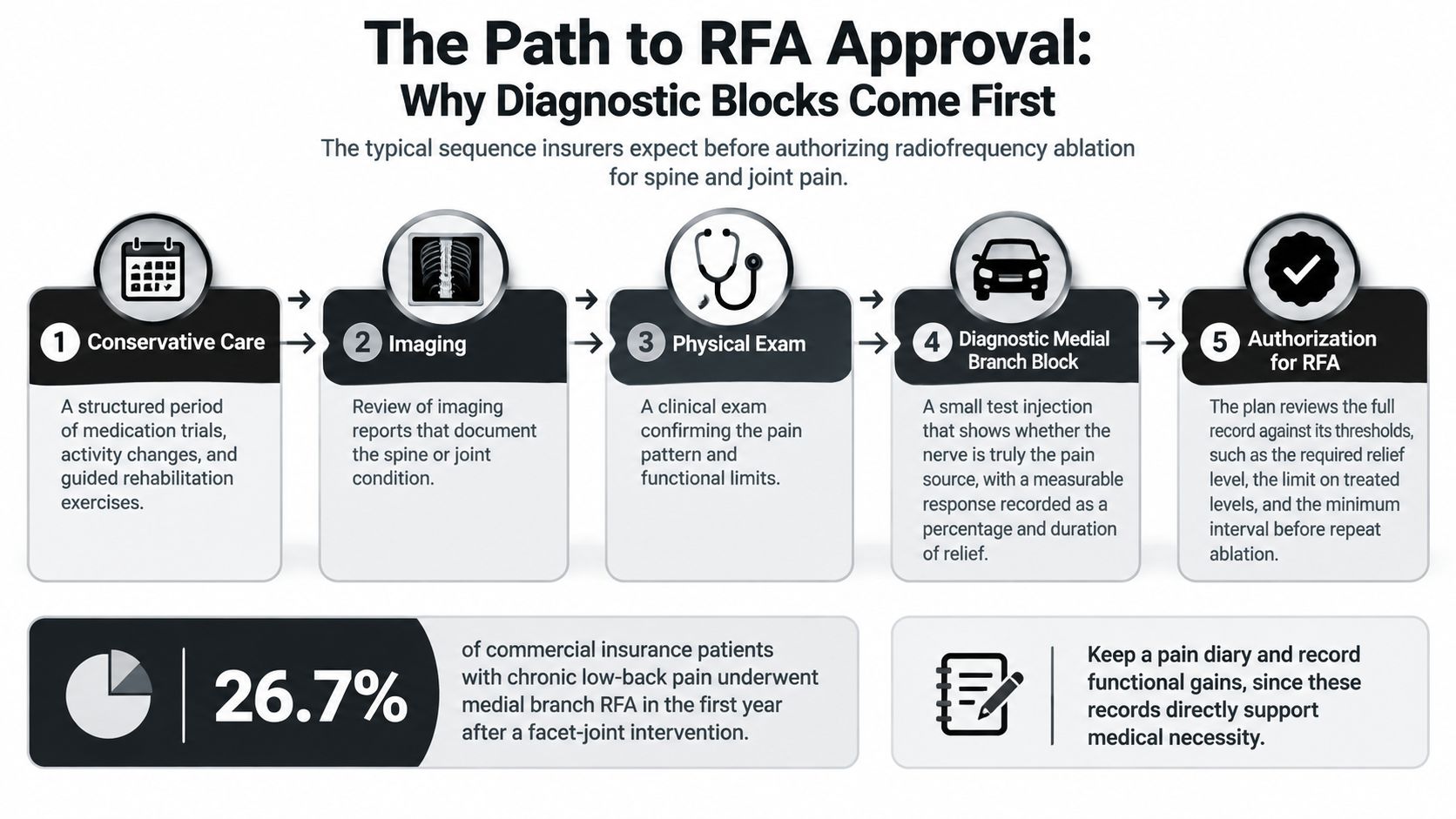
The key insight is that the block usually shows up late in the sequence. By that point, a clear pain pattern should already be documented.
Reading the Research Behind Approvals
Research supports the value of a structured pathway. A pooled analysis of three prospective clinical trials of basivertebral nerve RFA reported reduced conservative-care and opioid use through five years. Commercial claims data also showed that 26.7% of patients with chronic low-back pain had medial branch RFA within the first year after a facet-joint intervention.
Numbers like these are encouraging, but they describe a common pattern, not a guarantee. Your plan still applies its own rules, and those rules matter more than any study average.
Thresholds Plans Often Apply
Even after a successful block, plans compare your results against specific benchmarks. These differ by insurer, but they often include:
- Relief level: A minimum percentage of pain reduction from the block must be recorded.
- Relief duration: The benefit must last a set amount of time, not just a few minutes.
- Treated levels: Many plans cap how many spinal levels or joints can be treated at once.
- Repeat interval: A minimum wait is often required before a repeat ablation is approved.
A diagnostic block answers one question: did this nerve truly cause the pain? Plans want that answer written down in measurable terms.
Keeping a Pain Diary That Proves Progress
Memory is unreliable when it comes to pain. A dated diary turns everyday experiences into evidence that a reviewer can actually check.
- Daily pain score: Rate your pain on the same scale each day.
- Function: Record walking distance, lifting limits, sitting time, and work tasks.
- Medications and treatments: Log dates, doses, and how each therapy helped.
These entries directly support medical necessity, so bring them to your visit. If you'd like more background before your test, check out our guide on what a medial branch block is and how it works.
Matching Codes to Your Prior Authorization and Appeals

Every claim for radiofrequency ablation covered by insurance travels with two codes. That sounds like a small detail, but understanding how those codes fit together can save you weeks of back-and-forth.
Two Codes, Two Jobs
Think of the CPT code as the shipping label on a box. It tells the payer exactly what procedure was performed, such as code 64635 for radiofrequency destruction of a single lumbar or sacral facet joint nerve.
The ICD-10 diagnosis code answers a different question: why was the procedure needed? It describes the condition being treated, and the two codes have to make sense together.
Here's a way to picture it. You order grilled salmon at a restaurant, and the kitchen brings out a steak. The ticket doesn't match the plate, so the order goes back.
Insurers handle mismatched claims the same way. When the procedure and the diagnosis don't line up on paper, the request gets flagged. Mismatched codes are a common cause of prior authorization delays and denials.
Before you schedule, it helps to know which codes and records carry the most weight. The table below shows what each one tells the payer and where you can ask for a copy ahead of treatment.
Key Codes and Documents That Shape an RFA Claim
| Code or Document | What It Tells the Payer | Where to Request It |
|---|---|---|
| CPT code | The procedure performed | Your procedure order or scheduling office |
| ICD-10 code | The condition being treated | Your visit notes and diagnosis summary |
| Visit notes and imaging | Symptoms, history, and findings | Your treating clinic or imaging center |
Getting these copies early means you can read them yourself before the reviewer does. If something looks off, your clinic can correct it before it turns into a denial.
Confirming Approval Before You Schedule
Timing matters just as much as paperwork. Work through these steps in order to keep your request moving.
- Confirm advance approval. Call the plan and ask whether RFA needs prior authorization before the procedure date.
- Submit matching records. Send notes and imaging that directly support the exact codes requested.
- Track the request. Write down the reference number and check the status weekly.
- Read any denial closely. The stated reason usually points to one specific gap, so find it first.
Turning a Denial Into a Second Chance
A denial is often a documentation gap rather than a final answer. Many reviewers just need a clearer picture of why the procedure is necessary.
A peer-to-peer review can close that gap quickly. The treating physician speaks directly with the plan's reviewer about the case, which often resolves questions faster than another round of paperwork.
A denial letter is a starting point for a conversation, not the end of one.
Common Mistakes and Their Fixes
- Incomplete notes: Visit notes that skip symptoms or treatment dates weaken the request. Fix: Ask your clinic to review the notes against the plan's written criteria.
- Mismatched codes: A procedure code that doesn't fit the diagnosis triggers delays. Fix: Have the billing team confirm both codes match the records before submission.
- Missing functional limitations: Notes that describe pain but not its daily impact leave gaps. Fix: Document specific tasks you can no longer do, such as sitting for long periods or lifting groceries.
- Late requests: Submitting after the procedure date can result in denial. Fix: Start the authorization process as soon as treatment is recommended.
Tracking Your Appeal Deadlines
Every denial notice prints a deadline for filing an appeal. Timelines vary by plan, so check the date the moment the letter arrives and mark it on your calendar.
If your claim for the procedure is denied, a structured appeal can recover the payment. Billing teams often rely on guidance to improve insurance claim appeals, and that resource is worth a read.
You might be interested in our guide on sacroiliac joint injection CPT codes if your provider is billing a different procedure.
Estimating Your Out-of-Pocket Costs Before Scheduling
Think of insurance as picking up the main part of the meal. You still get a check for the rest.
Your deductible, coinsurance, and anything billed separately land with you. So even when radiofrequency ablation is covered, the final bill can be bigger than people expect.
Where the Procedure Takes Place
Where you have it done changes the numbers fast.
An office procedure, an ambulatory surgery center, and a hospital outpatient department all price differently. Hospital settings usually add higher facility fees, so the same treatment can cost quite a bit more depending on the location.
Charges That Often Arrive Separately
Approval for the ablation is only one piece. Other services are often billed on their own:
- Imaging guidance: Check if the imaging used to guide the needle is included or separate.
- Anesthesia: Ask if the anesthesia provider bills independently.
- Facility and pathology: Facility charges and any tissue analysis can show up as extra line items.
- Follow-up visits: Rechecks after the procedure may carry their own copay or deductible.
Each piece can process differently under your plan. That is why one approval letter never tells the full story.
Reading a Cardiac Cost Study Carefully
You may see a U.S. study of 3,194 patients who had ablation for atrial fibrillation. Total spending dropped after treatment, with average savings of about $800 per month.
That is helpful background, but it is cardiac care. It is not a price tag for an outpatient spine or joint procedure, so do not use it to guess your own cost.
Before you schedule, call your plan and ask these five things:
- Remaining deductible: How much is left on my deductible this year?
- Coinsurance percentage: What share do I pay after the deductible is met?
- Out-of-pocket maximum: What is the most I could pay in a plan year?
- Prior authorization: Do I need approval before we set a date?
- Network status: Are the clinic, facility, and anesthesia provider all in network?
The only estimate that matters is the one built from your plan's numbers, not a national average.
How Your Coverage Source Changes the Bill
The rules shift with who is paying. Medicare Advantage plans, commercial employer plans, workers' compensation, and personal-injury claims all run on different processes.
If you are in Chicago Ridge, IL, Palos Heights, IL, Palos Hills, IL, Evergreen Park, IL, or Hickory Hills, IL, confirm which set of rules applies to you before you book.
Check out our guide on radiofrequency ablation cost.
Getting your records together ahead of time helps your care team see the full picture — what hurts, what you've already tried, and where coverage questions might come up.
Real-World Example and Your Visit Checklist

Hypothetical example, not an actual patient outcome: Think of a 58-year-old from Hickory Hills, IL living with stubborn low-back pain.
She'd already spent several months on medication and home-based conservative care without lasting relief. After diagnostic blocks gave her real — though temporary — relief, her doctor at the pain and wellness clinic brought up RFA as the next step.
Like most patients, her first question was whether she could get radiofrequency ablation covered by insurance. She also worried her chart didn't quite reflect how hard daily life had become. Her pain diary helped fill that gap, noting trouble standing long enough to cook dinner, plus how much better she felt after each block.
Documentation, timing, and benefits checks belong together. An approval answers a different question from an estimate of what you'll owe.
From there, the clinic staff pulled everything into one authorization packet — imaging, visit notes, and that diary.
They ran a benefits check and confirmed submission rules before sending the request. Then they waited for the authorized treatment dates before putting anything on the schedule.
In this made-up scenario, the plan said yes. That doesn't guarantee the same result for anyone else. But it shows how solid prep ties the clinical story to the cost conversation.
Bring These Items to Your Coverage Review
Coming from Chicago Ridge, IL, Palos Heights, IL, Palos Hills, IL, Evergreen Park, IL, or Hickory Hills, IL? Bring what you have. If something's missing, just let the clinic know you need help tracking it down.
- Insurance card and photo ID, plus any secondary coverage details
- Referral, if required, with your referring doctor's contact information
- Imaging reports, including dates and where the scans were done
- Current medication list, with doses, supplements, and allergies
- Prior treatment and injection records, with dates and how you responded
- Pain and function diary, showing symptoms and what activities they limit
- Workers' compensation or claim numbers, if they apply, with contact info
- Written cost questions, especially about separate bills or payment timing
Small details matter here. Instead of just writing “walking hurts,” note how far you can go before you have to stop. And don't guess at old treatment dates — just flag what's missing so staff can confirm it.
Before you agree to treatment:
- Request an eligibility and benefits review.
- Ask what is still unconfirmed, including authorization and your estimated share.
Schedule your review at Midwest Pain & Wellness in Chicago Ridge, IL, a pain and wellness clinic, to talk through likely coverage and costs before you decide on next steps.
Getting radiofrequency ablation covered by insurance starts with your own policy. No two plans handle it exactly the same way.
Frequently Asked Questions About Coverage
Does Insurance Cover Radiofrequency Ablation for Back or Neck Pain?
It can, when your records clearly support medical necessity. Your plan, your diagnosis, and what you've already tried all matter.
So ask about the exact procedure your clinician recommends, not RFA in general. Approval for one spinal area, for example, doesn't automatically mean coverage for another.
Your clinic can help pinpoint which notes and test results the plan wants to see.
Coverage is conditional. A treatment recommendation and an insurance approval are two separate decisions.
Why Was My Radiofrequency Ablation Denied?
Most denials come down to paperwork. Missing records, mismatched codes, or not enough documentation of conservative care and diagnostic block results are common reasons.
Your denial letter should spell out the specific cause. Before you respond:
- Identify the gap described in the notice
- Ask your clinic if those supporting records were sent
- Check the deadline and follow the appeal instructions closely
Confirm Your Benefits Before Scheduling Treatment
Does Medicare Cover RFA?
It depends on the body area, diagnosis, and your local contractor policies. Medicare Advantage plans often add their own authorization and network rules, so confirm that process before you schedule.
Can I Get an Estimate Before My Procedure?
Yes. Ask for an eligibility and benefits review to clarify your remaining deductible, coinsurance, and prior authorization needs. Just remember, an estimate is not a guarantee of final payment.
- Request the estimated patient responsibility
- Ask which charges are included
- Keep the written estimate for your records
If you live in Chicago Ridge, IL, Palos Heights, IL, Palos Hills, IL, Evergreen Park, IL, or Hickory Hills, IL in Illinois, always double-check this information against your own plan documents.
Contact Midwest Pain & Wellness, a pain and wellness clinic in Chicago Ridge, IL serving Palos Heights, IL, Palos Hills, IL, Evergreen Park, IL, and Hickory Hills, IL, to request a benefits review and talk through coverage questions before you commit to treatment.