A medial branch block is a diagnostic injection used to pinpoint whether specific spinal facet joints are causing your pain, and it's generally considered “positive” only if you get at least 50% pain relief for the expected duration of the numbing medicine. In many cases, that short-term response becomes the key first step toward a longer-lasting, opioid-sparing treatment plan.
If you're dealing with stubborn neck or back pain in Chicago Ridge or nearby communities like Oak Lawn, Palos Hills, Palos Heights, Worth, Bridgeview, Hickory Hills, Alsip, Burbank, Evergreen Park, or Orland Park, you may already know how frustrating this can be. You try rest, activity changes, medications, maybe even therapy, and the pain still keeps showing up when you stand too long, twist, turn your head, or try to get through a normal workday.
What many patients want most isn't another temporary patch. They want a clear answer. They want to know what is a medial branch block, why it matters, and whether it can finally help identify the actual source of pain instead of treating everything broadly.
That's where this procedure becomes useful. A medial branch block helps answer a very specific question. Is your pain coming from the small joints in the spine called facet joints? If the answer is yes, it can open a path to more durable relief without relying on opioids.
Your Guide to Finding the Source of Chronic Pain
One common story sounds like this. A person wakes up stiff, gets moving, and notices pain across the low back or into the neck. It isn't always sharp. Sometimes it feels deep, mechanical, or achy. It may flare when leaning back, rotating, or standing in one place. The scan results may show age-related changes, but that still doesn't tell the full story.
That gap between “something hurts” and “this is exactly why it hurts” is where many people get stuck.
In practice, unresolved spine pain often lasts not because nothing can be done, but because the pain generator hasn't been identified with enough precision. Muscles can hurt. Discs can hurt. Nerves can hurt. Facet joints can hurt. Those problems can overlap, and the treatment only works well when the diagnosis is accurate.
Why precise diagnosis matters
A medial branch block isn't meant to be mysterious. It's a focused test used when a pain specialist suspects the facet joints may be involved. Instead of guessing, the doctor targets the small nerves that carry pain signals from those joints.
When the pain pattern fits, this approach can change the whole conversation:
- Less guesswork: The block helps sort facet-related pain from other spinal problems.
- Better treatment selection: A clear response can point toward the next step, rather than repeating treatments that haven't helped.
- An opioid-sparing path: If the source is confirmed, care can move toward targeted procedures instead of escalating pain medication.
Patients often feel relief simply from having a plan that makes sense. A good diagnostic procedure doesn't just numb pain for a short time. It clarifies what to do next.
For many people in the southwest suburbs around Chicago Ridge, that's the value. Not just another injection, but a test that can guide a long-term strategy.
Understanding Facet Joints and Medial Branch Nerves
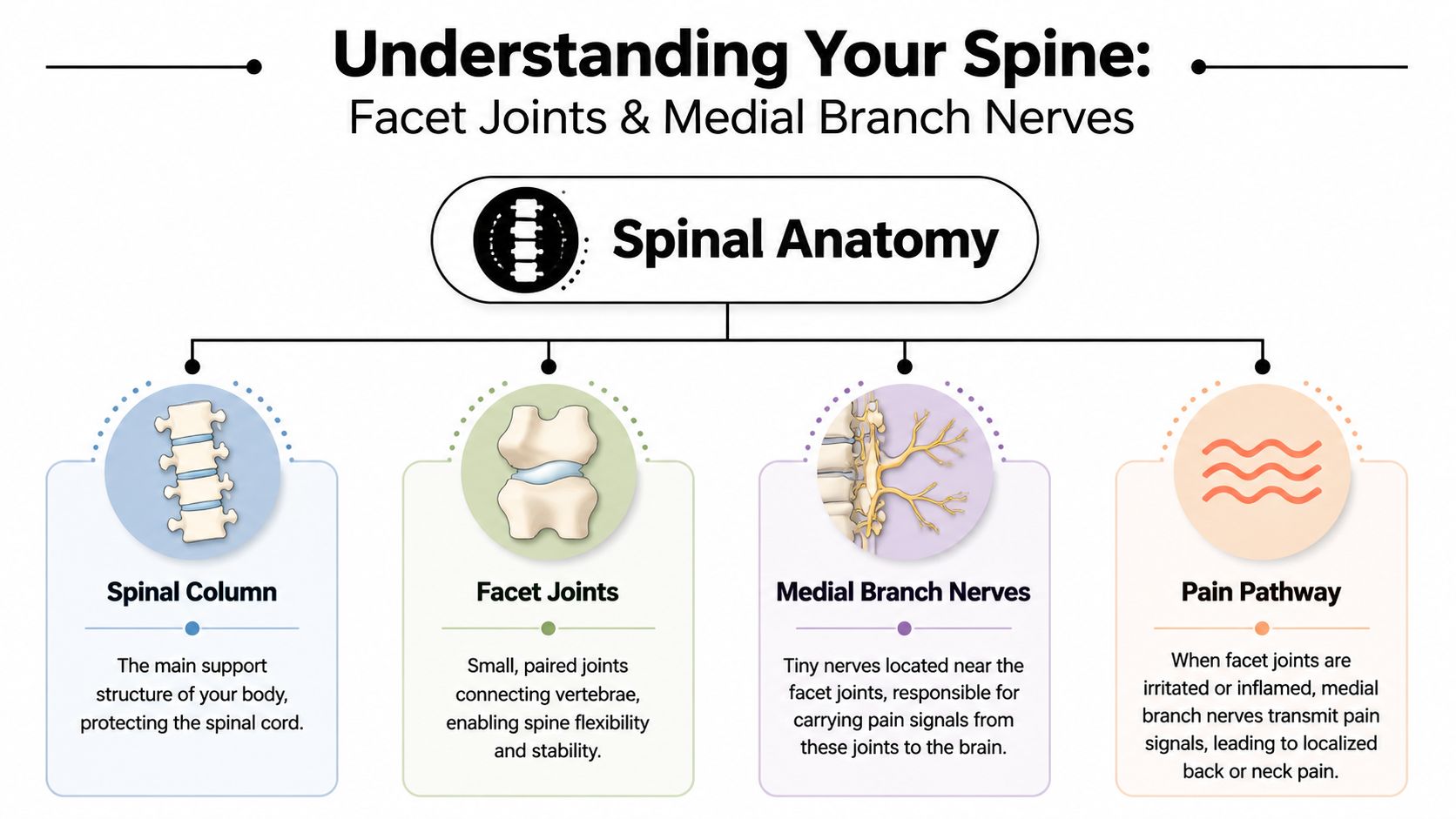
Facet joints are small joints at the back of the spine that help each level move with control. They guide bending and twisting, and they add stability in the neck and low back. When these joints become inflamed from arthritis, repetitive strain, prior injury, or everyday wear, they can produce ongoing pain that feels stubborn and hard to pin down.
Medial branch nerves serve as the pain-signaling pathway for those joints. They do not control the major muscles in your arms or legs. Their job is much narrower. They carry pain information from the facet joint region to the brain. That is why a medial branch block can be so useful. If numbing those nerves reduces your usual pain for a short time, the facet joints move much higher on the list of likely pain sources.
If you want a closer look at the condition itself, this overview of facet-mediated pain explains the patterns we look for in clinic.
What facet pain usually feels like
Facet pain is usually axial, which means it tends to stay centered in the neck or low back instead of traveling in a strong pattern down the arm or leg. Patients in Oak Lawn, Orland Park, and nearby southwest suburbs often describe a familiar set of symptoms:
- Local soreness: Pain in the neck or back close to the spine
- Pain with extension: More discomfort when leaning backward
- Twisting pain: A flare with turning or rotating
- Stiffness after inactivity: Symptoms that feel worse after sitting, driving, or sleeping
That symptom pattern supports the diagnosis, but it does not confirm it.
Other problems can mimic facet pain. Disc-related pain, sacroiliac joint pain, spinal stenosis, and muscle pain can overlap. In practice, that overlap is one reason patients often arrive frustrated after trying therapy, medications, or general injections without a clear answer.
Why anatomy changes the treatment
The placement of the injection matters. A medial branch block is performed near the medial branch nerve, outside the facet joint itself, because the goal is to test the nerve supply that carries pain from the joint. That gives cleaner diagnostic information than a broad approach that numbs a larger area.
This distinction shapes the treatment plan. If the block significantly reduces your usual pain, that supports a facet-based diagnosis and may open the door to radiofrequency ablation for longer relief. If it does not help, we keep looking. That is still useful information, because it helps patients avoid drifting toward repeated opioid use or procedures aimed at the wrong target.
For patients across the Chicago area, including communities like Oak Lawn and Orland Park, understanding this anatomy makes the rest of the care journey easier to follow. The purpose is not to chase temporary numbness. The purpose is to identify the true pain generator and choose a treatment path with a better chance of lasting relief.
The Medial Branch Block Procedure Explained
You have back or neck pain that flares when you turn, stand from a chair, or get out of the car after a long drive through Oak Lawn or Orland Park. Imaging may show age-related changes, but imaging alone does not tell us which structure is causing your pain. A medial branch block helps answer that question with much more precision.
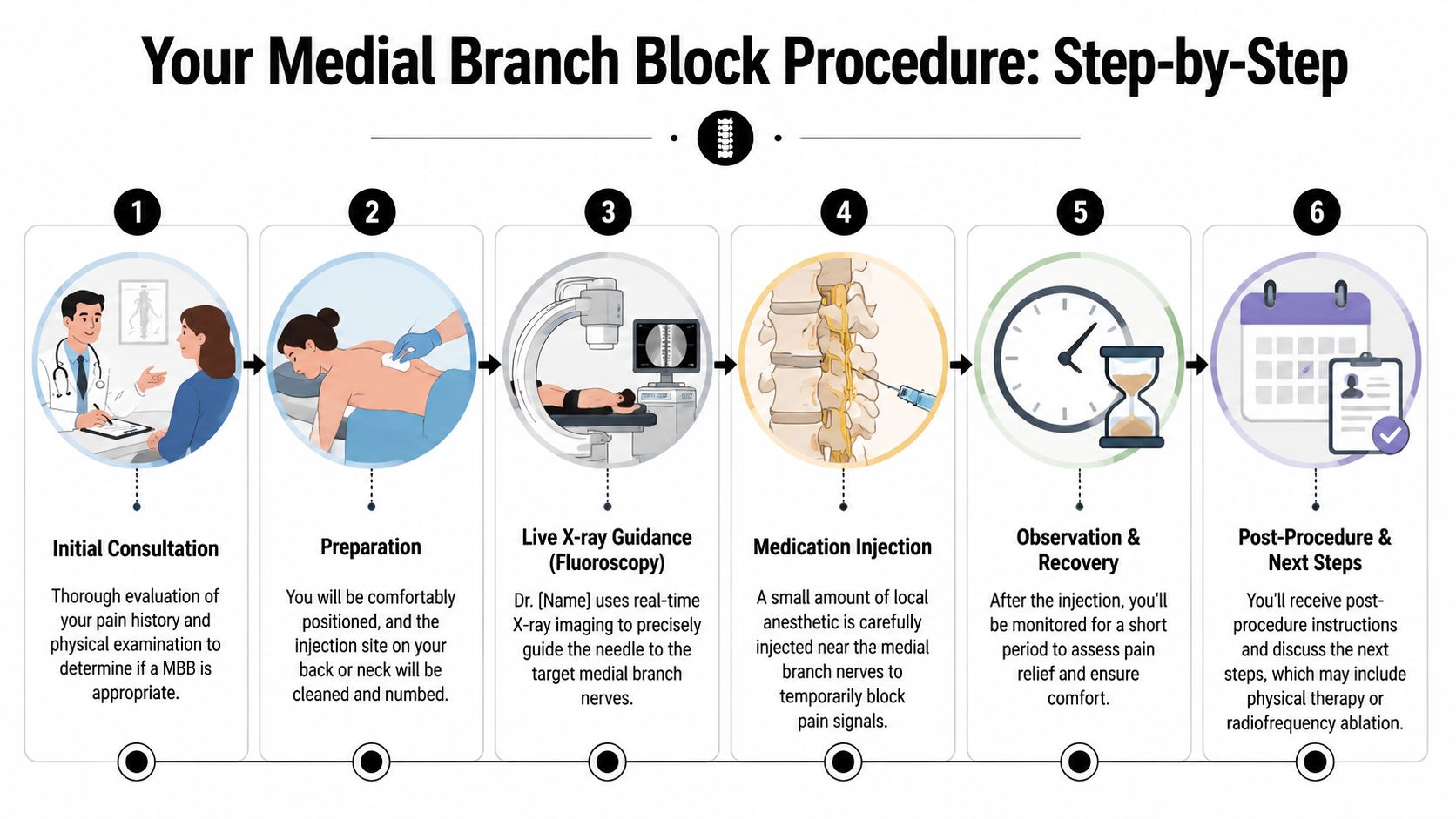
A medial branch block is an image-guided diagnostic injection. I explain it to patients as a focused test, not a heavy-treatment day. The goal is to briefly numb the small nerve supply to a suspected facet joint and then measure what happens to your usual pain during the next several hours. That information helps us choose a treatment plan that is more targeted and less dependent on escalating pain medication.
If you want to compare this with a different targeted spine injection, our page on the facet joint injection procedure explains how the purpose and injection location differ.
What happens on procedure day
The procedure is usually done in an outpatient setting and does not require a long recovery day. In many cases, patients are in and out fairly quickly.
A typical visit looks like this:
-
Target review
Your physician confirms the pain pattern, the side being treated, prior response to care, and the spinal levels that make the most sense to test. -
Positioning and sterile prep
You lie in the position that gives the safest access to the target area. The skin is cleaned carefully, and a small amount of numbing medicine is used at the entry site. -
Fluoroscopic guidance
Live X-ray guidance helps place the needle near the correct medial branch nerve. Accuracy matters because these nerves are small, and the value of the test depends on precise placement. -
Small anesthetic injection
A limited amount of local anesthetic is placed near the nerve. The injection is near the nerve outside the joint, not into the facet joint itself. -
Pain response check
After the block, you track how your usual pain changes during the expected anesthetic window. I often ask patients to test the movements that normally trigger their pain, because the most useful answer is whether your real, familiar pain improves.
Many patients tolerate the procedure well with only local numbing medicine. That is often the better approach for a diagnostic block because heavy sedation can blur the result and make it harder to know what changed.
What counts as a positive result
A helpful result is not based on whether the procedure felt easy or whether the area felt temporarily strange. What matters is whether your typical pain drops clearly during the expected duration of the anesthetic.
Many physicians and insurers look for substantial short-term pain relief before calling the block positive and considering the next step. In practice, the key question is simple. Did the activities that usually reproduce your pain become meaningfully easier for the limited time the anesthetic was active?
That does not mean the problem is permanently fixed. It means the tested facet joints are likely contributing to the pain, which gives us a clearer path toward treatment that can reduce reliance on opioids and avoid repeating injections aimed at the wrong source.
Why some patients need two blocks
Some patients are asked to complete two medial branch blocks on different days before radiofrequency ablation is approved or recommended. The reason is accuracy. A single block can occasionally look positive for reasons unrelated to the target nerve, including placebo response or spread of numbing medicine to nearby structures.
Two well-performed blocks can give a more dependable answer. That extra step can feel inconvenient, but it is often a reasonable trade-off before moving to a longer-acting procedure.
A medial branch block is designed to identify whether a specific set of facet joints is driving your pain. For patients in the Chicago area who want a clear diagnosis, a treatment plan that builds toward longer relief, and an opioid-sparing approach, that precision matters.
Benefits Limitations and Potential Risks
The biggest benefit of a medial branch block is clarity. If your pain improves in the expected window, your doctor gains much more confidence that the facet joints are involved. That can prevent the wrong treatment pathway and focus care where it has the best chance of helping.
A second benefit is that some patients do get meaningful short-term relief. Even though the procedure is mainly diagnostic, pain reduction can make it easier to move, sleep, or resume activities while the longer-term plan is being decided.
What works well
When the symptoms, exam, and imaging line up with facet-mediated pain, this procedure is useful because it answers a narrow but important question. It can support a treatment strategy that is more precise and less medication-heavy.
A patient education review notes that MBBs are primarily a screening test for RFA, but they may also have therapeutic value. That same review reports approximately 55 to 70% pain relief after injection, with more than 85% of followed patients still reporting 50% pain relief at six months in one cohort, as described in this discussion of the medial branch nerve block procedure.
What it does not do
A medial branch block does not permanently treat the underlying problem. The local anesthetic is short-acting by design. If the block works, the main value is the information it provides.
That means a temporary response can still be a successful test. Patients sometimes worry that if the pain returns, the procedure “failed.” In diagnostic terms, that's not necessarily true. A short-lived but clearly positive response can be exactly what your doctor needed to confirm the source.
Risks and trade-offs
No injection is completely risk-free. The usual concerns include bleeding, infection, temporary soreness, or short-lived numbness. In experienced hands, these risks are generally managed carefully, but they still deserve a clear discussion before treatment.
A balanced view looks like this:
- Main upside: Better diagnostic confidence
- Main limitation: Relief from the block itself is usually temporary
- Main decision point: Whether the result is clear enough to support the next step
From Diagnosis to Durable Relief with Radiofrequency Ablation
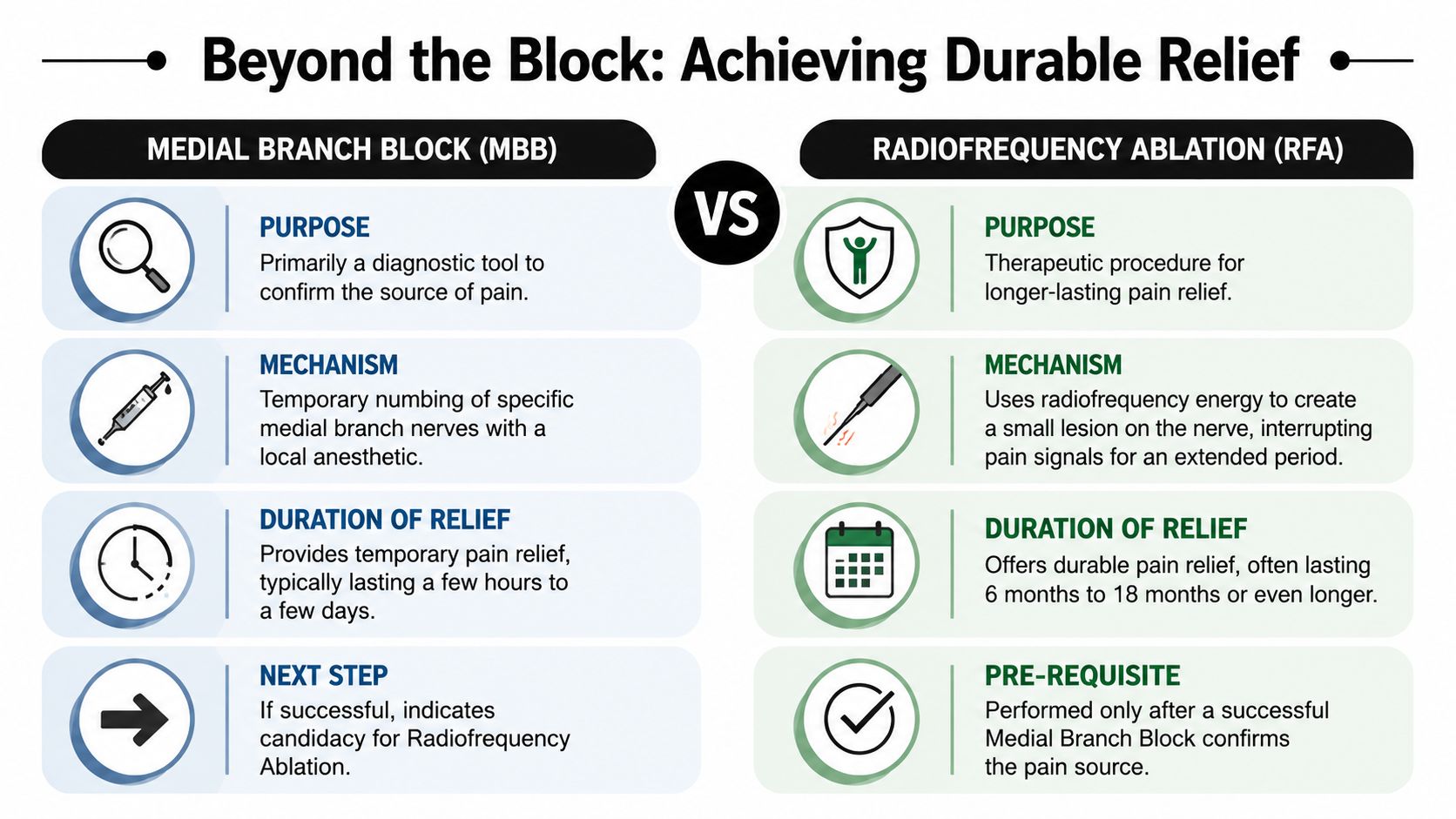
A successful medial branch block is often the doorway to a longer-lasting procedure called radiofrequency ablation, sometimes called radiofrequency neurotomy. The block identifies the right target. RFA then treats that target more durably by interrupting pain signaling from the medial branch nerve for a longer period.
That distinction matters. The block is the test. RFA is the treatment.
For patients considering that next step, this explanation of radiofrequency ablation outlines how heat-based nerve treatment is used in interventional pain care.
How the care pathway usually unfolds
When the diagnostic block gives a clearly positive response, your doctor can discuss whether you're a good candidate for RFA. This step-up approach is one reason MBBs fit so well into an opioid-sparing plan. Rather than adding stronger medication, the care path becomes more targeted.
A verified study on progression through the lumbar medial branch block pathway found that 73% of patients who had a second positive block advanced to radiofrequency neurotomy, as reported in this ScienceDirect publication on progression to RFN.
Why this matters over the long term
Many patient articles stop after describing the injection itself. The more important question is what happens over the next several months.
A practical treatment pathway often includes:
- Diagnostic confirmation first: The block identifies whether facet joints are the likely pain generator.
- Step-up care when appropriate: If the response is clearly positive, RFA may be considered for longer-lasting relief.
- Repeat planning over time: Because nerves can regenerate, future repeat treatment may become part of a long-range plan.
- Function as the target: The goal isn't just a lower pain score. It's better walking, sitting, sleeping, working, and daily activity.
The best use of a medial branch block is not as a one-off event. It's as part of a sequence that helps a patient move from uncertainty to a more durable plan.
This is also where realistic expectations matter. Some patients benefit most from using the block as confirmation before RFA. Others get enough relief from the block itself to pause and reassess. Good pain management isn't rigid. It uses the result to guide the next right decision.
Are You a Good Candidate for This Procedure
A medial branch block makes the most sense when your symptoms suggest facet-mediated neck or back pain, not when the main problem appears to be something else.
You may be a reasonable candidate if your pain is mostly localized in the neck or low back, tends to worsen with twisting or extension, and hasn't responded well enough to conservative care. The evaluation still matters, because several different spine conditions can look similar at first.
Signs that point toward a better fit
Patients are often stronger candidates when they have:
- Chronic axial pain: Pain centered in the neck or back more than the arm or leg
- Mechanical triggers: Symptoms aggravated by leaning back, rotating, or prolonged standing
- Incomplete relief from conservative care: Medications, activity changes, or rehab haven't solved the problem
- A pattern consistent with facet arthropathy: Exam findings and imaging support the diagnosis
For many adults in Bridgeview, Hickory Hills, Burbank, and nearby Illinois communities, that's the point when seeing an interventional pain specialist becomes useful. The visit isn't just about getting an injection. It's about sorting out whether the injection is even the right test.
When a medial branch block may not add much value
This isn't the right procedure for every spine complaint. If pain is mainly driven by a disc herniation, dominant radiculopathy, central spinal stenosis, or a broader neuropathic pain syndrome, an MBB may not answer the right question.
That's why a careful workup comes first.
If the history doesn't fit facet pain, forcing a medial branch block into the plan usually doesn't help the patient. The right procedure starts with the right diagnosis.
A good consultation should leave you with a clear rationale. Why this test. Why now. What result would count as meaningful. And what happens if the block is negative, equivocal, or clearly positive.
What to Expect at Midwest Pain and Wellness
A typical visit starts with a patient from Oak Lawn or Orland Park sitting down and saying, “I need to know what is causing this pain.” That question shapes the entire appointment.
At Midwest Pain & Wellness, the first step is a focused evaluation. We review where the pain sits, what movements bring it on, what treatments you have already tried, and whether your history and imaging fit facet joint pain. The goal is to decide whether a medial branch block is the right diagnostic test for you, not to push you toward an injection that may not answer the problem.
For appropriate candidates, care is image-guided and opioid-sparing. A medial branch block may be one part of a larger plan for chronic neck or back pain, especially when the priority is to identify the pain source clearly and avoid drifting into long-term medication use without a diagnosis.
During and after the visit
Patients usually feel more at ease when they know what to watch for after the procedure. The block itself is brief, but the information you track afterward is what makes the test useful.
The most helpful details are simple:
- What activity usually triggers your usual pain
- Whether that same pain improves after the injection
- How much relief you notice
- How long the relief lasts
We often ask patients to pay close attention to routine activities such as turning the head, standing upright, walking, or getting out of a chair. Specific feedback matters. “I felt a little better” is less useful than “I could stand and walk through the grocery store with much less pain for several hours.”
The care plan after the block
Your next step depends on the result. Clear, meaningful short-term relief supports the diagnosis and may make you a candidate for radiofrequency ablation, which can provide longer-lasting relief. A negative or unclear result still helps, because it tells us to reconsider the pain source and choose a different path.
That is often reassuring for patients in Chicago Ridge, Alsip, Evergreen Park, Palos Heights, Worth, and nearby communities. A well-run medial branch block is not just an injection. It is a decision point in a structured care plan, aimed at better function, a more accurate diagnosis, and less reliance on opioids.