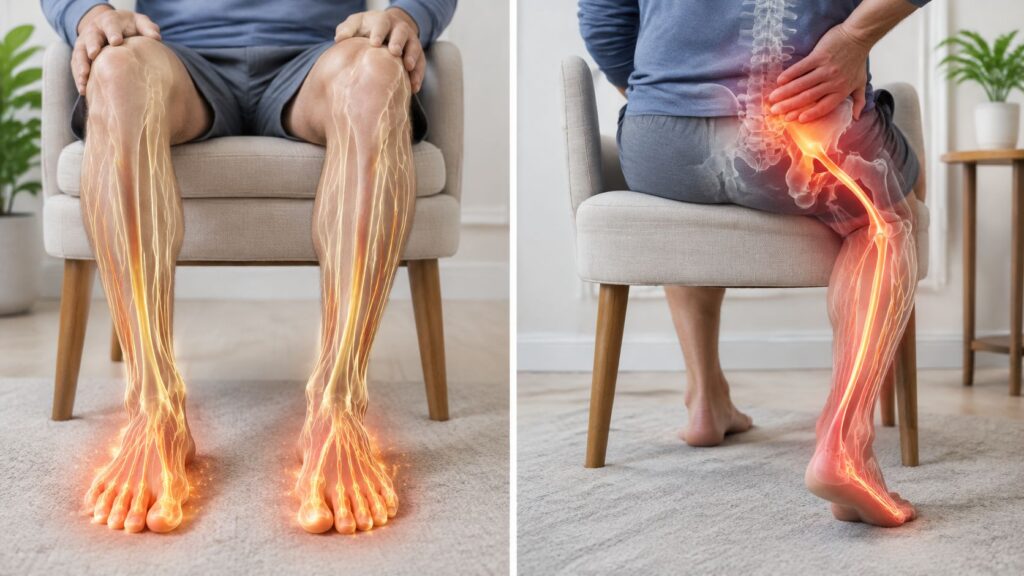
A lot of people type anesthesiologist near me when they're stressed, hurting, and trying to solve a problem fast. Sometimes it's because surgery is coming up and they want to know who will be handling anesthesia. Other times it's because they've had back pain, nerve pain, headaches, or lingering pain after an injury and they assume an anesthesiologist is the right specialist to call.
In the Chicago Ridge area, that search gets even more confusing because nearby options may serve very different roles. A hospital-based anesthesia doctor in Oak Lawn or Orland Park may be exactly right for a procedure day, but not the right office to evaluate chronic neck pain. A pain-focused physician may be the right fit for someone in Palos Hills, Worth, Bridgeview, Hickory Hills, Alsip, Burbank, Evergreen Park, or Palos Heights who needs diagnosis, treatment planning, and ongoing relief.
That distinction saves patients time. It also prevents the common mistake of calling the closest name in a directory and ending up at the wrong type of practice.
Start Your Search Are You Looking for Surgical or Pain Care
If you're searching for an anesthesiologist in Illinois, start with one question.
Do you need anesthesia for an upcoming procedure, or do you need evaluation and treatment for ongoing pain?
That sounds simple, but it changes everything about where you should look, who should refer you, and what kind of appointment you need. Many people assume one anesthesiologist does all of it. In reality, some patients searching for anesthesia care are looking for help with chronic pain, spine pain, nerve pain, or post-surgical pain care rather than operating-room anesthesia, and the specialty scope matters more than distance alone, as outlined by UC Davis Health's overview of anesthesiology and pain medicine.

When the search is really about surgery
If you've been told you need a colonoscopy, orthopedic surgery, a spine procedure, or another operation, you usually won't shop for a standalone anesthesiologist the same way you'd shop for a primary care doctor. In many cases, the hospital or surgery center assigns the anesthesia team based on the facility, your procedure, and the clinicians scheduled there.
That means your practical questions are different:
- Which facility is doing the procedure: The anesthesia team is often tied to that location.
- What kind of anesthesia or sedation is planned: Light sedation, deeper sedation, regional anesthesia, and general anesthesia aren't interchangeable.
- Who handles pre-op concerns: Medication questions, fasting instructions, sleep apnea history, and prior reactions to anesthesia should be reviewed before the procedure day.
When the search is really about pain
If your problem is pain that keeps coming back, limits sleep, makes work harder, or hasn't improved after basic treatment, your search probably isn't for an operating-room anesthesiologist. It's for a pain management anesthesiologist or interventional pain specialist.
That patient often sounds like this:
- Low back pain that's lasted months
- Pain shooting down the leg or into the arm
- Neck pain after a crash or work injury
- Ongoing pain after surgery
- Headaches or nerve pain that keep disrupting daily life
Practical rule: If no surgery is scheduled and the main problem is persistent pain, don't stop at “anesthesiologist.” Look specifically for pain management or interventional pain care.
In the south suburbs, that matters. Someone in Burbank or Evergreen Park may find plenty of nearby physician listings, but the right match depends on whether the doctor's day-to-day work is procedural anesthesia, pain diagnosis, or long-term symptom management.
A simple way to decide
Use this quick filter before you book anything:
- You already have a surgery date. Call the surgeon's office or facility first.
- You have chronic or recurring pain without a surgery date. Look for a pain specialist.
- You had a procedure and now have ongoing pain afterward. A pain clinic may be more useful than a general hospital anesthesia office.
- You aren't sure which one you need. Ask your primary doctor what problem they are referring for: anesthesia clearance, procedural sedation, or pain management consultation.
That first step clears up most of the confusion behind an anesthesiologist near me searches.
Decoding the Credentials Anesthesiologist CRNA and Pain Specialist
Not every clinician involved in anesthesia or pain care has the same training, job description, or clinic role. Patients often hear titles that sound similar and assume they mean the same thing. They don't.
One reason local searches can feel inconsistent is that anesthesia care is delivered by a broader team, not physicians alone. The American Association of Nurse Anesthesiology reports that, as of March 2026, more than 67,000 CRNAs/nurse anesthesiologists were in practice in the U.S. and administered more than 58.5 million anesthetics each year, which is why access in Illinois often depends on both physician anesthesiologists and CRNAs working in hospitals and surgical centers. You can review those figures on the AANA page about becoming a CRNA.
The three roles patients most often encounter
A physician anesthesiologist is a medical doctor focused on anesthesia, perioperative care, critical decision-making around sedation depth, airway management, and safety before, during, and after procedures.
A CRNA is an advanced practice nurse who provides anesthesia care, often as part of a hospital or surgical team. In many real-world settings, patients may interact with both the anesthesiologist and the CRNA.
A pain specialist may also be an anesthesiologist by original training, but the key difference is practice focus. This doctor evaluates pain conditions in clinic, interprets imaging and symptom patterns, and may provide image-guided procedures and longer-term treatment plans outside the operating room.
Provider Comparison Anesthesia and Pain Management Roles
| Provider Type | Training | Primary Role | Common Setting (in IL) |
|---|---|---|---|
| Physician anesthesiologist | Physician training in anesthesiology | Manages anesthesia, sedation, airway, perioperative safety | Hospital, surgery center, procedural suite |
| CRNA | Advanced nursing training in nurse anesthesia | Delivers anesthesia care, often within a team-based model | Hospital, surgery center, procedural suite |
| Board-certified interventional pain specialist | Physician training in anesthesiology or related field with advanced pain-focused specialization | Diagnoses and treats chronic, spine, nerve, joint, and post-surgical pain | Pain clinic, outpatient procedure center, specialty practice |
What this means for patients in the south suburbs
If you live in Palos Hills, Hickory Hills, or Alsip, the title on the directory listing matters less than the actual service you need.
For example:
- A patient having surgery may never need a separate office consultation with an anesthesiologist before choosing a hospital.
- A patient with chronic sciatica usually needs a physician who evaluates pain patterns, reviews prior treatment, and builds a treatment plan over time.
- A patient with severe procedure anxiety may need detailed discussion about sedation safety and who will manage rescue if sedation deepens.
The right question isn't “Which title sounds closest to my problem?” It's “Which provider actually treats this problem in the setting I need?”
A practical reading of credentials
When reviewing a website or referral sheet, look for these signals:
- Procedure-day focus: Terms like perioperative care, surgical anesthesia, labor epidural, hospital privileges, or ambulatory surgery support usually point to surgical anesthesia.
- Clinic-based pain focus: Terms like interventional pain, spine care, nerve pain, joint pain, migraine, injections, radiofrequency ablation, or neuromodulation point to pain management.
- Team-based language: If the office explains who performs anesthesia, who supervises, and where care occurs, that's usually a good sign. Clear roles tend to reflect organized care.
Patients don't need to memorize training pathways. They do need to know whether the person they're calling is set up to solve the problem they have.
How to Find Specialists in Your Illinois Neighborhood
Once you know whether you need surgical anesthesia support or pain care, the search gets more practical. People in Chicago Ridge often start with a map result and stop there. That's understandable, but it's not enough.
Local access depends on more than mileage. A broader review of anesthesia access notes that proximity is not the same as access, because workforce availability, training depth, and equipment infrastructure shape whether a nearby clinician can provide timely and appropriate care. That point is discussed in this review of barriers to safe anesthesia access.
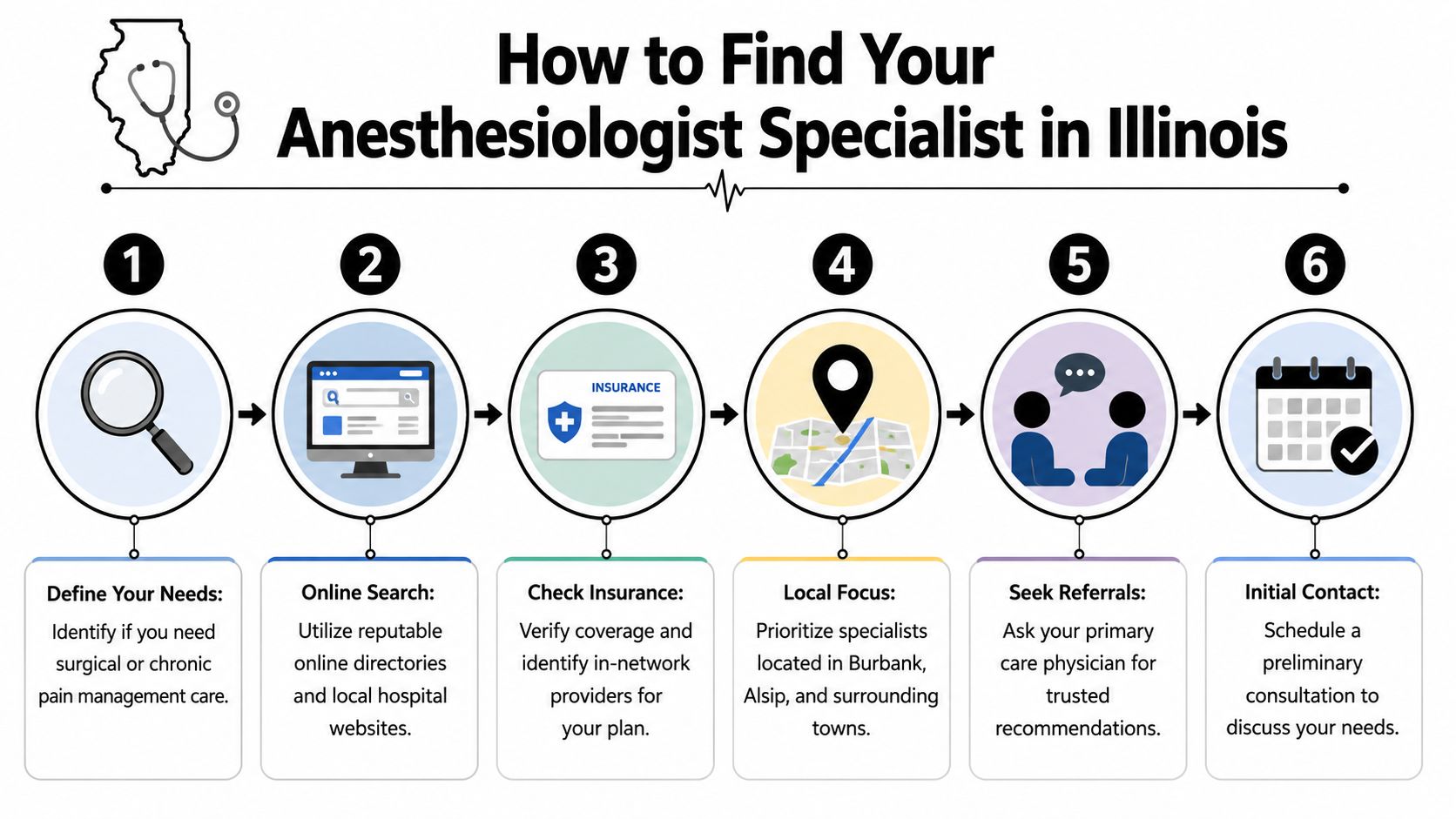
Build your list the right way
Start broad, then narrow.
Use your insurance directory first
This gives you a rough list of in-network names and facilities in Chicago Ridge, Oak Lawn, Palos Heights, Orland Park, and nearby towns. Treat it as a starting point, not a final answer. Directories are often incomplete, outdated, or too vague about specialty scope.Check the facility or clinic type
A hospital-based anesthesia group and a pain clinic may both appear under anesthesiology-related searches. Read the service description carefully. If the listing mostly discusses surgery support, you may be in the wrong lane for chronic pain.Search by condition, not just specialty
“Anesthesiologist near me” is broad. If you have a more specific problem, search the problem itself with your town. Back pain, nerve pain, chronic headaches, post-surgical pain, and spine-related symptoms often lead to more useful results than a generic specialty search.Ask your primary or referring doctor for context
Don't just ask for a name. Ask why they are recommending that type of doctor. If you want extra guidance, this overview on how to find a specialist doctor can help you prepare the right questions before you call.
Focus on Illinois neighborhoods that make sense for you
Patients around Chicago Ridge often search outward in rings. Someone in Worth may look at Oak Lawn first. Someone in Bridgeview may check Burbank or Hickory Hills. Someone in Evergreen Park may compare south suburban options before driving farther.
That approach is reasonable, but use a short filter:
- Driving convenience matters if repeat visits are likely
- Procedure setting matters more if your care may involve sedation or injections
- Scheduling availability matters most when pain is affecting work, sleep, or mobility now
What works and what doesn't
Here's what tends to work well:
- Shortlist a few offices instead of calling one result and hoping it fits
- Confirm the exact services offered before booking
- Ask whether the practice treats your condition routinely
- Verify where procedures are performed
What usually doesn't work:
- Choosing only by zip code
- Assuming every anesthesiology listing offers pain treatment
- Assuming every pain office handles complex spine, nerve, or post-surgical problems
- Waiting until the first visit to ask whether the practice treats your issue
A good search in the south suburbs is targeted. It's not just about who is nearest. It's about who is nearby and equipped to help.
Vetting Your Doctor Key Questions for Your Consultation
Once you've identified the right kind of specialist, the consultation is where you confirm fit. During this meeting, many patients either gain confidence or realize they're in the wrong office.
For local anesthesia-related searches, one of the most useful benchmarks is procedural scope and safety planning. A review on pediatric sedation and analgesia outside the operating room found that anesthesiologist involvement has historically been associated with reduced adverse events, higher success rates, and better image quality, which is why it's worth asking exactly how a clinician manages sedation depth, airway rescue, and complication prevention for your procedure type. The review is available through PubMed Central's article on pediatric sedation and anesthesiologist involvement.
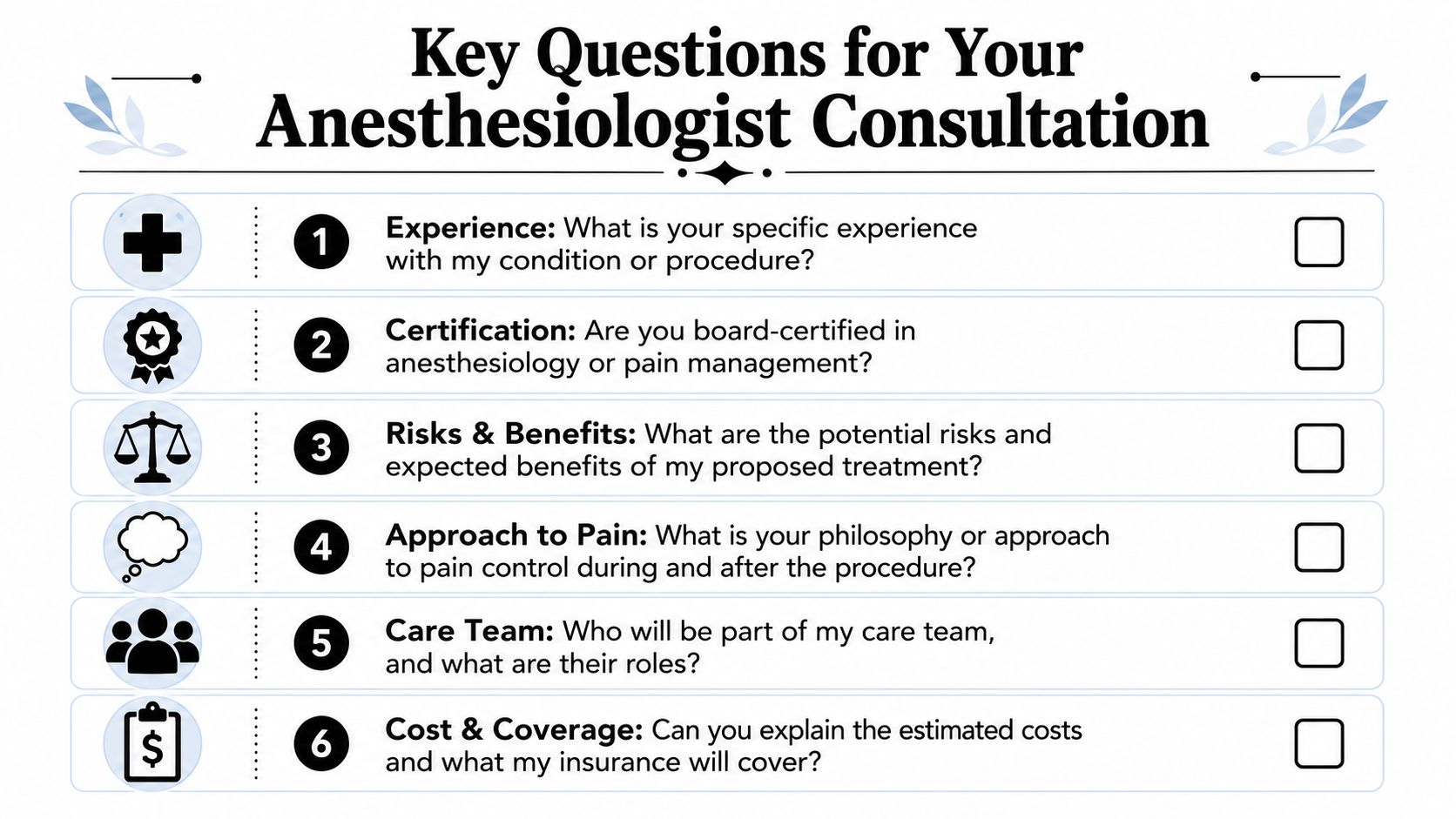
Questions for a surgical anesthesia visit
If you're meeting before a procedure, keep your questions focused and specific.
- Who will be present on the day of my procedure? You want clarity on the care team and roles.
- What type of anesthesia or sedation is planned for me? The answer should fit your procedure and medical history.
- How do you handle airway or breathing issues if sedation becomes deeper than expected? This gets directly into rescue capability.
- What risks matter most in my case? A useful answer is specific to your health, not generic.
- What should I do with my regular medications before surgery? This is especially important for blood thinners, diabetes medications, and sleep-related medications.
Questions for a pain consultation
A pain visit should feel less like a rushed handoff and more like a diagnostic conversation.
Ask things like:
- What do you think is causing my pain?
- Do you treat this condition often?
- What are the non-opioid treatment options you use first?
- If you recommend an injection or procedure, what is it meant to diagnose or treat?
- How will you coordinate with my surgeon, primary doctor, or therapist if needed?
If you want another framework for screening a provider before you commit, this guide on how to know if a pain management Chicago provider is right gives patients a practical checklist.
Ask for the plan in plain language. If you leave the visit only knowing the name of a procedure, you still don't know enough.
What a strong consultation sounds like
Good consultations usually include:
- A clear explanation of diagnosis
- A discussion of alternatives
- Specific safety planning
- Realistic expectations about next steps
Weak consultations often sound vague. If the office can't explain why a treatment fits your symptoms, or can't tell you who will perform it and where, that's a reason to slow down.
You don't need to interrogate the doctor. You do need enough clarity to understand the reasoning, the setting, and the backup plan if the first step doesn't work.
Navigating Insurance Pre-Op Steps and Your First Visit
After you choose the right clinician, the logistical part begins. At this point, patients in Oak Lawn, Worth, or Orland Park often run into avoidable delays.
The first call should cover insurance, location, records, and timing. Don't assume that because a surgeon is in-network, every related clinician or facility will be processed the same way. Don't assume that because a pain clinic accepts your insurance generally, every procedure will follow the same authorization path. Get details early.
If you're headed for surgery
The usual sequence is straightforward, but details matter.
You get the procedure date. The surgeon's office gives instructions or tells you when the anesthesia team will review your case. You may be asked about past anesthesia problems, medication allergies, heart or lung history, sleep apnea, and current prescriptions.
Then come the practical steps:
- Confirm the facility address and arrival time
- Ask about fasting rules and medication holds
- Arrange a driver if sedation is planned
- Clarify when you'll meet the anesthesia team
- Bring a current medication list
A smooth pre-op process usually depends on following instructions exactly. Problems tend to happen when patients keep taking a medication they were told to stop, show up without a ride after sedation, or assume the facility already has every outside record.
If this is your first pain clinic visit
A pain consultation is different. It's not just a procedural appointment. It's an evaluation.
Expect the visit to include a symptom history, discussion of what makes the pain worse or better, review of past treatment, imaging review if available, focused physical examination, and a plan. That plan may include conservative care, a diagnostic step, or an image-guided intervention depending on the pattern of symptoms and prior treatment.
Bring these items if you have them:
- Recent imaging reports
- Operative notes if pain began after surgery
- Medication list
- Prior treatment history
- Workers' compensation or injury claim details if they apply
The first visit goes better when the doctor can see the sequence. When did the pain start, what changed, what was tried, and what happened next?
For injury-related or work-related pain, administrative paperwork often becomes part of care. That doesn't need to be intimidating, but it does mean accuracy matters from the first intake form onward.
When to Choose a Specialized Pain Clinic like Midwest Pain & Wellness
If your search started because of persistent pain, a dedicated pain clinic may be the better fit than a general anesthesia office. That's especially true when the problem is affecting daily function rather than a single upcoming surgery date.
The difference is focus. A surgical anesthesiologist is centered on getting you safely through a procedure. A specialized pain clinic is centered on diagnosing why pain is continuing and choosing the least disruptive treatment that can improve function, reduce flare-ups, and help you move forward.
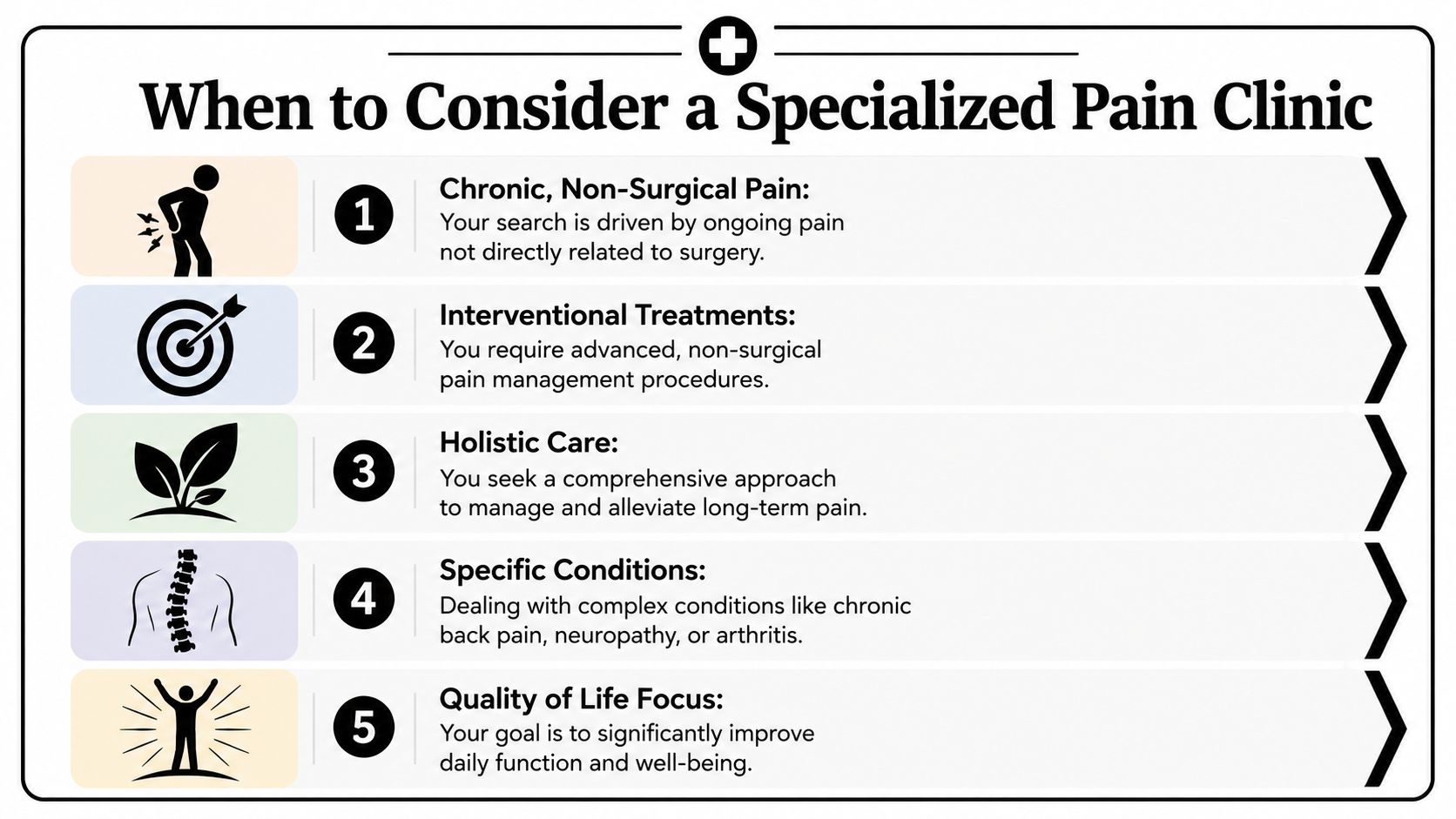
Situations where a pain clinic makes more sense
A specialized pain clinic is often the right next step when:
- Pain has lasted beyond the expected healing window and keeps limiting activity
- Symptoms suggest a spine or nerve source such as radiating pain, numbness, or burning
- Pain continues after surgery or injury and basic measures haven't solved it
- You need targeted procedures rather than another round of general advice
- You want an opioid-sparing plan built around function, not just temporary relief
That's where interventional pain care becomes useful. Depending on the diagnosis, treatment may involve image-guided injections, medial branch blocks, epidural steroid injections, sacroiliac or facet interventions, radiofrequency ablation, spinal cord stimulation, peripheral nerve stimulation, or minimally invasive options for selected spine conditions.
What patients should look for in a dedicated clinic
A strong pain clinic usually does three things well.
First, it identifies the pain generator instead of labeling everything as “inflammation” or “wear and tear.” Second, it offers more than one lane of treatment. Third, it coordinates with other treating clinicians when the case is more complex.
If you're comparing options, look for a clinic that discusses thorough evaluation, image-guided treatment, non-opioid strategies, and functional goals. Patients who want to understand what that model looks like can review an interventional pain management clinic approach.
A simple decision guide
Choose the pain-clinic route when your main question is not “How will I get through surgery?” but “Why am I still hurting, and what can be done now?”
That applies to many patients in Chicago Ridge and nearby communities dealing with:
- back or neck pain
- nerve pain
- post-surgical pain
- joint-related pain
- chronic headaches or related pain conditions
The best choice is the one aligned with the actual problem. If your need is chronic pain evaluation and treatment, a specialized clinic is often the most direct path.
If you're in Chicago Ridge or nearby communities such as Oak Lawn, Palos Hills, Palos Heights, Worth, Bridgeview, Hickory Hills, Alsip, Burbank, Evergreen Park, or Orland Park, Midwest Pain & Wellness offers evaluation and interventional treatment for chronic pain, spine and nerve disorders, post-surgical pain, injury-related pain, and headache conditions. When your search for an anesthesiologist near me is really a search for lasting pain relief, their team can help you identify the right next step.