Seeking Botox for migraine before and after results suggests you're likely not after a beauty treatment. Rather, you're after your life back.
For many people in Chicago Ridge and nearby communities, migraines don't stay contained to a bad afternoon. They spill into workdays, family dinners, school pickups, weekend plans, and sleep. By the time someone starts asking about Botox, they've often already tried to push through, tried to wait it out, and tried to manage with short-term fixes that don't hold.
What matters most is setting the right expectation. Botox for chronic migraine can help, but the before-and-after story usually isn't immediate. The best results often build over time, and understanding that timeline can prevent a lot of frustration early on.
When Chronic Migraines Control Your Life
A parent in Oak Lawn may start the morning hoping this will be a workable day, then feel the familiar pressure build behind one eye before breakfast. By early afternoon, the plan to finish work, pick up groceries, or make it to a school event is gone. By evening, the house is still moving, but they are in a dark room waiting for the pain, nausea, or light sensitivity to ease.
Patients from Oak Lawn to Orland Park describe that same pattern all the time. Life gets organized around the next attack. Rescue medication stays within reach. Commitments start to feel risky. If you are still sorting out whether your symptoms fit migraine or another headache type, this guide on how to identify a migraine is a useful place to start.
More than a headache problem
Chronic migraine changes daily behavior in ways other people often do not see. Patients stop exercising because exertion can trigger pain. They leave events early. They hesitate to drive once visual symptoms or nausea begin. After enough bad months, even a free weekend can feel uncertain.
That loss of reliability is usually what brings someone in for a preventive treatment discussion. The goal is not a dramatic overnight before-and-after moment. The goal is to create more usable days over time, with fewer attacks, lower intensity, and less recovery time after each one.
I tell patients this often. The first Botox treatment is the start of the process, not the final picture. Some people notice an early shift, but the more meaningful "after" result often develops across repeat treatment cycles. For patients in the southwest suburbs who are trying to keep up with work, family, and commuting, that long-view matters. It keeps early improvement from being dismissed as too small, and it prevents the wrong conclusion if month one is only modestly better.
For the right patient, Botox becomes part of a broader chronic migraine plan. The change can be quiet at first. A more dependable morning. Fewer cancelled plans in Orland Park. Less time spent recovering in bed after pushing through a workday. Those gains matter, and they tend to build.
Are You a Candidate for Migraine Botox Treatment
The main question isn't whether migraines are painful enough. The main question is whether they meet the pattern Botox is designed to treat.

The patients Botox is meant for
Botox is approved for chronic migraine, not occasional migraine and not every recurring headache disorder. In practice, the right candidate is someone whose headaches happen frequently enough that prevention makes sense as an ongoing strategy.
Patients who usually fit this path often have several features in common:
- Headaches happen often: They deal with headache days so frequently that the condition affects work, family responsibilities, and sleep.
- Migraine features are present: Light sensitivity, sound sensitivity, nausea, throbbing pain, or one-sided pain may be part of the pattern.
- Short-term treatment isn't enough: Rescue medication may help some attacks, but it doesn't prevent the next week from looking the same.
- They need prevention, not just reaction: The treatment goal shifts from surviving attacks to reducing how often attacks happen.
Why episodic migraine is different
Someone in Palos Heights or Hickory Hills who gets migraines once in a while may still suffer a great deal, but that doesn't automatically make Botox the right choice. Preventive Botox is used for a clearly defined chronic migraine population. If headache frequency is lower or the diagnosis is less clear, a different plan may fit better.
That distinction matters because the treatment schedule is structured. Botox is typically repeated on a maintenance cycle rather than used as a one-time rescue option.
Clinical reality: A strong candidate for Botox usually has a long history of trying to manage migraines before moving to a procedural preventive treatment.
Questions that help you self-assess
To help you assess your situation, these are the questions I want patients to think about before their visit:
- How many days each month does headache affect me?
- Am I missing work, family events, or routine tasks because of it?
- Do my headaches have migraine features rather than simple tension pain?
- Have I reached the point where prevention matters more than just temporary relief?
A consultation then sorts out the rest. The diagnosis has to be accurate. The headache pattern has to fit. Your medical history, prior treatments, and treatment goals all matter. Botox is a targeted option, but only when the problem being treated is chronic migraine.
Your Botox Treatment Process Step by Step
A patient from Oak Lawn or Orland Park often comes in hoping one treatment will flip the switch. Chronic migraine treatment rarely works that way. Botox is a scheduled preventive treatment, and the long-term result depends as much on staying with the plan as it does on the first injection day.
Step one is confirming the diagnosis
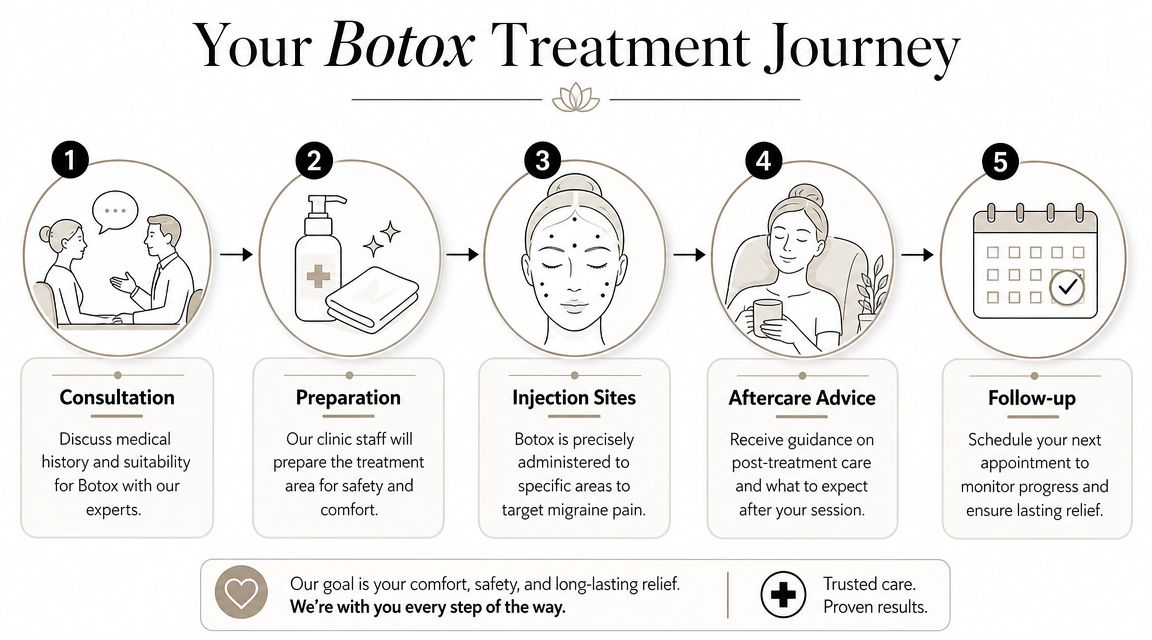
The first visit is about accuracy. Chronic migraine can overlap with cervicogenic headache, occipital nerve irritation, jaw tension, and upper neck pain. If those problems are driving the symptoms, the plan may need more than Botox or a different treatment entirely.
I also review what has already been tried, what caused side effects, and how many days each month are being lost to headache. That history matters because Botox is used as preventive care, not as a same-day rescue treatment.
Step two is planning the injection session
Once Botox is a reasonable fit, the treatment plan is built around repeat visits, usually on a 12-week cycle. The injections follow a standardized pattern across specific muscle groups in the head, neck, and shoulder region, with adjustments when the clinical picture supports them.
Patients often do better when they understand the schedule upfront. The first session starts the process. It does not define the final outcome.
If you want a practical preview of the appointment itself, this guide on what happens during your Botox treatment walks through the visit in plain language.
Step three is the procedure itself
The procedure is brief and done in the office. Small injections are placed at measured sites rather than only where pain is worst that day. That difference is important because migraine Botox follows a prevention protocol, not a pain-chasing approach.
During the visit, patients are usually seated comfortably, the needle used is very small, and there is no extended recovery period. Many people return to work, drive home, or continue with a normal day afterward.
Step four is tracking the early response
This is the step patients underestimate.
Some notice change within the first few weeks. Others feel little after the first round and assume it did not work. In practice, I advise patients to judge response across treatment cycles, not by one early checkpoint. The more useful question is whether the monthly burden starts to trend down over time.
Track the response in concrete terms:
- Headache days per month
- Migraine intensity
- Rescue medication use
- Missed work, school, or family activities
- Whether attacks feel easier to recover from
A simple migraine diary helps. Patients who keep good records usually make better treatment decisions because they can see gradual improvement that is easy to miss week to week.
Step five is staying on schedule
The long-term "after" picture comes from consistency. Patients who benefit from Botox usually stay close to the treatment interval instead of waiting until headaches are back at full force. Delaying too long can make it harder to tell whether the treatment is helping and can let the migraine pattern build up again.
That matters for busy patients in Chicago's southwest suburbs, where commuting, work schedules, and family logistics can push follow-up care aside. If you live in Oak Lawn, Orland Park, Chicago Ridge, or nearby communities, plan the next visit before you leave the office. That simple step often makes the difference between a partial trial and a fair trial.
Realistic Botox for Migraine Before and After Results
A patient from Oak Lawn or Orland Park often comes in after the first round and asks a fair question: “If this is going to work, shouldn't I know by now?” My answer is usually no. Migraine Botox is judged over time, not by one early snapshot.
What the data shows
The practical before-and-after picture is a drop in monthly burden. That may mean fewer headache days, less severe attacks, fewer recovery days, or less reliance on rescue medication. In clinical trials, patients receiving Botox for chronic migraine had an average of 8 to 9 fewer headache days per month, according to the chronic migraine efficacy summary and review data discussed in this publication.
That is the result patients feel in daily life. They miss fewer shifts. They cancel fewer plans. They get more usable days back.
Why the first treatment is rarely the final answer
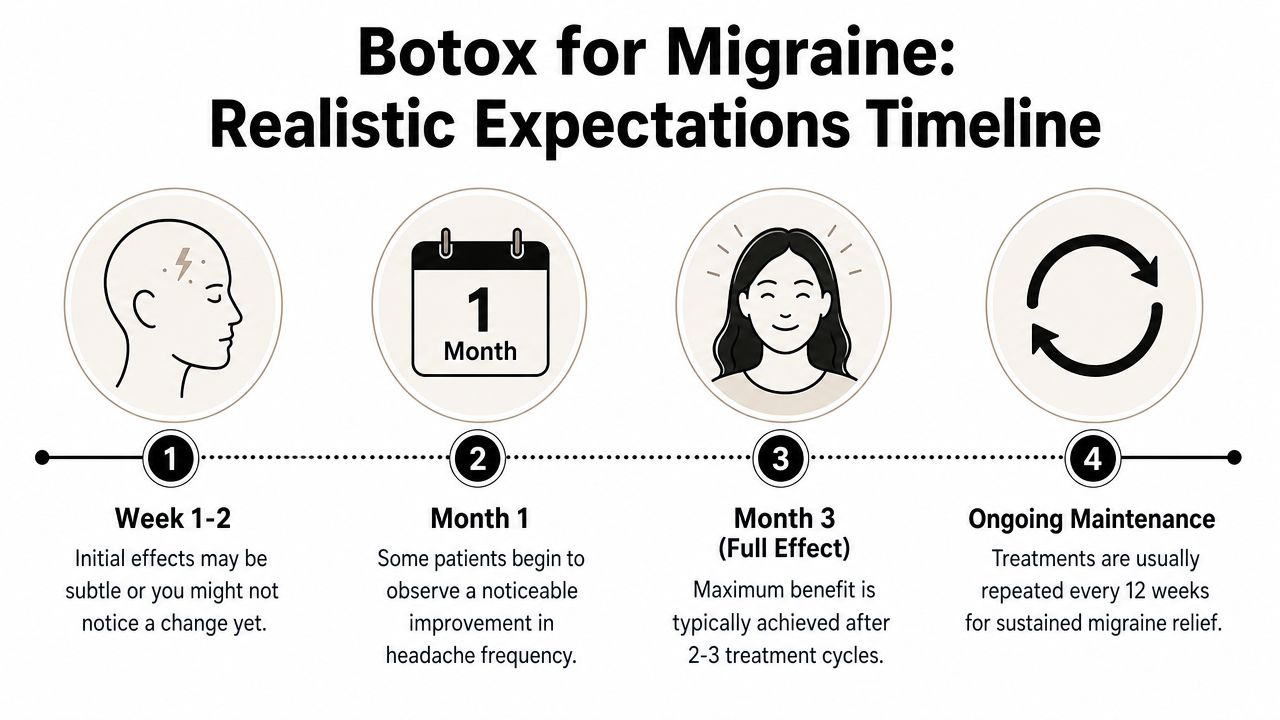
The first cycle can help, but it often does not show the full value of treatment. Some patients notice improvement within weeks. Others feel only a modest change after the first round and see clearer benefit after later cycles.
Chronic migraine is a pattern, not a single event, so Botox works best when it is given on schedule and judged across repeated treatments. In practice, the long-term “after” picture is often more meaningful than the early one.
I tell patients to look for trend lines:
- Fewer headache days across the month
- Less severe flares
- Lower use of rescue medication
- Faster recovery after an attack
- More confidence making work, family, and social plans
A patient who starts with very frequent migraines may still have headaches after treatment. That does not mean the treatment failed. If the headaches are less frequent, easier to manage, and less disruptive, that is real progress.
What meaningful improvement looks like over time
A strong result is usually functional before it is dramatic. Patients may not describe a perfect “after.” They often describe a life that is more manageable.
| Before treatment | After treatment over time |
|---|---|
| Headaches control much of the month | More headache-free or lower-burden days |
| Work and family plans are hard to trust | Daily life becomes more predictable |
| Rescue medication is used often | Short-term medication may be needed less |
| Recovery days stack up | Patients bounce back faster between attacks |
For many people in the southwest suburbs, that change is the primary goal. Getting through a commute from Orland Park. Finishing a workweek in Oak Lawn without losing multiple days. Making plans in Evergreen Park and feeling reasonably confident you can keep them.
That is a better standard than asking whether every migraine disappears.
Improvement is not only about headache counts
The same review also noted better disability-related outcomes over longer follow-up. Patients often report that they function better even before they describe a dramatic change in headache numbers.
That may look like:
- Less interruption to work or school
- More stamina during the day
- Less fear about the next attack
- Better quality of life across repeated cycles
There is also a narrower surgical use case. A positive Botox response before migraine decompression surgery has been associated with better later surgical outcomes in selected patients, as described in the report on preoperative Botox response and migraine surgery outcomes. That does not apply to every patient with chronic migraine, but it supports an important point. Response to Botox can provide useful clinical information, not just symptom relief.
For patients in Chicago's southwest suburbs, the main takeaway is simple. Judge Botox by the direction of your month, not by one good day or one bad week. The best “after” result is usually cumulative.
Managing Aftercare and Potential Side Effects
The hours and days after treatment are usually uncomplicated, but patients do better when they know what's normal.
Some people experience a migraine attack on the day of treatment. Others notice temporary neck pain, bruising, tenderness, muscle weakness, or drooping around the brow or eyelid area. Cleveland Clinic's patient guidance notes that these effects are usually temporary and often resolve within days to weeks in its overview of Botox treatment for migraines.
What can feel normal after treatment
Not every symptom after injections means something is wrong. The procedure itself can leave the treated areas feeling sore or tight for a short time.
Common early experiences include:
- Injection-site tenderness: Mild soreness or bruising where the medication was placed
- Neck or shoulder discomfort: Usually temporary and mechanical in nature
- A same-day migraine flare: Frustrating, but it can happen
- A heavy or unusual feeling in treated muscles: Often settles as the body adjusts
What helps during the first day or two
Keep the aftercare practical. Most patients do well with simple common-sense measures rather than complicated restrictions.
A reasonable approach includes:
- Take it easy for the rest of the day. Don't make treatment day your yard-work day or your heavy workout day.
- Pay attention to new symptoms without panicking. Mild soreness is one thing. Progressive weakness or symptoms that feel clearly wrong deserve a call.
- Track your headaches. A calendar or app is useful because memory gets unreliable when you're trying to judge improvement over time.
- Stay on your follow-up plan. One uncomfortable day doesn't predict the long-term result.
A temporary rough patch right after injections doesn't mean Botox won't help. Early discomfort and long-term benefit are not the same thing.
When to contact the clinic
Call if symptoms feel more intense than expected, last longer than seems reasonable, or interfere with swallowing, vision, or normal function in a way that concerns you. Patients don't need to self-diagnose every post-treatment sensation. They do need clear communication when something feels outside the usual pattern.
How Botox Compares to Other Migraine Treatments
Botox sits in the preventive category. That alone makes it different from treatments patients take only when an attack starts.
Where it fits in the treatment landscape
Oral preventive medications can be helpful for some patients, but they may bring side effects, require daily use, or fail to reduce migraine burden enough. Other preventive options also exist, and each has its own strengths, limits, cost issues, and practical considerations.
Botox stands out when the goal is a targeted procedural option for chronic migraine rather than another daily medication. It also fits well in an opioid-sparing pain management model, where the focus stays on reducing the migraine burden instead of masking it with habit-forming medication.
What tends to work well with Botox
Botox is often most useful when it is part of a broader plan, not the entire plan by itself.
That broader plan may include:
- Headache tracking: So treatment decisions are based on patterns rather than guesswork
- Trigger management: Sleep, hydration, stress, and routine still matter
- Rescue medication strategy: Acute treatment remains important even when prevention improves
- Coordinated specialty care: Some patients need overlap between headache care, neck pain evaluation, and interventional treatment
If you want a simple explanation of the mechanism, this overview of how Botox works gives helpful background without overstating what treatment can do.
For patients in Illinois who have frequent migraines and want an interventional, non-opioid option, Midwest Pain & Wellness is one practice that includes Botox for chronic migraine within a broader pain management approach.
Take Your Next Step at Midwest Pain and Wellness
If migraines are controlling your calendar in Bridgeview, Evergreen Park, Oak Lawn, Orland Park, Worth, Alsip, Palos Hills, Hickory Hills, Burbank, or Palos Heights, the next step is a proper evaluation. The key question isn't whether you've suffered enough. It's whether your headache pattern matches chronic migraine and whether Botox belongs in your treatment plan.
Dr. Yaw Donkoh is a double board-certified interventional pain specialist, and that matters because migraine patients often have more than one pain generator. Some need straightforward chronic migraine prevention. Others need a broader workup to separate migraine from overlapping neck, nerve, or musculoskeletal pain.
A good consultation should answer practical questions quickly:
- Does this look like chronic migraine?
- Is Botox appropriate for my pattern of symptoms?
- What should I expect after the first treatment and after later rounds?
- How will progress be measured?
Patients do best when they start with clear expectations and a treatment plan built around function, not hype. If your headaches have become frequent enough that you're planning life around them, it's time to get evaluated rather than continuing to guess.
Frequently Asked Questions About Migraine Botox
What if Botox doesn't work after the first round
That happens more often than patients expect, and it doesn't automatically mean the treatment has failed. Real-world guidance emphasizes that benefits are cumulative, and many patients see the full effect after 2 to 3 treatment cycles spaced 12 weeks apart, as described in this patient-focused review of after-Botox migraine results. The right response is usually to review the headache diary, assess whether there has been any early shift in frequency or intensity, and decide whether continuing the planned series makes sense.
Are the injections painful
Most patients say the injections are tolerable. The needle is small, the injections are quick, and the appointment is brief. People who are anxious about procedures often imagine something much more intense than what happens.
Is this the same as cosmetic Botox
No. The medication is the same type of product, but the goal, dosing pattern, and injection sites are different. Migraine Botox is a medical preventive treatment for chronic migraine, not a wrinkle treatment performed for appearance.
Will Botox cure my migraines
No preventive treatment should be framed that way. The primary goal is reducing frequency, severity, and disruption. For many patients, success means more functional days and fewer headache-heavy weeks, not complete elimination of every attack.
Can Botox make migraines worse before they get better
It can. Some patients have a migraine on treatment day or feel temporarily worse before the longer-term effect settles in. That's one reason early expectations need to be grounded in the full treatment timeline rather than the first few days after injections.
How should I judge whether it's helping
Use a headache diary and track real-life function. Count headache days, note how severe they are, and pay attention to whether you need rescue medication less often or can keep more of your normal routine. Vague impressions can be misleading. Patterns over time are much more reliable.
Is Botox only for severe cases
It's more accurate to say it's for the right pattern of migraine. Severity matters, but frequency and diagnosis matter more. A patient with chronic migraine who is losing a large part of each month to headaches is very different from a patient with occasional migraine attacks.
If frequent migraines are limiting your life in Chicago Ridge or the surrounding southwest suburbs, schedule an evaluation with Midwest Pain & Wellness. A careful assessment can clarify whether Botox fits your diagnosis, what kind of improvement is realistic, and how to build a treatment plan focused on fewer migraine days and better function.