Epidural steroid injections for chronic pain usually last from several weeks to over a year, with peak effectiveness often in the six to 12 month range. A labor epidural is completely different. It lasts through childbirth while medication is topped off, then the numbness usually wears off within a few hours after delivery.
If you're reading this in Palos Hills, Oak Lawn, Orland Park, or nearby communities around Chicago Ridge, you're probably not asking an academic question. You're asking because your back or leg pain keeps interrupting sleep, work, errands, driving, or even simple things like standing at the kitchen counter. You want to know whether an epidural will help, how fast it works, and whether it's worth doing if you're trying to avoid opioids and stay active.
The first important point is simple. When people ask, "How long epidural lasts?", they may be talking about two very different treatments. One is used for labor anesthesia. The other is an epidural steroid injection, which pain specialists use to calm inflamed spinal nerves and improve function in conditions like sciatica, disc herniation, and spinal stenosis.
Understanding Your Epidural Options in Illinois
Chronic spine pain rarely stays in one lane. It starts as back pain, then becomes leg pain, numbness, poor sleep, missed exercise, and a shorter temper because you're hurting all day. Many patients from Palos Heights, Worth, Bridgeview, and Hickory Hills reach the point where home remedies and oral medication just aren't enough.
That is usually when the epidural question comes up. But the answer depends entirely on which epidural you mean.
Two treatments share the same word
A labor epidural is designed to block pain during childbirth. An epidural steroid injection is designed to treat inflammation around spinal nerves. Both involve the epidural space, but they don't serve the same purpose, don't use the same medication mix, and don't have the same expected timeline.
For people dealing with chronic neck, back, or radiating arm and leg pain in Illinois, the relevant procedure is usually the therapeutic pain-management version. If you'd like to see where this fits among other interventional options, review these pain treatment procedures used in clinical care.
The best results come when the diagnosis is correct first. An epidural isn't a general reset button for every kind of back pain.
What most patients actually want to know
In practical terms, patients usually ask four things:
- How quickly will I feel anything
- How long will the benefit last
- Will it help me move better, sleep better, and do more
- What happens if the effect fades
Those are the right questions. An epidural steroid injection isn't meant to be a magic trick. It's a targeted way to reduce inflammation so you can function better, participate in rehab when appropriate, and avoid relying on opioids as the main long-term strategy.
Epidural for Pain Management vs Labor Anesthesia
The confusion around epidurals is common because the name sounds the same. The actual purpose is not.
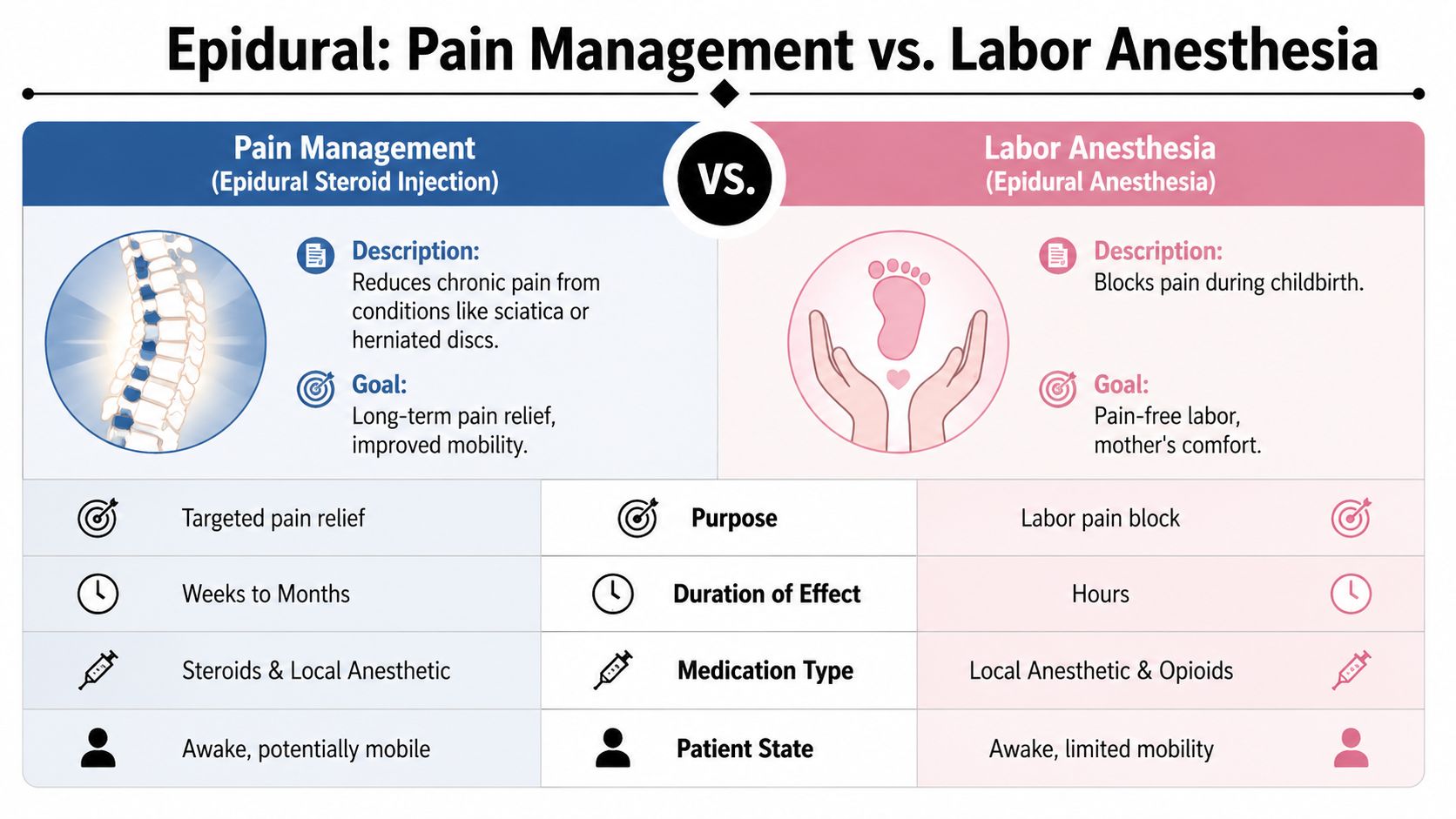
A labor epidural is built for temporary anesthesia during childbirth. An epidural steroid injection is a treatment for inflamed spinal nerves and pain that may be traveling into the arm or leg. One blocks pain signals for a specific event. The other tries to calm the irritated tissue causing the pain in the first place.
Same location, different mission
I often explain it this way. A labor epidural acts like a temporary soundproof wall. It reduces what the body feels during labor. An epidural steroid injection acts more like a targeted anti-inflammatory treatment sent to the exact area where the nerve is irritated.
That distinction matters because patients with chronic pain need realistic expectations. If you're being treated for sciatica or lumbar radiculopathy, you aren't looking for a few numb hours. You're looking for meaningful relief that supports walking, sitting, sleeping, and returning to daily life.
People exploring their diagnosis can compare common spine and nerve conditions treated in pain management to better understand where an epidural steroid injection fits.
Side by side comparison
| Feature | Epidural Steroid Injection (For Pain) | Labor Epidural (For Anesthesia) |
|---|---|---|
| Primary purpose | Reduce inflammation and nerve irritation | Control pain during childbirth |
| Main goal | Improve function and reduce chronic or radiating pain | Provide comfort through labor and delivery |
| How long it lasts | Often weeks to months, depending on the condition and response | Relief begins in 10 to 30 minutes and continues through labor as medication is topped off. After delivery, numbness from a single injection wears off in a few hours according to Cleveland Clinic's epidural overview |
| What the patient feels | Usually not full numbness. The aim is pain reduction | Marked numbness and reduced labor pain |
| Best use case | Herniated disc, sciatica, stenosis, nerve root irritation | Childbirth |
A labor epidural is not a benchmark for what to expect from a pain clinic epidural. They solve different problems.
Why this distinction helps
Patients make better decisions when they stop lumping all epidurals together. If you're in Burbank, Alsip, Evergreen Park, or nearby and considering treatment for chronic back or leg pain, the useful question isn't just "how long does an epidural last?" It's "how long does an epidural steroid injection for my diagnosis last, and what can I do with that window of relief?"
The Timeline of Relief from an Epidural Steroid Injection
A common Palos Hills area scenario goes like this. A patient gets an injection, feels somewhat better that afternoon, then worries the next day when the pain starts to creep back. That early change can be real, but it is often from the numbing medicine, not the steroid itself.

What happens first
Most epidural steroid injections include a local anesthetic and a steroid. The anesthetic may calm pain within hours, but that effect is short-lived. In clinic, I tell patients from Chicago Ridge, Oak Lawn, and Orland Park not to judge the procedure by the first evening alone.
The steroid portion works on inflammation, and inflammation settles more slowly.
What happens over the next several days
According to MedlinePlus guidance on epidural injections, pain may briefly increase for a few days after the procedure before improvement begins. That pattern surprises patients, but it is well within the range of normal. Some people improve within several days. Others need closer to one to two weeks before they can tell the injection is helping in a meaningful way.
That delayed response matters because the goal is not a few numb hours. The goal is lower nerve irritation so walking, sleeping, sitting, driving, and physical therapy become more manageable.
How long relief may last
There is no honest single number for every patient. Relief can last for weeks or for several months, depending on the diagnosis, how long the nerve has been inflamed, and whether the pain generator was accurately targeted.
In practice, the better question is whether the injection creates a useful treatment window.
If it does, patients often use that period to restart exercise, tolerate therapy, improve sleep, and cut back on medications that carry more risk. That is a major part of our opioid-sparing approach. An epidural is rarely the whole plan. It is often the step that makes the rest of the plan possible.
What meaningful improvement looks like
Useful relief usually shows up in daily function, not just on a pain score. Examples include:
- Walking farther before leg pain forces a stop
- Sleeping with fewer wake-ups from sciatica
- Sitting through work or a car ride with less radiating pain
- Getting back into home exercise or formal rehabilitation
- Relying less on short-term pain medication
For many patients, that is a successful result even if some pain remains.
A practical timeline to use at home
Day of procedure
Temporary relief may come from the local anesthetic.First few days
Pain may stay the same, improve unevenly, or even flare briefly.Several days to two weeks
This is the usual window when steroid benefit becomes easier to judge.After that
If the injection helped, the benefit may continue for weeks or months and gives us time to build strength, restore mobility, and keep care focused on function instead of opioids.
Patients who want a clearer sense of how this can play out in real life can review these patient experiences with pain treatment over time.
Key Factors That Influence How Long Your Relief Lasts
Two people can have the same procedure and get very different results. That doesn't always mean one injection was done well and the other wasn't. It usually means the underlying problem, the medication choice, and patient-specific variables are different.

Diagnosis drives durability
Sciatica from a disc herniation behaves differently than pain from spinal stenosis or post-surgical irritation. The injection works best when the pain pattern, exam, and imaging all point to an inflamed nerve root that can be reached and treated.
If the main problem is mechanical instability or a pain generator outside the epidural space, an ESI may help less or help for a shorter period. That isn't failure. It's information.
Steroid choice matters
According to this overview of epidural steroid medication differences, particulate steroids such as methylprednisolone acetate can provide 6 to 12 months of relief, while soluble steroids such as dexamethasone may offer 1 to 3 months. The same source notes that some patients experience a temporary steroid flare with increased pain for 24 to 48 hours before the anti-inflammatory effect takes hold.
That doesn't mean one option is always better than the other. The choice depends on anatomy, safety considerations, and the treatment goal.
Technique and aftercare change the outcome
Precision matters. In pain medicine, image guidance is not a cosmetic extra. It's how the clinician confirms placement and delivers medication where it has the best chance to help.
Patients also affect the result more than they may realize. What tends to help:
- Follow discharge instructions so early irritation doesn't get amplified by overactivity
- Use the relief window productively by resuming guided movement or rehab when appropriate
- Track pain by function instead of only by a number on a scale
- Report partial benefit clearly because that can guide the next step
Practical rule: If pain changes location, intensity, or pattern after an injection, tell your specialist exactly what changed. That detail often matters more than saying it "helped a little."
What doesn't work is expecting the procedure alone to carry the full burden of long-term recovery while everything else stays the same. In most chronic pain cases, the injection opens the door. It doesn't walk you through it by itself.
Your Epidural Journey at Midwest Pain & Wellness
A patient from Oak Lawn or Palos Heights usually doesn't arrive saying, "I need an epidural steroid injection." They come in saying their pain shoots down the leg, sitting is miserable, sleep is broken, and they want a plan that doesn't revolve around opioids.
That starting point matters. Good pain care begins with identifying the pain generator, not rushing to a procedure because the MRI mentions disc disease.
Step one is the consultation
At the first visit, the specialist reviews symptoms, prior treatment, imaging when available, and the functional losses that matter most to you. For one person, that may be trouble climbing stairs in Worth. For another, it may be not being able to drive from Bridgeview to work without severe leg pain.
The discussion should stay practical:
- Where is the pain traveling
- Is there numbness or tingling
- Does coughing, standing, walking, or bending worsen it
- What has already been tried
- What activity do you want back first
What the procedure day usually feels like
When an epidural steroid injection is appropriate, the procedure is typically done as an outpatient intervention. The focus is safety, efficiency, and precise delivery into the epidural space using image guidance.
Most patients describe the day as much less dramatic than they feared. There may be pressure, some procedural discomfort, and then a short recovery period. The bigger issue is usually expectation management. Many people want to know right away if it "worked," when the better answer is to monitor how pain and function change over the following days.
Relief is most useful when it translates into action. Better sleep, longer walks, easier sitting, and less reliance on opioid medication are the outcomes that count.
Care doesn't stop after the injection
An injection by itself is rarely the whole plan. Patients from Hickory Hills, Alsip, and nearby communities often do best when the pain specialist coordinates with other treating clinicians, which may include a primary care physician, surgeon, chiropractor, or rehabilitation provider.
That kind of multimodal plan is what stretches the value of the injection. Once pain settles enough, the next step is to protect that gain. That may involve targeted exercise, movement retraining, work restrictions for a period, or a different procedure if the first intervention provides useful but incomplete information.
An opioid-sparing philosophy becomes real. Instead of increasing medication every time pain flares, the plan uses diagnosis, image-guided treatment, follow-up, and function-based reassessment to keep moving toward durable relief.
Alternatives and Next Steps When an Epidural Wears Off
A fading epidural does not mean the treatment failed. In clinic, I often see patients from Chicago Ridge, Oak Lawn, and Orland Park who got enough relief to sleep better, walk farther, or sit through work again, but then notice the benefit taper off. That pattern still gives us useful information and a clear next step.
Repeat injection or change strategy
The decision starts with two questions. How much function came back, and for how long?
If an injection gave meaningful relief and improved daily activity, a repeat epidural may be reasonable. If the benefit was brief, partial, or absent, repeating the same procedure without rethinking the diagnosis usually adds little. Insurers and pain practices commonly place limits on how often epidural steroid injections are done, and the American Society of Interventional Pain Physicians outlines frequency guidance to balance benefit with steroid exposure and procedure risk in its epidural intervention recommendations.
Those are guardrails. They are not a preset series for every patient.
A person with a clear lumbar disc herniation and leg pain may be a good candidate for another injection. A person whose pain pattern has shifted to facet joints, sacroiliac dysfunction, or spinal instability usually needs a different plan.
The injection also helps refine the diagnosis
Response matters diagnostically. Strong but temporary relief can support the idea that inflamed nerve tissue is part of the problem. Little to no relief may point us toward another pain generator, another level in the spine, or a condition that will respond better to a different procedure or surgical opinion.
That is why I review more than a pain score at follow-up. I want to know whether getting in and out of the car improved, whether standing at the kitchen counter became easier, and whether opioid use dropped. Those details tell us what the injection changed.
Other opioid-sparing options
When an epidural no longer gives enough benefit, the next step depends on the structure causing pain. Options in a specialized pain clinic may include:
- Radiofrequency ablation for pain coming from arthritic facet joints
- Minimally invasive lumbar decompression or interspinous spacer procedures for selected spinal stenosis cases
- Spinal cord stimulation for certain cases of persistent nerve pain, including some post-surgical pain syndromes
- Targeted diagnostic blocks or other image-guided injections to identify and treat a different pain source
The goal stays the same. Reduce pain enough to restore movement and daily function, while avoiding an automatic drift toward stronger opioid medication.
For many patients in the Palos Hills area, the best results come from combining the temporary window of relief with physical therapy, home exercise, weight management when relevant, and careful follow-up. That multimodal approach often extends the value of an injection better than repeating procedures alone.
Frequently Asked Questions About Epidural Injections
Will the injection itself hurt
Most patients feel pressure more than sharp pain, though some brief discomfort can happen. The procedure is designed to be tolerable, and the team talks you through it.
What are common short-term side effects
Soreness at the injection site can happen. Some patients also notice a temporary pain flare before the steroid starts helping. As noted earlier, that flare can last 24 to 48 hours.
Can I drive myself home
That depends on the medication used, how you feel afterward, and your clinic's instructions. Many patients arrange a driver because short-term numbness, soreness, or procedural medication can make driving a poor choice.
How will I know whether it worked
Judge it by function, not just a pain score. Are you sleeping better, walking farther, sitting longer, or using less rescue medication? Those are the changes that matter.
Is an epidural meant to replace everything else
No. It works best as one part of an opioid-sparing plan focused on restoring function. If you expect the injection to do all the work while activity patterns and the broader treatment plan stay unchanged, results are usually less durable.
If you're dealing with ongoing back, neck, or radiating nerve pain in Chicago Ridge, Palos Hills, Oak Lawn, Palos Heights, Worth, Bridgeview, Hickory Hills, Alsip, Burbank, Evergreen Park, or Orland Park, Midwest Pain & Wellness offers evaluation and interventional pain care built around accurate diagnosis, image-guided treatment, and a clear opioid-sparing plan to help you move better and function more comfortably.