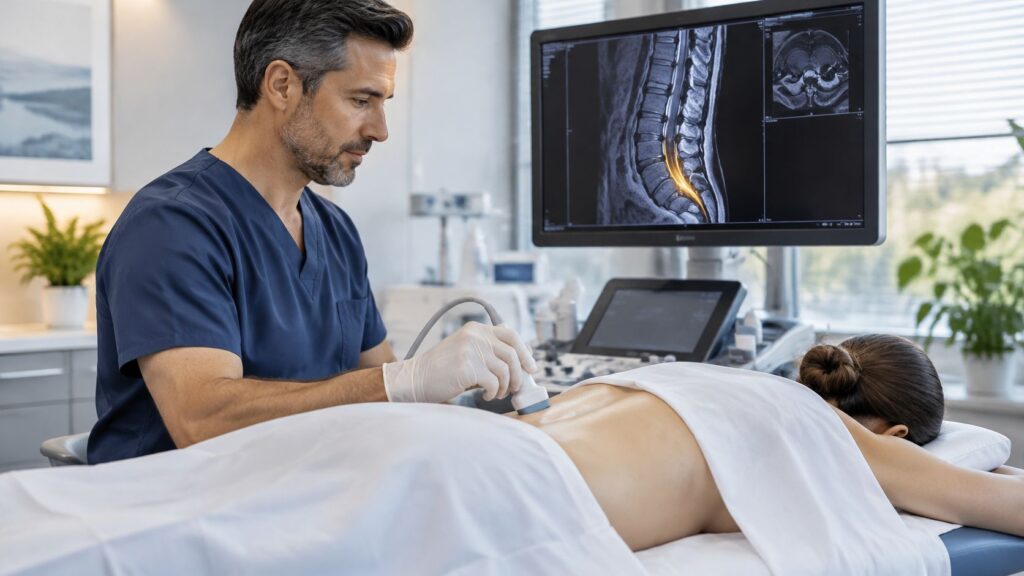
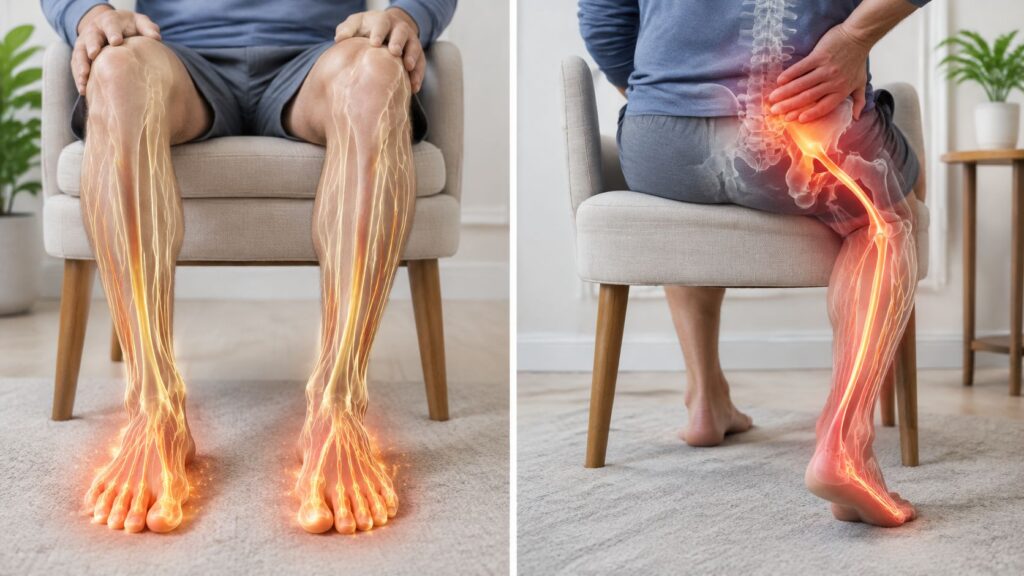
If you've started planning your day around places to sit down, you're not alone. Many people with lumbar spinal stenosis describe the same pattern. They can stand for only a few minutes, walking gets heavy or burning in the buttocks and legs, and leaning forward on a counter, cart, or walker brings relief.
That pattern matters because it points to a problem that's often treatable. The goal isn't merely to “cover up” pain. Instead, the goal is to identify what's being compressed, what symptoms are coming from stenosis, and which treatment fits the stage of disease you're in right now.
For patients across the Chicago Southland, including Oak Lawn, Palos Hills, Palos Heights, Worth, Bridgeview, Hickory Hills, Alsip, Burbank, Evergreen Park, Orland Park, and nearby Illinois communities, the path usually works best when it's stepwise. Start with the least invasive option that matches the problem. Escalate only when the earlier step hasn't restored function.
Your Guide to Overcoming Spinal Stenosis Pain
A common story goes like this. A patient can still make it through the parking lot, but by the time they reach the back of the grocery store, the legs feel weak, tight, numb, or painful. They stop, bend forward over the cart, and within a moment the pressure eases enough to keep going.
That isn't ordinary “getting older” pain. It's a classic presentation of neurogenic claudication, one of the most recognizable signs of lumbar spinal stenosis. The canal or nearby openings in the lower spine narrow enough that standing upright and walking aggravate the nerves. Sitting or bending forward creates a little more room, so symptoms settle down.
When people ask how to fix spinal stenosis, they usually want one simple answer. There usually isn't one. There is, however, a clear process. First confirm the diagnosis. Then separate leg-dominant nerve compression from facet pain, disc pain, hip disease, peripheral neuropathy, and poor circulation. After that, choose treatment based on the symptom pattern, imaging, exam findings, and how much function has been lost.
Practical rule: The best treatment for spinal stenosis is the one that matches the structure causing the symptoms, not the one that sounds most aggressive.
That's why some patients improve with careful medication changes, activity modification, and rehabilitation, while others need image-guided injections, minimally invasive decompression, or a surgical opinion. A good treatment plan should reduce pain, but it should also help you walk farther, stand longer, and return to normal daily movement without relying on opioids as the center of care.
Is It Spinal Stenosis Recognizing the Warning Signs
Spinal stenosis has a pattern. Once you know what to look for, it becomes easier to tell the difference between stenosis and more routine back strain.

The shopping cart sign
One of the strongest clues is what many clinicians call the shopping cart sign. You feel worse when standing upright or walking. You feel better when leaning forward. That can happen over a grocery cart, a walker, a countertop, or even while pushing a stroller.
People often describe:
- Leg pain more than back pain that builds as they walk
- Buttock or thigh heaviness that eases after sitting
- Numbness or tingling in the legs or feet during longer standing
- A shrinking walking distance over months or years
If your symptoms sound like this, it's reasonable to look at a fuller list of conditions we treat at Midwest Pain & Wellness to see how spine and nerve problems are typically sorted out in clinic.
Lumbar versus cervical symptoms
Not all stenosis is in the low back. Lumbar stenosis usually affects the buttocks and legs. Cervical stenosis affects the neck, shoulders, arms, hands, and sometimes balance.
A simple distinction helps:
| Region | Symptoms more likely |
|---|---|
| Lumbar spine | Leg pain, cramping, numbness, weakness, walking intolerance |
| Cervical spine | Neck pain, arm symptoms, hand clumsiness, balance trouble |
That matters because treatment planning changes depending on where the narrowing is and whether the spinal cord itself is involved.
When waiting it out stops making sense
A lot of patients in Palos Hills, Worth, and nearby Illinois suburbs spend too long assuming this is just arthritis or age. Mild aches can be watched. Progressive walking limitation should not be ignored.
Get evaluated sooner if you notice:
- Walking tolerance dropping week by week or month by month
- Leg weakness that wasn't there before
- Numbness that persists even after you sit down
- Trouble with balance or hand function, which raises concern for cervical involvement
- Pain that no longer responds to basic rest, position change, or over-the-counter medication
The key question isn't “Does my back hurt?” It's “What happens to my legs when I stand and walk?”
That's often the turning point. Mechanical back pain can hurt when you move. Stenosis often announces itself through position-dependent leg symptoms and a clear loss of walking capacity.
The Foundation of Care Conservative First Steps
Before anyone talks seriously about procedures, the first step is to build a sound baseline. That isn't stalling. It's standard care.
A major review reports that lumbar spinal stenosis affects about 11% of older adults in the U.S., and it identifies activity modification, pain medications, and physical therapy as first-line treatment before moving to more invasive options when those measures no longer provide enough relief (2022 PubMed review on lumbar spinal stenosis).
What conservative care actually means
Patients often hear “try conservative treatment” and assume that means vague stretching and hoping for the best. Done properly, it's more structured than that.
It usually includes:
- Activity modification: changing how you move through the day so you don't repeatedly provoke nerve compression
- Non-opioid medication strategy: using medicines thoughtfully to calm pain without making them the whole treatment plan
- Targeted rehabilitation: improving flexibility, trunk support, hip mobility, and tolerance for upright activity
For many patients in Burbank and Hickory Hills, this phase also helps clarify the diagnosis. If forward-flexed positions consistently help but extension worsens symptoms, that supports the stenosis pattern. If symptoms behave differently, another pain generator may be contributing.
Why this step matters before procedures
Conservative care does three useful things. First, it may reduce symptoms enough that no procedure is needed. Second, it creates a baseline, so later decisions are based on what failed and what helped. Third, it identifies who has persistent disability despite doing the right basics.
That last point is important. Procedures work best when they're solving a clearly defined problem, not when they're used as a shortcut around diagnosis.
Clinical reality: If someone hasn't had a careful exam, symptom review, and a structured trial of first-line care, it's too early to talk like a procedure is the obvious answer.
What doesn't work well as a long-term plan
Two mistakes are common. One is trying to rest your way out of stenosis. The other is relying on repeated passive care without a clear goal. Temporary relief can be useful, but temporary relief alone isn't the same thing as restoring function.
A conservative-first plan is not the final answer for everyone. It is the right starting point for many individuals. When symptoms keep limiting walking, standing, work, errands, sleep, or independence, that's when the discussion shifts from basic care to intervention.
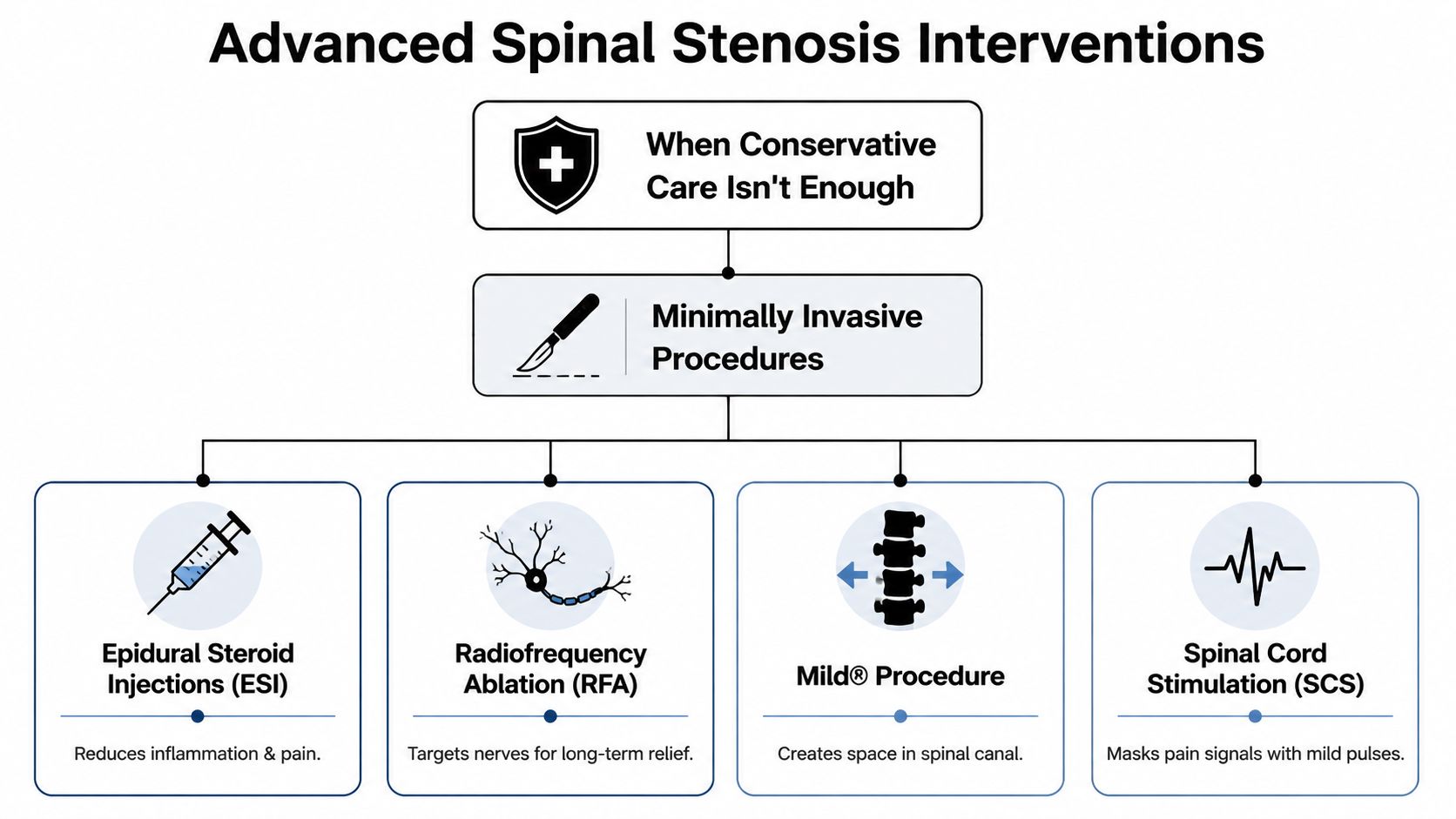
Advanced Interventions When Conservative Care Is Not Enough
When first-line care hasn't restored function, the next step is not random escalation. It's targeted escalation. The question changes from “What can we try?” to “What structure is causing the problem, and which procedure addresses that structure?”
Patients in Alsip, Bridgeview, and Evergreen Park often arrive at this point after months of reduced walking and stop-and-go relief. By then, the treatment plan should be specific.
Injections and diagnostic blocks
Not every procedure for spinal stenosis is designed to “open space.” Some are used to reduce inflammation. Others help confirm which structure is driving pain.
Here's the practical distinction:
- Epidural steroid injections: These are most useful when inflamed nerve roots contribute to leg symptoms. They can reduce irritation around compressed nerves, especially when pain has a radicular or inflammatory component.
- Medial branch blocks: These don't treat stenosis itself. They help determine whether the facet joints are a separate source of back pain.
- Facet-directed treatment and radiofrequency ablation: If the back pain component is coming from arthritic facet joints rather than the stenotic canal, radiofrequency ablation may help with that part of the picture.
This is why “back pain” and “stenosis pain” can't be treated as if they're identical. A patient may have both. If the wrong target is treated, the result is underwhelming even when the procedure itself is technically done well.
For patients who want to understand the range of options used in interventional pain practice, Midwest Pain & Wellness treatment procedures include image-guided injections, radiofrequency techniques, neuromodulation, and minimally invasive lumbar procedures.
Matching the symptom to the procedure
A useful benchmark from an algorithmic treatment review is that decompression is most effective for leg pain and neurogenic claudication, with reported improvement rates of 80% to 90%, while numbness improves less reliably at 65% to 75% (review of lumbar spinal stenosis treatment pathways).
That changes how expectations should be set.
If your main complaint is:
- Walking-triggered leg pain or heaviness, decompressive strategies usually make more sense.
- Persistent numbness, improvement can happen, but it may be less complete.
- Primarily axial low back pain, the main stenosis procedure may not address your biggest symptom.
Fixing spinal stenosis starts with picking the right target. Leg-dominant claudication and facet-mediated back pain are not the same problem.
When MILD may fit
The MILD procedure is designed for a specific scenario. In some patients, a thickened ligament in the lower spine contributes to narrowing. MILD removes small portions of that obstructing tissue through a minimally invasive approach to create more room in the canal.
This option tends to make sense when:
- Imaging supports central canal narrowing related to ligament thickening
- Walking and standing trigger classic claudication symptoms
- Conservative care and simpler interventions haven't restored function
- The goal is decompression without moving straight to open surgery
A patient who says, “I'm fine sitting, but I can't stand long enough to cook or shop,” is often describing the kind of function-limiting pattern that pushes the conversation toward decompression-based treatment rather than more medication adjustments.
When Vertiflex may fit
The Vertiflex Superion procedure is also symptom-specific. It's generally considered for patients whose pain improves in flexion and worsens in extension, especially when standing upright narrows the available space enough to trigger claudication. The implant helps maintain a more open position at the affected level.
This may be considered when:
- Flexion clearly helps, such as relief leaning forward
- Symptoms are posture-dependent, especially with standing and walking
- The anatomy is suitable on imaging and exam
- The patient wants a less invasive path before considering larger surgery
MILD and Vertiflex are not interchangeable for every patient. One may fit the anatomy better than the other. Some patients are not good candidates for either and need a different route.
When surgery enters the conversation
There's a point where minimally invasive pain procedures are no longer the most appropriate lead option. If symptoms keep progressing, walking tolerance continues to collapse, or neurologic findings become more concerning, a surgical opinion is often the right next step.
The broader literature supports that sequence. Surgery is generally reserved for patients who continue to have pain, walking limitation, or nerve symptoms after first-line care, and decompression alone performed similarly to decompression plus fusion in one noninferiority trial, while fusion carried greater burdens such as blood loss, infection risk, longer hospital stay, and higher cost in the reviewed evidence already cited earlier in this article.
That doesn't mean surgery is bad. It means fusion should have a reason. If there isn't real instability or spondylolisthesis, adding more hardware and recovery burden may not improve the symptom that matters most.
Controlling Chronic Pain with Neuromodulation
Some patients have already addressed the structural side of the problem, yet the nervous system keeps broadcasting pain. That's where neuromodulation enters the conversation.
Instead of physically widening the spinal canal, neuromodulation changes how pain signals are processed. This matters for people with chronic nerve pain in the back or legs, especially after prior spine surgery or after multiple treatments that improved anatomy without fully calming pain.
Spinal cord stimulation
Spinal cord stimulation, often called SCS, uses a small device to deliver mild electrical signals near the spinal cord. The purpose is to interfere with pain transmission so the brain receives a quieter, less distressing signal.
The patient-centered advantage is the trial period. Before anyone commits to a permanent implant, the therapy can be tested first. That matters because it lets patients judge whether daily function, sleep, and pain control improve in real life.
SCS is often considered when:
- Leg or back pain has become chronic and hard to control
- Prior injections or decompression did not provide adequate lasting relief
- Previous spine surgery left ongoing neuropathic pain
- The patient wants an opioid-sparing strategy for long-term management
Peripheral nerve stimulation
Peripheral nerve stimulation, or PNS, works on a similar principle but targets a more specific nerve distribution. In the right patient, it can be a focused way to treat a localized chronic pain pattern rather than the broader distribution more commonly addressed by spinal cord stimulation.
A few practical distinctions help:
| Therapy | Main concept | Typical use case |
|---|---|---|
| SCS | Modulates pain signaling near the spinal cord | Broader back and leg neuropathic pain |
| PNS | Targets specific peripheral nerves | More localized nerve-related pain |
Who usually benefits most
Neuromodulation is not a first treatment for newly diagnosed stenosis. It's usually a later-stage tool for people whose pain has become persistent, complex, or post-surgical.
The best candidates are usually not asking for a miracle. They want steadier function, fewer pain spikes, and less dependence on medications that haven't solved the problem.
That mindset matters. Neuromodulation doesn't “reverse” degeneration. It helps control the way chronic pain is experienced when other structural or inflammatory options have reached their limits.
What patients should expect
The right expectation is improvement in function and quality of life, not a promise of zero pain. Patients should also expect a screening process. A careful review of pain pattern, prior treatment response, imaging, and goals is necessary before moving forward.
For the right patient, though, neuromodulation can become one of the most useful parts of a long-term strategy, especially when standard structural fixes don't fully explain the ongoing suffering.
Your Recovery and Long-Term Outlook After Treatment
Many people hear “fix” and assume one procedure should solve everything forever. Spinal stenosis rarely behaves that way. Treatment is better understood as a process of reducing nerve compression, improving function, and then maintaining gains over time.

What durable improvement looks like
For decompression surgery, leg pain relief is often strong. Reported success rates for decompression in relieving leg pain are around 80% to 90%, and about 70% of patients report good outcomes at 3 to 5 years according to a spine practice summary of published benchmarks (lumbar spinal stenosis surgery success overview).
Those are useful numbers, but they need context. Durable improvement doesn't mean every symptom disappears. It means many patients walk better, tolerate activity better, and regain a meaningful amount of life that stenosis had taken away.
Why long-term management still matters
Even after a good result, the spine still ages. Degenerative changes don't stop because one level was treated. That's one reason some people do well for years and later need a new strategy, whether that's rehab, another injection-based approach, further decompression, or a different modality altogether.
There's also a major evidence gap around long-term progression after some minimally invasive options. Patients often ask whether symptom relief means the underlying narrowing has stopped progressing. Current patient education materials don't answer that well enough. For newer or less invasive interventions, the key practical point is this: symptom improvement and anatomic progression are not always the same thing.
Recovery is functional, not just procedural
A good recovery is measured by daily life:
- Can you stand long enough to cook a meal?
- Can you walk through a store without searching for the nearest bench?
- Can you get back to gardening, church, errands, or time with grandchildren with fewer forced rest breaks?
That's a better definition of success than a pain score alone.
A realistic plan focuses on what you can do after treatment, not just what hurts less.
Setting expectations after intervention
Some procedures have very little downtime. Others require a more phased return to activity. The exact timeline depends on the treatment, the anatomy addressed, the presence of instability, and the amount of nerve irritation present before the procedure.
What patients should carry forward is simple. The right treatment can make a major difference. It may not be permanent, and it may not correct every symptom equally well, especially when numbness or longstanding nerve injury is involved. Good spinal stenosis care respects both sides of that truth.
Frequently Asked Questions About Local Spinal Stenosis Care
Patients in Chicago Ridge, Palos Heights, and the surrounding Illinois suburbs usually ask practical questions first. That makes sense. Before anyone commits to evaluation or treatment, they want to know how the process works.
Local care pathway questions
| Question | Answer |
|---|---|
| Do I need a referral to be evaluated? | That depends on your insurance plan. Some plans allow direct specialty scheduling, while others require a referral from a primary care physician or another treating clinician. |
| Should I bring imaging to my first visit? | Yes. Bring MRI, CT, X-ray reports, discs if available, medication lists, prior procedure records, and any surgical history. Old records often prevent duplicated work and make triage more accurate. |
| What if I'm not sure it's stenosis? | That's common. Leg symptoms, hip arthritis, vascular issues, peripheral neuropathy, and facet pain can overlap. A proper evaluation sorts through those possibilities. |
| Will the first visit automatically lead to a procedure? | No. A procedure only makes sense after your symptoms, exam findings, and imaging line up. Sometimes the first recommendation is further workup, medication adjustment, rehab coordination, or surgical consultation. |
| Can treatment stay opioid-sparing? | In many cases, yes. Modern pain practice often combines rehabilitation, image-guided procedures, and device-based therapies to reduce reliance on opioids. |
| What if I've already had back surgery? | Persistent pain after surgery is common enough that it deserves a careful second look. The next step may involve injections, neuromodulation, or reassessment of whether the current pain generator is still structural. |
| Are workers' compensation or injury cases different? | They often require more documentation, clearer functional goals, and tighter coordination with other providers. The clinical principles stay the same, but communication becomes even more important. |
How to get started locally
If you live in Oak Lawn, Orland Park, Bridgeview, Evergreen Park, Worth, Hickory Hills, Alsip, Burbank, Palos Hills, or Palos Heights, the first move is straightforward. Gather your records, confirm whether your insurance needs a referral, and request an evaluation through the clinic's online appointment page.
What the first decision usually comes down to
The first visit is rarely about choosing between “surgery or no surgery.” It's usually about answering three narrower questions:
- Is this spinal stenosis?
- Which symptom is the primary treatment target?
- What is the least invasive option that still has a realistic chance of restoring function?
Those questions prevent wasted months. They also prevent the opposite mistake, which is jumping to a procedure that doesn't match the anatomy or the symptom pattern.
If you've been trying to wait this out and your walking keeps getting worse, that's usually the sign to stop guessing and get a specialist opinion.
If you're ready to figure out what's causing your walking pain, leg symptoms, or persistent back-related nerve pain, schedule an evaluation with Midwest Pain & Wellness. A focused workup can clarify whether you need conservative care, image-guided treatment, minimally invasive decompression, neuromodulation, or a surgical referral, so the next step fits your spine and your goals.