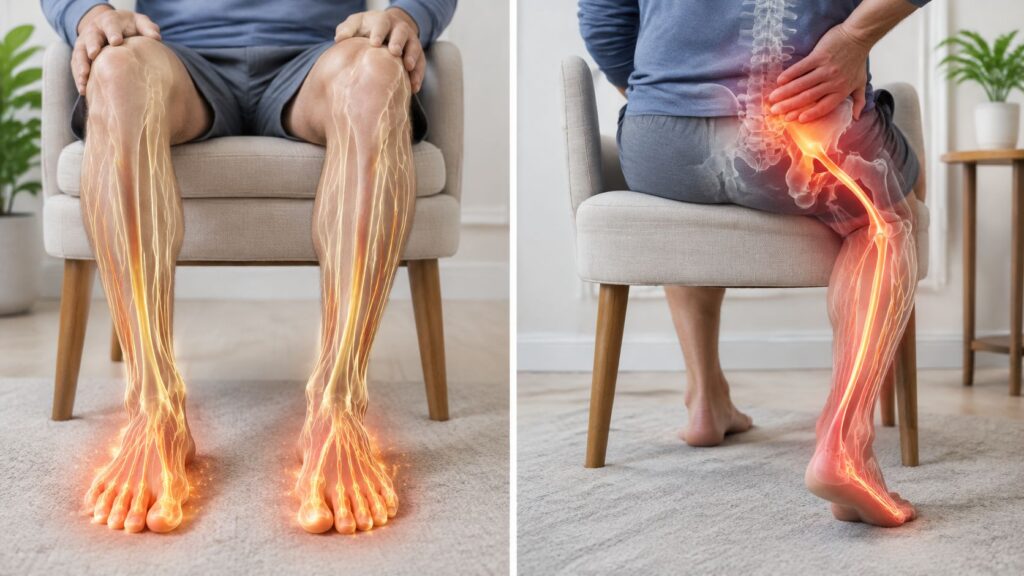
If you're reading this because standing in line hurts, walking through the grocery store has become a strategy exercise, or your legs feel heavy after a short distance, you're not alone. Spinal stenosis often shows up in everyday moments first. People notice they lean on a shopping cart, sit more often, or avoid outings because they don't trust how long their back and legs will hold up.
The good news is that helping spinal stenosis usually doesn't start with surgery. In practice, the right plan often begins with smart home changes, targeted movement, better diagnosis, and then, if needed, image-guided procedures that are designed to reduce pain and restore function. For patients in Oak Lawn, Palos Hills, Palos Heights, Worth, Bridgeview, Hickory Hills, Alsip, Burbank, Evergreen Park, Orland Park, and the surrounding Illinois communities near Chicago Ridge, the key is knowing what to try first and when it's time to move beyond basic care.
Understanding Spinal Stenosis and Your First Steps at Home
Spinal stenosis means there is less room than there should be around the nerves in the spine. That narrowing can happen in the lumbar spine (low back) or the cervical spine (neck). When nerves get crowded, people often feel pain, numbness, tingling, cramping, or weakness.
In the low back, the classic pattern is discomfort with standing or walking that eases when sitting or bending forward. In the neck, stenosis may cause arm symptoms, hand clumsiness, balance trouble, or neck pain. The details differ, but the underlying problem is the same. Nerves don't like being compressed.
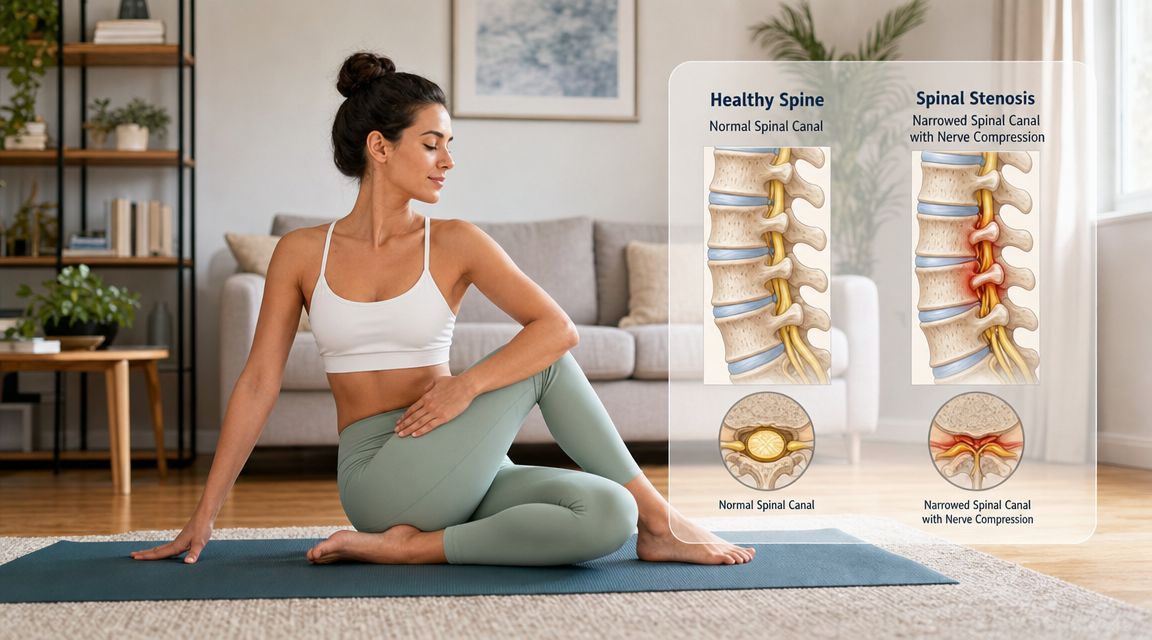
A useful way to think about it is this. If the spinal canal is a hallway, stenosis makes that hallway tighter. Standing upright for long periods can further irritate the space. Bending slightly forward often gives the nerves a little more room, which is why many people say they do better leaning on a counter, walker, or cart.
A major review in JAMA notes that first-line care is typically conservative, including activity modification, medications such as NSAIDs, and physical therapy. That matters because spinal stenosis is common, affecting about 11% of older adults in the United States according to that review in JAMA.
What you can change today
Most patients need a starting plan they can use at home. These changes won't reverse the narrowing, but they can reduce symptom flare-ups and help you function better.
- Shorten standing time: Break up kitchen tasks, laundry, and yard work into smaller blocks. Sit before symptoms become intense rather than after.
- Use the forward-lean position: A shopping cart, rolling walker, or even leaning on a countertop can make walking easier for some people with lumbar stenosis.
- Choose supportive seating: Firm chairs with armrests are usually easier than deep, soft couches that are hard to get out of.
- Adjust your work area: If you stand for work, use a footrest or stool and alternate positions often.
- Be thoughtful with over-the-counter medication: Anti-inflammatory medicine may help some people, but it isn't right for everyone, especially if you have kidney disease, stomach ulcers, blood thinner use, or certain heart conditions.
Practical rule: If an activity predictably triggers symptoms, don't stop living. Change the position, shorten the duration, or build in recovery breaks.
A simple home checklist
Use this checklist for the next several days:
- Track your walking limit. Notice when symptoms start, not just when they become unbearable.
- Sit before pain spikes. Planned rest works better than pushing through.
- Try slight forward flexion. See whether leaning forward reduces leg symptoms.
- Sleep smarter. Many people do better on their side with a pillow between the knees, or on their back with support under the knees.
- Reduce irritation, not all movement. Complete rest usually makes stiffness and deconditioning worse.
People often ask if spinal stenosis can be cured at home. Usually, home care is about symptom control and preserving mobility. The goal is to keep you moving safely while you learn your pattern and decide what level of care you need next.
If you want a broader overview of spine and nerve conditions that pain specialists evaluate, the conditions treated at a Chicago Ridge pain clinic can help you see where stenosis fits.
Building Functional Strength with Targeted Exercise Guidance
The right exercise plan isn't about chasing soreness or forcing your spine to "loosen up." It's about improving function. That means better walking tolerance, less fear of movement, stronger trunk support, and fewer pain spikes during ordinary tasks.
A structured conservative pathway is commonly tried for about 4 to 6 weeks, often with 2 to 3 supervised sessions per week, and the best available review found that exercise can reduce pain, disability, and analgesic use. That same review also noted that patients who later needed surgery often recovered faster if they had done physical therapy first, as summarized in this review of lumbar spinal stenosis management.
What kind of exercise usually helps
For many people with lumbar stenosis, flexion-friendly movement is better tolerated than repeated back extension. That's one reason stationary cycling is often easier than long walks on flat ground. The posture naturally places the spine in a slightly forward position.
Useful examples include:
- Stationary biking: Often better tolerated than treadmill walking.
- Pelvic tilts: Help patients learn controlled spinal positioning.
- Single or double knee-to-chest movements: Often relieve low back and leg pressure temporarily.
- Gentle core stability work: Think control and endurance, not aggressive abdominal training.
- Hip mobility and glute activation: Helpful because stiff hips often force the low back to work harder.
By contrast, some people flare with high-impact drills, repeated jumping, heavy axial loading, or exercises that repeatedly force the low back into strong extension. That doesn't mean every extension movement is forbidden. It means the exercise choice needs to match the symptom pattern.
Why guided care still matters
A pain clinic isn't a physical therapy office, and that distinction matters. The job of an interventional pain specialist is to diagnose the pain generator, calm symptoms when needed, and coordinate the right next step. For some patients, that means referring for targeted therapy with clear goals instead of handing out a vague "do PT" instruction.
The best exercise program for stenosis is the one you can keep doing without repeatedly triggering a setback.
Adherence is where many plans fail. Patients often start strong, then stop because the wrong exercises increased pain, the schedule wasn't realistic, or no one explained what improvement should look like. Progress isn't always dramatic. Sometimes success means you can stand long enough to cook dinner again, get through a store without sitting twice, or sleep with fewer interruptions.
Red flags that change the plan
Most exercise-related soreness is manageable. Some symptoms aren't.
Seek urgent medical attention if you develop:
- Progressive leg weakness
- New bowel or bladder changes
- Loss of balance that's rapidly worsening
- Severe numbness in the saddle area
- Rapid loss of hand function if neck symptoms are involved
Those patterns suggest this may be more than routine symptom management.
A better standard for success
Patients from Worth, Bridgeview, and nearby Illinois suburbs often tell me they judged progress only by pain level. That's too narrow. A better question is whether you're doing more with less limitation.
Look at these markers instead:
| Functional marker | What improvement looks like |
|---|---|
| Walking tolerance | You can go farther before symptoms start |
| Standing tolerance | You need fewer breaks during chores |
| Recovery time | Flares settle faster after activity |
| Daily confidence | You avoid fewer errands and social events |
If exercise is helping, keep building on it. If you're doing the work and your walking distance keeps shrinking, that's a sign to look deeper.
When to Pursue Imaging and a Specialist Consultation
Some patients improve with home changes and structured exercise. Others hit a wall. They aren't bedridden, but their world gets smaller. They park closer. They stop attending events. They sleep poorly because the pain returns at night. Their legs feel less reliable.
That's usually the point where the question changes from "How do I help spinal stenosis at home?" to "What exactly is causing this, and what are my options now?"
Signs you've outgrown basic care
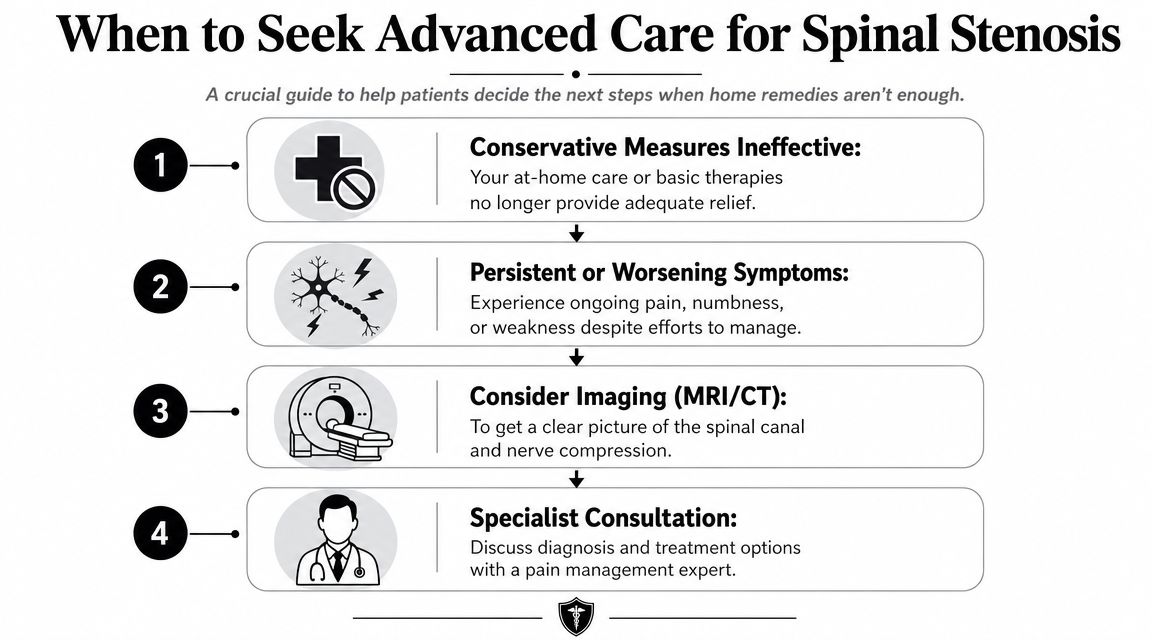
If symptoms are getting more intrusive despite a reasonable trial of conservative treatment, it's time to consider imaging and a specialist evaluation. The most important trigger isn't a pain score. It's functional loss.
Common signs include:
- Walking tolerance is declining
- You need to sit down more often to get through routine tasks
- Pain wakes you from sleep
- Weakness affects stairs, balance, or getting out of a chair
- Numbness or radiating pain is becoming more constant
Guidance from the National Institute of Arthritis and Musculoskeletal and Skin Diseases emphasizes that conservative care is the starting point, but when symptoms worsen or walking tolerance declines, it's appropriate to escalate care and discuss next steps in this spinal stenosis treatment overview.
What imaging actually adds
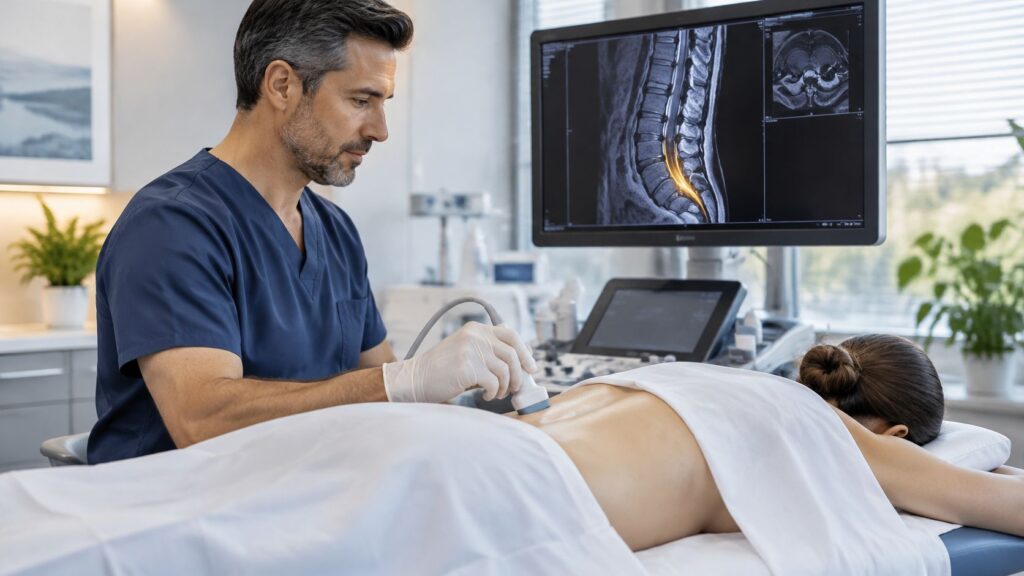
An MRI usually gives the clearest view of the spinal canal, discs, ligaments, and nerve compression. A CT scan can also be useful in certain situations, especially when MRI isn't ideal or when bony anatomy needs closer review. Imaging doesn't replace the history and exam, but it helps confirm whether symptoms match central canal narrowing, foraminal narrowing, facet-related pain, or another source entirely.
That distinction matters because not all back and leg pain from aging spines is the same. One patient has nerve irritation from stenosis. Another has mostly facet joint pain. Another has both. The treatment plan changes with the diagnosis.
Why see an interventional pain specialist
A surgeon evaluates whether an operation is needed. An interventional pain specialist focuses on diagnosis, image-guided non-surgical treatment, and deciding whether a procedure can reduce pain enough to restore function or delay surgery.
For many people in Hickory Hills, Evergreen Park, Orland Park, or Palos Hills, that middle ground is exactly what's missing. They don't need to jump straight to an operation, but they also shouldn't stay stuck with ineffective home care forever.
If your life keeps narrowing because your walking and standing are getting worse, you need more than reassurance. You need a clearer map.
If you're ready to discuss imaging, review symptoms, and talk through procedural options, you can request a visit through the appointment page for pain evaluation.
Advanced Non-Surgical and Regenerative Pain Treatments
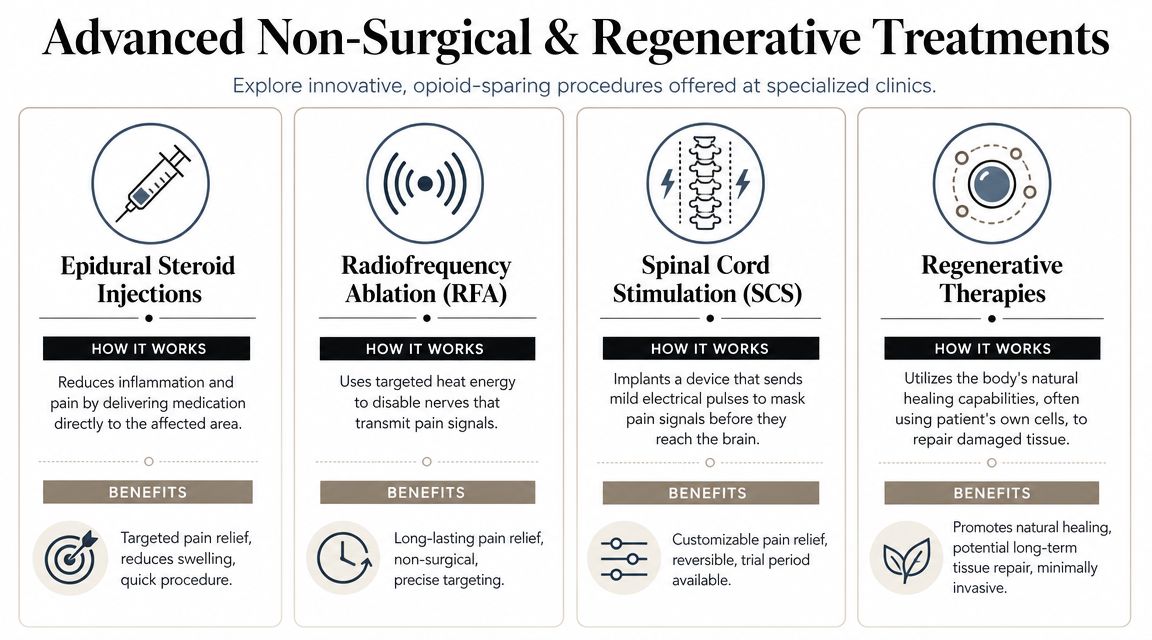
Once conservative care has done what it can, the next step isn't automatically surgery. There is a broad middle category of treatments that can reduce inflammation, identify the pain source, interrupt pain signaling, or create more room around irritated structures.
That matters because the overall trend in spine care is toward the least invasive effective option. As noted earlier from the JAMA review, surgery is typically reserved for selected patients who don't improve with conservative management, and a trial found similar outcomes between decompression alone and decompression plus fusion for many patients. In plain language, more surgery isn't always better.
Epidural steroid injections
An epidural steroid injection places anti-inflammatory medication near irritated spinal nerves. The goal isn't to fix the narrowing itself. The goal is to calm inflammation enough that leg pain decreases and function improves.
This can be useful when stenosis creates an inflamed, irritable nerve environment and the patient needs a window to walk better, sleep better, or participate more effectively in rehabilitation. Some patients get meaningful temporary relief. Others don't. One important trade-off is that long-term benefit hasn't been demonstrated in the foundational review cited earlier, so these injections should be viewed as a symptom-management tool, not a cure.
Good candidates often include patients who have radiating leg pain, neurogenic claudication symptoms, or a flare severe enough to block progress with exercise and daily activity.
Medial branch blocks and radiofrequency ablation
Not all pain in a patient with stenosis comes from stenosis alone. Many adults with degenerative spines also have facet joint pain. Facet pain often feels more mechanical and localized to the low back, sometimes worse with extension and twisting.
A medial branch block is a diagnostic injection. It numbs the small nerves that supply the facet joints. If that block gives the expected pattern of relief, the next step may be radiofrequency ablation, often called RFA. RFA uses heat generated by radiofrequency energy to interrupt pain signals from those targeted nerves.
This isn't a treatment for severe canal narrowing itself. It's a treatment for the facet-mediated part of the pain picture. In the right patient, that distinction is huge. If leg heaviness is from stenosis and back pain is from facets, treating only one piece leaves the other untouched.
MILD and Vertiflex Superion
Some patients need more than an injection but still want to avoid open surgery if possible. Two procedures often discussed in that setting are MILD and Vertiflex Superion.
MILD
Minimally Invasive Lumbar Decompression, or MILD, is designed for selected patients whose stenosis is related in part to thickened ligament tissue in the lumbar spine. Through a very small access point, the goal is to remove small portions of tissue that are crowding the canal. Think of it as creating more breathing room rather than rebuilding the whole hallway.
The ideal candidate is someone with lumbar stenosis symptoms, especially walking and standing intolerance, whose imaging and exam match the procedure's target anatomy. It sits between simple injection care and larger decompressive surgery.
Vertiflex Superion
The Vertiflex Superion procedure places an implant between specific vertebrae to help maintain a slightly flexed posture at that level. For selected patients, that helps keep the space more open where symptoms occur.
A simple analogy is a doorstop that keeps a door from swinging shut all the way. It doesn't cure every form of stenosis, and patient selection is everything, but it can be useful when symptom relief clearly relates to flexion and imaging supports the anatomy.
Spinal cord stimulation and peripheral nerve stimulation
Some patients continue to have significant pain despite injections, decompression-focused procedures, prior surgery, or longstanding nerve irritation. In those cases, neuromodulation may be appropriate.
Spinal cord stimulation uses implanted leads and a battery system to deliver electrical signals that change how pain is processed. The goal isn't to "erase" the underlying spine changes. It's to reduce the nervous system's pain output so the patient can function better.
Peripheral nerve stimulation works on a similar principle but targets a specific peripheral nerve or nerve distribution. These treatments are especially useful when pain remains disproportionate to what further structural intervention is likely to fix.
One practical advantage is that spinal cord stimulation commonly involves a trial period before permanent implantation. That allows the care team and patient to judge whether daily function improves.
Regenerative approaches
Many patients ask about PRP and other regenerative procedures. These treatments aim to use the body's own biologic repair mechanisms. Their role in spinal stenosis care is nuanced.
Regenerative options may have a place when pain is coming from associated soft tissue, joint, tendon, or degenerative structures rather than from severe fixed canal narrowing alone. They are not a mechanical cure for advanced stenosis. If the main problem is that a nerve doesn't have enough room, the treatment has to match that reality.
That doesn't make regenerative care unhelpful. It means expectations need to be disciplined. The right use is targeted, diagnosis-driven, and part of a bigger plan.
Comparing non-surgical spinal stenosis treatments
| Procedure | Primary Goal | Best For Patients Who… | Approach |
|---|---|---|---|
| Epidural steroid injection | Reduce inflammation around irritated nerves | Have radiating pain or flare-ups limiting function | Image-guided medication delivery near the affected area |
| Medial branch block | Identify facet-mediated pain | Have a strong mechanical low back pain component | Diagnostic numbing of facet nerve supply |
| Radiofrequency ablation | Prolong facet pain relief | Responded appropriately to medial branch blocks | Targeted heat lesion to pain-transmitting nerves |
| MILD | Create more space in selected lumbar stenosis cases | Have anatomy consistent with ligament-related crowding | Minimally invasive decompression |
| Vertiflex Superion | Maintain more room at targeted lumbar levels | Improve with flexion and fit implant criteria | Spacer placement between vertebrae |
| Spinal cord stimulation | Modify pain signaling | Have persistent pain after other measures or surgery | Trial first, then implant if benefit is clear |
| Peripheral nerve stimulation | Target a specific pain pathway | Have focal nerve-related pain patterns | Minimally invasive neuromodulation |
| Regenerative therapies such as PRP | Support healing in selected pain generators | Have related degenerative or soft tissue contributors | Injection-based biologic treatment |
Choosing the next step intelligently
A specialist's judgment matters most. A patient with classic shopping-cart relief, limited walking distance, and imaging showing ligament-related narrowing may fit a decompression-oriented option. A patient whose main complaint is extension-sensitive back pain may need facet treatment first. A patient with persistent pain after prior surgery may be a neuromodulation candidate.
One Illinois option for learning what these procedures involve is the interventional treatments used for spine and pain conditions, which includes image-guided injections, radiofrequency ablation, spinal cord stimulation, MILD, Vertiflex Superion, and regenerative therapies.
The right procedure should answer a specific problem. If no one can explain what structure they're targeting and why that matches your symptoms, keep asking questions.
Your Path Forward with Coordinated Care in the Chicago Area
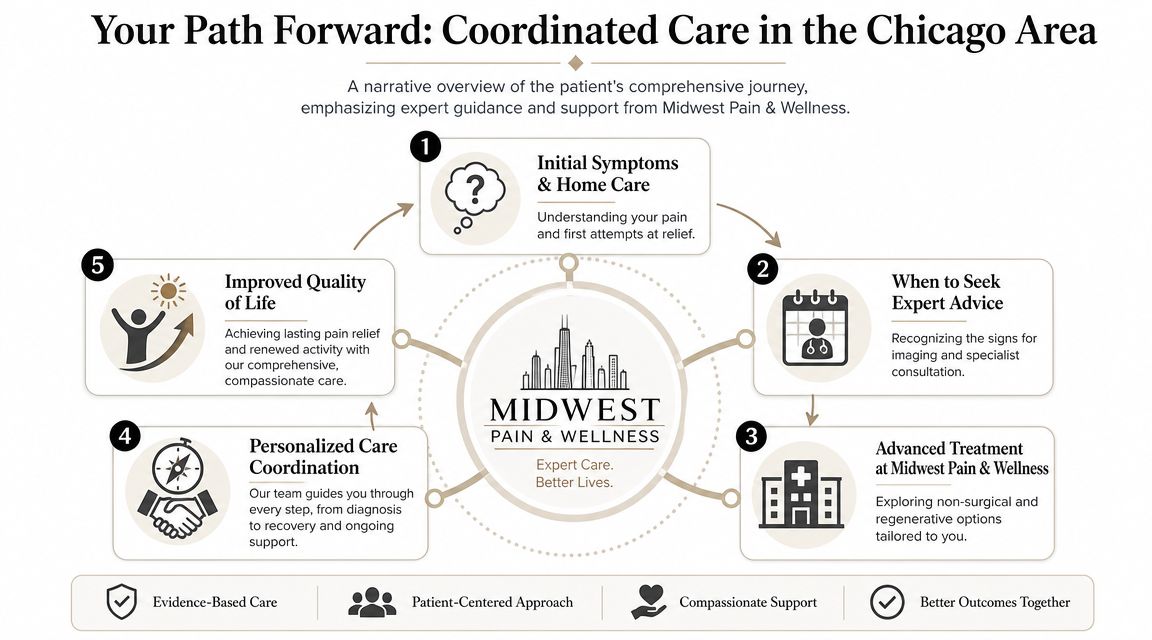
The most effective spinal stenosis care is rarely one thing. It is usually a sequence. First, symptoms are identified clearly. Then home changes and medication choices are cleaned up. Targeted therapy is used when it fits. Imaging confirms the anatomy if symptoms persist. Procedures are chosen based on the actual pain generator, not guesswork. Surgery is considered when function keeps declining or when the anatomy demands it.
That sequence is what coordinated care should feel like. Not random referrals. Not repeated short-term fixes with no larger plan.
What a real care pathway looks like
Take a typical patient from Oak Lawn or Palos Heights. They start with back and leg pain while standing. They try rest, over-the-counter medication, and cutting back activity. That helps a little, but now they're avoiding stores, family events, and stairs.
The next move isn't to tell them to "live with it." It is to define the pattern. Does bending forward help? Is the pain mostly in the legs, the low back, or both? Is weakness present? Has walking tolerance dropped? Is this lumbar stenosis, facet pain, sacroiliac pain, post-surgical nerve pain, or a mixture?
Once that is clear, treatment can become specific. Some patients need a better exercise framework and symptom control. Some need an epidural injection to calm a flare enough to move again. Some are better candidates for medial branch blocks and RFA. Others need MILD, Vertiflex, neuromodulation, or a surgical consultation.
The clinic as quarterback
For spine patients, fragmented care is common. A primary care clinician may order medication. A therapist may focus on movement. A surgeon may evaluate imaging. A chiropractor may address mechanics. Each can help, but somebody still needs to connect the dots.
That is where coordinated interventional pain care matters. Dr. Yaw Donkoh and the team at Midwest Pain & Wellness work in that middle lane between basic care and major surgery, helping patients and their other providers align around one diagnosis-driven plan. That can include reviewing imaging, clarifying which symptoms are most limiting, deciding whether a procedure fits, and coordinating with surgeons, primary care clinicians, chiropractors, and rehab professionals when needed.
Setting realistic expectations
Patients do better when expectations are honest. The aim isn't always a cure. The aim is often better function with less pain, fewer activity restrictions, better sleep, and more confidence in daily life.
For one patient, success means walking through a store without leaning on the cart the whole time. For another, it means standing to cook, returning to church, driving longer distances, or getting through the workday without constant stops. Those are meaningful outcomes.
Recovery also varies by treatment type:
- After an injection: Many people resume light activity quickly, but the full anti-inflammatory effect may take time.
- After RFA: Soreness at the treatment site can occur before the longer pain-relief phase sets in.
- After MILD or Vertiflex-type procedures: The focus is usually gradual improvement in standing and walking tolerance.
- After neuromodulation: The process includes programming and adjustment, not just implantation.
What doesn't work well
Patients deserve clarity about the trade-offs. A few common traps delay progress:
- Waiting too long despite clear decline: If walking tolerance keeps shrinking, time alone isn't a treatment.
- Chasing passive care only: Massage, heat, or short-term relief measures can help, but they rarely solve a progressive functional problem by themselves.
- Expecting one injection to fix everything: Procedures work best inside a larger plan.
- Using opioids as the whole strategy: They may dull pain temporarily, but they don't open the canal, identify the source, or rebuild function.
Relief matters. Function matters more. The best plan does both.
For patients in the southwest suburbs of Chicago
If you live in Alsip, Burbank, Bridgeview, Hickory Hills, Worth, Evergreen Park, Orland Park, Palos Hills, Palos Heights, Oak Lawn, or nearby Illinois communities, you shouldn't have to choose between doing nothing and jumping straight to surgery. There is a middle path. It starts with clear diagnosis, respects conservative care, and uses advanced procedures when the symptom pattern and imaging support them.
That's the practical answer to how to help spinal stenosis. Start with the basics. Measure function, not just pain. Escalate when walking and standing keep getting worse. Match the treatment to the structure that's causing the problem. And make sure one clinician is looking at the whole picture.
If spinal stenosis is limiting your walking, standing, sleep, or independence, a careful evaluation can help clarify what to try next. Midwest Pain & Wellness provides diagnosis-driven, opioid-sparing care for spine and nerve pain in the Chicago Ridge area, including image-guided procedures and coordinated treatment planning for patients across nearby Illinois suburbs.