A migraine often announces itself at the worst possible moment. You may be driving through Oak Lawn on the way to work, getting kids ready in Palos Heights, or trying to finish a normal afternoon in Orland Park when the warning signs start. Light feels harsh. Your neck tightens. You begin to wonder if the rest of the day is about to disappear.
That dread is one reason prevention matters so much. Migraine isn't a rare nuisance. More than 1 billion people worldwide live with migraine, and a preventive treatment is often considered meaningful when it cuts attacks by 50% or more, according to the American Migraine Foundation migraine facts overview.
People asking how to prevent migraines usually aren't looking for abstract theory. They want a plan they can follow. In clinical practice, that means stopping the cycle before pain builds, not merely chasing each attack after it starts.
Regaining Control From Migraine A Proactive Approach
Migraine prevention works best when patients stop thinking in all-or-nothing terms. The goal usually isn't to eliminate every attack forever. The primary target is better control. Fewer attacks, less severe attacks, shorter attacks, and fewer days lost to pain.
That mindset matters in the Chicago suburbs, where schedules are packed and routines are easy to disrupt. A skipped lunch in Worth, a late shift in Bridgeview, poor sleep in Evergreen Park, or repeated use of rescue medication can push a vulnerable nervous system in the wrong direction. Prevention is about lowering that load.
What prevention actually looks like
A good prevention plan usually has layers:
- Foundation habits that make the brain less trigger-sensitive
- Pattern tracking so you know what consistently sets attacks off
- Preventive medication when attack burden is high enough
- Procedure-based care for patients with frequent or disabling migraine
- Follow-up adjustments because migraine management often needs refinement
Patients often feel relieved when they hear that prevention is a structured process rather than guesswork. You don't need to fix everything in one week. You do need a repeatable system.
Practical rule: Migraine prevention works better when you measure patterns and make targeted changes, not when you react to every bad day as if it were random.
In an interventional pain practice, I look at prevention through an opioid-sparing lens. Opioids are not a migraine prevention strategy. A durable plan usually depends on habit consistency, selective use of medications designed for prevention, and targeted procedures when the history supports them.
Why a proactive plan changes outcomes
People often wait too long to escalate care because they assume migraine is something they should just push through. That usually backfires. The earlier you identify the pattern, the easier it is to build a plan around work demands, family responsibilities, commute stress, sleep disruption, and the treatments you've already tried.
If you're living in Palos Hills, Hickory Hills, Alsip, Burbank, or nearby Illinois communities, prevention should feel accessible and local, not theoretical. The right plan is one you can carry out between real-life obligations.
Identifying Your Personal Migraine Triggers
A patient in Orland Park may come in convinced that red wine or chocolate is the problem. After we review the pattern, the more likely cause is often a cluster of smaller hits: short sleep, a skipped meal, screen strain, stress, then a food ultimately blamed. Trigger work matters because treatment decisions get better when the pattern is clear.
The goal is to separate a true trigger from a coincidence and to spot the combinations that lower your migraine threshold. That is the part many people miss when they only remember the last thing they ate or drank.
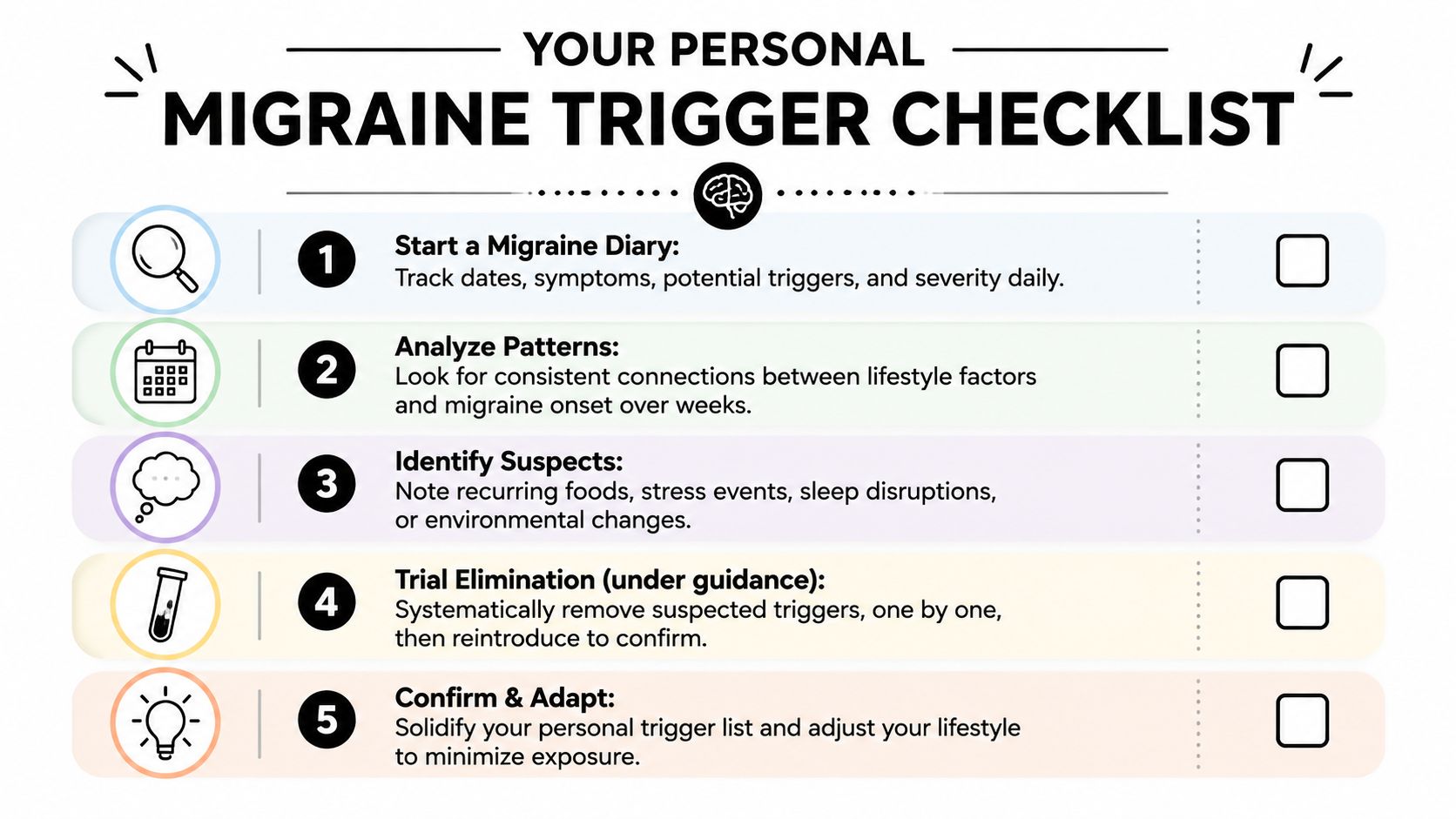
What to track in a migraine diary
A diary works best when it captures ordinary days as well as bad ones. Recording only severe attacks leaves out the comparison points that help a clinician see what changed before the migraine started.
Track these items every day:
- Sleep pattern including bedtime, wake time, naps, and major schedule shifts
- Meals and hydration including skipped meals, long gaps without eating, and low fluid intake
- Stress load such as deadlines, conflict, travel, or a poor recovery day after heavy stress
- Hormonal timing if attacks appear linked to your cycle
- Environment including bright light, strong odors, weather changes, long drives, or prolonged screen exposure
- Medication use especially how often you need rescue treatment
- Headache features including start time, location, nausea, light sensitivity, sound sensitivity, and how long the attack lasts
A notebook is fine. A phone note is fine. Consistency matters more than the format.
How to read the pattern
After a few weeks, review repeats instead of isolated events. In clinic, I often find that migraine behaves like a threshold disorder. One poor night may not be enough. Add delayed meals, dehydration, commute stress, and extended screen time, and the attack risk rises.
That distinction changes care.
A patient from Evergreen Park may blame chocolate because it showed up before several attacks. The diary may show a different sequence: a tense workday, late dinner, then shortened sleep. Chocolate was present, but it was not the main driver.
Migraine triggers often work in combinations. If you focus on one suspect, you can miss the most important pattern.
A practical way to test likely triggers
Make one change at a time and give it enough time to show a pattern. Large elimination plans usually fail because they create too many variables and become hard to maintain during work and family routines.
Use this process:
- Pick one likely trigger based on your diary, not a guess
- Test one change at a time for a sustained period
- Keep recording every day so headache days and non-headache days can be compared
- Reintroduce carefully if you need to confirm whether that factor was involved
- Bring the diary to your appointment so your history can be reviewed in context
This matters even more when headaches are frequent, mixed with neck pain, or no longer respond well to over-the-counter medication. In those cases, trigger review should sit alongside a broader evaluation of migraine and related pain disorders, including the headache and pain conditions treated at Midwest Pain & Wellness.
In the Chicago suburbs, from Oak Lawn to Palos Heights, I want patients to know that identifying triggers is not busywork. It guides whether simple routine changes may be enough, whether preventive medication makes sense, or whether it is time to consider options such as Botox, CGRP-targeted treatment, or a nerve block as part of a more structured migraine plan.
Building Your Foundation With Lifestyle and Behavioral Strategies
A patient from Orland Park might do well all week, then wake up Saturday with a migraine after sleeping late, skipping breakfast, and trying to push through a stressful to do list. That pattern is common in clinic. Prevention often improves when daily inputs become more predictable.
One practical framework is SEEDS: Sleep, Exercise, Eat, Diary, and Stress. It gives patients a usable structure without turning prevention into a full-time job. I use it because it helps separate changes that are realistic and repeatable from changes that sound good but fall apart within two weeks.
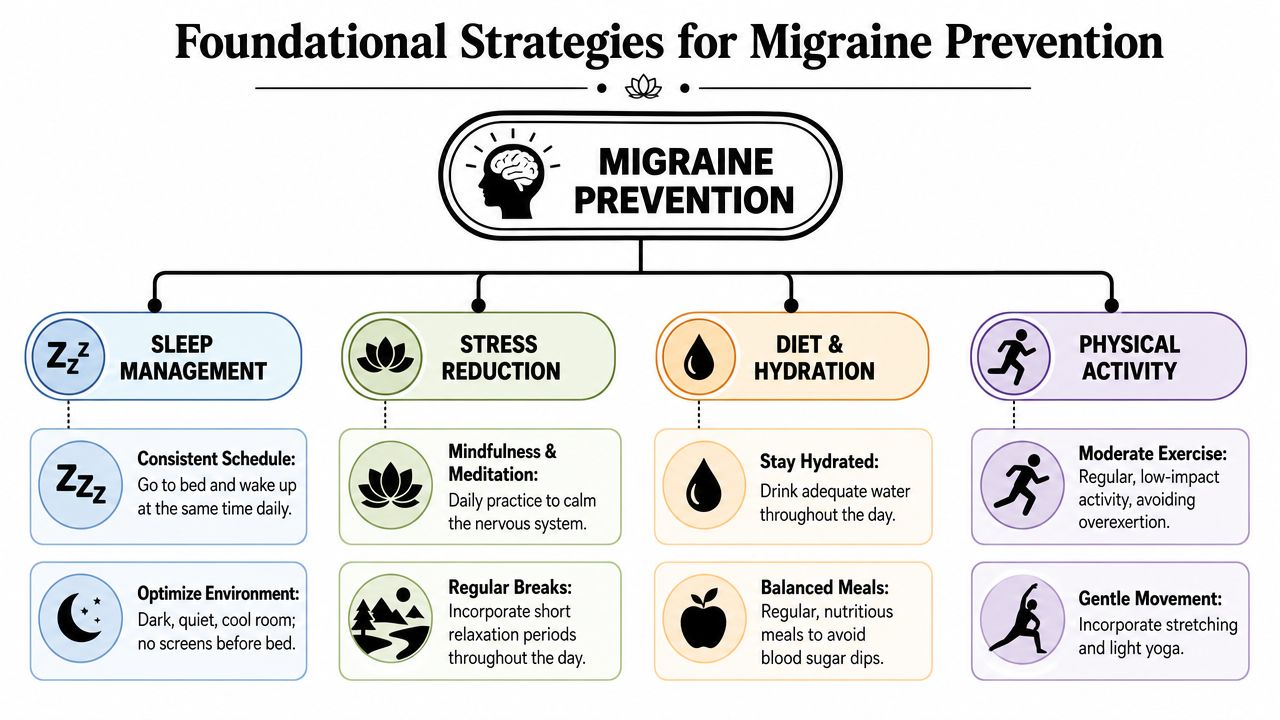
Sleep needs regular timing
Sleep hygiene is not just about getting more hours. Migraine brains often respond poorly to inconsistency. A different bedtime on weekends, late-night screen time, or frequent naps can be enough to increase attack frequency even when total sleep seems adequate.
A review in PMC on lifestyle and behavioral prevention discusses sleep efficiency and other behavioral measures that support migraine prevention, including stable sleep habits, limiting naps, and avoiding routines that keep you awake in bed longer than needed.
Patients usually do better with a simple plan:
- Keep bedtime and wake time close to the same every day
- Use the bed for sleep, not an hour of scrolling or television
- Avoid late catch-up naps that delay nighttime sleep
- Set a realistic sleep window you can maintain
Eating and hydration work best with consistency
Missed meals and dehydration cause trouble because they lower your margin for error. That matters even more during busy workdays, long commutes, and irregular schedules, which many patients in Oak Lawn, Palos Heights, and nearby suburbs deal with every week.
The goal is not a perfect diet. The goal is fewer physiologic swings.
Helpful strategies include:
- Eating on a regular schedule
- Keeping a portable snack available for long work blocks or errands
- Drinking fluids throughout the day instead of trying to catch up at night
- Avoiding broad food restrictions unless your diary shows a repeatable pattern
I often tell patients to make this part boring. Boring routines prevent migraines better than dramatic resets.
Exercise helps when the dose is realistic
Exercise can reduce migraine burden, but patients often abandon it because they start too aggressively. Three hard workouts followed by a flare of head or neck pain is not a prevention plan. A steady aerobic routine is usually more useful.
Walking, cycling, swimming, and elliptical training are good options because they are easier to repeat week after week. The right starting point depends on the patient. Someone with chronic migraine and neck pain may need to begin with shorter sessions and build gradually. Someone else can tolerate longer sessions from the start.
Consistency matters more than intensity.
Diary and stress skills make the plan usable
The diary still matters after trigger patterns become clearer. It shows whether these routine changes are reducing headache days, lowering severity, or shortening recovery. It also helps later if treatment needs to expand to prescription prevention, Botox, CGRP-targeted therapy, or an office procedure such as a nerve block. Without a baseline, it is harder to judge whether a treatment is working.
Stress management also deserves a practical definition. The goal is not to remove stress from life. The goal is to reduce the body's reactivity to it. Behavioral therapy, relaxation training, cognitive strategies, and biofeedback can all help. Patients usually get better follow-through when they pick one method they can practice consistently instead of building an overly ambitious routine they will not keep.
Lifestyle work is the foundation, not the full ceiling of care. For some patients, these changes reduce attacks enough to avoid stepping up treatment. For others, especially those with frequent or disabling migraines, this foundation supports the next layer of care and improves how well preventive medications or interventional options work.
Exploring Modern Preventive Medications
Lifestyle strategies matter, but they don't replace medical prevention when attack burden gets high enough. Medication for prevention is different from rescue treatment. Rescue medication is taken during an attack. Preventive medication is used on a scheduled basis to make attacks happen less often and with less disruption.
A review in the Cleveland Clinic Journal of Medicine on migraine prevention notes that preventive medicines are typically considered when patients have three or more debilitating attacks per month. The same review states that roughly half of patients taking a preventive medication achieve a 50% reduction in migraine frequency, and identifies CGRP antagonists as the newest class of specifically designed migraine prophylaxis.
Older oral preventives still matter
Many preventive plans begin with established oral medications. These include categories such as:
- Beta blockers
- Certain antidepressants
- Anti-seizure medications
These drugs were not all originally developed only for migraine, but they can be useful in the right patient. The trade-offs are practical. One medication may fit well if a patient also has another condition that overlaps with its use. Another may be a poor fit because of side effects, sedation, mood concerns, blood pressure issues, or the patient's daily schedule.
That is why medication choice should never be reduced to a generic internet ranking. The best option is the one that matches the migraine pattern, medical history, and tolerance profile of the individual sitting in front of you.
CGRP-targeted treatment changed the conversation
The newer migraine-specific preventive class targets CGRP-related pathways. For many patients, that matters because these therapies were designed around migraine biology rather than borrowed from another disease area.
That doesn't mean everyone should start there. It means they belong in the conversation, especially when a patient has frequent attacks, has already tried standard prevention, or needs a more targeted approach.
Here is the practical difference:
| Approach | Typical role in practice | Main consideration |
|---|---|---|
| Traditional oral preventives | Common first-line or early-line option | Fit depends on side effects and medical history |
| CGRP antagonists | Newer migraine-specific prevention option | Often considered when burden is higher or prior strategies haven't worked |
What medication does and doesn't solve
Preventive medication can lower attack frequency, but it doesn't replace sleep regulation, meal consistency, trigger review, or monitoring of rescue medication use. It works best as one layer in a broader plan.
It also requires patience. Stopping and starting medications too quickly is a common reason people conclude that "nothing works." In practice, the decision should be collaborative. A specialist should review diagnosis accuracy, attack pattern, prior medication exposure, comorbid conditions, and whether the main problem is migraine, cervicogenic headache, occipital neuralgia, medication overuse, or a mix of several issues.
Advanced Non-Drug Therapies and Interventional Procedures
Some patients do everything right with sleep, meals, hydration, exercise, and medication, and they still have frequent or disabling migraine. That is where advanced care becomes important. In an interventional pain setting, the goal is to use targeted, opioid-sparing tools that fit the specific headache pattern.

Botox for chronic migraine
For patients with chronic migraine, Botox is one of the most established non-opioid procedural options. In clinic, this isn't framed as a cosmetic treatment. It's a structured medical therapy used to reduce the burden of frequent migraine.
Patients usually want to know three things:
What does it involve
A series of small injections is placed in specific head and neck muscle regions according to a standard treatment pattern.What does it feel like
Most patients describe it as brief pinches or pressure rather than a major procedure.When will I know if it's helping
Response is usually judged over time rather than immediately after one session.
For the right candidate, Botox can be part of a broader migraine-prevention plan that also addresses neck-related pain drivers, sleep disruption, and rescue medication patterns.
Nerve blocks and related interventional options
Not every headache patient has pure migraine. Some have overlap with occipital neuralgia, neck-mediated headache, or peripheral nerve irritation that contributes to the pain pattern. In those cases, targeted procedures can be useful.
These may include:
- Occipital nerve blocks when pain tracks through the back of the head or upper neck
- Other focused injections when examination suggests a peripheral pain generator
- Radiofrequency ablation in select patients when pain appears linked to specific cervical pain structures rather than migraine alone
This is where diagnosis matters. A person with central migraine biology and a person with substantial neck-based pain can both say, "I get headaches all the time," but they may need different treatment layers.
Patients looking into procedural options can review procedures used for treatment at Midwest Pain & Wellness to understand the range of interventional care available in a Chicago Ridge pain clinic.
The hidden problem of medication-overuse headache
A common trap is taking more and more acute medication as headaches become more frequent. That can worsen the cycle instead of helping it. Cedars-Sinai warns in its guidance on at-home migraine remedies that taking over-the-counter or prescription acute headache medications more than 10 days a month can paradoxically increase headache frequency.
If you're treating headaches more and more often but functioning less and less well, the plan may need prevention, not simply stronger rescue medicine.
That is one reason interventional care can be useful. Procedures don't replace a full migraine strategy, but they can help patients break out of the escalating-rescue-medication cycle and regain room to build a more stable preventive plan.
When and How to Seek Specialist Migraine Care in the Chicago Area
Some patients are appropriate for self-management plus primary care follow-up. Others need specialist input sooner. The key is recognizing when migraine has crossed from occasional disruption into a condition that is directing your schedule, work capacity, and medication use.
The American Migraine Foundation migraine prevention overview makes an important distinction. Lifestyle measures are helpful, but they aren't always a substitute for medical prevention, especially in chronic migraine, defined there as 15 or more headache days per month. The same overview notes that escalating to a specialist matters when self-management fails, with options such as CGRP-based preventives and Botox for more frequent or disabling cases.
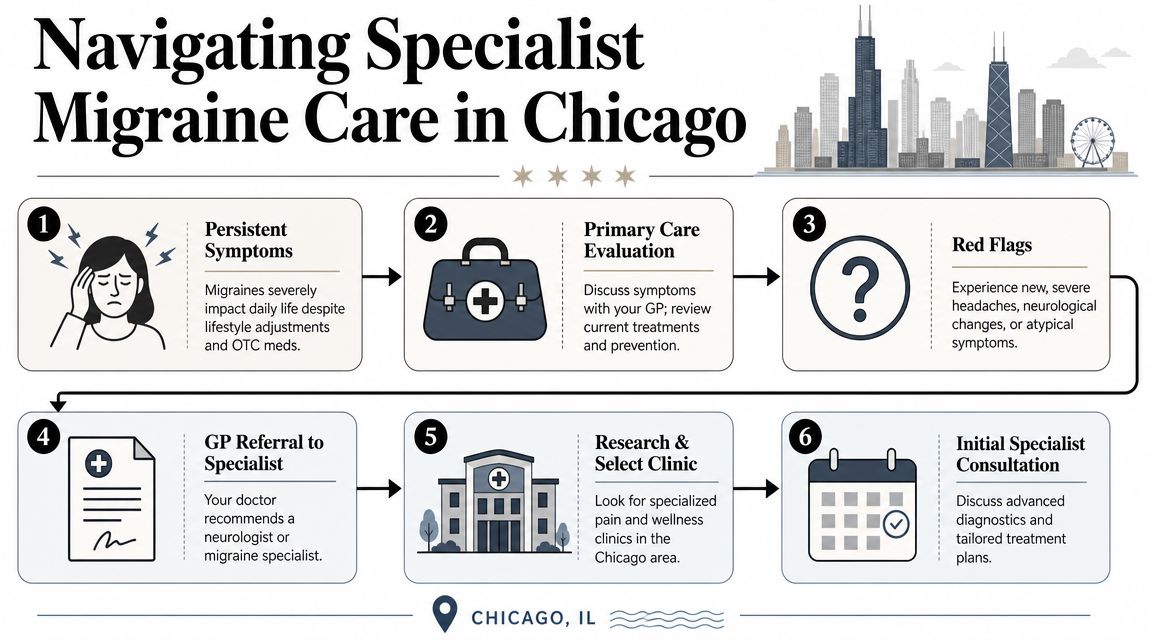
Signs it's time to move beyond self-management
You should consider specialist evaluation if any of these are true:
- Attacks stay disruptive even though you've already improved sleep, meals, hydration, and stress management
- Rescue medication use is climbing and you feel stuck in a repeat cycle
- Headaches are frequent enough that your month is organized around them
- The diagnosis is unclear because neck pain, occipital pain, facial pain, or other symptoms overlap
- Previous medications haven't worked or caused side effects you couldn't tolerate
- Work and family function are slipping because you never know when the next attack will knock you out
That applies to patients across Oak Lawn, Palos Hills, Palos Heights, Worth, Bridgeview, Hickory Hills, Alsip, Burbank, Evergreen Park, and Orland Park. Geography matters less than access, timing, and whether you're getting a plan advanced enough for the burden you're carrying.
What a specialist should evaluate
A proper migraine consultation isn't just a quick medication refill. It should sort out several questions:
| Clinical question | Why it matters |
|---|---|
| Is this migraine alone or migraine plus another headache source | Treatment choice changes if the neck or occipital nerves are involved |
| How often are rescue medications being used | Overuse can undermine prevention |
| What has already been tried | Repeating failed strategies wastes time |
| How much disability is occurring | The more life disruption there is, the more important escalation becomes |
| Is chronic migraine present | Higher-frequency disease often needs more than lifestyle advice |
The specialist's role becomes practical rather than abstract. A good visit turns a vague problem into a decision pathway.
What a local treatment plan often includes
For adults in the southwest Chicago suburbs, a realistic plan often combines several layers at once. It may include sleep regularization, meal timing, a diary, a preventive medication, Botox for chronic migraine, nerve-focused procedures if the exam supports them, and tighter limits on rescue-medication use.
That kind of multimodal thinking is common in pain medicine because headache disorders rarely stay in one neat box. A patient may have migraine biology, muscle tension from guarding, cervical pain that refers upward, and medication overuse all at the same time. If you treat only one layer, the overall result may be underwhelming.
A clinic such as Midwest Pain & Wellness can evaluate those overlapping contributors through an interventional, opioid-sparing lens, especially for patients in Chicago Ridge and surrounding Illinois communities who need more than generic advice.
What to expect at the first visit
Most patients do better when they prepare before the appointment. Bring your medication list, prior imaging if you have it, and a migraine diary if you've started one. The visit should cover your headache history, pattern, associated symptoms, previous treatment response, neck and nerve findings when relevant, and what your month looks like when headaches hit.
A strong first consultation usually leads to a plan with:
- A confirmed working diagnosis
- A discussion of prevention layers that fit your pattern
- A rescue strategy that doesn't worsen long-term control
- A schedule for reassessment so changes are based on response, not guesswork
Patients who are ready to start that process can request an appointment with the clinic.
Specialist care shouldn't make the plan more confusing. It should make the next step clearer.
The decision framework I use in practice
If a patient asks, "How do I know whether I need specialist care?" the answer usually comes down to burden, failure of simpler measures, and diagnostic complexity.
Consider specialist evaluation sooner if:
- You can't maintain control with routine habits alone
- You keep needing more rescue treatment
- Your headache pattern is changing or becoming more frequent
- Neck pain, scalp tenderness, or nerve-like pain suggest a layered diagnosis
- You need options beyond oral medication
That is especially relevant in busy suburban life, where people often delay care until the condition has already become entrenched. Earlier intervention doesn't guarantee a perfect outcome, but it usually gives us more room to prevent the next phase of escalation.
Your Path to Fewer Migraines Starts Today
Migraine prevention works best when you stop searching for one magic answer and start building a layered plan. For some people, that begins with a diary, a steadier sleep schedule, and fewer skipped meals. For others, it also means a preventive medication, Botox, or a targeted procedure because the burden has already moved beyond what self-management can reasonably handle.
The important point is that improvement is possible. Prevention doesn't require perfection. It requires consistency, honest tracking, and a willingness to escalate care when the current plan isn't enough.
If you're in Orland Park, Evergreen Park, Oak Lawn, Palos Hills, Palos Heights, Worth, Bridgeview, Hickory Hills, Alsip, Burbank, or nearby Illinois communities, you don't have to keep improvising through each month. A careful, opioid-sparing migraine plan can reduce uncertainty and help you function with more confidence.
When patients ask how to prevent migraines, the most accurate answer is this. You prevent more attacks by identifying your pattern, strengthening the daily foundation, using evidence-based prevention when needed, and getting specialist help before frequent headaches become your normal.
If migraines are interfering with work, sleep, family time, or daily function, schedule a consultation with Midwest Pain & Wellness. The clinic provides opioid-sparing, evidence-based pain care in Illinois and can help you build a personalized prevention plan that may include lifestyle strategies, preventive medication guidance, Botox for chronic migraine, and other targeted interventional options.