Understanding Your Prescription Options in Today’s Healthcare System
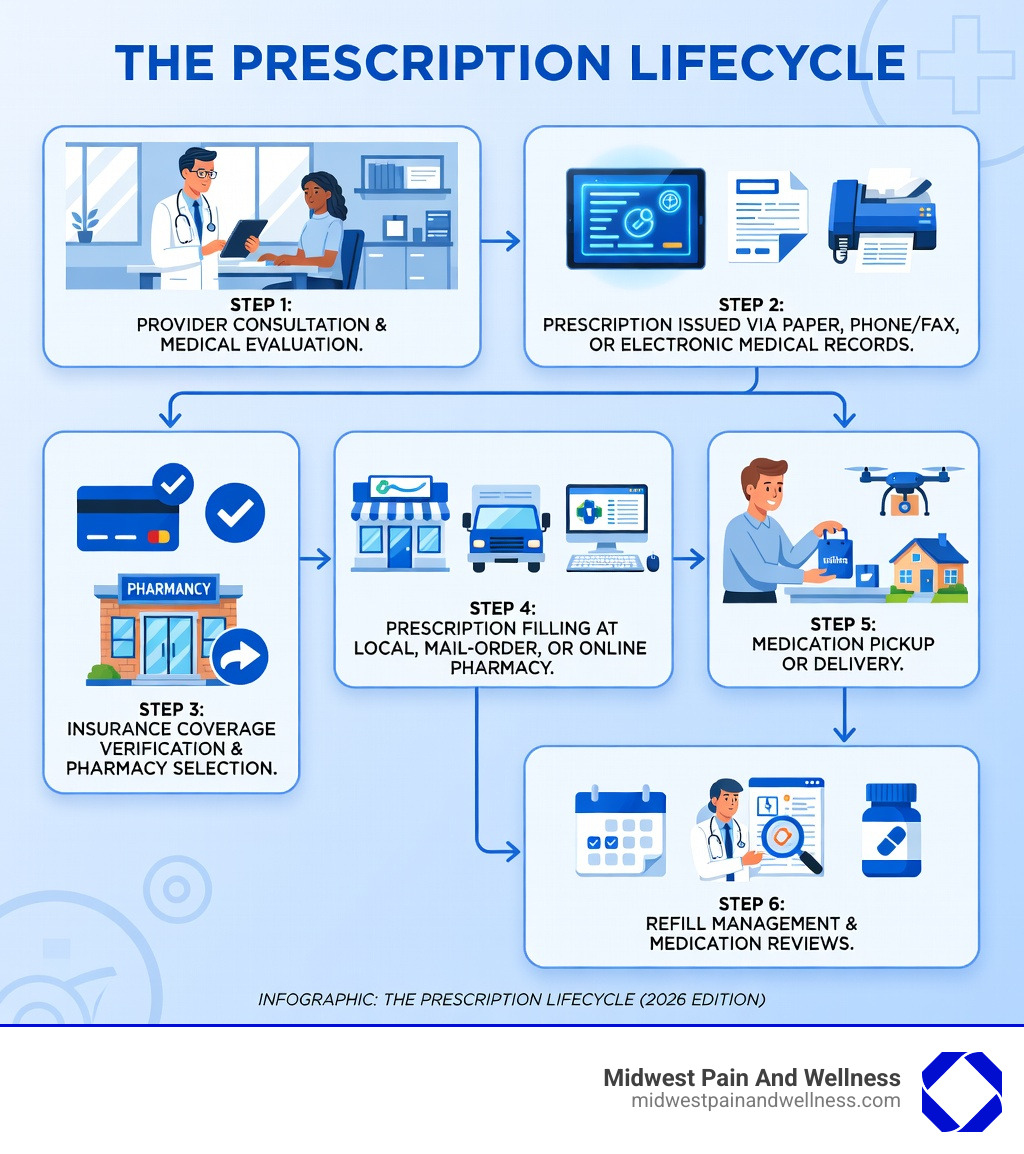
How to get prescription medications starts with a consultation with a healthcare provider who will evaluate your condition and determine if medication is appropriate. Here’s the quick overview:
Steps to Get a Prescription:
- Schedule an appointment with a doctor, nurse practitioner, or other qualified healthcare provider (in-person or via telehealth)
- Receive your prescription via paper script, phone/fax to pharmacy, or electronic transmission through medical records
- Check insurance coverage by calling the number on your insurance card or contacting your pharmacy directly
- Choose a pharmacy type – local, mail-order, or online – based on your medication needs
- Fill your prescription by providing your insurance card and prescription details
- Pick up or receive delivery of your medication according to your chosen method
Whether you’re managing chronic pain or need medication for another condition, understanding how to navigate the prescription process can save you time and reduce stress. The system has evolved significantly, with options ranging from traditional paper prescriptions to electronic submissions that send your medication order directly from your provider’s computer to your chosen pharmacy.
I’m Dr. Yaw Donkoh, a double board-certified physician in anesthesiology and interventional pain management. Throughout my career treating patients at Midwest Pain and Wellness, I’ve helped countless individuals understand how to get prescription medications safely and efficiently, especially those seeking relief from chronic pain conditions.
The Essential Guide on How to Get Prescription Orders
Getting a prescription isn’t just about walking into a pharmacy and asking for medicine. It is a regulated process designed to ensure that the medication you receive is safe, necessary, and appropriate for your specific health needs. In the United States, and specifically here in Illinois, the journey begins with a licensed healthcare professional.

There are three primary ways a provider can issue a prescription:
- Paper Scripts: The traditional method where the doctor writes the medication details on a pad and hands it to you. You then carry this physical piece of paper to any pharmacy of your choice.
- Phone or Fax: Your provider may call the pharmacy directly or fax the order. This is common for urgent needs or when you’ve already established a “preferred pharmacy” with your doctor’s office.
- Electronic Medical Records (EMR): This is the most modern and secure method. The prescription is sent digitally from the doctor’s computer directly to the pharmacy’s system. It reduces errors caused by messy handwriting and speeds up the process significantly.
For more detailed information on drug safety and health topics, the National Library of Medicine offers extensive resources. At Midwest Pain and Wellness, we see patients for a wide variety of issues. You can learn more about the Conditions We Treat to see if your symptoms align with the specialized care we provide.
Understanding the Provider Consultation
To understand how to get prescription orders, you must first understand the medical evaluation. A doctor cannot simply give you medication because you asked for it; they must perform a physical exam, review your medical history, and sometimes order diagnostic tests.
In recent years, telehealth has become a popular way to handle these consultations. During a virtual visit, we can discuss your symptoms and, if appropriate, send a prescription to your local Chicago Ridge pharmacy. However, for complex pain issues, we often recommend in-person evaluations to perform Treatment Procedures that provide long-term relief without relying solely on pills. Interventional therapies, such as nerve blocks or injections, are often more effective than oral medication for chronic conditions.
Risks of Sharing and Misuse
It might be tempting to borrow a pill from a friend who has similar symptoms, but this is incredibly dangerous. Every prescription is tailored to an individual’s weight, age, allergies, and existing medical conditions.
- Dosage Instructions: Taking too much can lead to toxicity, while taking too little may render the treatment ineffective.
- Drug Interactions: Some medications, when taken together, can cause life-threatening reactions. This is why we always ask for a full list of everything you are taking, including herbal supplements.
- FDA Safety Tips: The FDA provides guidelines on how to buy and use medicines safely. Always ensure your prescription information is clear and legible.
In some regions, systems like the Yellow Card Scheme allow patients to report side effects directly to regulators. In the US, your best line of defense is a strong relationship with your doctor and pharmacist.
Navigating Insurance Coverage and Pharmacy Options
Once you have the script in hand (or sent digitally), the next hurdle is often the cost. Understanding your insurance is key to a smooth experience at the pharmacy counter.
Comparing Local, Mail-Order, and Online Pharmacies
Not all pharmacies are created equal. Depending on whether you need a one-time antibiotic or a long-term medication for chronic pain, your choice of pharmacy might change.
| Pharmacy Type | Best For | Delivery Speed | Pros | Cons |
|---|---|---|---|---|
| Local Pharmacy | Acute issues (infections, sudden pain) | Immediate / Same-day | Personal contact with pharmacist; immediate access | May have higher co-pays for some plans |
| Mail-Order | Chronic, long-term medications | 1-2 weeks | Often cheaper; 90-day supplies; home delivery | Not for urgent needs; potential shipping delays |
| Online Pharmacy | Convenience; specific brands | 3-5 days | Easy to manage via apps; competitive pricing | Must verify legitimacy to avoid “rogue” sites |
Local pharmacies in Chicago Ridge are excellent for medications that require special storage (like refrigeration) or if you need to start the medication right away. Mail-order services, often managed by companies like Express Scripts, are fantastic for saving money on 3-month supplies of maintenance drugs.
Understanding Charges and Subsidies
The cost you pay at the window is rarely the full price of the drug. In the US, this is usually a “co-pay” determined by your insurance plan. To find out what you’ll owe, check your plan’s formulary—a list of covered drugs divided into “tiers.” Tier 1 is usually the cheapest (generics), while higher tiers cost more.
You can find more about navigating these costs on the HealthCare.gov insurance guide. While other countries have different systems—such as the flat $5 charge in New Zealand or the NHS system in the UK—US patients often rely on manufacturer coupons or subsidy cards. For example, some high-end weight loss medications like Wegovy have offered self-pay pricing programs as low as $149/month for specific doses to help bridge the gap for those without insurance coverage.
Managing Your Health: Online and Mail-Order Services
If you are looking for how to get prescription refills without leaving your house, digital services are the answer. Many modern pharmacies now allow you to manage your entire medicine cabinet from a smartphone app.
How to get prescription refills through digital apps
Using an app to manage refills can significantly reduce the “pharmacy fatigue” many patients feel. In systems like the UK’s NHS App, patients can track their prescription status in real-time. In the US, apps from major retailers or mail-order services offer similar features:
- 3-5 Day Readiness: Most digital requests take a few days to process.
- Tracking Labels: You can see when the doctor has approved the refill and when the pharmacist is “preparing” the medication.
- Barcode Usage: Some apps provide a digital barcode that you simply scan at the pharmacy for a touchless pickup.
For those using the NHS system abroad, the NHS App help page provides a great walkthrough of this digital workflow.
How to get prescription medications delivered to your home
Mail-order is a game-changer for people with limited mobility or busy schedules. When using these services, keep these rules in mind:
- Delivery Windows: Most offer 1-2 day delivery, but some provide same-day service for an extra fee.
- Requirements: For same-day delivery, someone usually must be home to sign for the package. If no one is home for a standard delivery, the post office may hold it for up to 15 days before returning it to the pharmacy.
- Cancellations: Most services give you a 10-day window to cancel an automatic refill after you receive a processing notification.
When ordering online, safety is paramount. The FDA BeSafeRx guide warns against websites that offer prescriptions without a doctor’s visit. Always use a pharmacy that requires a valid script from your healthcare provider. For more tips on the filling process, check out the MedlinePlus filling guide.
Handling Emergencies, Travel, and Medication Reviews
Life happens. You might lose your suitcase while traveling, or realize on a Sunday night that you’ve taken your last pill.
What to Do if You Run Out of Medication
If your GP or regular clinic is closed, don’t panic.
- Contact your pharmacist: They may be able to provide a small “emergency supply” (usually 3 days’ worth) if they have a record of your previous prescription.
- Urgent Care or NHS 111: If you are in a region with a public health line (like the UK), they can direct you to an out-of-hours prescriber. In Chicago Ridge, an urgent care center is your best bet for a temporary bridge script.
- Hospital Discharge: If you were recently in the hospital, your discharge papers often serve as a temporary authorization for a community pharmacist to fill your initial meds.
Managing Complex Medication Regimens
If you are taking multiple long-term medications (known as polypharmacy), you are at a higher risk for side effects and drug interactions. This is why we recommend a medicines review at least once a year.
During a review, your doctor or a clinical pharmacist looks at everything you’re taking to see if any medications can be stopped or if dosages should be adjusted. This is also the time to discuss “rejected” prescriptions. A prescription might be rejected if your insurance requires “prior authorization” or if the doctor believes the treatment is no longer suitable. You can find more Medicines review info to help prepare for your next appointment.
Frequently Asked Questions about Getting a Prescription
Can someone else pick up my prescription for you?
Yes, in most cases. A friend or family member can pick up your medication as long as they have your name, address, and date of birth. However, for controlled substances (like certain pain medications), the rules are stricter. The person picking it up may need to show a valid photo ID, and the pharmacist may call you to verify that you’ve given consent.
What prescriptions cannot be automatically refilled?
Controlled substances (Schedule II drugs), specialty medications that require strict monitoring, and certain prescriptions covered by government payers (like Medicare Part B) often cannot be set to “auto-refill.” You will need to manually request these each month, and in many cases, your doctor must send a brand-new electronic order every time.
How do I check if my insurance covers a specific brand?
The fastest way is to log into your insurance provider’s member portal and use their “Price a Medication” tool. Alternatively, you can call the number on the back of your insurance card and ask for a coverage check on a specific drug name. Always ask if there is a “preferred generic” available, as this will almost always be the most cost-effective option.
Conclusion
Navigating healthcare can be complex, but knowing how to get prescription orders filled shouldn’t be the hardest part of your day. By understanding the different ways providers issue scripts, the benefits of various pharmacy types, and how to manage your insurance, you can take control of your health journey.
At Midwest Pain and Wellness, we are committed to helping our patients in Chicago Ridge find long-term relief. We specialize in comprehensive, opioid-free pain management, utilizing a multi-modal approach that combines interventional therapies with custom care plans. Whether you are dealing with joint pain or seeking Botox for Chronic Migraine, our double board-certified doctors are here to support you.
Don’t let the stress of managing medications hold you back. Reach out to us today to create a plan that works for your life and your health.