If you rely on Botox for chronic migraine or cervical dystonia, it's normal to worry when a treatment that helped so much starts feeling less predictable. A patient in Orland Park or Palos Heights might notice headaches returning sooner, neck tightness creeping back earlier than expected, or a treatment cycle that just doesn't feel as strong as the last one. The first fear is usually the same. “Am I becoming resistant?”
That concern is understandable, but it helps to separate fear from what happens in practice. True immune resistance can occur, but it's uncommon. Much more often, a reduced response comes from factors that can be reviewed and corrected, such as dose selection, injection technique, treatment timing, or expectations about how long relief should last.
For patients in Chicago Ridge, Oak Lawn, Bridgeview, Evergreen Park, Worth, Hickory Hills, Alsip, Burbank, Palos Hills, Palos Heights, and Orland Park, the most useful approach is not to panic or chase faster repeat injections. It's to understand what Botox resistance really means, what raises the risk, and what practical steps protect long-term results.
Your Guide to Maintaining Botox Effectiveness Long-Term
Botox works by interrupting abnormal muscle signaling. In pain medicine, that can mean fewer migraine days, less muscle overactivity, and better daily function. When it works well, people often want to keep that relief going for years. That long view matters, because preventing resistance is mostly about how treatment is managed over time.
Patients often assume the best prevention strategy is to switch brands early, ask for more units, or schedule a quick touch-up the moment symptoms start returning. In reality, those aren't usually the smartest first moves. The better strategy is measured and disciplined. Use the smallest dose that still does the job. Keep treatments appropriately spaced. Reassess carefully if response changes.
Practical rule: If Botox seems less effective, don't assume your body has rejected it. First ask whether the treatment plan, timing, and injection approach still fit your condition.
A clear clinical framework is helpful. Begin by asking one question: is this true resistance, or is it pseudo-resistance? True resistance means the immune system has developed neutralizing antibodies that interfere with the medication. Pseudo-resistance means the result seems weaker, but the reason is something else, often something fixable.
That distinction gives patients a better way to think about how to prevent Botox resistance. Instead of reacting emotionally to one disappointing cycle, you look at the full picture:
- Treatment timing and whether sessions have been too close together
- Dose history and whether treatment has drifted higher than necessary
- Technique and whether placement matches the actual pain pattern or muscle targets
- Expectations and whether symptom return is being mistaken for total treatment failure
When patients understand those trade-offs, they make better decisions and avoid the one habit that causes trouble most often: retreating too soon.
What Is Botox Resistance A Look at the Science
Botox resistance isn't one single problem. Clinically, I think of it as two very different categories that happen to get lumped under the same phrase. One is true immunogenic resistance. The other is the far more common problem of pseudo-resistance.
The distinction matters because the solutions are different. If you treat pseudo-resistance as if it's true immune resistance, you can make the situation worse by increasing exposure too quickly or changing products before you've identified the actual issue.

True immunogenic resistance
True resistance means the body has created neutralizing antibodies against botulinum toxin. A simple way to think about it is this: the immune system starts recognizing the treatment as something foreign and blocks it before it can do its job at the nerve ending.
That sounds alarming, but it's important to keep the scale in perspective. One patient resource summarizing the issue notes that many “Botox resistance” cases are pseudo-resistance from placement or dosing, while true neutralizing-antibody resistance is estimated at about 1 in 10,000 patients and another independent study found 1.5% developed neutralizing antibodies, suggesting technique and treatment planning are much more common reasons for a reduced response (patient guidance on Botox resistance and prevention).
Pseudo-resistance is more common
Pseudo-resistance means the treatment seems to have stopped working, but the cause isn't an antibody problem. In practice, most troubleshooting begins with this scenario.
Common reasons include:
- Dose mismatch: The dose may be too low for the current symptom burden, or too spread out across targets.
- Injection placement issues: The right medication in the wrong muscle, depth, or pattern won't produce the expected result.
- Condition changes: Chronic migraine patterns evolve. Cervical dystonia can recruit different muscles over time.
- Expectation gaps: Some patients remember their best cycle and compare every later treatment to that benchmark, even if today's relief is still clinically meaningful.
- Timing confusion: Symptoms returning near the end of a cycle doesn't automatically mean resistance.
Reduced benefit doesn't prove antibody formation. It often signals that the treatment plan needs review.
What patients should listen for
When I discuss this with patients, I focus less on labels and more on clues. If Botox worked well for a long time and now seems less precise, shorter acting, or inconsistent, that doesn't automatically point to immune resistance. It may mean your injector needs to revisit muscle selection, dosing distribution, or the reason you're being treated in the first place.
A good evaluation usually includes a review of:
- What changed first. Duration, strength of effect, or onset.
- Whether the injection pattern changed between cycles.
- Whether you had early retreatment or top-ups in prior sessions.
- Whether your underlying condition has shifted since the original plan was created.
Why this science should reassure you
The biggest mistake patients make is assuming a weaker cycle means Botox has failed permanently. That's usually not the case. The science supports a calmer, more practical response. First rule out the common explanations. Then decide whether anything about the schedule, product, or injection strategy needs to change.
That approach protects you from overtreatment and helps preserve long-term effectiveness, which is the main goal.
Your First Line of Defense Dosing and Timing Strategies
If you want a direct answer to “How do I prevent Botox resistance?” it starts with two variables that matter more than anything else. Dose and interval.
Those aren't glamorous answers, but they're the ones that hold up clinically. Most prevention advice comes back to reducing unnecessary antigen exposure over time. In plain language, that means avoiding more Botox than you need and avoiding injections sooner than you need them.
Why the lowest effective dose matters
More toxin doesn't automatically mean better durability. It can sometimes mean more exposure without more benefit. The smarter strategy is to find the lowest effective dose that produces reliable symptom control and then stay disciplined about reassessment.
A systematic review and meta-analysis reported overall neutralizing antibody formation rates of only 0.2% to 0.4% in aesthetic botulinum toxin A use, but it also emphasized cumulative immunogenic risk with long-term treatment. In the same evidence base, a 2024 survey of 673 clinicians found the most common prevention step was keeping treatment intervals more than 3 months (54.8%), followed by choosing products with lower resistance potential (47.0%), reducing the amount used per session (28.2%), and minimizing re-administration (14.9%) (systematic review and clinician survey on prevention strategies).
What does that mean for a patient in Evergreen Park or Bridgeview? It means asking for “a little extra just in case” isn't always harmless. If the current dose is working, pushing it higher without a clear reason may not improve outcomes and can work against long-term planning.
A careful dose strategy usually looks like this:
- Start with a defined goal: Fewer migraine attacks, less neck pulling, less muscle spasm, or better function.
- Match the dose to that goal: Not to anxiety about symptom return.
- Document the response: How long it helped, how strong the benefit was, and what wore off first.
- Adjust only when the pattern justifies it: Not because one cycle felt imperfect.
Timing is where many problems begin
The most common preventable mistake is retreating too early. Patients often feel a few symptoms returning and assume the treatment has “failed.” Then they ask for a quick booster. From an immunologic standpoint, that repeated short-interval exposure is exactly what you want to avoid.
The practical message is simple. Let the treatment cycle breathe.
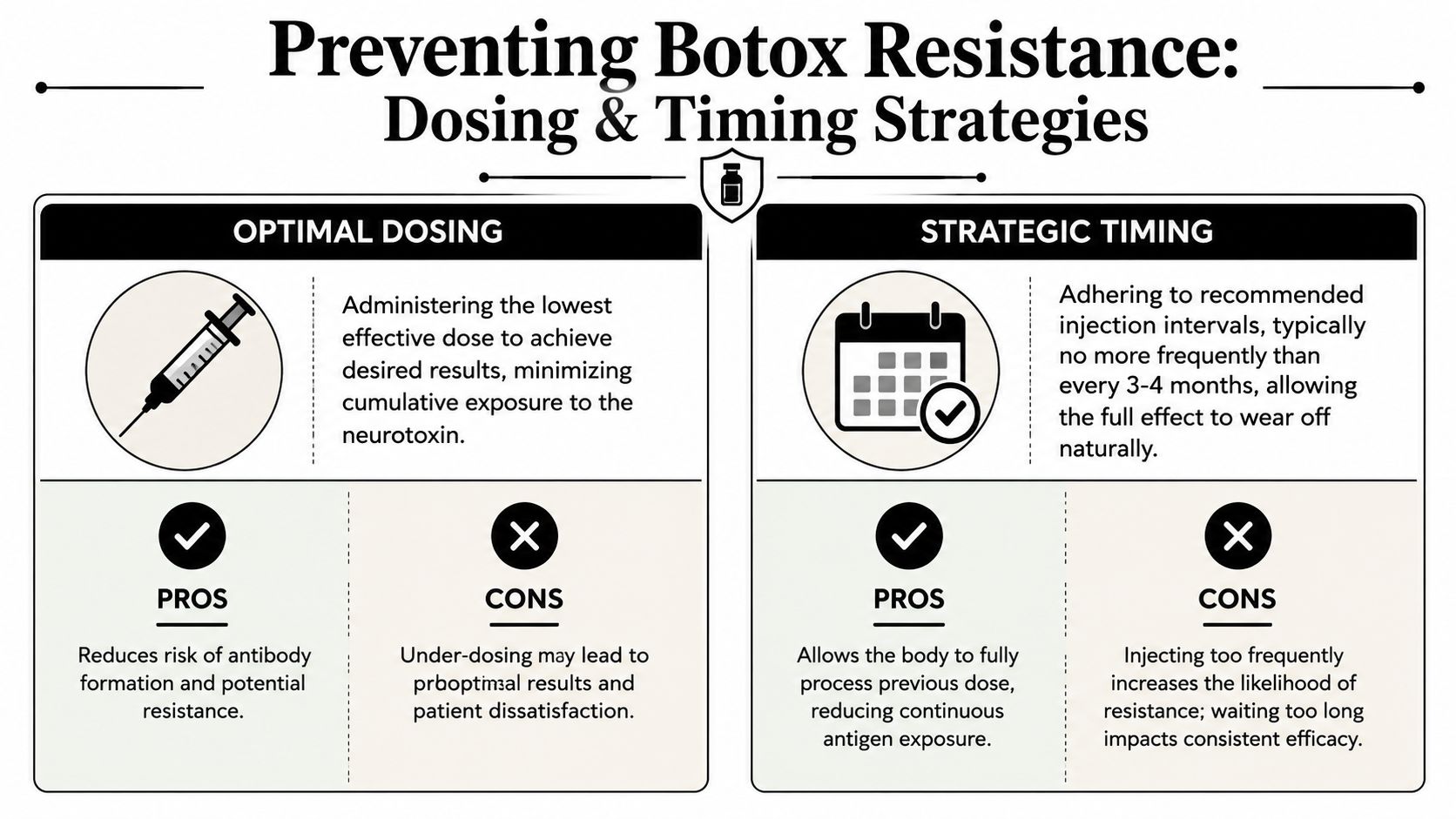
For many therapeutic uses, a 12-week interval is the standard benchmark. That's one reason chronic migraine treatment protocols are built around that rhythm. If a patient seeks repeat treatment much earlier, the right response usually isn't “come in next week.” It's “let's review why the response feels different.”
The urge to top up early is understandable. It still isn't usually the right move.
What works and what doesn't
A lot of prevention advice becomes clearer when you sort it into habits that help versus habits that create risk.
| Approach | More likely to help | More likely to create problems |
|---|---|---|
| Dosing | Use the lowest effective dose that still meets the treatment goal | Escalate dose automatically because one cycle felt weaker |
| Scheduling | Keep sessions appropriately spaced, often at least 12 weeks for therapeutic use | Book short-interval retreatments because symptoms started to return |
| Follow-up | Review what changed before altering the plan | Assume every short-lived result is true resistance |
| Expectations | Track pattern over multiple cycles | Judge success only by whether relief felt perfect every week |
Patients who want to understand broader procedural options for headache and pain care can review treatments used in interventional pain management, but the key principle here stays the same. Long-term success depends more on disciplined scheduling and sensible dosing than on chasing instant corrections.
The patient side of prevention
You play a role in this too. Prevention isn't just what the injector does. It's also what the patient avoids asking for.
- Don't push for early touch-ups unless your clinician identifies a specific reason.
- Don't compare yourself to someone else's schedule because migraine and dystonia patterns vary.
- Don't assume more units mean stronger care.
- Do keep records of benefit, duration, and symptom return.
That kind of consistency is one of the best ways to prevent Botox resistance over the long term.
The Clinician's Role in Preventing Resistance
Patients usually focus on the product name. Clinicians should focus on the entire treatment system. Product selection matters, but so do injection precision, target selection, handling, and judgment about when not to treat.
A large multicenter clinician survey adds some useful perspective here. In a 2024 survey of 3,140 participants, 363 clinicians (53.9%) reported encountering botulinum toxin resistance in practice. The leading cause they identified was short intervals between procedures (48.3%), followed by high-dose use (21.8%) and a higher-protein 900 kDa botulinum toxin-A formulation (20.9%). When resistance was suspected, the most common response was switching to a different company's product (43.7%), and 26.4% specifically switched to a 7S botulinum toxin formulation believed to cause fewer immune reactions (multicenter clinician survey on resistance causes and management).
Technique changes outcomes
The same number of units can perform very differently depending on where they go. That's especially true in pain medicine, where Botox isn't being used only for appearance. Chronic migraine requires a deliberate pattern. Cervical dystonia requires careful muscle selection based on the patient's exact pull, posture, and pain map.
An experienced injector helps prevent pseudo-resistance by getting several technical details right:
- Muscle targeting: Choosing the muscles driving symptoms
- Depth and placement: Delivering the medication where it can work best
- Dose distribution: Avoiding the mistake of placing too much in one area and too little in another
- Reassessment: Updating the pattern when the condition evolves
If those pieces are off, the patient may think the drug stopped working when the underlying issue is that the treatment didn't match the current anatomy or symptom pattern.
Product choice is a tool, not a shortcut
Botox, Xeomin, Dysport, and Azzalure aren't interchangeable in every practical sense. Their formulations differ, and some clinicians consider product selection part of resistance prevention or management. That can be reasonable, especially when response has changed over time.
Still, product switching shouldn't become a reflex. Fewer than half of clinicians in the prevention-focused discussion cited product selection as a primary prevention tactic. That tells you something important. Fundamentals come first. Dose and timing still do the heavy lifting.
Good injectors don't jump straight to “you need a different brand.” They first ask whether the plan, the pattern, and the interval still make sense.
Why specialist experience matters
This is one reason patients should be selective about who manages therapeutic Botox. A clinician treating chronic migraine or cervical dystonia needs more than familiarity with the vial. They need pattern recognition, procedural precision, and enough experience to tell true loss of response from a fixable treatment issue.
If you'd like to understand the background of the physician directing that type of care, Dr. Donkoh's clinical profile and training offer useful context on the interventional pain perspective. That expertise matters most when treatment stops following a simple script and needs thoughtful adjustment instead of guesswork.
When Botox Seems Less Effective Troubleshooting Steps
The worst response to a weaker treatment cycle is a rushed one. If Botox seems less effective, the next step shouldn't be a panic call asking for immediate reinjection. It should be a structured review.
The goal is to answer one question carefully. Is this a temporary treatment-plan problem, or is there a real reason to suspect resistance?
Start with a symptom record
For chronic migraine, a headache diary is extremely useful. For cervical dystonia, a log of neck pulling, muscle spasm, pain pattern, sleep disruption, and functional limits can help the same way. Memory is unreliable, especially when pain fluctuates.
Write down:
- When the benefit started
- How strong the benefit felt
- When symptoms began returning
- Whether the return was gradual or abrupt
- What symptoms came back first
Those details help your clinician spot patterns. A gradual return late in the cycle is different from no meaningful response at all.
Review the basics before assuming resistance
A stepwise approach is the most practical one when resistance is suspected. One clinical resource notes that premature retreatment, especially top-up injections within 3 weeks, can increase antigenic stimulation and should be avoided. It also advises maintaining at least 12 weeks between sessions. For confirmed resistance, a treatment holiday of 6 to 12 months or a switch to a more purified formulation are common strategies, while true neutralizing-antibody resistance remains very rare, with estimates as low as less than 1.5% (clinical guidance on suspected Botox resistance and treatment holidays).
That gives patients a practical order of operations.
- Check the interval. Were treatments given too close together?
- Review the injection pattern. Was the same plan used, or did targets change?
- Look at the dose history. Has the amount gradually increased or decreased?
- Clarify the complaint. Shorter duration is not the same as zero response.
- Consider product strategy only after the basics are reviewed.
Signs to discuss with your doctor
The table below isn't a diagnosis tool. It's a conversation starter.
| Symptom or Sign | More Likely to be Pseudo-Resistance (Common) | More Likely to be True Resistance (Rare) |
|---|---|---|
| Relief was good in prior cycles, then became less consistent | Yes | Possible |
| Benefits still happen, but they wear off earlier than expected | Yes | Less typical |
| The injection pattern or clinician changed | Yes | No |
| Symptoms improved only partially in one cycle | Yes | Less typical |
| No meaningful effect despite previously correct technique and adequate prior response | Possible | More concerning |
| Early top-ups or very short intervals happened in past cycles | Yes, and also raises concern about future risk | Possible contributor |
| The problem improves after plan adjustment | Yes | Less likely |
| Loss of response persists across repeated, well-executed cycles | Less likely | More concerning |
What management may look like
If the concern turns out to be pseudo-resistance, treatment usually focuses on refining the plan. That might mean changing muscle targets, adjusting the amount used, improving timing, or correcting expectations about onset and duration.
If the concern for true resistance is stronger, your clinician may consider options such as:
- A treatment holiday: Allowing time before re-exposure
- A product switch: Sometimes to a more purified formulation
- A deeper record review: Looking back at prior intervals, dosing, and injection mapping
- Reassessment of diagnosis: Making sure the original condition still explains the current symptoms
A weaker cycle should trigger analysis, not automatic reinjection.
What not to do
Patients can accidentally make this harder by trying to self-direct the answer. Common missteps include asking for a higher dose immediately, insisting on a different brand before review, or scheduling too early because “last time it faded faster.”
Those moves may feel proactive, but they can blur the clinical picture. A careful troubleshooting process gives your provider a better chance of preserving long-term effectiveness and avoiding unnecessary exposure.
Navigating Treatment for Chronic Migraine and Cervical Dystonia
Botox isn't used the same way for every condition. That matters when you're thinking about long-term durability. A patient in Burbank with chronic migraine and a patient in Alsip with cervical dystonia may both receive botulinum toxin, but the prevention strategy isn't identical because the treatment goals and muscle targets differ.
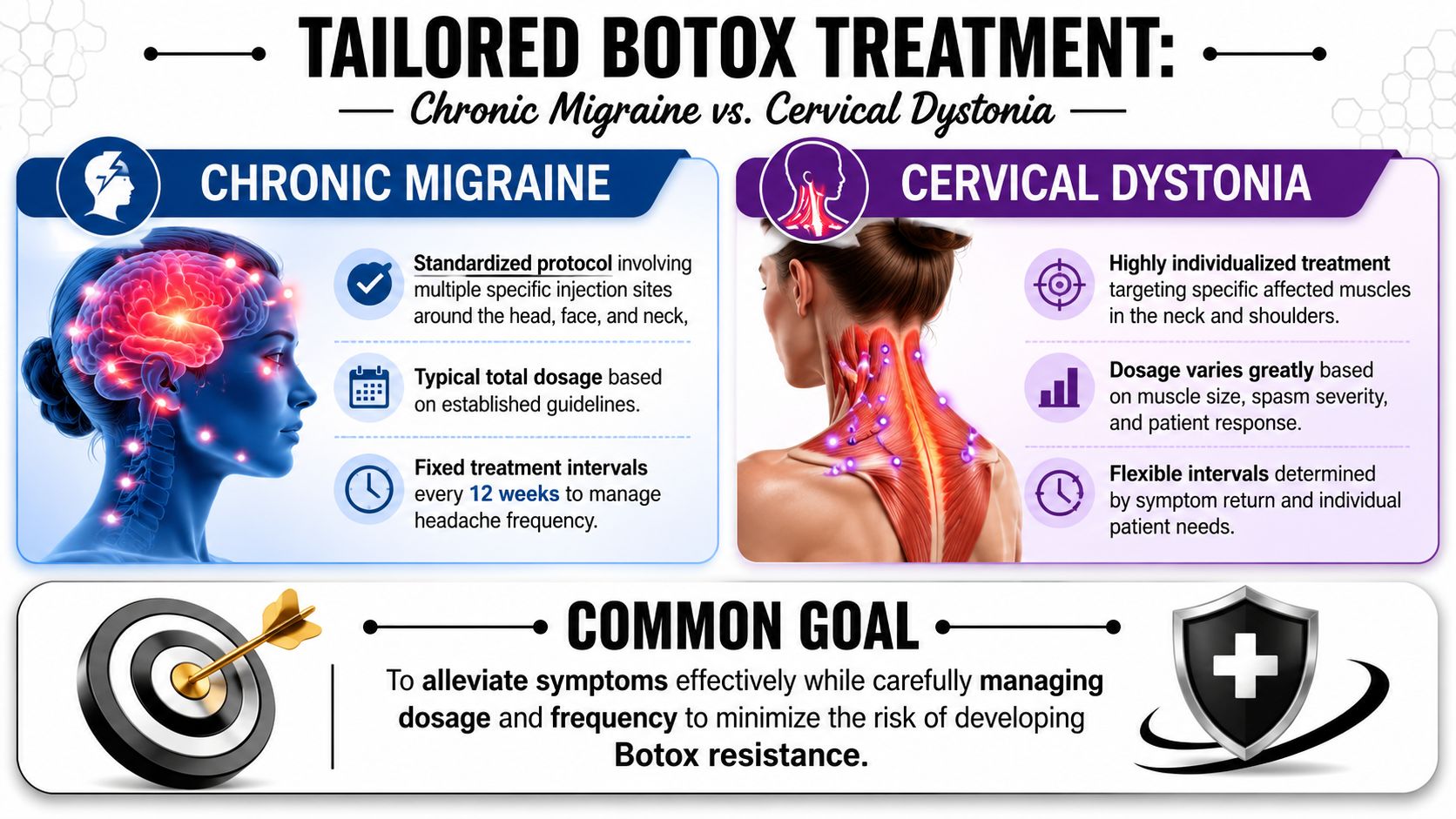
Chronic migraine requires consistency
For chronic migraine, patients often do best when treatment follows a stable rhythm. The challenge is that migraine relief can make people eager to move sessions closer together when headaches begin creeping back. That's understandable, but it can create the wrong habit over time.
A practical example is the patient who gets meaningful relief for most of the cycle, then starts getting anxious during the last few weeks. The answer usually isn't to compress the schedule on the fly. It's to review the pattern across several cycles and decide whether the protocol still fits the current headache burden.
Cervical dystonia often needs more tailoring
Cervical dystonia is less standardized. One patient's pain may come from rotational pull. Another may have shoulder elevation, posterior neck spasm, or complex muscle recruitment that changes over time. That means the injection pattern often needs more customization.
The key trade-off is straightforward. Dystonia may require broader muscle selection and sometimes higher overall treatment intensity than cosmetic use, but that doesn't mean “more is better.” It means the injector has to be selective. The right muscles need treatment. The wrong ones should be left alone.
What both groups should do before changing brands
For patients concerned about resistance, the first move isn't always switching products. A practice-focused discussion notes that clinicians often take a broader approach by verifying injector technique, reviewing dosing history, and making sure intervals are respected. It also points out that fewer than half of clinicians cited product selection as a primary prevention tactic, which supports focusing first on the fundamentals of dose and timing (clinical discussion of resistance prevention and stepwise decision-making).
That principle applies to both chronic migraine and cervical dystonia:
- Review the diagnosis: Are today's symptoms still coming from the same problem?
- Review the map: Are the same muscles still the right targets?
- Review the interval: Has scheduling drifted too early?
- Review the response pattern: Was there less benefit, or just shorter duration?
Patients who want to see how migraine, neck pain, and related disorders fit into a broader pain care plan can explore the conditions commonly treated in interventional pain practice. The main clinical message stays the same. Long-term success depends on a personalized plan, not on chasing quick fixes.
Your Partner in Long-Term Pain Relief
The most reassuring truth about Botox resistance is that a disappointing cycle doesn't usually mean the treatment is over. True immune resistance is rare. More often, the issue is timing, targeting, dose strategy, or a change in the underlying condition.
That means prevention is practical. Keep intervals appropriate. Avoid early top-ups. Use the lowest effective dose. If results change, review the plan before assuming the medication has stopped working. Patients who do that tend to make better long-term decisions and avoid the overtreatment patterns that create preventable problems.
The other takeaway is that Botox works best as part of an ongoing clinical relationship, not as a series of isolated injections. Chronic migraine and cervical dystonia both change over time. Good care changes with them. The right response is thoughtful reassessment, not guesswork.
For patients in Chicago Ridge and nearby Illinois communities such as Oak Lawn, Palos Hills, Palos Heights, Worth, Bridgeview, Hickory Hills, Alsip, Burbank, Evergreen Park, and Orland Park, the goal isn't just temporary relief. It's durable function, fewer setbacks, and a plan designed to protect treatment effectiveness for the long run.
If you're concerned that Botox isn't lasting like it used to, schedule a consultation with Midwest Pain & Wellness. The team can review your treatment history, clarify whether you're dealing with true resistance or a more common pseudo-resistance pattern, and build a personalized, opioid-sparing plan for chronic migraine, cervical dystonia, and other pain conditions.