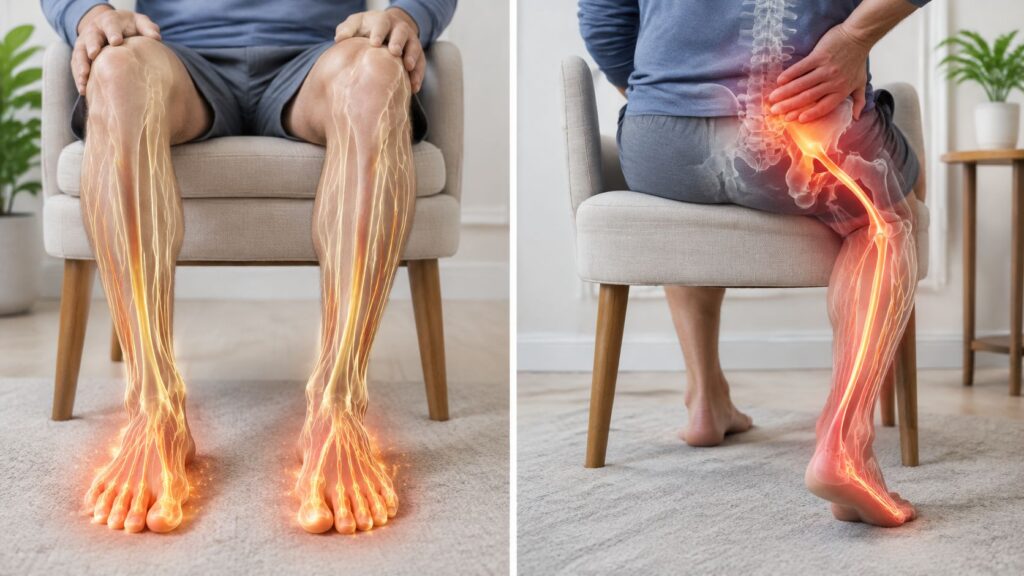
If you can walk only part of a grocery aisle before your legs start burning, aching, or feeling weak, you're not imagining it. Many people with lumbar spinal stenosis develop a very specific pattern. Standing still feels bad, walking gets worse, and sitting down or leaning forward over a cart finally gives some relief.
That pattern matters because it points to a specific pain generator, not just “general back pain.” When the problem is neurogenic claudication from lumbar spinal stenosis, the right treatment path often looks different from the path for a disc injury, muscle strain, or arthritis alone. Some patients do well with medication, targeted exercise, or injections. Others reach a point where conservative care just isn't enough, but they still want to avoid a larger spine surgery if possible.
The Vertiflex Superion procedure sits in that middle ground. It was developed for a narrow, well-defined group of patients with moderate lumbar spinal stenosis and leg-dominant symptoms that worsen when standing or walking. For the right person, it can be a practical next step when months of non-operative treatment haven't restored function.
Finding Relief When Standing and Walking Becomes a Burden
A common story sounds like this. You can sit through dinner. You can drive. You may even sleep reasonably well. But the moment you stand in line, walk through a store, or try to make it around the block, the pain starts building in your low back, buttocks, or legs.
Many patients describe it as losing trust in their own body. They plan outings around benches. They lean on shopping carts because that slight forward bend gives relief. They stop going to events because parking lots, stadium steps, and long hallways become obstacles.
That pattern often points toward lumbar spinal stenosis with neurogenic claudication rather than a simple muscle problem. It also explains why people get frustrated when rest, medication, or repeated short-term treatments help only a little. If the spine is narrowing in a way that pinches the nerves when you stand upright, temporary symptom control may not be enough.
For patients in Chicago Ridge and nearby Illinois communities, the decision usually comes after trying the basics first. They've already looked into exercise, medication, injections, or other options for managing spinal stenosis symptoms. What they want next is clarity. Is there a treatment that's more targeted than ongoing conservative care, but less invasive than open surgery?
That's where the Vertiflex Superion procedure becomes part of the conversation. It isn't for every form of back pain. It isn't a catch-all solution. But for the right spinal stenosis pattern, it was designed to address the mechanical problem that shows up when standing and walking become the hardest parts of the day.
Many patients don't need a bigger surgery first. They need the right diagnosis first.
What Is Lumbar Spinal Stenosis
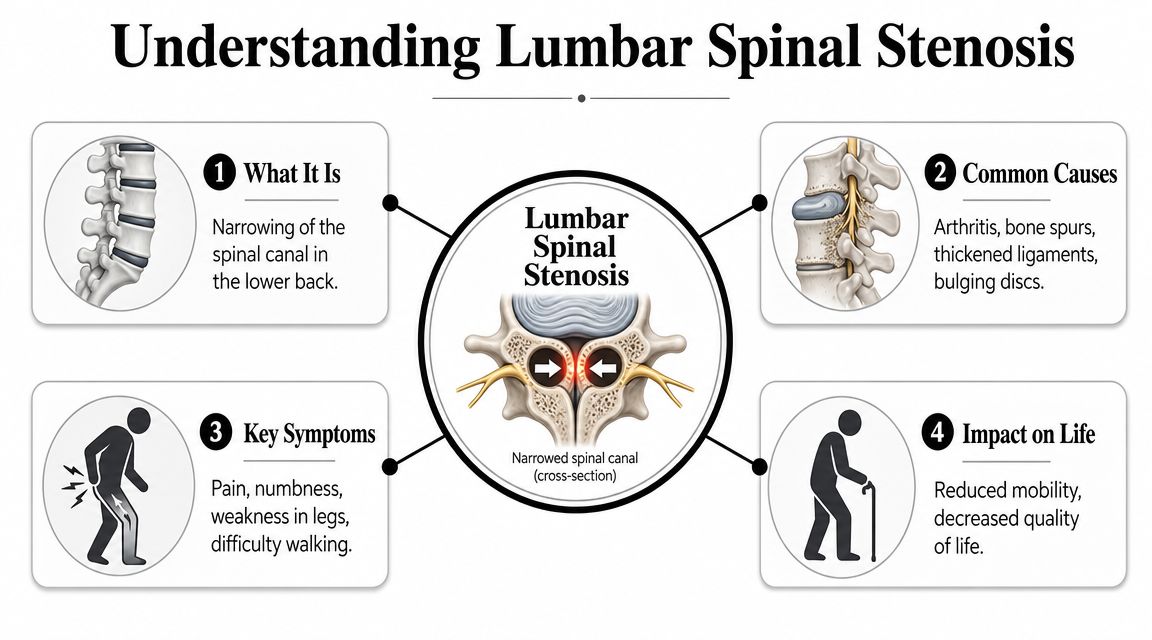
Lumbar spinal stenosis means there's a narrowing in the lower part of the spine where nerves travel. It's similar to a garden hose that has been partially pinched. Water can still move through, but not freely. In the spine, that “hose” is the space around the nerves, and when that space gets tighter, the nerves become irritated.
Why symptoms change with posture
This condition often behaves in a way that confuses people at first. You'd think standing upright would help your back. With stenosis, the opposite often happens. Standing and walking can narrow the space more, which increases pressure on the nerves.
Sitting or bending forward usually opens that space a bit. That's why someone may be miserable walking across a parking lot but feel noticeably better after sitting on a bench for a few minutes. It's also why leaning over a shopping cart can feel surprisingly helpful.
Common symptoms can include:
- Leg pain with walking: Pain may move into the buttocks, thighs, or calves.
- Numbness or tingling: Nerves under pressure can create pins-and-needles sensations.
- Weakness or heaviness: Some people say their legs feel tired long before they should.
- Relief with sitting: That posture clue is often one of the most useful diagnostic details.
What causes the narrowing
Lumbar spinal stenosis usually develops from wear-and-tear changes in the spine. Discs, joints, ligaments, and bony structures can all contribute to reduced room for the nerves. The important point for patients is that the pain isn't random. There is often a structural reason behind the walking intolerance.
Not every person with spinal narrowing has the same symptoms. Some have more back pain. Others have more leg symptoms. Some have mixed pain from several sources at once, which is why a careful evaluation matters before choosing a procedure.
When symptoms improve with sitting and worsen with standing, that pattern gives your pain specialist a strong clue about where the problem is coming from.
How the Vertiflex Superion Procedure Works
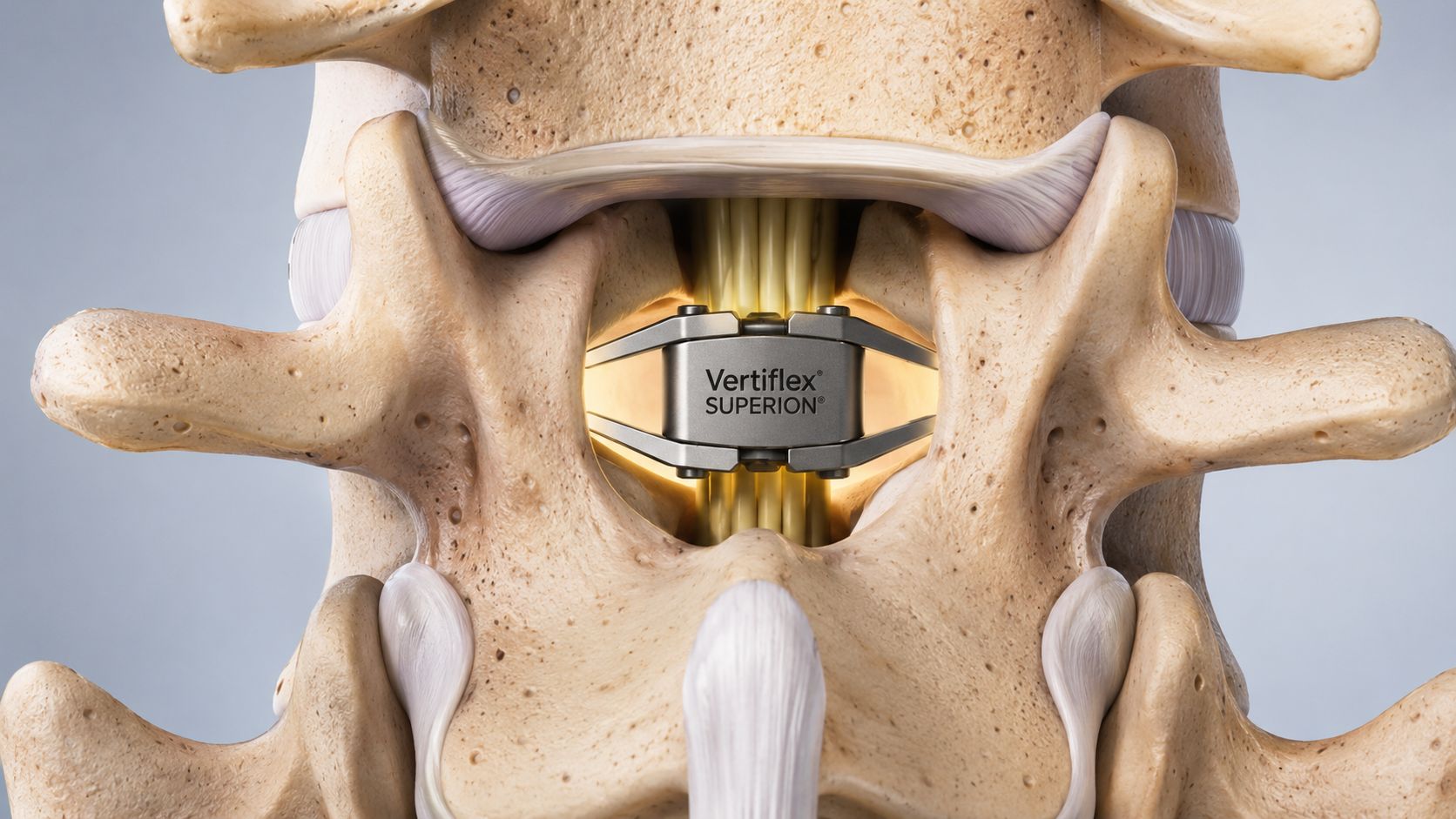
The Vertiflex Superion procedure uses a small implant to help maintain space in the lower spine where the nerves are getting crowded. The device is a titanium interspinous spacer made from titanium 6Al-4V ELI alloy, and it's designed to sit between the lumbar spinous processes to provide indirect decompression by preserving flexion-dependent canal opening, as described in the Boston Scientific device labeling.
A simple way to picture it
A useful analogy is a tiny car jack placed in exactly the right spot. It doesn't remove bone. It doesn't fuse the spine. Its job is to help hold open the space that tends to collapse down when you stand upright.
That's why the term indirect decompression matters. Traditional decompression surgery often creates room by removing tissue or bone. Vertiflex works differently. It aims to create more room for the nerves by controlling the position between the spinal bones in the back of the spine.
Why that approach appeals to some patients
For the right anatomy, this can be a very sensible middle option. It addresses the mechanical issue behind neurogenic claudication without jumping straight to a more extensive operation. It also preserves future choices. If someone later needs another procedure, this type of treatment doesn't automatically close the door on other options.
That matters in real practice. Some patients are clearly headed toward open decompression because their stenosis is severe or their anatomy is unstable. Others have a narrower problem that may respond well to a spacer-based approach. The art is knowing which category you're in.
Patients sometimes ask how this compares with other minimally invasive options such as MILD for lumbar stenosis. The answer depends on what is causing the narrowing. If thickened ligament is the main issue, one option may make more sense. If posture-dependent collapse between the spinous processes is a better match, Vertiflex may fit the problem more directly.
What works and what doesn't
Vertiflex tends to make the most sense when the pain pattern is classic for stenosis. It's less compelling when the symptoms are coming mostly from something else, such as a different nerve issue, marked instability, or another major structural pain generator.
It's also important to keep expectations realistic. The goal isn't to make the spine young again. The goal is to reduce nerve crowding enough that standing and walking become more tolerable and daily life opens back up.
Are You a Good Candidate for Vertiflex
Considering specific factors makes many treatment conversations more useful. A lot of procedures sound good in general terms. Vertiflex is better understood by asking a stricter question. Does your history, imaging, and symptom pattern fit the group it was studied for?
According to the FDA instructions for use for Superion, the procedure was studied for moderate lumbar spinal stenosis in adults 45 or older with neurogenic intermittent claudication at one or two contiguous levels from L1 to L5 after at least 6 months of non-operative treatment. The same FDA document also notes that spinous process fractures can occur with implantation, which is part of the trade-off discussion patients deserve to hear.
Signs you may fit the profile
You may be closer to a good Vertiflex candidate if several of these are true:
- Your symptoms are posture-dependent: Standing and walking bring on pain, numbness, weakness, or heaviness in the legs. Sitting or bending forward helps.
- Your imaging matches the story: An MRI or similar study shows moderate degenerative lumbar spinal stenosis in the lower back.
- Conservative care hasn't held up: You've already spent time on non-operative treatment and still can't function the way you need to.
- The problem is limited in scope: The stenosis is at one or two neighboring levels, not a broad multilevel problem with major instability.
- You want a smaller intervention: You're looking for something between repeated temporary measures and open decompression surgery.
Situations that deserve extra caution
Not every patient with stenosis should get a spacer. Borderline anatomy matters. Mixed pain sources matter. If someone has scoliosis, instability concerns, significant obesity-related technical issues, or pain that seems to come from several places at once, the decision takes more nuance than a website checklist can provide.
One clinician-facing discussion notes that scoliosis doesn't automatically rule the procedure out, but a Cobb angle above 10 degrees may make it unsuitable because of possible implant instability, which reflects a candidacy gap that many patient pages don't explain well, as noted in this discussion of scoliosis and Vertiflex selection.
Practical rule: The better your symptoms, imaging, and daily limitations line up with classic neurogenic claudication, the more sense it makes to discuss Vertiflex seriously.
Questions worth asking at your consultation
A good evaluation usually includes questions like these:
- Where is the narrowing, exactly? One level and two levels are different conversations from widespread stenosis.
- Is the pain mostly in the legs, the back, or both? Vertiflex is typically more compelling when the stenosis pattern is driving leg symptoms with walking.
- What already failed, and why? If conservative care helped briefly but didn't last, that tells us something.
- Is there a reason to choose another procedure instead? Sometimes MILD, laminectomy, or another path is the more logical fit.
What to Expect During and After the Procedure
From the patient's point of view, the Vertiflex experience is usually much less dramatic than people fear. This is typically a minimally invasive outpatient procedure. You come in, have the treatment, recover briefly, and go home the same day rather than staying in the hospital.
A clinical description places the procedure time at 15 to 45 minutes under local anesthesia, and it's positioned as a faster-recovery option than open decompression surgery in this clinical overview of the Vertiflex procedure. In practice, that shorter and less invasive setup is one reason many patients consider it after months of unsuccessful conservative care.
The day of the procedure
You'll typically arrive, review the plan, and get positioned for the procedure. The treatment is done through a small incision, and the physician uses real-time fluoroscopy, which is live X-ray guidance, to place the implant accurately.
Most patients are relieved to learn that this isn't the same experience as open spine surgery. There's no large incision, no broad dissection, and no long inpatient recovery built into the standard process. That doesn't mean it's casual. It means the procedure is targeted.
Early recovery and the first few days
Afterward, many people feel a mix of relief and caution. Relief because the procedure itself is over and usually manageable. Caution because the back still needs time to settle down. You may have soreness at the procedure site, and activity instructions matter.
A realistic recovery mindset helps:
- Expect a short recovery window, not an instant reset: The goal is progress, not perfection on day one.
- Follow lifting and activity guidance carefully: Even minimally invasive spine procedures need respect.
- Pay attention to walking tolerance: Daily function often tells the story better than pain scores alone.
Most patients care less about the incision than about this question: Can I stand longer and walk farther without needing to sit down?
What you should and shouldn't expect
You should expect a procedure designed to reduce nerve crowding with less disruption than open surgery. You shouldn't expect it to solve every source of low back pain if multiple problems are present.
That distinction matters. The best outcomes usually happen when the procedure matches the problem precisely.
Comparing Vertiflex to Other Spine Treatments
By the time many patients ask about Vertiflex, they are usually past the stage of trying one more round of medication, one more injection, or one more course of physical therapy and hoping walking gets easier. The decision is often narrower than that. It becomes a choice between staying with treatments that are no longer restoring function, trying a minimally invasive decompression option, or considering surgery.
That decision should be based on the actual cause of symptoms.
Treatment options for lumbar spinal stenosis
| Treatment | Invasiveness | Mechanism | Ideal For |
|---|---|---|---|
| Conservative care | Lowest | Tries to reduce symptoms with medication, exercise, activity changes, and injections | Early treatment, mild symptoms, or patients still sorting out the diagnosis |
| MILD | Minimally invasive | Removes tissue contributing to stenosis in selected cases | Patients whose anatomy suggests ligament-related narrowing is a major driver |
| Vertiflex Superion | Minimally invasive | Indirect decompression with an interspinous spacer | Patients with moderate stenosis and classic neurogenic claudication after non-operative care fails |
| Laminectomy | More invasive | Direct decompression through surgical removal of tissue or bone | Patients with anatomy or symptom severity that calls for broader decompression |
Vertiflex fills a very specific role. It is designed for patients with neurogenic claudication from lumbar spinal stenosis, especially those who feel better bending forward or sitting down and worse when standing upright or walking. In plain terms, it helps hold open the space in a way that can reduce the crowding around the nerves during standing and walking.
MILD and Vertiflex are both minimally invasive, but they solve different versions of the problem. MILD is often a better fit when thickened ligament is a major source of narrowing. Vertiflex is often a better fit when the goal is to limit extension at the affected level and create more room indirectly without removing bone or doing a larger decompression. A good MRI review usually makes that distinction clearer.
Laminectomy remains an important option. Some patients need that level of decompression because the stenosis is more severe, the anatomy is less favorable for a spacer, or there are other structural issues that call for a broader surgical approach. I often explain it this way to patients: Vertiflex is a focused structural procedure for the right anatomy. Laminectomy is a bigger operation, but sometimes it is the more appropriate one.
Published follow-up on Superion has reported improvement in function and leg symptoms, along with sustained patient satisfaction over longer-term follow-up, in a published clinical report on Superion follow-up. Those results matter, but the practical question is still whether your imaging and symptom pattern match the procedure.
For patients reviewing broader chronic back pain treatment options, the best next step is usually the one that matches the pain generator, the level of limitation, and the amount of recovery time you can realistically accept.
Expert Vertiflex Care in the Chicago Area
You may already know this pattern well. A trip through the grocery store turns into several stops to lean on the cart. Standing at the sink or waiting in line brings on leg heaviness, aching, or numbness. Physical therapy, medications, and injections may have helped for a while, but walking is still limited.
For patients in Chicago Ridge and nearby Illinois communities, the next decision is usually not whether to get treatment. It is which treatment fits the actual cause of the symptoms and the amount of recovery you can reasonably take on. That decision depends on a careful exam, a good MRI review, and an honest discussion about trade-offs.
At Midwest Pain & Wellness, Dr. Yaw Donkoh is a double board-certified interventional pain specialist who treats chronic spine and nerve conditions with an opioid-sparing, image-guided approach. In practice, that means starting with diagnosis, then choosing the least invasive treatment that still makes sense for the anatomy and symptom pattern.
Why local evaluation matters
Vertiflex is not the right answer for every patient with back or leg pain. It is a specific procedure for a specific problem. The best candidates usually have symptoms that match neurogenic claudication from lumbar spinal stenosis, have already worked through conservative care, and want to avoid a larger operation if a smaller structural procedure can reasonably help.
That local evaluation matters because the choice is often between real options with different goals. Some patients are better served by MILD. Some need a laminectomy because the narrowing is too severe or the anatomy is not favorable for a spacer. Some are strong Vertiflex candidates because their symptoms worsen with standing and walking, ease when bending forward or sitting, and line up with imaging in a way that makes indirect decompression a sensible next step.
I tell patients that this part is less about selling a procedure and more about ruling the right procedures in or out.
Durability also matters. Patients want to know whether relief is likely to last long enough to justify treatment, especially if they have been postponing surgery and trying to stay active. As noted earlier, longer-term follow-up on Superion has shown sustained improvement and patient satisfaction in selected patients, but those results only help if your spine anatomy fits the device.
Communities served in Illinois
Patients often come from surrounding southwest suburban communities where access to specialty spine care close to home makes follow-up easier. That includes people in Oak Lawn, Palos Hills, Palos Heights, Worth, Bridgeview, Hickory Hills, Alsip, Burbank, Evergreen Park, and Orland Park.
If standing and walking have become the hardest parts of your day, a focused evaluation can clarify what is driving that limitation and whether Vertiflex is a reasonable next step. A careful review of your symptoms, imaging, and prior treatment can help determine whether the Vertiflex Superion procedure, MILD, or a different surgical option makes the most sense for you in Chicago Ridge and the surrounding Illinois communities.