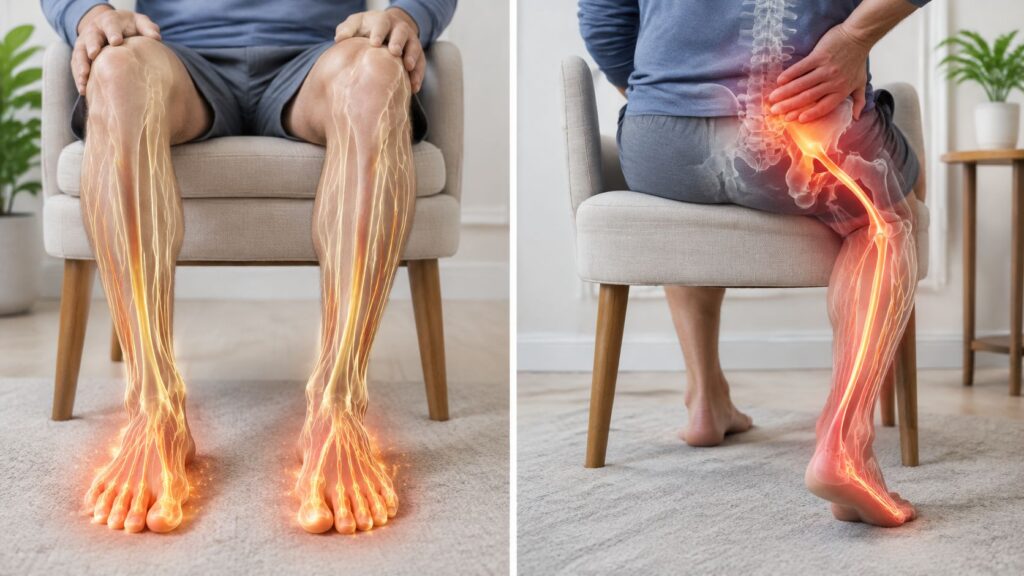
Morning stiffness that eases after a hot shower. A knee that hurts on stairs in Oak Lawn. A hip that aches after grocery shopping in Orland Park. Hands that feel tight when you grip the steering wheel on Harlem Avenue or try to open a jar at home. That's how osteoarthritis usually shows up in real life. Not as one dramatic injury, but as a steady loss of comfort, confidence, and movement.
Individuals who come in from Palos Hills, Hickory Hills, Burbank, Evergreen Park, Bridgeview, Alsip, Worth, or Palos Heights have already tried a few things on their own. They've rested the joint, taken over-the-counter pain medicine, bought a brace, or pushed through because they assumed pain was just part of getting older. The problem is that “just live with it” is not a treatment plan.
Osteoarthritis is the gradual breakdown of joint cartilage with related changes in the surrounding joint structures. Patients often call it wear and tear, and that description is useful, but the pain itself is more complex than cartilage alone. The joint lining can become inflamed. Nearby tissues can become irritated. Muscles can weaken. Nerves can become more sensitive.
There's still reason for optimism. Osteoarthritis treatment options range from foundational self-care to image-guided injections and advanced interventional procedures that can reduce pain and help you move better without relying on opioids or rushing straight to surgery.
Living with Osteoarthritis Pain in the Chicago Area
For many adults in the southwest suburbs, osteoarthritis pain follows a pattern. You wake up stiff. The first few steps are the worst. By afternoon, the joint may loosen up, but if you sit too long, the pain returns. At night, the ache can make it hard to settle into one position.
That cycle affects more than the joint itself. It changes how you move through your day. People start avoiding stairs, yard work, long walks, exercise classes, and family outings because they don't trust the joint anymore.

What osteoarthritis feels like day to day
Knee osteoarthritis often shows up as pain with standing, walking, squatting, or climbing stairs. Hip osteoarthritis may feel like groin pain, buttock pain, or reduced flexibility when getting in and out of a car. Shoulder, hand, and spine-related arthritic pain can limit sleep, lifting, or fine motor tasks.
The hardest part for many patients is uncertainty. They want to know whether they should keep trying home care, ask for an injection, or start thinking about surgery.
Osteoarthritis treatment works best when it's matched to the stage of pain, function loss, and what the patient is trying to get back to.
Why this decision gets confusing
A lot of online advice stops at broad basics like exercise, anti-inflammatory medication, and weight loss. Those matter, but they don't fully answer the question many patients are really asking: what comes next if those first steps help only a little, or stop helping at all?
That's where a pain specialist can add value. In practice, the key decision point isn't only whether you have arthritis. It's whether your current plan is still good enough for the life you want to live in Illinois.
Foundational Steps for Managing Osteoarthritis Symptoms
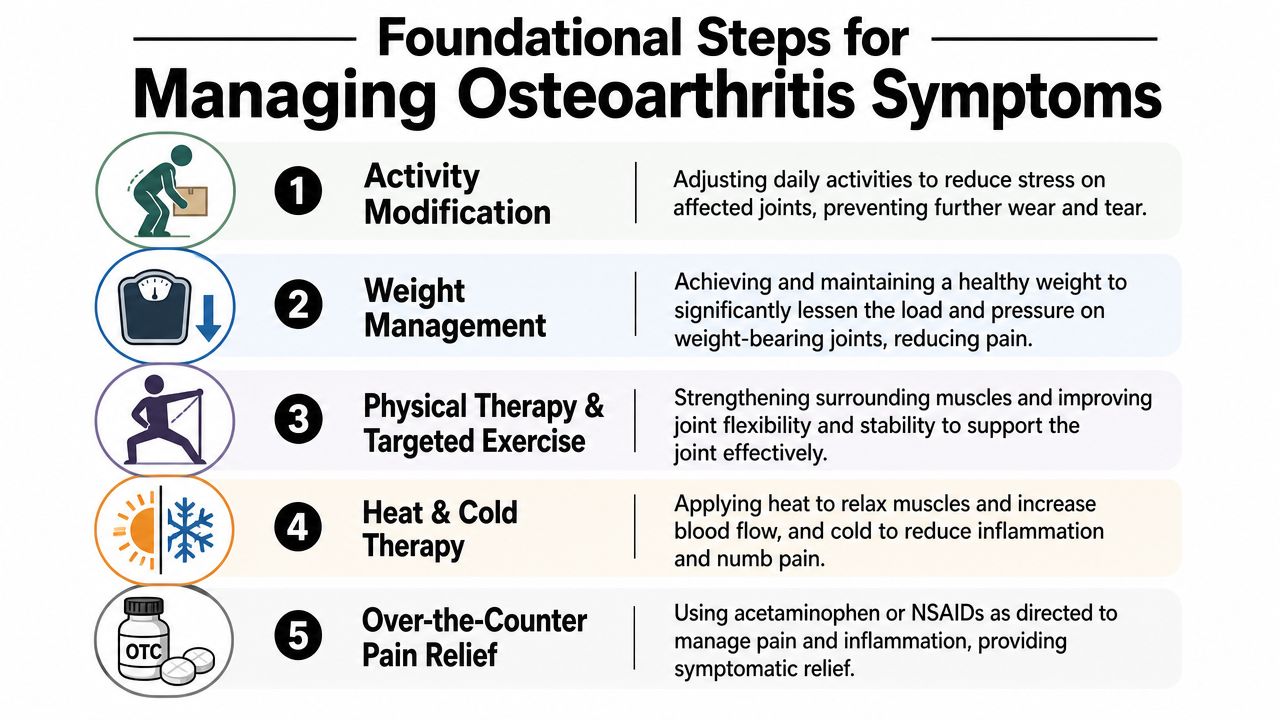
The best osteoarthritis treatment options don't start with a procedure. They start with a foundation that lowers joint stress, improves support around the joint, and makes flare-ups easier to control. Even when someone eventually needs an injection or a nerve procedure, these basics still matter.
Start with the joint mechanics you can change
Exercise is one of the most important first-line treatments because stronger muscles reduce the load placed directly on an arthritic joint. For knee arthritis, that often means building better support through the thigh and hip. For hip arthritis, it means improving strength, stability, and motion without forcing painful range.
Weight management matters for the same reason. Less load through a painful joint usually means less irritation with everyday movement. The goal isn't perfection. The goal is to make the joint's workload more manageable.
A practical home plan often includes:
- Activity modification: Change how you do painful tasks instead of stopping all activity. Shorter walks, better footwear, pacing, and less kneeling or deep squatting can calm symptoms.
- Targeted exercise: Low-impact movement such as cycling, walking within tolerance, water exercise, or a guided strengthening plan usually works better than complete rest.
- Heat or cold: Heat can loosen stiff tissues. Cold can settle down a hot, irritated flare.
- Bracing or assistive support: A brace, cane, or shoe modification can improve confidence and reduce stress through the joint.
- Simple pain relief: Some patients use acetaminophen or nonsteroidal anti-inflammatory drugs when appropriate.
Why topical treatment often makes sense first
For knee osteoarthritis, topical NSAIDs are a first-line, evidence-based option because they provide local anti-inflammatory treatment with much lower systemic exposure than oral NSAIDs, making them a preferred starting point alongside exercise and weight loss, according to this review on knee osteoarthritis management.
That distinction matters. Many adults in Worth, Bridgeview, and Alsip want pain relief but are also trying to avoid the stomach, kidney, cardiovascular, or medication interaction issues that can come with long-term oral treatment.
Practical rule: If knee pain is local and predictable, it often makes sense to try a local treatment strategy before moving to a body-wide medication strategy.
If sore knees are limiting stairs, walking, or getting up from a chair, this guide to soothing sore knees gives a useful overview of simple symptom-control steps patients can discuss with a clinician.
Medical Management When First Steps Are Not Enough
There's no cure for osteoarthritis, so treatment focuses on symptom control through a combination of exercise, weight management, assistive devices, and medicines. The World Health Organization estimate summarized in the NCBI review notes that 344 million people with osteoarthritis have moderate or severe disease that could benefit from rehabilitation, which shows how often patients need more than a single pill or a single visit to manage this condition well. That summary also reflects the broader treatment model used in practice, where care is layered rather than one-dimensional. See the NCBI overview of osteoarthritis treatment and rehabilitation.
Where prescription medication fits
When home strategies and over-the-counter treatment aren't enough, oral NSAIDs are often the next medication step if a patient can take them safely. These medicines can reduce pain and improve function, but they need to be matched to the patient in front of you. Age, kidney function, cardiovascular history, stomach risk, and other prescriptions all influence whether they're appropriate.
That's why medication should be part of a plan, not the whole plan. If a patient needs frequent medication just to get through ordinary walking, standing, or sleep, the joint usually needs a more focused strategy.
Why opioid-sparing care matters
In chronic osteoarthritis care, opioids are not a strong long-term answer. They can cause sedation, constipation, balance problems, and dependence, and they don't fix the mechanical and inflammatory drivers of joint pain. In older adults especially, those trade-offs can become more harmful than helpful.
A safer model is to use the least systemic treatment that can still restore function. That may include prescription anti-inflammatory treatment, bracing, exercise progression, and then image-guided procedures if the pain continues to interrupt life.
Here's the key clinical question: are medications helping you participate in recovery, or are they merely helping you endure a declining joint? If it's the second one, it's usually time to talk about procedural options.
Understanding Image-Guided Joint Injections
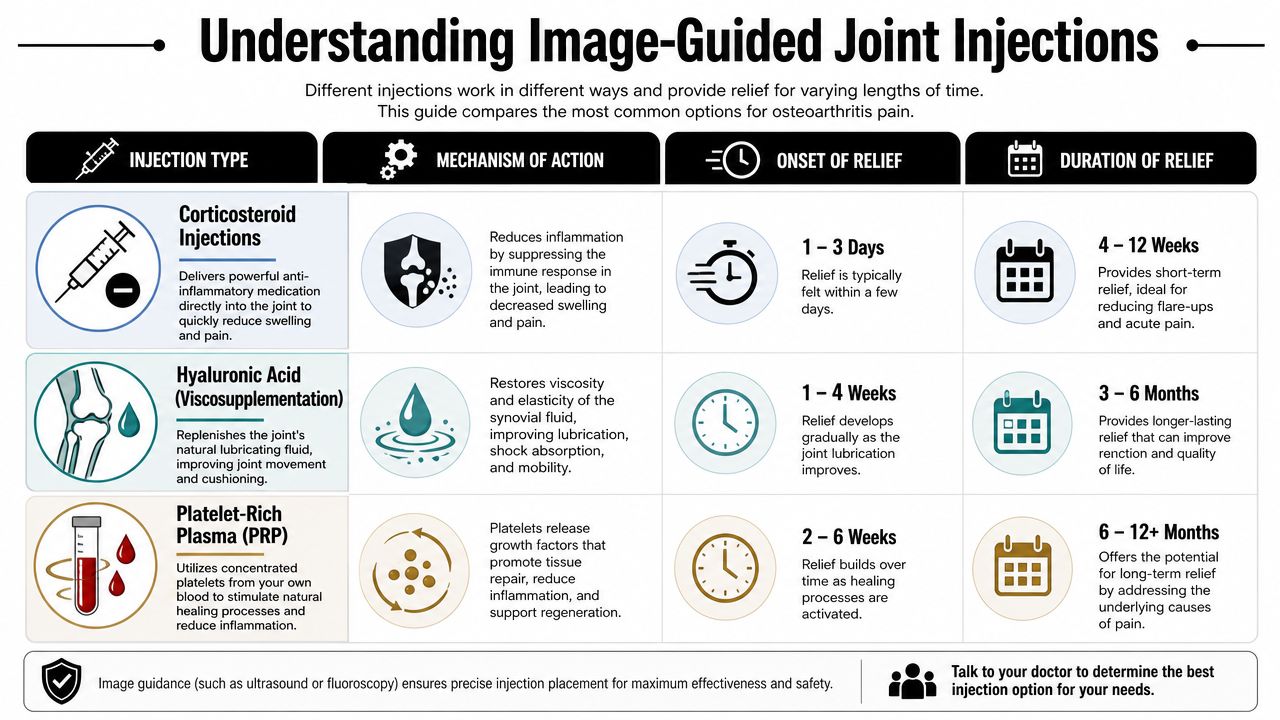
When patients say, “I've done the basics, but I still can't trust this joint,” injections often become the next step. The most useful way to think about osteoarthritis injections is by purpose. Some calm inflammation quickly. Some try to improve joint mechanics. Others aim for a different type of biologic response.
Corticosteroid injections for short-term calming
A corticosteroid injection is usually the “settle this down” option. It's designed to reduce inflammation inside the joint and can be useful when the pain has flared enough to disrupt walking, sleep, or rehabilitation.
The trade-off is duration. This is generally a short-term relief strategy, not a structural fix. According to the AAOS guideline for knee osteoarthritis, intra-articular corticosteroid injections can provide short-term relief, and Mayo Clinic guidance summarized in the verified data notes they are generally limited to three or four per year because repeated use may worsen joint damage over time.
If you want a plain-language explanation of technique and expected response, this overview of how a steroid injection works is a helpful starting point.
Hyaluronic acid as a selective option
Hyaluronic acid is often described as a joint lubricant or cushion. That analogy is useful, but it can oversimplify expectations. Some patients report benefit, while others don't notice much difference. Evidence is mixed, and it's not something I would present as a routine answer for every arthritic knee.
That doesn't mean it has no place. It means selection matters. If someone is considering it, the decision should be individualized and based on prior treatment response, symptom pattern, and the overall plan.
PRP for a different strategy
PRP, or platelet-rich plasma, works from a different idea. Instead of injecting a steroid to calm inflammation directly, PRP uses concentrated platelets from the patient's own blood as a biologic signal that may reduce pain and improve function in symptomatic knee osteoarthritis. The AAOS guideline states that PRP may reduce pain and improve function in symptomatic knee OA.
Some injections are used as a bridge. Others are used because the patient wants a longer-running option and wants to avoid repeated steroid exposure.
A simple comparison patients can use
| Injection type | Main goal | Best use case |
|---|---|---|
| Corticosteroid | Rapid anti-inflammatory relief | Painful flare, short-term symptom reduction |
| Hyaluronic acid | Cushioning or lubrication approach | Select patients, variable response |
| PRP | Biologic pain and function support | Patients seeking a non-steroid option |
Image guidance matters here because accuracy matters. If the medication isn't placed where it needs to go, the result can be less predictable. That's one reason technically precise injection care can make a real difference in the patient experience.
Advanced Pain Relief Without Major Surgery
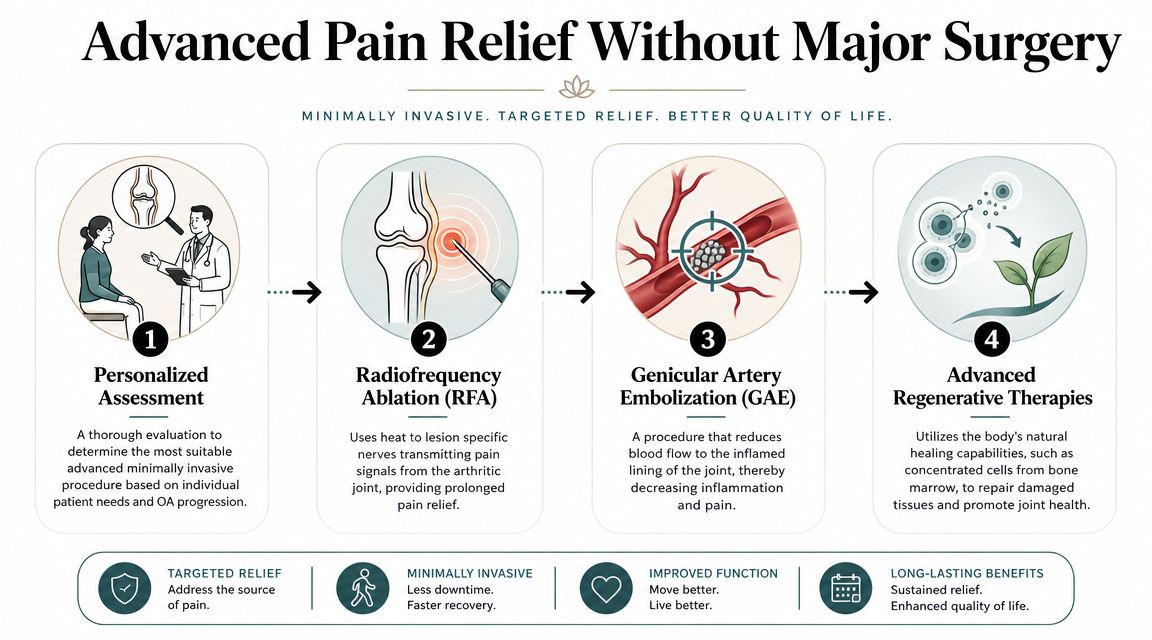
A large group of patients get stuck in the middle. They're not doing well with conservative care alone, but they're not ready for joint replacement. In this situation, interventional pain management can help fill a very real treatment gap.
For patients with osteoarthritis, one of the biggest problems is deciding what to do when conservative care fails but surgery is still premature. The Arthritis Foundation notes that radiofrequency ablation is generally reserved for patients who have failed less invasive therapy, and it can offer a path for longer-duration, opioid-sparing pain relief. See the Arthritis Foundation discussion of osteoarthritis treatment pathways.
Radiofrequency ablation for joint pain signals
Radiofrequency ablation, often called RFA, doesn't repair the arthritic joint itself. It targets the nerves carrying pain from that joint. In knee arthritis, this often means treating the genicular nerves. The goal is to reduce pain transmission so the patient can walk, stand, exercise, and function with less discomfort.
This approach can make sense for someone who had only temporary relief from injections, can't tolerate medications well, or wants to delay surgery. In practice, candidacy depends on the pain pattern, imaging, exam findings, and response to diagnostic nerve blocks when indicated.
Peripheral nerve stimulation and other next-step options
Peripheral nerve stimulation uses a different strategy. Instead of using heat to disrupt pain signaling, it modulates nerve activity with a small device-based approach. It may be considered in selected cases where persistent pain has become more neuropathic, more stubborn, or less responsive to simpler treatments.
These decisions are rarely one-size-fits-all. A patient with mainly inflammatory flare pain may do better with one path. A patient with chronic daily pain, poor tolerance of medications, and a desire to stay active without surgery may fit another.
Clinical reality: The right next step depends less on what sounds newest and more on which pain generator is actually driving the problem.
Who should think about these procedures
You may be a candidate for advanced, minimally invasive treatment if several of these apply:
- Daily function is slipping: Walking, stairs, shopping, housework, or sleep are getting harder despite good effort with conservative care.
- Injections helped, but not enough: Relief was incomplete or wore off too quickly.
- You want to avoid opioids: You'd rather target the source of pain than rely on sedating medication.
- Surgery feels premature: The joint is painful, but you're not ready for replacement or you're not an ideal surgical candidate right now.
For patients in the Chicago Ridge area, Midwest Pain & Wellness offers interventional options such as PRP within a broader pain-management setting, which is relevant for patients trying to bridge the gap between basic care and surgery.
When to Consider Surgery and Consult a Pain Specialist
Surgery has an important role in osteoarthritis care. When a joint is severely damaged and function is significantly compromised, joint replacement can reduce pain and restore movement. For the right patient at the right time, that can be life-changing.
But surgery shouldn't be treated as the automatic next step after basic care stops working. There's often a meaningful stage in between where a pain specialist can clarify what has and hasn't been fully tried.
What should happen before a surgical consult
A thoughtful pre-surgical review usually asks:
- Have first-line treatments been used well enough? That includes exercise, weight control, assistive support, and appropriate medication.
- Were injections chosen for the right reason? A flare-treatment injection is different from a strategy aimed at longer symptom control.
- Is the pain coming from the joint alone? Hip pain can be confused with spine pain. Knee pain can be amplified by nerve sensitivity or gait changes.
- Have advanced non-surgical procedures been considered? In some patients, they can delay surgery or make daily life much more manageable.
According to the PMC review of osteoarthritis management and treatment patterns, joint replacement is a standard option for end-stage disease, while most guidelines do not support opioid analgesics or viscosupplementation as effective routine treatments. That reinforces a multimodal path that prioritizes evidence-based options before surgery.
Why a pain consultation can change the plan
A pain specialist looks at the decision differently from a surgeon. The question isn't only whether the joint is arthritic. The question is whether pain can be reduced and function improved through less invasive means first.
For patients in Palos Heights, Orland Park, Oak Lawn, or Evergreen Park, that can be the difference between feeling rushed toward an operation and making a more informed decision. Sometimes surgery is clearly the best next move. Sometimes a targeted procedure buys meaningful relief and better function. Sometimes it helps a patient become stronger and better prepared if surgery is later needed.
Your Osteoarthritis Questions Answered for Illinois Patients
Which osteoarthritis treatment option is best for my knee pain in Palos Hills or Burbank
There isn't one best treatment for every knee. The best option depends on what the pain feels like, how much function you've lost, what you've already tried, and whether the main problem is inflammation, mechanics, or ongoing nerve-driven pain. That's why evaluation matters more than guessing from a symptom list.
If I'm a woman in midlife or after menopause, does that change treatment planning
It can. A 2024 review on osteoarthritis treatment gaps in women highlights the need to better understand how sex hormones, menopause status, and bias in care may affect treatment response. In practical terms, that supports a more personalized approach rather than assuming every patient will respond the same way.
Should I wait until the pain is severe before seeing a specialist
Usually not. Earlier evaluation can help when pain starts changing how you walk, sleep, work, or stay active. Waiting too long often means more deconditioning, more fear of movement, and fewer simple options.
Are advanced procedures only for people trying to avoid surgery
No. Some patients use advanced procedures to delay surgery. Others use them because they aren't surgical candidates, want to stay opioid-sparing, or need better function now while deciding on the next stage of care.
Do I need the same treatment plan as someone else my age in Illinois
No. Osteoarthritis care should be individualized. Age matters, but it's only one piece of the picture. Joint involved, pain behavior, medical history, goals, and prior treatment response matter just as much.
If osteoarthritis is limiting your walking, sleep, work, or daily routine in Oak Lawn, Palos Hills, Palos Heights, Worth, Bridgeview, Hickory Hills, Alsip, Burbank, Evergreen Park, Orland Park, or nearby Chicago Ridge, Midwest Pain & Wellness can evaluate where you are in the decision process and help you understand which osteoarthritis treatment options fit your condition, goals, and tolerance for risk.