If you're dealing with chronic back or neck pain in Oak Lawn, Palos Hills, Palos Heights, Worth, Bridgeview, Hickory Hills, Alsip, Burbank, Evergreen Park, or Orland Park, the conversation often goes the same way. You finally get an explanation for why the pain keeps returning. Then the next question hits right away. What is the radiofrequency ablation cost, and can you afford it?
That concern is reasonable. Pain procedures are rarely billed as one simple flat fee, and online pricing often mixes together very different kinds of RFA performed for very different medical problems. A number you find on a national page may have very little to do with what you would pay for a spine or facet pain procedure in the Chicago suburbs.
Navigating Your Radiofrequency Ablation Cost
A patient from Worth or Alsip might come in after months of aching low back pain, failed medications, and limited relief from therapy. They hear that radiofrequency ablation may help, then immediately worry that the procedure will be out of reach financially. That reaction is common, especially when internet searches return a wide spread of prices without explaining why.

Nationally, RFA pricing can range from about $2,000 for simpler procedures like varicose vein treatment to as high as $30,000 for more complex cardiac ablations, as noted in this clinical cost overview of radiofrequency ablation pricing. That range tells you one important thing right away. Radiofrequency ablation cost is not one price.
For pain management in the Chicago Ridge area and nearby suburbs, the question isn't just, “What does RFA cost?” The better question is, “What kind of RFA am I having, where will it be performed, what does my insurance require, and what charges are included?”
Practical rule: If a price quote doesn't tell you whether it includes physician services, imaging guidance, anesthesia, and facility charges, it isn't a complete estimate.
Patients in Evergreen Park, Burbank, and Orland Park usually feel more comfortable once the bill is broken down into parts. That's where the confusion starts to clear. Instead of treating the cost as a mystery number, it helps to look at the actual pieces that create the final amount.
What Is Radiofrequency Ablation for Pain Management
Radiofrequency ablation for pain management is a minimally invasive procedure used to reduce pain coming from small sensory nerves, often around the facet joints in the neck or low back. In plain language, the procedure targets a nerve that's carrying a pain signal and interrupts that signal.
A simple way to think about it is this. If a wire in your home keeps sending a bad signal, you don't need to tear down the whole wall. You identify the wire and disable the part causing the problem. RFA works in a similar way for certain pain patterns.
How the procedure helps
RFA is often considered after a patient has already tried more conservative care and after diagnostic injections suggest the pain is coming from a specific nerve pathway. For spine-related pain, that usually means the treatment is focused and image-guided rather than broad or guess-based.
Because it is targeted, RFA is often part of an opioid-sparing pain plan. The point isn't to mask symptoms temporarily. The point is to quiet a known pain generator in a precise way.
For patients who want a more complete overview of how this treatment works in an interventional pain setting, this guide on understanding radiofrequency ablation gives helpful background.
Why this matters for cost
What you're paying for isn't just “a shot” or a brief office visit. You're paying for evaluation, image-guided precision, sterile technique, procedural skill, and follow-up planning. That distinction matters because patients sometimes compare RFA to treatments that aren't designed to do the same job.
The cheapest option upfront isn't always the least expensive path if it leads to repeated visits without durable relief.
Breaking Down Your RFA Bill What Are You Paying For
Most patients don't receive one charge called “RFA.” They receive a bundle of related charges connected to the procedure. Consequently, online searches often fail people. They give one number, but they don't explain what that number includes.
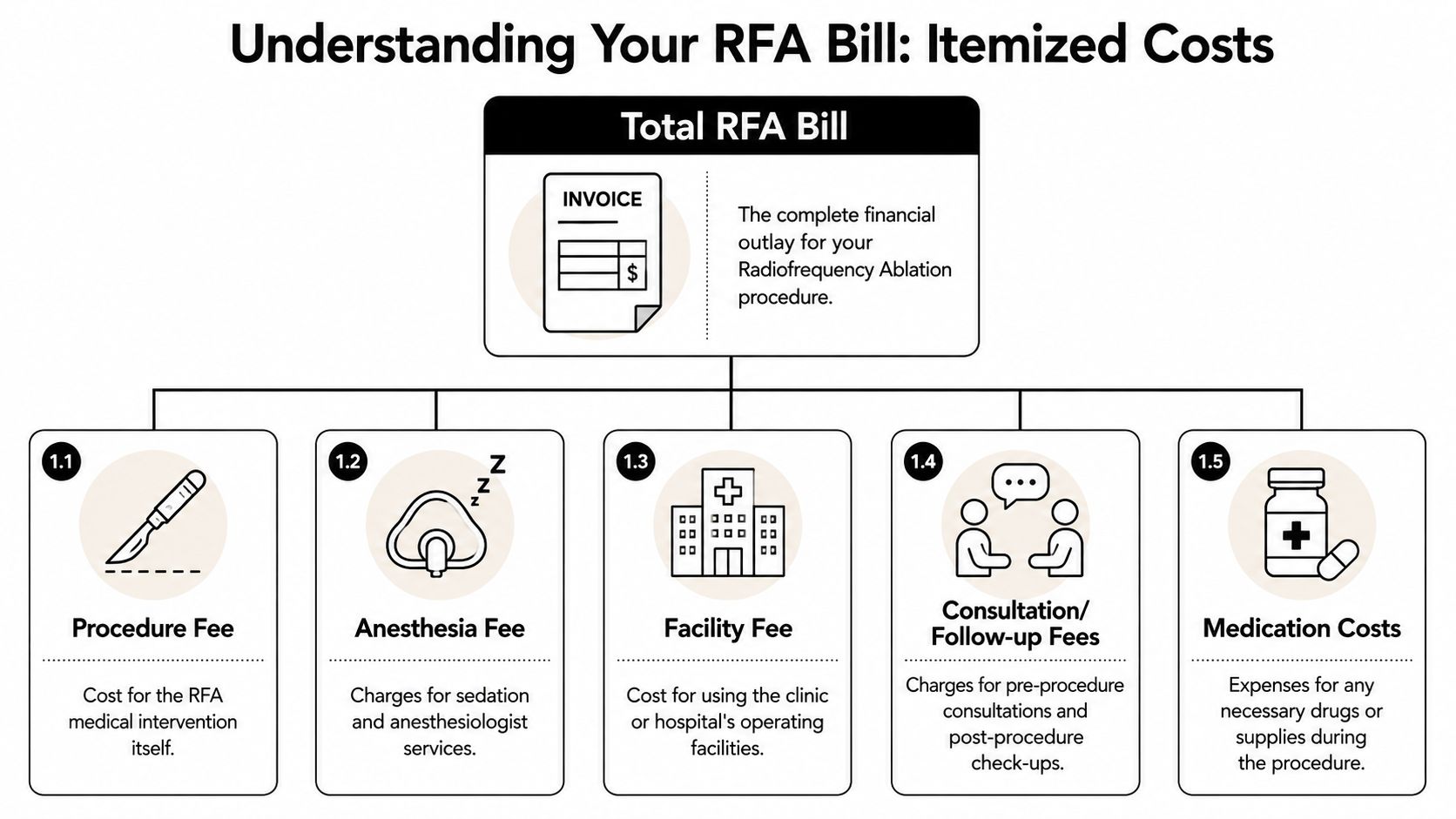
Public pricing often leaves out anesthesia, imaging guidance, and facility fees, even though those can make up a large share of the final bill. This public pricing discussion of radiofrequency ablation also notes that the procedure cost is highly sensitive to the base RFA price and the setting where it is performed.
Common parts of an RFA bill
| Bill component | What it usually covers | Why it affects cost |
|---|---|---|
| Physician fee | The specialist's work performing the procedure | Expertise, planning, and technical precision are part of this charge |
| Facility fee | Use of the procedure room, staffing, supplies, and recovery area | This can vary a lot based on where the procedure is done |
| Imaging guidance | Fluoroscopy or other guidance used for accurate needle placement | Image guidance improves precision and safety |
| Anesthesia or sedation | Medication and monitoring if used | Not every patient needs the same level of support |
| Disposable procedural supplies | Sterile needles, cannulas, grounding materials, and related single-use items | Specialized equipment adds to the total |
| Pre-procedure and follow-up visits | Evaluation, documentation, recovery review, and next-step planning | These visits are separate from the ablation itself in many billing structures |
Why patients get surprised
A patient in Evergreen Park may see one online “cash price” and assume that's the final number. Then a separate anesthesia or facility charge appears later, and the estimate no longer matches expectations. The problem usually isn't that anyone is hiding the ball. It's that healthcare billing often separates services that patients naturally think of as one event.
Here are the most important questions to ask before scheduling:
- Is this quote only for the procedure itself? Some estimates exclude other common charges.
- Where will the procedure be performed? The site of service can materially change the total.
- Will imaging guidance be billed separately? That depends on the billing structure.
- Is sedation planned, optional, or not expected? That changes both logistics and cost.
- Are follow-up visits included? Some are, some aren't.
What works and what doesn't
What works is asking for an estimate tied to your exact treatment plan. What doesn't work is shopping by headline number alone.
A useful estimate should reflect the body region being treated, the number of levels involved, the procedural setting, and the expected insurance pathway. Without those details, the number is only a rough placeholder.
Key Factors That Influence Your Final RFA Cost
Two patients in nearby suburbs can both be told they need radiofrequency ablation and still receive very different estimates. That's normal. The procedure name may be the same, but the details often aren't.
Procedure complexity matters
A cervical RFA and a lumbar RFA aren't automatically priced the same. Treating one area is different from treating several levels, and the technical demands can vary depending on anatomy and prior surgery.
In practical terms, cost tends to move with complexity. A straightforward, single-region treatment is usually a different financial event than a more involved procedure plan with broader treatment targets or repeat sessions.
The care setting changes the math
One of the biggest drivers of radiofrequency ablation cost is where the procedure happens. Hospital outpatient billing can look very different from physician-office or ambulatory procedural billing. The actual nerve treatment may be similar, but the total charge structure often isn't.
That matters for patients in Oak Lawn, Hickory Hills, Bridgeview, and surrounding communities because local availability, insurance contracts, and site-of-service rules can shape the final estimate as much as the procedure itself.
If you're comparing estimates, compare the setting first. A lower physician fee doesn't help much if the facility charge is much higher.
Repeat treatment can become the bigger cost issue
For lumbar facet pain, the long-term economics aren't driven only by one day's bill. Real-world utilization data showed that lumbar RFA sessions in a large commercially insured group rose about 131% from 2007 to 2016, increasing from 49 to 113 procedures per 100,000 enrollees per year, while total spending rose from $94,570 to $266,680 per 100,000 enrollees in the same period, according to this review of lumbar RFA utilization and spending. The takeaway is simple. Long-term cost is shaped by how often treatment is repeated, not just the price of one session.
For patients trying to understand the steps that often come before ablation, this overview of medial branch block treatment in Chicago helps explain why careful diagnosis matters.
What usually lowers waste
A few things consistently help patients avoid unnecessary cost:
- Accurate diagnosis first: RFA works best when the pain source has been identified carefully.
- Matching the setting to the case: Some cases can be handled efficiently outside a hospital environment, depending on clinical needs and coverage rules.
- Avoiding premature repeat procedures: Timing matters. Repeat treatment should follow a clear clinical reason, not habit.
- Clear pre-authorization planning: Administrative mistakes can create financial surprises even when the treatment itself was appropriate.
Navigating Insurance and Medicare for RFA Coverage
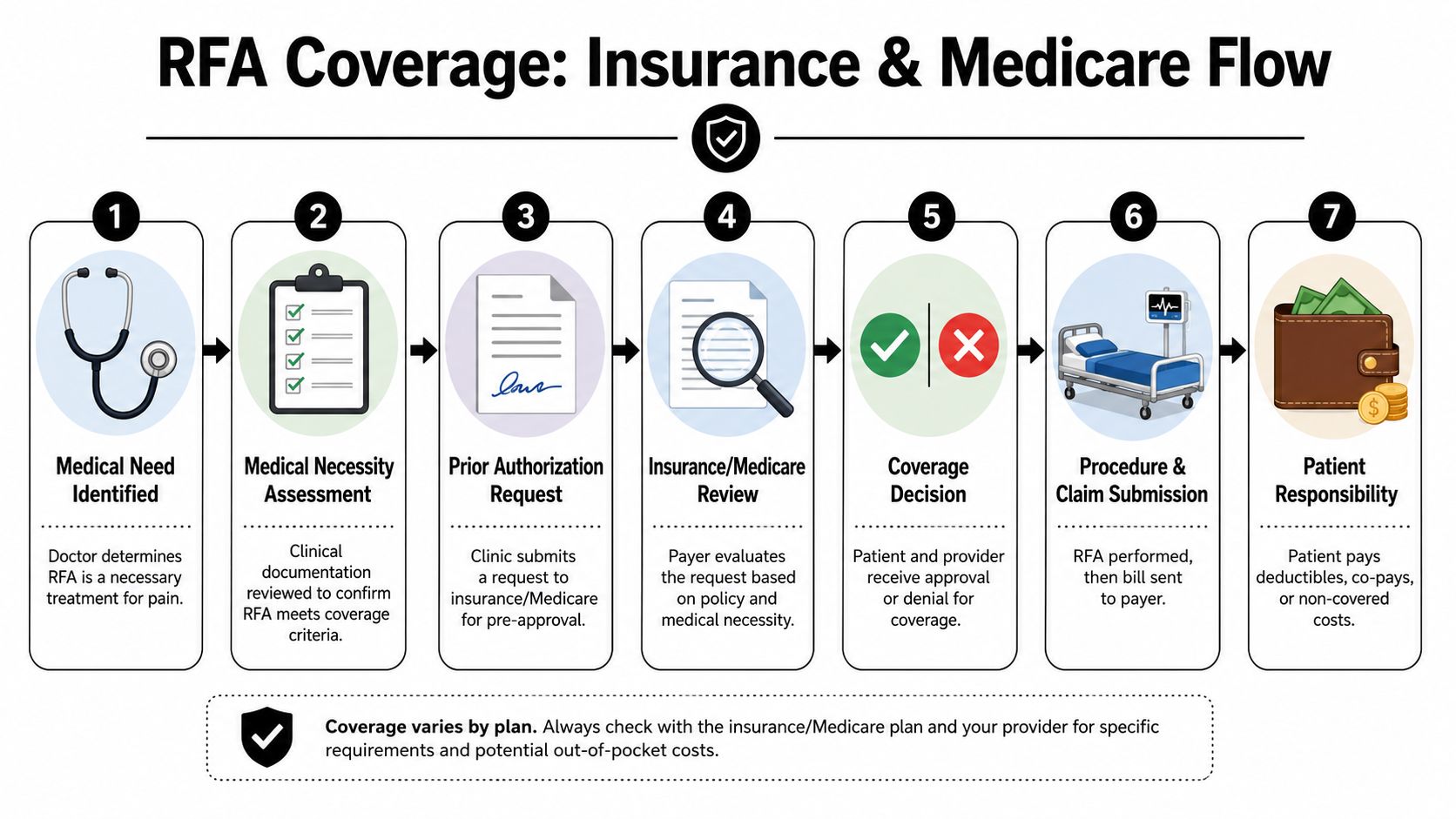
Most patients don't pay the full billed amount out of pocket. The key question is whether the procedure is covered, what conditions must be met first, and how your share of the cost is calculated.
Insurance plans and Medicare often cover RFA when the treatment is considered medically necessary. In pain management, that usually means the medical record has to support the diagnosis, prior conservative care, and the clinical logic for why ablation is the next step.
What medical necessity usually means in practice
For many pain patients in Palos Heights, Burbank, or Alsip, approval doesn't happen just because pain has lasted a long time. The payer usually wants documentation showing that the diagnosis and treatment plan make sense.
That commonly includes:
- Documented pain pattern: The symptoms should fit the condition being treated.
- Prior treatment history: Plans often want to see what has already been tried.
- Diagnostic confirmation: In spine care, diagnostic blocks often help show the targeted nerve is the pain source.
- Procedure-specific documentation: The chart needs to support why ablation is appropriate for that patient.
Medicare coverage and patient responsibility
For 2025, Medicare lists a reimbursement payment of about $925 for a typical RFA procedure in the reimbursement guide, but that does not mean the patient pays nothing. The same Medicare framework includes a Part B deductible of $257 in 2025, and after the deductible, Medicare generally covers 80% of approved outpatient costs, leaving the patient responsible for 20%, as outlined in this 2025 Medicare reimbursement guide for pain management RFA.
That distinction matters. Patients often hear the approved amount and assume that's the same as their out-of-pocket cost. It isn't. Deductibles, coinsurance, and the site of care all affect the final patient balance.
Commercial insurance is less predictable
With employer plans and other commercial insurance, coverage can still be available, but the path is usually less straightforward. Two people in Orland Park with the same diagnosis can owe very different amounts because their deductibles, coinsurance, network rules, and authorization requirements are different.
A few terms matter:
| Insurance term | What it means for you |
|---|---|
| Prior authorization | The plan wants approval before the procedure is scheduled |
| Deductible | The amount you may need to pay before coverage fully applies |
| Coinsurance | Your share of the allowed charge after the deductible rules are met |
| Allowed amount | The payer's recognized amount, which may differ from the billed charge |
| In-network status | Whether your benefits apply at the more favorable contracted rate |
Approval is a clinical and administrative process. Good documentation matters just as much as good treatment planning.
What patients should do before the procedure
Before scheduling, ask the office to help verify:
- Whether prior authorization is required
- Whether diagnostic criteria have been met
- Which setting is planned for the procedure
- What portion may apply to your deductible or coinsurance
- Whether any separate bills are likely
One practical option for patients in the Chicago Ridge area is Midwest Pain & Wellness, a pain management clinic that offers radiofrequency ablation as part of interventional care. In any clinic you choose, the key is having a staff that can verify benefits, submit required documentation, and explain the expected patient responsibility in plain language.
How to Get a Clear RFA Cost Estimate in the Chicago Area
A useful estimate starts with the clinical plan, not the billing sheet. Until the physician knows what region is being treated, how many levels are involved, and what setting makes sense, the number will only be approximate.
What to ask during scheduling
If you live in Oak Lawn, Palos Hills, Worth, Bridgeview, Evergreen Park, or Orland Park, you can save yourself a lot of frustration by asking direct questions early.
Use a checklist like this:
- What exact procedure is being planned? Neck, low back, sacroiliac-region pain, and peripheral nerve procedures can involve different billing pathways.
- Where will it be performed? Office, ambulatory setting, and hospital outpatient settings don't bill the same way.
- Will my estimate include related services? Ask specifically about imaging guidance, sedation, and follow-up.
- Has insurance authorization been reviewed? Don't assume that scheduling means approval is complete.
- Can I receive a written estimate? A written number is easier to review than a verbal range.
Why the consultation matters
Patients sometimes want a firm price before the first visit. That's understandable, but it usually isn't realistic. An accurate estimate depends on the diagnosis, physical exam, imaging review, and whether prior diagnostic treatment has already confirmed the source of pain.
If your pain appears to be coming from the facet joints, this page on facet-mediated pain can help you understand why the diagnosis step affects both treatment and cost.
Practical ways to make the cost easier to manage
Patients often do better when they approach RFA cost as a planning issue rather than a surprise bill issue.
Consider these steps:
- Ask for a Good Faith Estimate when appropriate: It gives you a clearer framework for expected charges.
- Use HSA or FSA funds if available: Many patients forget these accounts can help with eligible medical expenses.
- Clarify timing: If you've nearly met your deductible, scheduling within the same benefit period may matter.
- Keep records of approvals and estimates: That makes billing follow-up much easier if questions arise later.
A clear estimate usually comes from three things working together: the right diagnosis, verified insurance information, and a billing team willing to explain the details.
Your Local Partner for Lasting Pain Relief
Radiofrequency ablation cost can feel confusing at first because it isn't one simple number. The final amount depends on the diagnosis, the body area being treated, the care setting, the insurance rules, and whether related charges are included in the estimate.
Patients across Oak Lawn, Palos Hills, Palos Heights, Worth, Bridgeview, Hickory Hills, Alsip, Burbank, Evergreen Park, and Orland Park deserve straight answers before they commit to treatment. That's especially true when you're already dealing with chronic pain and trying to make a careful financial decision.
The most useful next step is a consultation with a qualified interventional pain specialist who can confirm whether RFA is the right treatment, explain what the procedure involves, and give you a more personalized cost picture based on your coverage and treatment plan. Clear answers are possible. They just require the right clinical and billing information upfront.
If you're trying to understand your options for chronic back, neck, joint, or nerve pain, Midwest Pain & Wellness can help you schedule a consultation, review whether radiofrequency ablation fits your condition, and discuss the practical cost questions that matter before treatment moves forward.