Knee pain has a way of shrinking daily life. A trip up the stairs starts to feel like a calculation. A walk through the neighborhood gets shorter. Standing at the kitchen counter, getting in and out of the car, or trying to sleep with a bent knee can all become reminders that something still hurts.
For many adults in the southwest suburbs of Chicago, that story feels familiar. You may live in Oak Lawn, Palos Hills, Palos Heights, Worth, Bridgeview, Hickory Hills, Alsip, Burbank, Evergreen Park, or Orland Park, and still feel oddly isolated by chronic knee pain because it affects so many ordinary moments. If you've already tried rest, medications, injections, braces, or activity changes, it's reasonable to ask whether there's another step before major surgery or long-term reliance on pain medicine.
Living with Chronic Knee Pain in Illinois
A patient from Orland Park recently described her knee pain in a way I hear often. She said the pain wasn't just in her knee. It had moved into her schedule, her mood, and her confidence. She stopped taking longer walks, hesitated before stairs, and thought twice before getting down on the floor with her grandchildren because she wasn't sure how she'd get back up.

That pattern shows up across Illinois suburbs. Someone in Alsip avoids the long aisle at the grocery store. Someone in Evergreen Park plans errands around parking and curbs. Someone in Bridgeview keeps saying, “I can manage,” while doing less and less.
When knee pain changes the shape of a normal day
Chronic knee pain rarely announces itself with drama. It usually chips away at routine.
- Walking becomes strategic instead of automatic.
- Stairs become a test instead of a transition.
- Family time gets edited because kneeling, standing, or keeping up feels harder.
- Sleep and mood can suffer when pain keeps returning.
That's why many people start looking beyond temporary relief. If you're also comparing knee pain relief methods, it helps to understand where minimally invasive pain procedures fit. Some treatments aim to calm inflammation. Others support the joint mechanically. Genicular nerve ablation is different. It targets the pain signals traveling from the knee.
Chronic pain often affects function before patients fully realize how much they've been compensating.
This approach can matter when the knee is still painful despite sensible conservative care, or when surgery isn't the right next step yet. It doesn't replace every other treatment. It also doesn't mean giving up on movement. It can create a window where everyday activity becomes more manageable again.
A local path forward
Patients in the Chicago Ridge area often want two things at once. They want advanced treatment, and they want it explained clearly. A good starting point is learning how knee pain is evaluated and what options may fit your situation, including this guide to soothing sore knees.
For the right patient, genicular nerve ablation can offer a practical middle ground. It's not the same as a knee replacement, and it's not a vague promise of relief. It's a targeted, image-guided procedure designed to interrupt pain messages from specific nerves around the knee.
Understanding Genicular Nerve Ablation
The simplest way to understand genicular nerve ablation is to think of the knee's pain system like a home alarm with a faulty sensor. The structure of the house is still the structure of the house. But one small part of the system keeps sending signals that something is wrong. Genicular nerve ablation aims to quiet those specific pain-carrying signals.
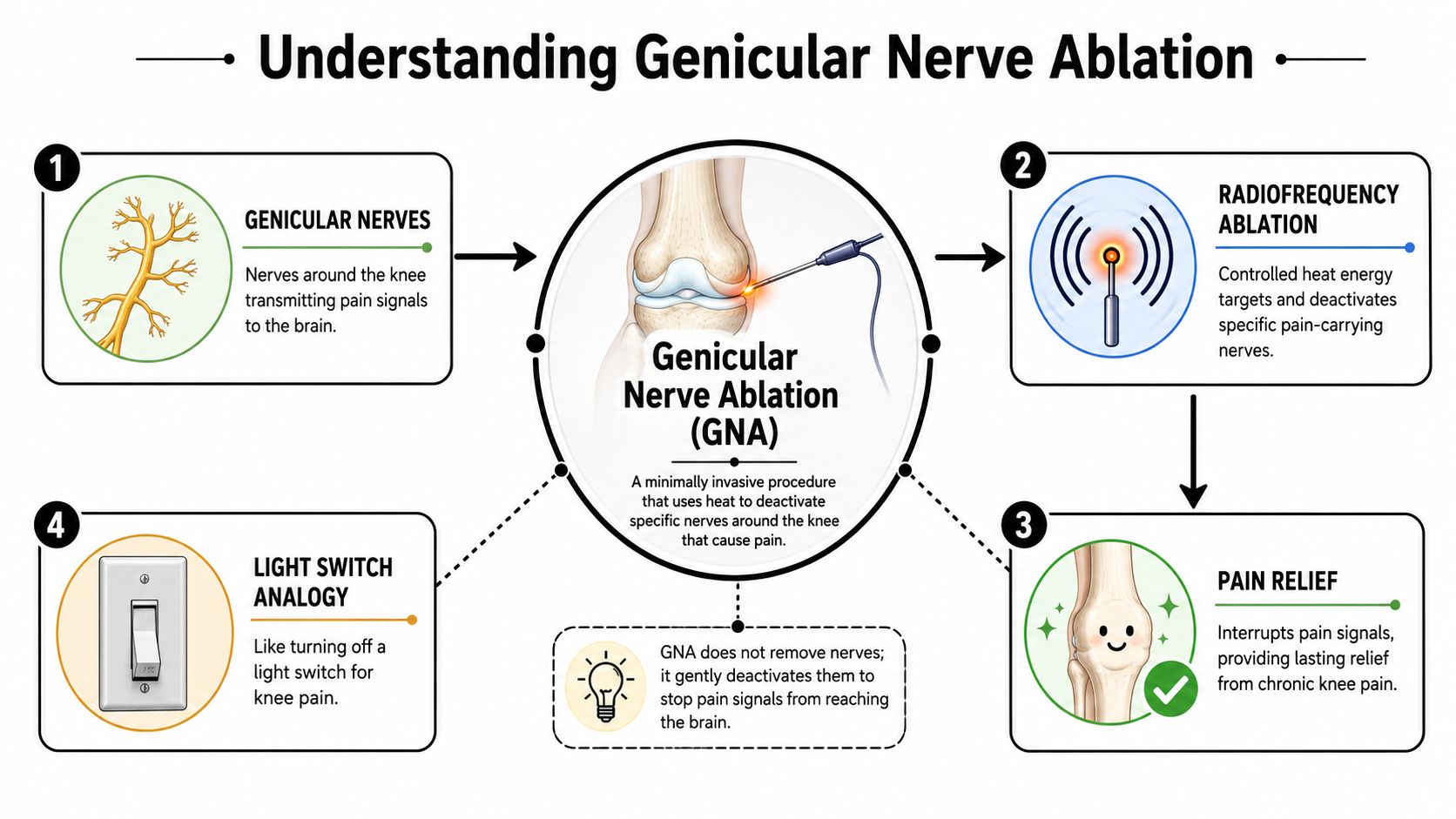
The targets are the genicular nerves, small sensory nerves around the knee joint. Their job is to carry pain information. In this setting, the procedure focuses on those pain pathways rather than changing the bones, cartilage, or alignment of the joint itself.
What the procedure is doing
During ablation, the physician uses radiofrequency energy to create a controlled heat lesion near selected nerves. In plain language, that means the nerve's ability to pass along pain signals is interrupted.
A few points help clear up common confusion:
- It doesn't “burn away” the knee. The treatment is precise and focused on small nerve targets.
- It doesn't rebuild arthritis. If arthritis is present, the joint condition is still there.
- It doesn't paralyze the leg. The goal is to target sensory branches involved in pain.
That last point matters. Many patients worry that if a nerve is treated, they'll lose strength or control. That isn't the purpose of genicular nerve ablation. The treatment is designed to reduce pain signaling, not shut down the muscles that help you stand, walk, and move.
How it differs from knee replacement
Knee replacement changes the joint itself. Genicular nerve ablation does not. It's a minimally invasive pain procedure that can be considered when pain is the main limiting problem and a person wants a less invasive option, isn't ready for surgery, or continues to have pain in a different clinical context.
Think of it as lowering the volume on the knee's pain messenger, not replacing the knee itself.
That distinction helps patients set realistic expectations. If your pain has been keeping you from climbing stairs, standing longer, or tolerating ordinary activity, reducing the pain signal may make movement more possible. It doesn't mean the knee becomes brand new. It means life may become less centered around pain.
Who Can Benefit from Genicular Nerve Ablation
Not every painful knee is a good match for this procedure. The best candidates are usually people with chronic knee pain who have a clear pattern of symptoms and who respond in a very specific way during evaluation.
One common group includes patients with symptomatic knee osteoarthritis who want meaningful relief but aren't ready for knee replacement. Another includes people who aren't ideal surgical candidates because of other health issues. There's also an important group that often gets less attention in public discussions. Some patients continue to have knee pain after a knee replacement and need a careful pain-focused assessment.
The most important step is the test block
Ablation is usually not the first step. It's part of a two-step, selection-dependent process. Before moving forward, clinicians typically perform an extra-articular diagnostic block around the key genicular branches. A practical threshold for proceeding is at least 50% pain reduction for at least 24 hours after the block, as described in this clinical overview of the diagnostic block pathway.
That test matters because it works like a preview. If numbing those target nerves brings clear short-term relief, it suggests those nerves are indeed contributing to the pain picture. If the block doesn't help, ablation may not be the right next step.
A simple way to think about candidacy
Here's a useful framework patients can bring into a consultation.
| Situation | Why genicular nerve ablation may be considered |
|---|---|
| Ongoing arthritic knee pain | It may help when pain remains limiting despite conservative care |
| Not ready for surgery | It offers a minimally invasive option focused on pain pathways |
| Not a surgical candidate | It can fit patients who need a non-surgical strategy |
| Persistent pain after knee replacement | It may be part of a broader interventional pain evaluation |
Good candidacy also depends on something more basic. The pain has to make sense anatomically and clinically. Knee pain can come from the joint, but it can also reflect referred pain from the hip, lower back, or surrounding soft tissues. That's why a careful exam still matters.
Practical rule: A strong response to the diagnostic block is one of the clearest signs that ablation may be worth considering.
A responsible pain clinic won't treat every painful knee the same way. The right question isn't “Can this procedure be done?” It's “Does this procedure fit the actual source of pain in your case?”
What to Expect During the Ablation Procedure
Most patients feel less anxious when they know what the day will look like. Genicular nerve ablation is generally an outpatient procedure, which means you come in, have the treatment, recover briefly, and go home the same day.
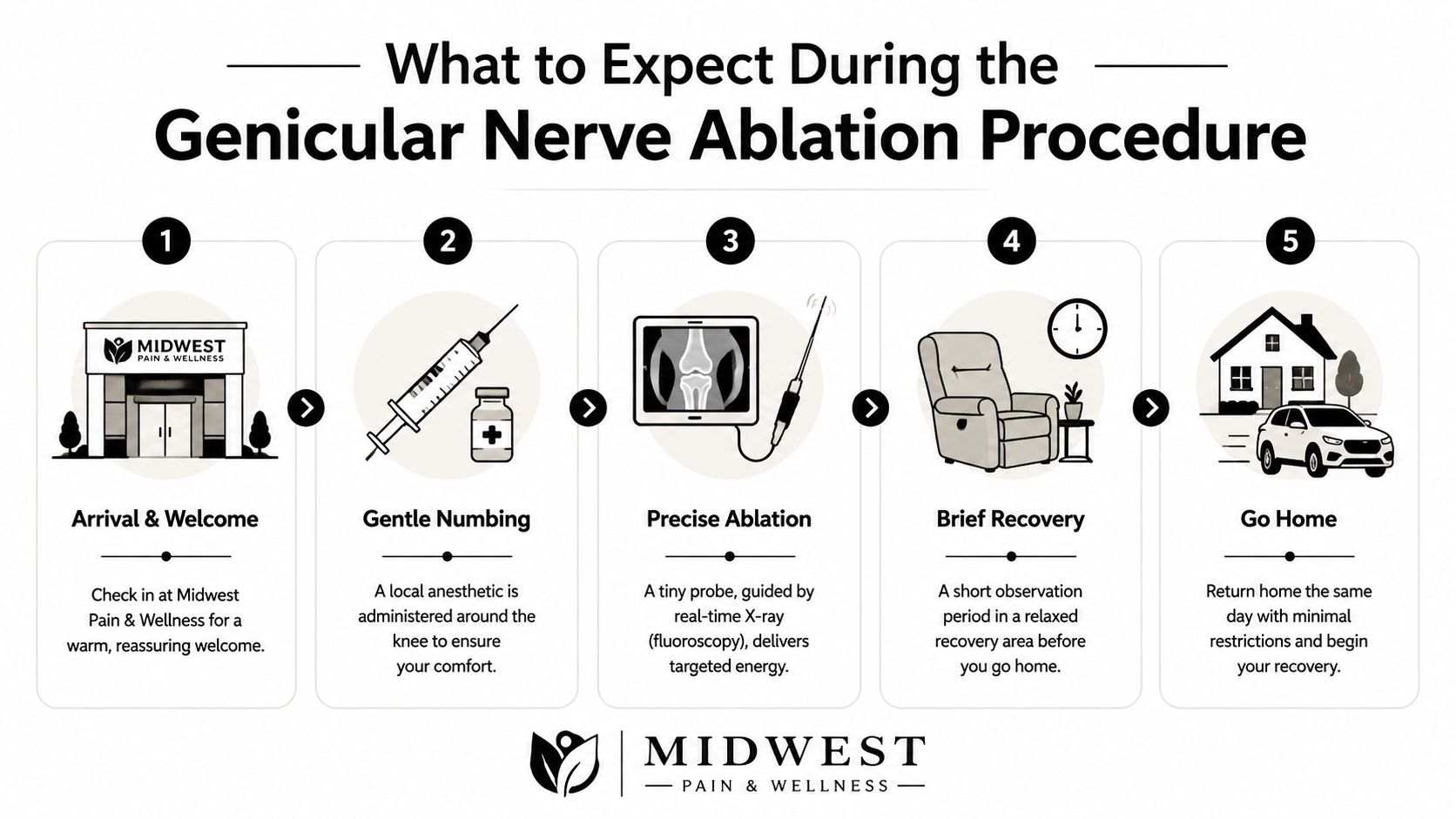
You'll typically arrive, review the plan, and get positioned comfortably for the procedure. The skin is cleaned, and a local anesthetic numbs the area. That numbing step is important because it reduces the sharp sting at the skin and soft tissue level before the ablation portion begins.
How precision and safety are built in
The physician uses imaging guidance, often fluoroscopy or ultrasound, to place the cannulas near established bony landmarks around the knee. The treatment isn't done by guesswork. It's guided carefully to improve accuracy.
Safety checks are part of the process. ASRA's technical guidance recommends motor stimulation before lesioning so the operator can reposition if muscle twitching suggests proximity to a motor branch rather than a sensory target, as described in this ASRA technical guidance on genicular nerve radiofrequency ablation.
That detail reassures many patients. A common fear is, “What if the treatment hits the wrong nerve?” Motor stimulation is one of the built-in checks used to reduce that risk.
What patients usually feel
Patients typically don't describe the procedure as sharply painful. They're more likely to feel pressure, positioning, or a warm sensation during key parts of the treatment. The exact experience varies, but the goal is controlled comfort, not endurance.
A straightforward way to picture the procedure is this:
- The skin is numbed so the entry points are more comfortable.
- The physician uses imaging to guide the needle-like instruments into position.
- Safety testing is performed before lesioning.
- Radiofrequency energy is applied to the selected sensory targets.
- You rest briefly afterward and then head home with aftercare instructions.
Many patients are relieved to learn that this is a targeted outpatient procedure, not a hospital-based surgery.
Because the treatment is minimally invasive, the day usually feels more like a guided medical procedure than an operation. Knowing that difference helps patients walk in with less fear and more confidence.
Expected Benefits and Success Rates of GNA
The main reason people consider genicular nerve ablation is simple. They want less pain and better function. In the right patient, those two goals often go together. When the knee hurts less, it may become easier to walk, stand, sleep, and take part in ordinary routines.
A recent clinical series gives a helpful snapshot of what improvement can look like. In that cohort, 64% of patients achieved at least a 50% reduction in visual analog scale pain scores by 6 months, and median WOMAC scores improved from 62.0 at baseline to 40.0 at 6 months, according to this clinical series on outcomes after genicular nerve radiofrequency ablation.
What those numbers mean in everyday life
Pain scores matter, but patients usually care more about what changes in real life. Functional improvement may mean:
- More tolerance for walking through a store or neighborhood
- Less hesitation with stairs
- More comfortable transitions from sitting to standing
- Less focus on the knee all day
The same clinical series also supports the idea that outcome tracking shouldn't stop at pain alone. Function improved alongside pain, which is exactly what most patients hope for. Relief is most meaningful when it helps you do more of what matters.
Some people also compare genicular nerve ablation with other non-surgical options before deciding. If you're weighing different approaches, this overview of hyaluronic acid injection for knee pain in Chicago can help clarify how another injection-based treatment fits into the larger picture.
Realistic expectations matter
Not every patient responds the same way. That's important to say plainly. A successful diagnostic block improves the odds that ablation is targeting the right pain pathway, but it doesn't guarantee a perfect outcome.
Possible short-term side effects can include soreness around the treatment area or a temporary change in skin sensation near the knee. In practice, patients are usually most reassured when they know two things at once. The procedure is designed to be precise, and results can still vary from person to person.
The best expectation isn't a “miracle cure.” It's meaningful pain reduction that may help restore function.
That kind of honesty tends to serve patients well. When expectations are grounded, people are better able to judge whether the procedure has helped them in the ways that matter most.
Recovery Aftercare and Long-Term Outlook
Recovery after genicular nerve ablation is usually straightforward, but it helps to know what's normal. Many patients have mild soreness for a short time at the treatment sites. That doesn't mean the procedure failed. It often reflects normal tissue irritation after a targeted intervention.
A simple first step is to take it easy for a brief period, follow the clinic's instructions, and avoid rushing back into strenuous activity. Ice may be recommended if the area feels irritated. Patients can return to routine daily tasks fairly quickly, but comfort often improves in stages rather than all at once.
What the first phase may feel like
The knee may not feel dramatically different the moment you leave. Some people notice improvement early. Others feel soreness first and then gradual relief as the treated nerves stop transmitting pain as effectively.
Helpful aftercare habits often include:
- Use ice if advised to calm local soreness
- Keep movement gentle instead of forcing exercise too soon
- Notice functional changes such as easier standing, walking, or stair use
- Report unusual symptoms if something doesn't feel typical
For patients who want to add safe movement as comfort improves, it can help to review general ways to rebuild knee strength with simple exercise concepts. The right progression should always match your clinician's advice and your specific knee condition.
How long relief may last
Independent patient education and review sources describe typical benefit lasting 6 to 12 months or longer, and note that repeat ablation is often feasible when pain returns because nerves can regenerate after thermal lesioning, as summarized in this patient-focused review of genicular neurotomy duration.
That last point is important. Genicular nerve ablation usually isn't thought of as permanently removing the pain source. It's better understood as a repeatable pain-management tool that may provide a meaningful stretch of relief. For chronic knee pain, that can be very valuable.
Your Partner in Pain Relief in the Chicago Area
When patients from Hickory Hills, Burbank, Worth, or Palos Heights look for help, they usually want more than a procedure name. They want a plan that makes sense. They want to know whether their symptoms fit the treatment, whether the process is thoughtful, and whether someone is paying attention to function, not just a pain scale.
That's where local, interventional pain care matters. At Midwest Pain & Wellness's interventional pain management clinic, patients can be evaluated for minimally invasive options such as genicular nerve ablation within a broader pain-management framework that also considers diagnosis, prior treatment response, and long-term strategy.
Why careful follow-through matters
Longer-term outcome data help explain why this procedure has become a meaningful option in knee pain care. In one long-term outcomes study, among responders the average duration of benefit was 330.0 ± 394.5 days, and another clinical summary noted that nearly 3 in 4 patients had knee pain reduced by more than half at 6 months after radiofrequency ablation, as reported in this long-term outcomes summary on genicular nerve ablation.
Those numbers are encouraging, but they also reinforce a practical truth. Response varies. The strongest care model is one that selects patients carefully, performs the procedure precisely, and stays engaged after treatment to judge how much daily life has improved.
If you live in Oak Lawn, Palos Hills, Bridgeview, Alsip, Evergreen Park, or Orland Park and your knee pain keeps limiting the things you want to do, a consultation can help answer the question that matters most. Is genicular nerve ablation a good fit for your kind of pain?
If chronic knee pain is interfering with walking, stairs, sleep, or time with family, it may be time to discuss a more targeted option. Midwest Pain & Wellness provides evaluation and interventional pain care for patients in Chicago Ridge and nearby Illinois communities. A consultation can help determine whether genicular nerve ablation, or another evidence-based treatment, matches your symptoms and goals.