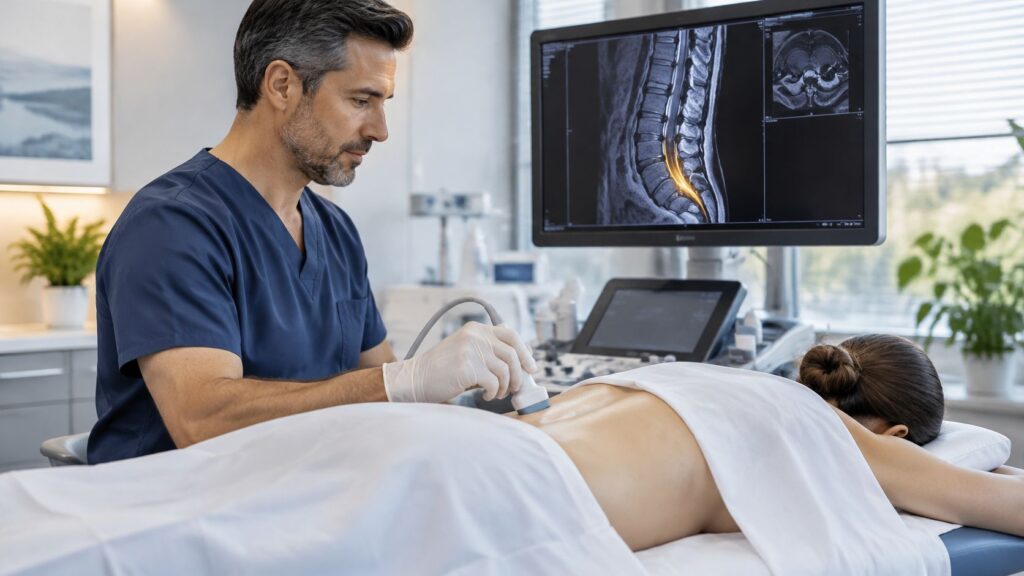
Individuals seeking a Cervical Dystonia specialist near me are likely dealing with more than a stiff neck. Many experience this need after weeks or months of head turning, muscle pulling, shoulder tension, headaches, or neck pain that keeps interfering with work, driving, sleep, and basic daily routines. The most frustrating part is that the problem can look simple from the outside while feeling anything but simple in your body.
The good news is that cervical dystonia is treatable, and local care matters. In Illinois communities around Chicago Ridge, including Oak Lawn, Palos Hills, Palos Heights, Worth, Bridgeview, Hickory Hills, Alsip, Burbank, Evergreen Park, and Orland Park, patients don't need to keep guessing whether they should see a neurologist, pain doctor, or another specialist first. The right evaluation usually makes that path much clearer.
Finding Relief from Cervical Dystonia in Illinois
Cervical dystonia can make ordinary movements feel unpredictable. You may notice your head pulling to one side while you're reading, talking, or trying to keep your eyes on the road. Some people feel constant tightness. Others have intermittent spasms that flare with stress, fatigue, or prolonged sitting.
This condition isn't rare in day-to-day practice. Cervical dystonia affects approximately 100,000 people in the United States, has a prevalence of 0.5% in the general population, and is most commonly diagnosed in individuals over 40 years of age, which is why regional access to treatment matters so much according to RWJBarnabas Health's overview of dystonia.
Why local access matters
When symptoms involve both abnormal neck muscle contractions and chronic pain, convenience becomes part of treatment. Injections often need to be repeated over time, and follow-up visits matter because dosing, muscle selection, and response patterns can change. A nearby Illinois clinic is more practical than a distant option if you're already struggling with turning your head, sitting upright, or tolerating a long drive.
Patients in the Chicago suburbs often search for fast relief, but speed isn't the only priority. The better goal is finding a clinician who can sort out two separate questions:
- Is this cervical dystonia rather than another neck condition?
- Is the pain coming only from muscle spasm, or is there also a mechanical pain problem that needs interventional treatment?
Clinical reality: A patient can have cervical dystonia and a separate pain generator in the neck at the same time. Treating only one part often leaves people partially relieved, not fully functional.
For residents of Oak Lawn, Orland Park, and nearby Illinois communities, that distinction can save time and reduce trial-and-error treatment. A careful, opioid-sparing plan should address both the involuntary movement pattern and the pain pattern, not assume they're identical.
What Is Cervical Dystonia and How Is It Diagnosed
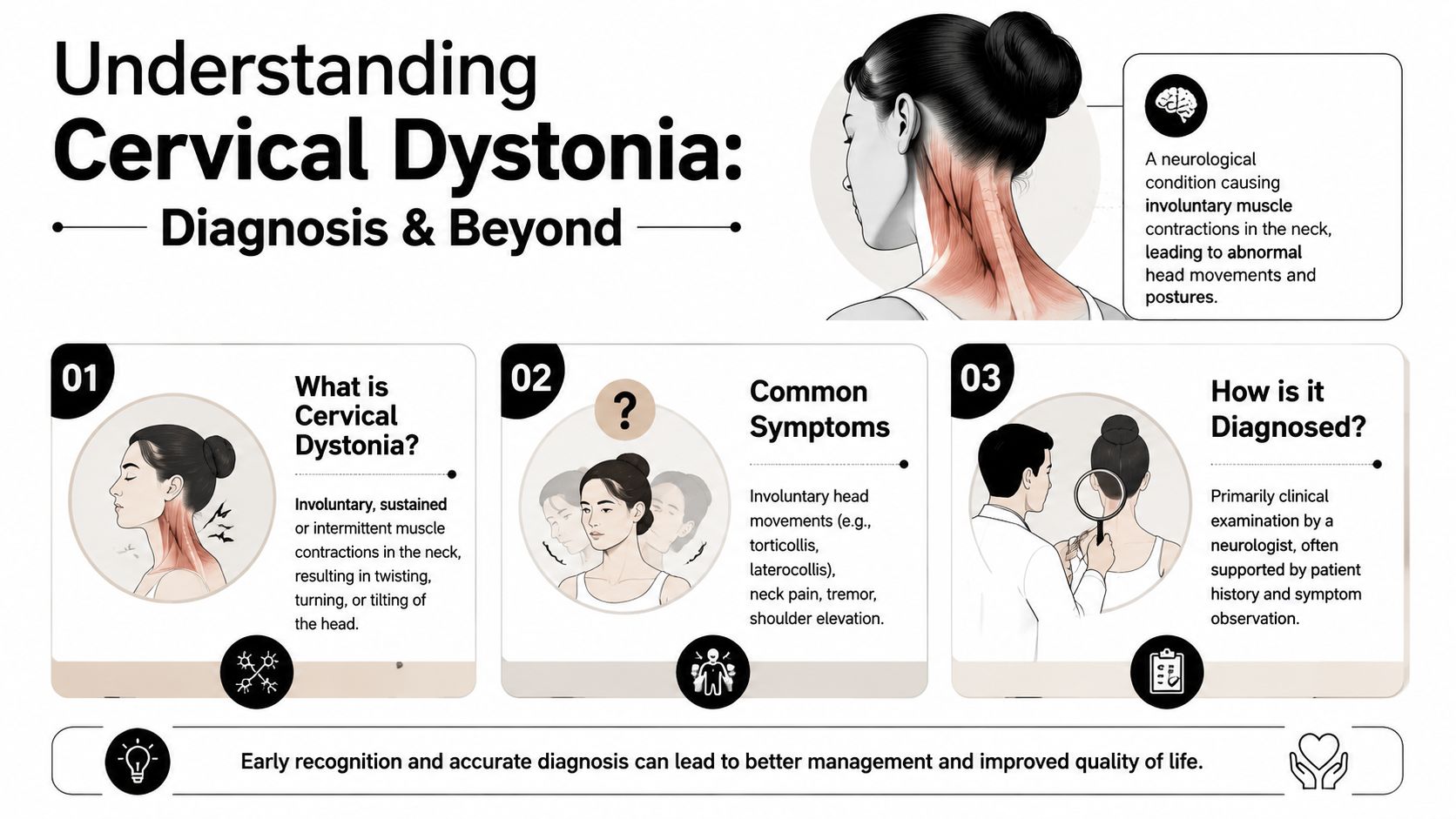
Cervical dystonia is a neurological movement disorder. The simplest way to think about it is faulty signaling between the brain and specific neck muscles. The muscles themselves aren't the root problem. The issue is that they receive abnormal instructions and contract when they shouldn't, or contract with too much force.
That misfiring can pull the head into different positions. Some patients develop turning of the head. Others tilt to the side, pull forward, or pull backward. Tremor, shoulder elevation, and deep aching pain are also common parts of the picture.
What symptoms usually bring people in
Patients rarely walk in saying, "I have dystonia." They usually describe what they feel.
Common complaints include:
- Head turning or tilting: The head drifts or pulls into a position you don't intend.
- Pain with posture: The neck hurts more the longer you try to hold a neutral position.
- Muscle tightness: One side of the neck or shoulder feels constantly overworked.
- Tremor or jerking: The head may shake or move in short, irregular bursts.
- Fatigue from effort: Holding your head straight can become tiring by the end of the day.
How the diagnosis is actually made
There isn't one blood test or one scan that "proves" cervical dystonia. Diagnosis is primarily clinical. A specialist listens to the history, examines the pattern of head movement, looks at which muscles are overactive, and considers whether anything else could explain the symptoms.
That evaluation matters because several conditions can mimic each other. Muscle strain, cervical arthritis, disc-related pain, nerve irritation, and movement disorders can overlap. A rushed visit can miss the full story.
The key question isn't just "Do you have neck pain?" It's "What is driving the pain, and what is driving the abnormal posture?"
A specialist will typically look for:
Pattern of abnormal movement
Is the head turning, tilting, flexing, or extending in a repeatable way?Trigger and relief pattern
Do symptoms worsen with certain activities, stress, or prolonged posture?Distribution of muscle overactivity
Are muscles such as the splenius capitis or trapezius acting like primary targets?Associated pain features
Is this purely dystonic pain, or is there a second mechanical pain problem layered on top?
What effective treatment is built around
Once the diagnosis is clear, treatment becomes more precise. Cervical dystonia is primarily managed by specialists through botulinum toxin type A injections into hyperactive neck muscles like the splenius capitis and trapezius, with clinical improvement in 80 to 90 percent of patients within 2 to 4 weeks.
That success depends on getting the right diagnosis first. If the wrong muscles are targeted, or if the pain source is misread, patients may assume "Botox didn't work" when the underlying issue was treatment selection, technique, or incomplete management of coexisting neck pain.
Evidence-Based Treatments Beyond Basic Medication
For most patients, the first question is simple. What works?
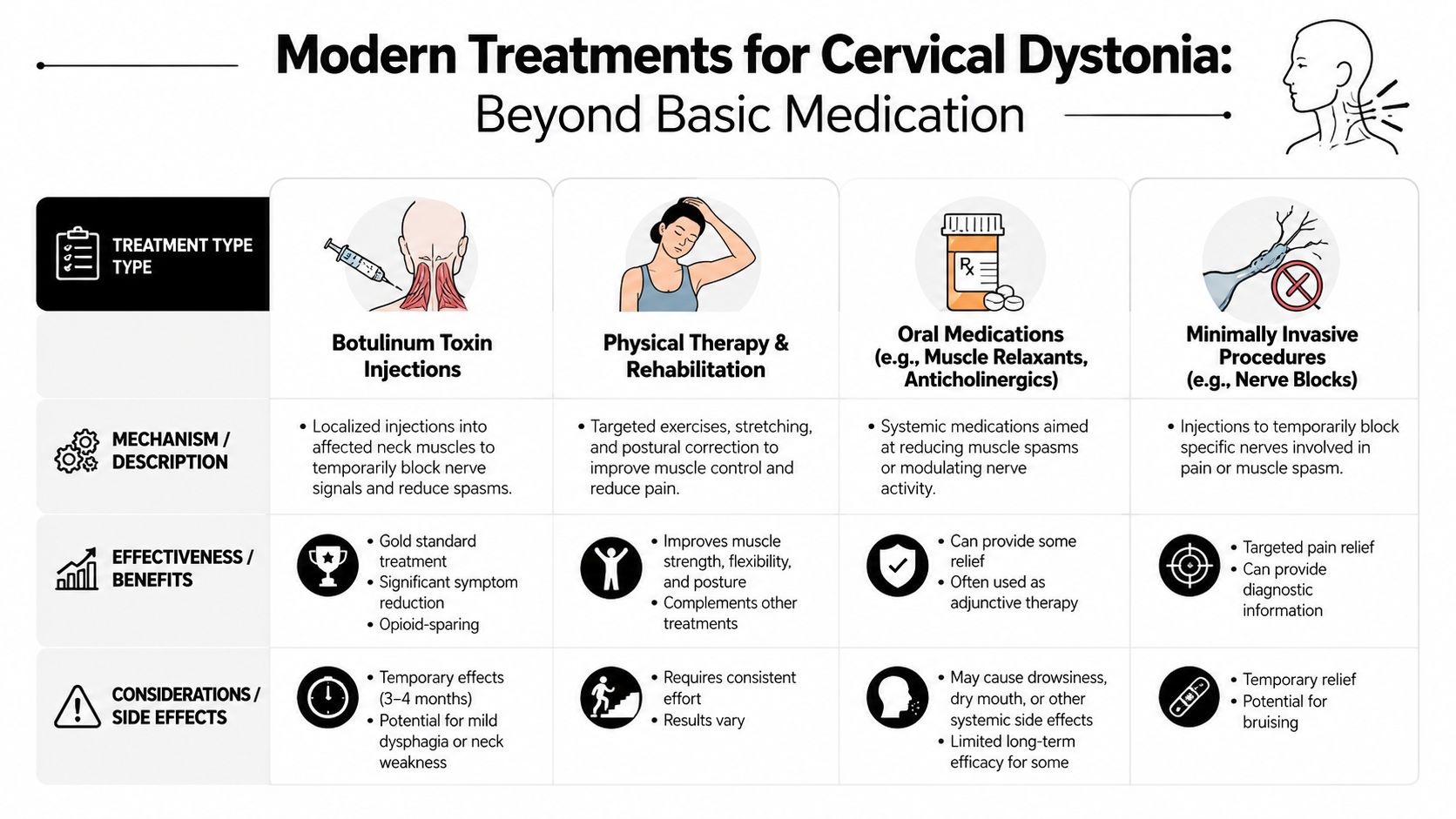
The first-line answer is botulinum toxin treatment. A landmark study found that 86% of patients with cervical dystonia receive botulinum toxin injections as their primary treatment, and the average duration of benefit lasts 3 to 4 months, which is why repeat treatment cycles are usually needed to maintain symptom control. The goal isn't to numb the whole neck. It's to relax the overactive muscles that are pulling the head into an abnormal pattern.
Why injections outperform basic medication alone
Oral medications can help some patients, but they often create a trade-off. You may get partial symptom relief at the cost of drowsiness, dry mouth, mental fog, or inconsistent day-to-day control. They also don't let the clinician target the exact muscles causing the abnormal movement.
Botulinum toxin works differently. It acts at the overactive muscle level. If you'd like a plain-language explanation of the mechanism, this overview of how Botox works gives a helpful foundation.
A useful comparison looks like this:
| Approach | What it helps most | Main limitation |
|---|---|---|
| Botulinum toxin injections | Involuntary muscle contraction and abnormal head posture | Temporary effect, requires repeat treatment |
| Oral medication | Broad symptom reduction in selected patients | Systemic side effects, less precise |
| Nerve blocks or similar procedures | Pain generators that aren't fully explained by dystonia alone | Not a substitute for dystonia-directed treatment |
| Advanced neuromodulation or procedural options | Selected complex cases with refractory pain or movement symptoms | Requires careful patient selection |
What doesn't work well by itself
A common mistake is treating cervical dystonia as if it were just "muscle tension." Massage, generic stretching, and temporary pain medication may help comfort for a short time, but they usually don't correct the abnormal neurological signaling behind the posture problem. The opposite mistake also happens. Some patients receive dystonia treatment but never get evaluated for structural or mechanical pain sources in the neck.
That's where an interventional pain perspective becomes useful.
- If spasm is the main issue, targeted botulinum toxin treatment may do most of the heavy lifting.
- If pain persists between treatment cycles, image-guided injections or related interventional options may help define and treat the pain source.
- If both are present, a multimodal plan is often more realistic than relying on a single medication.
What works in practice: The best outcomes usually come from matching the treatment to the driver of symptoms, not forcing every patient into the same template.
In Illinois, a clinic that can evaluate both dystonia and chronic neck pain in one setting gives patients a clearer path. Midwest Pain & Wellness is one example of a Chicago Ridge pain clinic that offers botulinum toxin treatment for cervical dystonia within a broader interventional pain model.
Choosing Your Specialist in the Chicago Suburbs
For those seeking a Cervical Dystonia specialist near me, it's often assumed the answer is always a general neurologist. Sometimes that's appropriate. But if you're also dealing with chronic neck pain, headaches, shoulder tension, or pain that hasn't improved with medication alone, a narrower choice can make more sense.

Why specialty fit matters
A 2024 study found that patients with both cervical dystonia and mechanical neck pain had significantly better functional outcomes when treated with a multimodal pain management approach, including nerve stimulation, compared to those receiving only pharmacotherapy. That matters for patients in Palos Hills, Bridgeview, Hickory Hills, and nearby Illinois communities because many don't have a pure movement disorder picture. They have dystonia plus pain that behaves like a separate mechanical problem.
A neurologist may diagnose the condition accurately. An interventional pain specialist brings a different strength. That physician can evaluate whether the pain is coming from dystonic muscles, cervical joints, irritated nerves, or a combination.
Questions worth asking before you book
Not every doctor who offers Botox treats cervical dystonia in the same way. Ask direct questions.
- Ask about dystonia-specific experience: Do they treat cervical dystonia routinely, not just cosmetic Botox or migraine Botox?
- Ask about targeting technique: Do they use EMG guidance or another precise method when needed for deeper neck muscles?
- Ask how they handle persistent pain: If spasms improve but pain remains, what is the next step?
- Ask about opioid-sparing care: Do they offer image-guided interventions and multimodal options before defaulting to long-term medication escalation?
A specialist who can explain both the movement problem and the pain problem in plain language is usually a better fit than one who addresses only half of the picture.
How to vet local options without guesswork
Online reviews aren't everything, but they can reveal how clearly a clinic communicates, whether scheduling is reliable, and whether patients felt heard. If you're trying to sort through local practices in Oak Lawn, Palos Heights, or Orland Park, practical guidance on strategies for online reviews can help you read review patterns more critically rather than relying on a star rating alone.
The right specialist isn't just close to home. The right specialist understands that cervical dystonia can be both a movement disorder and a pain disorder at the same time.
What to Expect at Your First Visit for Cervical Dystonia
Most patients feel some uncertainty before the first appointment. They want to know whether they'll be rushed, whether they'll be believed, and whether anyone will explain the problem in a way that makes sense. A strong first visit should reduce confusion, not add to it.

Assess
The visit starts with history and examination. The clinician asks when the abnormal movement began, whether it is constant or intermittent, which activities make it worse, and what treatments you've already tried. Neck pain is discussed in detail because pain pattern often reveals whether a second mechanical issue is present.
The exam focuses on posture, range of motion, muscle activation pattern, pain triggers, and function. Some patients have obvious turning or tilting during conversation. Others only show the movement pattern when they try to hold their head straight for a period of time.
Recommend
After the exam, the next step is a treatment plan that fits what was found. Expertise in this area is paramount. Interventional pain specialists who are double board-certified in pain medicine and anesthesiology are uniquely qualified to administer Botox for cervical dystonia alongside other advanced treatments, ensuring thorough, opioid-sparing care.
That recommendation may include one treatment or several. A patient with straightforward cervical dystonia may be a good candidate for botulinum toxin injections alone. A patient with dystonia plus persistent joint-mediated or nerve-related pain may need a broader interventional plan.
Treat
Treatment timing depends on the evaluation, prior records, and insurance requirements. In some cases, the plan is scheduled after authorization. In others, the patient leaves the first visit with a clear roadmap and a short timeline.
A practical first-visit flow often looks like this:
History review and focused exam
The clinician identifies the movement pattern and pain generators.Discussion of options
Risks, benefits, expected onset, and likely duration are reviewed in plain language.Targeted treatment planning
Muscle selection, procedural options, and follow-up timing are mapped out.
Patients usually feel more comfortable once they understand that treatment isn't guesswork. It follows the anatomy, the movement pattern, and the pain pattern.
For many people, the most reassuring part of the first visit is hearing that the goal isn't only symptom suppression. The goal is better head control, better function, less pain, and less dependence on opioids.
Navigating Insurance Coverage and Workers Compensation
Insurance questions stop many patients before they even schedule. That's understandable. Cervical dystonia care often involves specialist evaluation, injection planning, and repeat treatment over time, so it's reasonable to ask what your plan covers before you commit.
In most cases, Botox for cervical dystonia is treated as a medical service rather than a cosmetic one. Coverage depends on your individual plan, prior treatment history, and whether prior authorization is required. If you've never dealt with that process before, this guide to understanding healthcare prior authorization gives a helpful overview of why insurers sometimes request documentation before approving treatment.
What to verify before your appointment
A short phone call to your insurance carrier can prevent delays. Ask specifically about specialist visits for cervical dystonia, botulinum toxin injections when medically necessary, and any referral or authorization requirements.
Keep your checklist simple:
- Diagnosis coverage: Confirm that movement disorder or pain management evaluation is covered under your plan.
- Procedure benefits: Ask whether botulinum toxin treatment for cervical dystonia requires prior authorization.
- Network status: Verify whether the clinic and treating physician are in network.
- Repeat treatment rules: Ask whether follow-up treatment cycles require new approval each time.
Workers compensation and injury-related claims
Some patients develop symptom aggravation after a work injury, repetitive strain, or another event that turns an underlying problem into a disabling one. Others already carry a workers compensation or personal injury claim and need a clinic that can manage both the medicine and the paperwork.
That part of care matters more than many people expect. Delays often come from records, claim coordination, and approval requirements, not from the treatment plan itself. If your case involves a workplace injury, this page on workers compensation care in Chicago Ridge explains the type of support available for claim-based treatment.
Administrative advice: Bring your insurance card, referral information if required, and any prior imaging or treatment records to the first visit. Good documentation speeds everything up.
The goal is to remove financial uncertainty early, so decisions are based on clinical need rather than billing confusion.
Schedule Your Consultation in Chicago Ridge Today
You don't have to keep living around the pull, tilt, pain, and fatigue of cervical dystonia. If your search for a Cervical Dystonia specialist near me has led to conflicting advice, the next step is a focused evaluation by a clinician who understands both movement-related spasm and chronic neck pain.
Patients from Worth, Burbank, Alsip, Evergreen Park, Oak Lawn, Palos Hills, Palos Heights, Bridgeview, Hickory Hills, and Orland Park often want the same thing. A clear diagnosis, an opioid-sparing plan, and treatment that addresses more than one symptom at a time. That usually starts with identifying whether botulinum toxin treatment alone is enough or whether a broader interventional strategy is needed.
If you want to learn more about local treatment options, this page on Botox for chronic migraine and cervical dystonia in Chicago Ridge is a practical next stop before scheduling.
Relief starts with a proper assessment. If your neck keeps pulling, your pain is lingering, or prior treatment hasn't gone far enough, it's time to get a more complete evaluation.
Midwest Pain & Wellness provides compassionate, evidence-based pain care in Chicago Ridge, Illinois for patients dealing with cervical dystonia, chronic neck pain, work injuries, and related conditions. To request an appointment, visit Midwest Pain & Wellness.