Knee pain has a way of shrinking a life one decision at a time. You skip the walk with friends, take the elevator instead of the stairs, and start planning your day around how much the knee will complain by evening. If you've already tried pills, rest, heat, or basic activity changes and the pain keeps coming back, knee joint pain relief injections can be a practical next step, not as a miracle cure, but as a targeted treatment that matches the problem inside the joint.
At Midwest Pain & Wellness in Chicago Ridge, I approach knee pain the same way I approach most chronic pain, with a plan that aims to reduce pain without leaning on opioids. That usually means choosing the right injection for the right job, then pairing it with a broader strategy that protects function and helps you move better in daily life. The key is setting honest expectations before the needle ever goes in.

When Knee Pain Disrupts Your Life
The story usually sounds familiar. The knee aches when you stand up after sitting too long, stiffens after a short walk, and turns stairs into a calculation. Some days it flares after activity, other days it seems to hurt for no clear reason, and the usual over-the-counter options no longer do enough to matter.
That's often when patients start asking about injections. They're looking for something more focused than pills, something that goes directly to the joint instead of flooding the whole body with medication. That instinct makes sense, because a knee joint injection is a local treatment aimed at a local problem, and that's one reason it can fit well inside an opioid-sparing plan.
Why targeted treatment matters
A knee joint can hurt for different reasons, inflammation, cartilage wear, fluid changes, or a combination of all three. A single injection won't solve every cause, but the right one can calm the pain enough to restore movement, improve sleep, and make it possible to get back to the basics that support recovery.
Practical rule: if pain relief doesn't improve function, it's not doing enough for a chronic knee problem.
That's the mindset I use with patients in Oak Lawn, Palos Hills, Palos Heights, Worth, Bridgeview, Hickory Hills, Alsip, Burbank, Evergreen Park, and Orland Park. The goal isn't to chase temporary comfort alone. It's to choose a treatment that gives the knee enough relief to let you walk, climb, and stay active again.
Understanding How Knee Injections Work
Knee injections are not all doing the same thing. Some are designed to quiet inflammation, some aim to improve joint lubrication and cushioning, and some are used to signal a healing response. If you think of the knee like a machine, the logic is easier to follow. One treatment is for overheating, one is for lubrication, and one is for repair support.
Three different jobs
Corticosteroid injections act like a coolant for an irritated joint. They're used when the knee is hot, swollen, or inflamed and you need relief quickly. Their strength is speed, not durability.
Hyaluronic acid injections, often called gel shots or viscosupplementation, are meant to supplement the joint's fluid environment. In simple terms, they try to restore some of the cushioning and glide that a worn knee has lost.
PRP, or platelet-rich plasma, uses your own blood components to deliver growth factors back into the joint. The idea is not instant numbing. The aim is to create a biologic environment that may support longer-horizon symptom improvement in selected patients.
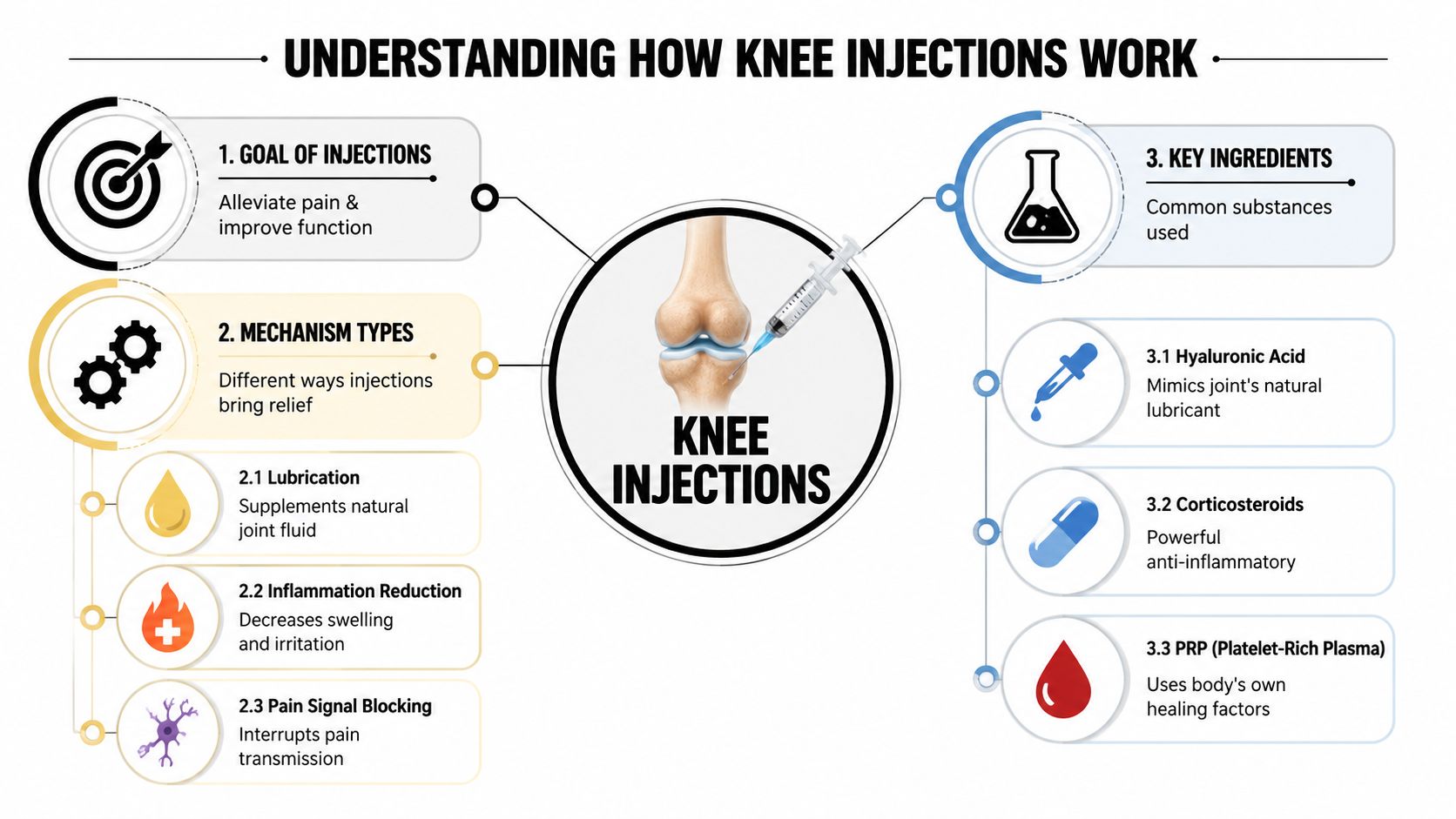
The right injection depends on what the knee is doing right now, not on which product sounds strongest in a brochure.
That distinction matters because a swollen flare-up and a long-standing mechanical ache don't always deserve the same treatment. If a patient needs rapid pain control so they can re-engage in rehab or walk through the workday, a short-acting anti-inflammatory option may make sense. If the goal is to pursue longer functional improvement, the conversation shifts toward other options.
Comparing Your Options Steroids HA PRP and Cell Therapy
The cleanest way to choose among steroids, hyaluronic acid, PRP, and cell-based therapies is to start with the clinical goal. Are we trying to reduce a flare fast, provide cushioning for a worn joint, or explore a regenerative approach with a longer timeline? Those are different problems, and they shouldn't be treated as if they're the same.
Knee Injection Options at a Glance
| Injection Type | Primary Goal | Typical Duration of Relief | Best For |
|---|---|---|---|
| Corticosteroid | Rapid inflammation control | Short-term | Flare-ups, swelling, quick return to activity |
| Hyaluronic Acid | Improve joint lubrication and cushioning | Variable, often temporary | Mild to moderate arthritis when other care hasn't helped enough |
| PRP | Support longer-horizon symptom improvement | Can extend further than standard injections in some studies | Selected patients seeking a regenerative option |
| Cell-based therapies | Experimental biologic support | Uncertain | Patients who understand the evidence is still limited |
Corticosteroid injections are the fastest-moving option, which makes them useful when a knee is too irritated to function normally. That's why they're often chosen for short-term rescue rather than long-term maintenance. Hyaluronic acid is different. It's less about stopping inflammation and more about trying to change how the joint feels and moves during daily use.
PRP sits in a different category altogether. A 2024 meta-analysis of 42 trials and 3,696 patients reported that PRP provided sustained symptomatic relief and functional improvement up to 12 months, and it ranked above hyaluronic acid, corticosteroids, and placebo in that analysis comparative effectiveness meta-analysis. At the same time, not every trial agrees, and a randomized placebo-controlled study found no significant difference among glucocorticoid, hyaluronic acid, PRP, and placebo during the first six months. That tells me patient selection matters a lot.
Cell-based therapies are even less settled. I don't treat them as a routine first-line answer for knee osteoarthritis because the evidence base is still developing, and patients deserve clarity before they spend money or time on something uncertain.
For patients who are not ready for injection-only care, an additional interventional option is discussed on our site at genicular nerve ablation, which can make sense when joint pain has become persistent and other measures have fallen short.
Why timing differs
The knee responds differently depending on what's being delivered. A steroid shot can reduce inflammatory signals quickly, so patients often feel something early. Gel-based treatments work more slowly because they're trying to change the joint's mechanical environment. PRP, when it works, tends to be judged over a longer window because the response is biologic rather than immediate.
Clinical takeaway: fast relief and lasting relief are not the same thing, and the best injection is usually the one that matches the timeline of the problem.
For patients considering regenerative care, our practice also discusses regenerative medicine and tissue engineering as part of the larger conversation about where PRP fits and where evidence is still emerging.
The Evidence What Clinical Studies Actually Say
A patient with knee osteoarthritis often wants the same answer every time, a shot that works quickly, lasts long enough to matter, and avoids surgery or opioids. The evidence does not support one universal answer, so the right injection depends on whether the goal is short-term flare control, longer symptom management, or a trial of a biologic option with less certainty.
The strongest evidence for corticosteroid injections is short-term. A review found clinically significant pain reduction in 5 randomized trials with 312 participants at 1 week, with the effect usually lasting 3 to 4 weeks and rarely beyond that short-term steroid review. Another meta-analysis of 8 randomized controlled trials found the biggest benefit in the first 1 to 2 weeks, with benefit fading by 4 to 6 weeks and becoming non-significant after 26 weeks. That is why I use steroid shots when a patient needs a fast reset to get through a flare, tolerate physical therapy, or move more comfortably in the near term.
Hyaluronic acid is more controversial
The 2022 BMJ meta-analysis changed the discussion around viscosupplementation. It pooled 24 placebo-controlled trials with 8,997 randomized participants and found only a small pain reduction, with a standardized mean difference of −0.08. That effect was below the minimal clinically important difference, and the analysis also reported an increased risk of serious adverse events BMJ meta-analysis. A broad reading of that literature does not support routine claims that gel shots work well for everyone.
Some orthopedic and pain practices still use hyaluronic acid in selected patients, especially when the arthritis is mild to moderate and the person wants a non-opioid, non-surgical option. Hospital for Special Surgery reports successful outcomes in 60.0% of knee osteoarthritis patients in one analysis of randomized trials, particularly in patients with mild to moderate arthritis who have not improved with medications, activity changes, or physical therapy HSS viscosupplementation overview. In practice, that means viscosupplementation can still be reasonable when the knee is not severely inflamed, the patient wants to avoid stronger medications, and expectations stay grounded.
How I read the mixed evidence
The studies point to a pattern, not a single winner. Steroids help early, hyaluronic acid has inconsistent benefit, and PRP may provide longer relief for some patients but still varies across studies. That is also why I discuss regenerative medicine and tissue engineering only when a patient understands that biologic treatments are not immediate fixes and that the evidence is still evolving.
I do not promise a miracle from any injection. I match the treatment to the likely goal, the likely duration, and the patient's tolerance for uncertainty.
The Injection Procedure What to Expect at Our Clinic
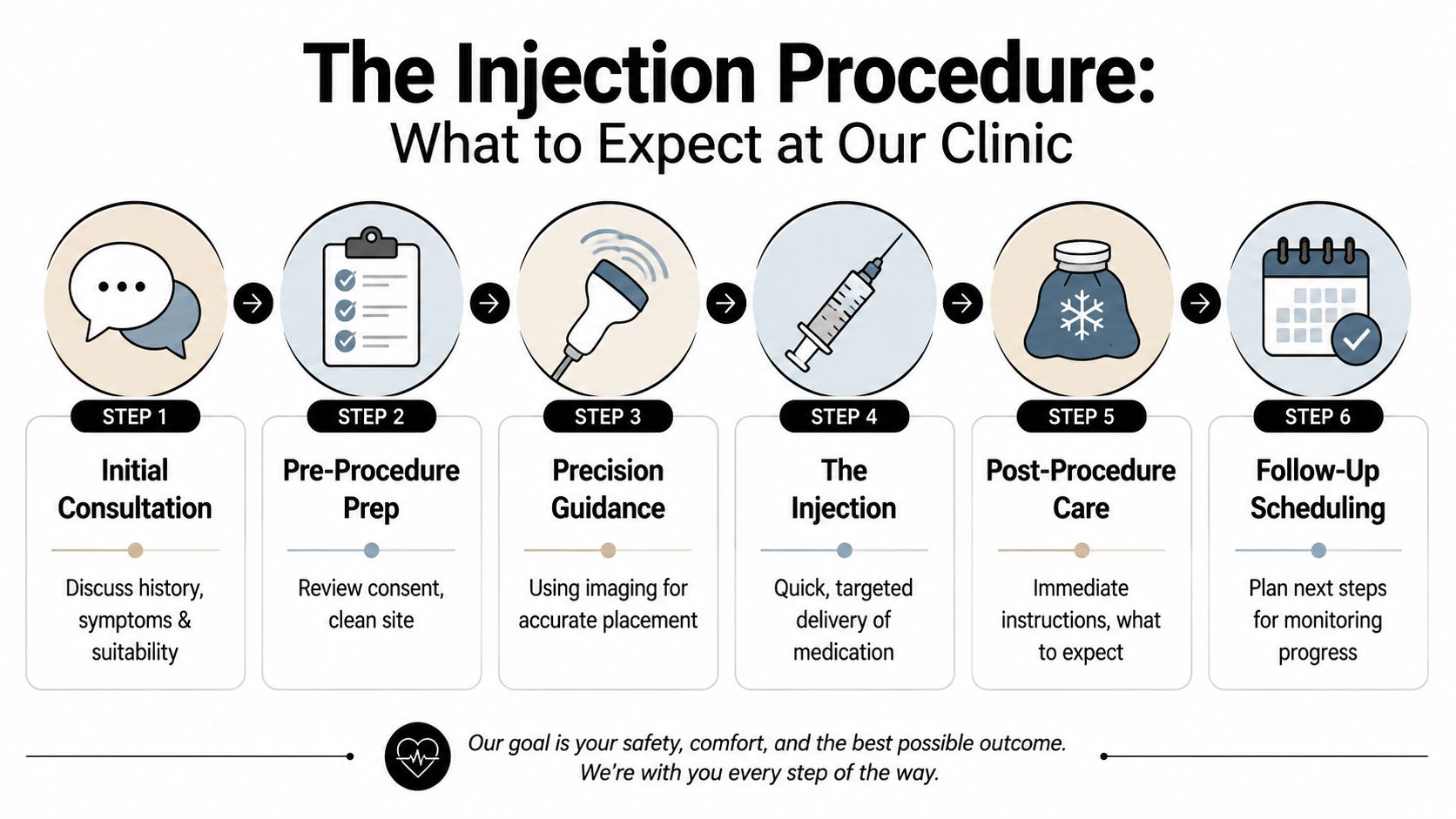
A knee injection starts with a consultation, not with a syringe. I want to hear where the pain sits, what makes it worse, what you have already tried, and whether the problem behaves more like inflammation, a mechanical issue, or a combination of both. That visit also helps me rule out situations where an injection is the wrong next step.
The day of treatment
On the day of treatment, the skin is cleaned carefully, the target is identified, and the medication is placed into the joint with image guidance when appropriate. In a specialty pain setting, that precision matters because accurate placement is part of what makes the procedure worthwhile.
For knee osteoarthritis, image-guided delivery helps keep the medication where it belongs, inside the joint space. That matters most when the injection is being used as a bridge back to movement, exercise, or the rest of the pain plan. For a patient who needs a short-term flare reset, corticosteroids can fit that role well because their benefit tends to show up early and then fade. I use them when the goal is to calm inflammation fast so function can improve in the near term, not as a long-term maintenance strategy.
If you are deciding between injection types, our osteoarthritis treatment options page explains how I think about the broader plan around the joint, not just the procedure itself.
After the injection
Most patients go home the same day. Mild soreness, warmth, or a brief pain flare can happen, especially after viscosupplementation. Cleveland Clinic notes that the most common side effect of hyaluronic acid knee injections is mild pain and swelling at the injection site, and some patients have a more pronounced flare with swelling and pain that may need fluid drainage Cleveland Clinic knee gel injections.
If the joint feels more irritated for a day or two, that does not automatically mean the injection failed. The tissue may have reacted to the procedure itself, and that reaction is part of the trade-off patients should understand before treatment.
Follow-up is where the plan becomes personal. Some patients need reassessment because the pain pattern changes. Others improve enough that no repeat procedure is needed right away. That visit is also where I decide whether to repeat the injection, switch to another strategy, or combine it with the next part of the overall pain plan.
Are You a Candidate for Knee Injections
A good candidate usually has knee pain that has persisted despite basic conservative care. That often includes people with mild to moderate arthritis who have not improved enough with medication, activity changes, or therapy. In that setting, injection therapy can still be reasonable for selected patients, but the choice depends on the goal. If the goal is to calm a flare quickly, a steroid may fit better. If the goal is to support a joint that still needs longer-term symptom control, hyaluronic acid can be part of the discussion. Our page on osteoarthritis treatment options explains how I think about that broader plan around the joint, not just the procedure itself.
Good reasons to consider an injection
A knee injection makes sense when pain is affecting sleep, walking, stairs, work, or exercise, and the joint still has a role you want to preserve. It can also be appropriate during a flare when inflammation has temporarily shut down normal activity. In that situation, the injection is not the whole plan, it is a way to lower symptoms enough so you can keep building strength, motion, and function.
The timing matters. A short-term flare-up usually calls for a treatment that works faster, while longer-term management is about buying enough relief to stay active without depending on repeated rescue care.
Reasons to pause first
Active infection, skin infection near the injection site, or a diagnosis that is still unclear all need a more careful review before treatment. A knee injection is a targeted medical procedure, so it should be chosen with the same discipline I use for any interventional pain treatment.
Good injection care starts with good selection. If the knee pain source is wrong, the injection choice is wrong too.
A multimodal plan matters because injections work best when they support movement, not when they replace it. That is why I often pair them with other conservative measures instead of treating them as a stand-alone answer. The broader approach should fit the arthritis pattern, the level of inflammation, and the patient's functional goals.
Your Next Steps in the Chicago Ridge Area
If you live in Oak Lawn, Palos Hills, Palos Heights, Worth, Bridgeview, Hickory Hills, Alsip, Burbank, Evergreen Park, or Orland Park, and your knee pain has started dictating what you can and can't do, it's worth getting a focused evaluation. The main mistake I see is waiting until the knee has been painful for so long that every option feels like a guess.
The evidence is clear on one important point, steroid shots can help in the short term, but the benefit often fades, and hyaluronic acid hasn't shown clear broad benefit over placebo in high-quality research NCBI review on knee injections. That doesn't mean injections have no place. It means they work best when the right one is chosen for the right goal, with realistic expectations from the start.
If you want a plan built around that kind of thinking, schedule a consultation with Dr. Yaw Donkoh at Midwest Pain & Wellness. We'll review your knee history, discuss evidence-based approaches, and build a treatment plan that aims for relief without defaulting to opioids.
A CTA for Midwest Pain & Wellness.