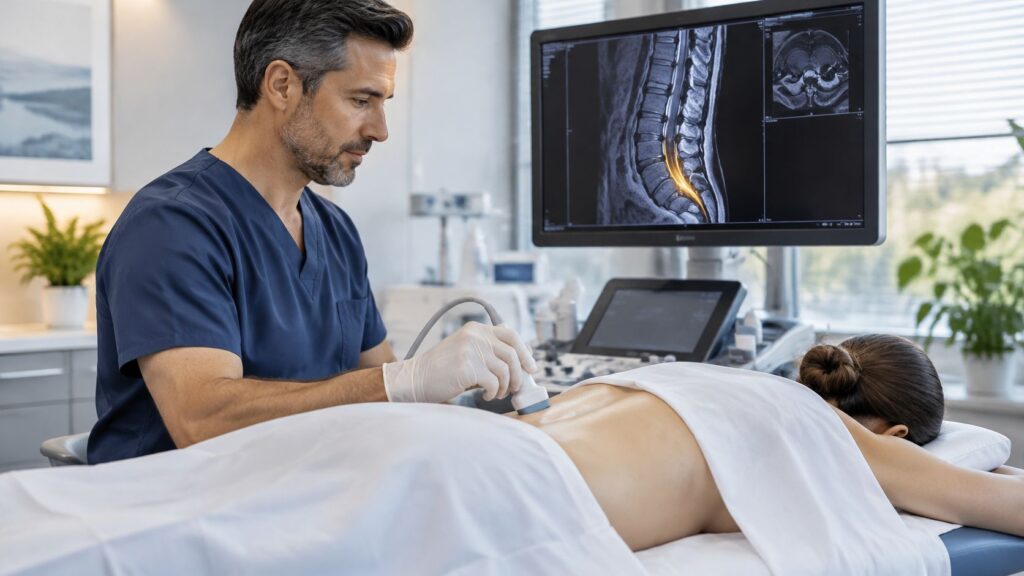
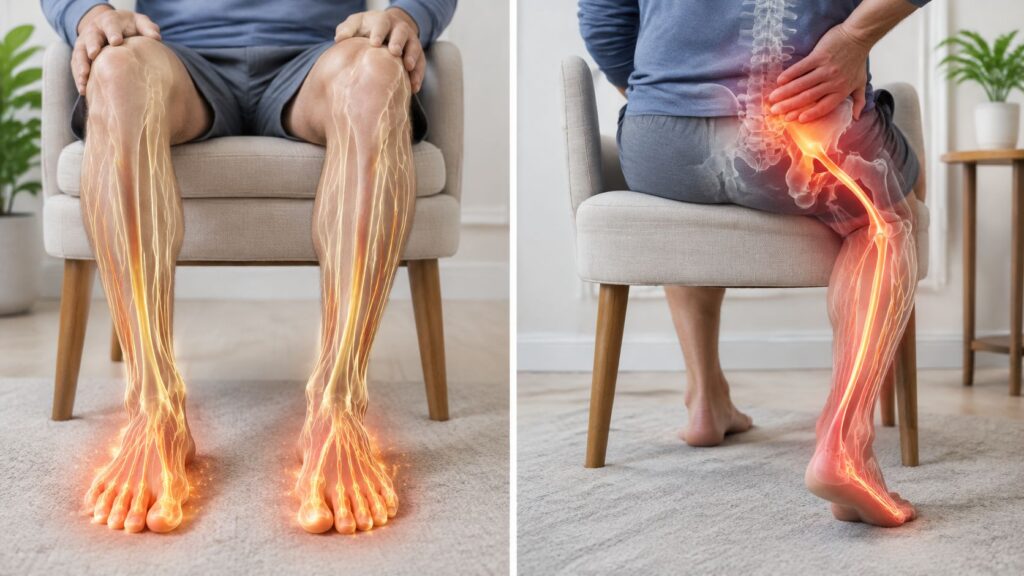
If you're reading this in Chicago Ridge, Oak Lawn, Palos Hills, Palos Heights, Worth, Bridgeview, Hickory Hills, Alsip, Burbank, Evergreen Park, or Orland Park, there's a good chance you've already tried the usual next steps for pain. Rest, medication, therapy, maybe a cortisone injection. Yet your knee still swells after stairs, your neck still locks up by afternoon, or your low back still flares every time you try to get back to normal life.
That's usually when people start hearing about regenerative treatments. The problem is that the term gets used too loosely. Some clinics describe almost any injection as “regenerative.” Others market lab-level science as if it were already routine care. Patients are left trying to sort out what's established, what's promising, and what's still more theory than practical treatment.
As a pain specialist would explain it, regenerative medicine and tissue engineering are best understood as an effort to support repair, reduce pain, and improve function using biologic principles. That's different from promising a miracle cure. In real practice, the right question isn't “Can this regenerate everything?” It's “For your specific pain problem, is there a biologic treatment that makes sense, is safe, and fits into a broader plan?”
An Introduction to Regenerative Pain Management
Regenerative care attracts attention because it addresses something many pain treatments don't fully address. Instead of only quieting inflammation or blocking pain signals, it tries to influence the environment where healing happens. For some patients, that's a meaningful shift.
What these terms actually mean
Regenerative medicine refers to treatments intended to help the body repair or restore damaged tissue. Tissue engineering is the related science of using engineering and biology together to create, support, or regenerate tissue. The modern field was formalized in the early 1980s, and it has expanded far beyond an academic niche. One market forecast estimates the global tissue engineering market at USD 14.62 billion in 2026 and projects USD 32.93 billion by 2033, with a projected 12.3% CAGR according to this tissue engineering market forecast.
That growth tells you something important. These treatments are no longer discussed only in research settings. But market growth is not the same thing as proof that every regenerative treatment works for every pain condition.
Practical rule: The more specific the diagnosis, the easier it is to have an honest conversation about whether a regenerative option is reasonable.
What pain patients should expect
In an Illinois pain clinic, regenerative treatment usually does not mean growing a new organ or replacing a worn-out joint in the office. It usually means targeted biologic procedures for selected musculoskeletal problems, often as part of a larger plan.
That larger plan may include:
- Precise diagnosis first so the injection targets the actual pain generator
- Movement-based rehab to protect and reinforce the treated area
- Image guidance so placement isn't based on guesswork
- Opioid-sparing care when long-term medication isn't the right answer
Patients with tendon pain, joint pain, or certain spine-related conditions often ask if they're “too far gone” for regenerative treatment. Sometimes the answer is yes. Advanced structural damage, severe instability, or a problem that clearly needs surgery may not be a good fit. But many people fall into a middle category where a careful biologic approach may be worth discussing.
A grounded way to think about it
The safest way to approach regenerative pain management is to strip away the hype. Ask what tissue is injured, what evidence supports treatment for that diagnosis, how the procedure is performed, and how success will be measured.
For chronic pain patients around Chicago Ridge and nearby suburbs, that mindset matters. It keeps the focus where it belongs: less pain, better function, and safer decision-making.
The Scientific Pillars of Tissue Repair
A simple way to understand tissue repair is to think about building a house. You need workers, a frame, and instructions. In tissue engineering, those three pieces are cells, scaffolds, and growth factors.
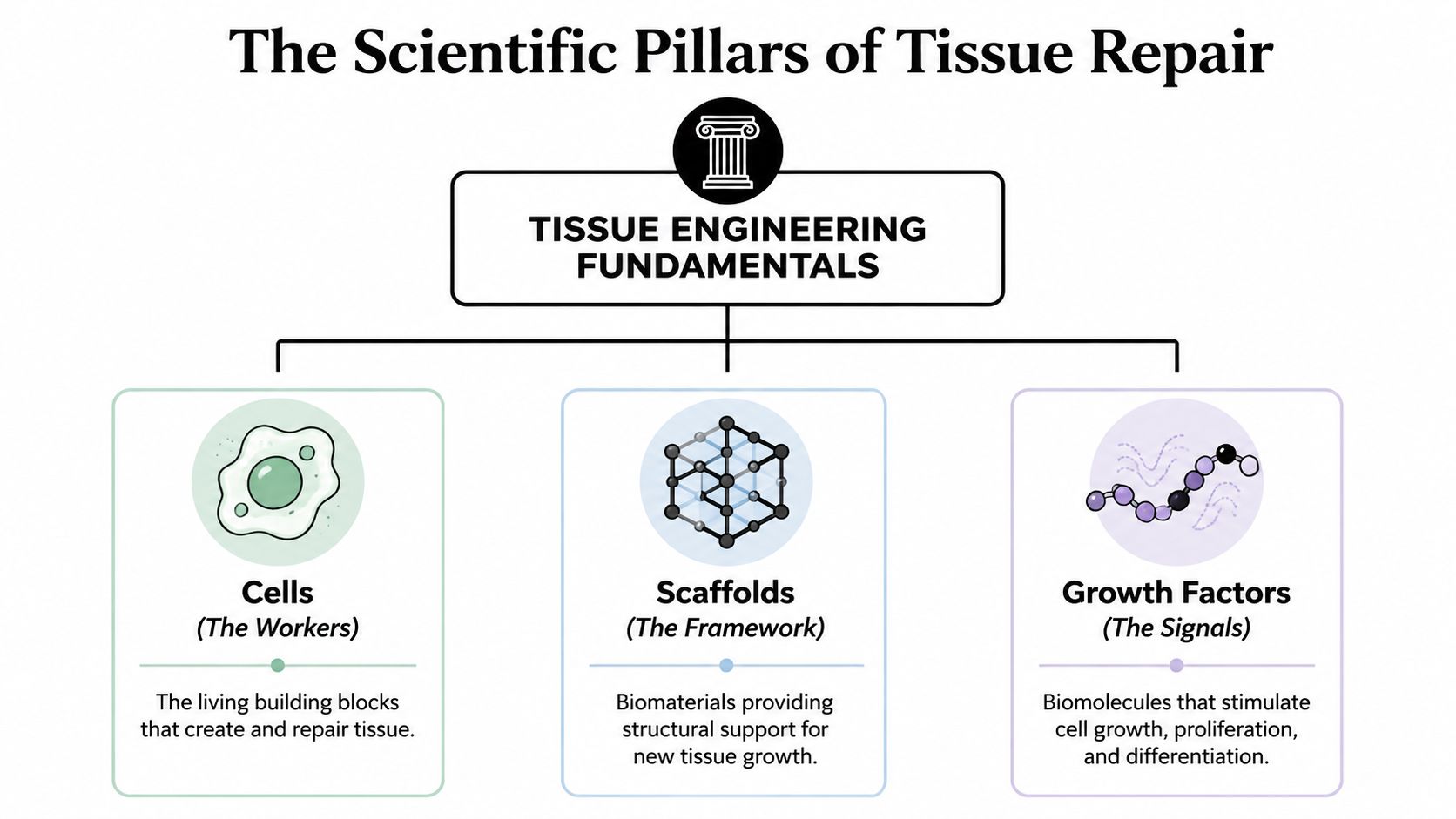
Cells, scaffolds, and signals
Here's the plain-language version:
- Cells are the workers. They build, remodel, and maintain tissue.
- Scaffolds are the framework. They give cells a place to attach and organize.
- Growth factors are the signals. They tell cells when to migrate, divide, or produce tissue.
If one part is missing, repair gets harder. If the signal is weak, the workers don't respond well. If the structure is poor, cells may survive but fail to create useful tissue.
A lot of regenerative pain treatment focuses less on constructing brand-new tissue and more on improving the signaling environment around injured structures. That's one reason PRP, or platelet-rich plasma, comes up so often in musculoskeletal care.
Where PRP fits
PRP is made from a sample of the patient's own blood that is processed to concentrate platelets. Platelets carry growth factors that participate in healing responses. In practice, the goal is not to “grow a new body part.” The goal is to deliver a more favorable biologic signal to a tendon, joint, or ligament that has stalled in a chronic pain cycle.
That's also why technique matters. The target tissue has to be correct. The injection has to be placed accurately. The aftercare has to make sense for the structure being treated.
Some patients also ask about supportive recovery tools and adjunctive biologic strategies. If you're trying to understand that broader field, Best peptides for tissue repair offers a useful overview of how these topics are commonly discussed, though peptide products are separate from standard in-office PRP care.
What remains cutting edge
The field has made major technical progress. A historical review notes that regenerative medicine and tissue engineering became formalized in the early 1980s, and that 3D bioprinting now enables fabrication of structures such as heart valves, vascular networks, and tumor models. That same review notes that multiple 3D-bioprinted constructs and stem-cell therapies have been approved by regulatory agencies in the last decade, as described in this review of regenerative medicine and 3D bioprinting milestones.
For pain patients, that doesn't mean your local clinic is printing cartilage in the procedure room. It means the science is advancing, but most office-based regenerative care is still far more practical and limited than headlines suggest.
Good regenerative care isn't about using the most futuristic term. It's about matching the right biologic tool to the right tissue problem.
If you'd like a patient-friendly explanation of one of the most discussed biologic topics, this overview of how stem cells work to repair your body can help clarify the basic concepts.
Common Applications for Spine and Joint Pain
When patients ask where regenerative treatment most often fits in pain practice, the answer is narrower than marketing makes it sound. These procedures are usually considered for joint degeneration, tendon disorders, and selected spine-related pain generators, not for every painful condition.
Knee and other joint pain
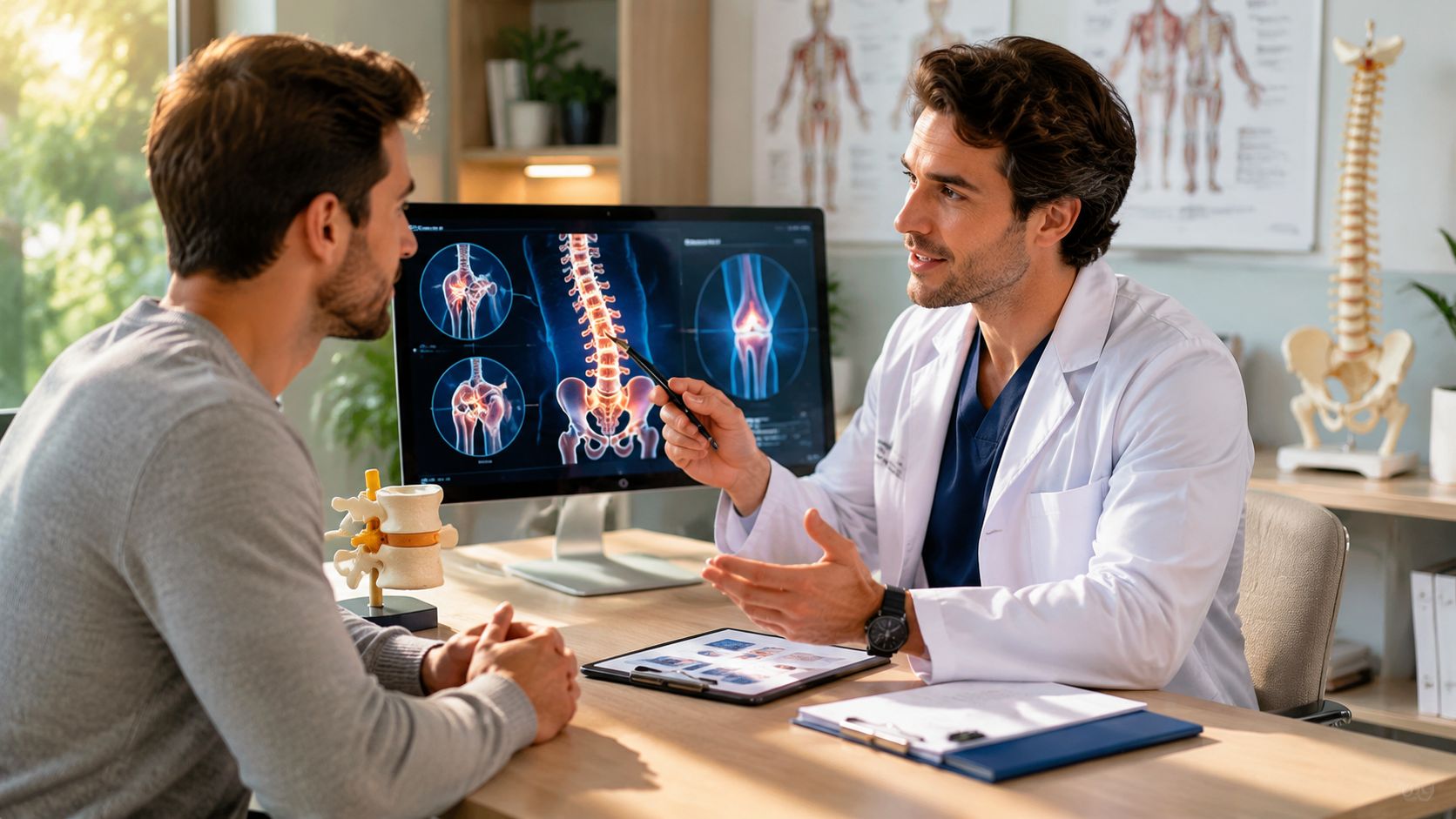
Knee osteoarthritis is one of the more common reasons patients ask about PRP. In daily practice, the typical candidate is someone with ongoing pain, stiffness, and activity limitation who isn't ready for surgery, doesn't want repeated steroids, or hasn't had enough improvement from standard conservative care.
PRP may also come up for:
- Shoulder joint pain when inflammation and degeneration are part of the picture
- Hip pain in carefully selected cases
- Mild to moderate arthritic complaints where the goal is symptom relief and better function, not structural reversal
The key limitation is that advanced bone-on-bone disease or major deformity often doesn't respond the way patients hope. A biologic injection can't reliably overcome severe mechanical damage.
Tendons and ligaments
This is an area where regenerative treatment often makes intuitive sense. Chronic tendinopathy isn't always a high-inflammation problem. Sometimes it's a failed-healing problem. That distinction matters.
Common examples include:
| Condition | Why patients consider regenerative care | Clinical reality |
|---|---|---|
| Tennis elbow | Persistent tendon pain despite rest and rehab | Often worth discussing when symptoms are chronic |
| Patellar or quadriceps tendon pain | Pain with stairs, squatting, or sports | Best when diagnosis is clear and rehab continues |
| Rotator cuff tendinopathy | Shoulder pain with reaching and sleep disturbance | Works better when tears and mechanics are fully assessed |
Selected spine conditions
Spine pain is more complicated. Not every back or neck problem is a regenerative medicine problem. In fact, many spine complaints respond better to other interventional tools, structured exercise, nerve-targeting procedures, or surgery when indicated.
Still, some cases raise the question of biologic treatment:
- Facet-related pain when the small joints in the spine contribute to symptoms
- Sacroiliac region pain in select settings
- Certain ligament or soft tissue pain patterns after careful evaluation
For neck pain specifically, treatment planning depends heavily on whether the pain is disc-related, facet-driven, myofascial, postural, or nerve-mediated. Patients comparing options can review PRP for neck pain to see how this discussion applies to cervical complaints.
The best use of regenerative treatment in pain medicine is usually focused, not broad. One tissue. One diagnosis. One reason for doing it.
In a multimodal clinic, these procedures are typically one part of care rather than the entire care plan. That may also include diagnostic blocks, rehabilitation, medication review, activity modification, or other image-guided interventions.
Navigating Evidence and FDA Regulations
Patients require the clearest guidance. The science around regenerative medicine and tissue engineering is exciting. The clinical marketplace is much messier.
Why the hype gets ahead of the evidence
Recent reviews describe major progress in cell therapy, extracellular-vesicle therapy, scaffold design, gene editing, and 3D bioprinting. They also stress that translation into routine care is still limited by technical, ethical, regulatory, and clinical-trial bottlenecks. The same review argues that the most practical near-term value may be in cell-free and platform technologies, especially advanced biomaterials and extracellular vesicle approaches, rather than full organ replacement, as discussed in this review on what is actually close to clinical use.
That point matters because many patients hear “stem cells” and assume the treatment is standard, proven, and broadly approved. Often, it isn't.
What a responsible clinic should say
A careful physician should be willing to tell you four things clearly:
- What is established for your diagnosis
- What is still investigational
- What the FDA has and has not approved
- What the realistic endpoint is, such as pain reduction or functional improvement
If a clinic skips those distinctions and moves straight to promises, that's a problem.
One useful example of how confusing FDA questions can become is hair restoration. Patients trying to understand the regulatory language around PRP in another field can look at is PRP FDA approved for hair, which shows why “approved,” “cleared,” and “used in practice” aren't interchangeable terms.
What to watch for
Some warning signs are easy to spot:
- Cure-all language that treats arthritis, disc pain, neuropathy, and severe structural damage as if they all respond the same way
- One-size-fits-all protocols with no imaging review or diagnostic precision
- Pressure to pay quickly before you've had time to weigh alternatives
- Vague biologic labels with little explanation of what is being injected
If a clinic can't explain what the injection is, why it fits your diagnosis, and what the limits are, you shouldn't move forward.
That doesn't mean regenerative care lacks value. It means the value depends on discipline. In a pain practice, that usually means using evidence-supported options where they fit, avoiding exaggerated claims, and keeping patient safety ahead of marketing.
Are You a Candidate for Regenerative Therapy
The right candidate for regenerative treatment is not merely someone who wants to avoid surgery. It's someone whose diagnosis, exam findings, imaging, and prior treatment history all point toward a biologic procedure being a reasonable next step.

What a real evaluation looks like
A proper consultation should include more than a symptom checklist. For pain patients, the workup usually centers on:
- History of when the pain started, what worsens it, and what treatments you've already tried
- Physical exam to identify whether the pain appears joint-based, tendon-based, nerve-related, or referred from another structure
- Imaging review such as X-rays or MRI when those studies help confirm the target
- Functional goals like walking farther, sleeping better, returning to work, or getting through exercise with less pain
That process often shows that some patients are good candidates, some are poor candidates, and some need a different diagnosis before anyone should talk about a biologic injection.
Who may be a reasonable fit
The patients most commonly considered are those who:
- Have persistent musculoskeletal pain despite standard conservative treatment
- Can identify a specific pain generator rather than diffuse unexplained pain everywhere
- Want an opioid-sparing approach and understand that improvement may take time
- Are willing to follow aftercare instructions and continue rehabilitation when needed
A patient with localized knee pain, imaging that matches symptoms, and incomplete response to conservative measures is very different from a patient with widespread pain, severe instability, and multiple competing diagnoses.
Who may need something else first
Regenerative treatment may not be the right next step when there is:
- Clear surgical pathology
- Active infection or major uncontrolled medical issues
- Bleeding risk that changes procedural safety
- Pain driven mainly by nerve compression or central sensitization rather than local tissue injury
One option patients in the Chicago Ridge area may encounter is Midwest Pain & Wellness, which offers regenerative procedures within a broader interventional pain model rather than presenting biologic injections as the only answer. That distinction matters because many people need a combination of treatments, not a single procedure.
Understanding Risks Limitations and Realistic Goals
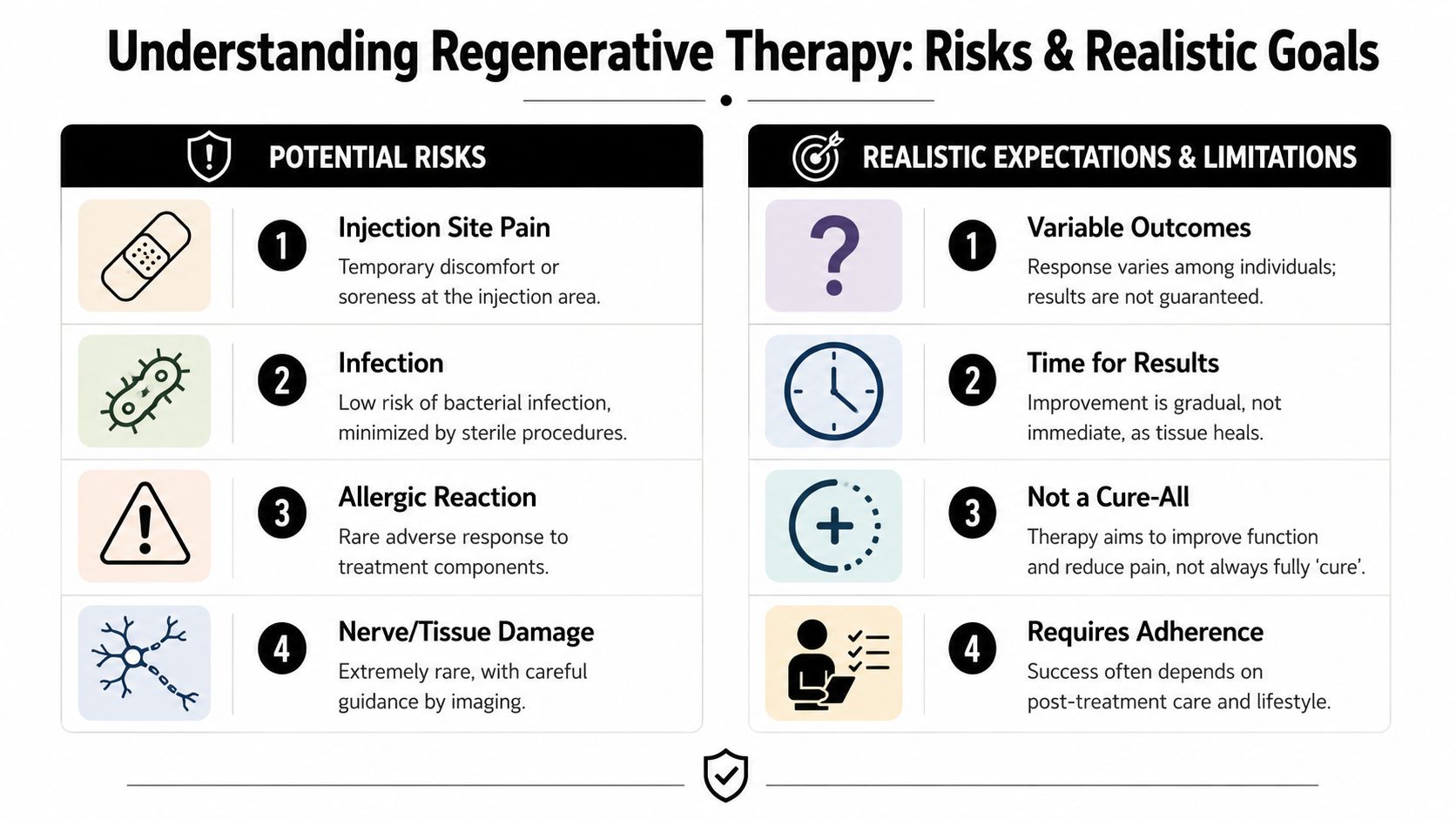
The safest conversation about regenerative medicine includes the downsides. Every injection-based treatment carries some risk, and every biologic treatment has limits.
The practical risks
Most patients tolerate these procedures well, but complications can happen. The discussion should include:
- Injection-site pain that may temporarily flare after treatment
- Infection despite sterile precautions
- Bleeding or bruising depending on the procedure and patient factors
- No meaningful benefit even when the procedure is done correctly
There is also the basic risk of treating the wrong structure. If the diagnosis is off, the biologic product can be perfectly prepared and expertly injected, yet still fail because the target was wrong.
Why results vary
Regenerative medicine is highly technique-dependent. Reviews discussing 3D bioprinting emphasize that material choice and printing strategy directly affect cell viability and function after implantation, highlighting how outcomes in this field depend heavily on protocol and execution, as outlined in this discussion of technique and biomaterial precision in tissue engineering.
That same principle applies in simpler office procedures. Preparation method, target selection, guidance method, and post-procedure rehab all influence whether treatment helps.
Some patients do very well. Some improve modestly. Some don't respond. Honest care plans make room for all three possibilities.
What realistic success looks like
Patients should define success before treatment starts. A realistic goal may be:
- Less day-to-day pain
- Better walking, sleep, or exercise tolerance
- Reduced reliance on medication
- Delay or avoidance of more invasive treatment
It may not mean a permanent cure. It may not mean normal imaging afterward. And it may not be covered by insurance, which makes cost transparency especially important before moving ahead.
How to Choose a Clinic in the Chicago Suburbs
If you're looking for regenerative treatment in Oak Lawn, Palos Heights, Bridgeview, Burbank, Evergreen Park, Orland Park, or the surrounding Illinois suburbs, choose the clinic the same way you'd choose any serious medical procedure. Start with the physician, the diagnosis, and the process. Not the ad.
Questions worth asking
Bring these questions to the consultation:
- Is the physician board-certified in a relevant field such as pain management or a closely related specialty?
- Will the injection be image-guided with ultrasound or fluoroscopy when appropriate?
- What exact diagnosis is being treated and how was that diagnosis confirmed?
- What are the realistic goals for pain and function in my case?
- What happens if this doesn't work and what are the non-regenerative alternatives?
- What will I pay out of pocket and what does that fee include?
Red flags patients should take seriously
Be cautious if a clinic:
- Promises regeneration for nearly everything
- Uses sales language instead of diagnosis-based language
- Avoids discussing risks or limitations
- Pushes expensive packages before completing a proper exam
Patients who are weighing biologic procedures often also want a straightforward discussion of pricing. This overview of how much stem cell treatment may cost is useful because cost should be explained before you commit, not after.
A responsible pain clinic in Illinois should make it easy to understand what's being offered, why it fits your condition, and where it sits within a multimodal treatment plan.
If you're dealing with ongoing back, neck, joint, or nerve pain and want a careful opinion on whether regenerative treatment belongs in your plan, Midwest Pain & Wellness offers consultations focused on diagnosis, image-guided treatment, and practical next steps for patients in Chicago Ridge and nearby Illinois communities.