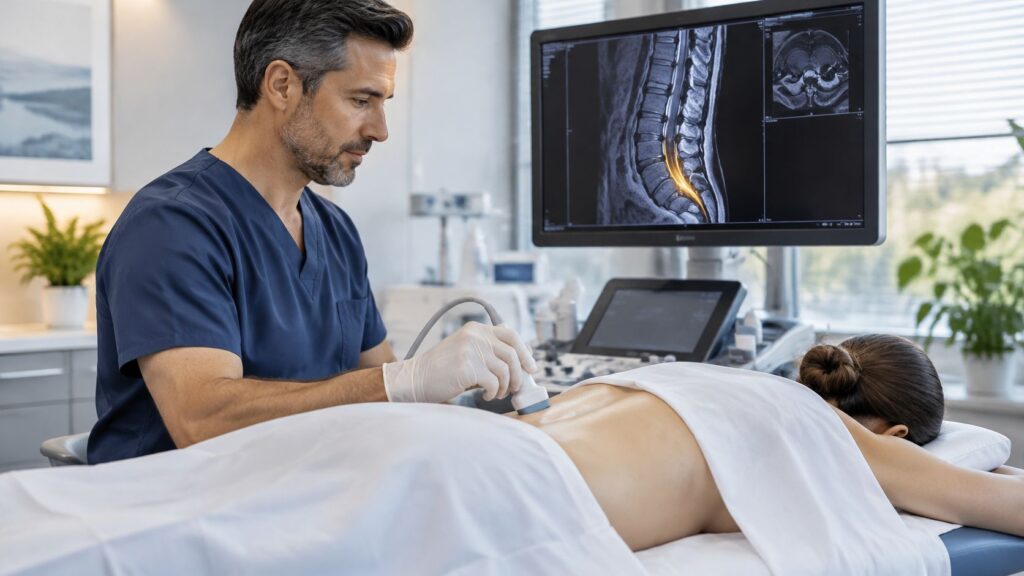
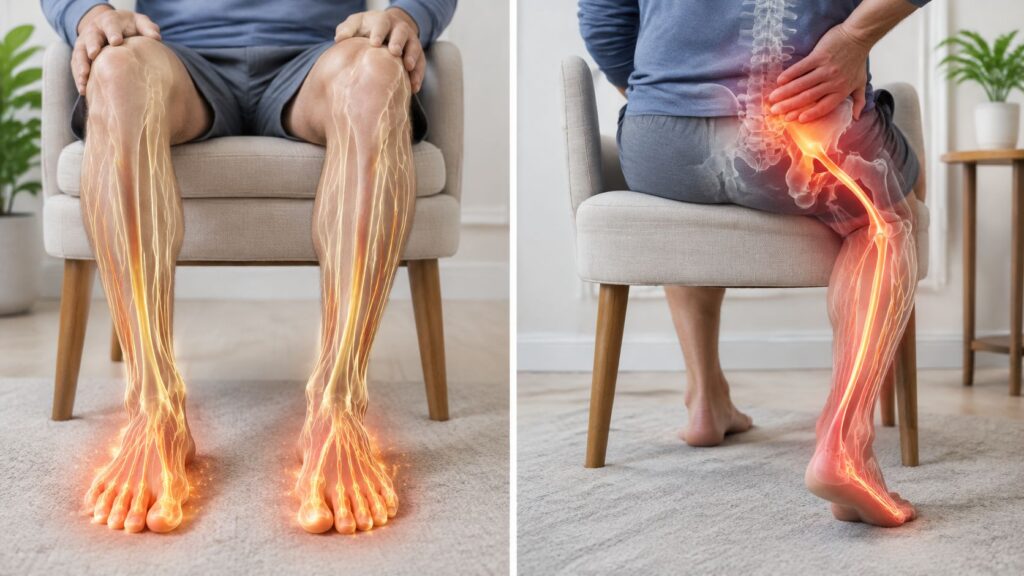
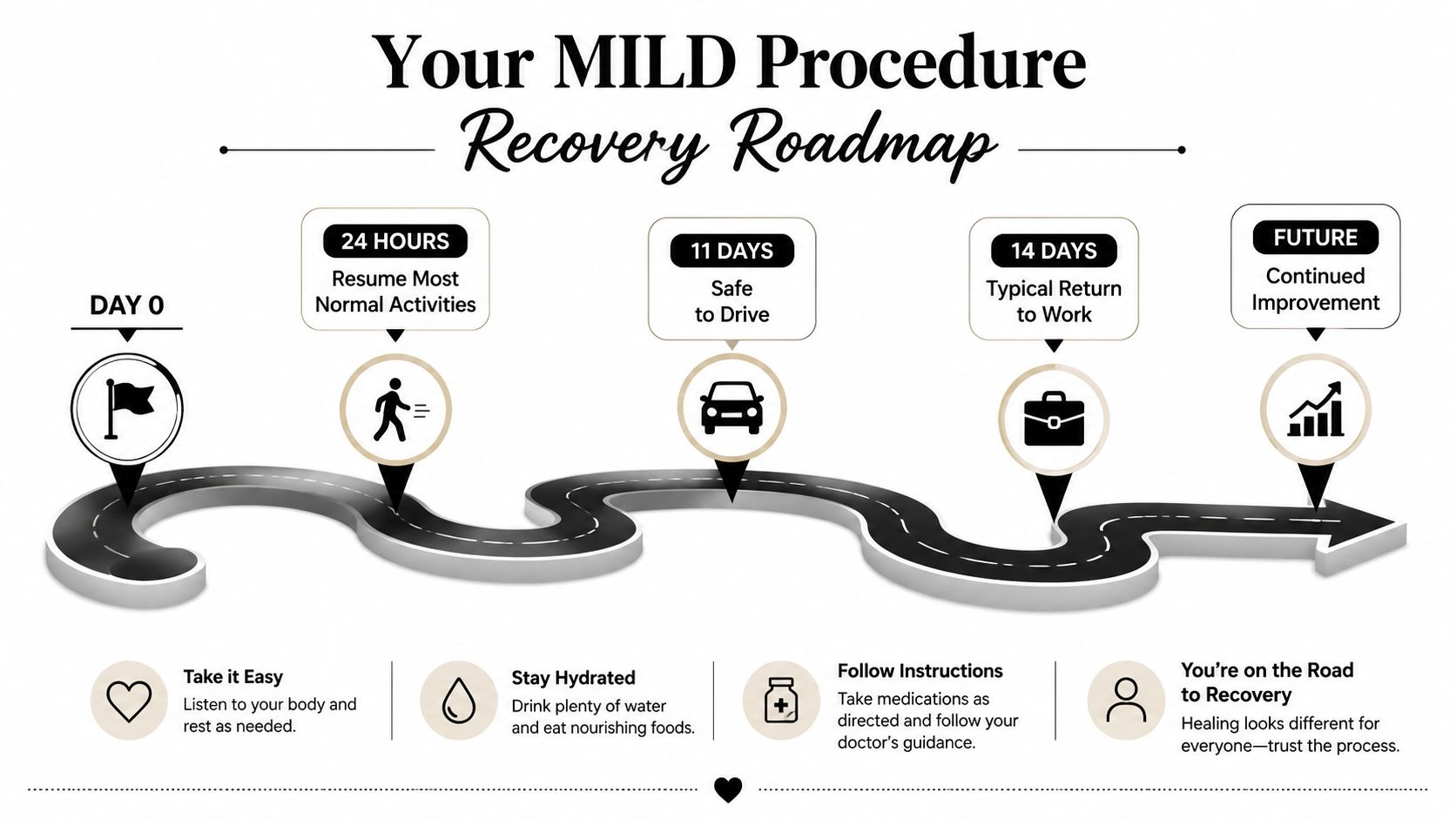
Most patients resume normal activity within 24 hours after a MILD procedure and begin prescribed physical therapy at 2 weeks. The procedure itself commonly takes 30 to 40 minutes, followed by short observation before same-day discharge.
If you're in Chicago Ridge, Palos Heights, Palos Hills, Evergreen Park, or Hickory Hills and planning around work, transportation, or family responsibilities, that timeline is encouraging, but it needs context. “Back to normal” doesn't mean you should test your back with heavy lifting, long car rides, or yardwork the next morning. It means the early recovery is usually less disruptive than open lumbar decompression, while your activity still needs to build in stages.
The other question deserves equal attention: Does a fast recovery mean the relief will fade quickly? Not necessarily. MILD is designed to relieve pressure from thickened tissue in the lumbar spinal canal, and longer follow-up suggests that improvement can continue beyond the first few days. Your first two weeks should be calm and active in the right proportions, with walking, symptom tracking, and clear communication when something doesn't fit the expected pattern.
Table of Contents
- What the First 24 Hours After MILD Really Feel Like
- Understanding the MILD Procedure and Why Recovery Is So Fast
- The First 72 Hours Day by Day
- Activity Restrictions and Do's and Don'ts for Week One
- Return to Driving Work and Exercise Milestones
- Does a Fast Recovery Mean Short-Lived Relief
- Follow-Up Care Incision Checks and Red Flags
- Your Recovery Roadmap and When to Reach the Clinic
What the First 24 Hours After MILD Really Feel Like
A representative patient wakes in the recovery area about 45 minutes after the procedure. The first surprise is often how ordinary the moment feels. They sit upright, notice that the heaviness in their legs seems lighter, and walk to the bathroom with a nurse before discharge.
There's usually a small bandage over the lower back. The area may feel sore, but many patients describe it more like a bruise than the deep surgical pain they feared. Relief may not arrive as one dramatic switch. Instead, the afternoon often brings a steady sense that standing and walking feel less restricted.
The ride home should be short, with the passenger reclined slightly for comfort. You won't drive yourself home. Once home, the useful routine is simple: rest, drink fluids, eat light meals as tolerated, and take scheduled acetaminophen if your clinician has approved it. Keep the first evening deliberately uneventful.
The early sense of feeling better can mislead you
Many patients expect to feel worse than they do. That's good news, but it can create a false sense of permission to overdo things. Feeling comfortable enough to walk around the kitchen doesn't mean your back is ready for laundry baskets, repeated stairs, bending, or prolonged sitting.
The small puncture site still needs protection, and your nervous system is adjusting to a change in nerve pressure. Understanding the difference between expected soreness and concerning postoperative pain can help, so review this practical guide to what postoperative pain can mean.
Practical rule: A comfortable first evening is a reason to protect the result, not a reason to accelerate the schedule.
The first day usually centers on safe movement, hydration, medication coordination, and observation. Over the next 72 hours, the goal shifts from getting home to building short, frequent periods of walking without provoking a flare.
Understanding the MILD Procedure and Why Recovery Is So Fast
I explain MILD with a clogged-drain analogy. Lumbar spinal stenosis can reduce the space available for nerves, in part because the ligamentum flavum becomes thickened and crowds the spinal canal. MILD, or Minimally Invasive Lumbar Decompression, uses a small access portal, described in clinical materials as about 5.8 millimeters, to remove selected pieces of thickened ligament and bone that contribute to the blockage.
The aim isn't to rebuild the entire pipe. It's to clear the material creating the restriction while preserving the surrounding structures. MILD doesn't rely on large muscle dissection, implants, or the broad bone removal associated with traditional open decompression. You can learn more about the approach in this overview of minimally invasive lumbar decompression.
Five design choices reduce the healing burden
Tissue-sparing access limits the amount of muscle and soft tissue that must recover. Traditional open decompression can involve more extensive exposure, including muscle disruption and laminectomy, so recovery is generally measured in weeks rather than days.
Anesthesia choices may also reduce the immediate burden. MILD is commonly performed without general anesthesia, depending on the patient and clinical setting. That doesn't eliminate every anesthesia consideration, but it can support a straightforward outpatient experience.
No implants means the body isn't healing around newly placed hardware. Minimal blood loss and a brief procedure also contribute to the same-day pathway described in the foundational review, which reports a procedure time of about 30 to 40 minutes and discharge after approximately a two-hour observation period without an overnight hospital stay. For general background on the body's repair process, this explanation of how wounds heal naturally can provide useful context.
The speed isn't a marketing promise. It reflects how little tissue the body has to repair compared with open surgery. That distinction matters when you're planning the first week in Illinois winter weather, arranging a ride from Palos Hills, or deciding when you can safely resume household tasks.
The First 72 Hours Day by Day
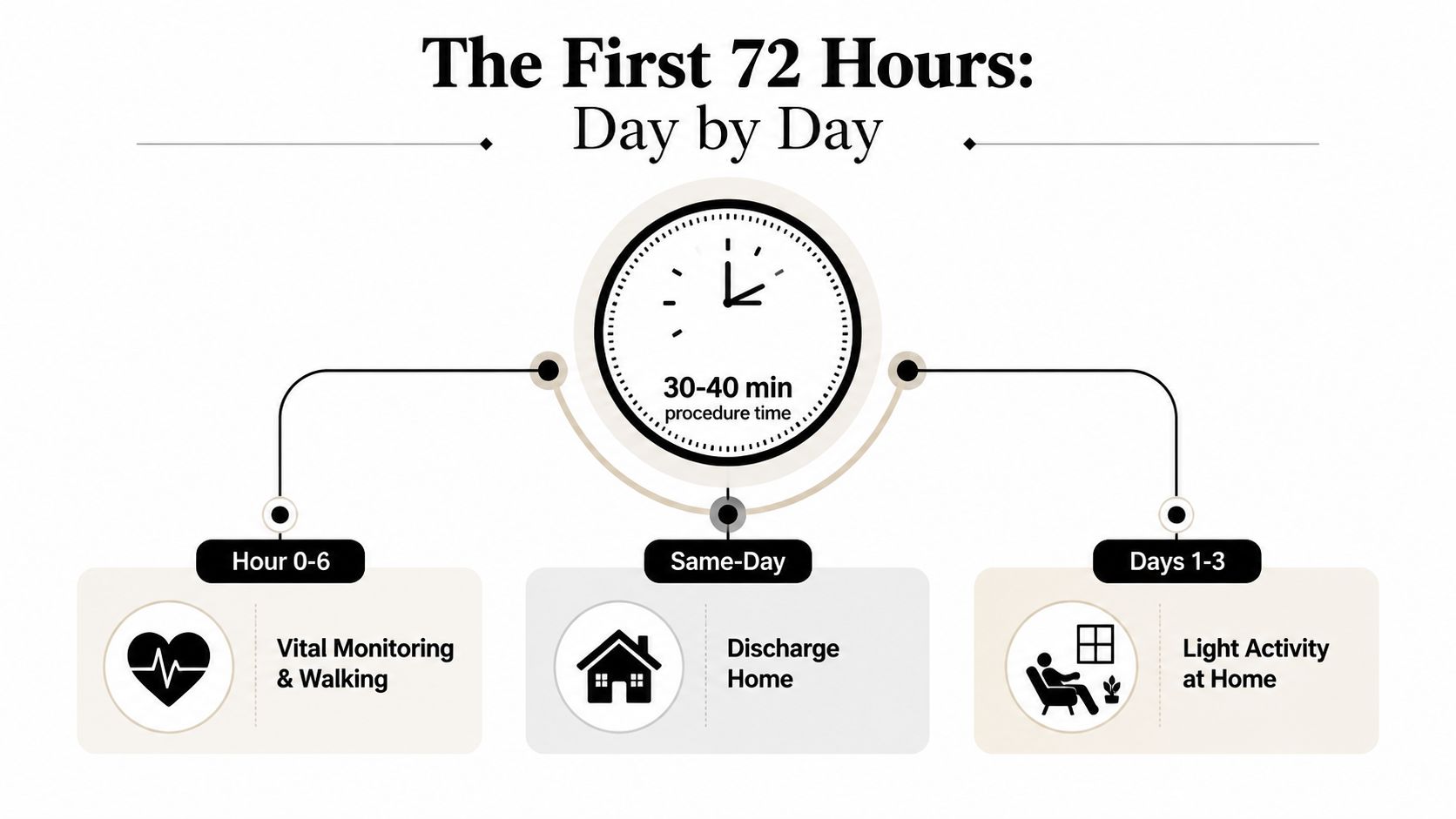
The recovery clock starts with a procedure that commonly takes 30 to 40 minutes, followed by observation and same-day discharge. The exact sequence depends on your medical history, sedation response, and examination, but the first three days generally follow a predictable progression.
Hours 0 through 6
In the recovery area, the team monitors your vital signs, checks sensation and strength, and helps you stand or walk. You'll leave once the staff is satisfied that your condition is stable and you can move safely with the support appropriate for you.
At home, use a short walk as a reset rather than an endurance test. Rest between brief periods of movement, keep the dressing protected, and avoid repeatedly getting up to complete chores.
Hours 6 through 24
Ice can help with local soreness. A common schedule is 20 minutes on and 40 minutes off, with a cloth barrier protecting the skin. If your clinician has approved it, resume light meals and take fluids regularly.
Walk every 1 to 2 hours for about 5 minutes while awake, unless your personalized instructions differ. These small walks are more useful than one ambitious walk because they limit stiffness without asking your back to tolerate prolonged loading.
Day 2
Soreness may peak and then plateau. A covered dressing may allow a shower after the permitted interval, but follow the instructions from your treating team rather than soaking the area. Short outdoor walks can begin if you feel steady and the weather is safe.
Day 3
Many patients begin noticing meaningful relief in the symptoms that brought them to treatment, while the puncture-site soreness fades and energy returns. The most important behavior in this window is incremental walking. Expected soreness should gradually settle. New weakness, escalating sharp pain, drainage, or rapidly worsening symptoms should reset the plan and prompt contact with the clinic.
Activity Restrictions and Do's and Don'ts for Week One
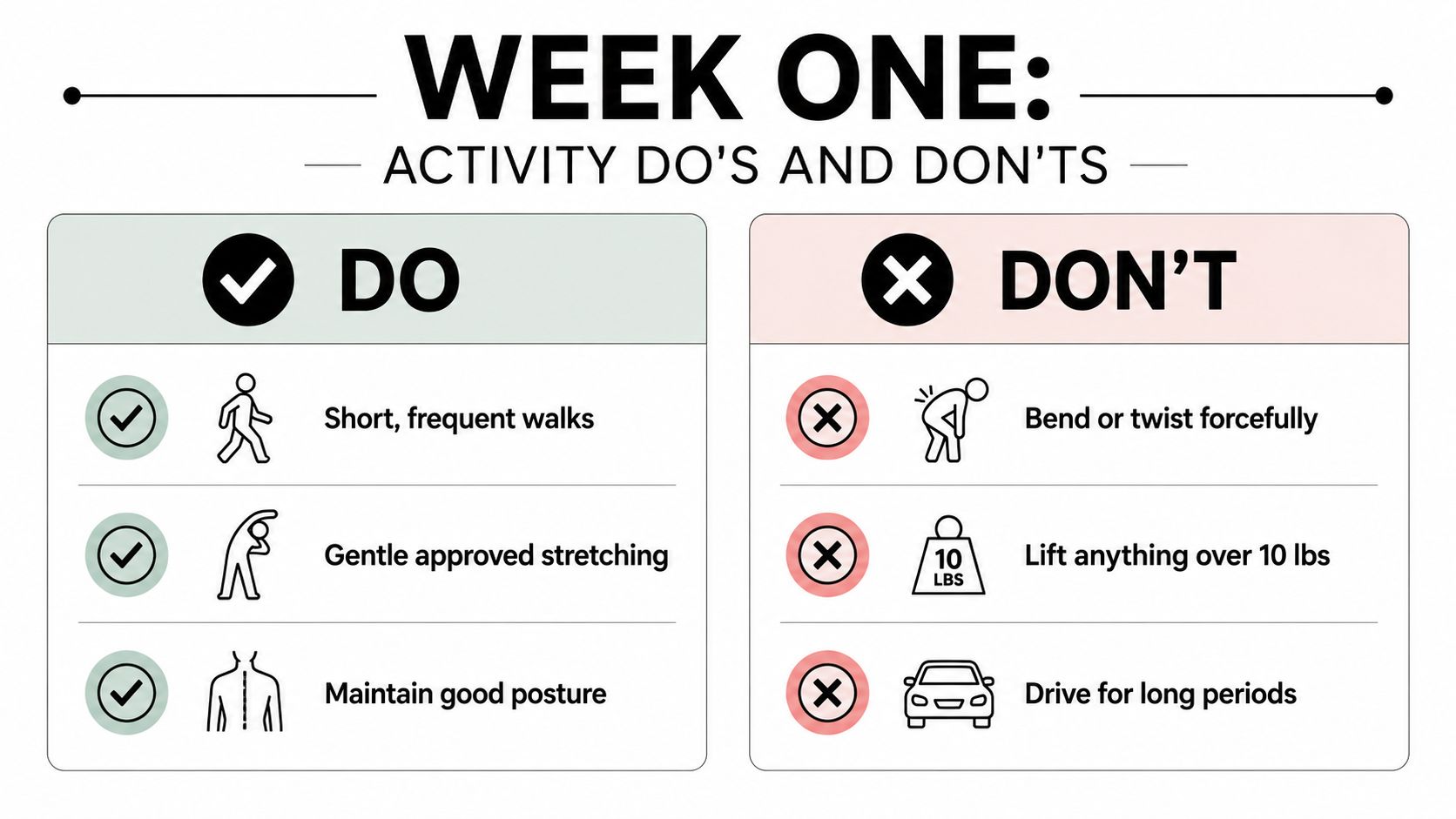
Week one works best when you stop guessing. You're allowed to move, but you're not cleared to challenge the spine with repetitive bending, forceful twisting, or heavy loads.
Do begin short, frequent walks on the day of the procedure if your care team says it's safe. Do gentle stretching only when approved, drink enough fluids, and use over-the-counter pain control as directed while prescribed opioid medication tapers. Walking encourages circulation and helps prevent the stiffness that often follows a day spent in bed.
Protect the puncture site and avoid mechanical stress
For the first 48 hours, keep the small bandage dry. Avoid baths, hot tubs, and swimming until the approximately 3-millimeter incision has sealed and your clinician confirms that soaking is appropriate.
Avoid bending, twisting, lifting more than 5 to 10 pounds, strenuous housework, and yardwork. These activities combine force and load at precisely the time you're trying to let local inflammation settle.
A useful test: If an activity requires you to hold your breath, brace hard, or bend repeatedly, it probably doesn't belong in the first week.
Keep car rides to no more than 1 hour during the early period, because prolonged sitting and lumbar flexion can increase pressure and aggravate symptoms. Don't drive while taking prescription opioids, even if you feel alert. The medication can impair reaction time and judgment.
Sleep positioning can reduce strain. When lying on your back, place a pillow under your knees. When lying on your side, place one between your knees. If you need more structured guidance after an intervention, the clinic's information on post-surgical rehabilitation may help you prepare questions for your follow-up.
Return to Driving Work and Exercise Milestones
Recovery becomes easier to plan when you tie it to function rather than a single calendar promise. Published outcome data on minimally invasive lumbar decompression reported a median of 11 days to return to driving and 14 days to return to work, with the study's tracked activities returning over a median of 27 days for most patients. These figures are useful anchors, not automatic permissions.
Driving requires more than sitting in a car. You should be off opioid medication, able to turn and check your surroundings, and capable of performing a pain-free emergency stop. Start with a short practice drive in a familiar area before attempting traffic, highway travel, or a longer commute.
Work depends on the physical demands
A desk job may be compatible with a return around the two-week mark if you can change position frequently and control discomfort. Work involving prolonged standing, concrete floors, walking, lifting, or repeated bending often requires light duty or a graded return that extends beyond desk-work expectations.
Your recovery can move more slowly with advanced age, higher body mass, poorly controlled diabetes, or pre-existing neuropathy. Those factors don't automatically rule out MILD, but they can affect wound healing, balance, endurance, and the interpretation of persistent numbness.
Build exercise in layers
During week one, walking is usually the foundation. After clearance, a stationary bike or elliptical may be introduced in the second week if it doesn't increase symptoms. Core-stabilization physical therapy generally becomes more relevant from the third week onward, with the exact progression set by your clinician.
Keep a one-page daily record for your two-week visit:
- Symptoms: Note back pain, leg pain, heaviness, numbness, and what brings each symptom on.
- Function: Record walking duration, standing tolerance, sleep quality, and whether you needed a rest break.
- Medication: Track acetaminophen, opioids, and any changes in use.
- Questions: Write down activities that caused a flare or felt unexpectedly easy.
That record gives the care team something concrete to adjust instead of relying on memory.
Does a Fast Recovery Mean Short-Lived Relief
A quick recovery doesn't automatically mean a quick fade. MILD is intended to address a structural contributor to neurogenic claudication by removing small portions of thickened ligamentum flavum and excess bone, creating more room for compressed nerves. It isn't just covering symptoms with medication.
The durability question still requires honesty. A 2021 long-term study followed 75 patients for five years and found that 9 required lumbar surgical decompression afterward. The same study reported a need for open surgery of about 2.4% per year after MILD. These figures come from the study population and shouldn't be treated as an individual prediction. Read the long-term study on MILD outcomes for the full context.
Relief and healing operate on different clocks
A 2025 review found improved pain and disability outcomes lasting up to 2 years in prospective trials. That supports the idea that a minimally disruptive procedure can produce benefit beyond the immediate postoperative window, although individual results depend on anatomy, symptom source, baseline health, and the extent of degenerative disease.
Persistent or recurrent symptoms don't always mean the original decompression failed. Lumbar stenosis can progress at another level, or symptoms may arise from a different structure that MILD wasn't designed to treat. That's why appropriate imaging review and symptom matching matter before treatment.
Fast healing tells us about tissue disruption. It doesn't, by itself, tell us how long functional improvement will last.
Staying active after recovery can help you preserve mobility, but activity needs to be rebuilt intelligently. Walking, posture habits, and prescribed strengthening support the second half of the outcome. They don't guarantee permanent relief, and they can't reverse every degenerative change, but they give you a better chance of using the space created by decompression.
Follow-Up Care Incision Checks and Red Flags
Follow-up isn't a formality. It gives the team a chance to verify the puncture site, reconcile medication use, assess walking progress, and decide whether the plan needs adjustment.
A practical sequence includes:
- Day 7: A clinic call to review pain, walking, medications, and any wound concerns.
- Week 2: An incision check and functional review, often near the time prescribed physical therapy begins.
- Week 6: A reassessment of strength, walking tolerance, posture, and progression into strengthening.
- Month 3: An outcome review focused on meaningful function, symptom change, and next steps.
The puncture site should remain clean and dry, with the edges together and no drainage. Mild pinkness can be acceptable, but expanding redness, increasing warmth, or discharge needs medical review.
Symptoms that warrant same-day contact
Contact the clinic the same day for:
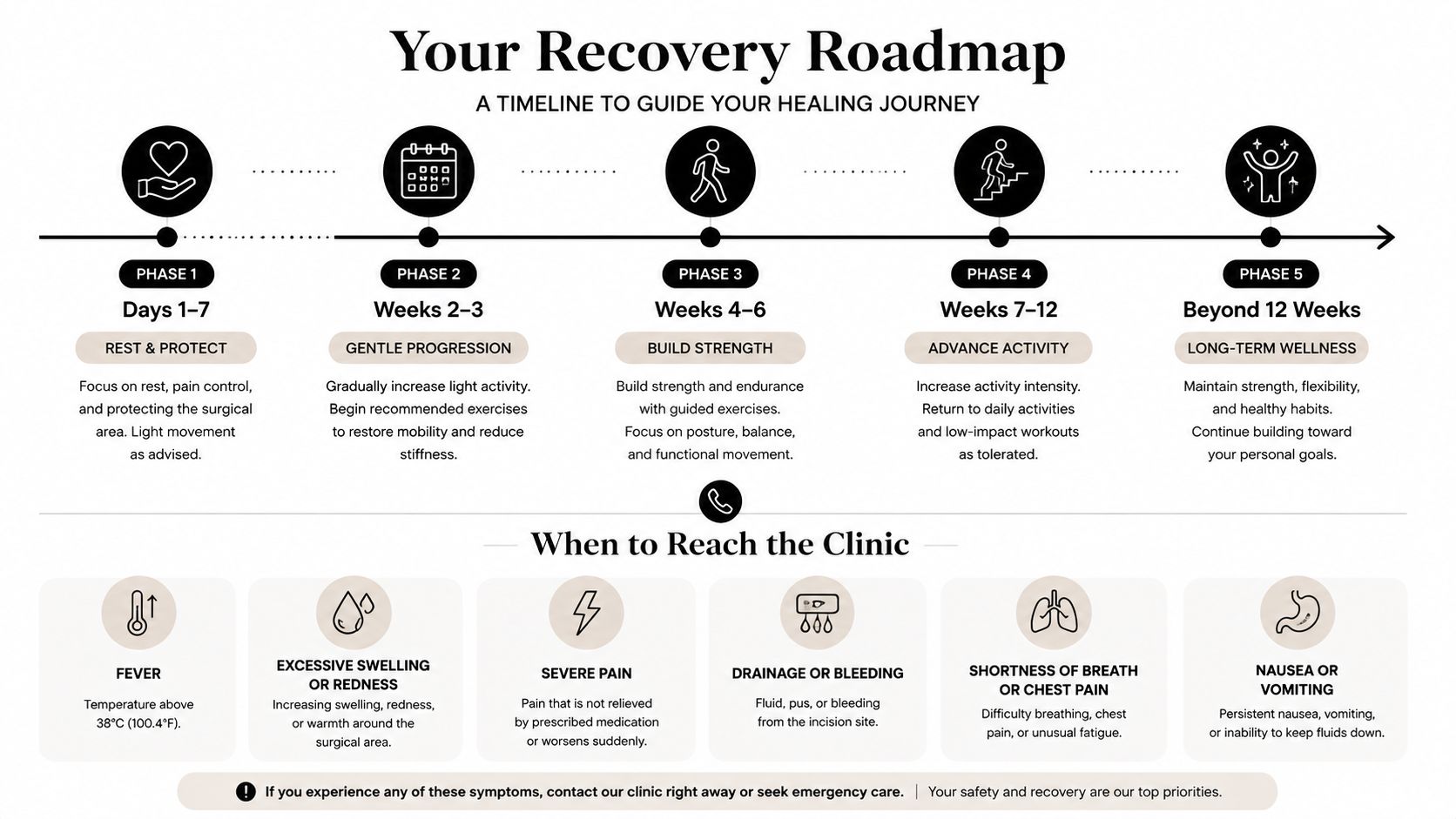
- Fever above 101°F, especially with worsening local symptoms.
- Expanding redness or warmth around the puncture.
- Purulent discharge or a dressing that becomes increasingly wet.
- Sudden worsening leg weakness, rather than expected soreness.
- New bowel or bladder changes, which require urgent evaluation.
- Calf swelling, particularly if it's new or associated with tenderness or breathing symptoms.
Mild back soreness is expected. Sharp, escalating pain is not something to push through. Medication reconciliation matters too, especially if you're tapering opioids or combining prescribed and over-the-counter medicines. If symptoms stall, the clinician may reassess the diagnosis and order imaging rather than assume the recovery is following the usual pattern.
Bring your walking log and symptom diary to every visit. For patients near Chicago Ridge, Palos Heights, Palos Hills, Evergreen Park, and Hickory Hills, that information helps the Midwest Pain & Wellness team make a specific adjustment based on your actual function.
Your Recovery Roadmap and When to Reach the Clinic
The MILD procedure recovery time is best understood as a series of functional checkpoints rather than a single finish line.
At 24 hours, many patients can resume normal activity, with common-sense limits on lifting, prolonged sitting, and strenuous work. At 11 days, published data provide a useful driving milestone, assuming you're off opioids, can react safely, and have tolerated a short practice drive. At 14 days, many patients reach a typical return-to-work point, although physical jobs may require a slower plan.
Prescribed physical therapy often begins at 2 weeks. The emphasis then shifts from protecting the puncture site to improving movement quality, trunk control, endurance, and confidence. At 6 weeks, reassessment can guide strengthening and activity progression. By 3 months, the review should focus on function you care about, such as walking farther, standing through a meal, shopping, or returning to work tasks.
Use the right contact route
Send routine questions through the patient portal, where the expected reply window is 24 hours. Red-flag symptoms shouldn't wait for a portal response. Call the Orland Park or Chicago Ridge line directly during business hours, or use the after-hours line after 5 p.m.
For additional general planning ideas, these post-surgery recovery timeline tips can help you organize transportation, meals, medications, and activity support. They don't replace the instructions from your treating clinician, because your health history and procedure details determine the safest progression.
Recovery is a partnership. The care team provides the procedure, monitoring, and adjustments, while you provide accurate updates, follow the walking plan, protect the incision, and report changes early. Honest communication is what keeps a reassuring recovery timeline from becoming an unsafe one.
Midwest Pain & Wellness provides personalized interventional pain care, including evaluation and recovery guidance for minimally invasive lumbar decompression and other spine treatments. If you're in Chicago Ridge, Palos Heights, Palos Hills, Evergreen Park, or Hickory Hills, visit Midwest Pain & Wellness to request an evaluation and discuss what your recovery plan may look like.