Most Illinois cash-pay PRP injections cost $750 to $2,000 per session, while cell-based treatments typically run $3,000 to $9,000 per treatment area. Your actual regenerative injection therapy cost can be higher once consultation, imaging guidance, processing, follow-up, and additional treatment areas are included.
You may be looking at a knee injection after months of pain, or comparing options for a hip, shoulder, spine, tendon, or arthritic joint. You call one clinic near Chicago Ridge and hear one price, then speak with another office in Palos Heights, Palos Hills, Evergreen Park, or Hickory Hills and hear something dramatically different. That doesn't automatically mean one clinic is overcharging. It usually means the quotes describe different biologics, procedures, and levels of service.
The right question isn't, “What does the injection cost?” It's, “What will this entire episode of care cost me, and what exactly am I receiving?”
Table of Contents
- What Regenerative Injection Therapy Costs in Illinois
- The Core Idea Behind PRP and Cell-Based Injections
- Comparing PRP, BMAC, and Other Cell-Based Options
- What Drives the Final Price Beyond the Injection Fee
- Insurance, Cash Pay, and Financing in the Illinois Market
- Regenerative Therapy Compared to Other Pain Treatments
- What to Expect at Midwest Pain & Wellness in Chicago Ridge
- Smart Questions to Ask Before You Commit to Treatment
What Regenerative Injection Therapy Costs in Illinois
You call three Chicago Ridge clinics about the same knee problem and hear quotes from $500 to $12,000. That spread becomes easier to understand once each quote is opened up. The lower figure may cover a basic PRP injection alone. The higher figure may include a cell-based procedure, aspiration, ultrasound guidance, multiple treatment areas, and follow-up visits.
For Illinois patients, PRP generally falls between $750 and $2,000 per injection site. More advanced cellular procedures can reach $3,000 to $9,000 per treatment area, according to a Chicago-area stem-cell cost guide. Broader pricing summaries list advanced regenerative protocols at $5,000 to $30,000, with specialized cases reaching $50,000 or more, according to this regenerative medicine pricing guide.
Treat those figures as starting points. The final episode price depends on the biologic source, preparation method, number of sites, imaging guidance, consultation, and follow-up plan.
Typical Illinois self-pay ranges
| Therapy Type | Typical Per-Session Range | Common Sessions Needed |
|---|---|---|
| PRP | $750 to $2,000 | One session or a multi-session plan |
| BMAC | $3,000 to $6,500 | Often one procedure |
| Amniotic or cryopreserved product | $2,500 to $9,000 | Often one procedure |
| Advanced cellular protocol | $5,000 to $30,000 or more | Depends on protocol complexity |
A national peer-reviewed pricing study reported a median PRP price of $800, with prices ranging from $350 to $2,815, and found that the Northeast tended to cost more. Its practical lesson applies in Illinois: no single market price covers every PRP procedure. Provider type and location affect the quote, but the included services affect your bill more.
Ask for the all-in amount before scheduling. The written estimate should separate the injection, biologic processing, consultation, ultrasound or other imaging guidance, follow-up care, and charges for additional areas. A quote that lists only the injection fee is incomplete.
The Core Idea Behind PRP and Cell-Based Injections
Regenerative injection therapy is an umbrella term for injections intended to support the body's repair response in a painful or injured joint, tendon, ligament, or spine structure. The most common options discussed in Illinois clinics include platelet-rich plasma, bone marrow aspirate concentrate, and amniotic or cryopreserved products.
PRP uses a sample of your own blood. The clinic processes that blood to concentrate platelets and their signaling proteins, then places the preparation at the treatment site. Think of it as turning up the volume on a quiet repair crew that's already present. The injection doesn't create a new joint or instantly rebuild damaged tissue. It aims to influence inflammation and the local healing environment.
A plain-language explanation of platelet-rich plasma benefits can help you understand why clinics describe PRP as a biologic treatment rather than a conventional pain shot.
Where cell-based treatment fits
BMAC begins with tissue taken from your own bone marrow, commonly through an aspiration procedure. The material is concentrated and delivered during the same treatment episode. The practical analogy is shipping in reinforcements rather than amplifying the signals from an existing repair crew.
Amniotic and cryopreserved products use donated tissue materials and occupy a different place on the biologic spectrum. They aren't the same as your own PRP or BMAC, and the product source, processing, volume, and intended use should appear on your estimate.
The biology explains part of the price difference. PRP generally requires a blood draw and processing kit. BMAC adds aspiration and more involved preparation. Donor tissue products involve product sourcing and handling. You're paying for the material and the work required to prepare and deliver it, not merely for the needle entering the joint.
A higher price doesn't automatically mean a better result. The appropriate choice depends on the diagnosis, severity, age, previous treatment, functional goals, and whether the clinic can explain realistic outcomes without promising overnight cartilage growth or a guaranteed cure.
Comparing PRP, BMAC, and Other Cell-Based Options
A torn rotator cuff and knee osteoarthritis raise different treatment questions, so the biologic should follow the diagnosis rather than the price tag. PRP uses platelets from your own blood to concentrate repair signals at the treatment site. It may suit selected tendon problems, mild to moderate joint degeneration, or patients seeking a simpler autologous procedure.
BMAC starts with bone marrow aspiration, concentration, and injection during the same treatment episode. The added procedure makes it more involved, but a higher fee does not guarantee a better result. The recommendation should reflect the tissue being treated, disease severity, prior care, age, and functional goals.
For a rotator cuff problem, the clinician should explain whether the concern is tendinopathy, a partial tear, or a larger structural tear. PRP may be discussed when the goal is to support tendon healing and manage pain. A significant tear may require a different plan altogether, because an injection cannot replace structural repair.
Osteoarthritis requires another discussion. PRP may be considered when joint pain and degeneration remain compatible with a biologic injection approach. BMAC may enter the conversation for selected cases involving more advanced degeneration or a need for a more involved autologous option. Ask what finding makes one choice more reasonable than the other.
Amniotic and cryopreserved products use donated tissue materials, so they are not the same as your own PRP or BMAC. Product source, processing, volume, intended use, and regulatory status should appear clearly on the estimate. Their price can reflect the product itself as well as handling and delivery.
Ask how concentrated the platelets are, whether the preparation is leukocyte-rich or leukocyte-poor, and how many treatment areas are included. Those details affect what you are comparing. A quote for one joint is not equivalent to a quote covering several areas.
You can review autologous cell therapy to understand how tissue collection and processing fit into an autologous treatment plan. Then ask the clinician to connect the proposed biologic to your diagnosis, realistic outcome, and total treatment episode.
Do not choose BMAC because it sounds more advanced, or PRP because it costs less. Choose the option with a clear clinical rationale, defined inclusions, and an honest explanation of what the injection can and cannot accomplish.
What Drives the Final Price Beyond the Injection Fee
A patient in Chicago Ridge may hear one PRP price during a phone call, then receive a higher estimate after the examination. The difference usually comes from services that were not included in the headline injection fee. Consultation, ultrasound guidance, preparation, follow-up, and treatment of additional areas can each change the all-in episode price.
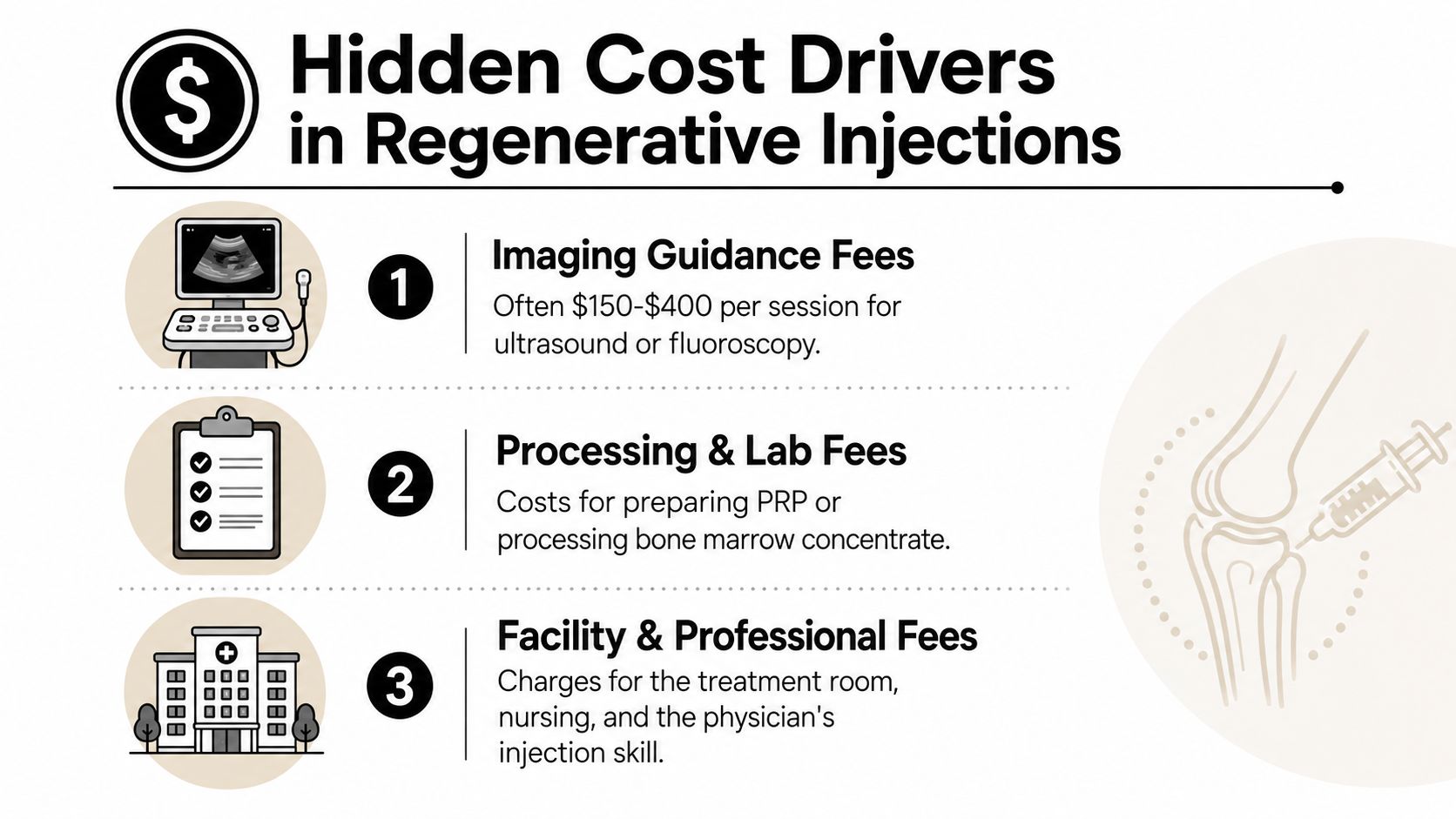
A pricing guide reports that ultrasound guidance may add $200 to $400, while a consultation may add $100 to $300. A separate Chicago-area assessment reported a mean PRP price of $686, a standard deviation of $172.73, a median of $925.16, and a standard deviation of $462.99, with pricing differing significantly by provider type, according to a Chicago sports-surgery practice. Use those figures as comparison points, not as a promise of what your clinic will charge.
The charges that change your total
- Imaging guidance: Confirm whether ultrasound or fluoroscopy is included. A separate guidance charge can materially raise the final bill.
- Consultation and follow-up: Ask whether the initial assessment, post-procedure review, and later reassessments are included.
- Processing: PRP kits, blood preparation, bone marrow aspiration, and biologic handling involve different steps and costs.
- Comfort measures: Local anesthetic, sedation, or other procedural support may appear as separate charges.
- Multiple areas: Two joints, several spine levels, or bilateral structures often use tiered pricing. The second treatment area may not cost the same as the first.
- Package structure: A series can lower the per-injection price while requiring a larger payment upfront.
Request one written estimate for the entire treatment episode. It should identify the consultation, guidance method, biologic source, processing, injection, number of treatment areas, follow-up, and any required rehabilitation. Chicago Ridge and southwest suburban operating costs and specialist services can differ from rural Illinois pricing, so compare quotes only after matching their inclusions.
Ask one direct question: “What will I pay from consultation through follow-up?” If the estimate does not identify the product, guidance method, number of sites, and follow-up plan, you do not yet have an all-in price.
Insurance, Cash Pay, and Financing in the Illinois Market
Plan on paying out of pocket. Many insurance plans don't cover PRP and other regenerative procedures, leaving patients responsible for the cash price at the time of care. A published Illinois pricing overview describes regenerative medicine as a structured private-pay market with menu-style pricing, but broad payer adoption remains limited.
That doesn't mean every part of the related medical care is automatically excluded. Your plan may handle diagnostic services, imaging, or rehabilitation differently from the biologic injection. Ask the clinic for separate line items and contact your insurer before scheduling. For general guidance on insurance questions involving diagnostic imaging, this explanation of whether insurance covers an MRI provides useful context, although your plan's rules control your claim.
Payment choices worth considering
| Payment Source | Typical Coverage | Patient Action |
|---|---|---|
| Commercial insurance | Regenerative injections are often excluded or not covered | Request a written benefit determination |
| Medicare | Coverage for these cash-pay regenerative procedures is generally uncommon | Ask whether any related diagnostic service is separately covered |
| HSA or FSA | May be usable for qualified medical expenses, subject to plan rules | Request an itemized receipt or superbill |
| Workers' compensation | May apply when the carrier authorizes treatment in writing | Obtain written authorization before treatment |
| Auto injury claim | May apply when the claim administrator approves care | Confirm approval and billing responsibility |
| Cash payment | Patient pays the quoted amount directly | Compare all-in estimates |
| Medical financing | May spread the cost over scheduled payments | Review total repayment, fees, and terms |
Some clinics offer package pricing for multi-session care or financing through third-party medical credit providers. Don't focus only on the monthly payment. Ask for the total amount financed, the interest terms, the cancellation policy, and what happens if you decide not to complete the series.
Before signing, confirm whether the price includes consultation, imaging guidance, processing, follow-up visits, and additional areas. If the clinic helps with HSA documentation, ask what paperwork it supplies and what remains your responsibility.
Regenerative Therapy Compared to Other Pain Treatments
You are comparing a treatment plan, not a single injection receipt. In the Illinois market, a cash-pay biologic can cost more at the appointment than a conventional injection, yet the practical comparison also includes repeat procedures, expected duration of relief, rehabilitation, downtime, and whether treatment may delay surgery.
The Illinois treatment comparison lists a single PRP session at $1,250, repeated cortisone injections at $150 to $300 each, viscosupplementation at $400 to $1,200 per series, BMAC at $4,500 to $7,000, a regenerative episode at $6,000, and joint replacement at $15,000 to $50,000. These figures do not predict your outcome. Repeat timing and treatment response vary, so the five-year totals are planning examples rather than promises.
Compare the episode, not the sticker
| Treatment | Per-Episode Cost | Estimated 5-Year Total |
|---|---|---|
| PRP | $1,250 | Depends on repeat treatment and response |
| Cortisone injection | $150 to $300 | Depends on how often treatment is repeated |
| Viscosupplementation | $400 to $1,200 per series | Depends on repeat series |
| BMAC | $4,500 to $7,000 | Depends on whether additional treatment is needed |
| Regenerative episode | $6,000 | Depends on response and later care |
| Joint replacement | $15,000 to $50,000 | Includes a major surgical episode, with patient cost varying by coverage |
Cortisone usually has the lowest point-of-service price, and it may provide short-term relief. Repeated injections still may not address the underlying structural pain problem. Viscosupplementation can fit some knee cases, but its durability varies. Joint replacement can address advanced structural disease, while adding facility, anesthesia, recovery, and rehabilitation costs.
Ask for the all-in episode price before choosing. Confirm whether the quote includes consultation, ultrasound guidance, biologic processing, the injection, follow-up care, and any additional joint or treatment area. A second area can change the estimate substantially.
The administrative side matters, too. Clinics must track authorizations, patient responsibility, and unpaid balances. Pain management revenue cycle management explains how those billing processes affect the patient's financial responsibility.
Choose based on your diagnosis, treatment goal, and tolerance for repeat care. Do not pay for a biologic just to avoid a necessary operation. Do not rush into surgery when a clearly selected and clearly priced regenerative episode may reasonably fit your plan.
What to Expect at Midwest Pain & Wellness in Chicago Ridge
At Midwest Pain & Wellness, the process begins with a pain-focused consultation rather than a product selection. The clinician reviews your imaging, previous injections, symptom pattern, functional limits, and goals. The key question is whether the painful structure has been identified clearly enough to justify a targeted injection.
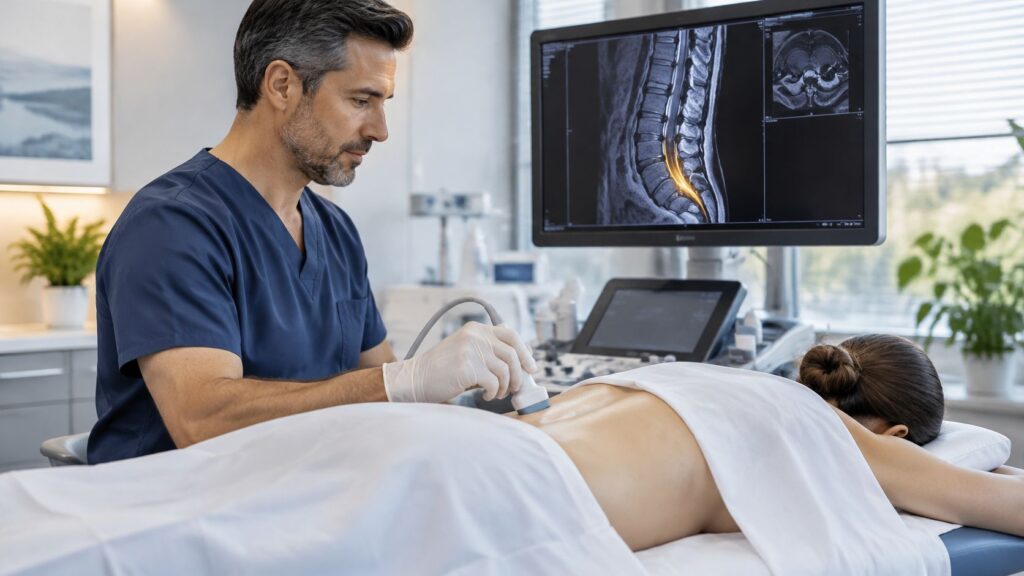
The clinic may use same-day ultrasound mapping to identify the joint, tendon, nerve, or spine structure being considered for treatment. That step helps connect the proposed procedure to the actual source of pain instead of treating a vague body region.
Your estimate should show the moving parts
Before consent, patients receive a written estimate that separates the relevant charges. Depending on the plan, the estimate may identify:
- Consultation: The evaluation and treatment-planning component.
- Processing: The preparation of PRP or another biologic.
- Imaging guidance: Ultrasound guidance or another method used to position the injection.
- Injection: The procedure itself.
- Additional areas: Separate joints, spine levels, or bilateral treatment.
- Follow-up: Rechecks or other services included in the episode.
The clinic uses episode-based pricing for multi-session PRP protocols involving areas such as the knees, hips, or shoulders. Instead of presenting every visit as an isolated “stick,” the office can quote the complete planned episode so you can compare the total against other Illinois estimates.
A typical visit may last 60 to 90 minutes. Follow-up commonly occurs at two, six, and twelve weeks, and reassessment helps determine whether another session is appropriate. These time points and visit details are part of the clinic's described care process, not a guarantee that every patient will follow the same schedule.
Chicago Ridge patients should leave with enough information to compare quotes from nearby communities such as Palos Heights, Palos Hills, Evergreen Park, and Hickory Hills. If one office includes ultrasound, processing, and follow-up while another lists only the injection, the lower headline number doesn't represent the lower regenerative injection therapy cost.
Smart Questions to Ask Before You Commit to Treatment
Bring a written checklist to your consultation. A trustworthy clinician should answer these questions directly, explain why a particular option fits your diagnosis, and separate known costs from possible add-ons.
Confirm what is being injected
Ask for the exact biologic name and source:
- Cell source: Is it your own PRP, your own bone marrow concentrate, or a preserved donor product?
- Preparation: What concentration, volume, and processing method will be used?
- Treatment target: Which joint, tendon, nerve, or spine structure will receive the injection?
- Clinical rationale: Why is this option more appropriate than a conventional injection or continued conservative care?
- Provider role: Who performs the blood draw, aspiration, processing, and reinjection?
Don't accept the label “stem cell” without clarification. The product type, tissue source, and preparation method should be stated in plain language on the consent documents and estimate.
Make the price genuinely all inclusive
Ask these questions before you schedule:
- Guidance: Does the quote include ultrasound or fluoroscopic guidance?
- Visit charges: Are the consultation and follow-up visits bundled?
- Procedure supplies: Are the processing kit, aspiration supplies, and facility charges included?
- Scope: Does the price cover one joint, one side, multiple areas, or several spine levels?
- Series terms: How many sessions are included, and are later injections discounted?
- Changes: What is the cancellation policy if imaging changes the treatment plan?
- Rehabilitation: Is post-procedure guidance included, and are any outside services separate?
You should also ask about risks, the clinician's specific training, complication management, and outcome data for your exact condition. A provider who makes guarantees, avoids discussing alternatives, or cannot explain the product source deserves caution.
Red flag: A low price without a product type, treatment area, guidance method, or session count isn't a bargain. It's incomplete information.
Finally, ask for the total episode price in writing. That single document lets you compare Illinois clinics on the same terms and prevents an attractive per-injection number from hiding the costs that matter most.
Midwest Pain & Wellness provides pain-focused evaluations, image-guided PRP and cell-based regenerative options, and written estimates that separate the consultation, processing, guidance, injection, and additional treatment areas. If you're in Chicago Ridge, Palos Heights, Palos Hills, Evergreen Park, or Hickory Hills, visit Midwest Pain & Wellness to request an evaluation and discuss your real all-in treatment cost before consenting.