Roughly $195 in a non-facility setting versus about $74 in a facility setting is the Medicare reference point for an image-guided sacroiliac joint injection. That benchmark rarely equals your personal out-of-pocket bill.
If you're scheduling care in Chicago Ridge, Palos Heights, Palos Hills, Evergreen Park, or Hickory Hills, the number that matters isn't a clinic's advertised sticker price. Your final responsibility depends on the site of service, the allowed amount from your plan, deductible status, imaging and facility charges, prior authorization, and whether one or both SI joints are treated. A cash price can look straightforward, while an insured patient's statement may contain several separate line items.
My advice is simple: don't schedule an SI joint injection until you know the procedure code, the setting, what's bundled, and what your plan expects you to pay.
Table of Contents
- What a Sacroiliac Joint Injection Actually Involves
- The Five Cost Drivers Behind the Sticker Price
- How Site of Service Changes What You Pay
- What Medicare Will and Will Not Cover
- Insurance, Workers Comp, and Personal Injury in Illinois
- Where an SI Joint Injection Fits in the Cost Ladder
- A Chicago-Area Patient Checklist Before You Schedule
- Putting It All Together for a Smarter Decision
What a Sacroiliac Joint Injection Actually Involves
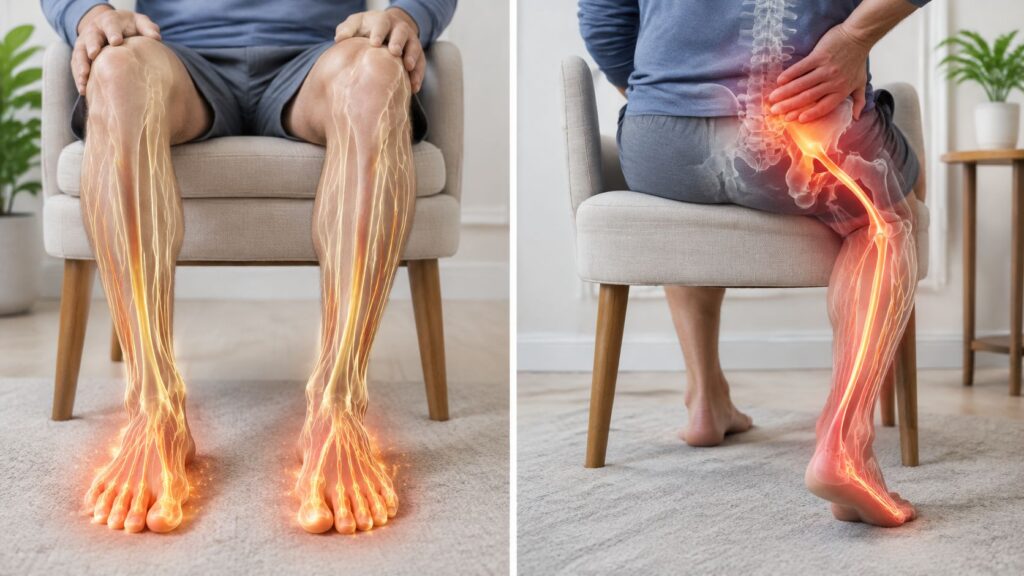
The sacroiliac, or SI, joints connect the lower spine to the pelvis. They can contribute to pain near the beltline, buttock, hip, or pelvic region, but those symptoms can also come from the lumbar spine, hip, nerves, muscles, or facet joints. An injection makes the most sense when the examination and pain pattern point toward the SI joint as a likely pain generator.
One visit can serve two purposes
An SI injection often combines a diagnostic block with a therapeutic treatment. Local anesthetic can temporarily numb the area and help show whether the joint is contributing to your usual pain. A corticosteroid may then be used to reduce inflammation and provide relief that lasts beyond the anesthetic's short effect.
The physician typically uses fluoroscopy, which is live X-ray guidance, or another form of image guidance to place the needle accurately. That precision matters because the SI joint is a specific target, not a general area where medication can be deposited casually. You'll usually receive local anesthetic at the skin, followed by the medication intended for the joint.
For a closer look at the technique, review this explanation of a fluoroscopy-guided injection.
The bill may have several components
Patients often assume an injection has one price. In reality, the claim may separate:
- The physician's professional work
- The imaging guidance or technical component
- The corticosteroid and local anesthetic
- The procedure room or facility
- Sedation or anesthesia, if used
- Follow-up care
The code used also matters. Public billing discussions may refer to CPT 27096 for an image-guided SI joint injection, while other coding references may describe related joint-injection codes. Don't rely on a verbal label such as “SI block.” Ask the office which code it plans to submit and whether the estimate includes every biller involved.
Practical rule: A low professional fee doesn't tell you the total cost until you know whether a facility, imaging group, drug, or anesthesia provider will bill separately.
The Five Cost Drivers Behind the Sticker Price
A single SI joint injection can produce very different bills depending on five cost drivers. The physician's fee is only one part. The setting, imaging, medication, side treated, and sedation can all change what a patient in Chicago Ridge, Palos Heights, Palos Hills, Evergreen Park, or Hickory Hills owes after insurance processes the claim.
Medicare publishes separate facility and non-facility values for CPT 27096. One 2026 fee-schedule summary reports about $175.69 in a non-facility setting and $73.82 in a facility setting. Another reports about $195 for non-facility physician reimbursement and roughly $74 to $76 in a facility setting. These are payment reference points, not guaranteed Illinois reimbursement or a patient bill. Compare the CPT 27096 Medicare benchmark with the separate 2026 valuation summary when reviewing an estimate.
| Cost Driver | What It Covers | Typical Range |
|---|---|---|
| Physician professional fee | Evaluation, needle placement, medication delivery, and medical decision-making | Varies by payer, locality, and setting |
| Imaging guidance | Fluoroscopy or ultrasound used to guide placement | May be included or billed separately |
| Facility or room fee | Procedure-room staffing, supplies, and overhead | Can create the largest setting-related difference |
| Medication | Corticosteroid and local anesthetic | Depends on drug and billing arrangement |
| Sedation or anesthesia | Medication and monitoring beyond local numbing | Applies only when ordered and provided |
The physician fee is only the starting point
The professional claim covers the physician's clinical work. It may not include the procedure room, imaging equipment, medication, or services from another clinician. An office may combine some charges, while a hospital or surgery center may submit separate facility or technical charges.
Bilateral treatment can change both coding and cost. A published Illinois self-pay sheet lists $400 for a unilateral injection and $600 for a bilateral injection. It also lists an SI joint block at $70 per site, so “SI injection” and “SI block” should not be treated as interchangeable descriptions. Review the published self-pay quotes as a comparison point, not a promise of your final bill.
Ask what the estimate includes
For a cash quote, ask whether the amount includes imaging, the drug, supplies, and follow-up. For insurance, request three figures in writing: the billed charge, the allowed amount, and your expected responsibility.
Also ask whether the estimate covers every biller involved. A facility, imaging group, medication charge, or anesthesia provider can create a second bill even when the clinic gives you one professional-fee quote. Insured patients should confirm deductible status, coinsurance, and whether the location is in network before scheduling.
How Site of Service Changes What You Pay
The procedure can be clinically identical and financially very different. In Chicago Ridge, Palos Heights, Palos Hills, Evergreen Park, and Hickory Hills, the location determines whether you face a professional fee alone or a separate facility claim.
Hospital outpatient departments
Hospital outpatient departments commonly bill a facility charge in addition to the physician's professional claim. That charge may include the procedure room, staff, equipment, and technical services. A physician-fee estimate therefore does not show your likely total.
Ask for the hospital and physician components in writing. The hospital and physician pricing discussion can provide general context, but it does not predict your Illinois allowed amount or final responsibility. Your insurer's adjudication controls what counts toward the deductible, coinsurance, or out-of-pocket maximum.
If you are choosing between a Chicago Ridge office and a hospital outpatient department in Palos Heights, ask both schedulers for the same CPT 27096 estimate. Request facility, imaging, medication, and physician charges as separate line items. Compare the allowed amounts, not just the billed charges.
Surgery centers and freestanding clinics
An ambulatory surgery center may have a lower facility charge than a hospital, but confirm whether the estimate includes imaging, medication, supplies, and anesthesia. A freestanding pain clinic may offer a clearer cash price for someone who has not met a deductible. Confirm whether that quote applies to unilateral treatment, bilateral treatment, or an insured claim.
Do not schedule from an advertised total alone. Ask who submits each claim and whether prior authorization applies to that location.
Office-based procedures
An office-based injection often creates fewer separate facility charges. Commercial insurance can still apply a deductible, copay, or coinsurance based on the plan and the office's network status. A cash quote may also exclude imaging or medication unless the clinic lists those items explicitly.
| Setting | What may appear on the claim | What determines your responsibility |
|---|---|---|
| Hospital outpatient department | Separate professional and facility charges | Deductible, coinsurance, network status, and facility benefits |
| Ambulatory surgery center | Professional, facility, medication, and possible anesthesia charges | Authorization and plan-specific cost sharing |
| Physician office | Professional charge, with fewer separate facility charges in some cases | Allowed amount, deductible, copay, and included services |
Call the number on your insurance card before scheduling. Then have the clinic confirm authorization, network participation, and the complete estimate in writing. A referral starts the process, but it does not settle the claim.
What Medicare Will and Will Not Cover
Medicare coverage for an SI joint injection turns on four practical questions: medical necessity, documentation, coding, and the treatment setting. HCPCS G0260 gives Medicare a procedure-specific reference point, but it does not predict your final coinsurance or deductible. Review the Medicare procedure price lookup for G0260, then ask the billing office to apply that information to your plan and proposed site of service.
Coverage depends on the record
Medicare's local coverage policy requires a documented pain pattern, functional limitation, examination findings, and appropriate conservative treatment history. The record may also need diagnostic confirmation that the SI joint is the pain source. The clinician must document image guidance and why the injection is medically necessary. A referral starts the process, but it does not guarantee payment.
Repeat treatment must show meaningful functional improvement, not only a short-term change in pain intensity. Track walking, sitting, standing, sleep, and daily activities so the follow-up record shows what changed. The CMS coverage determination for SI joint injections explains the documentation and utilization framework.
For patients in Chicago Ridge, Palos Heights, Palos Hills, Evergreen Park, or Hickory Hills, call the number on your Medicare card before scheduling. Give the representative CPT 27096/G0260, the proposed site of service, and the facility or physician NPI. Ask whether authorization is required, whether the providers are in network, and how the claim will apply to your remaining deductible and coinsurance. Original Medicare and Medicare Advantage do not process every claim the same way.
| Coverage question | What Medicare looks for | What you should confirm |
|---|---|---|
| Medical necessity | Symptoms, examination, conservative care, and a supported SI-joint diagnosis | Whether your chart contains each required element |
| Repeat treatment | Documented functional improvement after prior care | Which activities the clinician will measure |
| Coding | Correct procedure and diagnosis coding | Whether the office plans to submit G0260, 27096, or related codes |
| Site of service | Different published values for facility and non-facility settings | Your expected patient responsibility at that location |
| Related services | Separate coverage rules for items billed with the injection | Whether imaging, medication, supplies, or other charges are included |
Medicare Advantage plans must cover Medicare services, yet they can add network, referral, authorization, and utilization requirements. Confirm those rules before the appointment, not after the claim is denied.
Medicare also does not automatically cover unrelated implants, durable equipment, or separately billed pharmacy items because they occur during the same episode of care. Ask the billing team to identify every expected claim and explain which items require separate review. The national coverage article for SI joint injections and procedures can help clarify an unclear coverage response.
Insurance, Workers Comp, and Personal Injury in Illinois
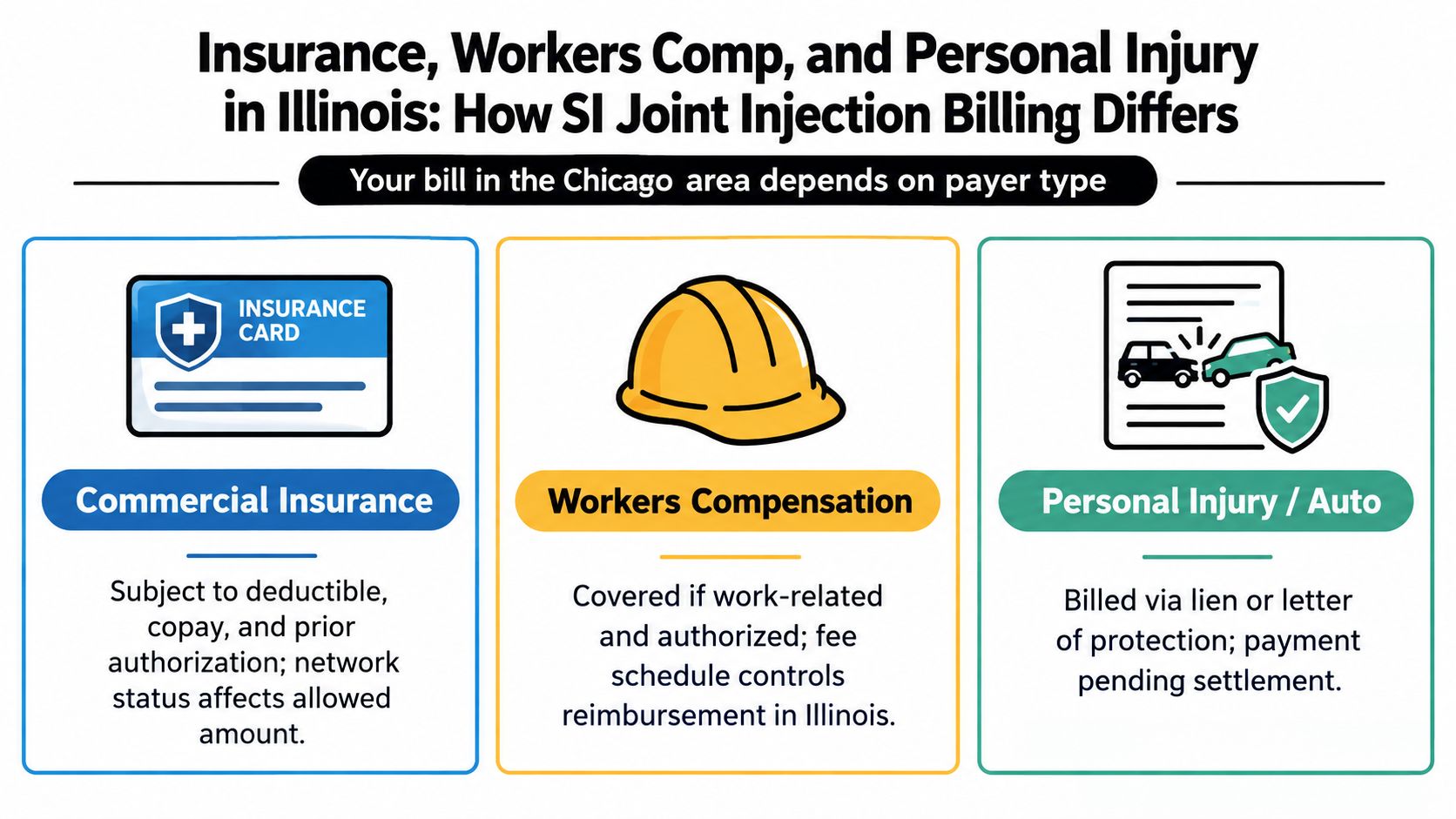
Your payer type changes the rules before the procedure begins. A patient with commercial insurance, Medicare Advantage, Illinois Medicaid, workers' compensation, or an auto-related claim may receive very different instructions for the same SI joint injection.
Commercial insurance
Commercial plans usually adjudicate the claim against an allowed amount, not the provider's full billed charge. Your responsibility may include a deductible, copay, or coinsurance, and network status can alter both the allowed amount and the percentage you owe.
Ask whether the plan requires prior authorization, a referral, conservative treatment documentation, or a specific site of service. Also ask whether the facility, imaging group, anesthesiologist, and physician are all in network. Separate bills can arrive even when you schedule through one office.
Medicare Advantage and Medicaid
Medicare Advantage plans may impose authorization and network rules beyond the general Medicare coverage framework. Illinois Medicaid coverage is administered through the state's health system and plan arrangements, so verify eligibility, participating providers, authorization, transportation needs, and any applicable copay before the visit.
For workers' compensation, the central issue is authorization, not a cash discount. Illinois workers' compensation reimbursement follows the Illinois Medical Fee Schedule rather than accepting the provider's billed charge. When the injury is covered and the treatment is authorized, patient responsibility is generally not the same as ordinary commercial cost sharing, but the employer or carrier still needs to approve care.
If you're unsure whether your injury qualifies, this guide on when am I eligible for workers comp can help you identify the employment and injury questions to raise with counsel. Confirm the choice-of-provider paperwork, authorization letter, and utilization-review timeline before scheduling.
Personal injury and auto claims
Personal-injury care may be arranged through a lien or letter of protection, depending on the case and provider. That can postpone payment while the claim is pending, but it doesn't erase the obligation or guarantee that settlement proceeds will cover every charge. Discuss the arrangement with your attorney and the clinic's billing department before treatment.
For crash-related symptoms, ask the clinic how it handles car accident pain management and whether the provider needs the claim number, attorney contact, and written authorization.
Where an SI Joint Injection Fits in the Cost Ladder
An SI joint injection should be judged by its role in the treatment plan, not as an isolated purchase. It may serve as a diagnostic block, provide temporary therapeutic relief, or help determine whether a different intervention is appropriate. That distinction matters for patients in Chicago Ridge, Palos Heights, Palos Hills, Evergreen Park, and Hickory Hills, because the amount owed after the claim is processed can differ sharply by setting and insurance plan.
The least expensive procedure may not be the least expensive plan
A diagnostic block can clarify whether the SI joint is contributing to pain. A corticosteroid injection may improve symptoms and function, but repeating a treatment that provides only brief relief can create more visits, facility charges, and claims. Radiofrequency ablation, including lateral-branch approaches, usually requires a larger treatment plan and documented diagnostic response. Regenerative procedures such as platelet-rich plasma or bone-marrow concentrate are often self-pay when a plan classifies them as investigational.
| Procedure | Cost and billing question | Decision rule |
|---|---|---|
| Diagnostic SI joint block | Request separate physician, imaging, and facility estimates | Use the result to confirm the suspected pain source before authorizing repeat treatment |
| Therapeutic corticosteroid injection | Published cash examples include $350 to $1,439, while hospital pricing may be substantially higher | Continue only if relief improves function enough to justify the total claim cost |
| Lateral-branch radiofrequency ablation | Obtain a separate estimate and confirm authorization requirements | If a diagnostic block provides more than 75% relief for the anesthetic duration and function improves for 2 to 4 weeks after a therapeutic injection, discuss candidacy |
| Sacral lateral-branch cooled RFA | Ask whether the plan treats it as an outpatient procedure and what facility charges apply | If relief is below 50% or lasts less than 1 week, reassess the pain generator before repeating injections |
| PRP or bone-marrow concentrate | Confirm the self-pay amount and whether the plan excludes the procedure | Do not assume a referral makes the treatment covered |
Published cash examples range from about $350 to $1,375, while another reported average is $1,439. Hospital pricing can average $8,278, with a range from $116 to $39,875. Those figures are not interchangeable with your bill. Ask for a written comparison that separates cash price, allowed amount, facility fee, and your responsibility for each option.
Before scheduling repeat injections, ask what measurable result would justify the next step. Review radiofrequency ablation cost as part of that discussion, then have the physician confirm whether ablation fits your diagnosis and coverage.
The injection is best viewed as a diagnostic and therapeutic bridge, not a guaranteed cure. If it identifies the pain source and improves function, it can support a longer-term plan. If relief is absent or short-lived, repeating the same procedure without reassessing the diagnosis can waste money and time.
A Chicago-Area Patient Checklist Before You Schedule
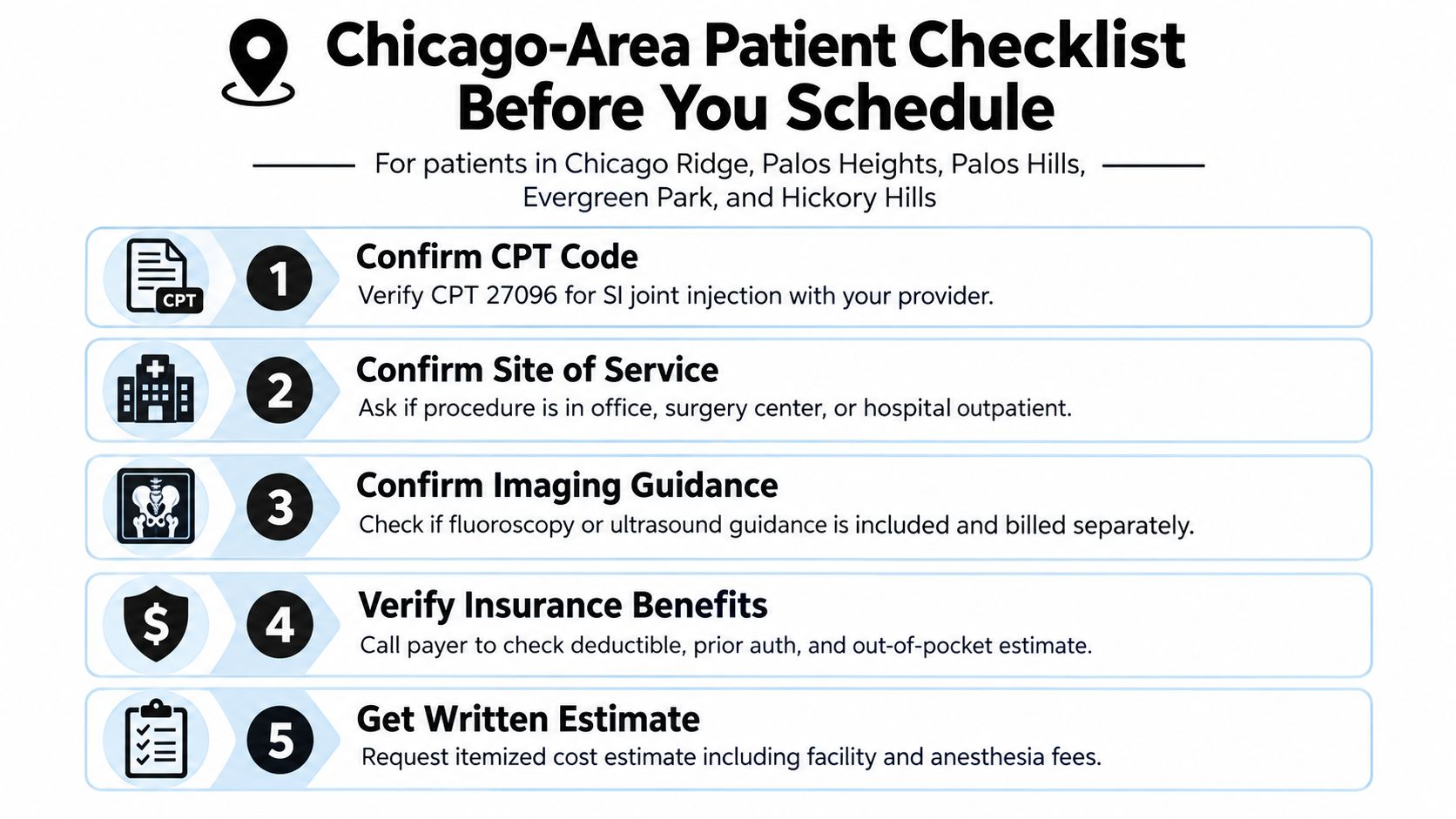
Patients in Chicago Ridge, Palos Heights, Palos Hills, Evergreen Park, and Hickory Hills should make the billing questions part of the medical appointment. A clear estimate protects your budget and helps the physician's office identify authorization problems before the procedure date.
Confirm the code. Ask whether the planned service is being billed under CPT 27096 and whether the claim includes one side or both. If the office uses a different related code, ask why.
Request an itemized estimate. Get separate lines for the physician, imaging, facility, medication, supplies, sedation, and follow-up. Ask for the estimated allowed amount and your expected responsibility, not just the billed charge.
Identify the setting. Confirm whether the injection happens in a physician office, ambulatory surgery center, or hospital outpatient department. The setting can determine whether a facility fee appears.
Verify authorization. Call your commercial or Medicare Advantage plan and ask whether prior authorization is required. Give the plan the procedure code, diagnosis information, provider name, and facility location.
Handle claim paperwork early. Workers' compensation and auto-related care may require an authorization letter, claim number, attorney information, or treating-provider approval. Don't assume a referral is enough.
Ask two more questions before you hang up: “Is fluoroscopy included or billed separately?” and “Is the steroid included?” If you're uninsured, ask for the office's written self-pay discount and whether bilateral treatment has a different price.
Putting It All Together for a Smarter Decision
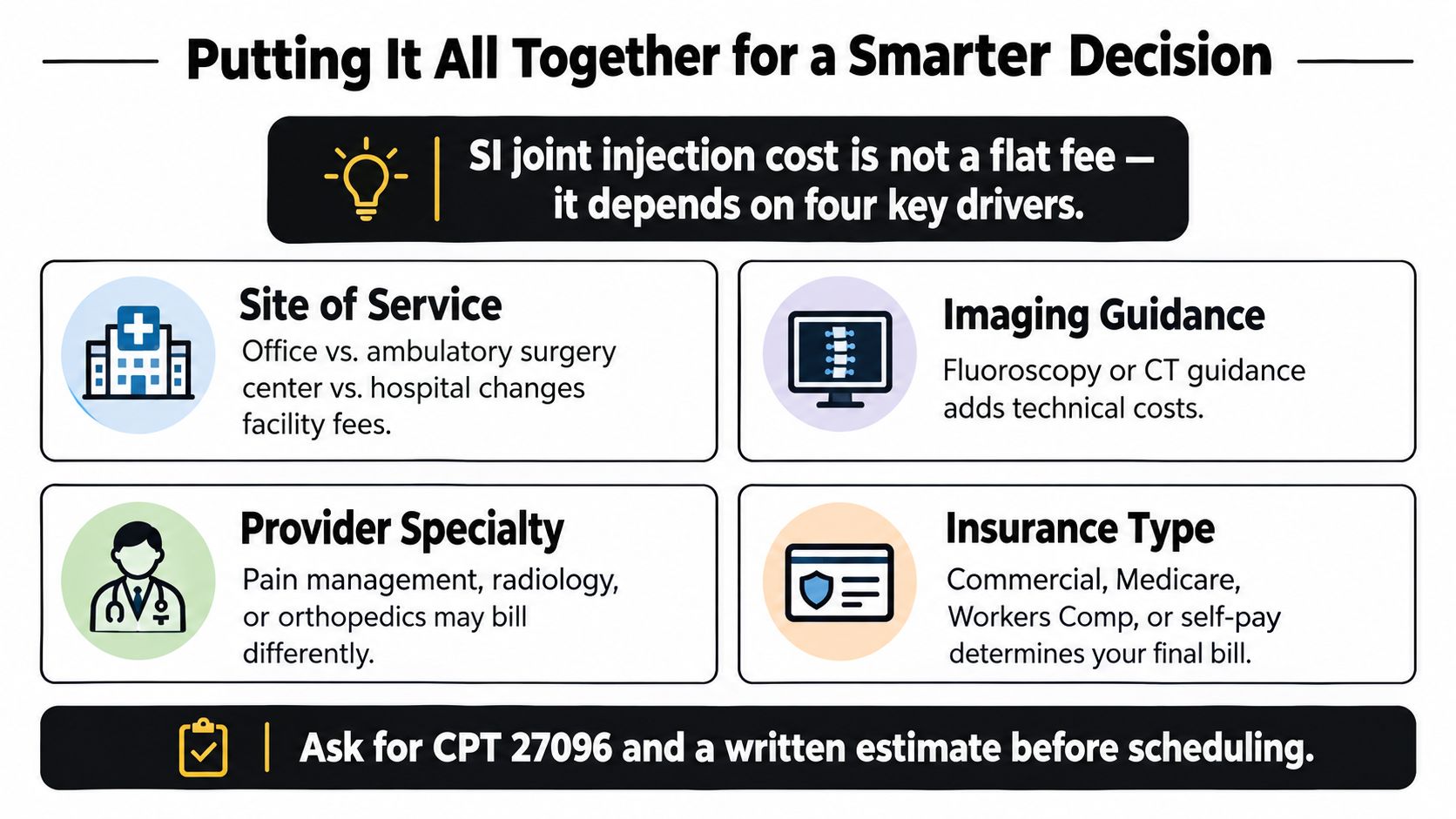
The sacroiliac joint injection cost isn't a flat Illinois price. Site of service, imaging guidance, provider billing, medication, facility charges, and payer type determine what reaches your mailbox.
Use the Medicare benchmark as a reference, not a promise. Remember that Medicare limits therapeutic SI injections to four sessions per rolling 12 months, while commercial, Medicare Advantage, Medicaid, workers' compensation, and personal-injury claims follow different administrative paths. Your estimate should explain those differences before you consent.
Take three actions this week:
- Request a written, itemized estimate.
- Confirm authorization and network status.
- Compare the injection with the broader treatment ladder, especially if repeated procedures are being proposed.
Midwest Pain & Wellness evaluates persistent SI joint and low back pain, provides image-guided diagnostic and therapeutic injections, and helps patients understand authorization and billing before treatment. Visit Midwest Pain & Wellness to request an appointment in the Chicago Ridge area and discuss a treatment plan that fits both your symptoms and your budget.