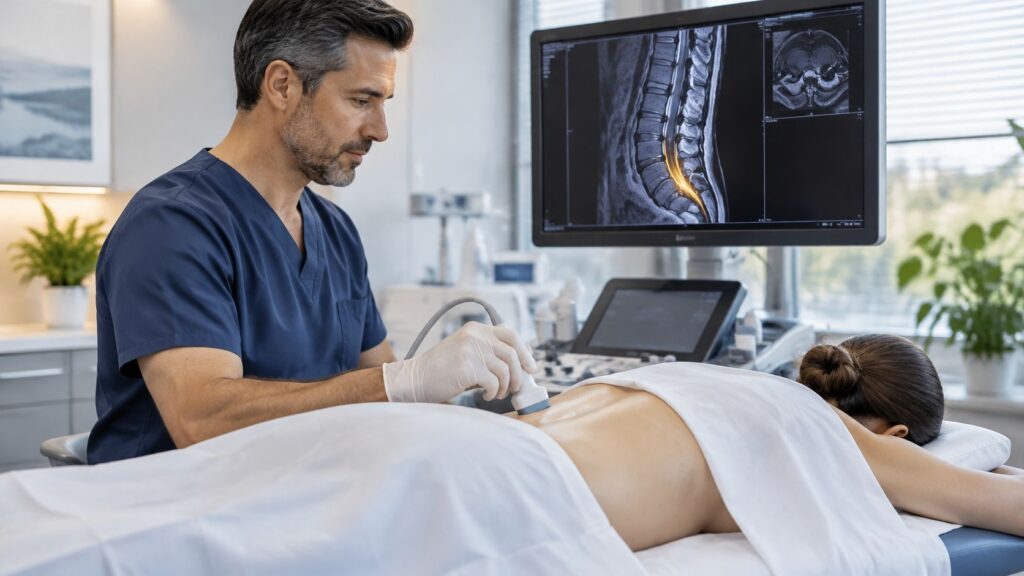
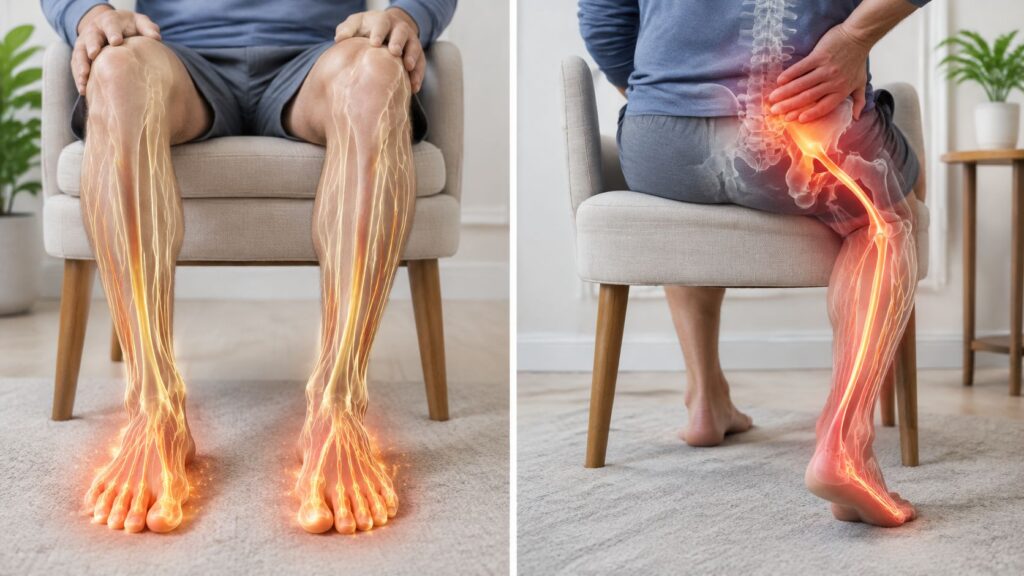
You've started avoiding the grocery store, leaning on a cart, or stopping after a short walk because your legs become painful, heavy, numb, or weak. Sitting may ease the symptoms, but standing again brings them back. An MRI may show lumbar spinal stenosis, and the next question is often whether an epidural steroid injection for spinal stenosis will reduce your pain or help you function a little better.
That distinction matters. An injection can calm inflammation around irritated nerves, but it can't widen a narrowed spinal canal or reverse the structural changes causing stenosis. The practical decision is whether a temporary reduction in nerve irritation could help you walk, stand, sleep, or participate in rehabilitation while you consider the next step.
Table of Contents
- What Epidural Steroid Injections Are for Spinal Stenosis
- What the Evidence Says About ESI for Lumbar Spinal Stenosis
- How the Procedure Is Performed
- Who Is a Good Candidate for Epidural Steroid Injections
- Epidural Steroid Injections vs Other Spinal Stenosis Treatments
- Next Steps and Questions to Ask Your Pain Specialist
What Epidural Steroid Injections Are for Spinal Stenosis
A patient with lumbar spinal stenosis often describes a predictable pattern. Walking brings on aching or burning in the buttocks and legs, standing becomes difficult, and sitting or bending forward provides relief. The narrowing inside the lumbar spine can crowd the nerve roots, particularly during standing and walking. When those nerves become irritated, symptoms may include radiating leg pain, tingling, numbness, or neurogenic claudication.
An epidural steroid injection, or ESI, places corticosteroid and local anesthetic into the epidural space around the spinal nerves. The medication is intended to reduce inflammation and irritation around compressed nerves. It doesn't remove bone, shrink a thickened ligament, or permanently restore space inside the spinal canal.
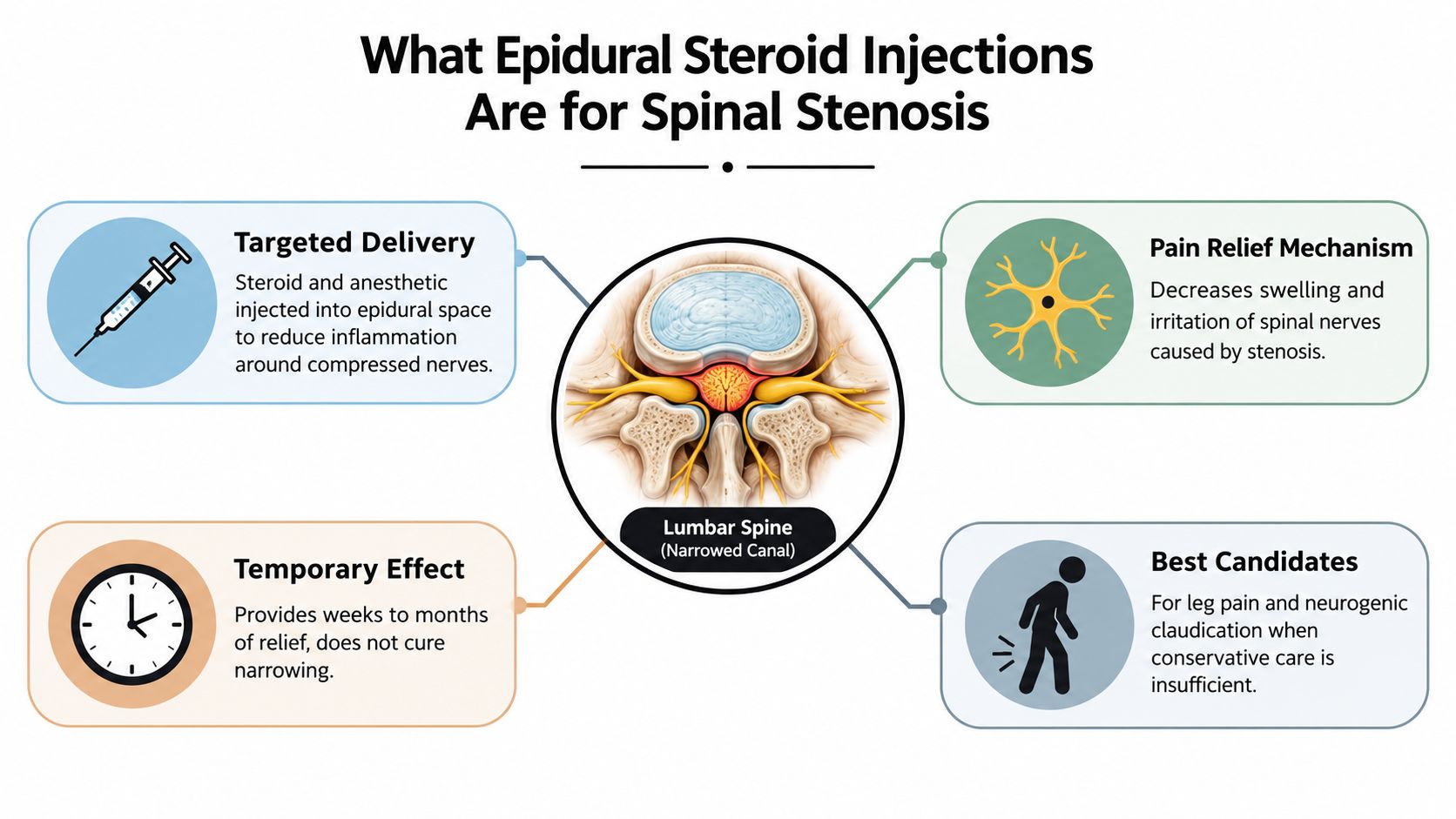
What the injection targets
The treatment makes the most sense when stenosis is producing nerve-related leg symptoms, such as radicular pain or neurogenic claudication. It's less compelling when the primary complaint is isolated low back pain without evidence that irritated nerves are contributing.
Before recommending an injection, I review the symptom pattern, neurological examination, and available imaging together. An MRI finding alone doesn't determine candidacy. Two people can have similar narrowing on a scan but very different symptoms and very different reasons to pursue or avoid an injection.
The steroid used in an injection is different from routine oral medication because the clinician delivers it near the affected spinal structures. Patients who want more background on one medication used in clinical care can review these Sunridge Medical laboratory tests, although medication selection and safety decisions belong in a medical consultation.
What ESI can't do
An ESI is a symptom-management treatment, not a cure for spinal stenosis. Its value is measured by what you can do afterward. If you can stand longer, walk farther, sleep more comfortably, or begin rehabilitation more effectively, the injection may have served a useful purpose even if the MRI looks unchanged.
For a plain-language explanation of the treatment process, see how an epidural injection works. The right expectation is a possible window of improved function, not a permanent repair.
What the Evidence Says About ESI for Lumbar Spinal Stenosis
The evidence is more limited than many patients expect. The multicenter, double-blind LESS trial marked an important turning point because it was designed to test whether adding steroid to local anesthetic produced better outcomes than local anesthetic alone in older adults with lumbar spinal stenosis. Later reviews of that trial era questioned whether the steroid component reliably adds meaningful pain relief, particularly when the comparison is local anesthetic alone. The trial history is summarized in this review of epidural steroid injections for lumbar spinal stenosis.
The most useful clinical distinction is between pain intensity and disability. A recent systematic review found that ESIs may reduce short-term disability, with a standardized risk difference of −26.2% and a number needed to treat of 4, but it found no clear short-term pain benefit. The same review reported possible long-term disability improvement, with a standardized risk difference of −11.8% and a number needed to treat of 8, while the confidence intervals reflected uncertainty. These figures come from the Neurology systematic review.
Function deserves its own score
If you judge the injection only by whether your pain disappears, you may conclude that it failed even when your walking improves. I ask patients to track practical measures such as:
- Walking tolerance: How far can you walk before leg symptoms force you to stop?
- Standing time: Can you prepare a meal, shower, or wait in line more comfortably?
- Daily activity: Are you able to complete necessary tasks with fewer breaks?
- Disability: Are you moving more normally, even if some pain remains?
The American Academy of Neurology reported that ESIs may modestly reduce disability for up to six months or more in people with spinal stenosis, but the treatment wasn't found to reduce pain for up to three months. Its summary of the evidence on epidural steroid injections supports a measured conversation rather than a promise of broad pain relief.
Why results vary
Some controlled research has reported meaningful improvement in selected patients. In one randomized double-blind trial involving 120 patients, significant pain and function improvement at two years occurred in 72% to 73% of participants across both treatment groups. Among participants with a successful early response, improvement rose to 84% to 85% at two years. Those results don't prove that steroid is superior, because both groups improved, but they show why individual response can differ from the average result.
The practical conclusion is straightforward. ESI may be reasonable when nerve-related symptoms limit function and conservative care hasn't been enough, but the expected benefit is usually modest and time-limited, with disability improvement better supported than durable pain reduction.
How the Procedure Is Performed
An image-guided injection is planned around your anatomy, symptoms, and the location of nerve irritation. The approach may be interlaminar, caudal, or transforaminal. Each route gives the clinician a different path to the epidural space, so the choice depends on whether symptoms involve one level, multiple levels, or a broader distribution.
Step 1, preparation
You'll review medications, allergies, medical conditions, and the treatment plan before the procedure. You'll then lie face-down, and the skin over the injection site will be cleaned carefully. Local anesthetic numbs the skin and deeper tissues before the epidural needle is advanced.
Step 2, image guidance
The clinician uses fluoroscopy, a form of real-time X-ray guidance, to identify the relevant spinal landmarks and guide the needle. This isn't an optional convenience. It helps confirm the intended path and reduces the chance of placing medication away from the target.
You can learn more about the role of fluoroscopy-guided injection before your appointment.
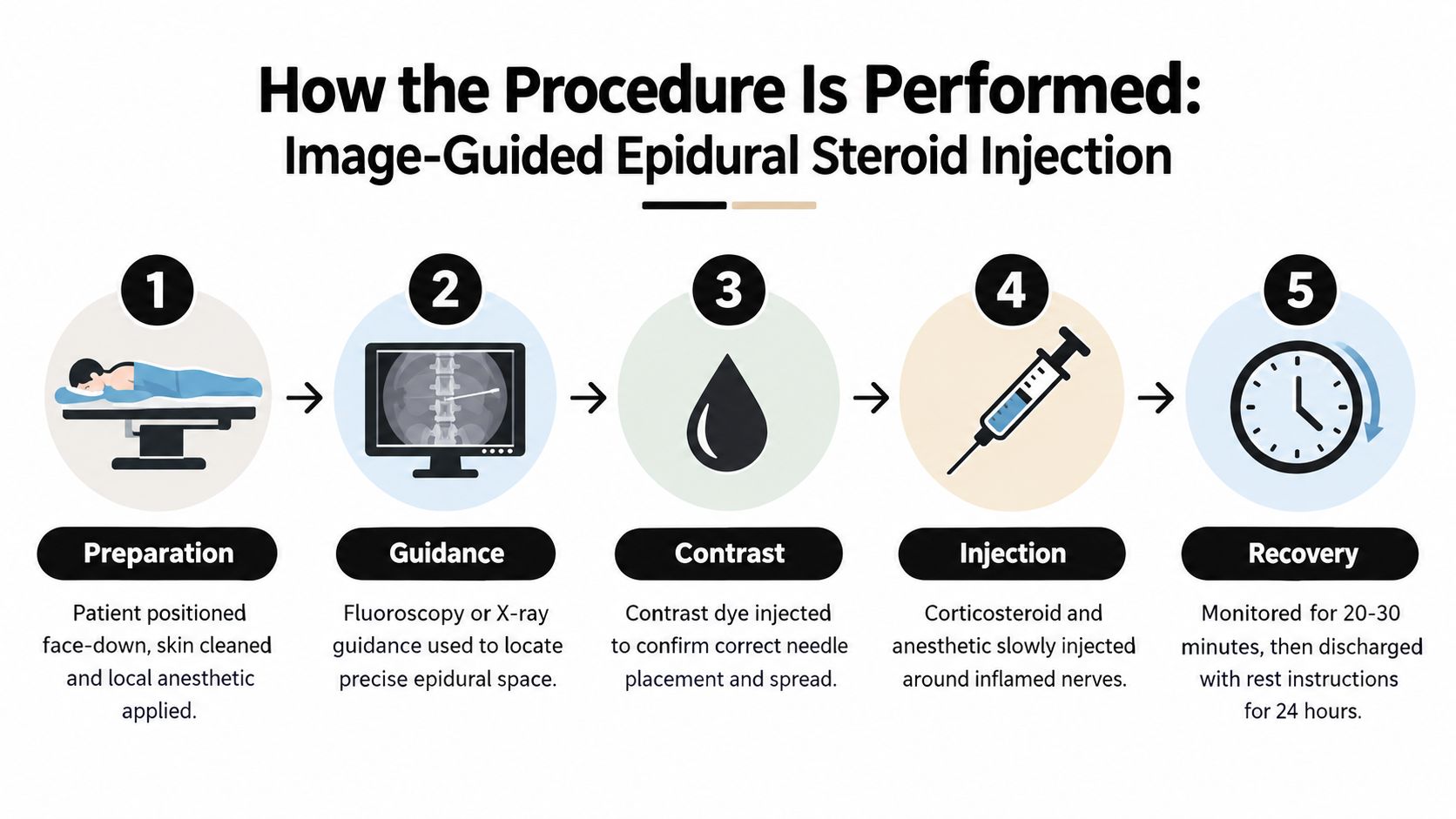
Step 3, contrast confirmation
Contrast is injected to confirm the needle's position and show how the medication will spread. CMS coverage guidance states that ESIs must be performed with CT or fluoroscopy image guidance and contrast, unless a documented contrast allergy or pregnancy changes that plan. The same guidance limits transforaminal injections to a maximum of two spinal levels in one region. You can review the CMS coverage guidance for epidural steroid injections.
Step 4, medication delivery
Once the position is confirmed, the corticosteroid and anesthetic are delivered slowly. You may feel pressure, fullness, or temporary reproduction of familiar symptoms. Tell the clinician if you experience unusual or severe discomfort during the injection.
Step 5, observation and discharge
Afterward, you'll be monitored before leaving. Follow the specific instructions provided by your clinical team regarding activity, medications, and warning signs. Arrange help if sedation is used, and contact the clinic promptly if you develop concerning neurological symptoms, fever, severe headache, or worsening weakness.
Who Is a Good Candidate for Epidural Steroid Injections
A good candidate isn't defined by an MRI report alone. The strongest rationale usually combines leg-dominant symptoms, findings that support nerve irritation, and limitations that haven't improved enough with appropriate conservative care.
Symptoms matter more than the scan alone
ESI is generally considered when lumbar stenosis causes radicular leg pain or neurogenic claudication. A patient who can identify a consistent walking or standing trigger may fit the treatment profile better than someone whose discomfort is diffuse, muscular, or unrelated to nerve compression.
I also look for a treatment objective. “I want less pain” is understandable, but a more useful goal is, “I want to walk to the store,” or, “I want to stand long enough to cook dinner.” Clear goals make it easier to judge whether the procedure earned a place in the care plan.
Severity isn't an automatic exclusion
Severe or multilevel lumbar stenosis isn't considered an absolute contraindication to a properly performed ESI. Published safety evidence hasn't shown a causal link between stenosis severity, injectate volume, and neurological injury. Reported volumes as high as 8 mL for interlaminar approaches and 20 mL for caudal approaches haven't been associated with significant complications in the cited review of epidural injection safety and spinal stenosis.
That doesn't mean every patient with severe narrowing should receive an injection. It means severity alone shouldn't replace individualized anatomical and clinical assessment. The route, medication, medical history, neurological findings, and symptom distribution still matter.
When another option deserves priority
An injection may be a poor fit when symptoms don't suggest nerve irritation, when there are safety concerns, or when progressive neurological problems require a different level of evaluation. New or worsening weakness, major changes in bowel or bladder function, or other urgent neurological symptoms need prompt medical attention rather than routine scheduling.
I also discuss expectations directly. If the likely result is only a temporary functional window, we should know what we'll do with that window. Rehabilitation, activity modification, or a discussion of decompression may be more important than repeating an injection without a defined purpose.
Epidural Steroid Injections vs Other Spinal Stenosis Treatments
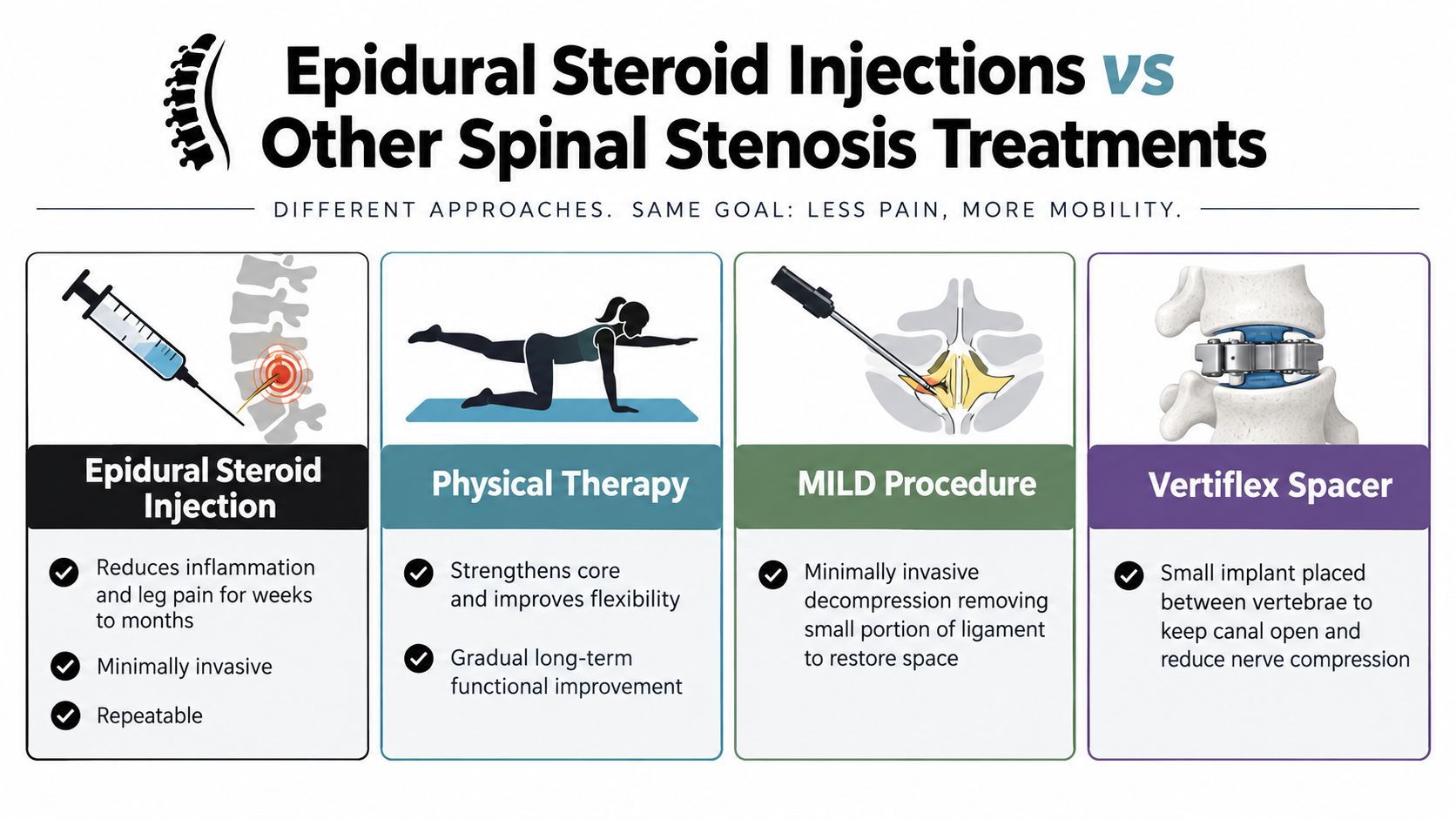
ESI works best as one component of a treatment plan, not as a replacement for every other option. The right choice depends on the dominant symptom, the anatomy producing it, your medical risk, and whether the goal is temporary symptom control or more direct treatment of compression.
Conservative care
Exercise-based rehabilitation and physical therapy can address strength, flexibility, posture, balance, and walking strategies. They don't remove the narrowing, but they may improve how you move and how much activity you can tolerate. Medication and activity changes can also support symptom management, though their suitability depends on your health history.
An injection may help when pain prevents participation in rehabilitation. In that situation, the ESI is a bridge to movement rather than the entire treatment.
Minimally invasive decompression
A minimally invasive lumbar decompression procedure, such as MILD, addresses selected forms of stenosis by removing a small amount of tissue contributing to narrowing. A spacer procedure, such as Vertiflex Superion, uses an implant to help maintain space between vertebrae in carefully selected patients. These treatments aren't interchangeable with ESI, and candidacy depends on the anatomy and the source of compression.
You can review the treatment category of minimally invasive lumbar decompression when discussing whether a structural option may be appropriate.
Other interventional and surgical choices
Radiofrequency ablation targets pain from specific facet joints, so it may be more suitable for facet-mediated back pain than for leg symptoms caused by central canal narrowing. Nerve stimulation and other interventions may have a role in selected chronic pain conditions, but they address different mechanisms.
Surgery may become appropriate when structural compression produces progressive neurological loss or symptoms remain disabling despite appropriate nonoperative treatment. The question isn't whether ESI is “better” than surgery in every case. The question is whether a less invasive treatment can safely provide a useful functional improvement, and whether that improvement supports a broader plan.
Practical rule: Repeat an injection only when the prior response was meaningful, the target remains appropriate, and the result will change what you can do next.
Next Steps and Questions to Ask Your Pain Specialist
Start by bringing a clear symptom history to your consultation. Record where the pain travels, what walking or standing triggers it, what relieves it, and whether you've noticed numbness or weakness. A simple tool for documenting chronic pain can help you organize this information before the visit.
Ask your pain specialist:
- What symptom are we targeting? Is the primary issue nerve irritation, neurogenic claudication, facet pain, or another source?
- What improvement should I measure? Discuss walking distance, standing tolerance, sleep, and disability, not only pain intensity.
- Which approach fits my anatomy? Ask why an interlaminar, caudal, or transforaminal route is being considered.
- What is the next step if it helps? Clarify whether the plan includes rehabilitation or further evaluation.
- What would make another treatment more appropriate? Ask about decompression, surgical consultation, or other options if function remains limited.
For patients in Chicago Ridge, Palos Heights, Palos Hills, Evergreen Park, Hickory Hills, and nearby Illinois communities, Midwest Pain & Wellness, led by Dr. Yaw Donkoh, provides opioid-sparing, image-guided interventional pain care. The clinic evaluates whether ESI fits the individual diagnosis and broader functional plan.
Midwest Pain & Wellness offers evaluation and image-guided epidural steroid injections for selected patients with lumbar spinal stenosis and nerve-related symptoms. Visit Midwest Pain & Wellness to request a consultation in Chicago Ridge, Illinois, and discuss whether an injection, rehabilitation plan, minimally invasive treatment, or another option best matches your goals.