You've tried to be patient. Physical therapy helped for a while, injections didn't last, medications now seem to create as many problems as they solve, and another surgery isn't an appealing answer. If you're searching for the best spinal cord stimulator, you're probably not looking for the newest device name. You're trying to determine whether stimulation fits your pain, whether a trial can prove its value, and what living with an implanted system may involve years from now.
For patients in Chicago Ridge, Palos Heights, Palos Hills, Evergreen Park, and Hickory Hills, Illinois, that decision belongs in a pain and wellness clinic with a careful trial-to-implant process. The right choice depends on your pain distribution, imaging, previous treatment response, psychological readiness, MRI needs, and willingness to accept possible programming, revision, or removal procedures.
| Decision factor | Why it matters |
|---|---|
| Pain pattern | Broad leg pain, axial back pain, and highly focal distal pain may respond differently to different approaches |
| Trial response | A permanent implant should follow meaningful relief and functional improvement during the temporary trial |
| Treatment history | SCS is generally considered after persistent neuropathic pain has not improved with appropriate conventional care |
| Long-term maintenance | Lead migration, revision, explantation, charging, programming, and MRI conditions affect the lifetime decision |
| Clinical setting | The provider should evaluate candidacy, perform or coordinate the implant, and provide follow-up programming |
Table of Contents
- When a Stimulator Becomes the Right Next Step
- How Spinal Cord Stimulation Actually Works
- Comparing the Major Stimulation Waveforms
- What the Evidence Says About Each Waveform
- Who Is a Candidate and How the Trial Works
- Benefits, Risks, and the Revision Picture
- Where SCS Is Heading and What “Best” Really Means
- Choosing a Provider in the Chicago Area
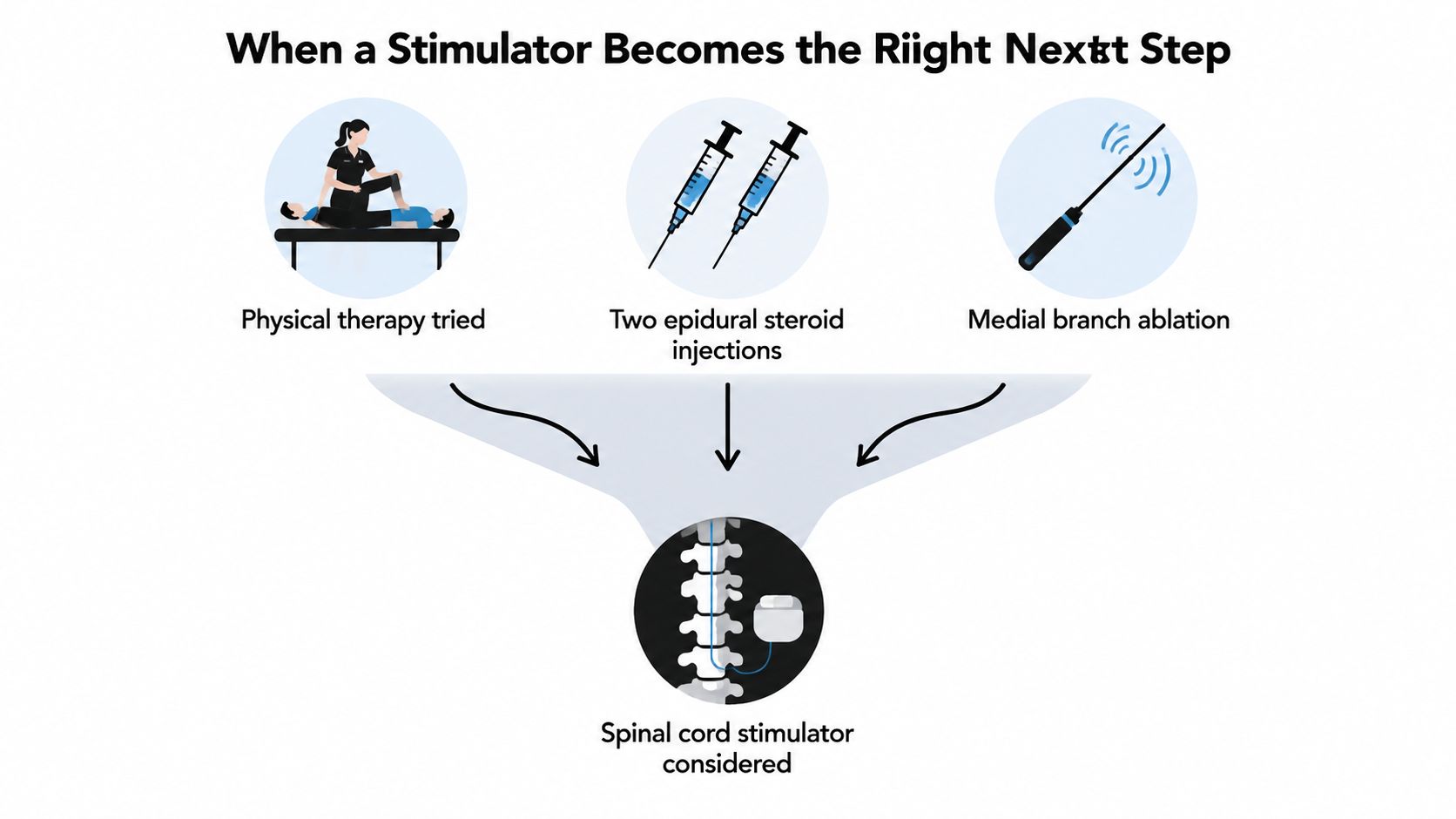
When a Stimulator Becomes the Right Next Step
A 54-year-old patient from the Chicago suburbs may arrive after a familiar sequence of treatments. He has post-laminectomy syndrome, completed physical therapy, underwent two epidural steroid injections, received a medial branch ablation, and tried increasing doses of gabapentin and duloxetine. His leg pain still interrupts sleep, sitting remains difficult, and the next medication increase feels less like a solution than a postponement.
That doesn't automatically make him a candidate for implantation. It does create the right clinical question: has the pain become refractory, and is the remaining pain neuropathic enough for neuromodulation to make sense?
What refractory pain looks like in practice
In a clinic, refractory doesn't mean that one treatment failed. It usually describes persistent symptoms after a sustained course of appropriate nonsurgical care, often involving physical therapy, medication optimization, targeted injections, and other interventions selected for the suspected pain generator. The key issue is whether those treatments produced meaningful functional gain, not whether a patient briefly felt better for a few days.
A patient may be ready for an SCS evaluation when pain remains consistently disruptive, sleep is affected, walking or working is limited, and medication escalation has become the only apparent next step. The treatment is positioned for severe, persistent neuropathic pain, not as an early substitute for diagnosis or rehabilitation.
Practical rule: The best device can't compensate for the wrong indication. First confirm that the pain pattern, imaging, and treatment history support stimulation.
NICE guidance describes SCS for adults with chronic neuropathic pain lasting at least 6 months, after conventional medical management has failed and after a successful stimulation trial. The guidance also uses a pain threshold of at least 50 mm on a 0 to 100 mm visual analogue scale. NICE guidance on spinal cord stimulation
A proper evaluation also considers MRI findings, whether a surgeon has ruled out a correctable structural problem, psychological clearance, opioid goals, and the patient's ability to attend follow-up programming. Patients who are also working on broader recovery goals may find it useful to review resources about how to improve well-being in recovery while addressing chronic pain safely.
For an overview of available options before a consultation, patients can review chronic back pain treatment options. The decision should remain individualized. “Best” means the system that matches the pain phenotype and produces convincing benefit during the trial, not the system with the most persuasive brochure.
How Spinal Cord Stimulation Actually Works
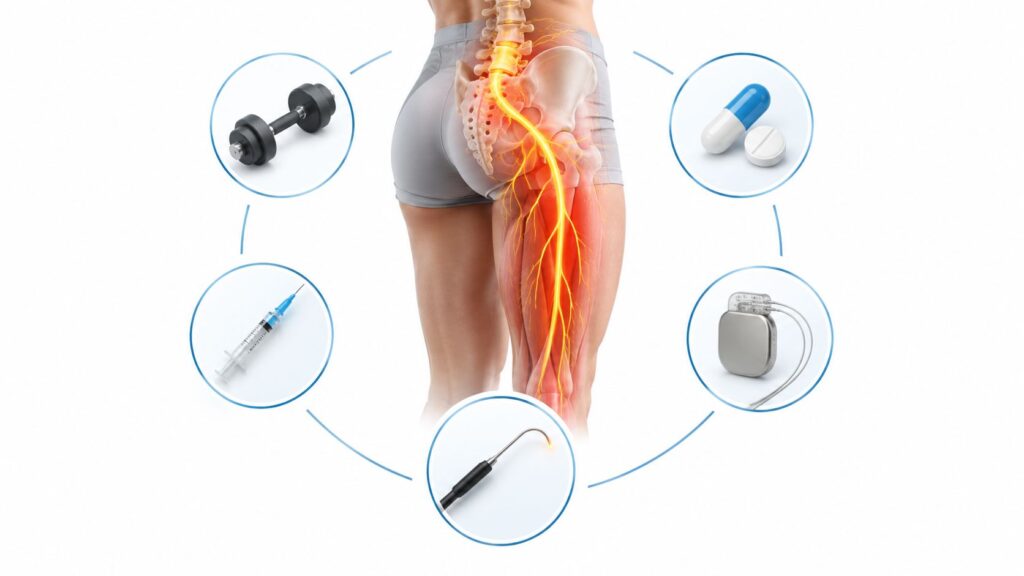
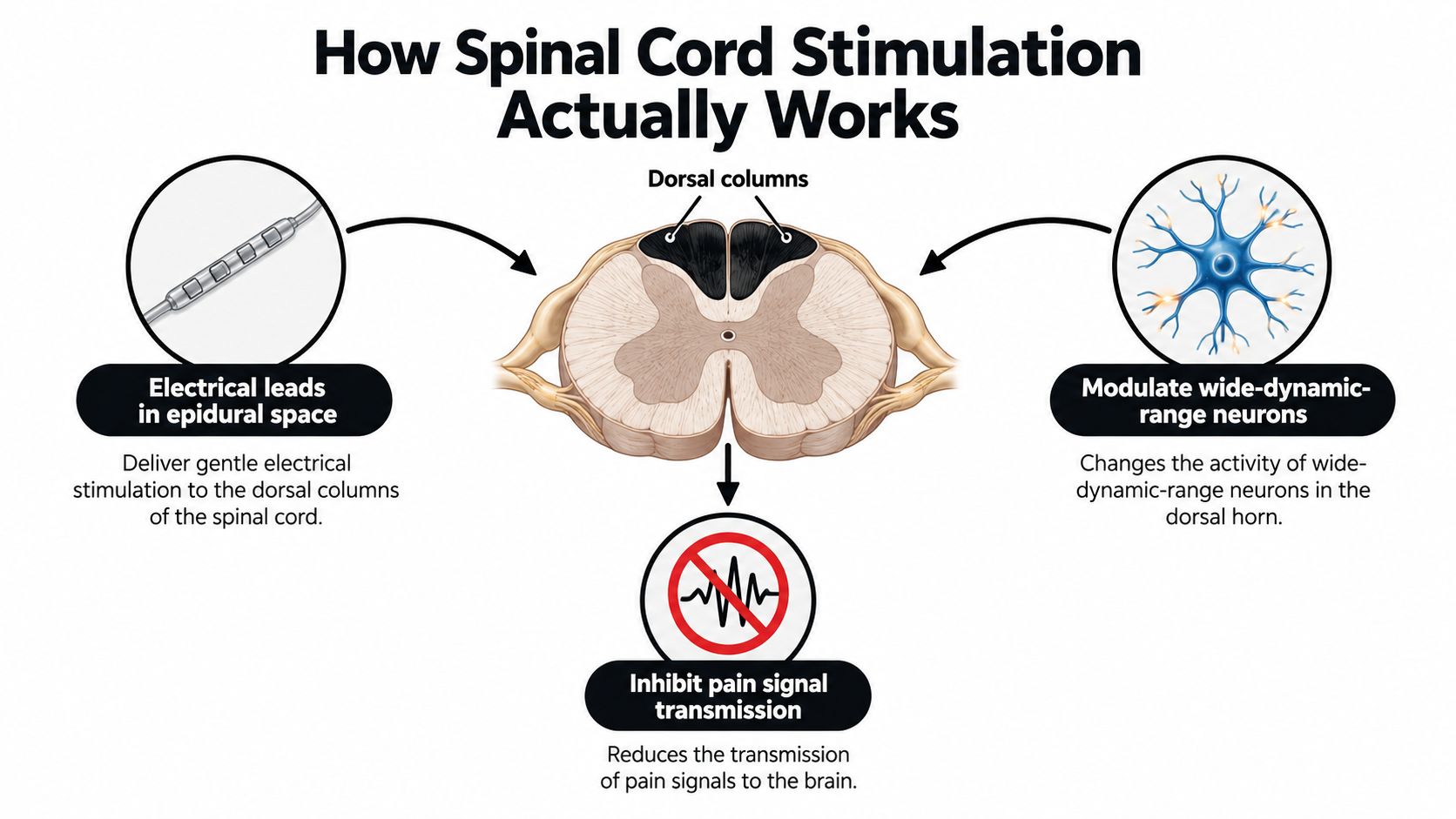
A stimulator does not repair a disc, remove scar tissue, or reverse arthritis. It changes how pain signals are processed. Thin leads sit in the epidural space near the spinal cord, while a pulse generator delivers programmed electrical impulses to the dorsal columns.
The traditional explanation comes from gate-control theory. Stimulation activates larger sensory pathways, which can reduce nociceptive signal transmission through spinal cord circuits before those signals receive full attention in the brain. Clinicians also consider effects on wide-dynamic-range neurons and broader pain-processing networks, particularly with newer programming patterns. The practical goal is less pain and better function, not merely a sensation from the device.
Tonic and sub-perception stimulation
Tonic stimulation usually creates paresthesia, often described as tingling or buzzing across the painful area. Some patients appreciate that sensation because it confirms coverage and shows that the system is active. Others find it distracting, especially when coverage changes with posture or movement. Programming can improve coverage, but it cannot guarantee a stable sensation in every position.
Sub-perception stimulation aims to reduce pain without an obvious tingling feeling. High-frequency and other newer programming strategies may use this approach. Paresthesia-free treatment is not automatically superior, however. The meaningful test remains measurable improvement in pain, sleep, walking, work, or other daily activities.
SCS developed from an experimental neurosurgical technique into an accepted option for selected chronic pain patients. C. Norman Shealy's landmark 1967 case report described an early successful clinical use of dorsal column stimulation. By 2008, NICE had issued formal guidance for selected adults with refractory chronic neuropathic pain. The history reflects both technical progress and stricter expectations for patient selection.
Modern pooled evidence supports meaningful benefit for many appropriately selected patients, though results vary. A 2024 systematic review and meta-analysis covering 27 studies and 2,220 patients reported substantial pain relief at 12 months in 68% for leg pain, 63% for back pain, and 73% for general pain. At 24 months, benefits remained in 63%, 59%, and 71%, respectively. The 2024 systematic review and meta-analysis
Those figures support a trial rather than replacing it. SCS is testable. The temporary trial should show convincing improvement in the patient's actual pain and daily function before permanent implantation is considered.
Comparing the Major Stimulation Waveforms
Waveform names can make SCS sound like a technology contest. In practice, each approach offers a different balance of sensation, targeting, programming complexity, and evidence for particular pain patterns.
| Waveform | Frequency | Paresthesia | Mechanism proposed | Best-fit pain pattern | Evidence strength | Lead count | MRI conditional |
|---|---|---|---|---|---|---|---|
| Conventional or tonic | Commonly described as low frequency | Usually present | Dorsal-column activation and gating | Broad leg pain with some axial back pain | Longest clinical history | Often two | Depends on the specific system |
| High frequency | Commonly associated with 10 kHz systems | Typically absent | High-frequency modulation without intentional paresthesia | Dense axial low back pain with or without leg pain | Strong comparative evidence, with durability questions | Often two | Depends on the specific system |
| Burst | Delivered in patterned bursts | May be absent or limited | Patterned stimulation intended to influence sensory and affective pain processing | Mixed back and leg pain | Supportive but less definitive comparative evidence | Often two | Depends on the specific system |
| Dorsal root ganglion stimulation | Targeted stimulation | Often limited or absent | Focal modulation at the dorsal root ganglion | Highly localized pain, including foot or groin distributions | Strong targeted evidence, narrower application | Often one or more, depending on targets | Depends on the specific system |
The clinical verdict
- Tonic: A reasonable, established option when broad coverage and a recognizable paresthesia are acceptable.
- High frequency: Particularly attractive when axial back pain is prominent and the patient wants paresthesia-free treatment.
- Burst: Useful to consider for overlapping back and leg pain, especially when the clinician wants a different programming strategy after evaluating the pain phenotype.
- Dorsal root ganglion stimulation: Most compelling when the pain is anatomically focal and difficult to cover with conventional epidural lead placement.
Frequency alone doesn't determine success. Lead placement, anatomy, programming, diagnosis, psychological readiness, and trial response all influence the result. MRI conditionality also varies by system, so patients who may need future imaging should ask for the exact conditions in writing rather than accepting a broad statement that a device is “MRI compatible.”
What the Evidence Says About Each Waveform
The strongest evidence for SCS comes from pooled clinical outcomes and comparative studies, not from brand positioning. A 2013 systematic review and meta-regression found mean pain relief of 58% at an average 24-month follow-up across chronic back and leg pain studies. The 2013 systematic review and meta-regression
| Waveform | Key evidence | Evidence strength | Best-fit indication |
|---|---|---|---|
| Conventional or tonic | Long clinical history and broad chronic back and leg pain evidence | Deepest overall evidence base | Established neuropathic leg and back pain patterns |
| High frequency | Comparative studies support strong back and leg pain relief | Strong, though long-term real-world durability still matters | Axial back pain with or without leg pain |
| Burst | Comparative studies suggest non-inferiority to tonic in selected settings | Supportive, but smaller and heterogeneous studies limit certainty | Mixed back and leg pain, including patients seeking paresthesia-free programming |
| Dorsal root ganglion | Targeted studies for focal pain and CRPS | Strongest for selected focal distal patterns, narrower evidence base | CRPS and highly localized distal pain |
Independent evidence supports some waveform-specific advantages, but it doesn't produce one universal winner. A meta-analysis of five studies found burst stimulation reduced chronic low back pain more than tonic stimulation, with a pooled mean difference of −1.64 points on pain scores, a 95% confidence interval of −2.43 to −0.84, and P < 0.001. The broader review included 11 waveform-comparison studies, while cautioning that superiority over high-frequency stimulation wasn't firmly established because of heterogeneity and limited trial counts. The independent burst waveform review
The MULTIWAVE randomized crossover study reached a more restrained conclusion. Among 28 PSPS-T2 patients, paresthesia-based, high-frequency, and burst stimulation showed no statistically significant overall difference in pain relief, with P = .08. The authors concluded that high-frequency and burst didn't clearly outperform paresthesia-based SCS, which remains a valid option. The MULTIWAVE study
The trial should answer a patient-specific question, not settle a marketing debate.
A 2025 systematic review and network meta-analysis found that all forms of SCS produced significantly greater pain reduction than conventional medical management at last follow-up within 24 months, with mean differences ranging from -2.37 to -5.55 on a 0 to 10 pain scale. The 2025 network meta-analysis That supports SCS as a treatment category for selected patients, while leaving waveform selection to the clinical details.
Who Is a Candidate and How the Trial Works
Candidacy starts with diagnosis, not device preference. The typical patient has chronic neuropathic pain affecting the trunk or limbs for at least six months, has tried appropriate nonsurgical care, and has no untreated psychological condition likely to interfere with coping, adherence, or realistic expectations.
Common clinical scenarios include persistent pain after back surgery, refractory radiculopathy, and complex regional pain syndrome. Coverage requirements vary, but documentation generally needs to show failed conservative treatment and a medically appropriate indication.
The screening process
A careful evaluation usually includes:
- Pain mapping: The clinician identifies whether symptoms are axial, radicular, distal, regional, or mixed.
- Imaging review: MRI and other studies help exclude a structural problem that should be treated directly.
- Treatment history: Medication trials, physical therapy, injections, and prior procedures are reviewed for both response and functional effect.
- Psychological evaluation: This assesses coping, expectations, mood, substance-use concerns, and the ability to manage an implanted system.
- Shared planning: The patient discusses charging, programming, MRI conditions, activity expectations, and possible future procedures.
The trial is usually an outpatient procedure. Temporary leads are placed percutaneously under imaging guidance, connected to an external generator, and used while the patient tracks pain, sleep, walking, work, and ordinary activities. The trial commonly lasts 5 to 7 days, although exact protocols can differ by practice.
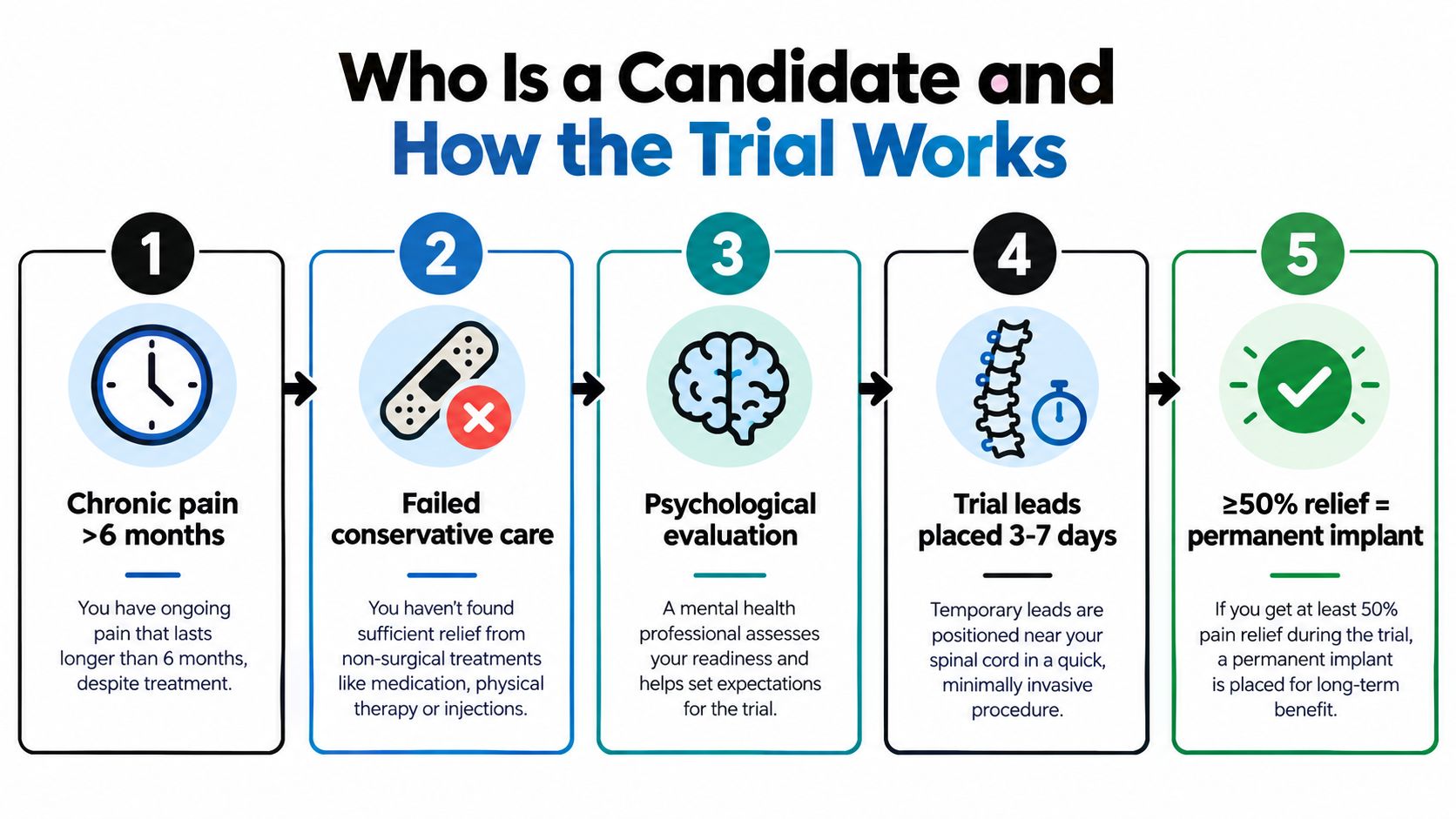
A successful trial requires at least 50% pain relief on a validated outcome instrument, according to an evidence-based consensus guideline. The consensus guideline on SCS trials The 2024 JAMA Network Open article also states that a permanent device is implanted only when the trial shows at least 50% improvement in pain intensity relative to baseline. The JAMA Network Open SCS article
Pain reduction alone isn't enough. I also want to see meaningful improvement in function, sleep, activity tolerance, or medication goals. A trial is a screening tool, not a promise that the permanent system will provide identical relief indefinitely.
Benefits, Risks, and the Revision Picture
A stimulator can reduce pain and support sleep, activity, and medication goals. It also places hardware in the body, creating an ongoing need for programming, monitoring, and, in some cases, revision or removal. Those trade-offs belong in the consent discussion before focusing on expected relief.
A 2025 systematic review found that 1,882 of 13,026 patients, or 9.82%, underwent explantation, with rates across included studies ranging from 1.8% to 38%. The 2025 systematic review of SCS explantation A separate pooled analysis reported revision procedures at 6.31 events per 100 patient-years and explantations at 2.93 events per 100 patient-years. Lead migration occurred more often than infection, at 7.05 versus 2.82 events per 100 patient-years, respectively.
What those numbers mean in clinic
Lead migration can alter coverage and reduce benefit, especially when the original pain area is difficult to target. Infection may require antibiotics, surgical treatment, or device removal. Other complications include uncomfortable paresthesia, hardware malfunction, bleeding, epidural hematoma, and rare serious neurological injury.
No waveform removes revision risk. Closed-loop systems and smaller-profile components may address particular technical problems, but every implanted system still requires follow-up and a plan for maintenance.
Before choosing a system, discuss:
- MRI access: Confirm the exact MRI conditions for the complete implanted system.
- Battery strategy: Compare rechargeable and nonrechargeable options, including whether regular charging fits your routine.
- Programming support: Ask who will adjust settings if pain changes or coverage becomes uncomfortable.
- Future surgery exposure: Understand how lead problems, infection, battery depletion, or loss of efficacy would be handled.
- Removal planning: Confirm whether the same care team evaluates and performs explantation when necessary.
SCS is a long-term therapy, not a one-time purchase. The best system is the one whose expected benefit fits the pain pattern and justifies its programming, maintenance, and possible revision burden for that individual patient.
Where SCS Is Heading and What “Best” Really Means
The field is moving toward systems that use more information during treatment. Closed-loop stimulation can incorporate feedback from neural activity, while sub-perception programming aims to reduce pain without an obvious tingling sensation. These developments may improve consistency for some patients, but newer technology isn't automatically better for every pain pattern.
A 2025 multidisciplinary review describes refined selection tools that use psychological profiling, standardized trial stimulation, and data-driven predictive models. It also identifies closed-loop and newer waveforms as part of the field's movement toward better efficacy and durability. The review emphasizes that cost-effectiveness differs by setting, with SCS potentially cost-effective in high-income countries but not yet clearly cost-effective in lower- and middle-income settings such as Thailand. The 2025 multidisciplinary review
| Decision factor | What it means in practice | Why it shapes “best” |
|---|---|---|
| Pain phenotype | Match coverage and programming to the location and quality of pain | A focal problem may need a different strategy than broad axial pain |
| Trial response | Measure pain, sleep, activity, and medication goals | A good trial provides evidence for the permanent decision |
| Programming pathway | Know how adjustments will be made after implantation | A technically capable system still needs appropriate follow-up |
| Durability | Consider revision, migration, infection, and explantation exposure | Initial relief doesn't tell the whole lifetime story |
| Economic setting | Evaluate coverage, access, and ongoing care | Value depends on the patient's healthcare context |
That logic also applies when considering dorsal root ganglion stimulation for highly focal pain. The technology should follow the pain pattern, not the other way around.
Choosing a Provider in the Chicago Area
The provider matters at least as much as the waveform label. A thoughtful team should explain why stimulation fits your diagnosis, identify what the trial must demonstrate, and describe what happens if the device provides incomplete relief or later loses effectiveness.
Start with the physician's training and role. Confirm board certification in pain medicine or neurosurgery, ask who performs the permanent implant, and determine whether the same practice provides programming and postoperative follow-up. A provider who only discusses the initial procedure isn't giving you the full treatment pathway.
Questions worth asking
- Why this waveform: Which feature matches my pain distribution, not just my diagnosis?
- What counts as success: Will we measure function and medication goals alongside pain scores?
- What happens after the trial: Who decides whether the permanent implant is justified?
- What are your outcomes: Can you explain your practice's revision and explantation experience?
- What are my imaging options: Is the proposed system conditionally compatible with the MRI studies I may need?
- Who manages problems: If a lead migrates, infection develops, or benefit fades, who evaluates me?
- What alternatives remain: Has imaging been reviewed for a structural cause that needs a different treatment?
For a broader framework on evaluating medical expertise, patients can read this guide on how to find a specialist doctor. The same principle applies here. You want transparent reasoning, not a brand-versus-brand ranking.
Midwest Pain & Wellness is a pain and wellness clinic in Chicago Ridge, Illinois, led by double board-certified interventional pain specialist Dr. Yaw Donkoh. Its care can include medication-sparing interventional treatment, image-guided injections, radiofrequency ablation, and peripheral nerve or spinal cord stimulation, with evaluation and follow-up matched to the patient's condition. Patients in Palos Heights, Palos Hills, Evergreen Park, and Hickory Hills can ask about whether a trial-to-implant pathway is appropriate for their specific pain pattern and treatment history.
Midwest Pain & Wellness can evaluate chronic neuropathic pain, review prior treatment and imaging, and discuss whether spinal cord stimulation or another interventional option fits your goals. Visit Midwest Pain & Wellness to request an appointment in the Chicago Ridge area and begin a personalized conversation about pain relief, function, and long-term treatment planning.