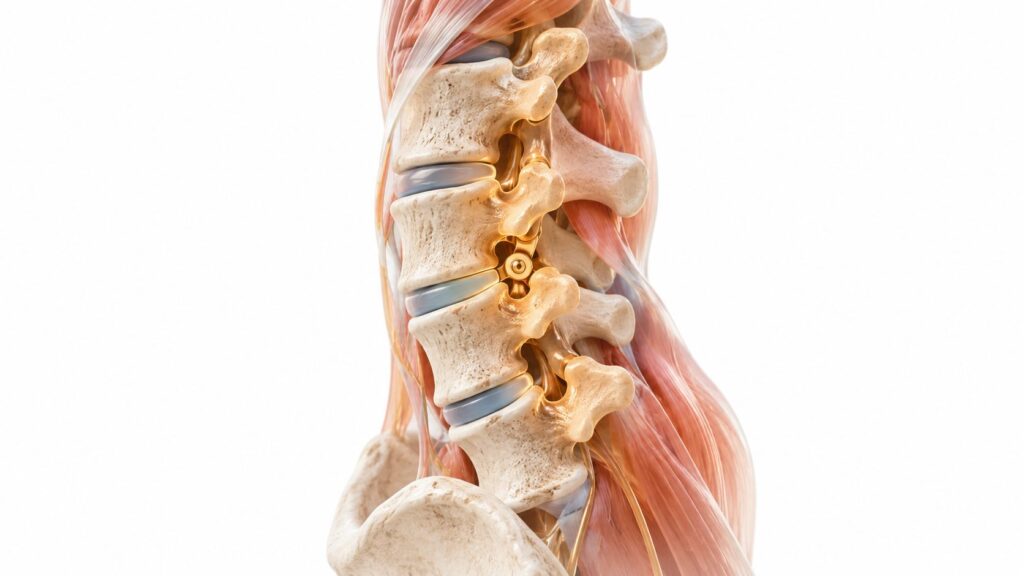
You're probably reading this because you've had that same frustrating appointment experience many people have. The doctor asks where it hurts, how bad it is, and when it started, and suddenly something you live with every day feels hard to explain. You know your pain is real. You know it's affecting your sleep, your work, your mood, or your ability to move. But putting it into words in a short visit can feel impossible.
That gap matters. In a pain and wellness clinic, especially when you're trying to get real answers instead of temporary relief, the way you describe pain can shape the next step. Clear descriptions help us decide whether your pain sounds more like a spine problem, nerve irritation, joint pain, post-surgical pain, or something that needs urgent evaluation. They also help us match you with opioid-sparing options that target the source of pain instead of masking it.
If you live in Oak Lawn, Palos Hills, Palos Heights, Worth, Bridgeview, Hickory Hills, Alsip, Burbank, Evergreen Park, or Orland Park, Illinois, and you're preparing for a specialist visit near Chicago Ridge, this guide will help you walk in ready.
Why Clearly Describing Your Pain Is the First Step to Relief
You sit down for your consult in our Chicago-area pain clinic, and the first question sounds simple: “Tell me about your pain.” The answer to that question often shapes the rest of the visit more than patients expect.
Before we consider an injection, a nerve treatment, or another opioid-sparing option, we have to decide what pain pattern you are describing. Low back pain that stays centered can point us in one direction. Pain that shoots down the leg, burns in the foot, or worsens with standing can point us somewhere else. If you want a clearer sense of how specialists sort through these patterns, this guide to diagnosing back pain explains what we look for.
The 0 to 10 pain scale still has value. It gives us a quick snapshot of intensity. But chronic pain care rarely turns on the number alone. A “6” that lets you work a full shift is different from a “6” that keeps you from sleeping, driving, or sitting through your child's school event.
In an interventional pain clinic, details help us decide what deserves attention first and what treatment is most likely to match the source of pain. Your description can help separate joint pain from nerve irritation, spine-related pain from muscle guarding, and post-surgical pain from a new problem. That can save time and reduce the trial-and-error approach many patients are tired of.
Useful descriptions usually include four things:
- Intensity: how strong the pain feels at its worst, at its best, and on an average day
- Pattern: when it starts, how long it lasts, and what sets it off
- Location: where it begins and whether it travels to the arm, leg, groin, buttock, or foot
- Character: whether it feels sharp, burning, aching, throbbing, stabbing, cramping, electric, or pressure-like
One sentence can change the visit. “My back hurts” gives us very little. “The pain starts in my right low back, shoots into my calf when I stand more than ten minutes, and feels like burning and tingling at night” gives us a much stronger clinical starting point.
Language barriers matter here too. If English is not the language you use most comfortably, ask for help before the appointment so your history comes across accurately. The Translators USA medical interpreting guide can help you understand what professional medical interpretation support looks like.
You do not need medical jargon. You need clear, specific details that help us connect your symptoms to the next step in care. That is often where real relief starts.
What to Do Before You See the Doctor
You finally get an appointment at a pain clinic, then the visit goes by in twenty minutes. You remember the worst flare, forget the timeline, and leave wishing you had explained it better. A little preparation changes that.
At our clinic, the patients who get the most useful first visit usually bring a short, organized picture of what has been happening. That does not mean pages of notes or medical jargon. It means giving us enough detail to decide whether you may need updated imaging, a focused exam, a diagnostic injection, physical therapy, medication changes, or another opioid-sparing option.
Build a one-page pain summary
Before your appointment, make a simple summary you can hand over or read from your phone. Keep it brief and practical.
Include:
- Your main pain problem: the body area you want addressed first
- When it began: the exact date if you know it, or your best estimate
- What changed over time: whether it spread, became more frequent, or started after a fall, surgery, illness, or repetitive work
- What you have already tried: medications, physical therapy, home exercise, injections, chiropractic care, massage, bracing, heat, ice, or rest
- What happened with each treatment: helped, did nothing, or made symptoms worse
- Current medications and supplements: especially anything used for pain, sleep, inflammation, or nerve symptoms
- Past injuries or surgeries: old injuries matter, even if they seem unrelated
- Prior testing: MRI, CT, X-ray, EMG, or lab work, plus the facility where it was done
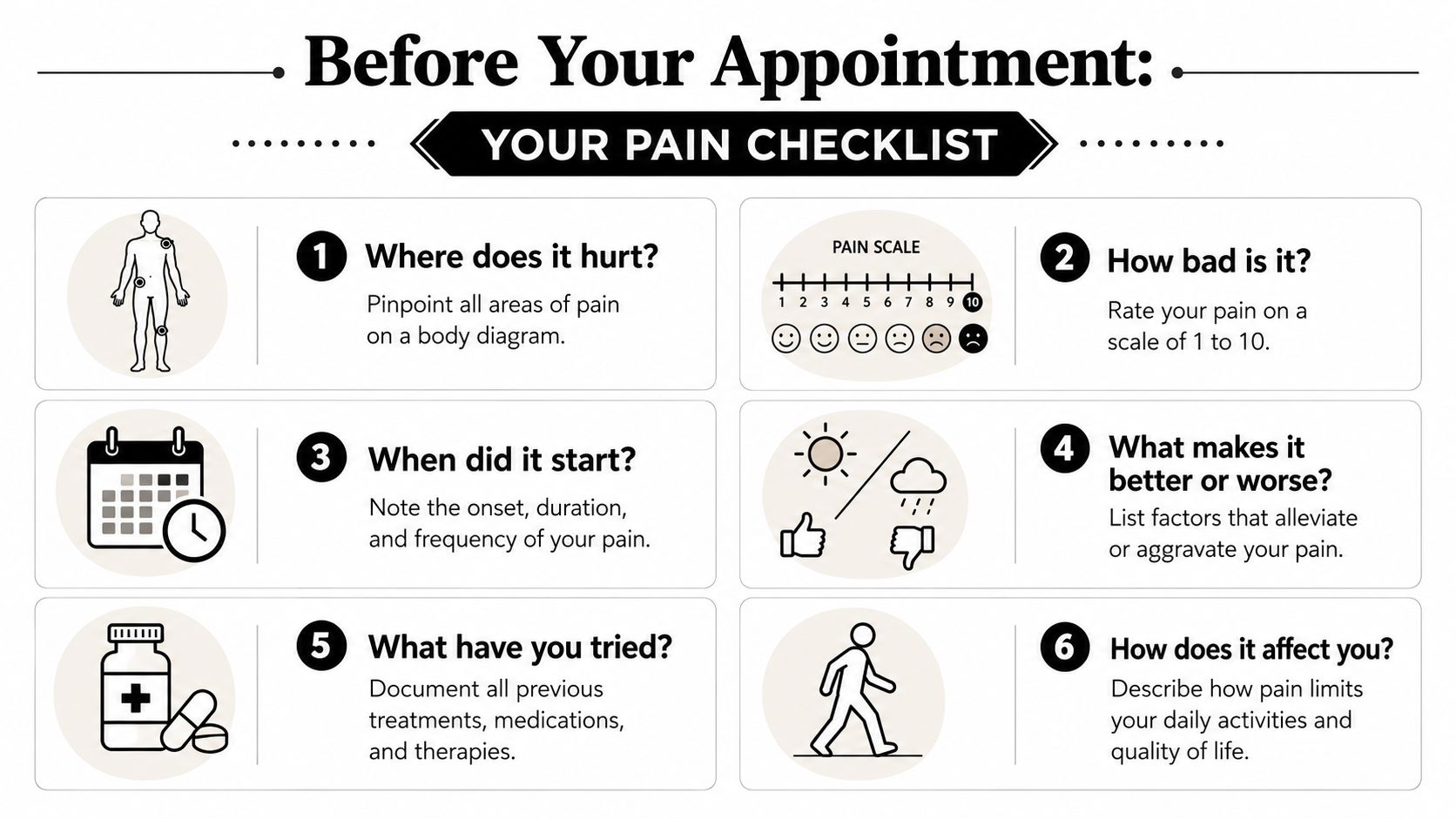
If your main complaint is spine-related, this overview of how back pain is diagnosed explains why your history often guides the next step as much as the physical exam.
Make your timeline specific
Timing changes medical decisions. “A long time” is hard to use. “Started after lifting a box in March, eased for two weeks, then came back and now wakes me at night” is much more useful.
Ohio State's guidance on describing pain accurately notes that vague reporting of duration can delay appropriate imaging or referral, while a clear timeline with the start date, duration of episodes, and frequency can shorten diagnostic delays in this pain timeline guidance.
A basic diary is enough. Track:
- Start date or closest estimate
- How often it happens
- How long a flare lasts
- What triggers it
- What settles it down
- Whether it is getting better, worse, or staying the same
If the pain feels constant, still describe the spikes. We want to know when it surges, how long that flare lasts, and what you were doing right before it started.
Bring the details patients often leave out
Pain does not happen in isolation. Sleep loss, stress, anxiety, depression, physically demanding work, and caregiving responsibilities can all affect symptoms and recovery. Sharing that is not complaining. It helps us choose treatment that fits real life.
A few plain statements are enough:
- Sleep: “I wake up three times a night from the pain.”
- Work: “I drive for work, and sitting more than thirty minutes brings it on.”
- Home life: “By evening I cannot cook or help with the kids.”
- Mood or stress: “The unpredictability makes me anxious, and flares are worse during stressful weeks.”
This also matters in an interventional pain clinic, especially around Chicago, where many patients are trying to stay active through long commutes, physical jobs, and year-round schedule demands. Treatment planning is better when we know what your day requires.
Prepare records in the easiest format to review
Bring reports if you have them. If you do not, bring dates and locations. A photo of your medication list is better than guessing. If you have trouble typing because of pain, a short voice note transcribed before the visit can help. HyperWhisper's guide to speech accuracy is a useful reference if you plan to dictate your symptom notes.
The goal is simple. Walk in with a clear timeline, a short treatment history, and a realistic picture of how pain affects your day. That gives us a stronger starting point for discussing targeted, opioid-sparing treatments instead of repeating steps you have already tried.
Using Precise Language to Explain Your Pain
You sit down for your visit, and the first question is, “Tell me about the pain.” A lot of patients freeze there, even when they have been hurting for months. The goal is not to sound medical. The goal is to give us details we can match to patterns that guide diagnosis and treatment, especially in an interventional pain clinic where we are deciding whether a nerve, joint, disc, muscle, or another structure is driving the problem.
Use a simple five-part description: where it is, how strong it gets, what it feels like, when it shows up, and what makes it better or worse. If you can answer those five points in a few plain sentences, you give your clinician something useful to work with.
Start with the pattern, not just the pain score
Point to the pain with one finger if possible. Then describe whether it stays in one place or travels. Radiation matters. A low back ache that stays centered suggests a different pain source than pain that runs from the back into the buttock, calf, or foot.
A clear report sounds like this:
- Location: “It starts at the base of my neck and goes into my right shoulder blade.”
- Intensity: “Most of the day it is about a 4, but driving pushes it to an 8.”
- Timing: “It builds through the afternoon and is worst by bedtime.”
- Triggers: “Looking down at my laptop brings it on within ten minutes.”
- Relief: “Lying flat helps. Reaching overhead makes it worse fast.”
That level of detail helps us decide what deserves a closer exam, what imaging may or may not add, and whether options such as a targeted injection, nerve-focused treatment, or rehabilitation are more likely to help than another round of medication.
The words you choose can point us in different directions
Pain quality often gives the biggest clue. “Aching” and “stiff” can fit muscle, joint, or spine-related pain. “Burning,” “electric,” “pins and needles,” or “shooting” can raise concern for nerve irritation. “Cramping” may suggest muscle spasm. “Throbbing” or “pressure” can suggest a different pattern again.
You do not need the perfect term. You do need the closest one.
Researchers discussing pain descriptors and the Pain Quality Index note that structured pain words can reduce misunderstanding between patients and clinicians in this discussion of pain descriptors and the Pain Quality Index.
These words are often useful:
| Pain Description | What It May Suggest |
|---|---|
| Aching | Muscle, joint, or deep structural pain |
| Burning | Nerve irritation or neuropathic pain |
| Shooting | Radiating nerve pain |
| Throbbing | Inflammatory or vascular-type pain |
| Stabbing | Sharp positional or mechanical pain |
| Cramping | Spasm or intermittent tightening |
| Tender | A localized area painful to touch |
| Heavy | Deep pressure or structural discomfort |
In clinic, I often hear patients apologize because they are not sure whether the pain is “burning” or “sharp.” Do not worry about that. Say both if both are true, and tell us when each happens. A pain that burns down the arm but turns sharp when you rotate the neck is more informative than a single label.
Build one sentence you can say without thinking
Stress makes people go blank. Before your appointment, rehearse one or two sentences out loud so you do not have to organize everything in the room.
A strong example is:
“I have a burning pain in my lower back that shoots into my left leg to the calf. It is worst after sitting through my commute, and it eases a little when I stand and lean forward.”
That statement gives us location, quality, radiation, timing, and aggravating factors in one short answer. In a busy Chicago-area clinic, that kind of description helps us move faster toward the right exam and the right next step, instead of spending the first half of the visit trying to decode “my back just hurts.”
If speaking is hard when you are anxious or flared up, record a voice note before the visit and bring the key phrases with you. For anyone using dictation, this HyperWhisper's guide to speech accuracy is a useful reference for getting your words captured clearly.
Connecting Pain to Your Real-World Function
You walk into your appointment and say, “My back hurts all the time.” That is a real problem, but it does not yet tell us how the pain is shaping your day or which treatment is most likely to help.
At an interventional pain clinic, function matters because procedures, targeted medications, physical therapy, and other opioid-sparing options are meant to help you do something again. Sit through work. Sleep through the night. Drive from Naperville or Oak Park into Chicago without your leg going numb. Stand long enough to cook. If you tell us what pain is stopping you from doing, we can match treatment goals to your life instead of chasing a pain score alone.

Turn pain into consequences
The clearest reports connect symptoms to a task, a limit, and a pattern.
Instead of saying:
- Vague report: “My pain is moderate most days.”
Say:
- Useful report: “After 20 minutes at my desk, my low back tightens and I have to stand up.”
- Useful report: “I can drive short distances, but after about half an hour my right leg starts to burn.”
- Useful report: “Carrying groceries up one flight of stairs flares the pain for the rest of the evening.”
- Useful report: “I wake up three times a night because rolling over triggers the pain.”
Those details help us sort out trade-offs. Pain that limits sitting points us toward a different exam and treatment plan than pain that mainly shows up with walking, twisting, coughing, or lying flat.
What to mention during the visit
Patients often leave out the parts of pain that matter most in treatment planning. Tell us where pain interferes with real life:
- Work: desk time, lifting, driving, climbing ladders, repeated bending
- Home tasks: cooking, laundry, vacuuming, carrying groceries, getting in and out of the shower
- Sleep: trouble falling asleep, waking with pain, needing extra pillows or a recliner
- Mobility: stairs, getting out of a chair, standing in line, walking through a store
- Family and routine: playing with your kids, attending church, exercising, commuting, traveling
Specific beats broad. “I cannot do yard work” helps. “I can rake for five minutes before I need to stop and sit” helps more.
Give us a target that matters to you
The best treatment plans have a clear functional goal. In our clinic, that often changes the conversation in a useful way. A patient may come in asking for pain relief, but what they really want is to return to work without leaving early, sleep in bed instead of a recliner, or sit through their child's game.
Say that out loud.
You can even bring two goals to your appointment:
- Short-term goal: “I want to sleep at least six hours without waking from pain.”
- Practical goal: “I want to drive to work and sit through a morning meeting.”
That gives us something measurable. It also helps when we discuss advanced options such as injections or other procedure-based care. Every treatment has trade-offs, including time, cost, recovery, and how quickly it may help. The right option depends on what function you need back first.
If your pain changed after surgery, mention what you still cannot do and how that differs from expected healing. Our guide to postoperative pain and recovery concerns can help you describe that clearly before your visit.
Recognizing Red Flags and When Not to Wait
Most pain visits are outpatient problems. Some symptoms are not. If pain comes with certain warning signs, don't wait for a routine clinic appointment.

Symptoms that need urgent medical attention
Seek urgent care or emergency evaluation if pain is accompanied by:
- High fever
- Sudden loss of bowel or bladder control
- Abrupt severe weakness
- New or rapidly worsening numbness
- Unexplained weight loss
- Chest pain or trouble breathing
- Vomiting blood or blood in the stool
- Pain after a serious fall or injury
- Severe pain that is rapidly escalating and feels very different from your usual pattern
These symptoms can point to problems that need immediate medical workup, not delayed management.
Don't try to self-interpret a dangerous change
A common mistake is assuming every new pain flare is “just the same problem again.” Sometimes it is. Sometimes it isn't. If the pattern changes sharply, the location changes, or new neurologic symptoms appear, it needs prompt attention.
If your pain began after surgery or changed unexpectedly during recovery, it may also help to understand the difference between expected healing pain and something that needs closer evaluation. This overview of postoperative pain and what it can involve is a useful starting point.
When in doubt, choose safety first.
Asking the Right Questions for Advanced Pain Treatment
You finally get in to see a pain specialist. The visit moves quickly, your MRI gets mentioned, and a procedure comes up before you feel sure anyone has explained the why. That is the moment good questions matter.
At an interventional pain clinic, especially in the Chicago area where many patients arrive after months of primary care visits, urgent care trips, physical therapy, or surgical consults, the goal is not just to name the pain. We want to identify the pain generator, connect it to your exam and imaging, and choose the least invasive treatment that has a reasonable chance of improving your function. Opioid-sparing care works best when the problem is described clearly and the plan is specific.
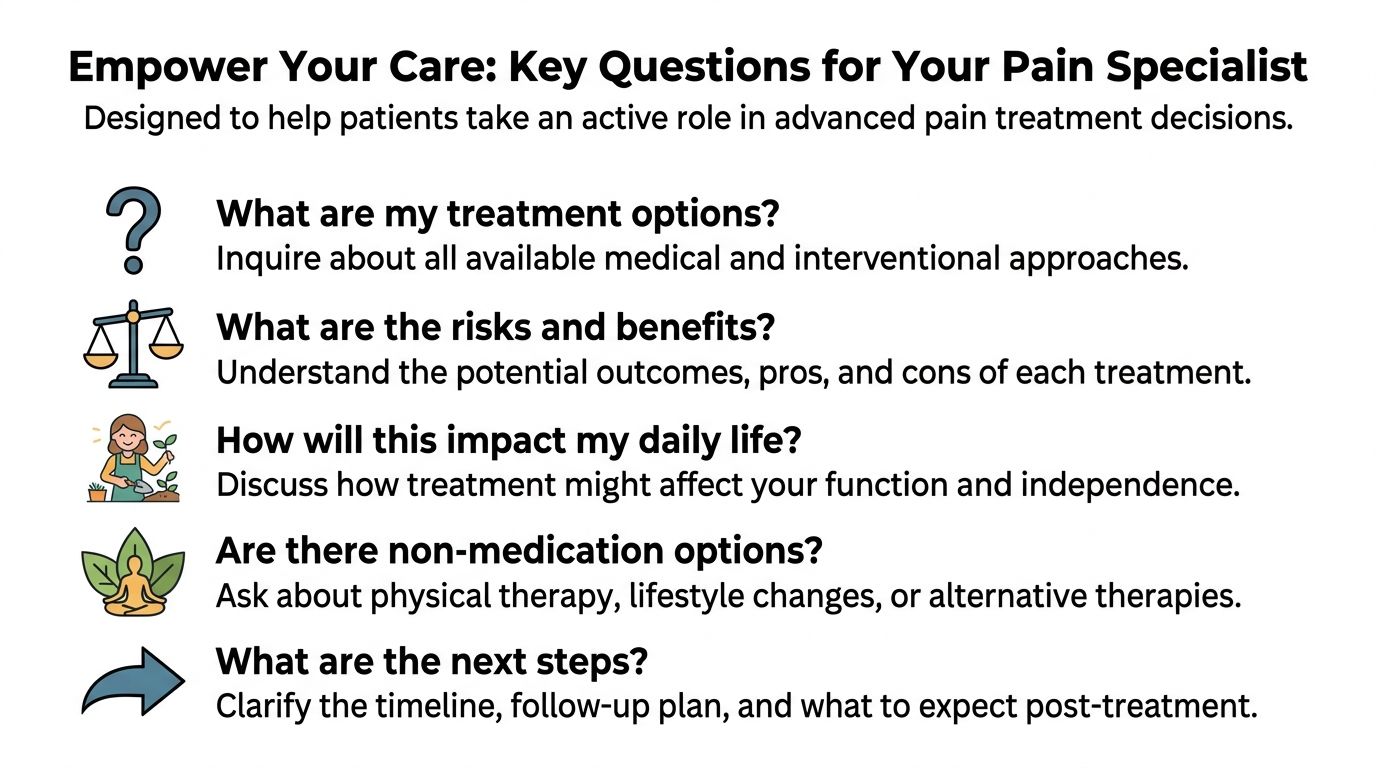
Questions that move the visit forward
After you rate your pain and describe the pattern, ask questions that help you understand the working diagnosis and the purpose of each recommendation.
Useful questions include:
“Based on my symptoms and exam, what is the most likely source of this pain?”
This gets the explanation out of medical shorthand and into plain language.“Does this sound mechanical, inflammatory, or nerve-related?”
Those categories often lead to different treatment options.“What are my non-opioid options right now?”
A good plan may include medication, targeted therapy, image-guided procedures, or a combination.“Are you recommending this injection to diagnose the source, to treat it, or both?”
That distinction matters. Some procedures help confirm where pain is coming from. Others are intended to provide longer relief.“What result would count as success for me?”
Ask about specific gains such as sleeping through the night, driving, climbing stairs, sitting through work, or walking farther with less pain.
Ask how the plan fits your case
Patients often hear the name of a procedure and focus on whether it sounds serious. A better question is why it fits your pattern of pain.
Ask:
- “What findings make this the right next step?”
- “How does this recommendation match my exam and imaging?”
- “What are the risks, side effects, and expected recovery time?”
- “If this helps, how long might the benefit last?”
- “If it does not help enough, what is the next option?”
- “How will we measure progress besides my pain score?”
In our clinic, the best visits are usually the ones where the patient leaves knowing what we are treating, why we chose that option first, and what outcome we are watching for.
Questions that are especially helpful in an interventional pain clinic
If you are seeing a specialist for spine, joint, or nerve pain, ask about the full treatment pathway, not just the first procedure.
You can say:
- “Is there a specific pain generator you are trying to confirm?”
- “Would diagnostic blocks change the treatment plan?”
- “Do I need updated imaging before deciding on treatment?”
- “What can I do between visits to improve the odds of success?”
- “Is surgery something you are trying to avoid, delay, or evaluate?”
These questions help you understand the trade-offs. For example, an injection may give short-term relief and useful diagnostic information, while a nerve procedure may be considered only after a more precise target is confirmed. That stepwise approach is common in opioid-sparing pain care because it reduces guesswork.
Know when specialist care makes sense
If pain keeps limiting work, sleep, walking, exercise, or daily tasks despite basic treatment, specialist evaluation is reasonable. If you are still deciding what kind of physician to see, this guide on how to find a specialist doctor for pain care can help you sort through the referral process.
For patients in Oak Lawn, Palos Hills, Palos Heights, Worth, Bridgeview, Hickory Hills, Alsip, Burbank, Evergreen Park, and Orland Park, a productive consultation starts with clear symptoms and better questions. You do not need to impress the doctor. You need a plan that makes clinical sense, matches your goals, and gives you a real path toward targeted, advanced, opioid-sparing treatment.