If you're getting ready for your first Botox treatment for migraine or cervical dystonia, you're probably not wondering about beauty trends. You're wondering whether you need to stop a medication, whether you can drive yourself, how sore you'll be afterward, and whether this will interfere with the rest of your care.
That's the right mindset.
Therapeutic Botox in a pain clinic is different from a casual cosmetic appointment. The treatment may still be quick, but the preparation matters more because many patients already manage chronic pain, headaches, nerve symptoms, muscle spasm, heart disease, or post-surgical recovery. Those conditions often come with medication schedules that can't be changed casually.
Your Guide to Therapeutic Botox in the Chicago Area
A first-time therapeutic Botox patient often arrives with one concern above all others. Not the needle. Not the appointment length. The concern is getting the preparation wrong while still managing the medications that keep daily life workable.
I hear this often from patients coming in from Orland Park, Oak Lawn, Palos Hills, Palos Heights, Worth, Bridgeview, Hickory Hills, Alsip, Burbank, and Evergreen Park. Someone has told them to stop every pain reliever. Someone else has said nothing needs to change. For a patient with chronic migraine or cervical dystonia, that advice is too vague to be safe or useful.
Therapeutic Botox in a pain clinic has to fit the rest of your medical care. The treatment plan needs to account for the reason you are getting injections, the medicines you depend on, your bleeding risk, and what symptoms would be hard to tolerate if you paused the wrong drug. That is very different from the one-size-fits-all advice patients often hear before cosmetic treatment.
A good place to start is knowing who is directing that plan. On Dr. Yaw Donkoh's physician profile, you can review the background of the doctor overseeing treatment in a pain management setting, where Botox is part of a larger clinical strategy rather than a stand-alone appointment.
Why therapeutic Botox needs a different kind of preparation
Therapeutic Botox is used to treat medical conditions that affect function, comfort, and day-to-day stability. A migraine patient may be trying to reduce headache frequency without disrupting a carefully built medication routine. A cervical dystonia patient may need injections targeted to specific overactive muscles, with planning based on posture, spasm pattern, swallowing history, and prior treatment response.
That is why preparation should be individualized.
In practice, the biggest source of confusion is medication advice. Some medicines or supplements can increase bruising risk, but that does not mean every patient should stop them on their own. Patients taking aspirin, anti-inflammatories, anticoagulants, migraine medicines, or heart medications need instructions that match their full medical picture. A blanket rule can create more risk than the injections themselves.
Therapeutic Botox preparation should protect both goals at once. Safe injections and stable control of the condition you already live with.
What first-time patients need before treatment
Patients rarely need an elaborate workup before Botox. They need clear decisions.
The useful questions are straightforward:
- Which medications am I taking now, including over-the-counter products and supplements
- Does anything need to be held, and who told me to hold it
- If a medication affects bruising, is it still safer for me to continue it
- Do I need a driver, time off work, or changes to my routine afterward
Those answers should come from the treating clinician, not from a friend, online forum, or cosmetic aftercare checklist. In a pain clinic, good preparation means reducing preventable problems without asking you to stop treatments that support your headache control, heart health, or daily function.
Your First Step A Thorough Medical Consultation
The injection day is not where preparation starts. It starts at the consultation, when the treatment plan is built around your symptoms, your history, and the medications you rely on every day.

In a pain clinic, this visit is less about “Are you a Botox candidate?” and more about whether Botox fits your diagnosis and how to do it safely. If you're receiving care for migraine, muscle spasm, post-surgical pain, or overlapping neck pain, that distinction matters.
You can also review procedures used for treatment to understand where Botox fits among other interventional pain options.
What to bring to the consultation
Bring more than your memory. A written list is better.
Include:
- All prescription medications. This includes anticoagulants, migraine medicines, blood pressure medications, muscle relaxants, and anything you take as needed.
- Over-the-counter pain relievers. Aspirin, ibuprofen, and related products matter because they can affect bruising risk.
- Supplements and vitamins. Fish oil, vitamin E, ginkgo, garlic, and similar products are often overlooked, but they still belong on the list.
- Any prior Botox treatment. Mayo Clinic advises patients to tell their clinician if they've had any Botox injection in the past four months and whether they take blood thinners, because that can affect planning and safety (Mayo Clinic Botox guidance).
Why medication honesty matters more in pain medicine
Many patients in pain management don't have the luxury of stopping a medication because an online checklist told them to. Some take anti-inflammatory medicine because without it they can't sleep. Others take prescription blood thinners for cardiovascular reasons. Some are balancing multiple specialists.
That's why the medication discussion can't be superficial.
Clinical reality: Many Botox prep guides say “stop blood thinners,” but for prescribed medications, the real decision often requires coordination with the injector and the prescribing clinician.
That practical issue is highlighted in this discussion of Botox treatment preparation, which notes that many patients have long-term medication regimens and that prescribed medications may not be safe to pause without coordination.
Questions worth answering before treatment is scheduled
A strong consultation usually answers a short list of useful questions:
| Question | Why it matters |
|---|---|
| What condition are we targeting | Migraine and cervical dystonia require different planning and injection targets. |
| Have I had Botox recently | Prior exposure affects timing and treatment planning. |
| Which medicines should I continue | Some medicines should not be stopped casually. |
| Which non-essential products should I hold | This helps reduce bruising when it's medically safe to do so. |
| What should I expect after treatment | Good expectations reduce unnecessary worry. |
What works and what doesn't
What works is a complete, specific review.
What doesn't work is saying “I only take a few supplements” or “I had Botox once a while ago” without details. Small omissions can create avoidable bruising, unclear timing, or confusion on injection day.
If you're trying to figure out how to prepare for Botox injections, this consultation is where the process becomes individualized. That's when the plan stops being generic advice and starts becoming your treatment plan.
Adjusting Medications and Lifestyle Before Your Treatment
The week before Botox is where most of the practical preparation happens. For most patients, the main goal is simple: reduce bruising risk without creating a bigger problem by stopping something you still need.
That trade-off matters in a pain and wellness clinic. A cosmetic med spa may focus mainly on appearance after injection. A therapeutic Botox plan has to account for function, safety, and the fact that many patients are already treating chronic conditions.

The main idea before treatment
A standard clinical workflow includes reviewing all medications, pausing non-essential blood-thinning agents when medically safe, avoiding alcohol for at least 24 hours, and arriving with a clean face for accurate assessment and sterility. Clinical prep guidance commonly mentions aspirin, ibuprofen, and fish oil in a 3 to 14 day window, depending on the protocol (clinical Botox prep workflow).
The range is broad because not every patient is the same, and not every injector uses the same cutoff. The principle is more important than pretending there is one universal rule.
What patients often pause when instructed
If your clinician says it's safe, common items discussed before treatment may include:
- Aspirin or ibuprofen if you're taking them as non-essential over-the-counter products
- Fish oil
- Vitamin E
- Ginkgo
- Garlic supplements
These are commonly discussed because anything that affects platelet function or blood flow can make bruising more visible around injection sites.
What you should never decide on your own
There's a major difference between stopping a non-prescription supplement and stopping a prescribed medication.
Use this rule:
- Non-prescription products may sometimes be paused if your clinician says they aren't necessary right now.
- Prescription blood thinners or other prescribed medicines should only be changed with direct guidance from the clinicians managing them.
For patients in Worth, Bridgeview, or nearby Illinois communities who are balancing pain care with heart, stroke, or post-surgical risk, that's often the most important part of Botox preparation.
Don't treat “blood thinner” as one category. Fish oil and a prescribed anticoagulant are not the same decision.
Lifestyle steps that help more than people expect
Medication review gets most of the attention, but a few simple habits also help:
- Avoid alcohol before treatment if your clinician advises it. Many protocols recommend avoiding it for at least the day before because alcohol can increase bruising risk.
- Hydrate well. It won't replace proper medication planning, but good hydration supports a smoother treatment day.
- Keep the skin simple. Come in with a clean treatment area and avoid loading the face or neck with products that make assessment harder.
- Skip unnecessary irritation. If your skin is already irritated, the injection day is never more comfortable because you pushed through it.
A practical timeline patients can follow
| Time before appointment | What to focus on |
|---|---|
| Earlier in the week | Confirm medication instructions with the injector and, if needed, your prescribing clinician. |
| A few days before | Hold non-essential supplements or over-the-counter products only if you were told it's safe. |
| The day before | Avoid alcohol if instructed. Keep your routine simple. |
| The morning of treatment | Arrive with clean skin and bring any medication updates. |
What doesn't help is last-minute guessing. Patients often get into trouble when they remember a supplement after they're already in the exam room or stop a prescription on their own because a friend told them that's what everyone does.
This is one place where Midwest Pain & Wellness can fit as a practical option for patients seeking Botox within a broader pain management plan, because the treatment can be considered alongside migraine care, cervical dystonia care, and other ongoing pain interventions rather than as a stand-alone cosmetic service.
Navigating the Day of Your Botox Appointment
By the time appointment day arrives, most of the important decisions should already be made. That makes the visit much easier. The goal is not to do anything fancy. The goal is to arrive calm, clean, and ready for accurate treatment.
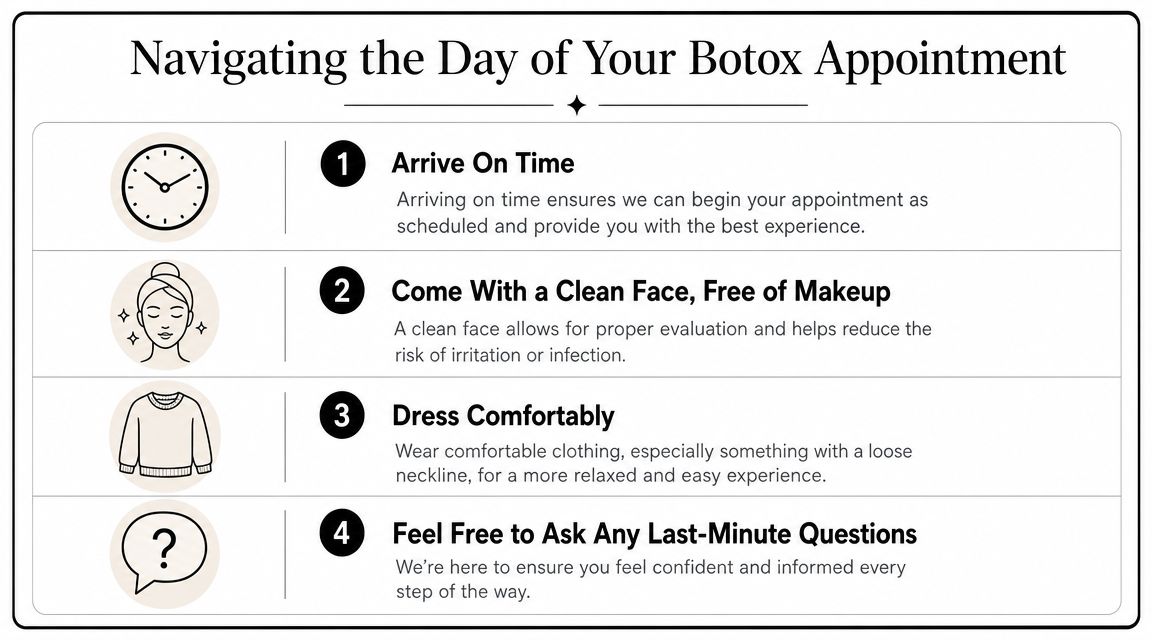
A patient driving in from Palos Heights or Hickory Hills might spend more time in traffic than in the procedure room. That surprises many first-time patients, but it often helps reduce anxiety. Botox injections are typically brief, often under 15 minutes, and proper preparation matters because the injector needs to see natural facial movement and baseline anatomy to map muscles correctly (CEENTA Botox treatment steps).
What to do before you leave home
Keep the morning simple.
- Wash the treatment area well. A clean face helps with sterility and lets the injector assess anatomy without interference from makeup.
- Wear comfortable clothing. This matters more than people think, especially if neck positioning will be part of the exam.
- Bring practical items only. ID, insurance information if relevant, and a short list of questions are enough.
What the visit usually feels like
Most first-time patients expect a dramatic procedure day. In reality, the pace is usually straightforward. You check in, review the plan, sign consent, confirm any medication changes, and answer final questions before treatment begins.
That last review matters. It's your chance to mention anything new, such as a recently started medicine, a missed instruction, or a symptom change since the consultation.
If something changed since your consultation, say it before the injections start, not after.
Good questions to ask before treatment begins
You don't need a long script. A few focused questions are enough:
- Which areas are you treating today
- What outcome are you targeting for my diagnosis
- What should I avoid afterward
- When should I expect to notice a change
- When should I call the clinic
That kind of conversation usually lowers anxiety because it replaces vague worry with a specific plan.
Special Preparations for Migraine and Cervical Dystonia
You arrive for Botox hoping for relief, then hit a confusing instruction online about “stopping your medications first.” For therapeutic Botox, that advice needs context. Patients being treated for chronic migraine or cervical dystonia often depend on daily medicines for pain, blood pressure, mood, sleep, or other chronic conditions. Preparation is more specific than cosmetic Botox advice, and it should be adjusted to the condition being treated.
For chronic migraine, the most useful preparation is a clear record of your headache pattern. Bring a headache diary if you keep one, or a simple note on how often headaches occur, how long they last, what symptoms come with them, and which treatments you've already tried. That information helps confirm that Botox fits the pattern we are treating and gives us a baseline for follow-up. Without that baseline, it is harder to tell whether the treatment is reducing headache days, lowering intensity, or shortening recovery time after an attack.
Medication questions come up often in migraine care. Do not stop a prescribed migraine preventive, blood thinner, or other long-term medicine on your own because of a generic online Botox checklist. Some drugs do increase bruising risk, but the right plan depends on why you take them and who prescribed them. In a pain clinic, we weigh the small procedural trade-off against the larger risk of destabilizing another condition.
Cervical dystonia requires different preparation. I need to see your usual head position, where the pull starts, which muscles seem overactive, and what makes the posture worse or better. If you force yourself to hold your head “normally” during the visit, the injection plan becomes less accurate. Come as you are on a typical day, including any pattern of tilt, turn, shoulder elevation, or muscle tightness you usually try to hide.
For cervical dystonia, your natural posture is part of the exam.
A short symptom log also helps here. Note where the neck pulls, whether pain spreads into the shoulder or upper back, and which tasks trigger the worst spasm, such as driving, reading, computer work, or walking. Photos or short phone videos taken on different days can be useful if the posture changes over time.
Both conditions require an individualized medication review, but for different reasons. In migraine, we are often sorting through rescue medicines, preventives, and patterns of overuse. In cervical dystonia, we may need to account for muscle relaxants, sedation risk, swallowing symptoms, or prior response to injections. If you are comparing Botox with other treatment paths for headache or neck pain, our conditions we treat in pain management page can help place it in the broader context of care.
The practical takeaway is straightforward. Migraine patients should bring symptom history that shows frequency, pattern, and prior treatment response. Cervical dystonia patients should let their usual posture and muscle pattern be seen clearly. In both groups, medication changes should come from your treating clinicians, not from a one-size-fits-all internet checklist.
After Your Injection The Critical First 24 Hours
You get home, the injection sites are a little sore, and the next question is usually practical. Can I lie down? Can I exercise? Can I take my usual medicines tonight? For therapeutic Botox patients, especially those treating chronic migraine or cervical dystonia, the first day is less about “recovery” and more about avoiding simple mistakes while keeping the rest of your medical routine safe and stable.
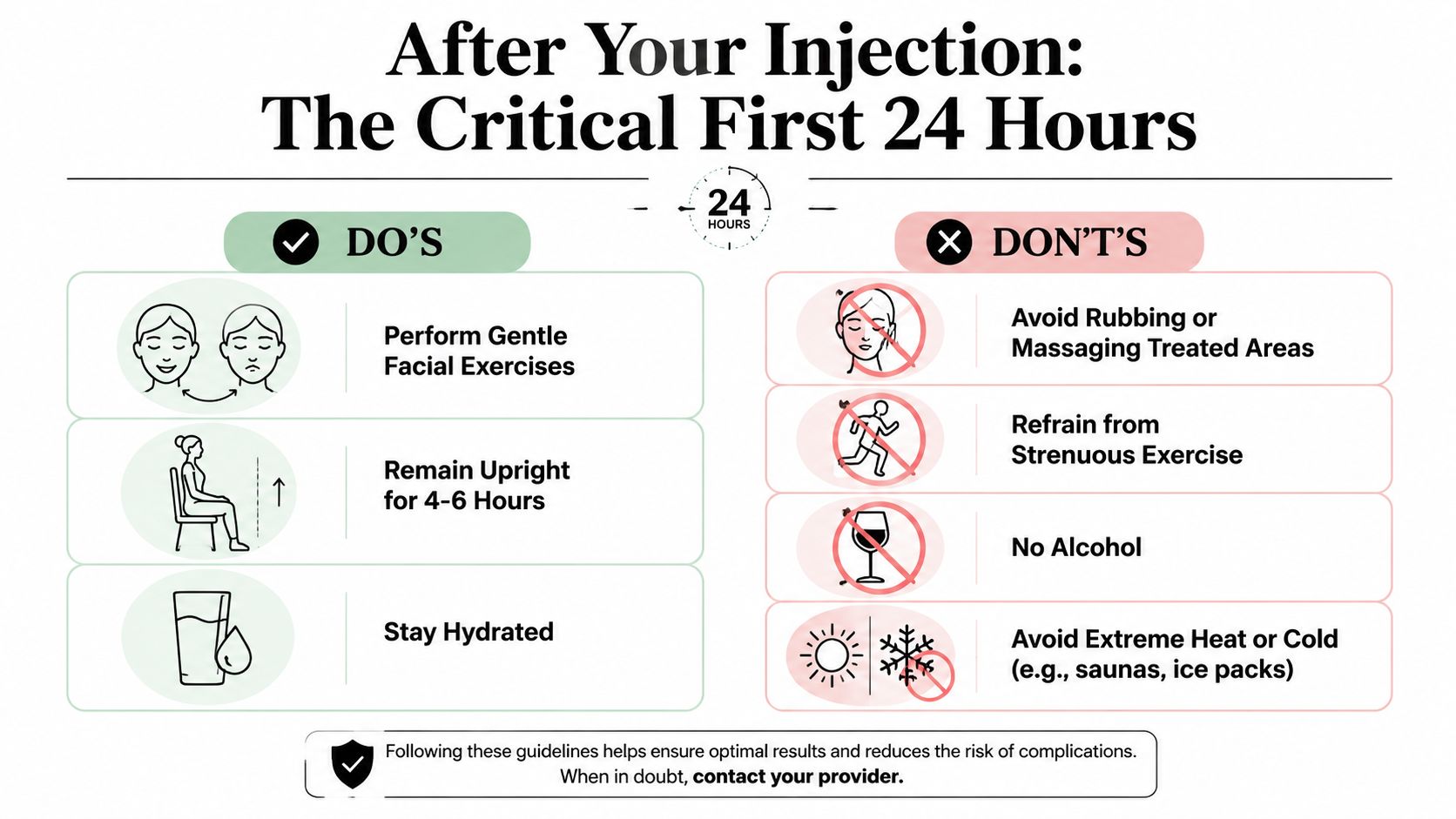
The main aftercare rules are straightforward. Keep the treated area untouched, stay upright for the time your clinician recommends after the procedure, and avoid activities that put pressure, heat, or heavy exertion on the injection sites for the rest of the day. Those steps help limit unwanted spread of the medication and reduce irritation.
Patients often get mixed messages here because they are also managing other conditions. A migraine patient may need rescue medication later that day. A cervical dystonia patient may depend on a muscle relaxant, sleep aid, or other daily treatment. In my practice, the safer rule is this. Restart or continue medications exactly as your treating clinicians directed. Do not make last-minute changes based on generic aftercare lists online.
A quiet day is usually best. Light routine activity is fine for many patients, but save strenuous workouts, sauna sessions, steam rooms, and deep tissue massage for later if your clinician advised you to avoid them. If you were injected in the neck for dystonia, pay attention to posture and swallowing over the next day or two, especially if those have been trouble spots before.
Do not expect immediate relief. Therapeutic Botox takes time to bind at the nerve ending and reduce muscle overactivity or headache frequency. Some patients notice early change within a few days. Others need more time, and the full treatment pattern is often clearer over the next couple of weeks.
That timeline matters for expectations. Botox for migraine is preventive treatment, not same-day rescue care. Botox for dystonia can reduce pulling and pain, but it does not erase every symptom overnight, and dose adjustments are sometimes part of later visits.
Mild soreness, pinpoint bleeding, a small bruise, or temporary tenderness can happen after injections. Call the clinic if something feels significantly worse than expected, if you develop new weakness in an area you were not warned about, if swallowing feels harder than usual, or if you are unsure whether to resume a medication that affects bleeding, sedation, or muscle tone.
Aftercare rule: The best first-day plan is simple. Leave the treated areas alone, follow your own medication instructions, and contact your clinician if anything feels off.
For patients in Evergreen Park and nearby Illinois communities, peace of mind usually comes from leaving the clinic with clear written instructions and a plan for medication questions, not from sorting through conflicting advice later that night.
If you're considering therapeutic Botox for chronic migraine or cervical dystonia and want a plan that fits the rest of your pain care, Midwest Pain & Wellness provides evaluation and treatment in Chicago Ridge for patients from Oak Lawn, Palos Hills, Palos Heights, Worth, Bridgeview, Hickory Hills, Alsip, Burbank, Evergreen Park, Orland Park, and nearby Illinois communities.