You've just returned home after a medial branch block, and you're wondering whether the tenderness, numbness, or brief increase in pain is part of recovery or a reason to worry. That uncertainty is common, especially because the injection is designed to change pain signals temporarily, so your body may feel different for several hours.
Most medial branch block injection side effects are mild and short-lived. The important distinction is between expected irritation, such as soreness or bruising, and warning signs such as progressive weakness, fever, breathing difficulty, or loss of bladder or bowel control. Your symptoms also help your pain specialist decide whether the targeted facet joint is contributing to your pain and whether another treatment is appropriate.
Table of Contents
- What Happens Right After a Medial Branch Block
- How a Medial Branch Block Actually Works
- Common Side Effects You Can Expect
- Rare but Serious Complications to Know
- Side Effect Timeline From Day 1 to Week 2
- Red Flags That Mean Call Your Doctor Now
- What Side Effects Mean for Your Next Treatment
- FAQs and Final Takeaways
What Happens Right After a Medial Branch Block
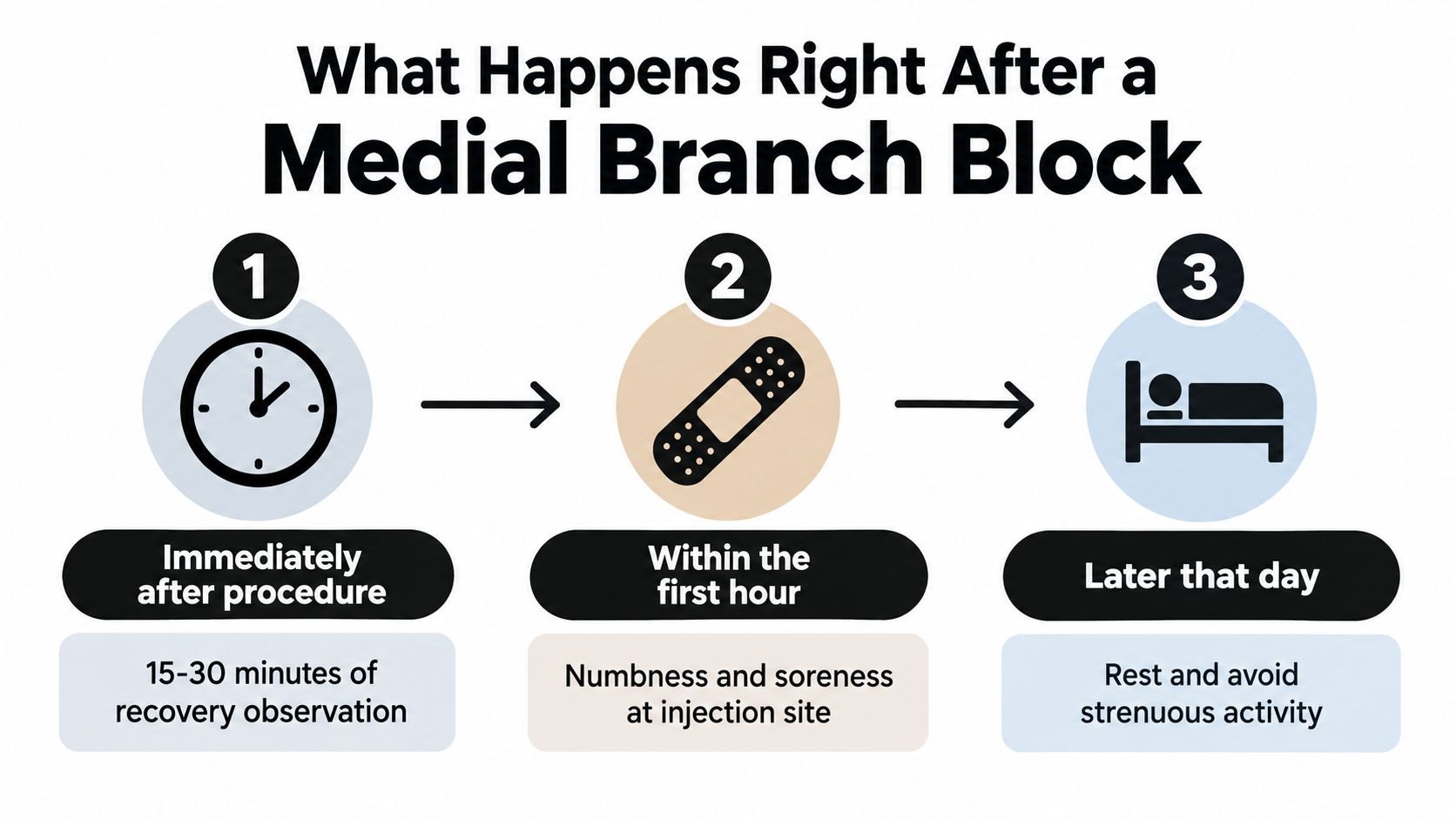
As the needle comes out, the clinical team places a small dressing over the injection site and checks how you're feeling. You'll usually remain under observation for 15 to 30 minutes, giving the staff time to monitor your blood pressure, alertness, movement, and any immediate reaction.
The first hour
Numbness, heaviness, or mild weakness can occur if local anesthetic spreads beyond the intended medial branch nerve. Depending on the injection location, you might notice temporary changes in your back, neck, buttock, leg, or another nearby area. Patient guidance notes that temporary leg numbness or weakness should settle within a few hours, and some patients remain in day surgery until normal movement returns (patient information on medial branch blocks).
Soreness at the needle site is also expected. The needle passes through skin and soft tissue, so tenderness, a small bruise, or a temporary pain flare doesn't mean the procedure went wrong. Mild dizziness or a vasovagal reaction can happen shortly after the injection, and the clinical team can help you sit or lie down safely.
The rest of the day
The local anesthetic usually wears off within hours. During that period, your usual pain may improve, return, or briefly feel different. Follow the instructions from your clinic, avoid strenuous activity, and use gentle movement rather than testing the area with heavy lifting or intense exercise.
Keep a pain diary during the first day. Record your usual pain, the time relief begins, how much relief you notice, when numbness fades, and whether your familiar pain returns. That record matters because a medial branch block is often diagnostic, not merely a treatment intended to make every symptom disappear.
Practical rule: Mild soreness and changing pain are observations to record. Progressive weakness, worsening neurological symptoms, or signs of infection require medical advice.
How a Medial Branch Block Actually Works
Facet joints sit at the back of the spine and help guide movement between neighboring vertebrae. Small nerves called medial branch nerves carry pain signals from these joints toward the central nervous system.
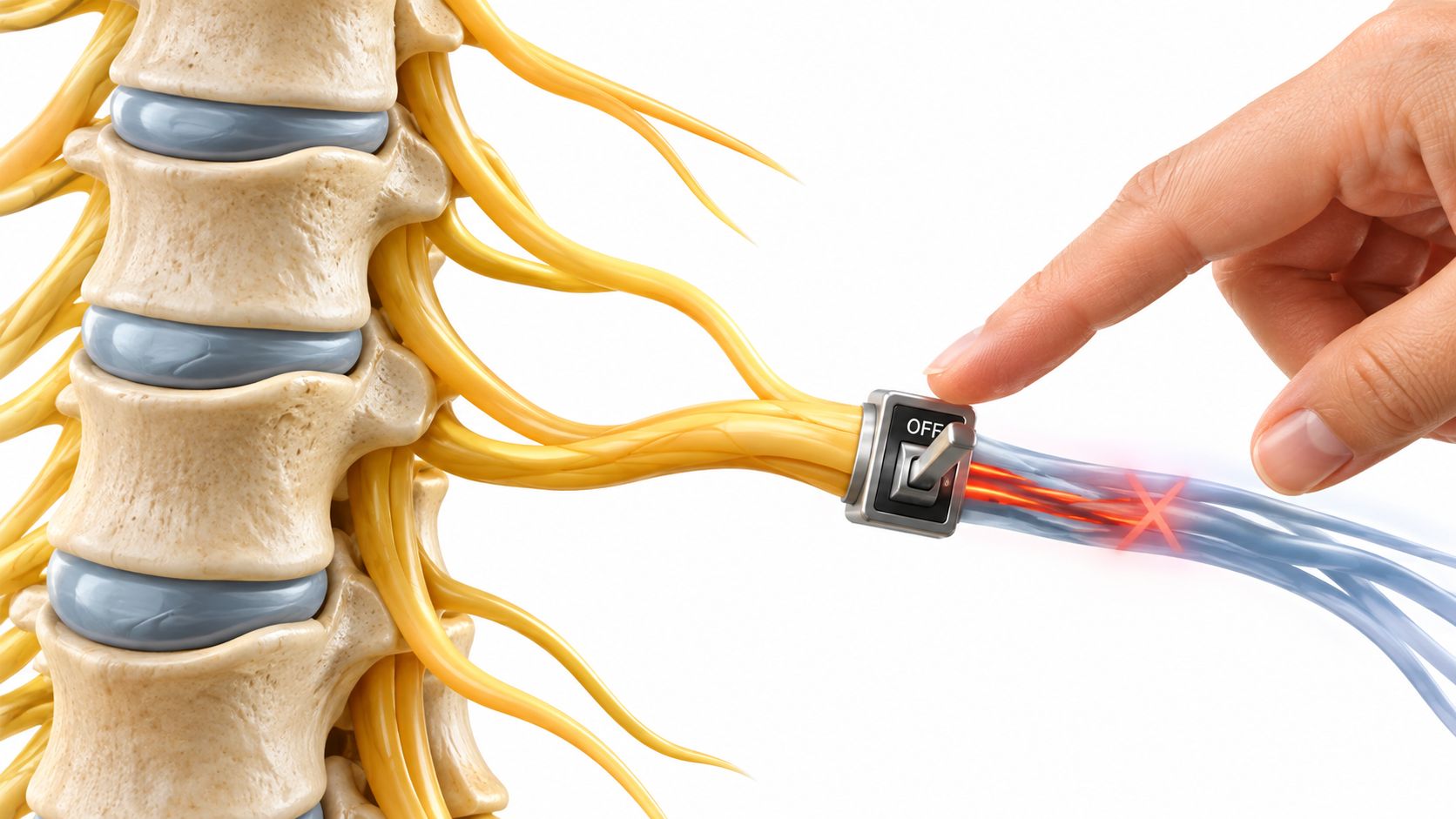
A medial branch block works like briefly switching off a set of pain wires. Under fluoroscopic imaging, your physician guides a thin needle to the area beside the selected nerve. The clinician then places a small amount of local anesthetic near that nerve. In some procedures, another medication may be included, depending on the treatment plan.
Why the block is diagnostic
If your familiar facet-related pain improves while the anesthetic is active, that response gives your physician useful evidence that the targeted medial branch nerve, and the joint it serves, may be contributing to your symptoms. The response doesn't prove that every symptom comes from that joint, but it helps narrow the diagnosis.
That's why your pain diary is more useful than a general statement such as “I felt better.” Note what movement became easier, how long relief lasted, and whether the same pain returned after the anesthetic wore off. You can learn more about the general purpose of this procedure in this guide to what a nerve block injection does.
What side effects have to do with the anatomy
The needle-track soreness comes from the tissues it passes through. Temporary numbness or weakness comes from anesthetic reaching nearby nerves. A brief pain flare can reflect local irritation as the medication wears off.
These effects don't automatically mean the needle missed its target. They're interpreted alongside your pain response, examination, medical history, and the technical details of the injection. A block can be uncomfortable and still provide clinically useful information.
Common Side Effects You Can Expect
The most familiar reactions are local and temporary. In a large prospective safety study of ultrasound-guided cervical medial branch blocks, researchers reported three minor immediate complications across 2,329 blocks, equal to 0.13% of blocks, with a 95% confidence interval of 0.03% to 0.38%. The events were two small subcutaneous hematomas and one vasovagal reaction, and the study found no delayed adverse events during its two-week follow-up window (prospective safety study).
That finding supports a calm approach to ordinary post-injection symptoms. Tenderness, bruising, and a temporary increase in pain usually settle without special treatment. You can often use a wrapped cold pack for short intervals, drink fluids if you're allowed to do so, and take gentle walks around the house.
Use the symptom as a benchmark
- Injection-site soreness: Tenderness for a few days is generally expected. Keep the area clean, use cold therapy as directed, and avoid pressing repeatedly on the site.
- Temporary numbness or heaviness: This should improve as the anesthetic wears off, usually within hours. Protect the numb area from falls, heat, and overuse.
- Mild bruising: A small, stable bruise can occur when a tiny blood vessel is irritated. Watch its size and color rather than repeatedly touching it.
- Brief headache or lightheadedness: A mild, short-lived headache or dizziness can occur after an injection. Rest, hydrate if appropriate, and contact the clinic if it becomes severe or persistent.
- Pain flare: Your familiar pain may briefly increase as the anesthetic fades. Gentle activity is usually more helpful than prolonged bed rest, unless your clinician gave different instructions.
A broader clinical trial reported minor adverse events in 8 of 92 medial branch block patients, or 9%, with 0% serious adverse events in that group (clinical risk overview). The studies use different designs and definitions, so they shouldn't be treated as competing promises. Together, they show why mild symptoms deserve monitoring without being confused with a dangerous complication.
| Side Effect | How Long It Typically Lasts | Simple At-Home Care |
|---|---|---|
| Soreness | A few days | Wrapped cold pack and gentle movement |
| Numbness or heaviness | Usually within hours | Protect the area and wait for sensation to return |
| Small bruise | Several days as it fades | Observe its size and avoid repeated pressure |
| Mild headache or dizziness | Short-lived | Rest, hydrate if appropriate, and call if severe |
| Temporary pain increase | Often settles on its own | Follow activity and medication instructions |
For procedure details and preparation questions, review the facet joint injection procedure information. Your own discharge instructions take priority over general guidance.
Rare but Serious Complications to Know
A serious complication is not defined by discomfort alone. The pattern matters, including whether symptoms are worsening, spreading, associated with fever, or affecting strength, sensation, breathing, or alertness.
Infection and bleeding
Infection may involve the skin and superficial tissues or, more rarely, deeper structures. Call your clinician promptly for fever above 101°F, chills, expanding redness, increasing warmth, drainage, or pain that becomes progressively worse instead of gradually settling. One patient-information source describes injection-site infection as occurring in less than 1 in 5,000 patients (NHS injection guidance).
A small bruise can be normal. A rapidly enlarging, firm, very painful swelling, especially with new weakness or numbness, is different and should be assessed urgently because a hematoma can compress nearby structures.
Nerve, allergic, and spinal complications
Persistent numbness, tingling, or weakness that doesn't resolve as the anesthetic should wear off needs medical review. Foot drop, inability to move a limb normally, or worsening neurological symptoms should be treated as urgent rather than watched at home.
Hives, facial swelling, throat tightness, wheezing, or breathing difficulty can signal an allergic reaction to contrast or local anesthetic. Call emergency services immediately for breathing or swallowing difficulty, fainting, or rapidly worsening swelling.
Needle misplacement can injure a nerve root or, in the cervical region, the spinal cord. A pain-medicine review describes spinal cord injuries after cervical medial branch blocks when operators didn't obtain correct views and the needle or electrode followed an unsafe trajectory (technical review of spinal facet procedures). A separate hospital source documents rare risks including spinal nerve injury, paralysis, stroke, or seizures from intravascular injection, with one leaflet estimating spinal nerve injury at around 1 in 10,000 patients (medial branch block safety guidance).
| Complication | Approximate Frequency | Threshold That Signals a Problem |
|---|---|---|
| Superficial infection | Less than 1 in 5,000 in one NHS source | Fever above 101°F, spreading redness, warmth, or drainage |
| Temporary weakness or numbness | Can occur as anesthetic spreads | Symptoms that persist, worsen, or include foot drop |
| Hematoma or significant bleeding | Uncommon | Rapid swelling, severe pain, or new neurological symptoms |
| Allergic reaction | Uncommon | Hives, throat tightness, facial swelling, or breathing difficulty |
| Spinal or vascular injury | Very rare but documented | Sudden paralysis, seizure, confusion, or severe new weakness |
| Dural puncture headache | Very low but real risk | Severe headache that worsens when upright or doesn't settle |
Image guidance and careful positioning are important safeguards. If you're uncertain whether a symptom is expected, call the clinic rather than trying to diagnose the complication yourself. Information about fluoroscopy-guided injection can help explain how imaging supports accurate needle placement.
Side Effect Timeline From Day 1 to Week 2
Recovery isn't identical for everyone, but a timeline gives you a practical reference point. The first day is mainly an observation period, while the following days help your physician interpret the diagnostic response.
Day 1
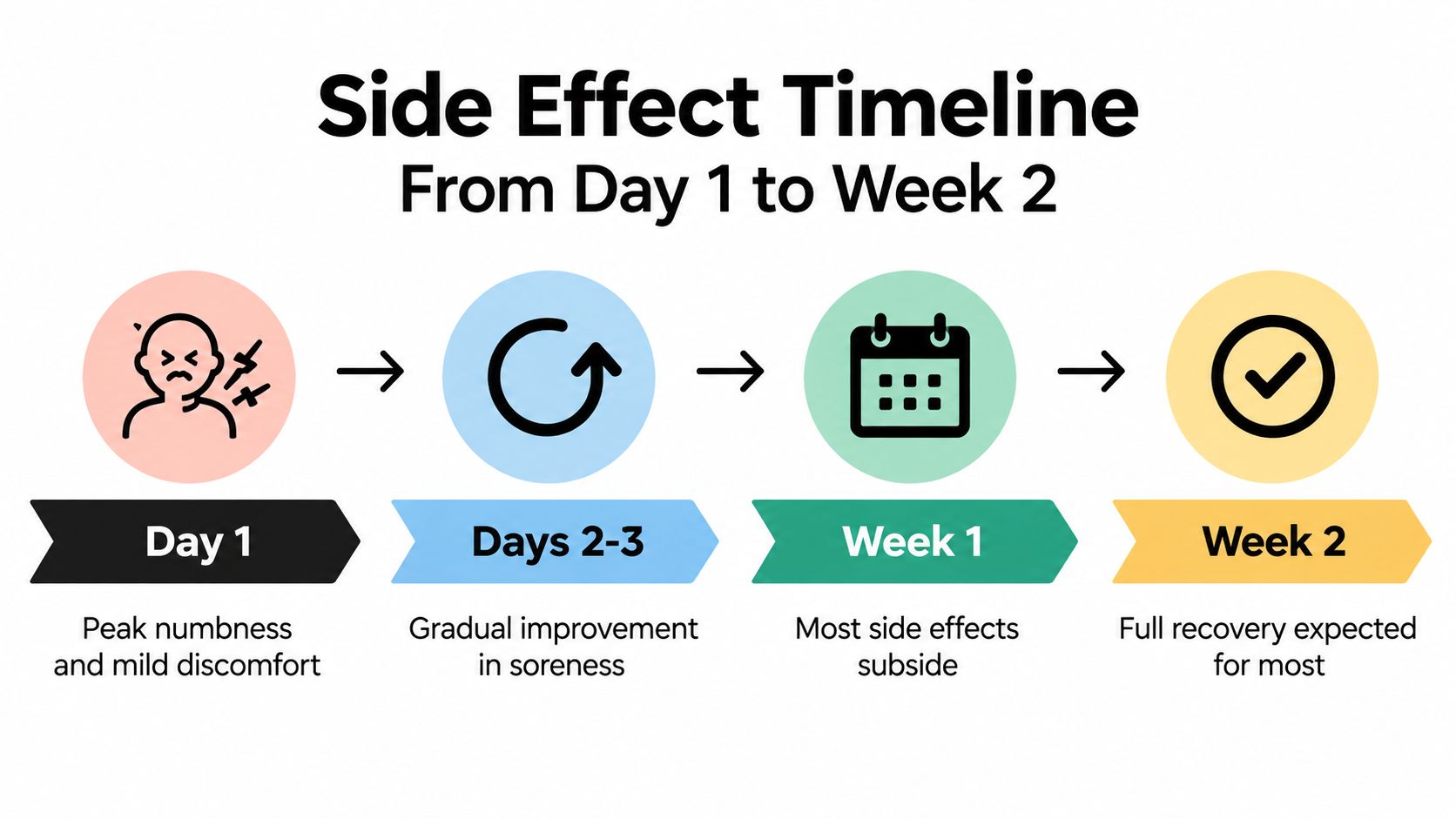
The local anesthetic is most noticeable during the first several hours. Your familiar pain may improve temporarily, and you may also experience injection-site soreness, mild bruising, dizziness, or temporary numbness near the treated area.
Write down your pain level before the procedure and at regular points afterward. Include what you can do more easily, not only the number on the pain scale. Avoid strenuous activity while you learn how your body responds.
Days 2 and 3
By this point, soreness should generally be easing rather than escalating. Bruising may remain visible, and your original pain may return as the anesthetic effect fades. Don't assume that the return of pain means the procedure failed. The block's diagnostic purpose includes observing whether relief was temporary and whether it matched the expected medication window.
Contact the clinic if numbness or weakness remains, if pain becomes severe and unfamiliar, or if the injection site grows red, warm, swollen, or wet with drainage.
Days 4 through 7
This is a useful period for reviewing the pattern in your diary. Most nuisance effects should be settling, allowing you to focus on whether the block changed the specific pain associated with the suspected facet joint.
Bring your notes to follow-up. Describe both the benefit and the side effects, including their timing. A clean response with manageable soreness provides different information from partial relief accompanied by unrelated symptoms.
Week 2
The second week is an assessment checkpoint. Lingering pain alone may have several explanations, but persistent weakness, new sensory loss, fever, or worsening injection-site symptoms shouldn't be left until a routine appointment.
Your physician may classify the block as diagnostically positive, partial, or inconclusive. That classification guides the next conversation, which may include another confirmatory block or a different treatment approach.
Red Flags That Mean Call Your Doctor Now
Save this checklist with your discharge instructions. You don't need to decide which rare complication is occurring. You only need to recognize the symptom pattern and choose the right level of help.
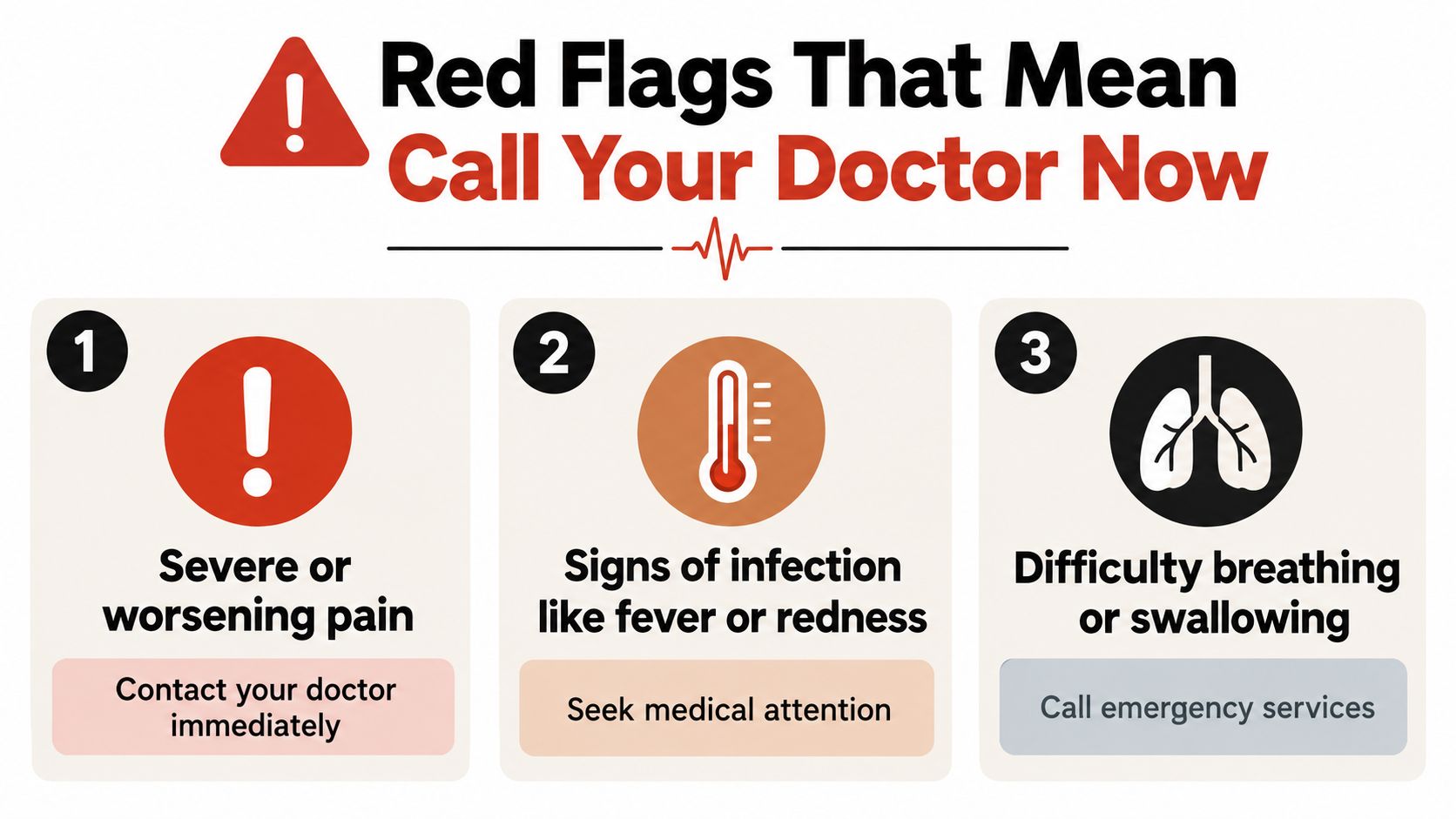
Get emergency evaluation
Go to an emergency department for:
- Progressive weakness or numbness: New or worsening loss of strength or sensation in the legs can indicate nerve or spinal compression.
- Loss of bowel or bladder control: This is an urgent neurological warning sign.
- High fever with chills: Fever above 101°F, especially with worsening back or neck pain, raises concern for infection.
- Severe positional headache: A headache that becomes much worse when standing may need evaluation for a dural puncture.
- Sudden breathing or swallowing difficulty: Throat tightness, wheezing, facial swelling, or trouble breathing can progress quickly.
Call 911 for signs of anaphylaxis, including breathing difficulty, throat tightness, rapidly spreading hives, fainting, or severe facial swelling. Don't drive yourself if you're dizzy, weak, confused, or having trouble breathing.
Call the clinic promptly
During business hours, contact your pain clinic for spreading redness, warmth, pus, a rapidly enlarging bruise, or new severe pain that feels different from your usual facet pain. Also report visual changes, severe dizziness, confusion, or symptoms that continue to worsen.
If you can't reach the clinic and the symptom is escalating, use urgent care or emergency services. Your clinician would rather assess a concerning change early than have you wait because the original symptom seemed minor.
Remember: Mild and improving belongs in the diary. New, worsening, spreading, or neurological symptoms belong on the phone or in emergency care.
What Side Effects Mean for Your Next Treatment
Your response after the block has two parts. The first is safety, meaning whether your body tolerated the injection without a concerning reaction. The second is diagnostic value, meaning whether the temporary numbing changed the pain your physician was trying to test.
A clean result might look like this: the injection site is mildly sore, there's no progressive weakness or infection sign, and your familiar facet-pattern pain improves during the expected anesthetic window. That combination supports the possibility that the targeted medial branch is carrying pain from the suspected joint.
A messy result needs more careful interpretation. Persistent numbness, new weakness, severe pain in an unrelated pattern, or symptoms that obscure your normal pain can make the block inconclusive. Your physician may delay the next intervention, review the imaging and technique, reconsider another pain source, or repeat the diagnostic process when appropriate.
How radiofrequency ablation enters the conversation
When diagnostic blocks provide meaningful, appropriately timed relief, a physician may discuss radiofrequency ablation. This treatment uses controlled heat to interrupt pain signaling from selected medial branch nerves for a longer period. Candidacy depends on your symptom pattern, examination, response to diagnostic testing, medical history, and the standards used by your treating clinician.
At Midwest Pain & Wellness in Chicago Ridge, the follow-up process can include reviewing the pain diary, examining the injection site and neurological symptoms, and discussing whether a repeat block or another treatment makes sense. The practice is a pain and wellness clinic, not a physical therapy office, and its interventional care may be coordinated with rehabilitation and other non-opioid strategies when appropriate.
Patients from Palos Heights, Palos Hills, Evergreen Park, and Hickory Hills, as well as Chicago Ridge, can ask how their individual response would affect the next step. The decision should be based on the full clinical picture, not on temporary soreness alone.
FAQs and Final Takeaways
Side effects don't automatically mean a medial branch block failed. Soreness, bruising, a short pain flare, or temporary numbness can occur even when the anesthetic reached the intended area. The useful question is whether the symptom is improving and whether your familiar pain changed in the expected way.
The large safety study cited earlier found no delayed adverse events during its follow-up window, while patient guidance describes many ordinary local effects as resolving within a few days. Your discharge instructions remain the most relevant guide for your procedure and medical history.
How long should soreness last?
Mild tenderness commonly settles over a few days. Use the care measures recommended by your clinic and call if pain becomes progressively worse, severe, or qualitatively different from the pain you had before the injection.
When should I worry about bruising?
A small, stable bruise can be part of normal needle-site healing. Call for rapidly expanding swelling, severe pressure-like pain, drainage, or bruising accompanied by new weakness or numbness.
Does temporary numbness predict radiofrequency ablation success?
Not by itself. Temporary numbness usually reflects local anesthetic spreading near nerves, while ablation decisions depend more on whether the block produced meaningful relief of the specific pain being tested and whether the response was safe and interpretable.
What should I bring to follow-up?
Bring your pain diary, medication list, procedure instructions, and a clear description of any numbness, weakness, dizziness, bruising, or pain flare. Honest tracking helps your physician distinguish expected recovery from a result that needs further evaluation.
The central takeaway is simple: most immediate reactions are manageable, but worsening neurological, infectious, allergic, or breathing symptoms deserve prompt attention. Record what happens, protect numb areas until sensation returns, and contact your clinic when the pattern doesn't fit ordinary recovery.
Midwest Pain & Wellness evaluates medial branch block responses, injection-site symptoms, and longer-term options such as image-guided procedures and radiofrequency ablation for eligible patients. If you're in Chicago Ridge, Palos Heights, Palos Hills, Evergreen Park, or Hickory Hills, visit Midwest Pain & Wellness to request an appointment and discuss your next step with a pain specialist.