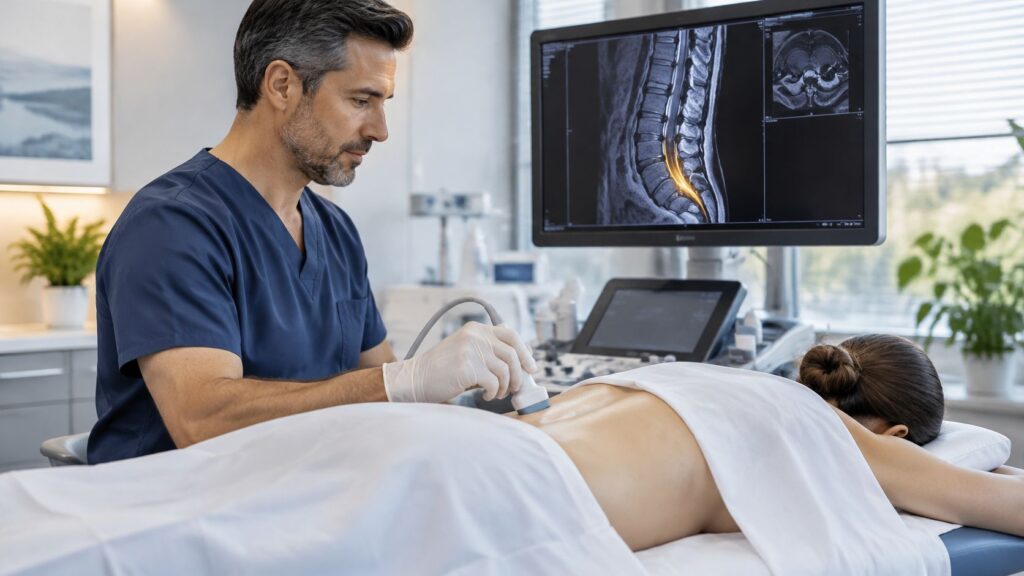
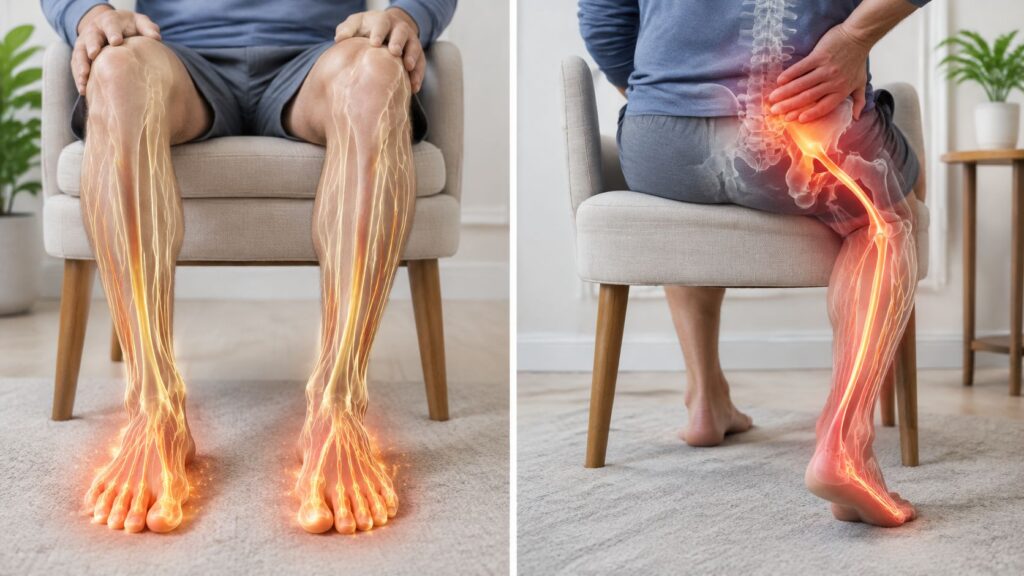
If you're searching for a MILD procedure for stenosis, there's a good chance daily life has gotten smaller than it used to be. You may still be able to get through the day, but standing in line, walking through a store, or making it from the parking lot to the front door now takes planning. Many people tell me the same thing in different words: “I can walk better if I lean forward on a cart, but standing upright is what really sets it off.”
That pattern matters. Pain, numbness, heaviness, or weakness in the legs that gets worse with standing and walking, then eases with sitting or bending forward, often points to neurogenic claudication from lumbar spinal stenosis. It's not “just aging,” and it's not always something you have to tolerate.
There's another point that causes a lot of confusion. The MILD procedure is not a treatment for “mild” stenosis. It's a specific minimally invasive treatment for a specific anatomical problem in the lower back. If you live in Chicago Ridge or nearby Illinois communities such as Oak Lawn, Palos Hills, Palos Heights, Worth, Bridgeview, Hickory Hills, Alsip, Burbank, Evergreen Park, and Orland Park, understanding that distinction can save you time and help you ask better questions at your consultation.
Standing Up to Spinal Stenosis Pain
A common story goes like this. You're fine for the first few minutes after getting out of the car. Then your legs start burning, tingling, or feeling heavy. You stop, lean on a counter or shopping cart, and the pressure eases enough to keep going.
That “shopping cart sign” is one of the most recognizable patterns of lumbar spinal stenosis. The nerves in the lower spine don't have enough room, and upright posture can make that crowding more noticeable. Sitting or leaning forward opens space temporarily, which is why patients often say they can ride a bike more easily than they can walk through a grocery store.
When symptoms follow a mechanical pattern
This kind of pain usually isn't random. It often reflects a mechanical narrowing in the spinal canal. In many patients, one of the main contributors is a thickened ligament called the ligamentum flavum.
When leg symptoms consistently worsen with standing and improve with sitting, that pattern gives us a clue. We need to look for the structure causing the crowding, not just chase symptoms.
That's where a targeted pain management approach becomes useful. The MILD procedure is designed for patients whose stenosis is being driven by that thickened ligament. It isn't a cure-all for every back problem, but for the right person, it addresses the structure causing the nerve compression rather than trying to calm the pain down.
What patients often try first
Before anyone talks about a procedure, individuals typically have already tried simpler measures.
- Rest and activity changes can help, but they rarely restore reliable walking tolerance.
- Injections may reduce inflammation, especially when symptoms flare.
- Exercise-based care can support strength and movement, but it won't physically remove a thickened ligament.
- Sleep support also matters. If nighttime pain is adding to your fatigue, practical guidance on finding the right mattress for spinal stenosis can make daily symptoms more manageable.
If you're still sorting out what spinal stenosis is and why these symptoms behave this way, this guide on how to manage spinal stenosis is a useful starting point.
What Is the Minimally Invasive MILD Procedure
You may hear the word “MILD” and assume it is meant for mild stenosis. That is one of the most common misunderstandings I see in clinic. MILD is the name of the procedure, not a description of how advanced your condition is.
The MILD procedure means Minimally Invasive Lumbar Decompression. It is an outpatient treatment used for lumbar spinal stenosis when a thickened ligamentum flavum is taking up space in the spinal canal and contributing to nerve compression. Through a very small incision, the physician removes a small amount of that excess tissue to create more room for the nerves. No implanted hardware is used, and patients usually do not need general anesthesia.
This is a targeted anatomical procedure. It addresses one specific cause of stenosis. That distinction matters.
The process is similar to trimming back tissue that has crowded into a narrow passage. The goal is not to change the whole spine. The goal is to reduce the pressure created by the thickened ligament so standing and walking become more tolerable.
What makes it different from open back surgery
Patients often hear “decompression” and picture a larger spine operation. MILD is much smaller in scope and is designed to preserve normal structures as much as possible.
- It is done as outpatient care. You go home the same day.
- It usually uses local numbing medicine with light sedation, not general anesthesia. That can lower the burden of treatment for some patients.
- It does not use screws, rods, or spacers. The physician removes tissue rather than placing hardware.
- It focuses on the canal narrowing caused by ligament thickening. If your stenosis comes from a different structure, another option may fit better.
For some patients, an implant-based approach is also part of the discussion. If you want to understand how that differs, this overview of the Vertiflex Superion procedure for lumbar stenosis explains that treatment path.
What it can and cannot do
MILD can improve function in the right patient. In practice, that often means better walking tolerance, less leg heaviness, and less need to sit down after short periods of standing.
It is less reliable for pain coming from other sources, such as significant instability, a large disc problem, or pain that is primarily mechanical low back pain rather than neurogenic claudication. That is the trade-off. The procedure is focused, which is one reason recovery is usually easier than with open surgery, but that also means it only helps when the anatomy matches the treatment.
Patients should also know what success looks like. Some people feel relief fairly early, while others notice the bigger change over time as they start moving more comfortably and rebuild walking capacity. The procedure creates space. The functional recovery comes as the irritated nerves calm down and daily activity becomes possible again.
Are You a Good Candidate for the MILD Procedure
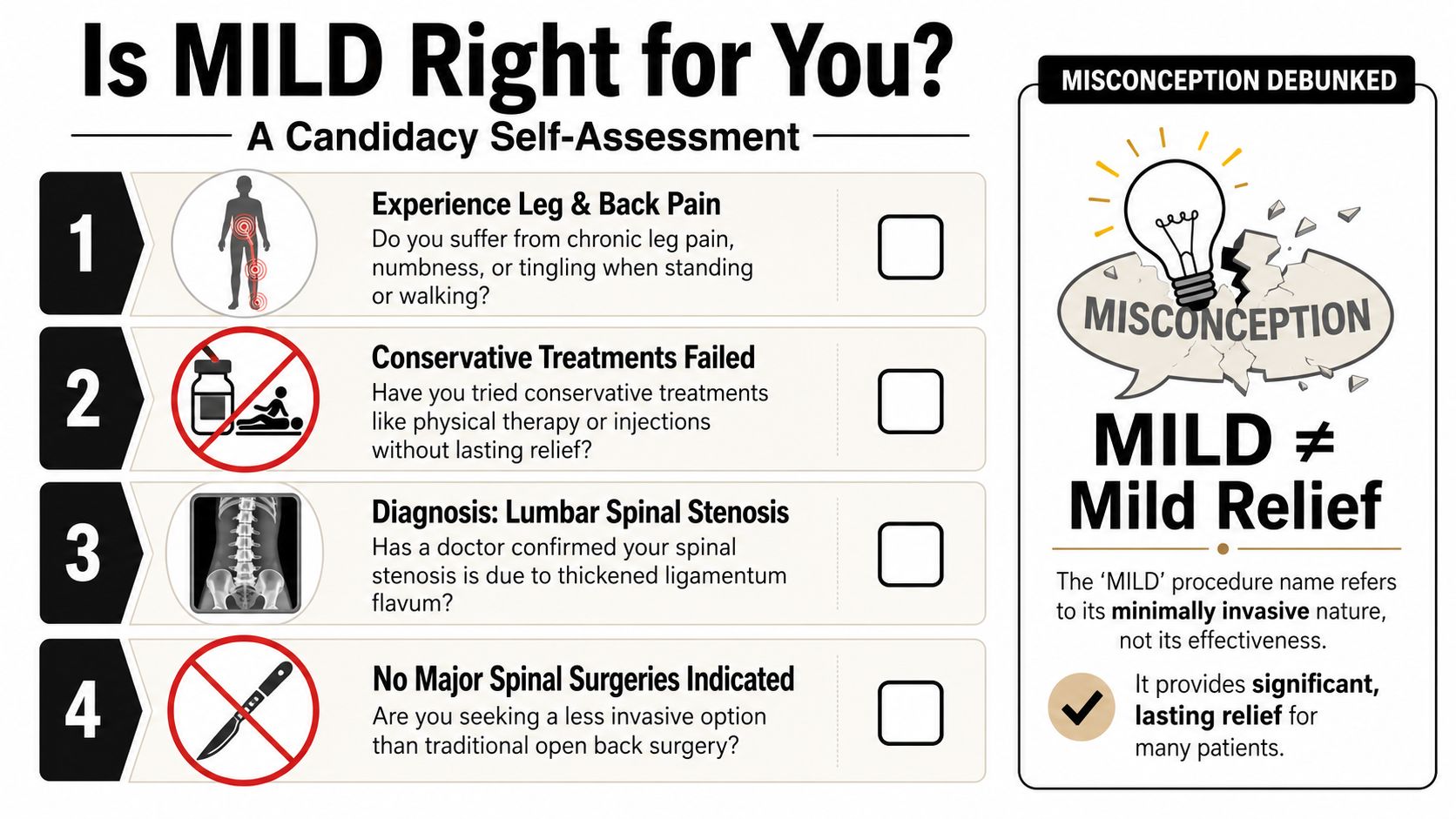
A common misunderstanding starts with the name. The MILD procedure is not meant for mild stenosis. I consider it for patients with lumbar spinal stenosis who have the right symptom pattern, have already tried conservative care, and show thickening of the ligamentum flavum on imaging as a meaningful cause of the narrowing.
That anatomy matters. A patient can have severe day-to-day limits and still not be a good MILD candidate if the stenosis is coming mainly from a different structure. The decision comes from the MRI, the exam, and the story your symptoms tell together.
The checklist that matters
I look for a few clear signs:
- You have lumbar spinal stenosis confirmed on imaging. Symptoms raise suspicion, but imaging helps show whether the canal narrowing matches what you feel.
- Your symptoms fit neurogenic claudication. Walking or standing brings on leg pain, numbness, tingling, weakness, or heaviness. Sitting or bending forward gives relief.
- Ligamentum flavum hypertrophy is part of the problem. MILD is designed for stenosis where thickened ligament is crowding the canal.
- Conservative treatment has not given enough relief. That may include medications, physical therapy, activity modification, or injections.
- You want to improve function with a less invasive option. For many patients, the main goal is walking farther, standing longer, and getting through daily tasks with fewer stops.
When MILD may not be the right fit
Some patients are better served by a different plan. If the main issue is instability, a large disc problem, advanced deformity, or a stenosis pattern not driven by ligament thickening, MILD may not address the pain generator. In those cases, forcing a less invasive procedure usually leads to disappointment.
There are also patients whose anatomy points toward another minimally invasive strategy. If you are comparing procedures that create space in a different way, this overview of the Vertiflex Superion procedure for lumbar stenosis can help clarify the difference.
The practical question is not whether your stenosis sounds "mild." It is whether your anatomy fits the procedure well enough to give you a real chance at better walking, better standing tolerance, and a smoother recovery.
A Patient's Journey Through the MILD Procedure
A common concern I hear is simple: patients want to know what the day will feel like. That question matters, especially because the name can be misleading. The MILD procedure is not a treatment for "mild" stenosis. It is a targeted procedure for a specific cause of stenosis, usually thickened ligament tissue narrowing the spinal canal.
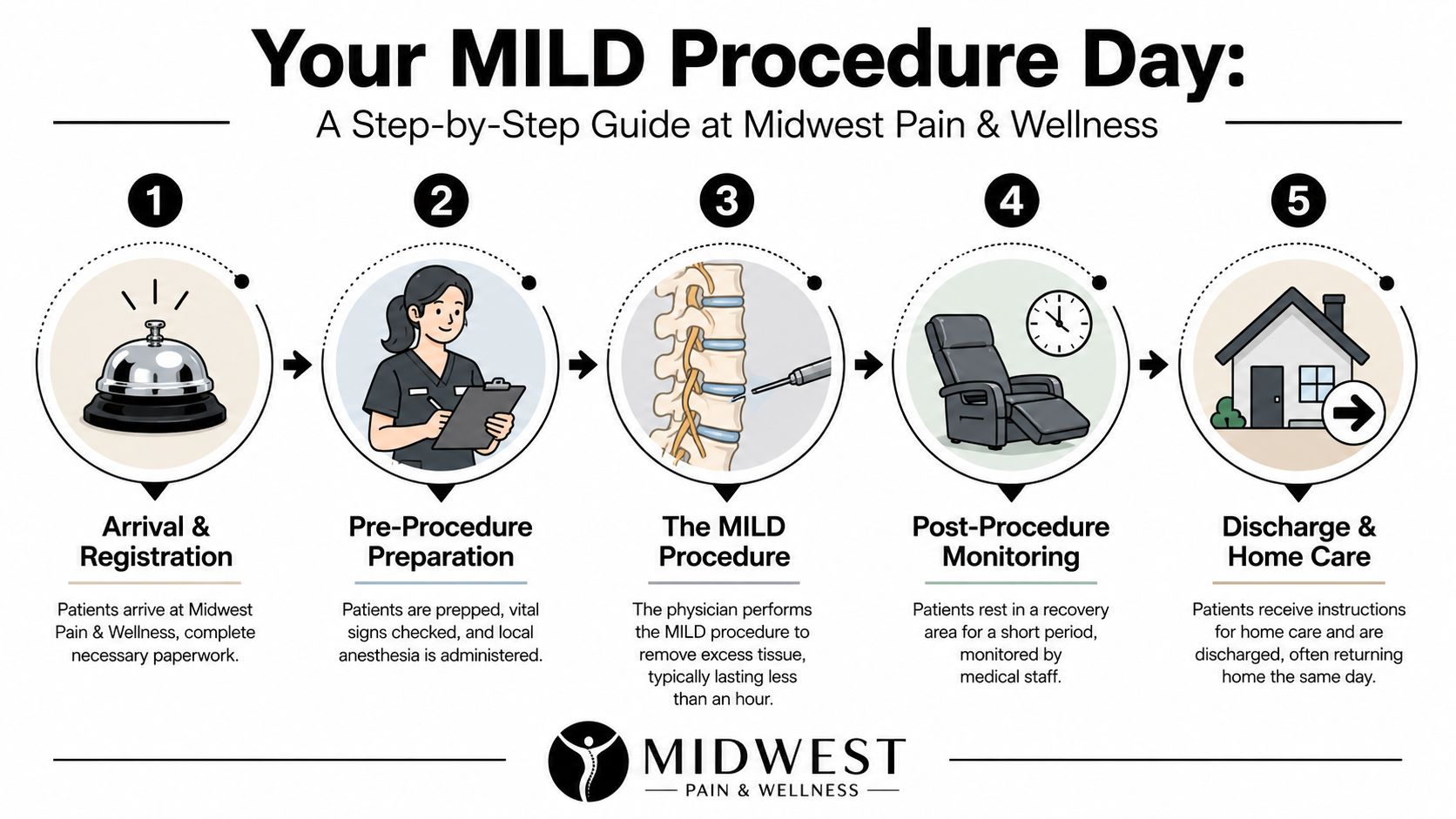
For the right patient, the day itself is usually straightforward. MILD is typically done in an outpatient setting with local anesthetic and light sedation. The physician uses fluoroscopic X-ray guidance and a very small opening in the skin to remove small amounts of the thickened ligament that are crowding the canal. The goal is to create more room for the nerves while preserving the normal bony structure and stability as much as possible.
Before the procedure starts
Preparation starts well before procedure day. Your physician reviews your symptoms, MRI findings, past treatments, medications, and the exact pattern of stenosis. That is where good decision-making happens. If the narrowing is not being driven by ligamentum flavum hypertrophy, this procedure may not give you the result you want.
On the day of treatment, you check in, change into a gown, and meet with the team to confirm the plan, answer final questions, and review aftercare instructions. The pace is deliberate. Patients usually feel better when they know what is happening and why.
During the procedure
The lower back is cleaned and numbed first. Because local anesthetic and light sedation are commonly used, patients are usually comfortable without needing general anesthesia.
Using fluoroscopic guidance, the physician advances specialized instruments to the treatment area through a very small opening. Small portions of the thickened ligament are removed to relieve pressure in the canal. In select cases, a very limited amount of nearby bone may be addressed if needed for access, but the procedure is designed to avoid the larger tissue disruption that comes with open surgery.
After the procedure
Afterward, patients spend a short time in recovery and then go home the same day with instructions on walking, wound care, and activity. The small dressing often surprises people. So does how ordinary the rest of the day can feel.
What I usually want patients to understand at this stage is the difference between procedural recovery and functional recovery. Getting through the procedure is the first step. Healing from the small incision and sedation is usually quick. Improvement in standing and walking can follow a different timeline, because irritated nerves and deconditioned muscles may need more time to settle and rebuild.
That distinction helps set realistic expectations. The procedure day is usually easier than patients fear, but the full benefit is measured by what you can do afterward. Walking farther, standing longer, and getting through daily life with fewer interruptions.
Recovery and Lasting Results with MILD
A common misunderstanding starts here. The MILD procedure is not for "mild" stenosis, and recovery is not just about getting through a small outpatient procedure. What matters is whether your symptoms are coming from the right anatomy, especially thickened ligamentum flavum, and whether treatment helps you stand and walk with less limitation over time.
Recovery happens in phases.
Early recovery after MILD
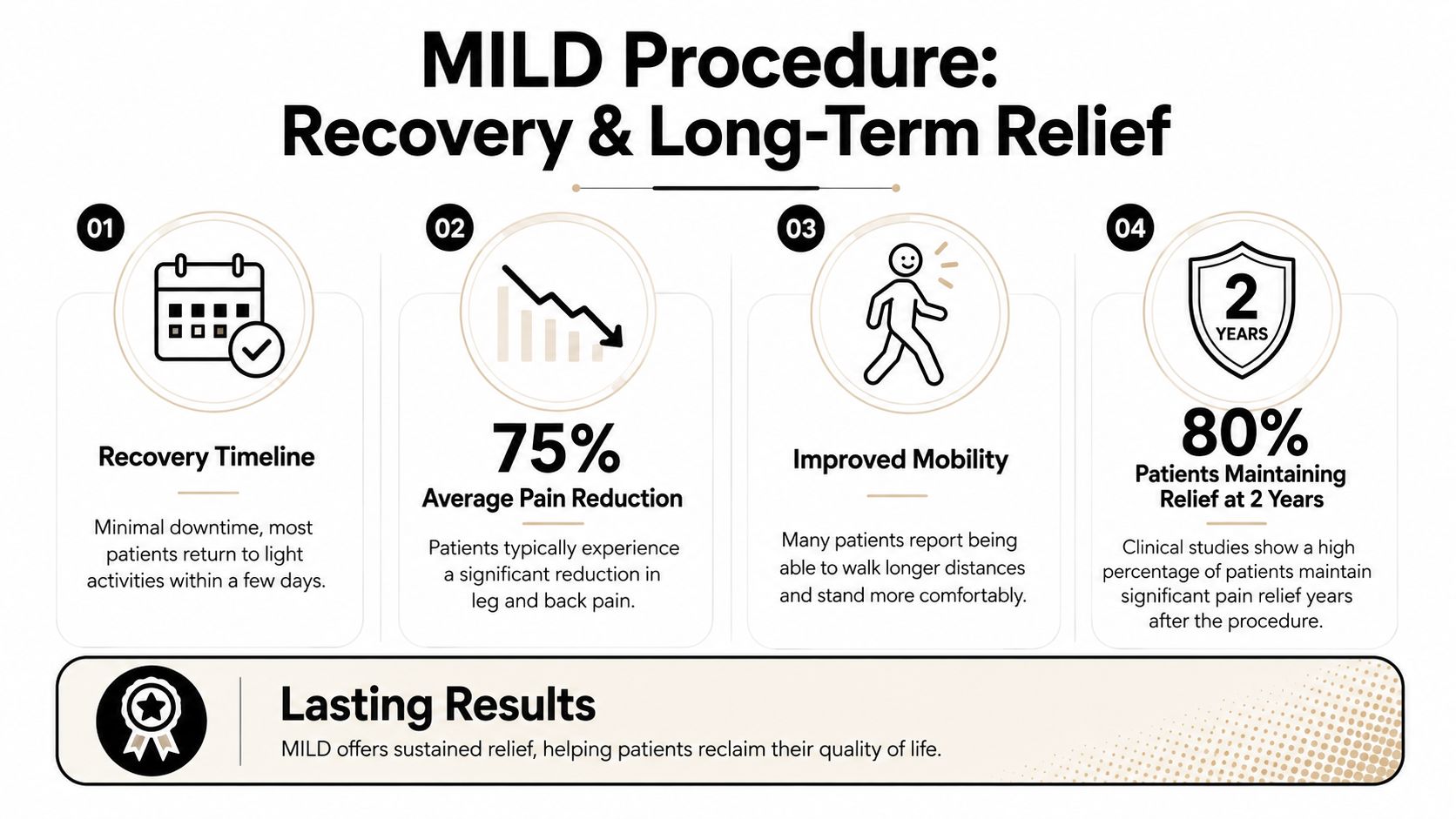
The first phase is procedural recovery. Most patients go home the same day. Soreness at the incision site is usually limited, and many people are back to light routine activity quickly.
The second phase is functional recovery. This tends to take longer, and it is the part patients care about most. If nerves have been crowded for a long time, they may calm down gradually rather than all at once. Muscles that have adapted to pain also need time to build stamina again.
That difference matters. A small bandage and a short recovery-room stay do not mean the full result shows up the next morning.
For patients weighing options, our overview of minimally invasive spine surgery for lumbar stenosis explains where MILD fits and where it does not.
What lasting improvement usually means
The goal of MILD is practical function. Patients often describe success in simple terms. They can stand long enough to cook a meal. They can walk through a store without stopping every few minutes. They can get out of the house with less planning around pain.
Some patients notice improvement early. Others improve over weeks to months as nerve irritation settles and activity tolerance returns. That slower timeline does not mean the procedure failed. It often reflects how long the spinal nerves were compressed before treatment.
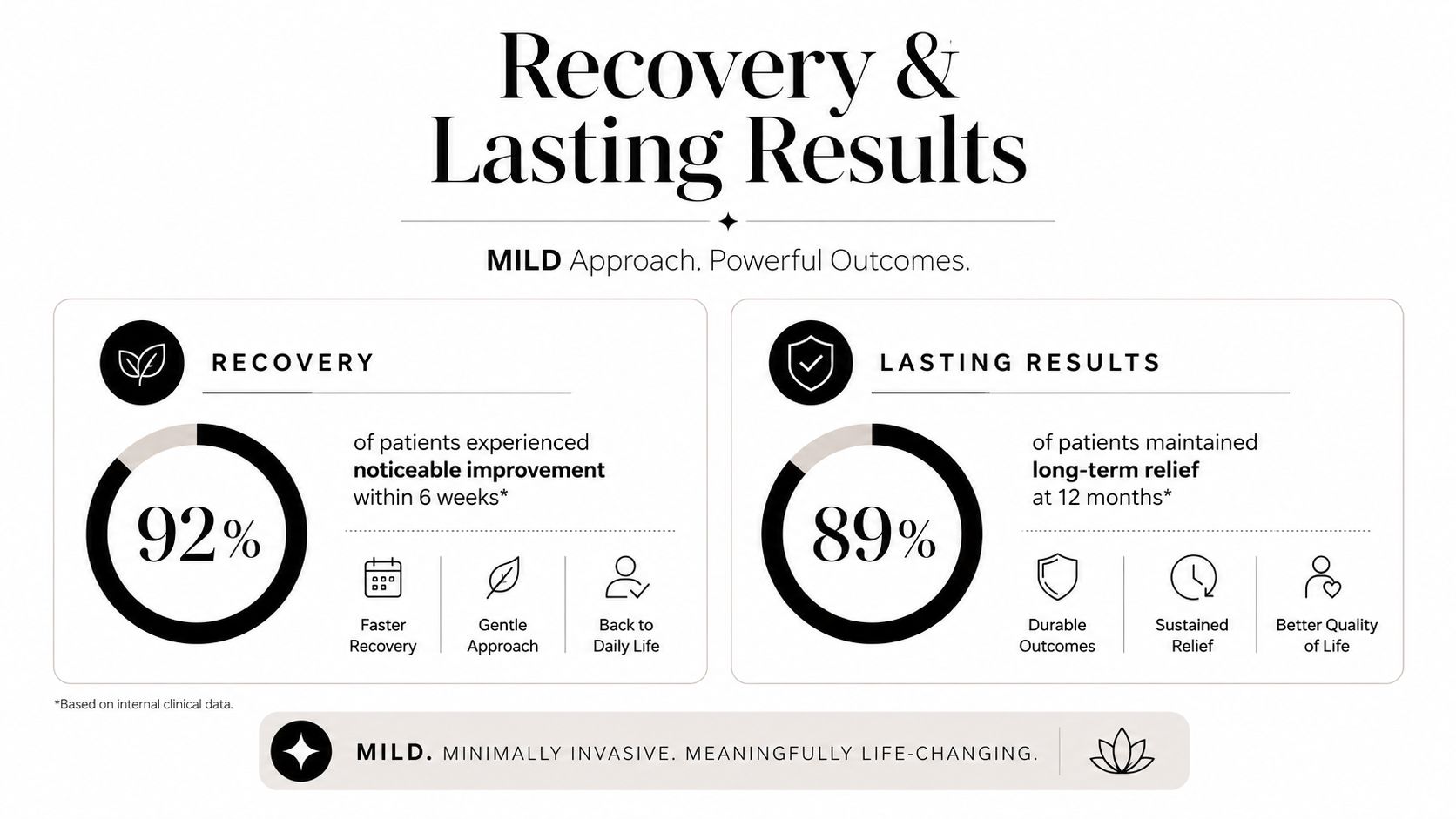
Long-term benefit also depends on the starting problem. MILD can create more room in the spinal canal by removing small portions of thickened ligament. It does not reverse arthritis, repair every pain source in the back, or create a "new spine." In the right patient, though, reducing that specific bottleneck can meaningfully improve daily mobility.
What helps recovery go well
Patients usually do best when they treat the next several weeks as a rebuilding period, not a test of how much they can do on day one.
- Walk regularly, within your physician's instructions. Short, frequent walks are often more useful than doing too much at once.
- Expect stamina to return after the incision has healed. Tissue healing is only one part of recovery.
- Keep follow-up appointments. If leg pain, numbness, or walking tolerance is not improving as expected, that deserves review.
- Measure progress by function. Standing longer, walking farther, and needing fewer rest breaks are often better markers than pain alone.
I tell patients to watch for quality-of-life wins. Better recovery means better use of your day.
Comparing MILD to Other Stenosis Treatments
Patients usually aren't choosing between “do something” and “do nothing.” They're choosing among treatment levels. The right option depends on anatomy, symptom severity, medical risk, and how much daily function has been lost.
Conservative care still has a role. Injections can calm inflammation. Exercise-based rehabilitation can improve conditioning and movement quality. But when a thickened ligament is physically crowding the canal, those options may not create enough space by themselves.
Spinal stenosis treatment comparison
| Treatment | Invasiveness | Recovery Time | Implant Used? | Best For |
|---|---|---|---|---|
| Conservative care such as medications, exercise-based rehab, and injections | Lowest | Usually minimal downtime, but symptom relief may be temporary or incomplete | No | Early management, flare control, or patients still evaluating next steps |
| MILD procedure | Minimally invasive | Outpatient recovery with a relatively quick return to routine activity | No | Moderate-to-severe lumbar spinal stenosis driven by ligamentum flavum thickening after conservative care has failed |
| Other minimally invasive spacer-based procedures | Minimally invasive | Often shorter than open surgery, but depends on the device and anatomy | Yes | Select patients whose anatomy and symptom pattern fit an implant-based approach |
| Open decompression surgery | Most invasive | Longer recovery than outpatient minimally invasive options | Sometimes | Patients with anatomy that requires broader surgical decompression |
Where MILD fits in the decision path
MILD often makes sense in the middle ground. It's more targeted than symptom management alone, but less invasive than open surgery. That balance is exactly why it appeals to many older adults and to people who want an outpatient option.
At a pain management clinic such as Midwest Pain & Wellness, minimally invasive spine procedures are evaluated alongside injections and other interventional options, which helps match the treatment to the actual pain generator rather than forcing one pathway on every patient.
Real trade-offs to keep in mind
- MILD is highly anatomy-dependent. If the narrowing isn't primarily from ligament thickening, another option may fit better.
- Implant-based procedures create space differently. That can be an advantage in some cases, but it also means different selection criteria.
- Open surgery can address broader structural problems. The trade-off is more tissue disruption and a longer recovery path.
Your MILD Procedure Questions Answered
A common misunderstanding comes up in almost every consultation. The MILD procedure is not designed for "mild" stenosis. It is designed for a specific cause of stenosis, usually thickened ligamentum flavum that is crowding the spinal canal and contributing to pain, heaviness, or leg symptoms with standing and walking.
Is the MILD procedure covered by insurance and Medicare
Coverage usually depends on four things: your plan, your diagnosis, your MRI findings, and whether the chart clearly shows medical necessity. Before scheduling, the office should verify benefits and explain any out-of-pocket costs so there are no surprises.
What are the real risks of the MILD procedure
Every procedure has risk, and patients deserve a straight answer about that. With MILD, the risks are generally lower than with more invasive spine surgery because the treatment is done through a very small opening and does not involve implanted hardware.
The issues I discuss most often are temporary soreness at the treatment site, bruising, bleeding risk, infection risk, and the chance that the procedure may not give enough relief if the anatomy is not a good match. Careful MRI review matters here. If the main problem is not ligamentum flavum hypertrophy, another treatment may fit better.
How do I find out if I'm a candidate in Illinois
The decision starts with symptoms, but it does not end there.
A good evaluation looks at how far you can walk, how long you can stand, whether you feel better leaning forward or sitting, what treatments you have already tried, and what your MRI shows. The key question is whether the narrowing is being driven by thickened ligament rather than a different structural problem that calls for another approach.
If you live in Oak Lawn, Palos Hills, Palos Heights, Worth, Bridgeview, Hickory Hills, Alsip, Burbank, Evergreen Park, Orland Park, or Chicago Ridge, ask for a review that focuses on function as well as imaging. I want to know what your day looks like. Can you get through the grocery store, walk to the mailbox, stand long enough to cook, or keep up with family? Those details often tell me as much as the scan.
How quickly will I feel better after MILD
Some patients notice early relief, especially with standing and walking tolerance. Others improve more gradually over weeks as post-procedure soreness settles down and activity increases.
That timeline matters. Immediate pain relief and long-term functional recovery are not the same thing. The goal is not just to lower pain for a day or two. The goal is to help you stand longer, walk farther, and get back to daily routines with less limitation.
Will MILD cure my stenosis
MILD does not reverse every cause of spinal stenosis, and it does not fix unrelated back problems. It treats a specific contributor to narrowing in carefully selected patients.
That is why candidacy is so important. A technically successful procedure can still disappoint if the anatomy was never a good match in the first place.
If leg pain, numbness, or heaviness is limiting how far you can walk or how long you can stand, scheduling a consultation with Midwest Pain & Wellness is a practical next step. A focused evaluation can show whether the MILD procedure fits your anatomy, or whether another pain management option makes more sense for your situation.