You're sitting in an imaging center in Chicago Ridge with an MRI order in your hand, but the scheduler has paused because you have a spinal cord stimulator. The scan is for your knee, shoulder, or a new spine symptom, yet the question is the same: Is my device safe inside the MRI machine?
The answer usually isn't a simple yes or no. MRI access depends on your exact stimulator model, every implanted component, the device's current condition, and the scanner's settings. A system that was eligible for MRI after implantation may require a new evaluation years later, especially if leads have moved, fractured, or developed impedance problems. Patients in Palos Heights, Palos Hills, Evergreen Park, Hickory Hills, and surrounding Illinois communities can protect their options by treating MRI clearance as a repeatable safety process, not a one-time approval.
Table of Contents
- When Your Implant Meets the MRI Machine
- What MRI Conditional Actually Means for Your Device
- Why Spinal Cord Stimulators and MRI Don't Always Mix
- How Major SCS Brands Differ in MRI Access
- How to Verify Your Own Device Is MRI Ready
- When MRI Conditional Stops Being Conditional
- Your Step-by-Step MRI Safety Protocol
- Keeping Your Imaging Options Open for the Long Run
When Your Implant Meets the MRI Machine
A 58-year-old former warehouse supervisor from Chicago Ridge had a spinal cord stimulator implanted four years ago for persistent pain after back surgery. After a fall on icy stairs, her orthopedic surgeon ordered an MRI of her right knee. At the scheduling desk, she began to worry. Could the scan heat the leads? Could it damage the device or erase her programming? Would the imaging center cancel the appointment?
Those concerns are understandable. Spinal cord stimulators contain an implanted pulse generator, leads, and other components that can interact with the magnetic and radiofrequency energy used during MRI. Early systems were broadly considered MR unsafe because heating at the lead tip could potentially injure the spinal cord, while magnetic forces and electrical effects could damage hardware or alter programming. A published review of MRI and spinal cord stimulation describes how compatibility remained problematic even as some systems began receiving conditional labeling.
The patient's first assumption was that an old clearance should still apply. That assumption can create trouble. MRI eligibility is not a permanent passport. The device may have a different status if a lead has migrated, a conductor has fractured, an extension has been disconnected, or an impedance check falls outside the manufacturer's accepted range.
Practical rule: Never schedule an MRI based only on the words “I have an MRI-compatible stimulator.” Schedule it after the exact system and scan conditions are documented.
For the Chicago Ridge patient, the next step isn't panic or automatic cancellation. She needs her device identification card, a review by the implanting or managing pain team, and confirmation from the imaging center that it can follow the manufacturer's protocol. The scan's body region matters, but it doesn't replace device verification. A knee MRI can still require the same careful clearance as a spine MRI.
What MRI Conditional Actually Means for Your Device
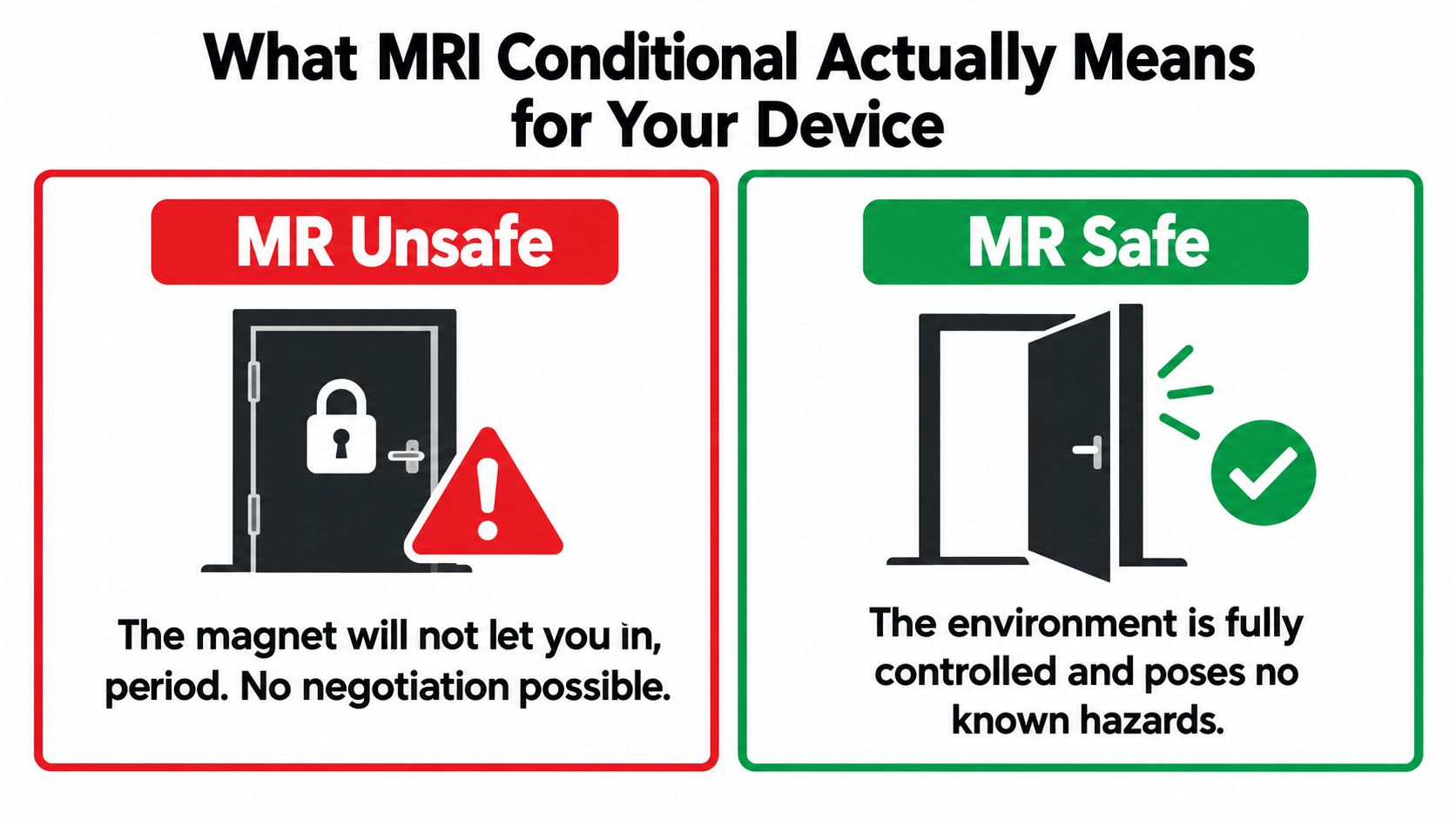
Think of MRI labeling like a hotel access system. MR Unsafe is a locked door. The scanner environment isn't approved for that device, so the patient shouldn't enter it under ordinary clinical scheduling. MR Safe is an open lobby, meaning the device is considered safe in the MRI environment without the special restrictions associated with conditional labeling.
MR Conditional sits between those two categories. It's more like a programmable key card that opens only certain floors, during permitted hours, and at a specified power level. The device may be scanned only when the approved components, scanner strength, coil, radiofrequency exposure, scan time, body region, and programming instructions all match the manufacturer's conditions.
The three labels in practical terms
- MR Unsafe: The system shouldn't undergo MRI because the risks haven't been accepted for that device configuration. Manufacturer guidance warns of possible heating, displacement, electronics damage, and shocks when an MR-conditional system isn't present or approved conditions aren't followed. Boston Scientific's patient safety guidance explains why patients need their exact system identified before imaging.
- MR Safe: The label indicates no known hazard in the defined MRI environment. This is different from assuming that every implant with little or no magnetic material is automatically safe.
- MR Conditional: The scan is allowed only under specified conditions. Those conditions can include 1.5T or 3T field strength, a permitted coil arrangement, specific absorption rate limits, MRI mode activation, and a scan-time cap. Some systems may allow only particular regions or require additional checks.
Your stimulator's label applies to the complete implanted system, not just the battery. The leads, extensions, pulse generator, and implant locations must be approved together. Understanding how spinal cord stimulation works can help explain the device's therapeutic role, but MRI clearance still requires a separate technical verification.
A system can lose conditional eligibility if one component is not approved, if the implant location is outside labeling, or if the scan exceeds a listed condition. That's why the radiology team needs written confirmation rather than a verbal shortcut.
Why Spinal Cord Stimulators and MRI Don't Always Mix
An MRI scanner combines a powerful magnetic field with radiofrequency energy. The leads in a spinal cord stimulator can behave somewhat like an antenna, concentrating energy near the electrode. Under the wrong conditions, that energy can produce heating at the lead tip and potentially injure nearby tissue.
The magnetic field can also interact with ferromagnetic materials, while radiofrequency energy may induce unwanted currents. Depending on the device and circumstances, patients may experience shocks or uncomfortable stimulation, and the pulse generator may suffer electronics damage or programming changes. These risks explain why an implanted stimulator can't be treated like a passive piece of metal.
Why older and newer systems differ
Early SCS devices were broadly treated as MR unsafe. By the mid-2010s, reviews still described MRI compatibility as a significant problem and noted that systems were considered MR conditional only when strict scanner and device requirements were followed. That historical review of SCS MRI safety helps explain why patients with older implants may receive different answers from those with newer systems.
Manufacturers redesigned systems to address these interactions. Modern generations may use filtered feed-through, less ferrous material, Hall-effect sensors, and improved lead designs to support conditional MRI access. Those engineering changes expanded options for many patients, but they didn't eliminate the need for restrictions.
A useful way to think about it is that the device was not just made “MRI safe.” It was engineered and tested for particular combinations of hardware and scanner conditions. Change the field strength, coil, scan region, specific absorption rate, impedance, or scan duration, and the tested safety profile may no longer apply.
That distinction matters for an Illinois patient whose device was implanted years ago. The implant date can provide context, but it can't establish eligibility. The exact model and complete system record do that.
How Major SCS Brands Differ in MRI Access
Patients often remember the manufacturer's name but not the model. That isn't enough. A single manufacturer may offer systems with different MRI permissions, and the approved scan conditions can differ between lead combinations, pulse generators, and revisions.
Some current systems require MRI mode, pre-scan checks, and use in a 1.5T cylindrical-bore scanner. Other systems may permit broader access but limit active scan time to 30 minutes per session, followed by a 30-minute wait between sessions, according to manufacturer guidance. Some newer systems may offer full-body conditional MRI at 1.5T and 3T, while other configurations remain head-only or more restricted. These differences are summarized in the device-specific MRI evidence.
The table below is a practical framework, not a substitute for a model-specific clearance letter.
| Manufacturer | Field Strength | Scan Region | Reprogramming Required |
|---|---|---|---|
| Abbott | May vary by approved system, including restricted or broader conditional access | May be head-only or full-body, depending on model and components | MRI mode and pre-scan checks may be required |
| Boston Scientific | May include 1.5T access, with conditions varying by system | May be head-only or full-body, depending on labeling | MRI mode, device checks, and post-scan restoration may be required |
| Medtronic | Varies by pulse generator and lead combination | May be restricted or full-body under approved conditions | MRI mode and programming steps may be required |
| Nevro | Varies by system and approved configuration | May include broader conditional access or region-specific restrictions | Manufacturer-directed settings and verification may be required |
What this means at an Illinois imaging center
An imaging center in Chicago Ridge, Palos Heights, Palos Hills, Evergreen Park, or Hickory Hills may have the right scanner but still need additional documentation. The center must confirm the field strength, coil type, scan region, specific absorption rate limits, and any scan-time restriction. It also needs to know whether the patient can place the stimulator into MRI mode or requires assistance from the pain team or an authorized device representative.
Brand recognition isn't clearance. Give the radiology department the exact model, lead information, and manufacturer instructions before the appointment is finalized.
How to Verify Your Own Device Is MRI Ready
Start with the patient ID card issued when your stimulator was implanted. It usually identifies the pulse generator and may include other system details, but it often doesn't list the complete MRI conditions. Treat it as the starting document, not the final approval.
A practical verification checklist
- Find the exact device information. Look for the manufacturer, model, serial number, and any information about the leads or extensions. If you've had a revision, replacement, or lead procedure, collect those records too.
- Ask the pain clinic to review the complete system. The team should determine whether every implanted component is approved for MRI and whether the current device check supports conditional scanning.
- Contact the manufacturer through its official support process. Abbott, Boston Scientific, Medtronic, and Nevro provide device-specific MRI support. Give the representative the model and serial information, then request the current MRI conditions in writing.
- Call the imaging center before scheduling. Ask whether it accepts patients with MR-conditional spinal cord stimulators, whether it has the required scanner and coil, and whether its staff will follow the manufacturer's protocol letter.
- Make sure the documentation reaches everyone. The ordering clinician, pain specialist, device representative, and radiology team should be working from the same information.
Questions to ask before you arrive
Ask the scheduler to confirm the field strength, scan region, coil requirements, specific absorption rate limits, and any active scan-time limit. Ask who will place the stimulator in MRI mode and who will restore the therapeutic program afterward.
Don't assume that an imaging center's general statement, such as “we perform MRI,” means it accepts every SCS configuration. Similarly, don't assume that a surgeon's office has completed the clearance because it ordered the scan. MRI eligibility should be documented in the chart, along with the instructions the technologist will follow.
If no one can identify the exact model and conditions, pause the appointment and ask your pain clinic for help. A short delay for proper verification is safer than arriving without the information needed to proceed.
When MRI Conditional Stops Being Conditional
MRI conditionality is a snapshot of a functioning system under defined conditions. It can change after implantation if the hardware or its measurements change. A 2024 review describes loss of conditionality associated with lead migration, lead or battery detachment, lead fracture, and impedance problems, and it also identifies lumbar MRI as an unresolved issue in some situations. Read more about spinal cord stimulation side effects and device concerns if you're noticing new symptoms around your implant.
Three changes that deserve attention
Lead migration can move an electrode away from the position used in safety testing. That changes the geometry of the lead and surrounding tissue, which may alter how energy concentrates during MRI.
Lead fracture creates a break in the conductor. A damaged lead may behave unpredictably in the scanner, so a previously approved configuration can require reassessment.
Impedance drift means the electrical resistance measured by the system has changed. An abnormal reading can signal a problem at the lead-tissue interface or a hardware concern, and some manufacturers make conditionality dependent on impedance staying within a specified range.
Other issues can matter too. An older hardware revision, an abandoned lead from an earlier system, a disconnected extension, or a depleted battery may affect the device assessment. These details are easy to miss if a patient reports only the brand name or says the stimulator worked normally at the last appointment.
Report new pain coverage changes, a shocking sensation, unusual stimulation, or a sudden change in device performance to your pain clinic. The team may need to examine the system and check its measurements before radiology can confirm the MRI.
A scan completed safely in the past is useful history, but it isn't automatic permission for the next scan. Every new MRI deserves a current review.
Your Step-by-Step MRI Safety Protocol
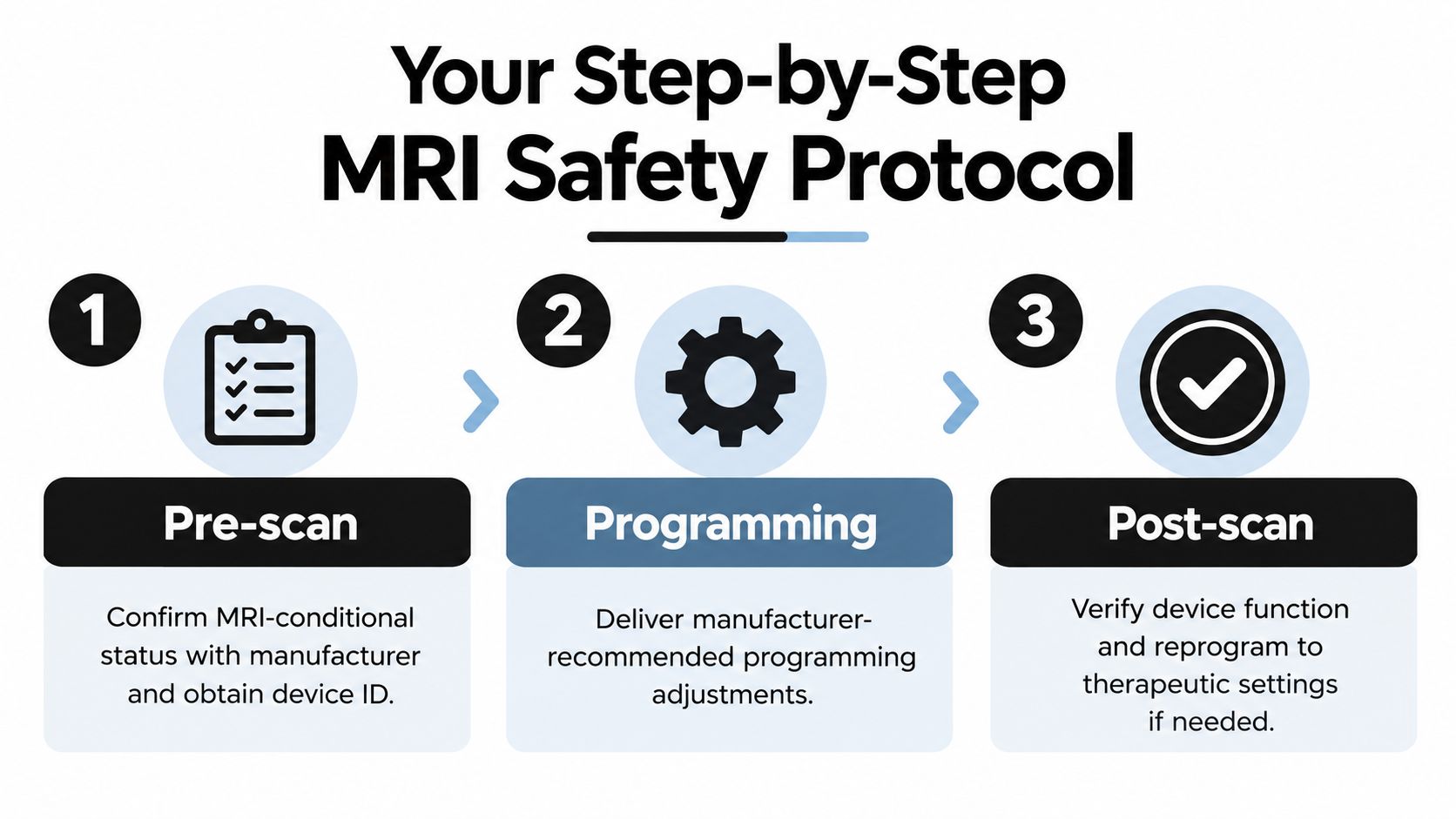
A safe process has three phases. The order matters because each phase answers a different question: Can the scan proceed, how should the device be managed during it, and did the system return to normal afterward?
Pre-scan confirmation
Begin before the appointment is finalized.
- Confirm the complete system: Match the patient ID card and implant records to the current pulse generator, leads, extensions, and implant locations.
- Check current device integrity: Have the pain team review the system for lead migration, fracture, abnormal impedance, or other changes.
- Match the scan to labeling: Verify the scanner field strength, coil, body region, specific absorption rate, scan-time limit, and any required waiting period.
- Send written instructions: Give radiology the manufacturer's MRI conditions and identify who will manage MRI mode or programming.
- Record the clearance: Ask that the approval and protocol be placed in the medical record.
The spinal cord stimulator recovery guidance can help patients understand why device follow-up remains important after implantation, but MRI clearance still needs to be completed for the specific scan.
During the scan
Follow the manufacturer's programming instructions exactly. Depending on the system, that may mean placing the stimulator in MRI mode or turning stimulation off, with output settings managed according to the approved protocol. Patients shouldn't independently improvise settings or rely on a generic “low power” adjustment.
Tell the MRI staff immediately if you feel heating, painful stimulation, shocking, or any unusual sensation. The team should know how to stop the scan and who to contact if troubleshooting is needed.
After the scan
The device shouldn't be forgotten once you leave the scanner.
- Restore the program: Follow the manufacturer's instructions to restart the device and return it to the prescribed therapeutic settings.
- Confirm function: Check that the stimulator responds normally and that the therapy feels as expected.
- Document symptoms: Report unusual sensations, new pain, weakness, or changes in stimulation.
- Arrange follow-up: A device check, including impedance review when appropriate, can identify a problem that isn't obvious immediately.
Repeat this protocol for every MRI. Compatibility is event-specific because the device condition and scan conditions can change.
Keeping Your Imaging Options Open for the Long Run
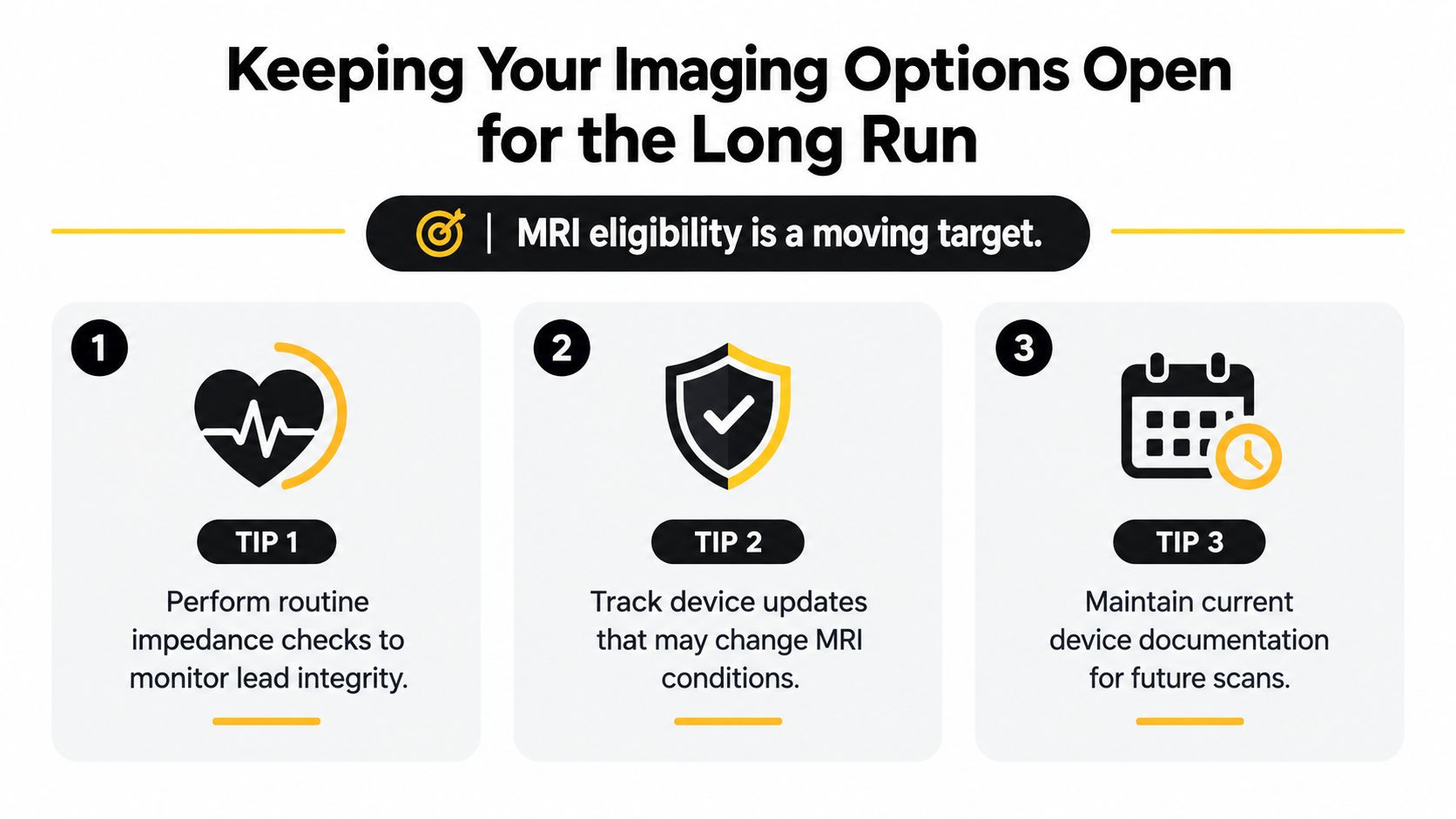
For Illinois patients living with chronic pain, the most useful mindset is simple: MRI eligibility is a moving target. The goal isn't to avoid needed imaging. The goal is to preserve access by monitoring the stimulator and verifying the rules each time.
Routine device reviews can identify changes before an MRI becomes urgent. Ask your pain team to monitor lead integrity and impedance during appropriate follow-up visits, keep a current record of the implanted components, and note any revisions or hardware changes. If you move from Chicago Ridge to Palos Heights, Palos Hills, Evergreen Park, Hickory Hills, or another Illinois community, take those records with you rather than assuming the next clinic can reconstruct them.
Build a durable documentation habit
Keep your device card in an accessible place and save the manufacturer's MRI information with your medical records. Bring the card to imaging appointments, even if the radiology department already has a copy. If you've had new stimulation, a fall, a revision, or a sudden change in pain coverage, tell the pain clinic before scheduling.
Midwest Pain & Wellness is a Chicago Ridge pain and wellness clinic that provides interventional evaluation and management for chronic pain, including spinal cord stimulation care and device-related guidance. Coordination among your pain specialist, the device representative, ordering clinician, and radiology team can make the clearance process more consistent.
The most important habit is also the easiest to remember: verify the exact device and scan conditions every time. Don't let a familiar brand name, a previous successful MRI, or an old clearance replace current documentation.
If you have a spinal cord stimulator and need an MRI in Illinois, Midwest Pain & Wellness can help review your device information, assess changes that may affect eligibility, and coordinate the next safety steps with your imaging team. Visit Midwest Pain & Wellness to request an evaluation and bring your device card and MRI order to the appointment.