You finish a long desk day with pressure behind your eyes, stiffness at the base of your skull, and shoulders that feel permanently lifted. A quick stretch helps for a few minutes, but the band around your head returns during the next screen session. That pattern is common, but it doesn't always represent the same headache disorder.
Effective neck tension headache relief starts with identifying whether you're dealing with tension-type headache, cervicogenic headache, or overlapping features of both. The distinction matters because a general relaxation routine may help muscle tension, while neck-driven pain may require a focused examination and multimodal care.
Table of Contents
- Why That Band Around Your Head Keeps Coming Back
- Tension Headache vs Cervicogenic Headache
- Self-Care Moves You Can Start Today
- Posture, Ergonomics, and Daily Habits That Reduce Triggers
- When Self-Care Stops Being Enough
- Interventional Options at a Pain and Wellness Clinic
- Your Next Step Toward Lasting Relief
Why That Band Around Your Head Keeps Coming Back
Tension-type headache is the most common headache disorder worldwide. The World Health Organization describes tension-type headache as affecting more than one third of men and more than one half of women in developed countries. Episodic tension-type headache occurs on fewer than 15 days per month, although some populations report it far more frequently.
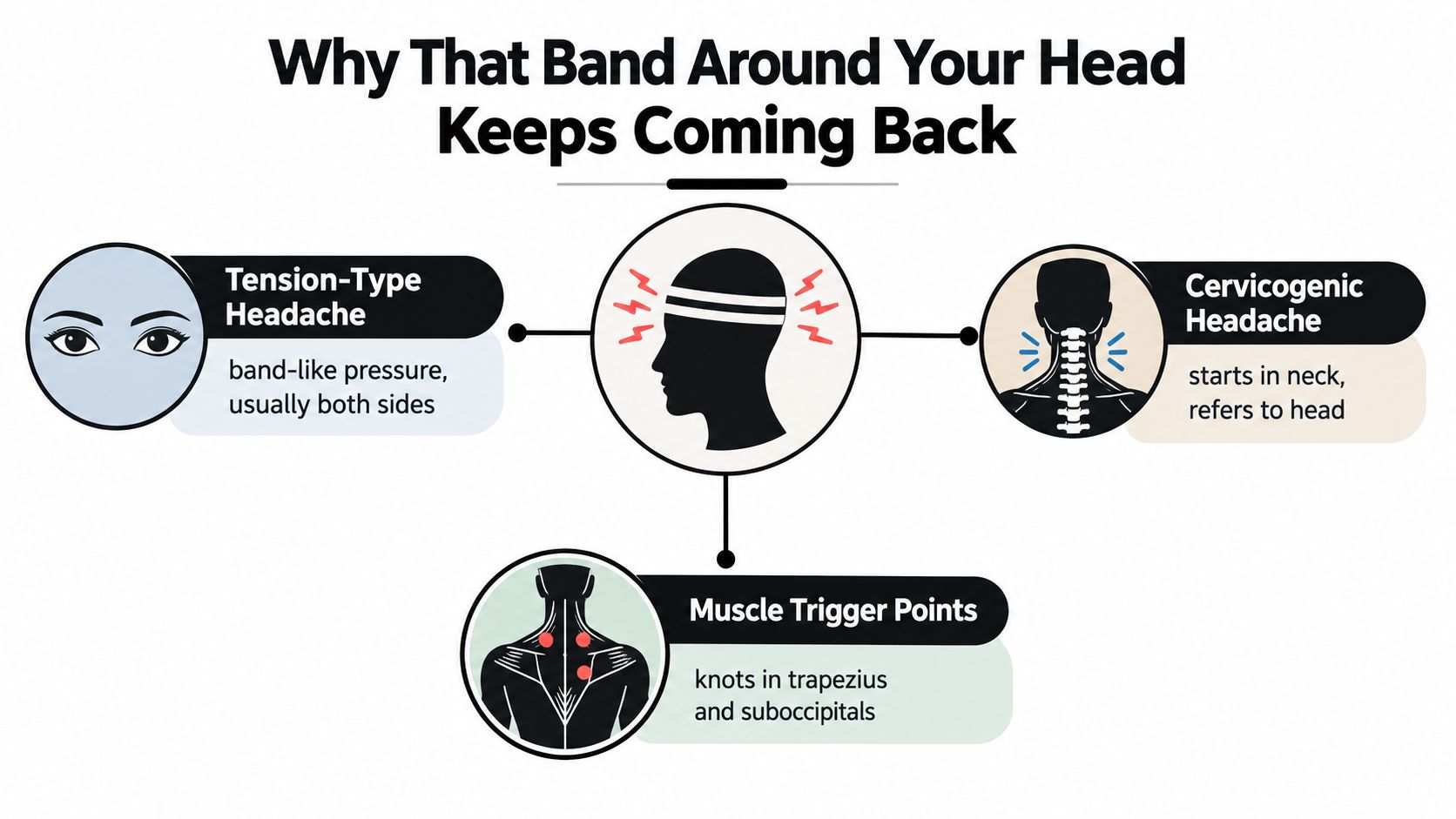
That pressure can come from several overlapping sources. Sustained desk posture loads the suboccipital and upper trapezius muscles, irritation in the upper cervical joints can refer pain into the head, and repeated episodes can make the nervous system more responsive to ordinary strain. A person may feel the headache in the forehead or behind the eyes even though the strongest mechanical driver sits in the neck.
Two patterns deserve separate attention:
- Tension-type headache usually feels like pressing or tightening on both sides of the head. Stress, poor sleep, prolonged screen work, jaw clenching, and missed meals can lower the threshold for an episode.
- Cervicogenic headache begins in a cervical structure and is perceived in the head or face. Reduced neck motion, pain provoked by neck movement, and symptoms that travel from the neck toward the forehead or eye support this possibility. The clinical description of cervicogenic headache emphasizes a demonstrable connection to the cervical spine.
A quick massage or stretch may quiet the immediate signal, but it won't necessarily change the factor that keeps provoking it. If recurring neck pain is part of the picture, a focused chronic neck pain relief approach can help connect the headache pattern with cervical mobility, endurance, and joint or soft-tissue findings.
The practical shift is simple: don't ask only how to stop today's headache. Ask what repeatedly loads the neck, what movements reproduce the pain, and whether the pattern is becoming more frequent.
Tension Headache vs Cervicogenic Headache
The most useful distinction isn't whether your neck hurts. Neck tightness can accompany several headache disorders. The more revealing clues are where the pain starts, whether it stays on one side, and what happens when you move the neck.
A tension-type headache tends to feel like a steady, pressing band across both sides of the head. It may build during stress or prolonged concentration and often accompanies tenderness in the scalp, temples, neck, or shoulders. A cervicogenic headache more often begins near the upper neck or base of the skull, then refers toward one side of the head, forehead, or behind the eye. It may worsen when you rotate, side-bend, or hold the neck in an awkward position.
| Feature | Tension-Type Headache | Cervicogenic Headache |
|---|---|---|
| Typical location | Bilateral pressure or tightening around the head | Often one-sided pain that starts in the neck or occiput and travels forward |
| Common triggers | Stress, screen posture, poor sleep, jaw clenching, or missed meals | Neck rotation, sustained forward-head posture, or a specific cervical position |
| Neck findings | General muscle tenderness may be present | Restricted range of motion, local neck tenderness, or pain with provocative movement |
| Response to simple care | May ease with rest, heat, gentle massage, or relaxation | May return quickly unless the cervical driver is addressed |
| Clinical question | Is the overall headache threshold being lowered by tension and lifestyle factors? | Can a cervical structure or movement reliably reproduce the head pain? |
These categories can overlap. Someone can have bilateral pressure from muscle tension and also have a stiff upper cervical segment that repeatedly triggers symptoms. Self-reports often miss the neck component because the pain is felt in the head, not at the structure creating the signal.
For general relaxation ideas, a natural headache relief guide can provide a low-risk wellness perspective, but it shouldn't substitute for assessment when the headache consistently begins with neck movement or restricted motion. Scent, massage, and rest may reduce discomfort without identifying the pain generator.
Clinical clue: If turning your head reliably recreates the headache, don't treat the symptom as a generic band of pressure until someone has examined your cervical motion.
The distinction guides the next decision. Intermittent, posture-linked pressure may respond well to home changes. A one-sided headache that starts in the neck, persists despite those changes, or limits rotation deserves a more targeted evaluation.
Self-Care Moves You Can Start Today
Use self-care as a controlled experiment, not as an endless promise. The aim is to reduce muscle guarding, restore comfortable movement, and observe whether the headache pattern changes when you remove common triggers.
Start with a calm breathing reset. Sit with your feet supported, let your shoulders drop, and breathe slowly into the lower ribs for several cycles. Diaphragmatic breathing can reduce the tendency to brace the neck and jaw during focused work.
A short mobility sequence
Move gently and stop if the exercise creates sharp, radiating, or escalating pain.
- Upper trapezius stretch: Sit tall, hold one side of the chair, and gently tilt the opposite ear toward the shoulder. Keep the shoulder down. Hold for 20 to 30 seconds on each side.
- Levator scapulae stretch: Turn your head slightly toward one armpit, then angle your chin downward until you feel the stretch along the back and side of the neck. Keep the movement easy and hold for 20 to 30 seconds per side.
- Suboccipital release: Lie on your back with two soft therapy balls or a folded towel supporting the base of the skull, not pressing into the neck. Relax there briefly, then remove the support if symptoms increase.
Reset your position every 45 to 60 minutes. Stand, walk briefly, roll the shoulders, and let the neck move through a comfortable range instead of holding it rigidly.

Heat, ice, and medication decisions
Use heat for 10 to 15 minutes when the dominant issue feels like muscle tightness in the neck and shoulders. A wrapped cold pack may be more comfortable when the pain feels acutely irritated after a specific movement. Protect the skin and avoid falling asleep with either application in place.
For adults who can safely take these medicines, short-term options may include ibuprofen 400 mg or naproxen 220 mg with food. Acetaminophen 500 to 1,000 mg may be an alternative for people who shouldn't use an NSAID. These doses aren't appropriate for everyone. Kidney disease, ulcer history, blood thinners, liver disease, pregnancy, medication interactions, and other conditions require clinician or pharmacist guidance. Avoid routine NSAID use beyond two weeks without medical advice.
Caffeine can help some people when paired with an acute headache medicine, but repeated reliance can make the pattern harder to manage. Keep caffeine consistent rather than using large rescue doses, drink water regularly, and don't let skipped meals become part of the trigger pattern. If relaxation is your main goal, general guidance on aromatherapy for relaxation may complement breathing and heat, but it isn't a treatment for a compressed or irritated cervical structure.
Posture, Ergonomics, and Daily Habits That Reduce Triggers
A workstation doesn't need to look perfect. It needs to stop asking the neck and shoulders to hold the head forward for hours.
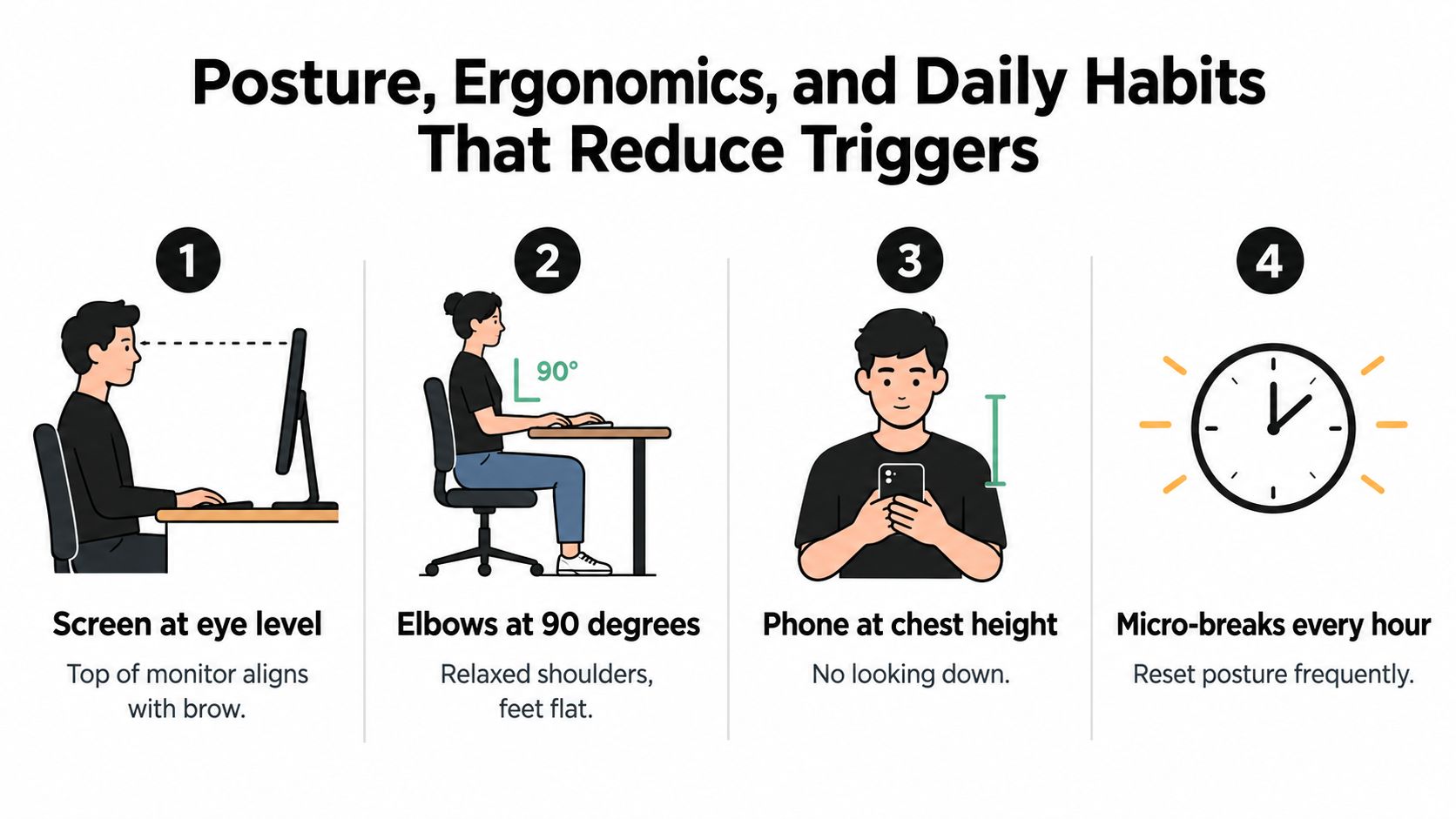
Set the monitor so your gaze stays near eye level, with the top third roughly aligned with your brow. Keep your elbows near 90 degrees, support the forearms, and place the keyboard close enough that your shoulders can remain relaxed. If you use a laptop for long periods, raise the screen and use a separate keyboard so you aren't choosing between neck strain and awkward arm position.
Treat the phone as a separate problem
Phone posture creates a different load than desk posture. Hold the phone closer to chest height, use speaker mode or a headset for calls longer than five minutes, and never cradle the phone between your ear and shoulder. That habit combines side-bending with sustained muscle contraction, a poor combination for an already irritable neck.
Build a 30-minute micro-reset into focused screen work. Stand, change position, look across the room, and roll the shoulders once before returning to the task. The point isn't to maintain one rigidly correct posture. It's to avoid staying in one posture long enough for the tissues to fatigue.
Sleep, fluids, and jaw tension
Side sleepers need a pillow that fills the space between the ear and shoulder without pushing the head upward. Back sleepers often do better with a thinner pillow and a small cervical roll supporting the natural curve. Your neck should feel supported, not forced into flexion.
Use a practical hydration target of roughly 2 liters daily unless a clinician has given you a different fluid restriction. Notice whether you clench your teeth during focused work. Repeated temporalis and jaw activation can reinforce frontal pressure, even when the original trigger came from the neck.
An ergonomic audit takes only a few minutes:
- Screen: Is the display high enough that you aren't looking down?
- Arms: Are your elbows supported without lifting the shoulders?
- Phone: Can you take a longer call without bending your neck sideways?
- Movement: Do you change position before stiffness accumulates?
- Sleep: Does your pillow keep your neck neutral?
If visual fatigue contributes to your symptoms, you can compare screen filters and blue light glasses, while remembering that eye comfort measures won't correct cervical joint or muscle dysfunction.
When Self-Care Stops Being Enough
Stretching and ergonomic changes work best when headaches are intermittent and clearly linked to posture or muscle fatigue. They underperform when the pain is daily, steadily escalating, repeatedly wakes you from sleep, or continues despite consistent changes.
Seek emergency evaluation for a sudden severe headache or new neurological symptoms such as limb weakness, slurred speech, or vision loss. Those symptoms aren't appropriate for a routine pain-clinic appointment.
Frequency also changes the decision. More than 15 headache days per month, or using over-the-counter headache medicine on more than 10 days per month, raises concern for medication-overuse risk and a cycle that usually needs professional guidance. The chronic headache specialist evaluation can help distinguish the headache phenotype, medication pattern, and cervical findings.
Signs of a neck-driven source
Pay attention to restricted rotation, tender points beneath the skull, and pain that starts in the neck and travels forward. Those clues don't prove a cervicogenic diagnosis, but they make generic stretching less likely to be the whole answer.
A practical threshold is failed conservative care over four to six weeks, increasing medication use, or meaningful disruption to sleep and work. At that point, the next step isn't necessarily an injection. It is a careful examination that determines whether the problem is primarily muscular, facet-mediated, nerve-related, disc-related, migraine-related, or a combination.
Interventional Options at a Pain and Wellness Clinic
Interventional treatment should answer a specific diagnostic question. It isn't a replacement for movement, sleep, workstation changes, or rehabilitation. The purpose is to reduce a well-defined pain signal enough that those measures become possible again.
| Procedure | Target | Best Candidate | Typical Benefit |
|---|---|---|---|
| Cervical medial branch block | Nerves carrying facet-joint pain | Headache reproduced by upper cervical facet loading or localized neck pain | Diagnostic information and temporary relief |
| Radiofrequency ablation | Selected medial branch nerves after a positive block | Recurrent facet-mediated pain that returns after conservative care | Longer-lasting interruption of facet pain signals |
| Occipital nerve block | Greater or lesser occipital nerve region | Pain tracking from the skull base toward the scalp or eye | Short-term relief and diagnostic guidance |
| Pulsed radiofrequency or stimulation | Persistent occipital nerve pain | Carefully selected refractory nerve-distribution symptoms | Potentially longer symptom control when simpler blocks are insufficient |
| Trigger point injection | Myofascial knots in the trapezius, levator, or suboccipital muscles | Reproducible muscular pain with palpable trigger points | Reduction of focal muscle pain to support rehabilitation |
| Cervical epidural steroid injection | Inflamed cervical nerve root or disc-related region | Headache accompanied by compatible radiating neck or arm symptoms | Relief when inflammation is a meaningful contributor |
| Botox for chronic migraine | Migraine-related muscle and nerve pathways | A pattern that meets a chronic migraine pathway rather than isolated neck tension | Preventive care for the appropriate migraine diagnosis |
Matching the procedure to the pain generator
A medial branch block can test whether upper cervical facet signals contribute to the headache. If the response is convincing but temporary, radiofrequency ablation may be considered for selected patients. It doesn't treat every headache, and it shouldn't be offered only because the neck hurts.
Occipital nerve blocks make more sense when pain follows the greater or lesser occipital distribution from the back of the skull toward the scalp or eye. Trigger point injections address a different problem, namely stubborn myofascial knots that remain active despite heat, mobility work, and load changes. Ultrasound guidance can help the clinician target soft tissue accurately.
An epidural injection belongs to a disc or nerve-root pathway, not a generic tension-headache pathway. Botox follows a separate chronic migraine pathway when the symptoms cross diagnostic boundaries. It shouldn't be used as a catch-all treatment for every pressure headache.
Some patients also ask about PRP treatment for the neck. Regenerative options require careful selection and a clear target, and they shouldn't distract from diagnosing the headache pattern first.
These are outpatient procedures performed in a clinic, not surgery. At Midwest Pain & Wellness, a pain and wellness clinic in Chicago Ridge, IL, treatment may combine image-guided injections, nerve procedures, medication strategy, and rehabilitation coordination. The intended role is to break a stubborn pain cycle while you continue addressing the mechanical and behavioral contributors.
Your Next Step Toward Lasting Relief
Run a structured experiment this week rather than collecting disconnected tips.
Begin with two short stretch sessions daily, using comfortable upper trapezius, levator, and suboccipital work. Complete a laptop-and-chair audit, then change one workstation factor that forces your head forward. Keep fluids near your individualized target of roughly 2 liters of water, protect 7 to 9 hours of sleep, and record headache intensity, duration, neck symptoms, posture, meals, jaw clenching, and suspected triggers.
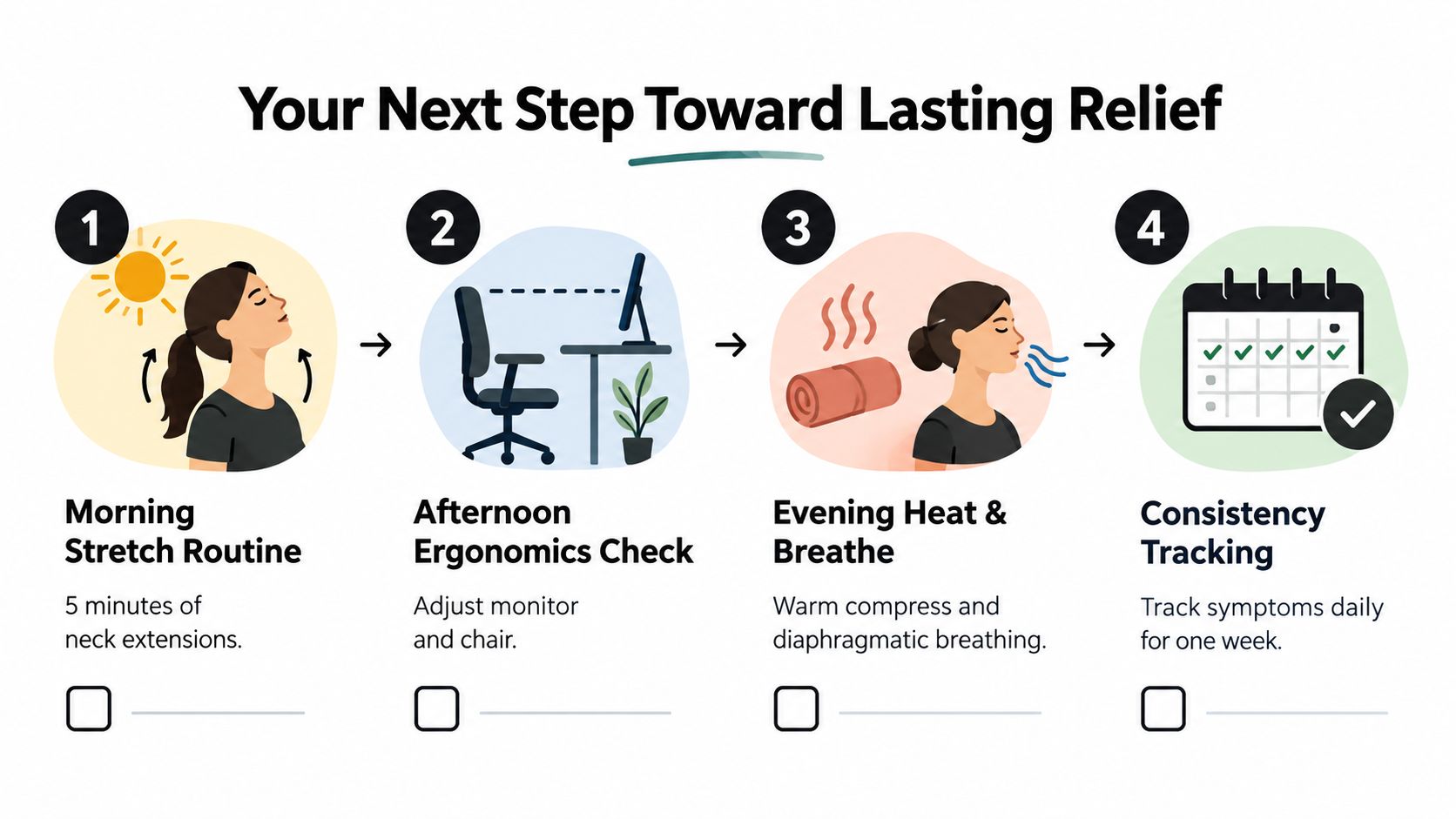
Your diary should help answer three questions:
- Does the headache begin in the neck or in the head?
- Does a specific neck movement reproduce it?
- Do heat, movement, sleep, and posture changes alter the pattern?
Schedule a professional evaluation if symptoms continue beyond two weeks of consistent self-care, occur on more than four days per month, or include visual changes, limb weakness, slurred speech, or another neurological warning sign. Adults in Chicago Ridge, IL, Palos Heights, IL, Palos Hills, IL, Evergreen Park, IL, and Hickory Hills, IL can seek assessment for cervicogenic or refractory tension headaches at a pain and wellness clinic serving the southwest suburbs and greater Chicago area.
The goal is fewer headache days and more reliable function, not a one-time fix.
Midwest Pain & Wellness evaluates neck-driven headaches, persistent tension-type headache patterns, nerve pain, and related spine conditions with individualized, opioid-sparing care. Visit Midwest Pain & Wellness to request an assessment in Chicago Ridge, Illinois, and determine whether conservative care, a targeted procedure, or a coordinated combination fits your symptoms.